
A lot of Brisbane business owners end up in the same spot. The website is live, referrals are inconsistent, Google Ads feels expensive, and inboxes keep filling with SEO pitches that all sound the same. One promises quick rankings. Another offers a bargain monthly package. A third talks in circles about authority, visibility, and traffic without ever saying what that means for actual enquiries.
That’s where most of the confusion starts. Affordable seo services brisbane shouldn’t mean buying the cheapest package on the page. It should mean paying for work that matches the stage of the business, fits the budget, and has a clear path to leads, calls, bookings, or sales.
For a time-poor small business owner, the core question isn’t ‘What’s the cheapest SEO available?’ It’s ‘What should be done first, what can wait, and how can the spend be tied to results that matter?’
Quick decision aid: Starter budget ($400–$800/month)? Expect foundation work: Google Business Profile setup, a handful of service page rewrites, and basic tracking. Growth budget ($800–$1,500)? Expect ongoing content, technical fixes, and local map pack work. If a quote sits below $400 with big promises, treat it as incomplete rather than affordable.
Understanding What Affordable SEO Really Costs in Brisbane
If a Brisbane business owner looks up local SEO pricing, the numbers can look all over the place. That’s partly because ‘affordable’ gets used to describe everything from bare-bones packages to properly managed local campaigns — and partly because Brisbane’s market spans both ends.
The context matters. Australia had approximately 2.73 million actively trading businesses in June 2025, and about 97% of them are small businesses — the tradespeople, professional practices, retailers and hospitality venues that make up most of Brisbane’s commercial base. Industry estimates put typical Australian small-business SEO spending at around AUD 1,200 per month, which is useful as a sanity check when comparing quotes (see this roundup of Australian SEO statistics).
Package tiers: what your money actually buys
After reviewing Brisbane agency proposals over the years, I’ve found that almost everything falls into three tiers. Knowing which tier a quote belongs to is the fastest way to judge whether it fits your business. These deliverables represent typical scoping guidance rather than guaranteed outputs, and the upper tier is an open-ended band for larger projects rather than a fixed market standard.
| Tier | Typical monthly range | What’s usually included (typical scope) | Best fit |
|---|---|---|---|
| Starter | $400–$800 | Google Business Profile setup and optimisation; a few service page rewrites; keyword targeting for one core service; basic monthly reporting | Sole traders and very small sites with low competition |
| Growth | $800–$1,500 | Everything in Starter, plus regular blog posts or new pages; a technical fix sprint (speed, crawl errors, duplication); suburb-specific landing pages; link and citation building; lead tracking tied to enquiries | Established local businesses wanting measurable lead growth |
| Local Dominance | $1,500+ | Everything in Growth, plus broader content, competitor campaigns, multi-location or e-commerce scope, and conversion rate work | Businesses ready to compete across the whole Brisbane market |
According to Better Marketing Results on affordable SEO in Brisbane, basic packages typically range from $300 to $800 per month, while a minimum of $1,049 monthly is recommended for businesses with 2 to 50 staff that want meaningful Google ranking improvements. The same source warns that services below $500 per month often signal low-quality or black-hat tactics — which lines up with the Starter tier floor above.
When comparing affordable seo plans, it helps to remember that a well-scoped seo package brisbane businesses choose should align with these benchmarks rather than undercut them drastically.
What the local price ranges usually mean
A lower-priced package often covers surface-level work. That might include a few keyword tweaks, a generic report, and occasional updates to title tags or page copy. For a very small site with low competition, that can sound sensible. The problem is that it rarely covers the pieces that make SEO stick.
A more solid monthly engagement usually includes work across the whole site. That means technical fixes, page improvements, Google Business Profile attention, local intent keyword targeting, content planning, and reporting that ties activity back to business goals.
For a Brisbane electrician, physiotherapist, bookkeeper, or online store, that difference matters. A cheap package may only ‘optimise’ a homepage. A stronger package is more likely to improve service pages, suburb pages where relevant, mobile usability, crawl issues, and lead tracking.
Practical rule: If a proposal is cheap because it removes strategy, technical work, and reporting, it isn’t affordable. It’s incomplete.
Why cheap often gets expensive later
The main trade-off isn’t just quality. It’s time. A business that spends months on weak SEO often ends up paying twice. First for underpowered work, then again to clean up thin content, poor backlinks, duplicate pages, or reporting that never showed what was happening.
A practical way to think about budget is this:
- If the business only needs a local foundation, the spend should still cover proper setup, not just cosmetic edits.
- If the business wants lead growth, the agency should be doing ongoing work that improves visibility, site quality, and conversion paths together.
- If the proposal sounds too broad for the fee, something important has probably been left out.
Brisbane is competitive enough that under-investing can stall progress. Small business owners don’t need the biggest package on the market. They do need enough work each month to move the site forward in a measurable way.
Affordable SEO Packages vs. Cheap SEO Services: What’s the Difference?
The two terms get used interchangeably in sales emails, but they describe different things.
Cheap SEO services compete on price alone. The deliverables are templated: the same audit, the same backlink list, the same report sent to every client. The provider’s margin comes from automating or outsourcing the work, so the client pays for activity rather than outcomes. This is why cheap services under $1,300 per month fail in 80–90% of cases, according to Safari Digital’s budget SEO analysis — the work is script-led instead of expert-led.
Affordable SEO packages compete on value per dollar. The price is lower than a premium national campaign, but the scope is deliberately matched to the business stage: a local foundation first, then lead growth, then dominance. The work is planned around the client’s actual services, suburbs, and margins.
In my experience reviewing Brisbane agencies, the reliable way to tell them apart in a five-minute call is to ask what the first month’s deliverables are. A cheap provider lists generic items. An affordable-but-serious provider names your pages, your suburbs, and your tracking setup.
The word ‘affordable’ is only meaningful relative to what’s delivered. $800 spent on a properly scoped local campaign beats $300 spent on a template every time.
Spotting Red Flags and Finding Genuine SEO Partners
The biggest risk in buying SEO isn’t paying a bit more. It’s paying for work that sounds active but goes nowhere. That’s why vetting matters more than the sales pitch.
Australian data highlighted by SEO Gone Wild’s Brisbane page says 68% of small businesses in Queensland abandon low-cost digital services within 6 months due to no measurable ROI. That usually happens when the provider reports vanity metrics, not outcomes tied to leads.
The promises that should trigger caution
Some warning signs show up immediately.
- Guaranteed rankings: Google rankings can’t be promised, especially across competitive local searches.
- Secret methods: If the explanation is vague on purpose, the work may be weak, automated, or risky.
- Instant turnaround language: SEO needs prioritised implementation, not magic.
- Traffic-only reporting: More visitors means very little if calls and form leads don’t improve.
- One-size-fits-all packages: A suburban plumbing business and a Brisbane e-commerce store should not be getting the same template.
There’s also a subtler red flag. Some providers keep everything sounding technical so the client won’t ask questions. If the business owner can’t understand what’s being done after a straightforward explanation, that’s a problem.
What a genuine partner usually does instead
A credible SEO provider tends to be plainspoken. They explain what they’ll work on first, why it matters, and what can realistically change over time.
A useful shortlist for green flags looks like this:
- Clear priorities: They can explain whether the first wins are likely to come from Google Business Profile, service pages, technical fixes, or content.
- Business context: They ask about margins, lead quality, service areas, seasonal demand, and sales process.
- Visible process: They can show how work gets planned, implemented, reviewed, and adjusted.
- Meaningful reporting: They talk about enquiries, booked jobs, quote requests, and sales, not just impressions.
- Local fit: They understand Brisbane geography, suburb intent, and how local service searches differ from broad national keywords.
A trustworthy SEO partner won’t try to overwhelm a small business owner. They’ll reduce confusion, narrow the focus, and make the next step obvious.
Key Questions to Ask Before You Hire an SEO Agency
The consultation call doesn’t need to be technical. It needs to be useful. The right questions can quickly separate a thoughtful operator from a polished salesperson.
That matters because Clutch’s Brisbane SEO firm listings show client satisfaction rates approaching 100%, with about 90% of reviews highlighting effective communication and detailed reporting. In practice, that means communication isn’t a soft extra. It’s part of the service.
Questions that reveal how they work
These questions are practical because each one uncovers something specific.
- What would you work on first for a business like this, and why?
This shows whether they can prioritise instead of listing every SEO tactic they know. - How will success be measured for this campaign?
A strong answer should mention leads, sales, or qualified enquiries. If the answer stays stuck on rankings alone, keep digging. - What will reporting include each month?
Ask to see a sample report. It should be readable and tied to action. - Who will do the work day to day?
That helps uncover whether the work is handled by a local strategist, passed to a junior, or outsourced. - What do you need from the business to make this work?
Good partners usually want access, approvals, service knowledge, and feedback from the front line.
For business owners comparing options, this guide to SEO companies for small business can help frame what a suitable partner should look like.
Questions that protect the budget
Some questions are less about SEO and more about avoiding waste.
- What isn’t included in this package?
This quickly exposes whether content, technical work, link work, or tracking setup sits outside the quoted fee. - How do you handle websites with existing issues?
If the site is slow, hard to edit, or full of weak pages, the proposal should account for that reality. - What happens if priorities change after the first few months?
Small businesses pivot. A rigid package can become dead weight. - How often will someone explain results in plain English?
Reports aren’t enough on their own. A business owner should know what changed and what happens next.
Ask questions that force specifics. A good agency gets clearer when challenged. A weak one gets vaguer.
A simple test helps too. If the agency can explain their plan in ordinary language over a short call, they probably know what they’re doing. If they need buzzwords to sound convincing, caution is sensible.
What a Good Affordable SEO Package Should Include
A useful SEO package isn’t just a list of deliverables. It’s a sequence of work that fixes the basics, improves local relevance, and builds authority over time.
That approach lines up with Content Authority’s guidance on affordable SEO in Australia, which says a proven methodology splits effort into 40% on-page, 30% technical, 20% local, and 10% off-page, with 2-3x traffic growth in 6-12 months for small businesses.
The core work that should be in scope
For most Brisbane small businesses, a decent package should cover these areas.
Local search fundamentals
Google Business Profile work matters because local service businesses often win visibility there before they dominate standard organic results. That includes verifying the profile, reviewing categories, refining service descriptions, and aligning the profile with the website.
A practical example is a mobile dog groomer serving selected suburbs. If the website says one thing, the profile says another, and service areas are unclear, the local signals are messy from the start.
The numbers back this up: roughly 46% of Google searches in Australia have local intent, about 93% of people search online for local businesses, and around 51% use Google Maps for local discovery — so for many Brisbane customers, the map listing is the first storefront they see (see these Australian digital marketing statistics).
For a deeper primer on how budget-level optimisation works across these fundamentals, there’s a solid affordable search engine optimisation guide over at Verbatim Digital.
On-page improvements
The site becomes clearer for both search engines and people. Service pages require proper targeting, better headings, stronger internal links, and copy that matches what Brisbane customers search for.
That doesn’t mean cramming location phrases into every paragraph. It means building pages around real intent. A pest control page, for example, should answer the service question, explain coverage areas where relevant, and make booking easy.
Technical clean-up
Technical SEO is what stops the website from getting in its own way. Common tasks include improving crawlability, fixing broken pages, checking indexation, cleaning duplication, and improving mobile usability.
If a site is slow or awkward on mobile, no amount of blog posting will compensate for that. The technical layer should be in scope early, not treated as an optional upgrade.
Cheap SEO often skips the hard parts. Good affordable SEO handles the boring work that makes the visible improvements possible.
Off-page and authority work
This area should be selective, not spammy. For a Brisbane business, that may include local directories, relevant mentions, and link opportunities connected to real business relationships.
If a proposal talks about ‘high volumes of backlinks’ without context, that’s a concern. For small businesses, relevance usually beats volume.
Typical inclusions in an affordable Brisbane SEO package
| Service Component | What It Means for Your Business | Brisbane Market Benchmarks |
|---|---|---|
| Local SEO audit | Reviews Google Business Profile, local relevance, service areas, and consistency between listings and website pages | Good: audit covers suburb-level coverage and citation consistency. Bad: audit is a scraped automated PDF with no local layer |
| Keyword research | Identifies realistic search terms based on service intent, local demand, and buyer language | Good: separates ‘emergency electrician Brisbane’ from suburb and informational terms. Bad: one flat list of national keywords |
| On-page optimisation | Improves headings, page copy, metadata, internal links, and page focus | Good: suburb-specific landing pages. Bad: generic city-wide pages only |
| Technical SEO | Fixes crawl, indexation, speed, mobile, and site structure issues that block growth | Good: a named fix sprint in month one. Bad: ‘technical work’ listed as a vague line item |
| Content planning | Builds or improves pages that answer common questions and support conversions | Good: regular new pages or posts mapped to services. Bad: AI-spun posts with no local angle |
| Off-page support | Pursues relevant local mentions and authority signals without relying on junk links | Good: citations and industry directories. Bad: bulk link packages priced per link |
| Reporting and review | Tracks changes in visibility, traffic quality, and lead activity in a way the owner can follow | Good: leads and enquiries in plain English. Bad: impressions-only dashboards |
In my experience reviewing Brisbane agencies, the best packages always include local map pack optimisation, not just organic keywords — it’s the single clearest divider between providers who understand this market and those recycling national templates.
Businesses wanting a clearer picture of what those services look like in practice can compare them against search engine optimisation services that outline the broader scope of ongoing SEO work.
| Service Component | What It Means for Your Business |
|---|---|
| Local SEO audit | Reviews Google Business Profile, local relevance, service areas, and consistency between listings and website pages |
| Keyword research | Identifies realistic search terms based on service intent, local demand, and buyer language |
| On-page optimisation | Improves headings, page copy, metadata, internal links, and page focus |
| Technical SEO | Fixes crawl, indexation, speed, mobile, and site structure issues that block growth |
| Content planning | Builds or improves pages that answer common questions and support conversions |
| Off-page support | Pursues relevant local mentions and authority signals without relying on junk links |
| Reporting and review | Tracks changes in visibility, traffic quality, and lead activity in a way the owner can follow |
Onboarding and Managing Your New SEO Partner
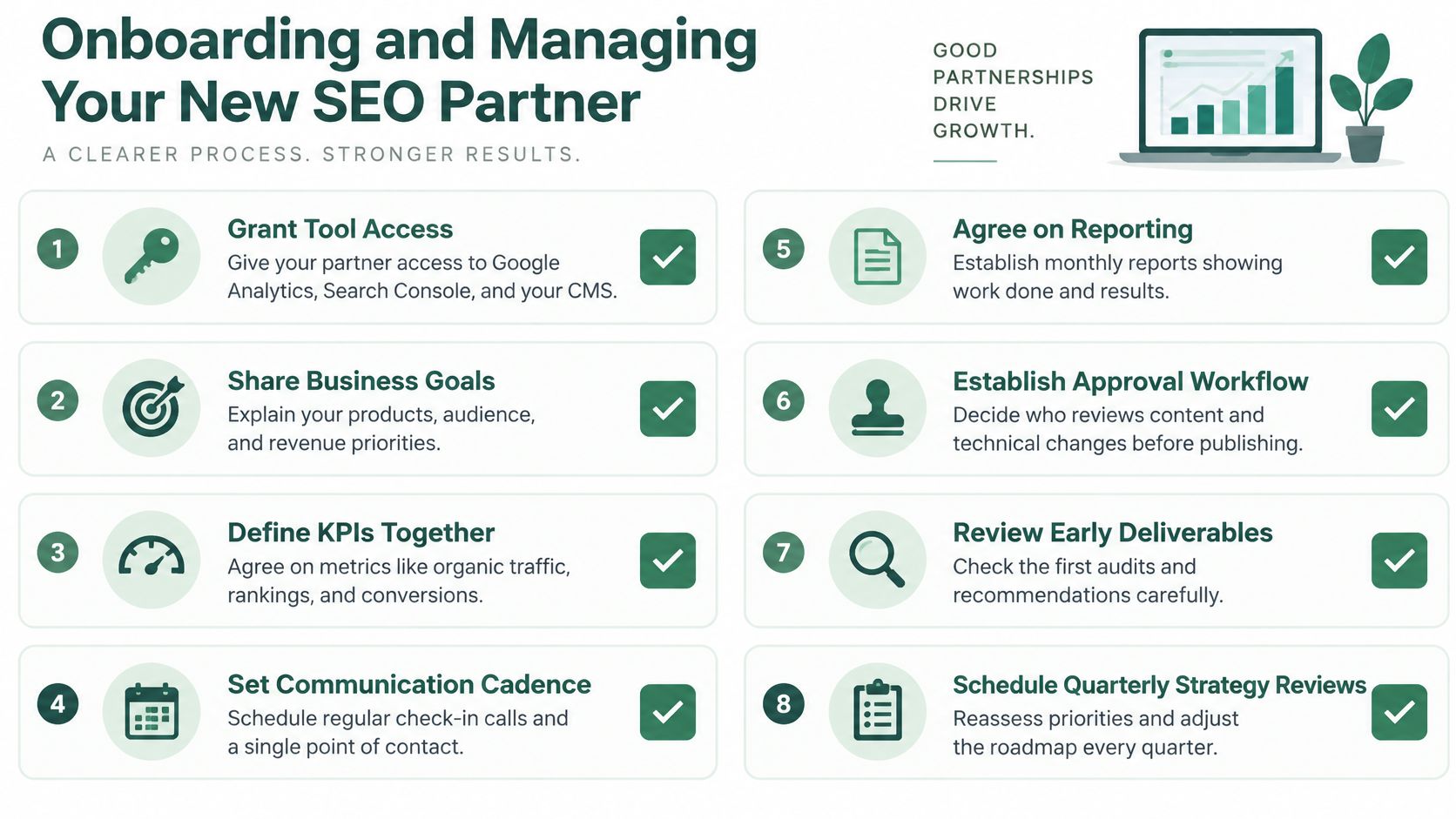
Signing an SEO agreement doesn’t remove the owner from the process. It changes the role. The agency handles execution, but the business still supplies the context that turns generic SEO into useful SEO.
That matters because Safari Digital’s budget SEO analysis reports that quality affordable SEO can deliver 150-300% organic traffic growth, while cheap SEO services under $1,300 per month fail in 80-90% of cases, often due to poor collaboration and automated scripts instead of expert-led work.
What to hand over early
Good onboarding saves weeks of avoidable delay. The basics are usually straightforward:
- Website access: CMS access for WordPress, Shopify, or whichever platform runs the site
- Google tools: Access to Google Analytics, Google Search Console, and Google Business Profile
- Business priorities: Highest-margin services, strongest suburbs, and the leads the team wants
- Past marketing history: Previous SEO work, content changes, redesigns, or penalties if known
- Conversion points: Phone numbers, enquiry forms, booking tools, checkout flows, and any offline sales steps
If the business uses tools like GA4, Google Search Console, and Google Business Profile already, the handover should include permission checks early. Waiting on access can cause the first month to stall.
How to stay involved without adding admin
Being involved doesn’t mean attending constant meetings. It means giving the agency enough information to make smarter decisions.
A manageable rhythm usually looks like this:
- Approve priorities quickly: Delayed approvals can slow technical fixes and content updates.
- Share sales feedback: Let the agency know which leads were junk and which ones turned into work.
- Flag seasonal changes: If a service spikes before storm season, tax time, or school holidays, the SEO plan should reflect that.
- Review reports with one question in mind: Did this create better opportunities for the business?
The best working relationships are usually simple. The agency brings structure. The owner brings market knowledge. Together, the campaign gets sharper.
Measuring SEO Success Beyond Rankings
Rankings matter, but they’re not the finish line. A Brisbane business can rank well for the wrong terms and still feel like marketing isn’t working. That’s why lead attribution matters.
According to RankingCo’s affordable SEO Brisbane page, local SEO can yield a 3.5x ROI when tracked correctly, yet only 28% of Brisbane small businesses accurately attribute leads from digital marketing efforts.
A simple SEO ROI framework for small business
A practical small business framework only needs a few moving parts.
Start with the enquiry actions that count. For most service businesses, that’s phone calls, form submissions, quote requests, booking requests, and sometimes direction clicks from Google Business Profile. For e-commerce, it’s product views, cart actions, and completed sales.
Then connect those actions to the SEO work. That usually means asking:
- Did organic search bring the visitor?
- Did the visitor take a meaningful action?
- Did that action turn into revenue or a qualified lead?
If the agency is only reporting traffic growth, the business owner still can’t answer the main question. Was the campaign bringing better opportunities or just more visits?
What to review each month
A simple monthly review should stay close to business outcomes.
- Lead volume from organic search: Count real enquiries, not all website interactions.
- Lead quality: Are the jobs, clients, or orders the business wants?
- Best-performing pages: Which service or category pages are creating action?
- Google Business Profile activity: Are local searchers calling, visiting, or requesting directions?
- Conversion friction: Are people landing on pages but not enquiring because the offer, form, or layout is getting in the way?
In my view, the first six months of properly scoped SEO work tend to show up in lead quality alongside raw traffic — the enquiries get more local, more specific, and easier to close. Boocoo’s own data supports this momentum, with average organic traffic growth in the first six months of SEO work reaching +190%.
A broader set of practical marketing articles on Boocoo’s digital marketing category can help small business owners understand how SEO fits with the rest of the funnel.
Rankings are a visibility metric. Enquiries are a business metric. The second one should drive the conversation.
When affordable seo services brisbane are working properly, the reporting gets simpler over time, not more confusing. The owner should be able to say which pages attract good prospects, which search themes create leads, and whether the monthly spend is producing useful momentum.
Frequently Asked Questions About Affordable SEO in Brisbane
How much does SEO typically cost in Australia?
For small businesses, expect roughly $400–$800 per month for foundation-level work, $800–$1,500 for a growth-focused local campaign, and $1,500+ for competitive or multi-location scope. The Australian small-business average sits near AUD 1,200 per month. Anything under $400 a month usually means the scope, not the price, is what’s small. When evaluating affordable seo plans, ensure the deliverables match these bands rather than falling suspiciously below them.
Is SEO optimisation free?
The tools aren’t the cost. Google Business Profile, Google Search Console and Google Analytics are free to use, and a sole trader can do meaningful foundational work themselves. But keyword research, content writing, technical fixes and link building take skilled hours, so professional SEO is a paid service. ‘Free SEO’ offers almost always monetise the client some other way.
What’s the difference between cheap and affordable SEO?
Cheap SEO sells templated activity at the lowest price. Affordable SEO sells a right-sized scope — foundation first, then growth — with real strategy behind it. The clearest test is whether the provider can name your pages, your suburbs and your tracking in the first call.
How long before affordable SEO shows results?
For local Brisbane service businesses, early wins such as map pack visibility or profile improvements can begin to appear within the first few months, though exact timing varies by competition and starting point. Meaningful organic traffic growth typically takes 6–12 months, which is why most quality providers work on rolling monthly agreements rather than short bursts.
What should I expect in a first month?
A solid first month should include access setup, an audit, keyword and competitor research, Google Business Profile work, and a prioritised fix list. If the first month’s report is just ‘optimisation completed’, ask what was changed.
Affordable SEO doesn’t need to feel murky. A Brisbane business owner usually needs four things. A realistic budget, a provider who explains the work clearly, a package with the right foundations, and reporting tied to real enquiries.
That’s the difference between SEO that sits in a report and SEO that supports growth.
For Brisbane businesses that want a low-pressure local partner to handle the work practically, Boocoo helps take marketing off the plate with clear advice, transparent communication, and support built around small business budgets and goals. Boocoo is a Brisbane digital agency offering SEO, digital advertising and social media, and has been helping small and medium Brisbane businesses grow online for over 15 years. Each client is assigned one dedicated strategist who knows their business, goals, and competitors, and every client receives a monthly breakdown of what was done, what it cost, and what it delivered, written in plain English with no vanity metrics.