

You're trying to get found on Google, but the quotes don't line up with reality.
One provider says they'll “do SEO” for a few hundred dollars a month. Another sends a proposal that looks like it belongs to a national franchise. Somewhere in the middle, there's a freelancer, a software tool, and a mate who says a few blog posts should do the trick. For a small business owner in Brisbane, that's not clarity. It's noise.
The hard part isn't deciding whether SEO matters. Most owners already know it does. The hard part is figuring out what affordable seo services for small business means in practice, what a sensible budget looks like, how long results usually take, and how to tell if the work is bringing in real enquiries instead of pretty reports.
This guide clarifies those choices. It examines the trade-offs between DIY, local SEO retainers, and broader campaigns. It also focuses on two things most articles skip: Brisbane-specific timing and how to measure business impact properly.
Tired of Confusing SEO Quotes?
A lot of small business owners hit the same wall. They ask for help with SEO and get back proposals that barely resemble each other. One includes “optimisation” with no detail. Another bundles content, technical fixes, backlinks, reporting, and local listings into a package that sounds useful but is hard to compare.
That confusion usually comes from two problems. First, SEO gets sold as one thing when it's really a mix of tasks. Second, some providers quote for what a business needs, while others quote for what sounds easy to sell.
A suburban electrician, removalist, accountant, or physio doesn't need the same campaign as a national e-commerce store. A local service business usually needs visibility for suburbs, services, reviews, map pack presence, and a site that loads properly on mobile. That's a narrower job. It should be priced like one.
Practical rule: If a quote doesn't explain what's being worked on each month, it's not a proper plan. It's a placeholder.
Affordable SEO isn't about finding the lowest monthly fee. It's about matching the work to the business model. If most leads come from a local area, the work should reflect local intent. If the website is slow, broken, or hard to use on a phone, fixing that should come before ambitious content plans.
That's where most owners get caught. They're not trying to buy “SEO”. They're trying to buy more calls, more quote requests, and more booked jobs without wasting time chasing jargon.
Decoding Affordable SEO What It Really Costs in 2026
A Brisbane business owner with a $600 monthly budget and a goal of doubling leads is usually shopping in the wrong category. That budget can cover a narrow local SEO job. It does not buy full campaign management, ongoing content production, technical fixes, link work, and reporting all at once.
Affordable SEO only makes sense when the scope matches the budget.
According to DesignRush's breakdown of affordable SEO pricing for small business, small business pricing generally falls into three buckets. DIY tools sit at the low end, local SEO is often priced per location, and full-service campaigns start much higher once strategy, technical work, and content are included.
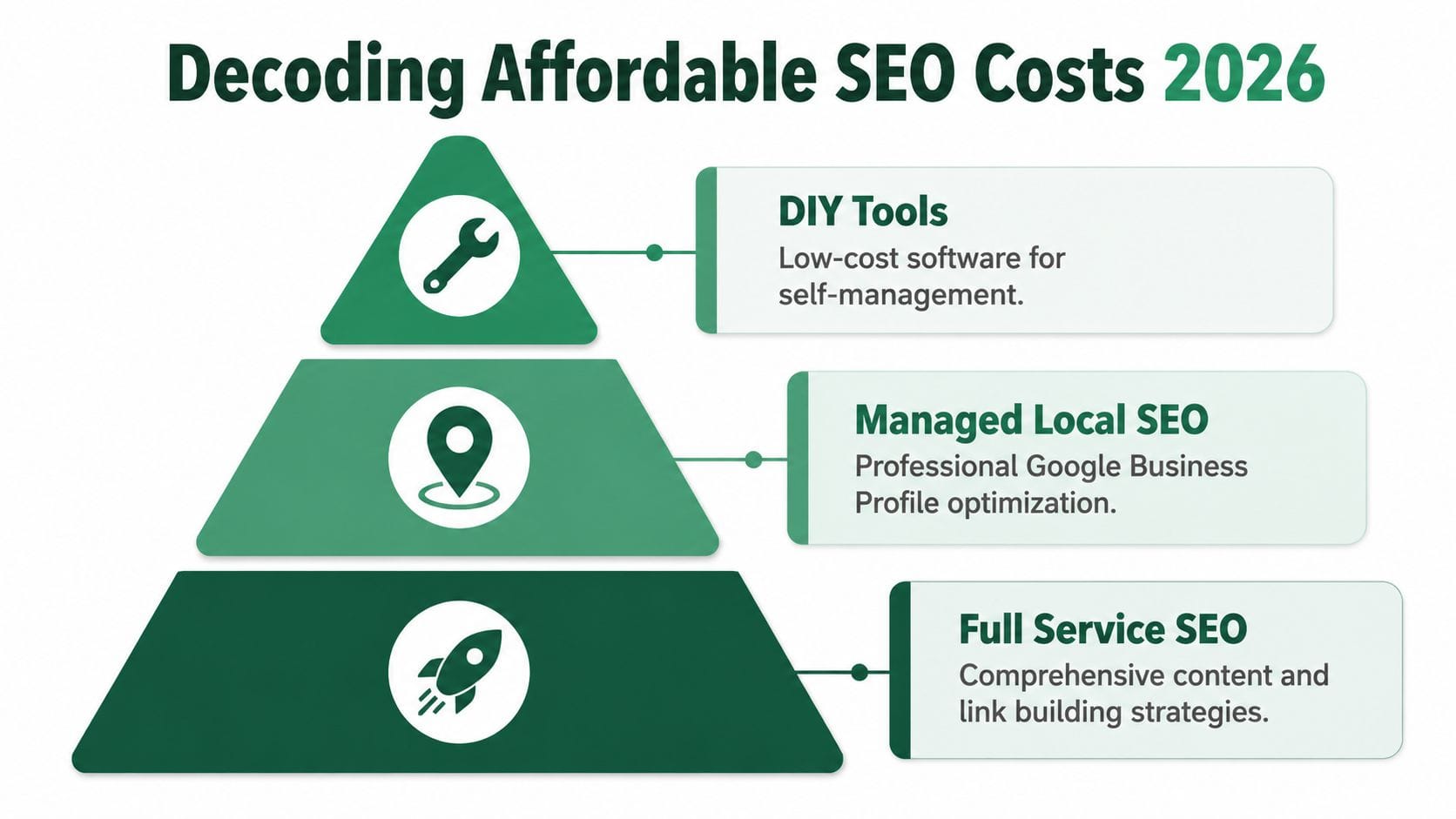
The three pricing tiers most small businesses will see
For Brisbane small businesses, the market usually breaks down like this:
| Service type | Typical fit | Price guide |
|---|---|---|
| DIY tools | Owners with time, a simple site, and enough patience to handle Google Search Console, Google Business Profile, and basic optimisation themselves | Zero plus optional tools at $20 to $50 monthly |
| Managed local SEO | Trades, clinics, consultants, and local service businesses chasing enquiries from Brisbane suburbs or a defined service area | Around $500 to $650 per location |
| Full-service SEO | Businesses that need ongoing technical work, content creation, service-page expansion, and broader visibility across many search terms | Usually starts at $1,500 to $3,000+ monthly |
The middle tier is the one I see small operators ask about most. It can work well for a plumber in North Brisbane, a physio in inner Brisbane, or an accountant targeting a handful of suburbs. It usually does not suit a business trying to grow across multiple locations, services, and competitive commercial terms at the same time.
That gap matters.
A provider can sell a low monthly fee by cutting the labour. Fewer page updates. Little or no content work. Generic reports. Minimal technical fixes. Sometimes the campaign is little more than a monthly email and a rank tracker screenshot.
Where cheap becomes expensive
Services priced under a few hundred dollars a month are often cheap because very little is being done, or because the work relies on shortcuts that create cleanup later, as noted earlier in the DesignRush pricing guide.
I have seen the same pattern more than once. A business signs up because the package sounds safe and affordable. Six months later, rankings have barely moved, leads have not improved, and the next provider has to clean up thin suburb pages, spammy backlinks, copied service copy, or a neglected Google Business Profile before real progress can start.
That is why price on its own is a poor filter.
A low-cost package can still be fair if it is honest about the scope. A freelancer charging a modest fee to fix title tags, tidy local citations, and improve a few key pages may be good value. A provider promising full SEO for the same money usually is not.
Affordable SEO is paid work on the right priorities. Cheap SEO is often underpriced admin dressed up as strategy.
For small businesses in Brisbane, the practical question is simple. Is this budget buying work that can produce more calls, quote requests, and booked jobs in your service area, or is it buying activity that looks busy in a report?
Beyond Price What Deliverables You Should Expect
Price only tells part of the story. Two packages can cost the same and produce very different outcomes depending on what's included. A useful package fixes what blocks visibility first, then builds on that base.
The fastest way to waste an SEO budget is to chase content before sorting out site performance. If the website loads slowly, looks clunky on mobile, or uses oversized images on key pages, every later activity has to work harder.
Start with the technical basics
Up North Media's review of affordable SEO services notes that image compression aimed at under 100KB per image, combined with server-level caching, delivers measurable performance gains for small businesses. The same source says these technical fundamentals should come before advanced schema work, and businesses that handle these basics first can see 40 to 60% faster ranking improvements than those using content-only strategies. It also frames technical audits as a one-time project in the $500 to $2,000 range.
That translates into a very practical checklist.
- Image optimisation: Large homepage banners, staff photos, and service images should be compressed properly. A provider should be able to say how they'll handle oversized media.
- Caching and speed work: This is not glamorous, but it matters. Small changes at server level and page level can make a site far easier to use.
- Mobile usability: Service businesses often get found and contacted on phones first. Buttons, forms, and page layout need to work without friction.
- Crawl and indexing checks: If search engines can't access or understand the right pages, later SEO work gets blunted.
What a local small business package should include
Once the technical base is in shape, an affordable package for a local operator should usually include a handful of core deliverables.
First, Google Business Profile optimisation. This includes correct categories, service areas, business information, imagery, and regular upkeep. For local intent, this often matters more than a flashy blog calendar.
Second, on-page work on the money pages. That means service pages written and structured around what people search for, such as suburb-plus-service combinations where relevant. It also means clear page titles, internal links, headings, and calls to action.
Third, citation and directory consistency. Businesses don't need to be sprayed across every directory on the internet. They do need their details to be consistent across relevant Australian listings and industry-specific places where buyers look.
A decent provider should also explain what won't be included yet. If the budget only covers technical cleanup and local page improvements, that's fine. Clear limits are healthier than bloated promises.
Setting Realistic Expectations Timelines and ROI in Brisbane
SEO vendors still make one mistake more than any other. They talk about activity as if activity is the same as outcome. For a small business owner, that's useless. Nobody cares that title tags were updated if the phones stay quiet.
Brisbane businesses need a more grounded view of timing, especially in competitive local categories where several operators are chasing the same suburb-level searches.

Why SEO takes time in local markets
According to Thryv's discussion of SEO timing for small businesses, AU industry benchmarks show that local SEO campaigns in competitive sectors such as plumbing and locksmithing often require 4 to 6 months to reach top-three local map pack rankings.
That timeline is useful because it cuts through fantasy. If a Brisbane trade business is entering a market with established competitors, review history, and stronger local signals, it won't leap to the top in a few weeks just because someone tweaked the homepage.
A better way to think about the first few months is momentum. The early work usually includes fixes, profile improvements, page updates, and clearer local targeting. Then Google has to recrawl, re-evaluate, and compare that business against others already earning visibility.
SEO should have a payback horizon. If a provider won't talk honestly about timing, they're asking for trust they haven't earned.
For businesses in travel, accommodation, and visitor services, the same lesson applies. Local intent still matters, but buyer behaviour can be more seasonal and research-heavy. That's one reason tourism digital marketing in Brisbane often needs a slightly different mix of local SEO, content depth, and conversion planning.
What return should look like
The right question isn't “how fast can rankings improve?” The better question is “what signs show this is moving toward revenue?”
For a local service business, useful signals include:
- More qualified phone calls: Not general enquiries from outside the service area, but calls from people looking for the service offered.
- Better form submissions: Contact forms should contain job requests, quote requests, or booking intent.
- Improved lead quality: A smaller number of stronger enquiries usually beats a bump in traffic from irrelevant searches.
That shift matters because rankings can improve for terms that don't generate work. A business can appear in more searches and still feel no commercial lift. Good SEO narrows the gap between visibility and actual jobs.
Your 7-Point Checklist for Choosing a Brisbane SEO Provider
Most owners don't need to become SEO specialists. They do need a reliable way to judge whether a provider is credible. The easiest way is to ask sharper questions and listen to how direct the answers are.
The checklist below works well on sales calls because it forces specifics. If the provider can't answer plainly, that usually tells its own story.

Questions worth asking on the first call
What exactly gets worked on each month?
Ask for deliverables in plain English. “Ongoing optimisation” isn't enough. A real answer should mention pages, profile work, technical tasks, or reporting.What comes first on this website, and why?
The answer reveals whether they can prioritise. A provider should be able to explain whether the site needs technical cleanup, local page work, content improvements, or Google Business Profile attention first.How will this be measured in business terms?
If the answer centres only on rankings or traffic, keep digging. A stronger answer links the campaign to enquiries, calls, and conversion actions.What type of businesses is this package for? Good providers know where their offer fits. A local SEO package for a Brisbane electrician is different from a national content campaign.
A useful SEO proposal should read like a work plan, not a word cloud.
Red flags that usually mean trouble
Some warning signs show up early.
- Guaranteed rankings: No provider controls Google. Guarantees often rely on cherry-picked keywords or vague wording.
- Tiny fees with huge promises: If a package claims full SEO at a bargain-basement rate, something is usually missing.
- No discussion of your service area: Local visibility depends on geography. If they don't ask where work comes from, they're guessing.
- Reports before strategy: Fancy dashboards don't fix weak targeting.
- No mention of website changes: If a provider says they'll improve rankings without touching the site, that's a concern.
A practical shortlist often includes agencies, freelancers, or specialist partners who stay narrow and transparent. One local example is Boocoo, which offers Brisbane small businesses support across SEO, websites, social media, and paid ads with a focus on practical delivery rather than oversized retainers. That's not the only model worth considering, but it's the kind of service scope that tends to suit time-poor operators.
The main point is simple. The provider should sound like they understand the business, not just the channel.
How to Measure Real Success and Avoid Vanity Metrics
A lot of SEO reporting looks impressive and says very little.
Traffic charts rise and fall. Ranking reports list dozens of phrases. Visibility scores get coloured green. None of that automatically tells a small business owner whether the campaign is producing sales opportunities. That's why cheap SEO often survives longer than it should. The reporting creates movement without proving value.
Guidance summarised around ACCC-related concerns and AU SME reporting gaps points out that many businesses struggle to separate vanity metrics, such as total traffic and keyword rankings, from lead-quality signals like conversion rate, call-throughs, and booked jobs tracked through calls or contact forms. The same source argues that affordable SEO for Brisbane SMEs should be judged mainly by cost per qualified lead over time and that owners should insist on monthly reports tied directly to those outcomes.
What to ignore in SEO reports
Some metrics are still useful as supporting context, but they shouldn't be the headline.
- Total traffic: More visits sound good, but irrelevant traffic doesn't pay wages.
- Raw keyword counts: Ranking for more terms can mean very little if those terms don't convert.
- General impressions: Visibility without action is just exposure.
A business owner doesn't need to ban these metrics. They just shouldn't let them carry the whole conversation.
What to ask for instead
The useful version of SEO reporting is much simpler.
Ask the provider to show how many enquiries came through tracked forms, how many calls came from organic search or Google Business Profile activity, and which pages or search themes drove those actions. Ask how qualified leads are being defined. If the business gets junk calls, wrong-area enquiries, or low-value jobs, that should be visible in the reporting discussion too.
A sensible setup often includes Google Analytics, Google Search Console, UTM tagging for local campaigns, and call tracking where appropriate. For businesses trying to improve what happens after the click, conversion rate optimisation support in Australia also matters, because good rankings with a weak page experience still leave leads on the table.
The report should answer one question first. Did SEO produce qualified opportunities this month?
That's the standard worth holding. Not whether the graph moved. Whether the business got closer to revenue.
Getting Started with Affordable SEO in Brisbane
A Brisbane business owner usually gets to this point after the same run of frustration. One quote is so cheap it barely covers the work. Another is packed with jargon, long audits, and ranking promises that do not explain how many leads the business might get. The right starting point is simpler. Match the work to the business stage, the local competition, and the sales goal.
For a newer business, that might mean fixing the basics first. Clean up the website structure, sort out Google Business Profile, tighten the main service pages, and make sure enquiry tracking works. For a more established operator in a competitive Brisbane suburb or service area, the starting plan often needs stronger local landing pages, content built around buying intent, and ongoing authority work. Cheap SEO can still be a smart buy, but only if the scope is realistic.
The practical question is not, "What is the lowest monthly fee?" It is, "What work will give this business the best chance of more qualified calls, form fills, and booked jobs over the next six to twelve months?"
That is the frame worth using before signing anything.
For Brisbane businesses that want a straightforward conversation about fit, Boocoo is one local option to consider. The team works with small businesses across websites, SEO, paid ads, and social media, with an emphasis on reducing overwhelm and tying activity back to business outcomes. If social is part of the mix as well, this guide on the best time to post to Facebook for business visibility can help round out the plan.
If a business owner wants to talk through options, Boocoo can be reached on 1300 093 797 or at hello@boocoo.au. A useful first call should cover goals, service area, budget, current lead flow, and how success will be measured. That gives both sides enough to decide whether SEO is the right next investment now, or whether the business should fix other gaps first.