

A lot of Brisbane business owners are in the same spot right now. The website exists, the Google Business Profile is half-filled out, a few sales emails have arrived promising page-one rankings, and nobody has clearly explained what’s worth paying for and what’s fluff.
For a café owner in West End, a plumber in North Lakes, or a small legal practice in the inner suburbs, SEO often feels like a pile of jargon with a side of pressure. But the decision itself is simple. SEO is about showing up when local customers are already looking for what the business sells.
That matters because 40% of small businesses in Australia now outsource their local SEO, and 96% of consumers use online searches to discover nearby businesses according to local SEO statistics from SEOProfy. In a city as competitive and spread out as Brisbane, being easy to find online is no longer a nice extra.
A strong website still sits at the centre of that effort. If the site is slow, unclear, or built like a brochure instead of a lead tool, SEO work has less room to perform. That’s why many owners start by tightening up the basics of their small business website presence before throwing money at broader campaigns.
Finding Your Way Through the SEO Maze
The usual pattern looks familiar. A business owner gets one email saying the site has “critical errors”, another offering cheap backlinks, and a third promising fast rankings with a “proprietary method”. None of them explain what the business needs.
That confusion is normal. SEO companies for small business often package useful services beside work that’s too advanced, too generic, or not relevant yet. A suburban electrician doesn’t need the same campaign as a national e-commerce brand. A local café doesn’t need a 20-page strategy document before fixing opening hours, menu pages, and map visibility.
SEO isn’t a dark art. It’s basic digital housekeeping plus consistent local visibility work.
For Brisbane operators, the hard part isn’t deciding whether search matters. The hard part is filtering out noise. The better agencies make that easier by talking about leads, calls, bookings, service areas, and actual pages on the site. The weaker ones talk mostly about rankings in isolation.
A practical way to think about SEO is this:
- Search intent first: Focus on what nearby customers type when they need a service now.
- Visibility second: Make sure the business shows up clearly in Google Business Profile, maps, and local search results.
- Conversion third: Send people to pages that answer their questions and make contact easy.
That order matters. Plenty of small businesses pay for content or links before their contact forms work properly, their suburb pages exist, or their site loads well on mobile.
Why local context matters
Brisbane isn’t one uniform market. Search behaviour shifts between inner-city service areas, outer suburbs, and tourist-heavy pockets. Good local SEO takes that into account. It aligns service pages, location references, reviews, and contact details with where the business operates.
A decent agency won’t overcomplicate that. It will explain what’s broken, what needs building, and what can wait.
Why Your Brisbane Business Can't Afford to Ignore SEO
The biggest cost of ignoring SEO isn’t technical. It’s operational. It means relying too heavily on referrals, paid ads, or foot traffic while nearby customers search and choose someone else.

Many owners think they’ll handle SEO later, after things calm down. That rarely happens. Jobs still need quoting, staff still need managing, and customers still need serving. SEO keeps slipping down the list because it doesn’t scream for attention until leads soften.
That’s one reason DIY often stalls. Data indicates that 68% of small businesses abandon DIY SEO efforts within three months because of time constraints, according to Millipixels' discussion of SEO companies for small business. The issue usually isn’t motivation. It’s that SEO competes with every other urgent task in the business.
DIY sounds cheaper than it is
On paper, doing it in-house sounds sensible. Update a few pages. Watch a couple of YouTube videos. Add some keywords. But most small businesses hit the same roadblocks:
- Time disappears: The owner starts strong, then customer work takes over.
- Tasks get done out of order: Blog posts get written before title tags, page structure, and local listings are fixed.
- No one tracks outcomes: Rankings might move, but calls and enquiries aren’t measured properly.
Practical rule: If SEO lives on a to-do list for “when there’s time”, it usually won’t get done well enough to matter.
A good local partner gives the business something DIY usually can’t. Consistency. That means someone keeps the work moving even when the owner is dealing with payroll, stock, staff rosters, or a full service schedule.
SEO supports real buying behaviour
For local businesses, SEO isn’t about chasing vanity traffic. It’s about showing up when someone searches for a nearby solution and wants to act. That could be a person looking for a café near the office, an emergency plumber, a bookkeeper, or a physiotherapist with good reviews and clear opening hours.
What works is boring in the best way. Accurate business details. Useful service pages. A strong Google Business Profile. Fast mobile pages. Clear calls to action.
What doesn’t work is treating SEO like a one-off trick. Search visibility comes from repeated, organised work that matches how local customers choose businesses.
What SEO Services You Actually Need
Most small businesses don’t need every SEO service on day one. They need the right services in the right order. The easiest way to think about it is like building a house. Foundation first. Then the rooms people use. Fancy additions later.
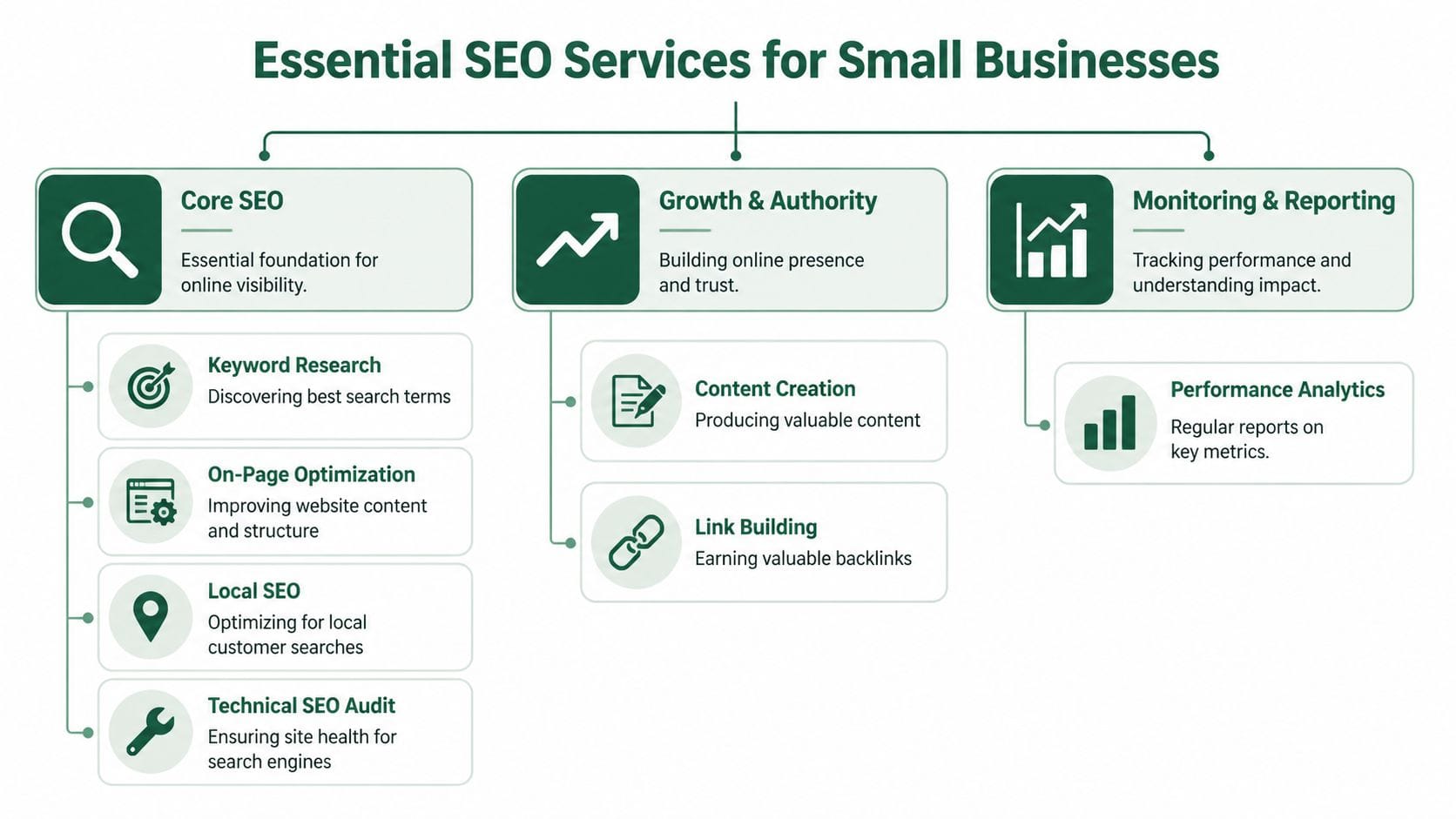
For many Brisbane operators, the most important starting point is local visibility. Optimising a Google Business Profile can produce a 3-5x increase in qualified leads, and some local agencies report top-3 local pack positions within 3-6 months according to Digital8’s Brisbane SEO service page. That’s why many reliable seo companies for small business start there.
Businesses that want to understand the software side before hiring help can also review tools that boost small business rankings with SEO. Tools can help, but they don’t replace strategy or local judgement.
A business looking for done-for-you support usually starts with small business SEO services in Brisbane once the priorities are clear.
Start with the foundation
These are the services most small businesses need first:
- Google Business Profile setup and optimisation: This includes the correct business category, service areas, opening hours, photos, descriptions, and regular updates.
- On-page basics: Title tags, page headings, service copy, and location references should match what customers search for.
- Contact and conversion fixes: Phone numbers, enquiry forms, booking buttons, and mobile usability need to be obvious and easy.
A practical example is a local café. Before paying for long-form blog content, it should have a polished Google Business Profile, a menu page that loads properly on mobile, suburb references where relevant, and clear directions or booking details.
Add growth services when the basics are working
Once the core setup is in place, growth services help a business expand reach and trust.
A trades business might add suburb or service-area pages. A law firm might publish helpful service explainers. A retailer might improve category pages and local landing pages.
Useful growth work often includes:
- Local content creation: Pages or articles that answer real customer questions.
- Citation building: Consistent business details across trusted directories.
- Review support: A process for encouraging more genuine customer reviews.
The best growth work answers a real buying question. It doesn’t just fill the blog with keyword-heavy filler.
Use advanced work when there is a clear reason
Advanced SEO matters, but not every business needs heavy technical work immediately. It becomes more valuable when the site is large, old, slow, or built on shaky foundations.
Examples include:
| Service | Best used when | Why it matters |
|---|---|---|
| Technical SEO audit | The site is slow, glitchy, or has indexing issues | It helps search engines crawl and trust the site properly |
| Schema markup | The business wants richer search appearance | It can improve how listings display |
| Deeper content strategy | The market is competitive and search intent is broad | It helps the site cover more useful topics without cannibalising pages |
The common mistake is buying advanced work too early. A small business with thin service pages and an unclaimed Google Business Profile doesn’t need complexity. It needs a clean local foundation and steady follow-through.
Understanding SEO Company Pricing Models
Pricing worries most small business owners more than SEO itself. Fair enough. The market is full of vague packages, hard sells, and unclear deliverables.
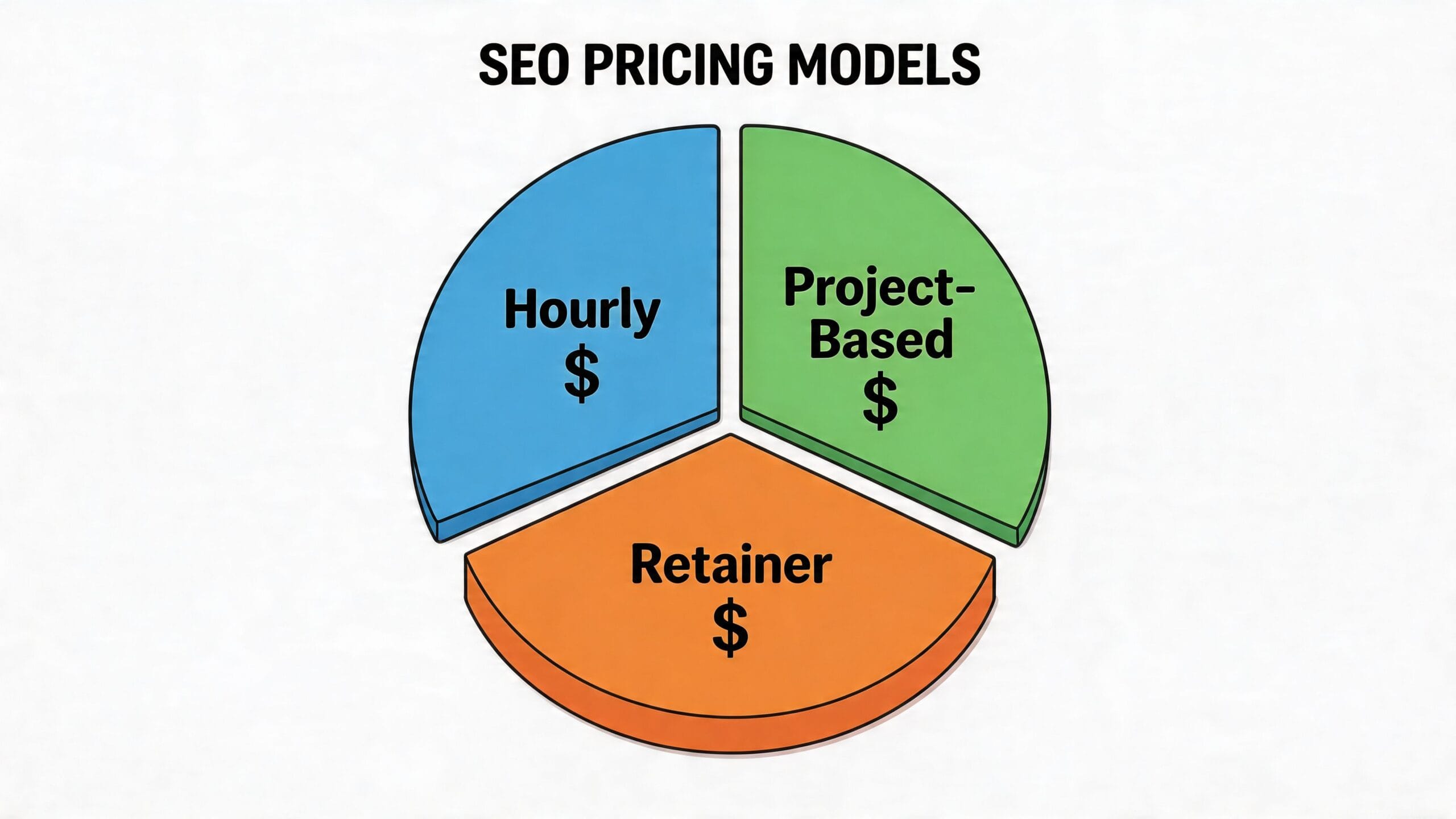
A useful benchmark exists. Australian small businesses typically invest between $497 and $3,000 per month on SEO, with 63% reporting a positive impact on organic traffic and search rankings according to AIOSEO’s SEO statistics roundup. That range is broad because the right spend depends on competition, website condition, and how much needs fixing before growth work starts.
Monthly retainers
A retainer is the most common model for ongoing SEO. The business pays a set monthly fee for agreed work.
This suits businesses that need steady progress, not one-off clean-up. It often includes ongoing page updates, Google Business Profile work, reporting, technical fixes, and content support.
A retainer tends to make sense when:
- The business wants consistency: SEO usually performs better as a regular process.
- There are multiple moving parts: Website, listings, content, and reporting all need attention.
- The owner doesn’t want to manage freelancers separately: One team handles the work.
Project work
Project pricing works well when the business has a defined problem. That could be a website migration, a local SEO setup, a one-time audit, or rebuilding service pages.
This can be a smart option for owners who want to fix the basics before deciding on monthly support. A café might pay for a local SEO setup and website tidy-up, then manage lighter updates internally. A trade business might start with a technical audit and core page rewrite.
Paying for a project makes sense when the scope is clear. It’s less useful when the agency can’t explain what happens after the project ends.
Hourly support
Hourly work is usually best for short advisory tasks, consulting, or overflow help. It’s flexible, but it can also become inefficient if the business needs regular execution.
For example, hourly support can suit a business that already has a good website and only needs occasional fixes, page reviews, or guidance around content and Search Console issues.
A simple way to judge a quote is to ask two questions:
- What work is included each month or project phase?
- How will that work affect leads, visibility, or website performance?
If the answer is fuzzy, the pricing probably is too.
How to Evaluate SEO Companies and Find a Good Partner
Choosing between seo companies for small business gets easier when the owner stops looking for the “best agency” and starts looking for the best fit. A good fit understands the business model, the service area, the budget, and the owner’s tolerance for complexity.
The strongest agencies are usually calm and specific. They don’t rush to impress with jargon. They ask questions about where enquiries come from, which services are most profitable, and what has already been tried.
What good agencies do early
One of the clearest green flags is the way an agency handles technical fundamentals. A quality technical SEO audit that resolves Core Web Vitals issues can boost a small business’s organic traffic by 25-50%, based on Business Medics’ guidance on small business SEO in Brisbane. The point isn’t the audit itself. It’s whether the agency can explain the issues in plain English and connect them to business outcomes.
A useful early-stage checklist looks like this:
- They review the site before pitching too hard: Good agencies usually spot obvious issues quickly.
- They connect SEO to leads: They talk about calls, forms, bookings, and service pages.
- They explain priorities: They can tell the owner what to fix now and what can wait.
- They show reporting examples: Reports should be readable, not stuffed with meaningless charts.
Questions worth asking on the first call
A business owner doesn’t need to sound technical. The right questions are practical.
| Ask this | A strong answer sounds like |
|---|---|
| What would you fix first? | Clear priorities tied to visibility and enquiries |
| What will you measure? | Calls, forms, bookings, local visibility, page performance |
| Who does the work? | A direct explanation of whether work is in-house or outsourced |
| What do you need from us? | Sensible requests for access, approvals, and business insight |
A good SEO partner makes the owner feel more informed after the first conversation, not more dependent.
Another green flag is restraint. A thoughtful agency won’t recommend everything at once. It will protect the budget by starting where returns are most likely.
Warning Signs and Common SEO Red Flags to Avoid
Bad SEO usually doesn’t look bad at the start. It often looks cheap, urgent, and confident. That’s why small businesses get caught.
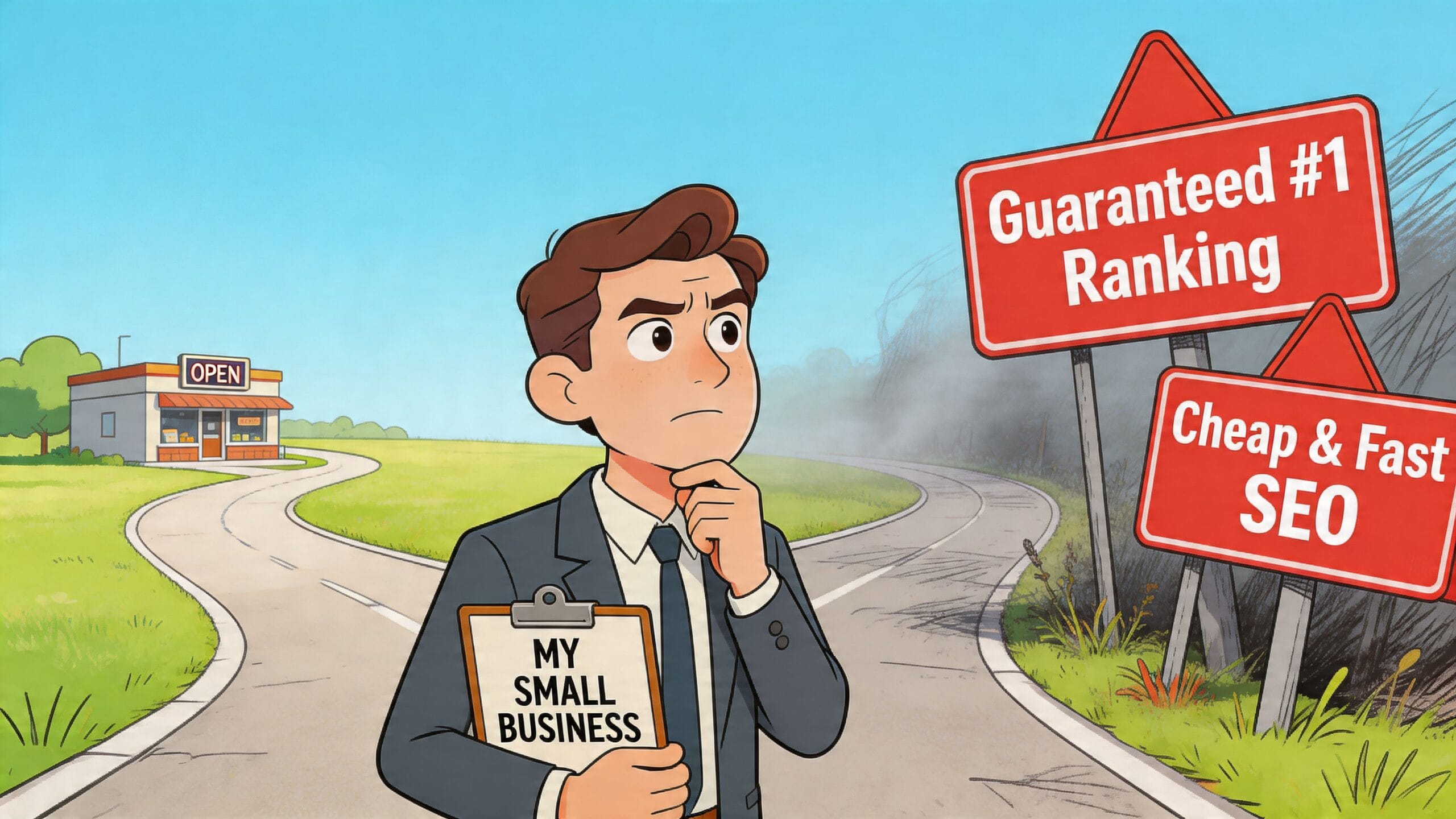
Low-quality providers know the common pressure points. Owners want leads, don’t have time, and often feel unsure about the technical side. So the pitch becomes simple. Quick wins, low prices, and certainty.
That’s exactly where caution matters. The same caution applies when reviewing newer claims around AI search. Business owners comparing providers may find it useful to read about choosing an SEO expert for AI visibility, especially if an agency is using AI buzzwords to dress up weak fundamentals.
What they say and what it usually means
These are some of the most common red flags:
- “We guarantee number one rankings.” Search results change constantly, and no agency controls Google. Guarantees usually signal sales theatre.
- “We have a secret method.” Good SEO isn’t secret. It’s structured work, clear priorities, and decent implementation.
- “You won’t need access to anything.” Owners should have access to their website, analytics, Google Business Profile, and Search Console.
- “Don’t worry about the details.” The details matter when the business is paying every month.
Another warning sign is reporting that says a lot without saying anything useful. If the report celebrates impressions and rankings while phone calls, form submissions, and key page performance remain unclear, the owner may be paying for activity instead of progress.
Why pressure is a bad sign
The sales process tells a business a lot about what working together will feel like later. If the provider is pushy before the contract is signed, communication usually won’t improve once the work starts.
Watch for this pattern:
- Fast close pressure: “This discount ends today.”
- Oversized package first: The business is sold a large plan before basics are reviewed.
- Vague deliverables: The contract lists broad terms but not real tasks.
- Defensiveness: Simple questions trigger evasive answers.
If a provider can’t explain the work clearly before payment, it probably won’t explain results clearly after payment either.
The safest choice is rarely the loudest one. It’s the provider that stays grounded, answers questions directly, and shows how the work links to actual customer actions.
Your Decision Checklist and Next Steps
At this point, the decision is less about SEO theory and more about fit. The right partner should save time, protect budget, and focus on the work that moves enquiries, not just dashboards.
A small business owner doesn’t need to master every term. The better move is to stay clear on the handful of things that matter most. What does the business want more of. Which services bring the best margin. Is the website ready to convert traffic. Does the provider explain priorities without turning every conversation into a pitch.
The checklist below keeps that decision grounded.
SEO Company Evaluation Checklist
| Evaluation Point | What to Look For |
|---|---|
| Business goals | They ask about leads, bookings, sales, and profitable services |
| Local understanding | They understand Brisbane service areas, suburbs, and customer intent |
| Scope clarity | They explain exactly what work is included |
| Reporting | They track meaningful outcomes in plain English |
| Website review | They identify obvious site issues before selling large retainers |
| Communication | They answer direct questions directly |
| Prioritisation | They separate urgent fixes from later-stage work |
| Access and ownership | The business keeps access to core platforms and accounts |
| Sales approach | The process feels low-pressure and transparent |
| Budget fit | The plan matches the business stage, not a generic package |
A sensible way to move forward
A practical next step is to shortlist two or three providers and compare them against that table. Not by who sounds smartest, but by who sounds clearest. If one agency talks in circles and another explains the first month of work plainly, that difference matters.
For Brisbane businesses that want a local, low-pressure partner, Boocoo fits the qualities covered above. The team focuses on practical SEO, web design, paid ads, and social support for small business owners who don’t want more complexity. Those ready for a straightforward conversation can contact the Boocoo team and talk through goals, budget, and what’s worth doing first.
The best SEO decision usually isn’t the biggest package. It’s the clearest plan, handled consistently, by people who understand the business and respect the budget.