
A lot of Brisbane business owners are in the same spot right now. The phone still rings from word of mouth, maybe a few jobs come through Facebook, but when someone searches “electrician The Gap” or “cafe West End”, a competitor shows up instead.
That gap usually isn't because the better business is winning. It's because the clearer digital footprint is winning.
For a small business, Brisbane local SEO doesn't need to become a massive project with endless tools, audits, and jargon. The useful version is much simpler. Fix the parts that help nearby customers find the business, trust it quickly, and make contact without friction. That's the 80/20. Most owners don't need more marketing theory. They need a short list of actions that fit into a busy week and move enquiries.
A useful comparison comes from businesses optimizing local search in New Zealand. The market is different, but the practical pattern is familiar. Small operators get traction when they tighten their profile, clarify service areas, and remove basic trust issues before spending time on advanced SEO.
Why Your Brisbane Business Isn't Being Found Locally
Take a plumber in Aspley. The business does solid work, answers the phone, and has good customers. But online, the listing has old photos, the opening hours are vague, the website has one generic services page, and suburb names barely appear anywhere. A competitor with a cleaner setup wins the click before the plumber even gets a chance.
That's how local search usually works. It's less about flashy tactics and more about reducing confusion for Google and for customers.
Most local businesses disappear in search for a few very ordinary reasons:
- The Google Business Profile is incomplete. Customers can't quickly confirm what the business does, where it works, or how to contact it.
- Service areas are too broad. Saying “we service Brisbane” sounds fine to an owner, but it's weak compared with clear suburb signals.
- Business details don't match everywhere. A different phone format, address variation, or outdated listing creates doubt.
- The website doesn't support local intent. It talks about services, but not where those services are delivered.
- No recent trust signals appear. Few reviews, no updates, stale photos, no visible proof of local work.
Practical rule: If a customer can't tell within a few seconds whether the business serves their suburb and solves their problem, local SEO is already leaking leads.
The good news is that Brisbane local SEO is often fixable without a huge budget. The highest return usually comes from tightening the basics, not chasing every tactic on an SEO checklist.
For a West End cafe, that might mean improving the profile categories, menu details, and photos. For a mobile mechanic in North Brisbane, it might mean building separate pages for key service areas and cleaning up old directory listings. Different business, same principle. Make the local footprint obvious, accurate, and easy to trust.
Your Google Business Profile The Digital Front Door
For most small businesses, Google Business Profile is the first thing to fix because it often acts like a mini-homepage inside Google. People check it before they visit the website. They look for hours, reviews, service details, photos, and whether the listing feels current.
Marketers rank Google Local Pack visibility as the top local SEO metric at 52%, ahead of other common measures, which is why Brisbane local SEO work should treat the profile as the main conversion surface rather than a side task in this local SEO benchmark reference.
Why GBP comes first
A business can have a decent website and still lose enquiries if the profile looks neglected. That happens a lot with trades, clinics, cafes, and professional services. The searcher sees a weak listing, assumes the business is less active, and moves on.
That's why the best small-budget approach is simple. Get the profile right first, then make the website support it.
The fields that actually matter
Don't try to outsmart the platform. Just complete it properly.
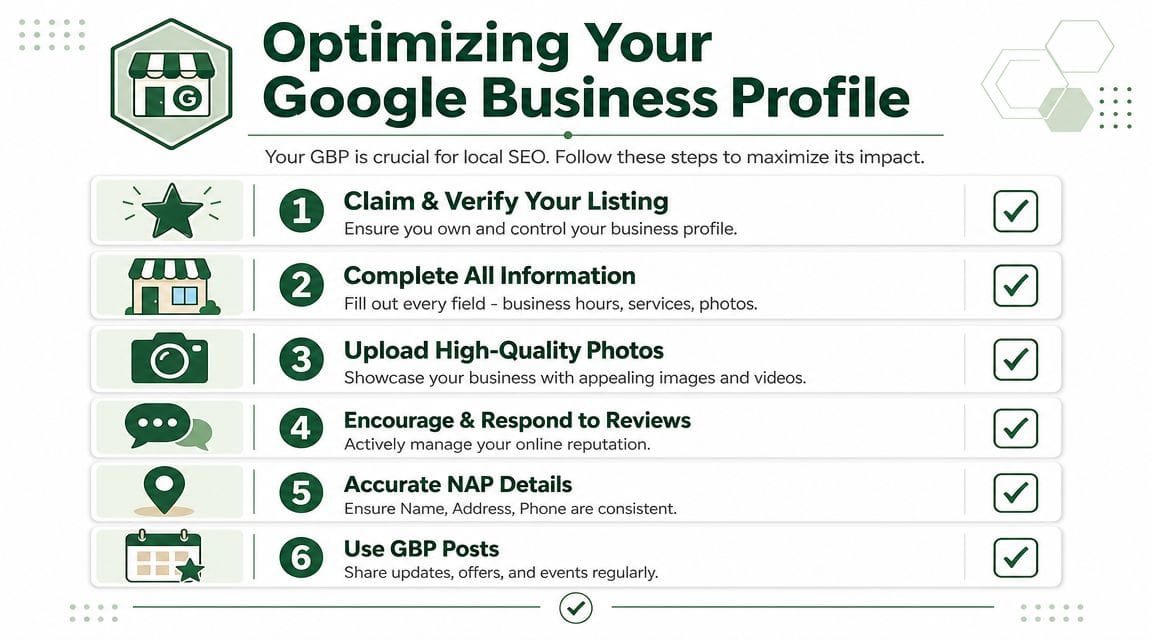
Claim and verify the profile
If the listing isn't controlled by the business, nothing else matters. Access needs to sit with the owner or a trusted staff member.Choose the most accurate primary category
This matters more than people think. A “Cafe” and a “Coffee shop” can attract slightly different search behaviour. A lawyer should choose the clearest fit instead of broad categories that sound impressive.Fill every core field
Include services, business description, hours, phone number, website, service area, and booking details if relevant. Empty fields make the listing weaker and less useful.Use real local photos
A Brisbane provider of outdoor design and construction should upload completed projects from suburbs they serve. A clinic should show the reception area, treatment rooms, exterior signage, and team. Stock-style images don't help much.Write for customers, not algorithms
The description should explain what the business does and where it works in plain language. Mentioning key suburbs naturally is useful. Stuffing every suburb in South East Queensland into one paragraph isn't.Check the questions and answers area
If common questions keep coming up on the phone, add helpful answers there. Think parking, service radius, booking process, emergency callouts, or same-day availability.
A well-kept profile reduces hesitation. A half-finished one creates it.
A simple monthly routine
The businesses that get the most value from their profile treat it like an active channel, not a one-off setup.
A practical monthly checklist looks like this:
- Update photos with recent work, team shots, products, or seasonal changes.
- Confirm business hours before holidays, public holidays, and busy trading periods.
- Review categories and services to make sure they still reflect the offer.
- Respond to reviews with short, specific replies.
- Add a post if there's a relevant update, offer, or event.
For a Chermside electrician or a Cleveland gardener, this kind of upkeep is more useful than spending hours reading about advanced ranking factors. The local listing needs to look alive, accurate, and trustworthy. That's the standard.
Finding Keywords Your Brisbane Customers Actually Use
Keyword research sounds technical, but for a small local business it usually starts with a basic question. What would a nearby customer type into Google when they need help?
That answer is rarely a polished marketing phrase. It's usually blunt and location-based.
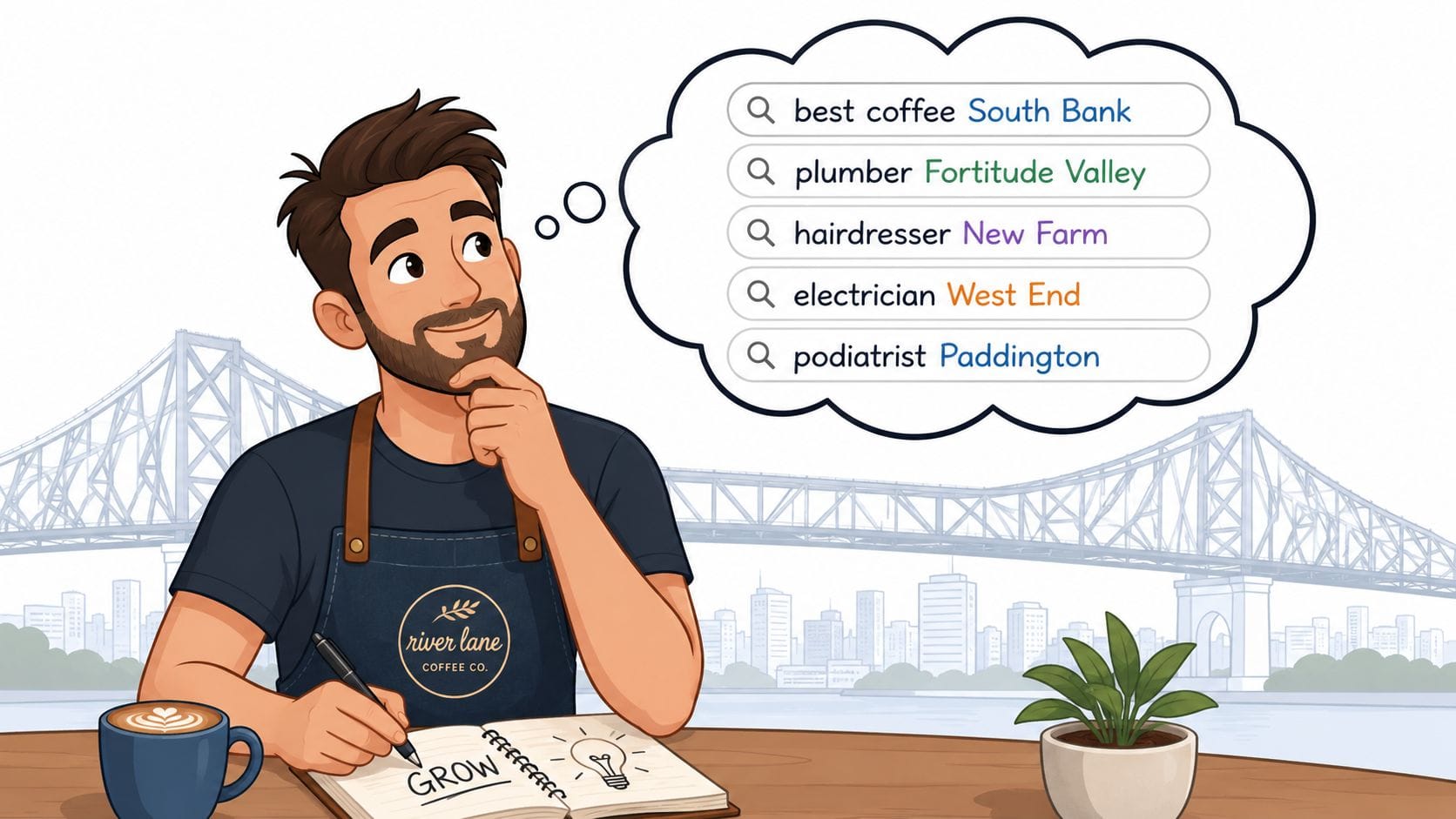
Start with service plus suburb
The easiest way to build a keyword list is to combine the main service with the places the business serves.
Examples:
- Plumber Kedron
- Family lawyer Brisbane northside
- Cafe Fortitude Valley
- Accountant West End
- Emergency electrician The Gap
- Physio New Farm
Then go one step further and think like a customer under pressure. They won't always search the official business category. They'll search the problem.
A locksmith might target “lockout service South Brisbane”. A roofing company might need “roof leak repair Carindale”. A criminal lawyer might get better traction from “drink driving lawyer Brisbane” than from a broad “law firm” phrase.
Use free Google clues
Expensive software isn't the starting point for most small businesses. Google already gives away plenty of keyword hints.
Use these free checks:
Autocomplete
Start typing a service and suburb into Google. The suggested completions often reflect common local searches.People also ask
These questions reveal concerns customers have before they call. Good material for FAQs and service page headings.Related searches at the bottom of results
Useful for finding variations and nearby suburb phrasing.Google Business Profile categories used by competitors
This can show how similar businesses frame their offer.
Build a short working list
Most small businesses don't need a giant keyword spreadsheet. They need a focused list they can apply on the site and profile.
A simple working list should include:
| Keyword type | Example | Best use |
|---|---|---|
| Core service | plumber Brisbane northside | Homepage or main service page |
| Suburb service | blocked drain Ashgrove | Suburb or service area page |
| Urgent intent | emergency electrician Windsor | Dedicated service page |
| Problem-led | leaking tap repair Stafford | FAQ or service content |
| Trust-led | family lawyer inner north Brisbane | Main service page copy |
Keep the list tight. If the business can realistically serve ten areas well, write for those ten. Broad coverage with thin content usually wastes time.
For Brisbane local SEO, the useful keyword list is the one the team can implement. If a phrase won't be used in the Google Business Profile, page title, heading, service copy, or FAQ, it probably doesn't need to be on the list yet.
Building Authority with Local Content and Citations
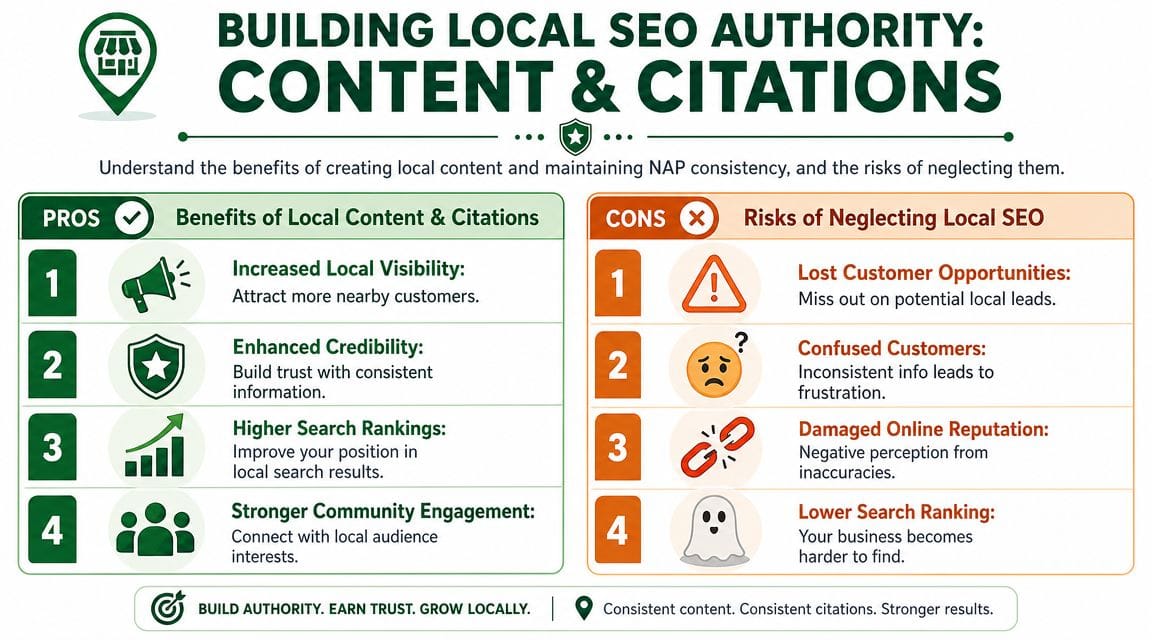
This is the part many owners skip because it feels fiddly. It matters because Google needs consistent signals to trust that the business is real, local, and relevant.
In Australia, 46% of all Google searches have local intent, and one in five consumers now search directly within maps platforms according to this Australian local SEO statistics summary. That's why citation accuracy and local content aren't side jobs. They support how customers and search platforms verify a business.
Consistency beats volume
A citation is any mention of the business name, address, and phone number online. The key point isn't chasing every directory on the internet. It's making sure the core listings match exactly.
If the website says “Unit 2, 18 Smith St” but another listing says “Suite 2/18 Smith Street”, that may look minor to a human. For local SEO, repeated variations can dilute confidence.
The 80/20 move is to clean up the major places first:
- Google Business Profile
- Apple Maps
- Bing Places
- Yellow Pages
- Local industry directories
- Relevant chambers, associations, and local business listings
For tourism, hospitality, and visitor-focused operators, local content also intersects with broader destination visibility. That's where a resource on tourism digital marketing can help connect local search work with content people use when planning visits.
Local content that earns trust
A lot of “local content” is thin suburb pages with barely changed wording. That usually adds clutter, not authority.
Useful local content answers real local questions. A Brisbane builder could publish a piece about deck extension considerations tied to local council processes. A pest control company could write about common termite issues in older Queensland homes. A cafe might create a page for catering in nearby business districts with practical delivery details.
Good local content usually has one of these traits:
It reflects how locals speak
Use suburb names, landmarks, and service areas naturally.It answers pre-sale questions
Parking, access, turnaround times, service radius, emergency availability.It shows local proof
Photos, examples, and references to work already done in the area.
On-page rule: One strong page for a real service area beats ten thin pages with swapped suburb names.
Where to place effort first
For a time-poor business owner, this order usually works best:
- Fix NAP consistency across core listings.
- Update the website contact page so details exactly match the main profile.
- Create service-area pages only for suburbs or regions the business actively targets.
- Add local schema and clear contact details if the website platform allows it.
- Publish occasional local content that helps a buyer decide, not just rank.
Brisbane local SEO works better when every local signal tells the same story. Same business details. Same service areas. Same offer. That coherence matters more than volume.
Generating Reviews and Earning Local Links
Reviews and local links do slightly different jobs, but together they build the same thing. Trust that can be seen from outside the business.
A strong review profile tells a customer, “other people in this area have used this business and were happy enough to say so.” A good local link tells Google, “this business is connected to the local community and recognised by relevant sites.”
Reviews are an operations job
Review generation works best when it's built into the customer handover, not treated like a random marketing extra.
That matters because stale or inaccurate profiles create friction fast. 47% of consumers would go to a competitor if a business's listed hours were wrong, and Google Business Profile management is rated the most valuable local SEO service by marketers at 76% and by clients at 52% in this local SEO reporting summary. The lesson is practical. Reputation and profile upkeep sit close together.
A simple review system usually includes:
A trigger point
Ask right after the job is completed, the item is delivered, or the service result is clear.One direct link
Don't make customers hunt for where to leave the review.A staff prompt
Reception, admin, or the technician finishes the interaction and mentions it naturally.A reply habit
Thank happy customers and respond calmly to unhappy ones.
If the team needs ideas, a practical guide to review strategies for local services is useful because it focuses on simple follow-up systems rather than gimmicks.
Local links should come from real involvement
Most small Brisbane businesses don't need fancy outreach campaigns. They need legitimate local mentions.
Good local link opportunities often come from things the business might already be doing:
- Sponsoring a junior sports club in a target suburb
- Joining a chamber or industry association
- Supporting a school fundraiser or community event
- Supplying a local charity or not-for-profit
- Collaborating with nearby businesses on an event or guide
A physiotherapy clinic might partner with a local gym. A mortgage broker might contribute a practical article to a local property blog. A cafe might be listed on a neighbourhood event page after catering a community function.
The side benefit is that these actions often help social content too. If the business is active in the community, timing and distribution matter, which is where a guide on the best time to post to Facebook can support the visibility of those local activities.
A practical follow-up template
This doesn't need to be fancy. Short is better.
Thanks again for choosing [Business Name]. If the service was helpful, a quick Google review would really help other local customers find us. Here's the link: [insert review link]
That works because it's clear, respectful, and easy to action. No bribe. No awkward script. Just a direct ask at the right moment.
When to DIY vs Hire a Brisbane SEO Agency
For many small businesses, the primary question isn't whether Brisbane local SEO matters. It's whether the owner should keep doing it personally or hand parts of it over.
That choice usually comes down to time, complexity, and the cost of delay. A sole trader can absolutely handle some local SEO tasks. But once the work starts stealing hours from quoting, service delivery, or follow-up, DIY stops being the cheap option.
A practical issue sits underneath this decision. Brisbane businesses often need to choose whether Google Business Profile optimisation or broader website SEO will move enquiries faster, especially when budgets are tight and digital maturity is limited, as discussed in this Brisbane local SEO overview.
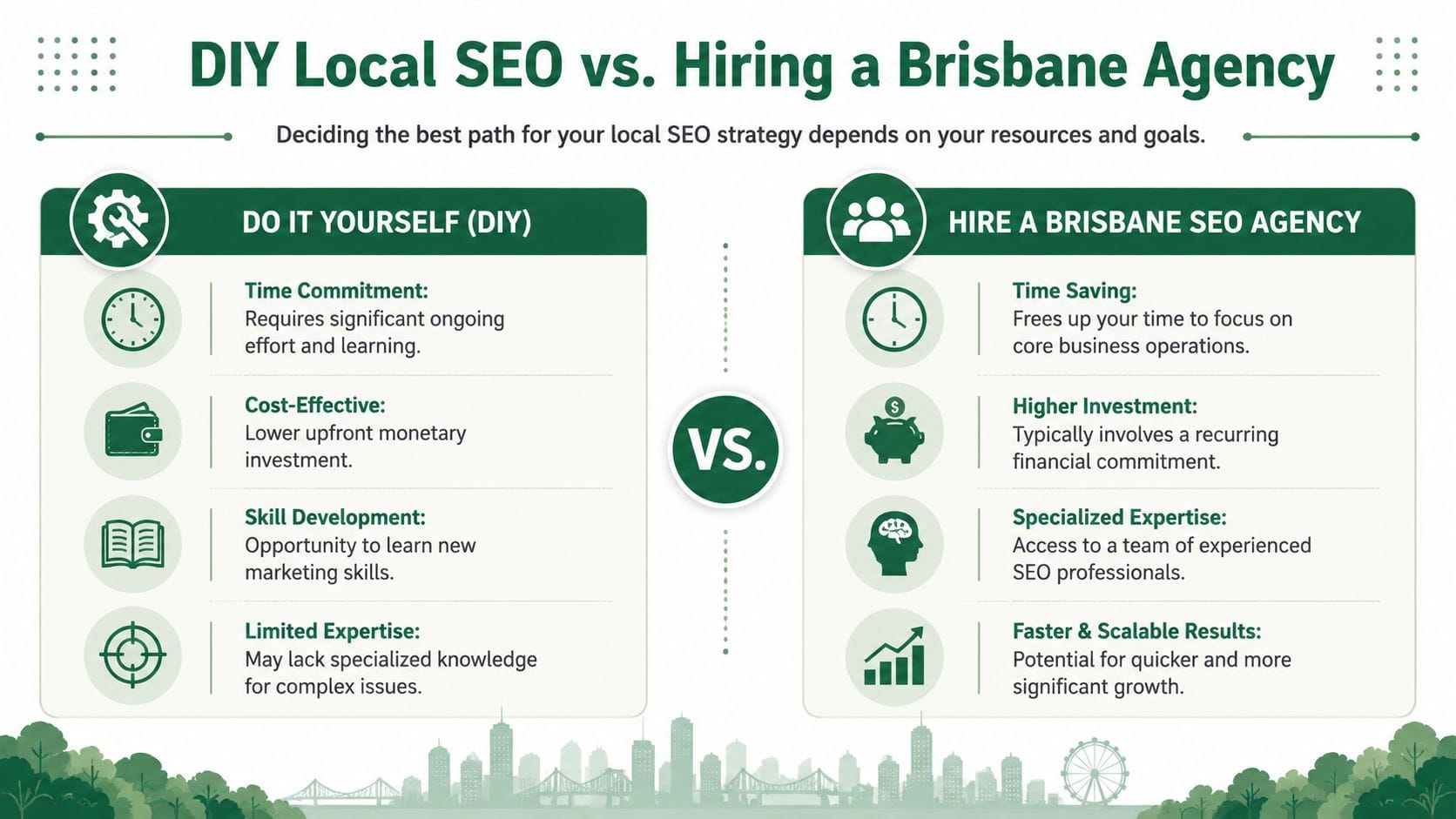
What to keep in-house
Some tasks are perfectly reasonable for an owner or admin team to handle:
| DIY task | Why it suits in-house teams |
|---|---|
| Updating photos on GBP | The business already has access to recent work and team images |
| Checking hours and holiday trading | Staff know changes before anyone else |
| Asking for reviews | Best done close to the customer interaction |
| Posting occasional updates | Easy if there's a real offer, event, or announcement |
| Keeping service info current | Owners know what's changed in the offer |
These jobs are close to daily operations. They don't usually need an SEO specialist.
What usually needs specialist help
Other jobs become messy quickly:
- Cleaning up inconsistent citations across multiple platforms
- Planning suburb and service page structure so the site doesn't become thin or repetitive
- Implementing structured data correctly
- Diagnosing technical issues that weaken local visibility
- Mapping search intent to conversion paths so traffic turns into calls and forms
This is also where website performance starts to matter more. If the business is getting visibility but not leads, local SEO alone isn't the whole answer. Conversion work becomes part of the picture, which is why a service such as conversion rate optimisation in Australia often sits alongside local search rather than behind it.
How to decide without overthinking it
Use a simple filter.
DIY makes sense when:
- the business has one location or a tight service area
- the owner can spend a little time each month consistently
- the profile is mostly set up and just needs maintenance
- the website only needs a few local improvements
Outside help makes sense when:
- listings are inconsistent across the web
- the business serves multiple suburbs or regions
- competitors dominate local pack visibility
- the owner keeps postponing the work
- website visits aren't turning into enquiries
One practical option in Brisbane is a provider that handles Google Business Profile fixes, NAP consistency, local signals on the website, and suburb-targeted service pages. Boocoo offers that type of local SEO support as one example of an external partner for businesses that want the work managed without making it a full in-house project.
The right move is the one that protects the owner's time while keeping lead flow moving. If the local basics are under control, DIY can work. If the work is half-done for months, hiring help usually costs less than staying stuck.