

A lot of Brisbane business owners are in the same spot right now. The work is solid, customers are happy, and the phone should be ringing more than it is. But when someone nearby searches for the service, a competitor shows up first, or worse, the map pack gets all the clicks and the business is nowhere to be seen.
That usually isn't a service problem. It's a discoverability problem.
Brisbane search engine optimization helps fix that. Not with gimmicks, not with bloated monthly reports, and not with busywork that eats a small business owner's week. The useful version of SEO is simpler than most agencies make it sound. It's about making sure search engines can access the right pages, local customers can trust what they find, and the business shows up where people look, including Google Maps, suburb searches, and increasingly, AI-generated answers.
Why SEO Is Your Best Investment for Brisbane Customers
A website on its own doesn't do much. It can look polished, load nicely, and explain the service clearly, but if Brisbane customers can't find it when they're ready to book, it won't pull its weight.
That matters more now because the local market is crowded. According to Semrush's Brisbane agency index, the city had at least 18 SEO companies listed in 2026, which shows Brisbane has a mature and competitive local SEO market rather than a niche one. In plain terms, showing up in search is no longer about merely having a site. It's shaped by execution.

Paid ads can help, but they switch off the moment the budget stops. SEO works differently. A well-built service page, a well-managed Google Business Profile, and clear suburb relevance can keep bringing in enquiries without paying for every click.
For a time-poor owner, that's the main appeal. Good SEO compounds. Bad SEO creates admin.
Practical rule: If a tactic doesn't improve visibility, trust, or enquiries from local buyers, it probably isn't worth a small business budget.
A Brisbane café, electrician, physio, or mortgage broker doesn't need an elaborate strategy deck to get moving. The useful starting point is much more grounded:
- Make key pages discoverable: Service pages need to be crawlable, indexable, and easy to reach.
- Match local intent: The site should reflect suburbs, service areas, and real search language.
- Back up claims with trust signals: Reviews, accurate business details, and strong local references matter.
- Measure leads, not just traffic: Calls, forms, bookings, and direction requests are what count.
The businesses that get results usually aren't doing magic. They're doing the obvious things properly, and they're doing them consistently. That's why Brisbane search engine optimization is often the most sensible long-term digital investment for a local operator. It supports how customers already search, compare, and choose.
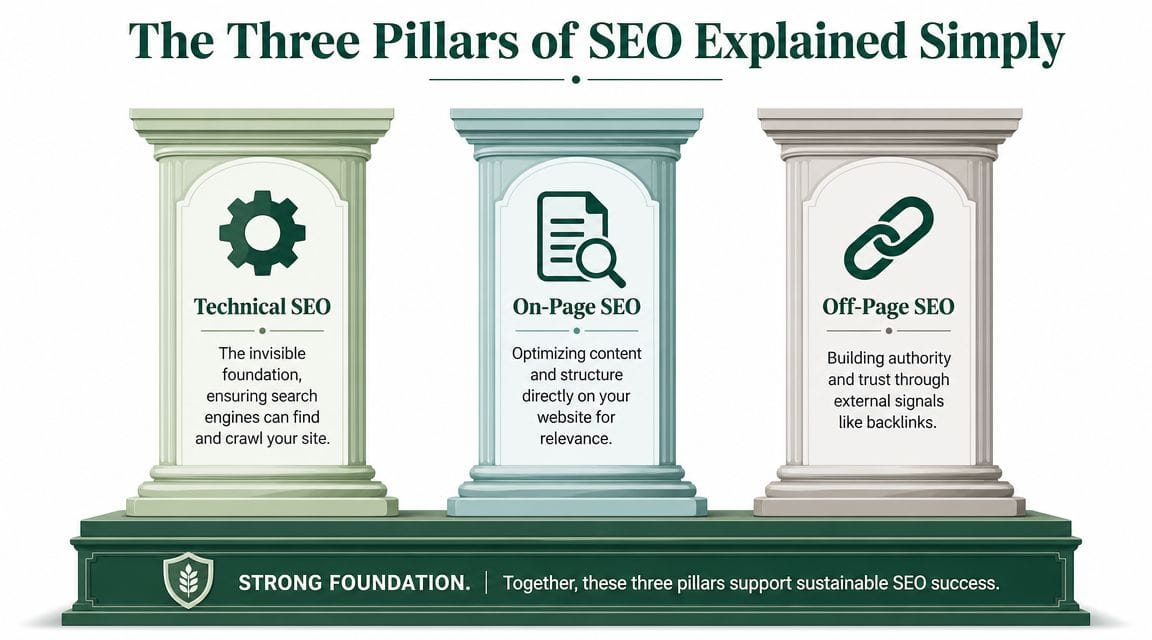
The Three Pillars of SEO Explained Simply
SEO gets easier to understand when it's treated like a building problem. A business website needs a foundation, clear signs, and a good reputation. Leave one out and the whole thing becomes harder to trust or harder to find.
Technical SEO is the foundation
Technical SEO is the invisible structure underneath the site. If search engines can't crawl the pages properly, or if the wrong versions are indexed, the rest of the effort won't land.
Brisbane specialists regularly treat technical work as the core layer because crawlability and indexation control decide whether important service pages can perform in the first place. That includes basics like robots directives, XML sitemaps, canonical tags, internal linking, and making sure key pages return a proper status and can be reached in a few clicks.
For a small business site, the practical checklist is simple:
- Check money pages first: Service pages, contact pages, and location pages should load properly and be accessible from the main menu or nearby internal links.
- Avoid duplicate confusion: If multiple pages target the same service with slight wording changes, search engines can struggle to prioritise the right one.
- Keep navigation clean: Fancy menus and overbuilt page builders often create more problems than they solve.
On-page SEO is the message
On-page SEO is what the page says and how clearly it says it. This includes titles, headings, copy, internal links, image alt text, and the way the page is structured.
A common mistake is writing pages to sound impressive instead of useful. Searchers don't type “premium integrated trade solutions”. They type “emergency plumber New Farm” or “family lawyer Brisbane northside”.
Useful on-page work looks like this:
- A service page with one clear main topic
- A headline that matches what the customer is searching for
- Copy that explains who the service is for, where it's available, and what to do next
- FAQ sections that answer pre-sale questions plainly
A page doesn't need more words. It needs fewer mixed signals.
Off-page SEO is the reputation
Off-page SEO is the trust built away from the website. That includes backlinks, reviews, business listings, and brand mentions around the web.
Many owners often get sold junk. Buying random links, stuffing low-quality directories, or outsourcing reviews creates risk and rarely creates durable value. Good off-page SEO usually looks slower because it's built on real-world signals. Partnerships, local mentions, industry references, happy customers, and consistent business details do more for a small operator than most “link packages”.
A useful way to think about the three pillars is this:
| Pillar | What it does | What usually wastes time |
|---|---|---|
| Technical | Helps search engines access and understand key pages | Constant tinkering on minor site errors that don't affect core pages |
| On-page | Matches pages to real search intent | Writing vague, keyword-stuffed copy |
| Off-page | Builds trust and authority | Cheap backlinks and spammy directory submissions |
When these three parts work together, SEO stops feeling mysterious. It becomes a set of practical fixes.
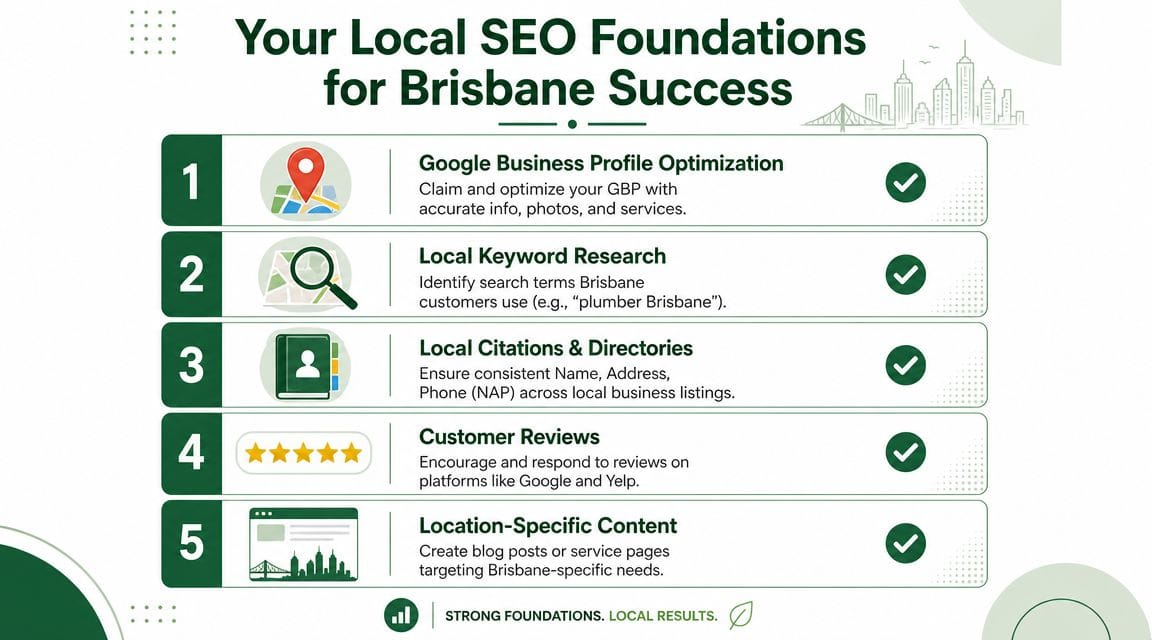
Your Local SEO Foundations for Brisbane Success
Local SEO is where most Brisbane small businesses should spend their first block of effort. It's the part that helps a business appear in map results, suburb searches, and local service queries from people who are ready to act.
Brisbane-focused providers consistently treat local relevance as a separate layer of SEO because location relevance signals shape visibility in ways generic optimisation doesn't. That means suburb coverage, service-area wording, and NAP consistency all need to line up across the website and listings. It also means local-pack actions like calls and direction requests deserve their own tracking.
Get the Google Business Profile right first
For many local operators, the Google Business Profile does more immediate work than the homepage. It often becomes the first impression, especially on mobile.
A useful profile setup includes:
- Correct primary category: Choose the closest match to the main service, not a broad label that sounds nicer.
- Accurate service areas: List the actual areas served. Don't claim every suburb unless the business operates there.
- Complete business details: Opening hours, phone number, website link, services, and photos all help remove doubt.
- Regular updates: Fresh photos, posts, and answered questions make the profile feel active.
A café in West End, for example, should make sure the profile reflects dine-in, takeaway, hours, menu highlights, and current imagery. A mobile service business should focus on service areas, response expectations, and clear service descriptions.
Clean up local consistency
A business can confuse search engines and customers at the same time if its details vary across the web. Different phone numbers, old addresses, and mixed suburb descriptions create avoidable friction.
The high-value job here is boring but effective. Check that the business name, address, phone number, and website are consistent across the website, Google Business Profile, socials, and key directories.
For businesses serving more than one area, this gets more important. A useful companion read is LLMrefs multi-location SEO insights, which breaks down how location pages and service-area coverage can be handled without turning the site into duplicated suburb spam.
For operators in visitor-heavy sectors, local visibility also overlaps with broader digital planning. A tourism business, accommodation provider, or local attraction can combine SEO with content and seasonal campaigns through tourism digital marketing support.
Keep one master record of the official business details. Use it everywhere. That saves hours later.
Build a simple review routine
Reviews help conversion as much as visibility. They reduce hesitation.
Most small businesses don't need a complicated automation stack. They need a repeatable habit.
A workable review routine looks like this:
- Ask at the right moment: After a completed job, a happy handover, or positive feedback.
- Use a short script: “Thanks again for choosing us. If you've got a minute, a Google review would really help.”
- Send the link quickly: The longer the delay, the lower the response.
- Reply to every review: Short, polite replies are enough. They show the business is active.
- Use reviews on-site: Add strong testimonials to relevant service pages, not just a single testimonials page.
What doesn't work well is begging every customer, offering awkward incentives, or pasting the same response under every review. Local SEO rewards consistency, not theatre.
Content and Keywords That Attract Brisbane Buyers
A lot of content fails because it targets the wrong type of search. It goes after broad phrases that look important in a keyword tool, while buyers are using longer, more specific searches with suburb names, urgency, or service detail built in.
That's why Brisbane content strategy should start with buyer intent.
Start with buying intent not broad traffic
There's a big difference between someone searching “electrician” and someone searching “emergency electrician Chermside”. The second search is closer to a job booking.
Small businesses usually get more value from pages and articles built around practical local intent, such as:
- Service plus suburb: “tax accountant Indooroopilly”
- Problem plus location: “blocked drain Brisbane northside”
- Need plus urgency: “same day appliance repair Carindale”
- Service plus audience: “NDIS cleaner Brisbane southside”
For owners doing keyword work in-house, a helpful primer on how to optimize for local search visibility can sharpen the way those phrases are grouped and prioritised.
The best keywords for a small business often don't look glamorous. They look specific, transactional, and a bit repetitive. That's fine. Those are often the pages that bring enquiries.
Build suburb pages with a real purpose
Suburb pages work when they reflect genuine coverage. They fail when they're mass-produced clones with only the suburb name swapped out.
Independent Australian local SEO research found that businesses targeting multiple locations drove 557% more traffic on average than single-location businesses, according to Australian local SEO statistics. For Brisbane businesses, that makes suburb-specific pages hard to ignore if the business already serves multiple areas.
A strong suburb page usually includes:
- Real service context: What the business offers in that area
- Relevant proof: Local jobs, testimonials, photos, or examples where appropriate
- Service details: Common issues, availability, or turnaround expectations
- A clear next step: Call, quote form, booking request, or visit prompt
A weak suburb page usually includes generic copy, no location detail, and no reason for that page to exist.
Worth remembering: One solid page for a real service area is better than ten thin pages written for search engines only.
Write so Google and AI tools can both understand the page
Local search is no longer only about blue links. Brisbane businesses also need pages that can be interpreted cleanly by AI answer engines and conversational search tools.
The current gap is practical. Much of the local SEO advice in Brisbane still leans heavily on old checklists, while AI answer engine visibility depends more on content structure, clear entity signals, and citation consistency than many owners realise.
A page that works for both Google and AI tools tends to have:
- One clear topic per page
- Direct opening answers
- Descriptive headings phrased like real questions
- Specific business details such as services, areas, and contact options
- Supporting trust signals including reviews, credentials, and consistent business information
That doesn't mean writing robotic FAQ sludge. It means making the page easy to parse. If a tool or search engine has to guess what the business does, where it works, and who it helps, the page is too vague.
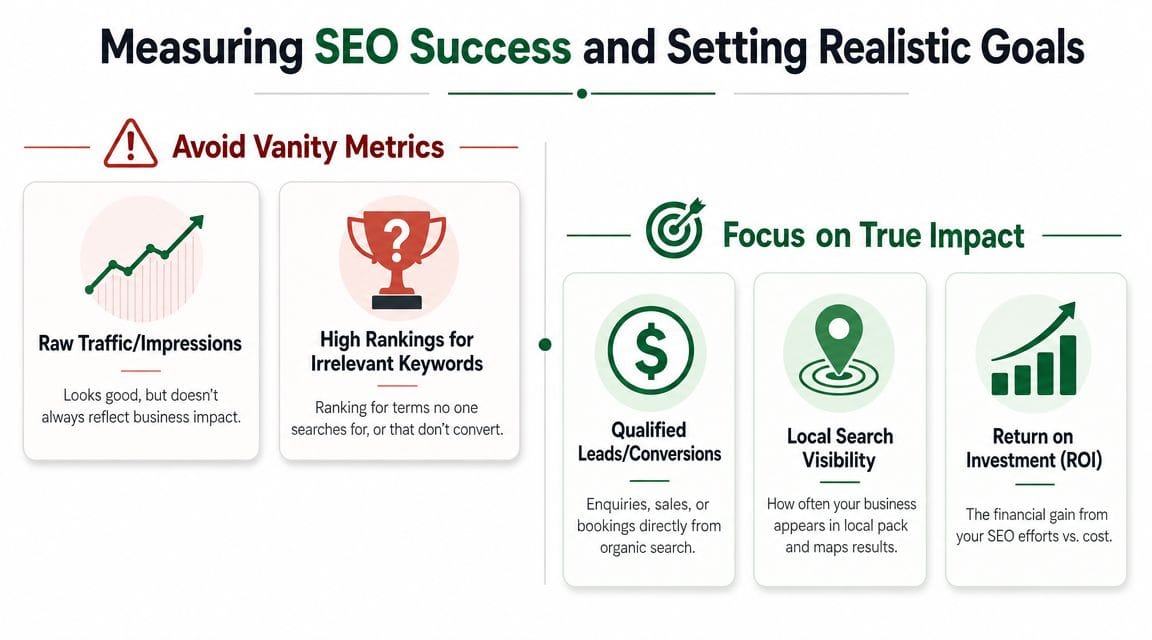
Measuring SEO Success and Setting Realistic Goals
SEO becomes frustrating when it's measured with the wrong scoreboard. A rise in impressions can look exciting and still produce no calls. A ranking report can look healthy while the wrong pages are attracting the wrong visitors.
The better question is simple. Did search generate more qualified enquiries?
Track business outcomes not vanity metrics
For most Brisbane small businesses, the most useful metrics are:
- Phone calls from search
- Contact form submissions
- Booking requests
- Direction requests from the Google Business Profile
- Enquiries from suburb or service pages
Google Analytics 4 can help with website conversions, and Google Business Profile data can help with map-driven actions. The key is to separate local intent from everything else. If one suburb page drives the right enquiries, that matters more than a blog post that gets broad traffic and no leads.
AI search is making this even more important. Brisbane SEO coverage still under-serves the issue of how search behaviour is shifting, and new forms of visibility beyond rankings now matter if a business wants to understand where discovery is happening. That's one reason conversion tracking and page-level performance deserve more attention than screenshots of ranking jumps.
For businesses that already have traffic but weak lead flow, conversion rate optimisation in Australia is often the missing layer.
Expect movement before major wins
SEO usually shows up in stages.
Early signs often include better page indexing, improved local visibility, and more consistent impressions for service terms. After that, the business may start seeing better enquiry quality, stronger map actions, and more traction from specific pages.
A realistic way to judge progress is:
| Stage | What to look for |
|---|---|
| Early phase | Technical fixes completed, important pages indexed, clearer tracking |
| Middle phase | Growth in local page visibility, better engagement from target suburbs |
| Established phase | More consistent qualified leads from search and maps |
This is slower than ads and often stronger once it settles. The businesses that get the most from SEO tend to review results monthly, make focused improvements, and avoid resetting the strategy every few weeks.
Brisbane SEO Pricing and Choosing Your Partner
Most business owners don't need a perfect SEO provider. They need one that fits the budget, communicates clearly, and works on the right priorities.
Pricing varies widely in Brisbane, and that's where confusion starts. Some offers are cheap because they're light-touch. Others are expensive because they include strategy, content, technical work, and reporting. The problem isn't the range. It's that many proposals hide what's being done.
Comparing Brisbane SEO service options
The most common service models look like this:
| Option | Typical Monthly Cost (AUD) | Best For | Key Consideration |
|---|---|---|---|
| Freelancer | Lower-cost to mid-range | Sole traders, simple websites, local service businesses with narrow scope | Quality varies a lot. Some are strong specialists, some are one-person generalists doing a bit of everything |
| Small local agency | Mid-range | Small to medium Brisbane businesses needing broader support | Usually better for combining SEO with content, web updates, and local strategy |
| Larger city firm | Higher-cost | Multi-location brands, larger sites, businesses needing bigger delivery capacity | Can be process-heavy. Smaller accounts sometimes get less hands-on attention |
The right fit depends on what the business needs. A simple brochure-style site may only need technical cleanup, local SEO, and a handful of strong service pages. A business with weak site structure may need web work first. In that case, website support options can matter as much as the SEO plan itself.
For owners comparing broader digital costs across the stack, even adjacent services can help frame budget expectations. For example, this overview of AI customer support pricing shows how some businesses now split spend across visibility, conversion, and support rather than treating marketing as one bucket.
Questions worth asking before signing anything
A good SEO conversation should get clearer as it goes, not murkier.
Useful questions include:
- What will be worked on in the first month
- How are local rankings, maps visibility, and leads being tracked separately
- Who writes the content and who approves it
- What technical fixes are included and what sits outside scope
- How are suburb pages handled without duplication
- What does reporting look like in plain English
- What needs access to the website, GBP, and analytics
- What happens if the current website is holding SEO back
If the answers stay vague, that's a warning sign. If the proposal is built around generic reports, dozens of low-value blog posts, or guaranteed rankings, it's worth stepping back.
The useful partner is usually the one that can explain trade-offs plainly. Not every task needs doing at once. That's often where budget gets protected.
Your Brisbane SEO Questions Answered
How long does SEO take in Brisbane
It depends on the site, the competition, and how much needs fixing first. A business may see early movement before it sees steady lead growth. Technical issues, weak local signals, and thin service pages usually need attention before stronger results show up.
Can a small business do SEO without an agency
Yes, at least partly. A business owner can often handle Google Business Profile basics, review requests, page updates, and local detail cleanup. Technical fixes, content planning, and larger site issues usually get easier with specialist help.
Is SEO better than Google Ads
They do different jobs. Ads are faster and useful for immediate testing. SEO is slower and more durable. Many Brisbane businesses use ads for quick demand and SEO for long-term visibility.
What should get fixed first
Start with the pages that make money, the Google Business Profile, and local consistency. If those are shaky, publishing more content usually won't help much.
Do AI search tools change the approach
Yes. Content now needs to be clearer, more structured, and easier to interpret. Businesses still need rankings, but they also need pages that answer questions directly and present strong local entity signals.