

A lot of Brisbane business owners are in the same spot right now. They know video matters, they've been told they need reels, website videos, testimonials, explainers, maybe even ads, but the whole thing feels expensive, vague, and harder than it should be.
The usual pattern goes like this. A business gets one polished video made, posts it a few times, then leaves the final file sitting in Google Drive while the team moves on to the next fire. The problem usually isn't the camera work. It's that the video was treated like a one-off project instead of a business asset.
That's why smart small businesses are starting with the lead goal first and the filming second. If the aim is to grow your small business with video marketing, the right question isn't “what kind of video should be made?” It's “what job does this video need to do once it's live?”
Your Guide to Brisbane Business Video Production
Business video production in Brisbane doesn't need to feel like organising a film set. For most small businesses, the job is much simpler. The main task is to create a piece of content that helps a potential customer understand the offer, trust the business, and take the next step.
That changes the way the whole project should be approached.
A local electrician, accountant, physio clinic, buyer's agent, or family law firm usually doesn't need a dramatic brand film packed with cinematic extras. They often need a clear homepage video, a short service explainer, a customer testimonial, and a handful of shorter cut-downs that can be reused across social media, email, and paid campaigns.
A useful video earns its keep after the shoot day. It keeps answering sales questions when the owner is busy, the office is closed, or the ad is running.
That's the practical lens that matters here. Not “how do businesses make videos?” but “how do Brisbane SMEs make videos without wasting time, money, or momentum?”
This guide treats video as part of a working marketing system. It covers the planning stage that prevents messy shoots, the cost drivers that catch people out, the briefing process that gets cleaner quotes, and the distribution plan that turns one production into multiple assets.
For a small business, that's the difference between a nice-looking file and something that helps generate enquiries.
The Foundation Planning Your Video for Business Results
Planning is where most budget is either protected or squandered.
Brisbane City Council's business guide lays out a practical workflow for video content. It points to a four-stage pipeline of pre-production, production, post-production, and delivery, and says planning should define the goal, key message, target audience, format, and brand voice before storyboards and shot lists are created, because those tools reduce on-set time and simplify editing, as outlined in Brisbane City Council's video content guide.

Start with one business goal
Most weak video projects start with a fuzzy brief. The owner says they want “something professional” or “something for social media”. That sounds fine, but it gives the production team almost nothing useful to build from.
A sharper starting point looks like this:
- Lead generation: A short service video on the homepage that helps visitors request a quote.
- Trust building: A testimonial video that reduces hesitation for first-time customers.
- Sales support: A simple explainer that answers common objections before a call.
- Recruitment: A culture-focused video for job ads and the careers page.
Each of those needs a different script, structure, runtime, and call to action.
A good rule is to write one sentence that finishes this phrase: “This video should help the business get more of this result from this audience.” If that sentence can't be written clearly, the camera shouldn't be booked yet.
Lock the message before the shoot
Once the goal is clear, the next step is narrowing the message. One video should carry one main point. Not five.
For example, a Brisbane mortgage broker might be tempted to talk about service, speed, lender access, communication, support, and results all in one video. A stronger version would focus on one takeaway such as: “We make home loan decisions easier for busy first-home buyers.”
That single message makes the rest of the project simpler:
- Script: Fewer competing ideas
- Shot list: Only footage that supports the message
- Edit: Cleaner structure with fewer revisions
- Distribution: Easier to match to a landing page or campaign
Practical rule: If the team can't describe the video in one clear sentence, viewers probably won't understand it in one watch.
Planning also needs to cover format. A website header video, square testimonial clip, vertical ad, and email thumbnail all behave differently. That's why many businesses now build the website and video plan together. If the video is meant to support a service page or homepage enquiry flow, it helps to map it against the page layout early, especially when the business is already reviewing its website structure and conversion flow.
For teams that want a simple way to visualise the production process before talking to suppliers, this overview of Whisper AI's production workflow is a useful companion. It helps connect planning decisions to the filming and editing stages without making the process feel overly technical.
Decoding Video Types and Typical Brisbane Costs
Most small businesses don't need to ask, “How much does video cost?” They need to ask, “What kind of video fits the job, and what makes the quote move up?”
That's where business video production in Brisbane gets easier to understand. A testimonial filmed in one location is a very different project from a multi-location brand piece with motion graphics, extra crew, and a longer edit.
A practical local benchmark is that all-inclusive productions commonly start at about A$4,000 + GST and often sit between A$4,000 and A$12,000 depending on filming days and edit complexity, according to Sound Images' Brisbane corporate video pricing guide. That same guidance points to a simple ROI protection rule. Define deliverables early and keep scope creep under control.
What different video formats are really for
The easiest way to choose a format is to work backwards from the sales problem.
A testimonial video works well when prospects already understand the service but still need proof. Think of a local bookkeeping firm filming one client in their office with a short interview and a few cutaway shots. That's usually a leaner project.
A brand promo is broader. It's often used on the homepage, About page, or pinned social content. A Brisbane landscaping company might show the owner speaking to camera, crews on-site, and finished projects across several locations. That takes more planning and usually more edit time.
A social ad video should be tighter and more direct. It needs a fast hook, simple message, and obvious next step. These often work best as short cut-downs captured during a larger shoot rather than commissioned as one-off hero pieces every time.
An explainer video is useful when the service is complex or unfamiliar. Professional services, trades with specialist processes, and B2B operators often benefit from this format because it reduces confusion before a sales call.
Brisbane business video production costs and timelines
The table below is best used as a planning tool, not a fixed rate card. The actual quote will still depend on scope, locations, crew, approvals, and post-production requirements.
| Video Type | Best For | Typical Budget (All-inclusive) | Typical Timeline |
|---|---|---|---|
| Testimonial video | Building trust with real customer proof | Often at the lower end of the typical Brisbane benchmark, depending on shoot simplicity | Usually shorter when filming is limited to one location and a simple edit |
| Brand promo video | Homepage use, company overview, general awareness | Often mid-range to upper-range within the typical Brisbane benchmark, depending on filming days and polish | Usually longer due to scripting, broader coverage, and revision rounds |
| Social media ad cut-downs | Paid campaigns, remarketing, short-form awareness | Often cost-effective when produced from a larger shoot rather than as isolated one-offs | Fastest when planned as part of a modular asset pack |
| Explainer video | Clarifying a service, process, or offer | Varies within the benchmark depending on scripting, graphics, and edit complexity | Can take longer if motion graphics, captions, or multiple versions are required |
A few cost drivers usually matter more than anything else:
- Shoot days: More filming time usually means more crew time, logistics, and scheduling.
- Locations: Moving between sites slows the day and adds complexity.
- Post-production polish: Motion graphics, audio cleanup, colour work, captions, and alternate versions all affect the final quote.
- Revisions: Open-ended feedback rounds can stretch both cost and timeline.
For businesses exploring leaner production options, it's also worth reading about ways to lower video creation costs with AI. The biggest value usually isn't replacing strategy or filming. It's reducing repetitive editing work and speeding up asset variations.
Briefing and Choosing Your Brisbane Production Partner
A vague brief creates vague quotes. It also creates the kind of project where everyone thinks they agree until the first draft lands and half the expectations were never written down.
That's avoidable.
Australia's motion picture and video production industry was estimated at 8,272 businesses in 2025, which points to a broad supplier market for Brisbane buyers and reinforces the need to compare providers carefully using IBISWorld's industry business count data. Plenty of choice is good. It also means the brief has to do more work.
What a useful brief actually includes
A useful brief doesn't need to be fancy. One page is often enough if it answers the right questions.
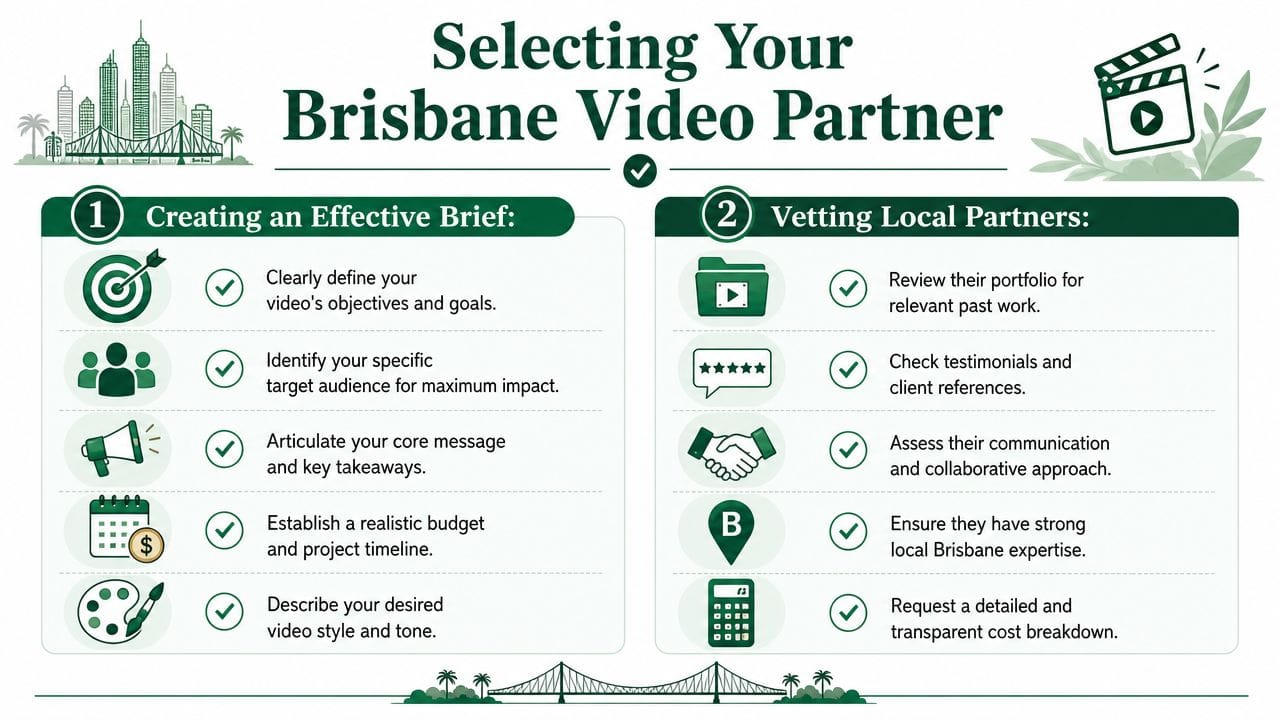
A practical brief should cover:
- Business goal: More quote requests, more booked consultations, better trust on the homepage, smoother sales conversations.
- Audience: New homeowners in Brisbane's northside, local business owners, time-poor parents, commercial property managers.
- Main message: One clear point the viewer should remember.
- Deliverables: Full-length video, short cut-downs, vertical clips, captions, thumbnail, different aspect ratios.
- Placement: Website homepage, service page, email campaign, Facebook ads, Instagram reels, Google Business Profile.
- Tone and style: Straight-talking, polished, warm, technical, premium, approachable.
- Logistics: Preferred filming window, location access, staff availability, approvals.
That last point matters more than many businesses expect. If a team wants staff on camera, customer testimonials, and a live workplace environment, coordination can take longer than the actual shoot.
The strongest briefs describe the business problem first and the creative idea second.
How to compare Brisbane suppliers properly
Once quotes start coming in, price alone won't tell the full story. One supplier may include scripting, shoot planning, captions, and multiple cut-downs. Another may only include a filmed edit and charge separately for everything else.
Useful questions to ask include:
- What is included in pre-production? Script support, shot list, schedule, interview prep?
- How many filmed deliverables are included? One master video or multiple edits?
- How many revision rounds are allowed?
- Who handles captions and export formats?
- What isn't included in this quote?
- Have they produced work for similar service businesses before?
- How do they plan footage for reuse after launch?
Some Brisbane businesses also want a marketing partner involved before filming so the creative choices match the conversion path, not just the visual style. That can include content planning, landing page fit, ad use, and follow-up campaign structure. Boocoo is one local option that helps small businesses connect those moving parts in a practical way rather than treating video as a stand-alone deliverable.
Beyond the Final Cut Distributing Video for Real ROI
A finished video file has no value sitting in a folder.
That sounds blunt, but it's where many projects fall over. The team spends weeks planning and filming, signs off on the edit, posts it once on Facebook, and then moves on. The asset never gets turned into a system.
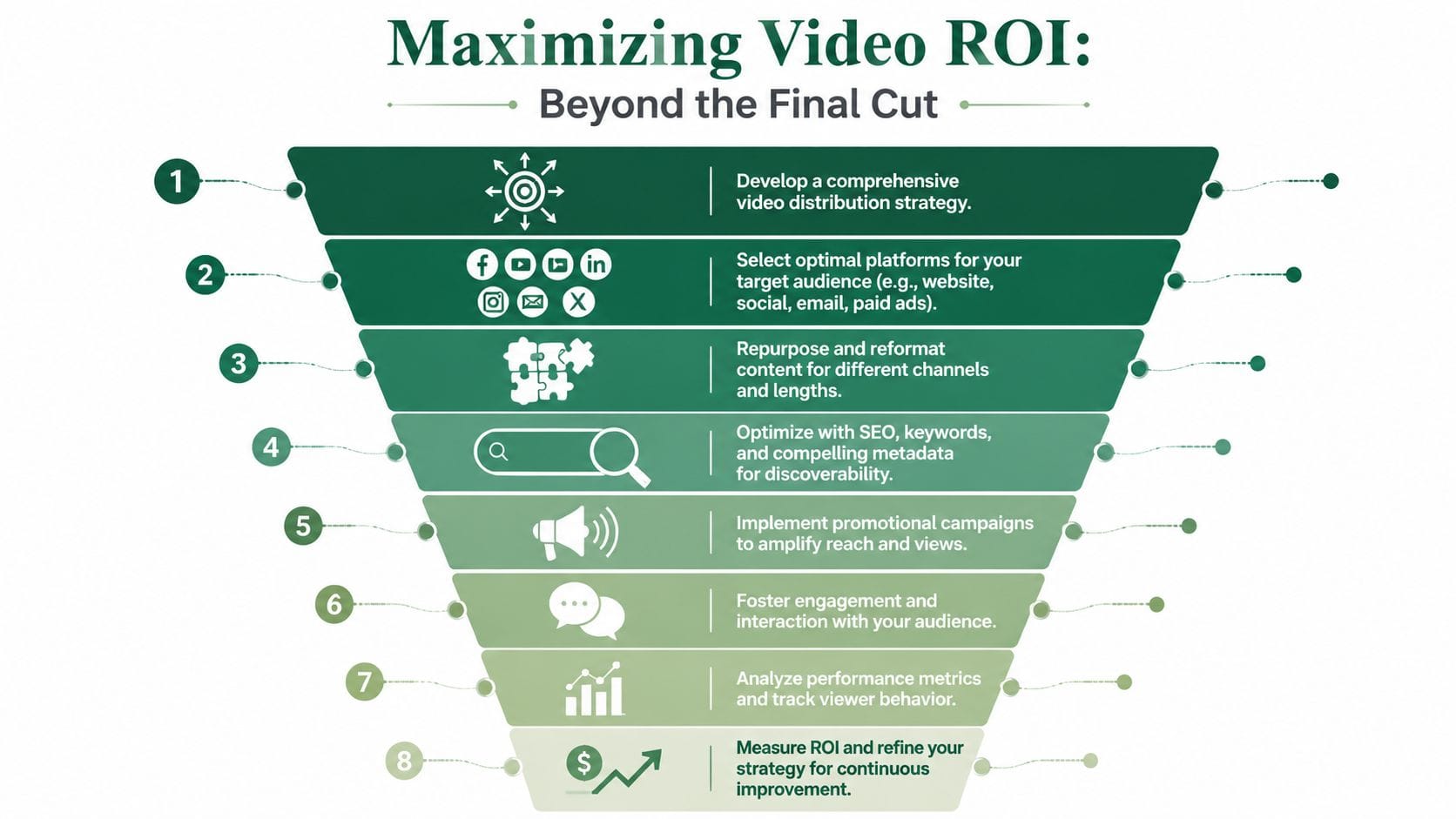
For Brisbane SMEs, the bottleneck is often promotion, not production. Australian audience research cited by Unreal Media says YouTube reached 96.2% of Australian internet users aged 18+ and TikTok reached 42.6% in 2024, which supports the need for a channel-specific plan rather than a single hero video, as discussed in Unreal Media's Brisbane video production analysis.
One video should become several assets
A small business usually gets better value when one shoot is planned to produce multiple outputs.
A simple example looks like this:
- Website version: A fuller cut for the homepage or service page
- Social version: Short vertical edits with captions for Instagram or Facebook
- Ad version: Tight clips with a direct hook and call to action
- Email asset: A thumbnail-led version used in newsletters or sales follow-ups
- Google profile support: Short clips that reinforce trust and show the team at work
That approach is usually more efficient than commissioning one polished video and then trying to force it into every channel later.
A modular system also helps the business keep showing up consistently. Short clips can be reused during quieter weeks, seasonal pushes, or campaign launches without booking another shoot straight away.
Distribution is where the return is won or lost
Each channel asks for a slightly different job from the same footage.
A homepage visitor may need reassurance and clarity. A cold social viewer needs a fast pattern interrupt. An email subscriber may only need a gentle nudge back to a booking page. That's why editing for placement matters just as much as filming quality.
A good production day creates raw material. A good distribution plan turns that material into enquiries.
This is also the point where timing and publishing habits matter. A short-form cut might perform well when posted organically, but the same clip may need a different caption, thumbnail frame, or opening line when used in paid distribution. Businesses already scheduling organic content can line this up with broader publishing patterns, including practical guidance on the best time to post to Facebook for Australian businesses.
The key mindset shift is simple. Don't buy a video. Build a video asset system. One that supports the website, feeds paid campaigns, gives sales staff useful follow-up content, and keeps working after launch day.
Your Brisbane Video Project Checklist and Next Steps
Most video stress comes from unclear decisions made too late. A simple checklist fixes a lot of that.
It also helps separate real buying criteria from the fluff. Screen Australia's ABS-based industry survey notes that for the 2021–22 financial year, profit figures for film and video production businesses had a standard error of more than 50%, making them too unreliable for general publication. That's a good reminder to choose suppliers based on observable factors like process, scope clarity, and portfolio quality, as noted by Screen Australia's industry survey summary.
A simple checklist to keep the project under control
Save this list before requesting quotes.
- Set one primary goal: Decide whether the video is for trust, enquiries, education, or sales support.
- Choose one audience first: Speak to one buyer group rather than everyone at once.
- Write one core message: Keep the promise tight and memorable.
- Decide where the video will live: Homepage, service page, social ads, email, or all of the above.
- List the deliverables clearly: Full version, short cut-downs, vertical edits, captions, and formats.
- Set a realistic budget range: Match the scope to what the business can produce and use.
- Prepare basic logistics: Filming location, who needs to be on camera, approvals, customer availability.
- Ask suppliers the same questions: This makes quotes easier to compare fairly.
- Review the portfolio for relevance: Similar businesses and similar business problems matter more than flashy visuals alone.
- Plan the follow-up use: Decide how the footage will be repurposed after launch.
What to do next
If the business already has website traffic but weak enquiry rates, video should be tied to conversion work, not added as decoration. That's where supporting strategy matters. A homepage explainer, testimonial block, or service-page video usually performs best when paired with stronger calls to action, clearer layout, and sharper page intent. Businesses reviewing that side of the funnel may also want to look at conversion rate optimisation for Australian websites.
The short version is this. Business video production in Brisbane works best when the project is scoped like a sales tool, not a creative experiment. Clear goal. Clear audience. Clear deliverables. Clear reuse plan.