
Across 666,476 rated Australian businesses, the average Google rating is 4.64 stars, drawn from 53.6 million reviews, according to the Starworks Australian Reputation Index. When the middle of the market sits between four and five stars, a high score stops being a differentiator and becomes the entry ticket.
That's the uncomfortable part for anyone chasing a flawless five. What a stranger weighs is how many people took the time to write, and how recently. A profile with a steady run of specific, recent reviews at 4.6 beats a locked-in 5.0 that last moved in 2022.
Getting there takes three habits: asking, replying, and handling the bad ones without flinching.
Why Google Reviews Decide Who Gets the Call
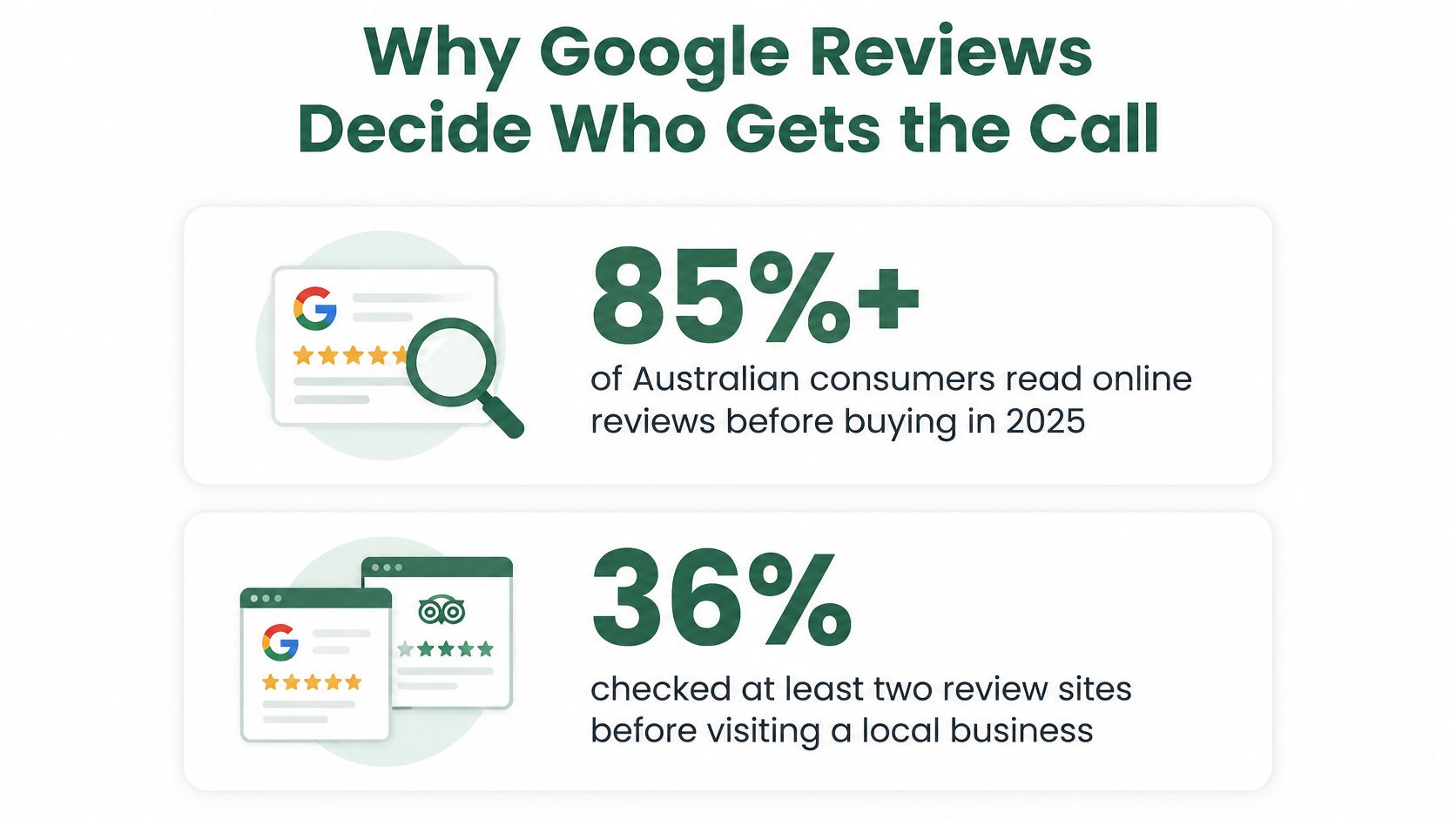
Judge the value of a review by what happens before a stranger calls your number. In 2025, more than 85% of Australian consumers read online reviews before buying, and 36% checked at least two review sites before visiting a local business, according to Red Search's Australian local SEO statistics. The enquiry you never knew about went to whoever looked more credible at 9pm on a Sunday, and price never entered it.
Your Google Business Profile is a shop window on a street where nobody gets out of the car. The photos, the suburb and the opening hours are the display inside. Google Business Profile reviews are what's painted on the glass, and they're what a driver reads while the light is red.
The two numbers behind that decision are worth keeping in view.
The checks happen in order:
- The score. A 4.9 buys permission to keep reading. Nothing more than that.
- The count. Six reviews is a sample size. Ninety reviews is a track record.
- The freshness. A newest review dated two years back tells a stranger something changed, and not in a good way.
Shoppers scroll for the one-star entries as well. A 2023 Australian summary of BrightLocal's Local Consumer Review Survey reported that 96% of users look for negative reviews when shopping online, up from 85% in 2018, as Red Search sets out. A profile with no criticism anywhere looks curated, and one calm, specific reply under a genuine complaint often sells harder than another perfect score.
Say a Brisbane plumber and a rival across the river quote the same call-out fee. The plumber has four reviews, the most recent from two years ago. The rival has thirty, several from this month. The rival gets the call. Reviews are one lever among several, and small business marketing statistics shows which of the others move a local buyer.
Reading a review properly is its own skill. Spotting red flags in fence reviews from Connecticut Fence Works breaks down how to tell a real complaint from a jab by someone who was never a customer, and the method carries straight across to any trade.
How to Ask for Google Reviews Ethically
Google lets you ask. It doesn't let you buy. Its guidance on getting reviews and replying to them treats a review request as an ordinary part of service, while warning that both the review and your reply have to meet Google's content policies. The gap between a healthy profile and a suspended one is usually six small decisions.
Two of those decisions set everything else up.
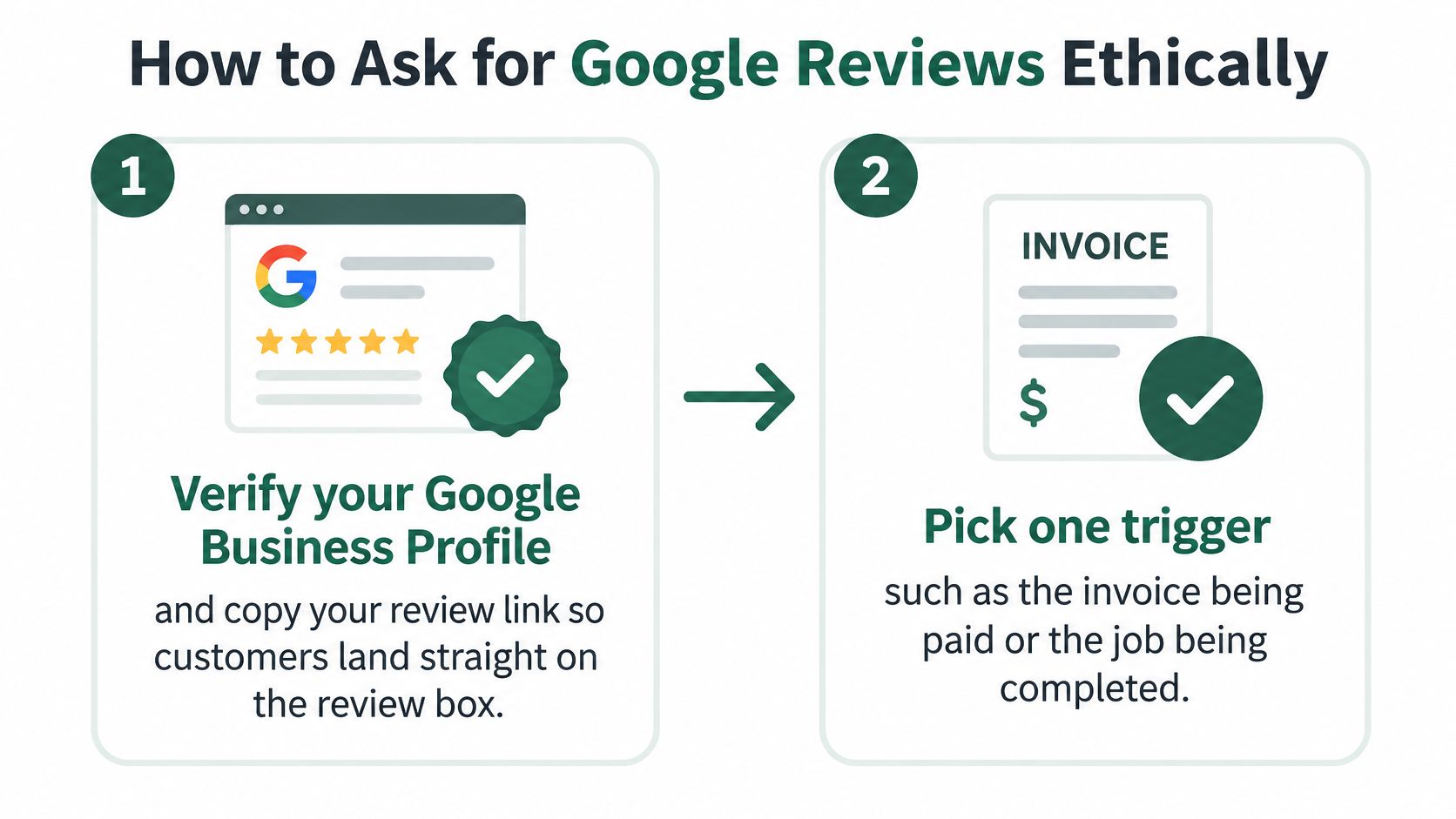
- Verify the profile, then copy the review link. The link opens the review box directly, so a customer who says yes lands on the right screen instead of a search page full of your competitors.
- Choose one trigger and apply it to every customer. The trigger is the invoice being paid or the job being signed off, not how happy you felt the customer looked on the day. A fixed trigger is the only way to keep the sample honest.
- Send the same short message every time. Asking everyone equally is what makes the profile representative, and it takes the guesswork out of who gets asked.
Thanks for choosing us. If you have a minute, please share your honest experience on Google.
- Use a channel you already use. A line on the invoice, a text from the same phone that sent the arrival-time message, or an email that goes out with the receipt. Setup takes minutes when the request rides on something that already exists.
- Log each request in a spreadsheet. Two columns matter at the start, the date the request went out and whether a review appeared. After two months that log will tell you whether your trigger is too soon, because a customer asked before the result settles rarely writes anything.
- Never pay, cherry-pick or ghostwrite. Money, discounts and gifts turn an honest review into a policy breach, and asking only the customers you remember fondly gives a reader a picture that isn't true. A review you drafted yourself is worth less than no review at all.
Here's the test. Would the profile look roughly the same if every single customer had replied? If not, your process is doing the selecting instead of your customers.
Customer photos and quotes work harder when they're collected deliberately, which is the principle behind a user generated content strategy, and reviews are the simplest version of it. What good looks like is unglamorous: a trickle of two to six new reviews a month, every month, rather than a burst after a single campaign and then silence.
Getting Your First Reviews From a Standing Start
The first handful are the hardest to earn and they carry the most weight. A Podium survey reported that 68% of Australian consumers distrust a high star rating when it is supported by few reviews, while 81% require reviews to be recent and relevant before giving them weight, as Inside Small Business reports. A thin profile isn't neutral. It works against you.
So run one batch, then hand the job over to the per-job trigger.
- Copy the review link. If the profile isn't claimed yet, start there, and how to add your business to Google walks through it in about the time it takes to drink a coffee.
- List every completed job from the last 90 days. Customer name, contact details, what the job was. Most sole traders find between 15 and 40 names.
- Send each of them the same short message, with the link underneath. Send it to the whole list, not only the people you got on with.
- Turn the link into a QR code and print it on invoices, job sheets and a sticker on the van, so a customer can review from the car park in about ten seconds.
- Ask in person at handover. "If you're happy with the job, the link is on your receipt" works because it puts the idea in their head at the moment the relief lands.
A Brisbane gardening contractor with no reviews sends one batch to 25 past clients on a Tuesday morning. It takes about half an hour. Reviews arrive over the following weeks rather than all at once, which looks natural because it is.
Treat the batch as a kick-start only. From then on the per-job trigger does the work, and there's never a need for a second campaign.
Replying to Every Review, Good or Bad
Every review gets an answer, and the type of review decides the answer.
| Review type | What to do | Reply focus | Time to reply |
|---|---|---|---|
| Five-star praise | Thank the reviewer and name the service | One specific detail in two sentences | Within a few days |
| Mixed three-star review | Acknowledge what went well and what you will fix | A specific fix or next step | Within a few days |
| Genuine complaint | Apologise for the experience and invite offline contact | Calm tone, no defensiveness, no private details | Same day if possible |
| Suspected fake or policy breach | Do not argue in public, report it | Optional brief neutral line | See the next section |
Replying at all depends on verification. Once the profile is verified, an owner can respond from Google Search or Google Maps, and the reply appears beneath the review after Google's policy checks. Google says replies are usually reviewed within about 10 minutes, although some can take up to 30 days, per Google's help page on replying to reviews.
Set one sitting a week and answer everything new in that block. Name the specific service, because "thanks for the feedback" proves nothing while "glad the switchboard upgrade sorted the tripping circuits" proves you were there. Two or three sentences is plenty. A Brisbane electrician writing about an emergency call-out and the arrival time gives the next reader evidence of how the business behaves at 11pm.
Keep three or four reply templates in a note and personalise every one. A pasted response repeated twelve times down a profile reads as automated, and prospects spot it faster than owners expect.
A worked complaint shows the shape. A cleaner replies to a one-star review about a bathroom:
Sorry the bathroom didn't meet the standard we set. We'd like to make it right, and the number on our profile goes straight to the office.
Three sentences, no defence, no detail about the customer's home. Every prospect who scrolls to the one-star section reads that reply, and it answers the question they have, which is what happens here when something goes wrong.
Replies are public, so never name the customer, quote their address or mention what they paid. Calm and specific beats clever every time, because prospects judge the reply as much as the complaint. Responding well feeds into the wider work covered under local SEO strategy, where categories, service areas and photos carry the rest.
What to Do About Fake or Policy-Breaking Reviews
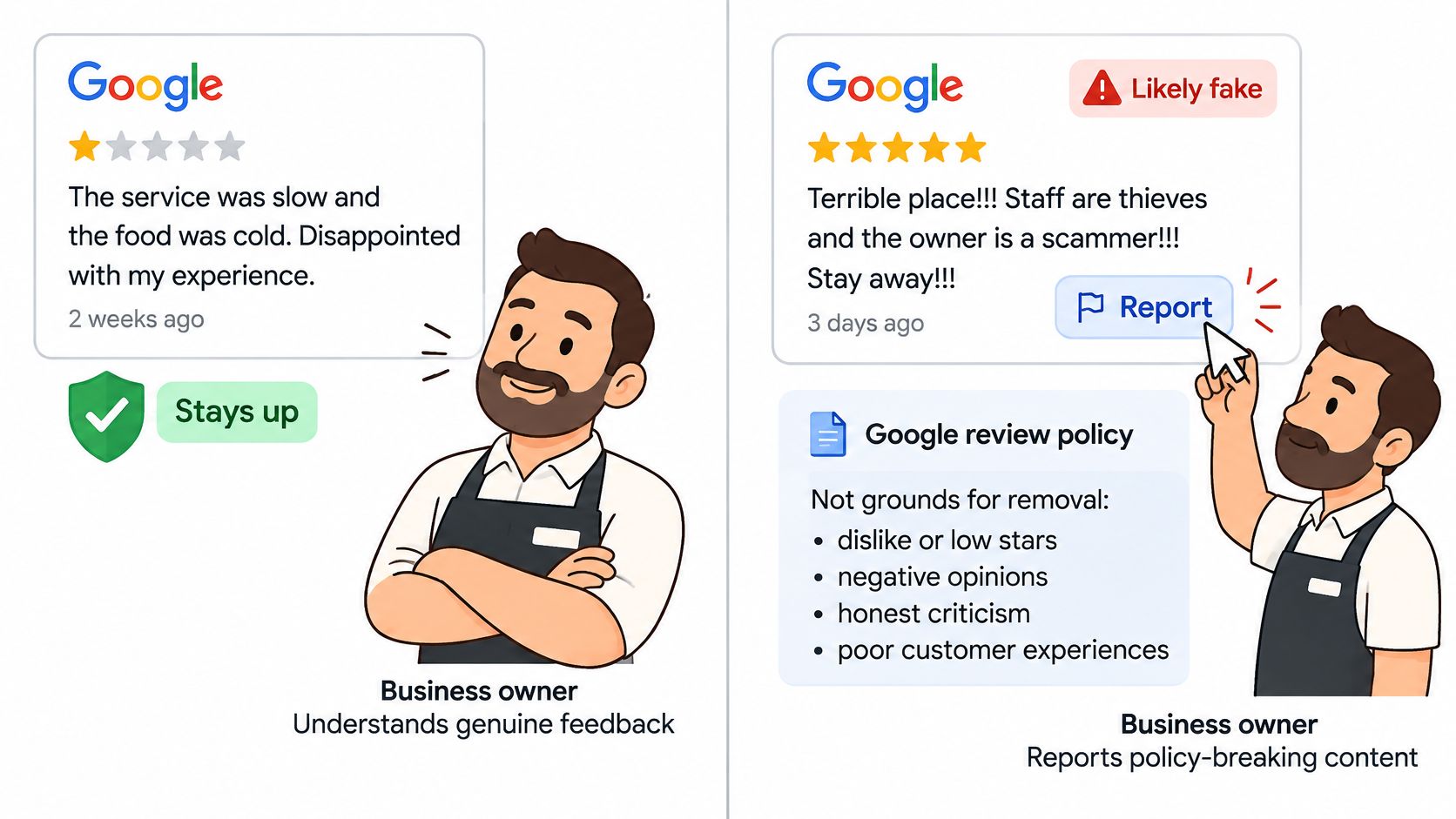
A harsh review isn't automatically removable. A fake one might be. Google removes content that breaks its policies, not content a business dislikes or a low star rating it would rather not have, per Google's guidance on reporting a review. That difference decides whether you reply or report.
Handling the two categories badly is how a small problem turns into a public one.
Work through it in this order:
- Find the review on Google Maps or Google Search, signed in as the profile owner.
- Screenshot it so the date and reviewer name are visible, and note any job record, quote or message thread you hold for that person. If there's no record at all, that's worth writing down too.
- Open the report or flag option on the review itself.
- Choose the category that fits, whether that's spam, fake engagement, illegal content or another listed breach. Guessing at a category slows the assessment down.
- Submit and wait. Reporting doesn't guarantee removal, so plan for the review staying up.
- Record the date you reported it and the outcome. A pattern of coordinated reviews is much easier to escalate when you have dated evidence rather than a general complaint.
Escalation has a real destination. The ACCC's guidance on online reviews states that reviews must be independent, genuine and based on the reviewer's actual experience, and it names Google and Facebook as the most common platforms for fake-review activity. The same guidance notes that small businesses are particularly exposed, because a handful of reviews can swing reputation and sales.
Take the cleaning company example. A real complaint about a missed skirting board gets a short reply, an apology and an invitation to call the office. A review from an account that never booked a job gets flagged separately, and the reply says something neutral or nothing at all.
The rule: answer the customer, report the fake. Never swap those two.
A calm public response protects the reputation while the platform does its work. Arguments are read by future customers. Screenshots and a report are read by Google.
A Weekly Review Routine That Fits a Busy Schedule
A routine only survives if it fits inside a week that's already full. Here's the whole thing mapped to the time a one-person business has.
| Task | How often | Typical time |
|---|---|---|
| Send review requests after completed jobs | After each job | 1 minute |
| Reply to new reviews | Weekly | 15-20 minutes |
| Check for fake or policy-breaking reviews | Weekly | 5 minutes |
| Log requests and responses | Weekly | 5 minutes |
| Review rating, count and review age | Monthly | 20 minutes |
| Refresh reply templates | Quarterly | 30 minutes |
That adds up to under an hour a week, and most of it is the replying block.
For context on where you land, in 2026 an analysis of 175,238 Australian businesses found an average Google rating of 4.68 stars and approximately 88 reviews per business, according to Starworks' Google review statistics for Australia. Use it as a reference point, not a target to chase at the cost of asking badly.
Track four numbers each month: new reviews, average rating, the share of reviews you replied to, and the age of your newest review. If the newest one is several months old, the request step has stalled, so fix the message or the trigger before you think about anything else. A Brisbane physiotherapist sitting on 40 reviews, a 4.7 average and nothing new since March doesn't need a campaign. She needs to check who is being asked and when.
Written answers save repeat phone calls. The FAQ for collision repair shops from Safety Restore shows the shape that works, one short question and one direct answer, and the same shape suits the reply templates you refresh each quarter.
For the first week, confirm verification, copy the review link, send the request to every customer after the next completed job, and book a block for replies. Keeping the details consistent across Google and the other directories is part of the same job, and business listing management covers that alignment. Boocoo's local SEO work includes Google Business Profile optimisation and local citations, and its monthly reports are written in plain English with no vanity metrics. If setup or replies feel like too much on top of running the business, Boocoo offers a free 30-minute call with one of its Brisbane strategists, with no lock-in and no obligation.