

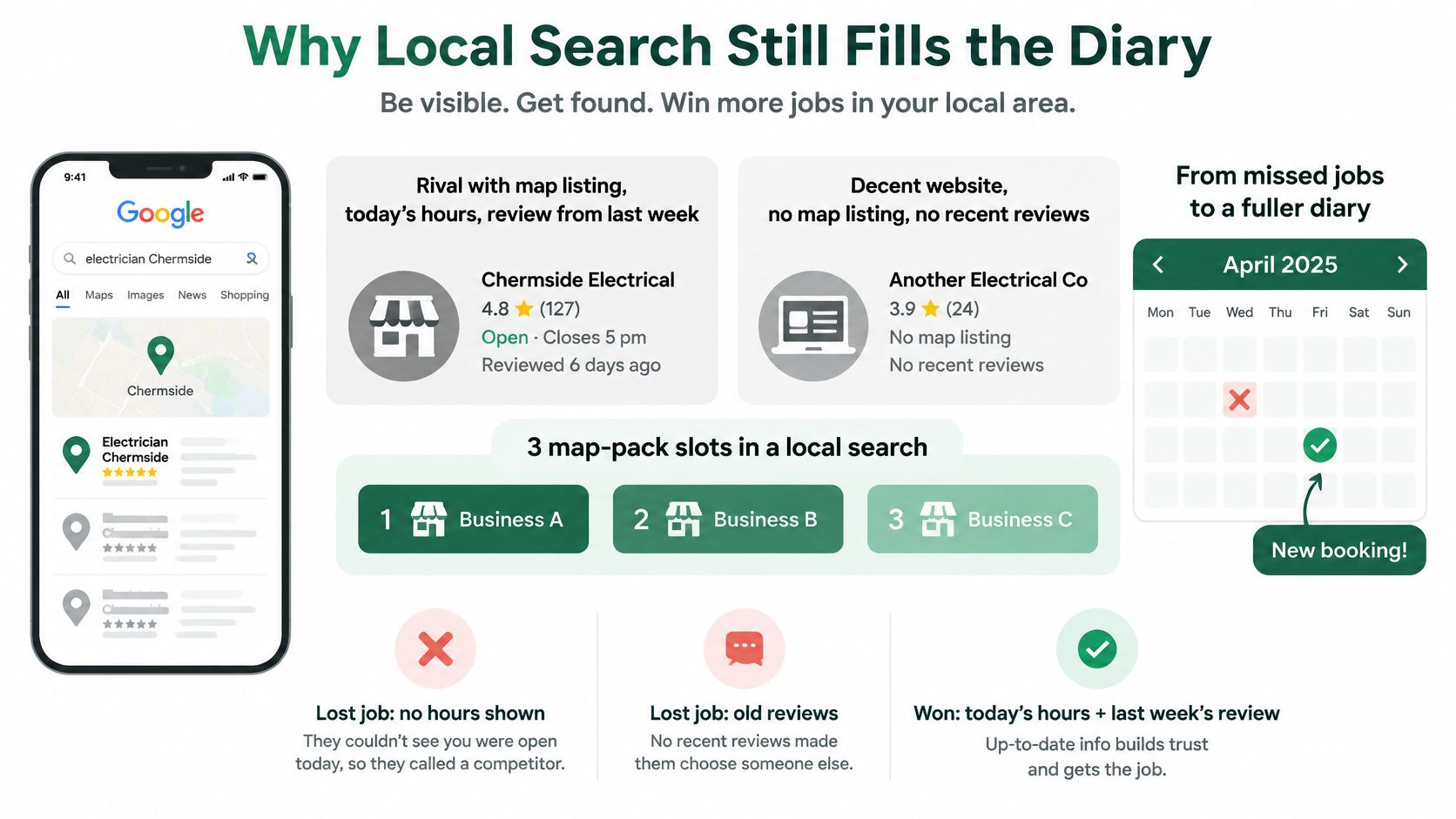
A Chermside electrician finishes a switchboard job at 10:40 and finds two missed calls. Across the suburb, a rival's map listing shows today's hours, a recent review about a safety switch and a clear “call now” path. The homeowner rings the business that looks easier to choose.
A practical local SEO strategy starts there: make the facts easy to trust before asking for content, ads or another subscription. Keep service areas consistent, earn fresh reviews that name the actual job and suburb, and track which searches turn into calls. AI answers and map results draw on the same signals, so twenty thin suburb pages say less than one accurate profile with proof from last week.
Why Local Search Still Fills the Diary
The electrician's problem isn't necessarily the quality of the website. The homeowner needs to know whether the business serves Chermside, handles the fault and can answer today. Missing information creates uncertainty at exactly the wrong moment.
A local SEO strategy is the system that turns a nearby search into a call, direction request or visit. Publishing blog posts can support that system, but it isn't the system itself.
The shopfront test
The website is the shop, the Google profile is the sign and opening hours on the footpath, and reviews are a neighbour saying the place is worth a stop. A polished shop doesn't help much when the sign is missing or the hours look unreliable.
Australian shopping behaviour explains why online discovery deserves attention even when customers pay in person. Australians spent $63.6 billion online in 2023, while the retail findings accompanying the Australia Post ecommerce report report that 76% of consumers shop in physical stores at least monthly and 45% research online before purchasing in-store; those findings also identify preferences for deals for locals, 34%, locally made products, 25%, aligned business values, 24%, and businesses that foster community, 22%.
Those preferences give a Brisbane owner useful direction:
- Show real coverage. An electrician should name the suburbs served, not claim every corner of Brisbane.
- Prove local relevance. A retailer can explain which products are locally made and identify the makers.
- Make community activity visible. Genuine involvement deserves a useful description, not a vague claim about supporting locals.
Why Google gets priority
According to the ACCC finding reported by Local Digital, Google held nearly 94% of Australia's general-search market in August 2024. That historical Australian figure supports putting Google Search and Maps at the centre of a small business plan, without assuming other discovery channels don't matter.
A useful local search result answers the customer's immediate question and makes contacting the business straightforward.
The practical outcome is an afternoon audit, a 90-day calendar, a manageable profile and review habit, stronger service pages and directory listings, and a monthly check of calls rather than rankings alone. None requires an owner to become a full-time marketer.
Your 90 Day Calendar and Weekly Budget
| Phase | When | Time | Done when |
|---|---|---|---|
| Audit and matching details | Weeks 1-2 | 3-4 hours, then 1 hour | Name, phone and service area match on profile and site |
| Google profile and reviews | Weeks 3-6 | About 2 hours a week | Profile complete and a review asked after each finished job |
| Pages and real citations | Weeks 5-8 | About 3 hours a week | One strong service page and listings on legitimate directories |
| Local proof and mentions | Weeks 7-12 | About 2 hours a week | A local example live and a few genuine local mentions |
| Monthly check | From month 4 | 1 hour a month | Calls, directions and quote forms reviewed, not just rankings |
This 90-day local SEO plan for a small Brisbane business is a suggested owner-managed schedule, not a promise about ranking speed. The time allowances are planning estimates for a straightforward business with access to its website and accounts.
The phases overlap deliberately. An owner can collect job photos while improving a service page, rather than waiting for every profile task to be perfect.
Set spending limits before buying tools
For a hypothetical sole-trader budget, sensible spending caps could be:
- Audit and cleanup, $0 to $150. Start with a spreadsheet and manual checks. Pay for a simple ranking or citation checker only when it removes repetitive work.
- Profile and review routine, $0. Use existing customer communication and Google's profile tools before adding software.
- Pages and directories, $0 to $200. Prioritise improvements to an existing page and relevant listings, not paid directory bundles.
- Local proof, $0 to $300. Consider a modest community sponsorship or local photo shoot if either has value beyond SEO. Don't buy links.
These are example spending allowances, not quoted supplier prices or unavoidable costs. A business can leave a budget unused when there isn't a worthwhile purchase.
The guide to how long local SEO takes helps owners distinguish completing the work from waiting for search visibility to change. A calendar controls activity; it can't guarantee when a customer searches or chooses a business.
Choose the row that removes the biggest obstacle
Say a West End cafe has a useful menu page but conflicting weekend hours. Its owner should start with matching details, not commission articles about Brisbane brunch. Once customers can confidently plan a visit, photos and current menu information become more useful.
A mobile plumber covering Kedron, Stafford and Chermside might already have correct contact details but no clear blocked-drain page. That business should move into the service-page phase while keeping review requests running after completed work.
Neither business needs a 20-suburb page pack in week one. That hypothetical purchase would create more pages to maintain before the owner knows whether the existing information is accurate.
The quarter's pass mark is practical: consistent details, a live profile, a handful of new genuine reviews, a strong service page and Google-sourced calls or forms recorded. Missing any of those basics is a better reason to adjust the schedule than a competitor publishing more articles.
Run the Local Audit in One Afternoon
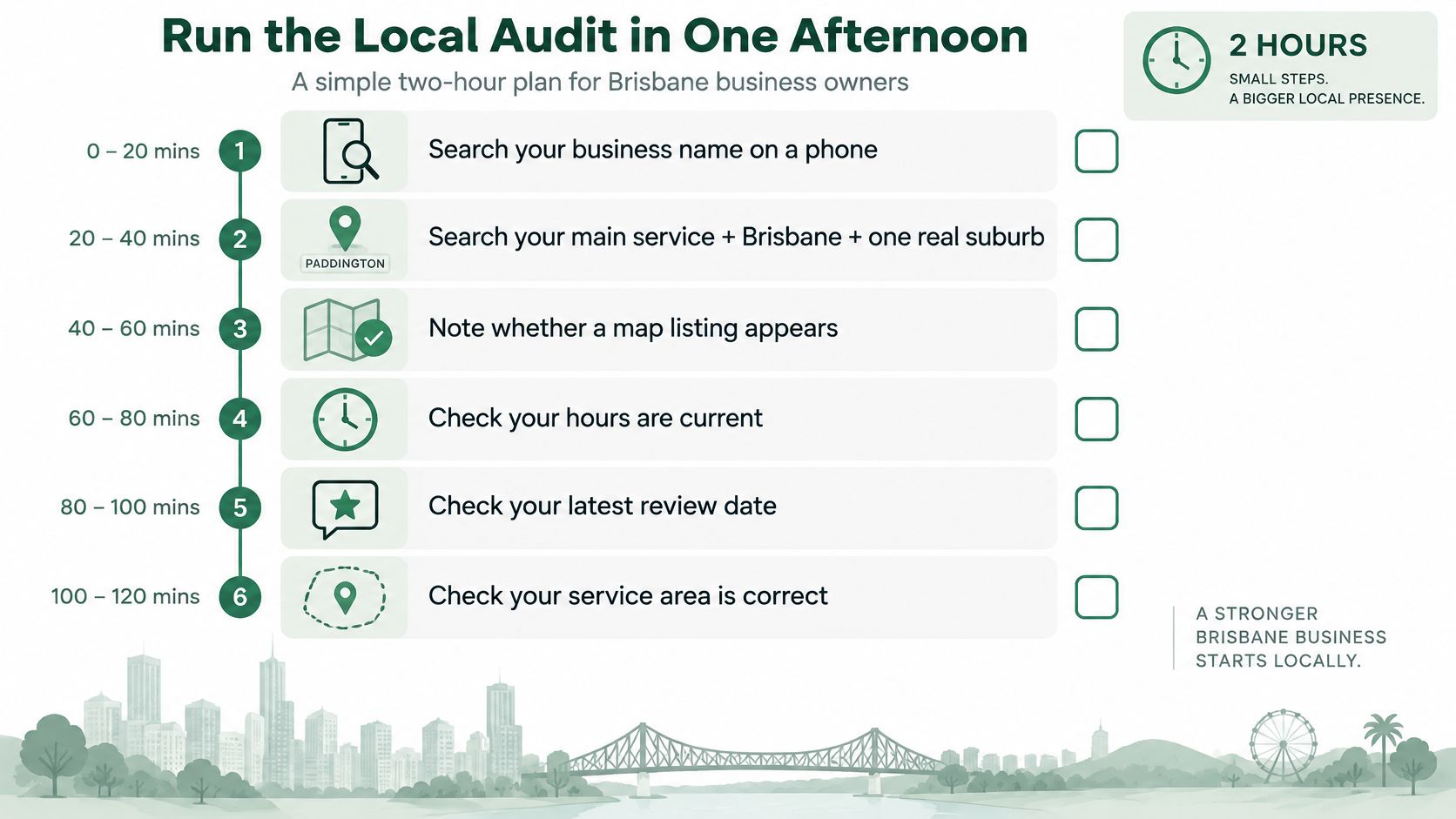
A phone, account access and a spreadsheet are enough for a useful first audit. Set aside a suggested two-hour working block and record problems before making changes, so the owner doesn't spend the afternoon fixing minor wording.
SearchScope's Australian internet statistics report reports that 51% of businesses used social media and 32% accepted online orders in 2024–25, while its industry reporting cites only 32% with a discoverable Google Business Profile. These are different measures, but they illustrate why having a digital channel isn't the same as having a complete local presence.
Complete the checks on a phone
Search like a customer. Search the business name, then its main service with Brisbane and a real suburb. Record whether the profile, website or a directory appears. A search for a New Farm physiotherapist may reveal something different from a branded search.
Open Google Business Profile and record the primary category, service areas, hours, phone and website. Check whether the business controls the listing and can edit it.
Compare the details side by side. Copy the name, phone and address or service area from the profile, website footer and two legitimate directories. Circle every meaningful disagreement, especially old numbers and previous premises.
Examine the main service pages. Each should identify the service, show genuine coverage and provide a usable call button and short enquiry form. Record omissions without rewriting the pages during the audit.
Check review freshness. Count reviews from the last 90 days as an audit window, and note whether customers describe the work performed. A total rating alone won't reveal whether recent customers discuss the relevant service.
Load the homepage on a phone using mobile data. Check whether the phone number can be tapped without zooming, whether pop-ups obstruct it and whether the enquiry form works.
Separate mistakes from competitive gaps
Consider a hypothetical New Farm physio whose website footer still says Paddington and whose profile omits Saturday hours. Before correction, a patient can't confidently identify the clinic or plan a weekend appointment. Afterwards, the location and available appointment hours agree, without adding a new article.
For comparing the result with nearby businesses, the local SEO competitor analysis guide provides a focused next step. For checking how AI tools describe the business, the MyMentions AI search audit playbook offers a separate audit resource.
Rank the immediate fix list by likely lost calls:
- Wrong hours. Correct misleading availability first.
- Missing category. Identify the actual main service.
- No mobile click-to-call. Remove the obstacle between interest and contact.
Set Up Your Google Profile and Reviews
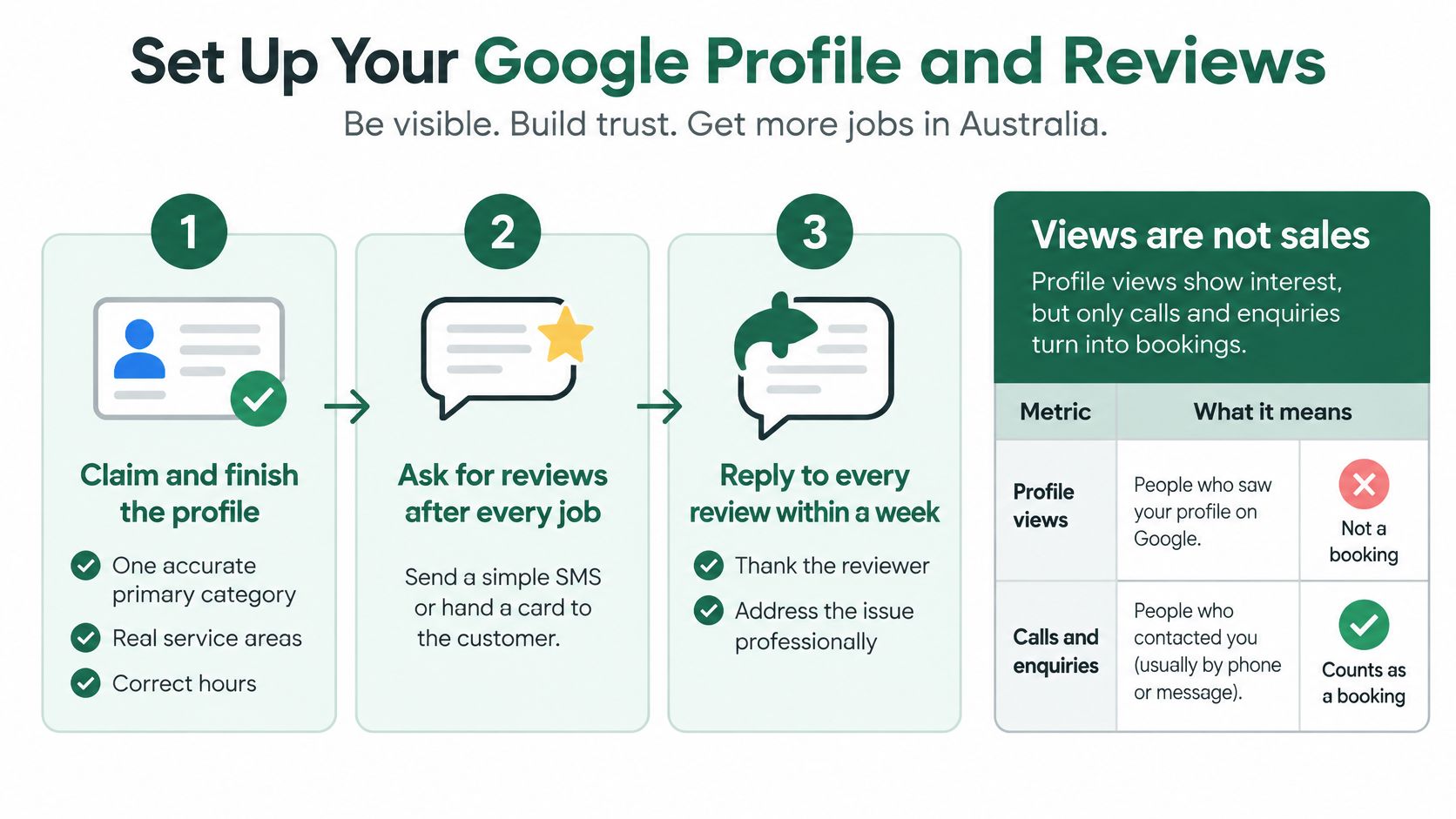
Claim and finish the profile. Select the most accurate primary category, then complete genuine service areas, ordinary and public-holiday hours, phone, website and services. Add photos of actual work, staff or premises rather than stock images. The business-on-Google setup guide can help with the account and listing process.
After completed work, send a plain request for an honest review. Offer no discount or gift, and don't filter customers by satisfaction before sharing the review option. A suitable message thanks the customer for the completed service and invites feedback in their own words.
Measure the route to a booking. Each month, record available search and profile metrics, calls, direction requests, website clicks, qualified enquiries and booked jobs. Keep those categories separate because a website click isn't a booking.
Use benchmarks without turning them into targets
The aggregated Australian figures in RockingWeb's local SEO benchmark compilation are approximately 1,260 monthly profile views, 1,410 monthly searches, 59 monthly actions, an indicative 4.7% action rate, and 14% of profiles with 100 or more reviews, summarised below.
Google profile benchmarks and what to fix
| Signal | Australian benchmark | If you are behind |
|---|---|---|
| Profile views a month | About 1,260 | Add real photos, services and a correct category |
| Searches a month | About 1,410 | Spell out services and the suburbs genuinely covered |
| Actions a month | About 59 calls, directions or site clicks | Make hours and the call button obvious |
| Action rate | About 4.7% | Send profile clicks to a page with a short quote form |
| Profiles with 100 or more reviews | 14% | Ask once after each finished job for an honest, specific review |
These are broad Australian yardsticks, not promised Brisbane results. Category, location and customer demand affect comparisons, and the indicative action rate describes actions against views, not booked jobs.
Make the review routine useful
For a prospective customer, a fresh review explaining a blocked-drain repair in Kedron can be more informative than an old, generic star rating. That's a trust distinction, not a claim that a particular review guarantees better rankings.
Customers shouldn't receive keyword scripts. An optional invitation to describe the work and experience leaves the wording with the person who received the service.
A negative review needs a calm response: acknowledge the concern, explain an appropriate next step and offer a private conversation. Public replies shouldn't disclose a customer's job details or, for a clinic, health information.
Owners needing a repeatable alert-and-response process can use CapyScout's review monitoring setup guide. A manageable internal habit is to review incoming feedback weekly rather than leave notifications unread.
Measurement rule: A profile action becomes a business result only when the enquiry is qualified and the outcome is recorded.
For a Brisbane plumber, the quote form can retain the campaign source through UTM tracking and store it alongside the enquiry. Call tracking or a dedicated landing-page number can help identify calls, provided the main business number remains consistent and tracking is configured carefully.
Avoid misleading categories, ineligible address use and duplicate shopfront listings. More apparent locations aren't a substitute for an accurate business presence.
Pages Citations and Links That Win Calls
Start with a commercial search such as emergency plumber Brisbane and assign it to an authoritative service page. Related searches can belong on that same page when the customer needs the same service.
The page should explain the work, actual coverage, availability limitations and the next step. A plumber covering Woolloongabba might include apartment-access requirements, a real job example and an explanation of how quotes are prepared.
Publish local detail that changes the answer
A useful service page needs more than a suburb in its title. Include the details that help a customer decide:
- Coverage and limits. Identify the suburbs served and any restrictions on travel or attendance.
- Evidence of the work. Describe a genuine project, with permission for identifying details and photos.
- Pricing context. Explain the factors affecting a quote. Publish a priced-from range only when the owner will honour it and can explain exclusions.
- Practical answers. Address access, preparation, booking and common service questions.
Apply the identical-page test before publishing a location page. If changing Woolloongabba to Kedron leaves everything else unchanged, the page probably doesn't provide a distinct local answer.
A Paddington gift shop could instead publish a page identifying local makers, the products stocked and collection arrangements. That helps a shopper evaluate locally made gifts without creating another version of the homepage.
An Australian consumer benchmark reported by Red Search says 87% of consumers use Google reviews when checking local businesses, with 33% always and 43% regularly reading them. Recurring customer questions can therefore inform useful FAQs, but reviews shouldn't be copied across pages at scale.
Make the same business recognisable everywhere
A citation is an online mention of business details, often in a directory. Keep the name, phone, opening hours, website and address or service-area information consistent wherever those details belong.
Use real Australian directories and relevant industry bodies rather than bulk submission packages. To organise a cleanup, owners can browse local citation audit articles from CitationOS and use the business listing management guide to establish an ongoing process.
A web developer can add the most specific applicable LocalBusiness structured data, which labels business facts for search systems. The same task should include a canonical URL identifying the preferred page version, readable HTML content and links from the homepage and related services.
A chamber listing, supplier reference or useful local resource is worth pursuing for its genuine business relevance, not simply because it might contain a link.
Community sponsorships should stay within the chosen budget and make sense without an SEO promise. Paid sponsorship links should be labelled appropriately rather than bought as ranking shortcuts.
Finish with the mobile experience: a tappable phone number, a clean-loading page and a form asking only for information needed to assess the enquiry. For most initial quotes, a full customer history isn't necessary.
Check AI Answers and Fresh Reviews
A recommendation from an AI tool should be checked for factual accuracy, not celebrated merely because the business name appears. A southside clinic recommended for a northside home-visit search may receive enquiries it can't fulfil.
AIRankLab's Australian Google Business Profile overview dates Google AI Mode's Australian availability to October 2025 and Gemini-powered Maps features beginning to roll out to August 2026. Individual features and availability can differ, so owners should test the tools their customers can access.
Test the facts behind the recommendation
Create a short reference record containing service boundaries, hours, accessibility, booking method, realistic response times, qualifications and a genuine customer outcome. Use it to check relevant information on the profile, service page and website footer, without putting every detail in every location.
A suggested monthly check can follow this sequence:
- Ask a realistic customer question. Test the main service and an actual suburb served.
- Test the boundary as well. Ask whether the business offers that service in a suburb it doesn't cover.
- Record the answer and its references. Separate incorrect business facts from the AI tool's unsupported assumptions.
- Correct the underlying profile or page when it's wrong. Where the business information is already accurate, use the tool's feedback option rather than rewriting correct facts to match an error.
The AI-powered SEO guide provides further context, but a pile of generic AI articles won't resolve an incorrect service boundary.

Keep a small decision scorecard
Use a concise record rather than a complicated dashboard:
- Map visibility. Whether the business appears for its main service in the relevant area.
- Boundary accuracy. Whether the answer describes coverage correctly.
- Qualified calls. Whether callers need a service the business can deliver.
- Booked jobs. Whether suitable enquiries become work.
Review freshness should be assessed alongside service detail, not treated as a guaranteed ranking factor. The recent-review audit window helps an owner notice whether feedback still reflects the work currently offered.
Red Search's Australian local SEO statistics report that roughly 93% of Australians search online for local brands, more than 85% read product reviews before buying, and 36% check at least two review sites before visiting a local business. Those measures support considering a second relevant review platform after Google is actively maintained, not opening accounts everywhere.
Decide the Next Fortnight From the Audit
The next fortnight should follow the clearest obstacle to a suitable enquiry. Another tactic isn't helpful when customers still encounter the wrong hours or an unusable phone number.
Choose the work that fits the problem
- Basics still broken. Correct conflicting hours, secure control of an unclaimed profile and repair mobile calling before commissioning new pages.
- Basics already reliable. Improve the service page closest to the main paying enquiry. As a practical fortnightly target, send ten honest review requests only where ten genuine completed jobs make that appropriate.
- DIY remains manageable. Keep the work in-house when the owner can protect a regular weekly working block and review enquiry outcomes monthly.
- Access or capacity is the obstacle. Seek help with suspended listings, duplicate profiles or a workload that leaves no room for maintenance.
A business doesn't need to outsource everything because one technical problem requires assistance. The sensible choice is the smallest amount of support that removes the obstacle and leaves clear ownership of the accounts.
Boocoo has helped small and medium Brisbane businesses grow online for over 15 years. Its first step is a free discovery call to understand the business, goals and current marketing, and work starts only after the client approves the strategy.