
The phone's quiet, the next week has gaps, and a competitor keeps appearing on Google Maps. Meanwhile, someone's suggesting SEO, someone else recommends Instagram, and an advertising quote makes it hard to tell what the monthly bill buys.
For a small business, Brisbane digital marketing should start with the clearest gap, not the longest list of services. A business that nobody finds needs different help from one that attracts website visitors but rarely receives an enquiry.
Six Local Services and Where Each One Fits
Say a plumber in Chermside gets only a few calls a month and keeps hearing that a competitor appears first on the map. Buying social posts might make the business look active, but it won't necessarily fix the reason nearby customers can't find it.
Local internet marketing services are the online work that helps people nearby find a business, trust it and make contact. The useful question isn't which service sounds most impressive. It's where potential customers are getting stuck.
Think of a shopfront. The website is the front door, the Google Business Profile is the sign visible from the street, reviews are what neighbours say over the fence, and paid ads are a sandwich board the business pays to place beside the road.
Six local services at a glance
These are practical planning windows, not guaranteed delivery dates or ranking promises.
| Service | What It Does | Best For | Typical Time to Results |
|---|---|---|---|
| Local SEO | Helps a website rank for searches such as electrician Brisbane northside | Businesses with a website and steady local demand | Allow 3-6 months |
| Google Business Profile | Shows hours, photos and reviews on Google Maps and Search | Every eligible local business, starting now | Allow 2-4 weeks for edits to show, subject to verification and review |
| Website optimisation | Makes pages quick on phones and calling or enquiring easy | Sites that get visits but few enquiries | Assess improvements over 1-3 months |
| Reviews management | Requests customer reviews and replies to them | Businesses that win work mainly through referrals | Assess the routine over 1-2 months |
| Social media management | Publishes local posts and handles messages | Businesses whose customers already use a suitable platform | Test over 2-3 months |
| Local paid ads | Targets Google and Meta advertising to a service area | Businesses needing enquiries while slower work builds | Days to a few weeks after launch |
Australia had 2,729,648 actively trading businesses at 30 June 2025, including 994,178 employing businesses, according to the Australian Bureau of Statistics. That's national context, not a count of Brisbane competitors, but it reinforces why a business needs to make its specific services and location clear.
Practical rule: No small business needs all six services at once. Fund the service that removes the next obstacle between a local search and a booked job.
How to Set Up Local SEO and Your Google Business Profile
A Google Business Profile is the listing Google displays on Maps and in local search results. Local SEO connects the website, business listings and service information so searchers can understand where the business operates and what it offers.
The distinction matters. A well-maintained profile can help someone make immediate contact, while a useful website explains the work in more depth.
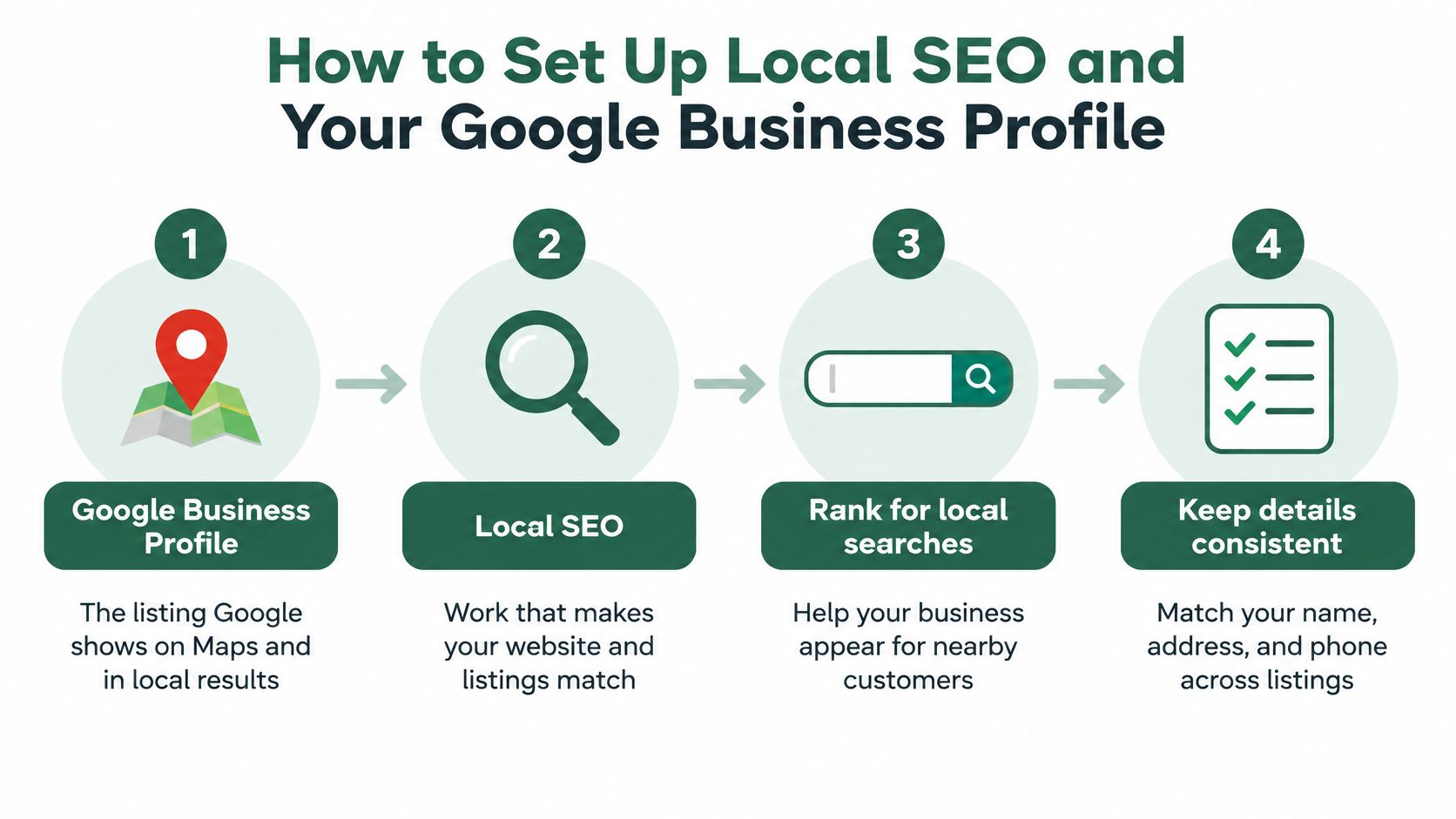
Set up the essentials in order
Establish control of the listing. Claim an existing profile or create an eligible new one, then complete the verification method Google offers, which may include video, phone or mail. Verification establishes management access; an existing listing may already be public before its owner claims it.
Make the identity consistent. Enter the business name, phone number and eligible address details to match the website. Don't add search keywords to the business name unless they're part of it.
Choose the closest primary category. Select the category that best describes the main business, then add relevant secondary categories. A plumber who also handles drainage should describe actual services, not select every loosely related trade.
Define the genuine service area. Businesses travelling to customers should add the suburbs they serve and hide a residential address when customers aren't received there. Listing distant suburbs doesn't make the business physically closer to searchers.
Show evidence of real work. Upload clear photos of completed jobs, the team and the vehicle, with permission where customers or properties are identifiable. A monthly refresh is a manageable maintenance task, not a requirement to manufacture new content.
Describe services naturally. Explain what the business does and where, using sentences such as a plumber providing hot-water repairs across Chermside and neighbouring suburbs. Repeating suburb names in every sentence makes information harder to read.
Check reputable directories. Start with two or three relevant listings and correct outdated details. These mentions are called citations, and accuracy matters more than collecting an enormous directory list.
A business listing management routine helps keep changes organised when hours, contact details or services change. Owners should retain account ownership and give providers appropriate access rather than sharing passwords.
Delegate the maintenance, not ownership
Boocoo's local SEO includes Google Business Profile optimisation and local citations. Its wider SEO service covers technical audits, on-page content and link building aimed at searches in the client's local market.
Owner time: Gather correct details, approve descriptions and supply real photos at setup. After the first month, check visibility trends, calls and direction requests, where available, and confirm that every review has a response. A healthy profile is complete and maintained; rising activity is encouraging, not guaranteed.
Website Changes That Turn Visits Into Enquiries
A local searcher often decides whether to call while looking at the website on a phone. Open the homepage on a mobile device and count the taps needed to call: if finding the number requires opening a menu or visiting another page, that's the first fix.
A website needs to help someone take action, not merely confirm that the business exists. The ACMA report on Australian SMEs in the digital economy reported that 64% of surveyed SMEs had a website, compared with 90% of medium-sized businesses. That historical benchmark isn't a ranking forecast, but it supports treating a clear, useful site as a business foundation.
Make the smallest useful changes first
- Put calling within reach. Add a tappable phone number near the top of every page. Check that it opens the phone dialler and reaches the correct number.
- Shorten the enquiry form. Start with name, suburb, job type and best contact number. A four-field version can be tested against an eight-field version, but judge qualified enquiries, not submissions alone.
- Separate the main services. Give each important service a page with a clear heading, a plain explanation, a genuine photo and relevant customer feedback.
- Build useful suburb pages. Include actual service coverage, job examples and practical local details. Don't publish dozens of near-identical pages with only the suburb name changed.
- Measure meaningful actions. Set up analytics events for phone clicks, form submissions and direction-button clicks. A phone click indicates intent, not proof that a conversation happened.
Improve before rebuilding
Say an electrician's switchboard page attracts visits but gives no indication of the work involved or how to request an assessment. Adding useful information and a visible enquiry option is a more targeted intervention than replacing the entire website.
Boocoo builds fast, conversion-focused WordPress websites that work across devices. However, an existing site may only need focused conversion rate optimisation work rather than a rebuild.
Fix the pages customers already visit before paying to attract more visitors.
Owner time: Supply job photos, approve service descriptions and test the enquiry process. A practical quarterly budget choice is to improve the three most-visited pages, then assess whether those changes produce better enquiries.
Reviews and Social Media That Build Local Trust
Reviews are the neighbour's recommendation over the fence; social media is the local noticeboard that keeps a business visible between jobs. Consistent, genuine evidence is more useful than a burst of posts followed by silence.
Neither service requires the owner to become a full-time content creator. It does require a repeatable routine and someone responsible for answering customers.
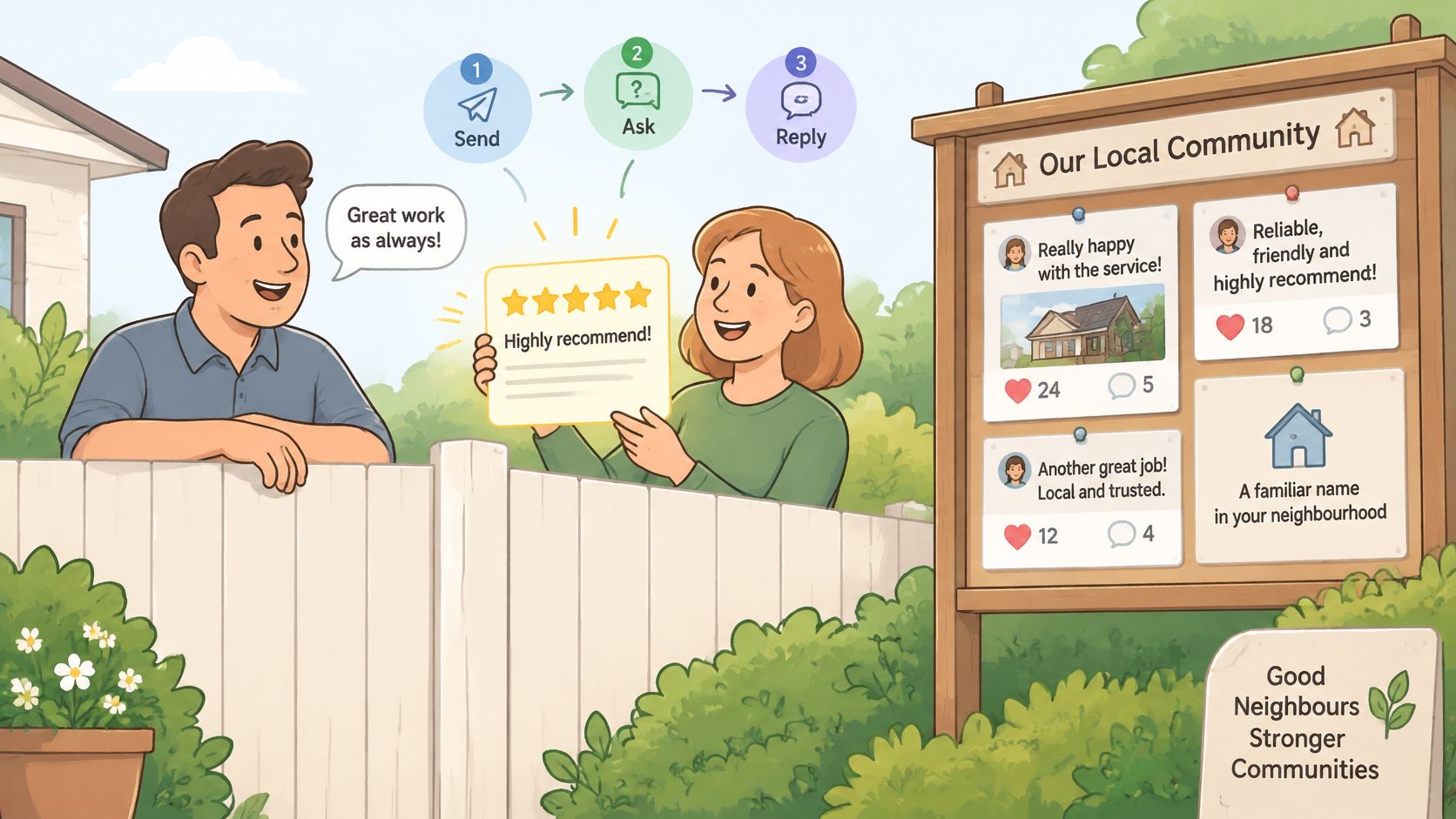
Make reviews part of finishing the job
- Ask while the job is fresh. As an operating routine, send a short text or email within 24 hours of completion, including the direct Google review link. Ask customers consistently rather than approaching only those expected to leave glowing feedback.
- Reserve a reply block. Put a 10-minute review check in the weekly diary. Thank positive reviewers personally and acknowledge complaints calmly, moving private details into a direct conversation.
- Check the pattern. Record review count and average rating monthly, but also read what customers mention. Repeated comments about missed calls or late arrivals identify operational problems that marketing can't solve.
Never offer discounts or gifts for Google reviews. Incentivised reviews breach platform rules and create avoidable enforcement risk, including review removal or account restrictions.
Replies should also protect privacy. A health practice, for example, shouldn't confirm treatment details because a reviewer mentioned them publicly.
Keep social media narrow and manageable
Choose a platform customers already use. Facebook may suit a local trade or hospitality venue, while a visually driven business may have stronger reasons to test Instagram.
A workable starting schedule is two or three posts a week, prepared in a monthly batching session. An hour spent gathering job photos, drafting captions and scheduling approved material is more manageable than deciding what to post every morning.
- Show local work. Explain a completed Paddington job, with customer permission.
- Answer a seasonal question. Share a relevant storm-season preparation tip.
- Make contact straightforward. State how enquiries are handled and check incoming messages.
The agency's social media management includes strategy, content creation and community management. Clear social media management responsibilities prevent an owner and provider from both assuming the other is answering messages.
Owner time: Supply authentic material and approve sensitive replies. Use a 60-day checkpoint: if posts produce no useful messages, enquiries or profile visits, change the content or platform rather than increasing volume.
Staying Visible When Customers Ask AI Tools
In auDA's 2025 Digital Lives of Australians research, 56% of Australians used AI, up from 45% in 2024, and finding answers to search queries was the leading use at 30%.
An AI recommendation is loosely comparable to a well-informed neighbour consulting local information, although tools use different sources and can make mistakes. Google still dominates Australian general search; AI adds another discovery route rather than making traditional local SEO obsolete.
Run a low-cost discovery check
- Maintain accurate details. Keep the Google Business Profile complete and directory information aligned with the website.
- Answer actual questions. A hot-water service page should directly explain whether the business handles repairs in Chermside, rather than hiding the answer beneath promotional copy.
- Keep evidence current. Invite customers to describe their genuine experience, including the work and location when relevant, without scripting reviews.
- Test customer questions quarterly. Record whether the business appears, which sources are referenced and whether the description is accurate.
Treat AI-powered SEO as an extension of clear, trustworthy publishing, not a separate shortcut.
Keep expectations grounded: No dependable method guarantees an AI recommendation. Owner time is better spent correcting missing information than repeatedly chasing different generated answers.
Local Paid Ads Without Wasting Your Budget
Google Search ads capture existing demand. Someone typing emergency plumber Brisbane is already expressing a need. Meta ads reach people while they browse, which can suit visual offers, planned purchases and reminders to eligible past website visitors.
Neither channel is automatically cheaper in a useful sense. An inexpensive click has little value if the person is outside the service area or wants work the business doesn't provide.
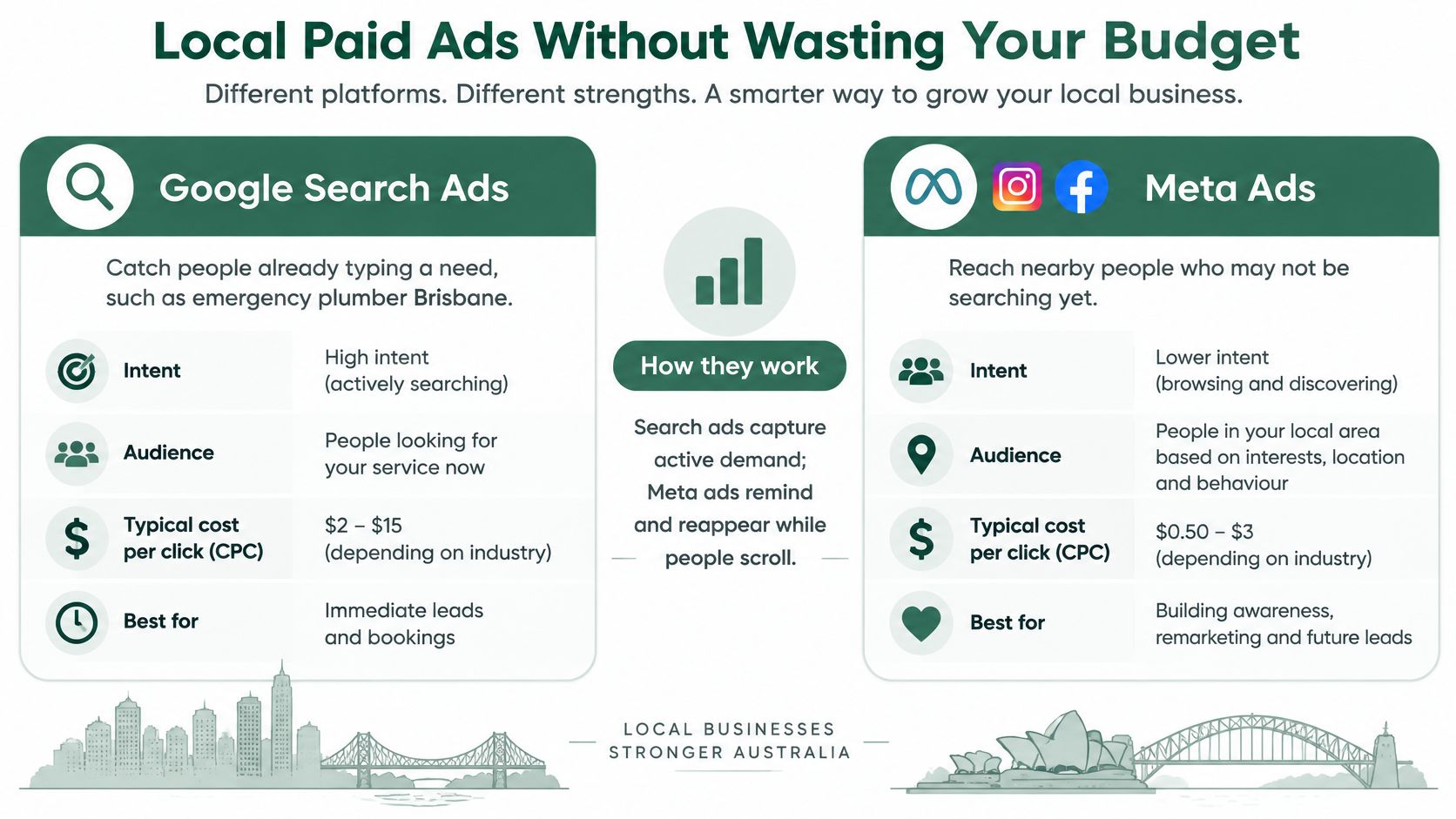
Put controls in place before launch
- Set an affordable test budget. Choose a monthly amount the business can afford to risk and use a 30-day review period. Separate the advertising budget from the management fee.
- Restrict the geography. Target the actual service area and exclude locations the team can't reach within its normal response commitments. Check location settings rather than assuming a radius excludes every irrelevant searcher.
- Filter unsuitable searches. Add negative keywords such as jobs, free, DIY or course when those searches aren't commercially relevant.
- Make calls easy. Enable suitable call assets, formerly called call extensions, and mobile click-to-call. Schedule call-focused advertising around times someone can answer.
- Connect enquiries to bookings. Record campaign source, enquiry quality and whether the job was won. A spreadsheet or simple customer-management system can do this.
- Use a stop rule. Pause an ad group that reaches its agreed spending limit without qualified enquiries. Check targeting, tracking and the landing page before transferring budget elsewhere.
Judge revenue, not activity
Boocoo runs Google Ads and Meta campaigns built around each client's budget, with every dollar tracked. It reports that its Brisbane clients average a 3x return on ad spend within the first quarter. That's one agency's reported average, not a promise, and advertising revenue isn't the same as profit.
A useful Google Ads cost guide for small business helps frame the budget discussion. Veo3 AI's overview of small business advertising strategies offers broader channel ideas, but local targeting and booked-job measurement still need business-specific decisions.
Owner time: Review lead quality weekly during the test and report missed calls promptly. Ads can run while SEO develops, provided the business has capacity to handle the resulting enquiries.
Pricing, Timelines and Numbers to Track
SEO and profile improvements need time to assess, while paid ads can begin generating enquiries soon after launch. Planning for several months of search work is more sensible than expecting an immediate ranking change.
The agency reports average organic traffic growth of 190% in the first six months of SEO work. That publisher-reported result depends on starting conditions and doesn't establish how much revenue a particular business will earn.
Separate the bill into meaningful parts
A usable quote distinguishes management or retainer fees, one-off project costs, and advertising spend paid to Google or Meta. A website build or technical audit shouldn't be hidden inside an unclear monthly figure.
Scope matters as much as the headline price. Content approvals, photography, landing-page development and tracking setup should have clear owners so apparently inexpensive work doesn't create unexpected owner workload.
Metrics to track for each local service
| Service | Metric to Track | Where to Find It | Review Cadence |
|---|---|---|---|
| Local SEO | Organic clicks, calls and direction requests from local searches | Google Search Console and Google Business Profile | Monthly |
| Google Business Profile | Profile views, calls and direction requests | Google Business Profile performance reporting, formerly Insights | Monthly |
| Website optimisation | Phone clicks, form submissions and direction requests | Analytics events on the website | Monthly |
| Reviews management | Review count, average rating and reply rate | Google Business Profile reviews tab | Weekly |
| Social media management | Messages and profile visits from social channels | Platform insights and inbox | Monthly |
| Local paid ads | Cost per enquiry and cost per booked job | Google Ads and Meta reports, plus phone log or CRM | Weekly during the test |
Search Console reports website search performance; profile reporting supplies profile interactions. Those figures shouldn't be combined as though they measure identical actions.
For owner workload, reserve a small recurring block for approvals, a profile refresh, review replies and the social batch. A few hours a month is a sensible planning allowance for a tightly scoped routine, not a universal service requirement.
The reporting standard should be a plain-English monthly breakdown of what was done, what it cost and what it delivered. The agency provides that breakdown; a useful report also explains the next change and distinguishes raw enquiries from suitable, booked work.
Questions to Ask a Local Agency Before You Sign
A useful agency conversation should make responsibilities clearer, not introduce another layer of jargon. Before signing, the owner should understand who handles the work, which accounts remain under business ownership and how success will be judged.
Request an anonymised example report from a similar trade before the call. Look for enquiries, bookings and costs rather than a presentation dominated by impressions.
The people
- Dedicated contact: Who is the named strategist, and how will that person learn the business's suburbs, customers and competitors?
- Initial conversation: Is there a free discovery call before a proposal or paid commitment?
- Account access: Will the business retain ownership of its website, profile, analytics and advertising accounts?
The publisher assigns each client a dedicated strategist who knows the business, goals and competitors. Its first step is a free discovery call covering the business, goals and current marketing.
The plan
- Initial priorities: What does the first 90-day plan include, and why are those tasks the best use of this budget?
- Local relevance: How will the work reflect the industry, location and actual service area?
- Included work: Are profile management, citations, content and technical fixes included, or charged separately?
- Owner workload: Which photos, approvals and customer information must the owner provide?
A customized plan should identify exclusions as clearly as inclusions. A social media package, for example, may cover publishing without covering photography at every job site.
The money and reporting
- Itemised costs: Are management fees, project charges and ad spend separate?
- Useful reporting: Will the monthly report explain completed work, spending and commercial outcomes?
- Exit terms: What notice is required, and how are access and assets handed back?
A local team can be easier to meet in person, although many effective providers work remotely. Physical proximity is useful only when communication and accountability are also sound.
Red flags worth taking seriously
- Guaranteed rankings: Promises of first-page placement regardless of competition or starting position.
- Immediate pressure: A demand to sign before the scope and terms are clear.
- Impression-only reporting: Attention figures without enquiry quality or business outcomes.
- No accountable contact: Nobody named to explain decisions or resolve a problem.
A credible provider should be comfortable explaining trade-offs. Budget limits are normal; pretending every channel deserves equal funding isn't helpful.
Pick One Service to Fund This Quarter
A focused plan suits a small-business budget: 91.6% of Australian businesses had annual turnover below $2 million in 2023–24, according to the Australian Bureau of Statistics. That doesn't set any individual marketing budget, but it supports making deliberate choices rather than buying a broad package by default.
Match the first purchase to the visible gap
- Nobody finds the business: Begin with Google Business Profile, then address local SEO.
- Visitors don't enquire: Fix the website's contact process and service information first.
- Trust is the obstacle: Establish a consistent review request and reply routine.
- Work is needed soon: Run a capped local advertising test while longer-term improvements develop.
- Existing customers forget the business: Consider a focused social presence on the platform they use most.
The first action should fit within a working day: claim access, test the contact form, prepare the review request or define an advertising limit. That's an initial task, not a promise that the whole marketing problem will be solved immediately.
At a 30-day checkpoint, review one useful number, such as profile calls or completed enquiry forms. Decide whether to keep the approach, change it or add another service.