

A post goes up on Tuesday because a quiet half hour appeared. By Friday, two messages sit unanswered, opening hours still show a public holiday from last month, and nobody knows whether the post produced a single enquiry. That gap isn't a creativity problem. It's an ownership problem, and it's exactly what clear social media management responsibilities are meant to fix for Brisbane small businesses.
What Social Media Management Responsibilities Include
A Brisbane cafe owner posts only when a spare half hour appears. The feed looks fine, but a catering question sits unanswered, a weekend special lists the wrong price, and a former staff member still holds admin access. That pattern costs enquiries because customers judge reliability from the profile before they ever walk in.
Three Layers of the Work
Social media management is the ongoing work that keeps business accounts accurate, useful and responsive. Think of the profile as the business's front counter. The manager keeps it open, stocked and tidy so a customer can find the offer, ask a question and take the next step.
Strategic work sets goals, chooses platforms, writes brand voice rules and approves monthly themes. Tactical work plans, writes, designs and schedules posts, answers comments and direct messages, and runs paid ads. Administrative work keeps profile details accurate, controls access and passwords, checks privacy and claims before posting, and tracks results.
| Layer | Responsibility | Typical time |
|---|---|---|
| Strategic | Set goals and choose platforms | 1 hour monthly review |
| Strategic | Write brand voice rules and approve content | 30 minutes |
| Tactical | Plan and write posts | 2-3 hours per week |
| Tactical | Design, schedule and publish | 1-2 hours per week |
| Tactical | Check and reply to comments and messages | 15-30 minutes daily |
| Tactical | Run and adjust paid campaigns | 1-2 hours per week |
| Administrative | Keep profile details accurate | 30 minutes monthly |
| Administrative | Manage access, passwords and MFA | 30 minutes monthly |
| Administrative | Check privacy and claims before posting | 10-15 minutes per post |
| Administrative | Track results and report | 1 hour monthly |
Consistency matters because standing out is getting harder. In March 2025, 44% of Australian small and medium-business owners said social media made it harder for their brand to stand out, according to the Vista Australia 2025 Small Business Report from a Pure Profile survey of 500 Australian SMB owners. Regular, relevant posts and fast replies therefore beat bursts of volume.
Practical rule: Set up the strategic and tactical layers first, then add administrative routines once the basics run smoothly.
For Brisbane Digital Marketing, that order keeps effort tied to enquiries rather than busywork. A small team that knows the goal, the platform and the reply standard has a system. Everyone else has a feed.
Which Tasks to Do First When Time Is Short
The common assumption is that every platform needs daily attention. It doesn't. Some social media management responsibilities protect the business and capture enquiries, while others only look productive. Sorting them is the fastest time-saver available.
A Triage Order for Busy Owners
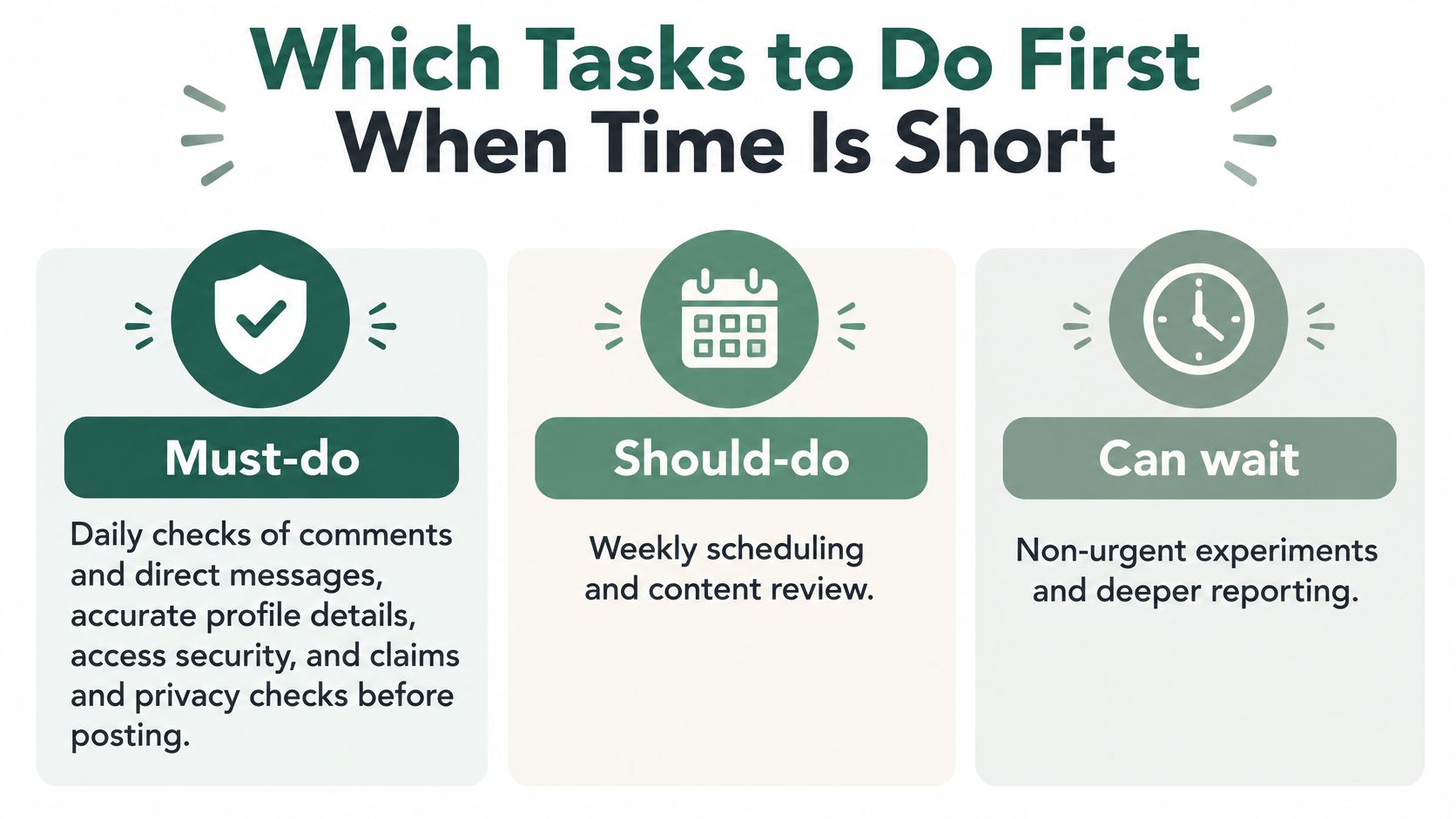
- Must-do: Daily checks of comments and direct messages, accurate profile details, access security, and claims and privacy checks before posting.
- Should-do: A weekly plan of three posts, a monthly report, and a review of any paid campaign.
- Can wait: Long video editing, a presence on every platform, daily posting, and campaigns chasing follower counts.
The emergency department analogy fits. Urgent enquiries get seen first, routine work follows, and elective projects wait until capacity exists. A business with three to five hours a week can split that time at roughly 60 percent on must-do and response work, 30 percent on planning and creating, and 10 percent on reporting.
Consider a Brisbane plumber with one van and four hours a week. Two platforms get dropped, Facebook and the Google Business Profile stay current, and every message gets a reply within the same working day. That trade-off protects lead flow better than daily posts nobody reads closely.
If a task doesn't lead to an enquiry, a booking or a protected account, it moves to can wait for the next quarter.
Owners don't need to do less marketing. Owners need to do the load-bearing parts first, every week, without negotiation.
Choosing Platforms and Setting Direction
Platform choice comes before posting, not after. ACMA reports Facebook reaches 78% of Australian adults, YouTube 71%, Facebook Messenger 71%, Instagram 53%, TikTok 30% and LinkedIn 26%, with the average adult using 5.5 platforms, according to the ACMA How We Communicate executive summary. No small team can cover that spread well.
Matching Platform to Purpose
- Facebook and Messenger: Local service enquiries, reviews and events.
- Instagram: Visual trades, hospitality and retail that can show finished work.
- LinkedIn: Professional services selling to other businesses.
- YouTube and TikTok: Businesses where filming is already routine.
Video only pays off when production is repeatable. A dealership filming stock arrivals weekly can use templates and tools such as automated promotional videos for dealerships to keep output steady. A business filming once a quarter shouldn't build a strategy around short video.
Three decisions need writing down before content starts. First, one measurable goal for the quarter, such as more quote requests from nearby Brisbane suburbs. Second, a main platform and a secondary platform, not five equals. Third, a brand voice guide of three to five rules, such as plain language, no jargon and one clear next step in every post.
Startups working through these early choices can find a useful starting point in this guide to building a social media strategy for startups, then adapt it to local service demand. A Brisbane physiotherapy clinic, for example, might use Facebook and a Google Business Profile for local enquiries and Instagram for staff introductions, while skipping LinkedIn because referrals come from local GPs. Fewer platforms, served properly, is the stronger Brisbane Digital Marketing position.
A Weekly and Monthly Schedule That Fits Small Teams
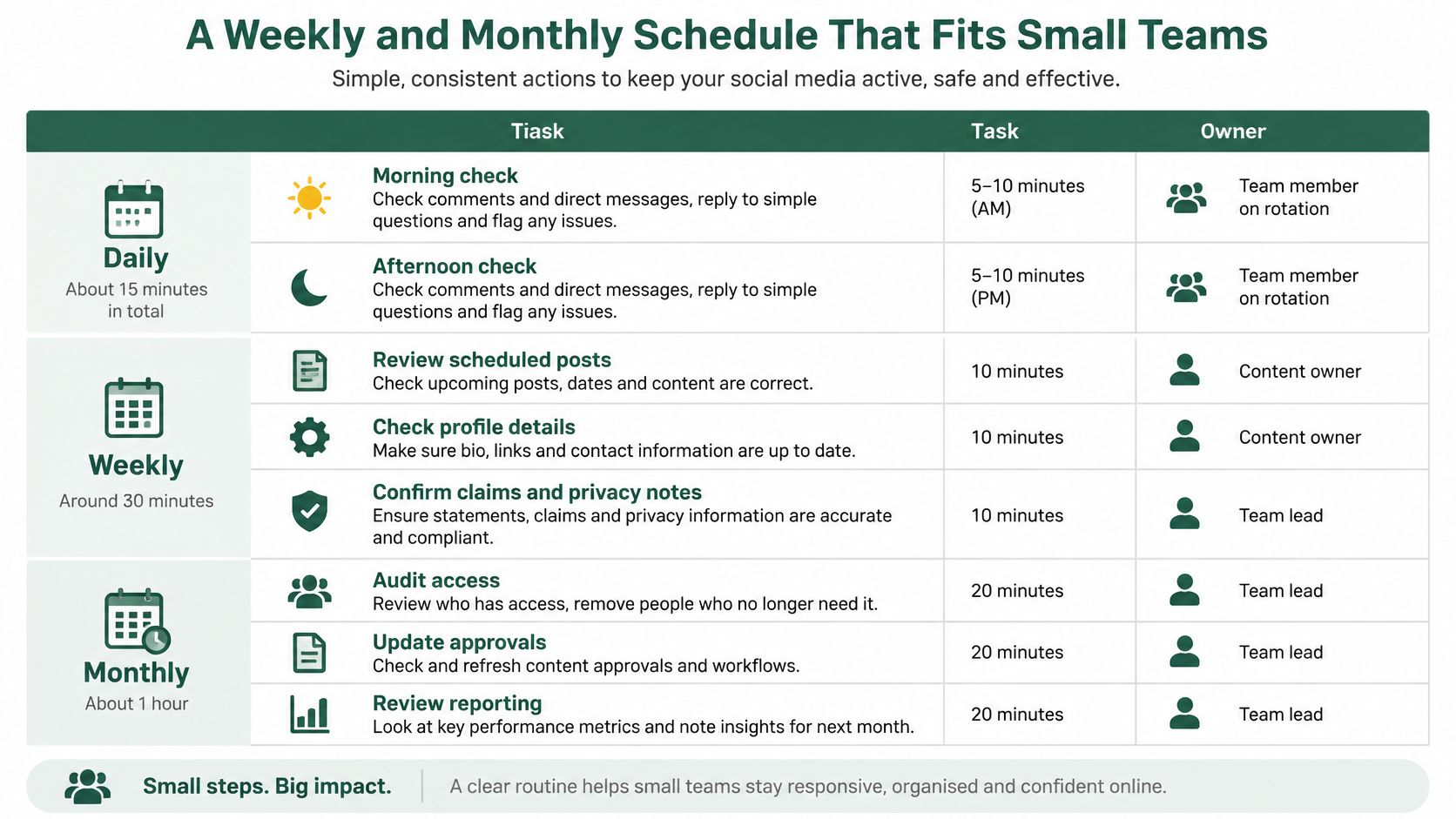
A schedule holds up in a busy fortnight only when each task has a fixed time block and a named owner. The team knows what happens on Monday morning without calling a meeting.
The Working Rhythm
| Frequency | Task | Time needed | Owner |
|---|---|---|---|
| Daily | Check comments and direct messages | 15 minutes | Owner or front desk |
| Daily | Reply to enquiries within the working day | Within the day | Owner or front desk |
| Weekly | Plan and approve three posts | 1 hour | Manager |
| Weekly | Create and schedule three posts | 90 minutes | Manager |
| Weekly | Review any paid campaign | 30 minutes | Manager |
| Monthly | Review KPIs and record results | 1 hour | Manager |
| Monthly | Check profile details and access list | 30 minutes | Owner |
| Quarterly | Revisit platform choice and content themes | 2 hours | Owner |
The two daily rows cover different jobs. A morning and afternoon sweep of comments and messages takes about 15 minutes combined, while replies land inside the working day because that is where bookings and quote requests sit. The Australian Government business guidance on social media recommends checking channels at least once a day, scheduling content consistently, protecting customers' personal information and avoiding misleading claims. Scams that start on social media are a growing risk for small businesses, so the monthly access-list check and a watch for unusual messages stay in the routine rather than on an annual list.
Weekly blocks stay small on purpose: one hour produces three approved ideas, then a separate 90 minutes covers captions, image resizing and loading the queue. The 30 minute paid review weighs spend against enquiry volume rather than impressions. Teams comparing scheduling tools can review this resource on choosing automated scheduling for social clips, and timing improves with guidance on the best time to post to Facebook.
The monthly KPI hour records which posts produced calls or messages and which platform earned nothing, so qualified enquiries outrank follower counts in the report.
A Brisbane cafe might batch photos on Monday, write captions on Tuesday, schedule on Wednesday and protect Friday afternoon for replies. Three useful posts a week outperform seven rushed ones. When hours get cut, I would defend two blocks first: the daily reply window and the scheduled posts.
Access, Privacy and Compliance Duties Owners Miss
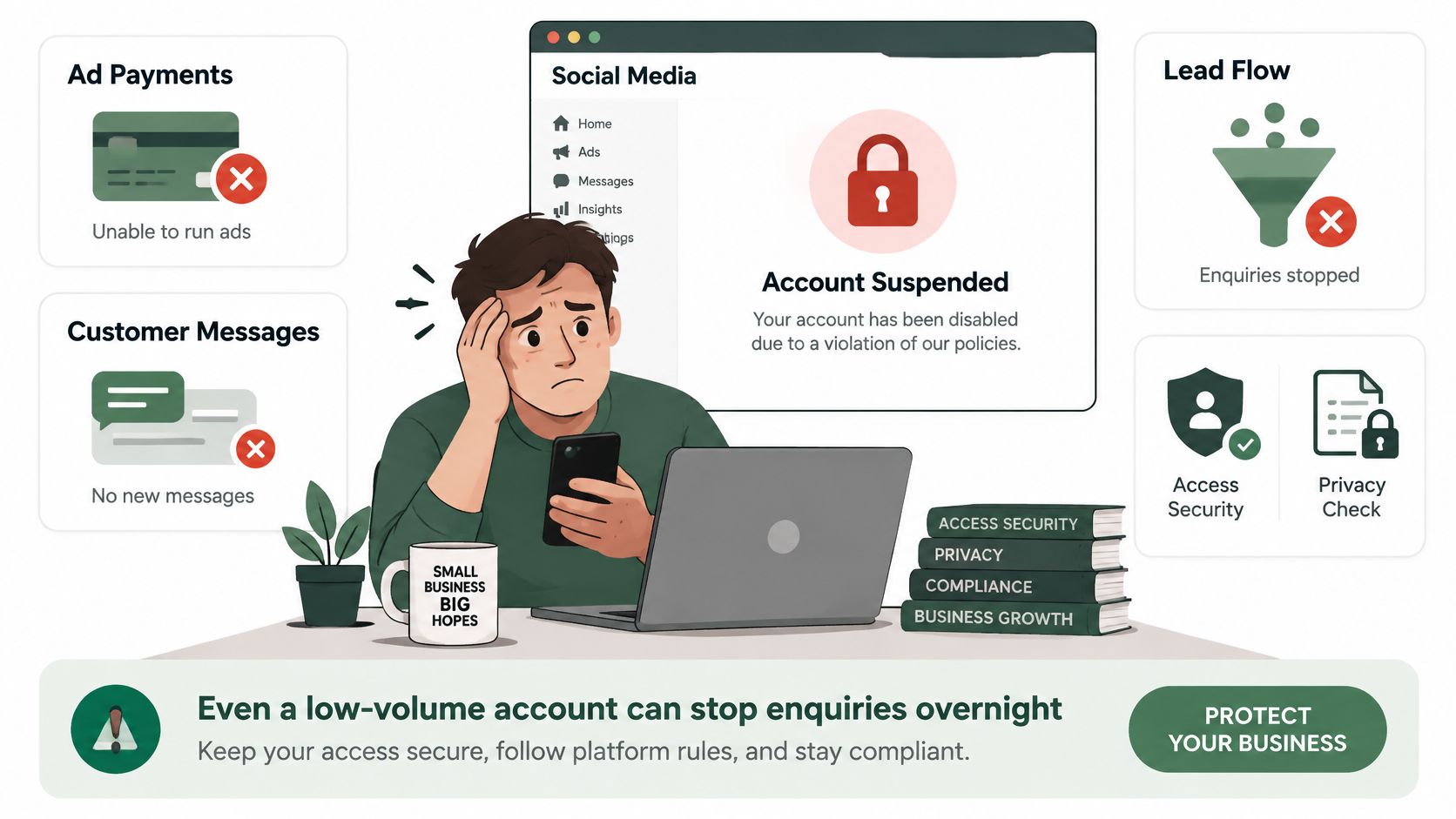
A low-volume account still connects to advertising payment details, customer messages, brand reputation and lead flow. A hacked or suspended account can stop enquiries overnight, which makes security a core part of social media management responsibilities, not an IT afterthought.
Six Access and Recovery Steps
- Name one owner: One person owns multi-factor authentication on every account.
- Limit admin access: Administrator permissions go only to people who need them.
- Remove leavers fast: Former staff and contractor access comes off in the same week.
- Store recovery details: Recovery information sits somewhere secure that the owner can reach.
- Keep two platforms: A presence on at least two platforms prevents one lost account stopping every enquiry.
- Record emergency rights: A written note shows who holds each login and who can pause paid advertising.
Privacy duties run alongside access. Permission comes before customer photos or testimonials get published. Public replies never expose phone numbers or private circumstances, and sensitive complaints move to a private channel quickly. Customers also need a clear warning that the business will never ask for payment or bank details by direct message.
Claims checks deserve the same discipline. Figures get confirmed against an original source, sponsored content gets labelled, and a simple record shows who approved each post. Partnerships raise the stakes further, so owners exploring influencer marketing in Brisbane should agree disclosure and approval rules before anything is published. Even seasonal content needs a rights check, whether the asset is a customer photo or background audio sourced from a guide to eerie seasonal soundtracks for an October promotion.
The finishing step is a response time the whole team can meet. A standard everyone honours beats an ambitious promise that fails every Friday.
Measuring Results With a Simple Monthly Report
Posting frequency doesn't prove value. Qualified enquiries, booked jobs and response speed do. Social media management responsibilities therefore include defining what counts as a real result before the month starts, then recording it the same way every month.
| Measure | What it tells you | Where to find it | Review |
|---|---|---|---|
| Qualified enquiries | Leads that match the service area and job type | Enquiry form, phone log, tagged inbox | Monthly |
| Response time | How fast replies go to messages and calls | Inbox timestamps and phone log | Weekly |
| Profile actions | Calls, direction requests and website clicks | Platform insights and Google Business Profile | Monthly |
| Booked jobs or consultations | Outcome linked to social activity | CRM or booking sheet | Monthly |
| Enquiries by post or campaign | Which content drives contact | Tagged links and code words | Monthly |
| Follower growth and reach | Awareness only, not a success measure on its own | Platform insights | Monthly |
Adoption alone doesn't guarantee returns. The CPA Australia 2025-26 Australia market summary says Australian small businesses were the least likely among surveyed Asia-Pacific markets to use social media for business purposes, and only 14% reported losing time or money to a cyber incident in 2025. Fit and capacity matter as much as presence. An account posting daily to the wrong audience still produces nothing an owner can bank.
A One Page Report
- Month and enquiries: Qualified enquiries listed by source.
- Outcomes: Booked jobs or consultations, plus average response time.
- Learning: The top post and why it worked, with spend if paid ads ran.
- Decision: One change for next month.
Four lines, reviewed once a month, beat a dashboard nobody opens.
Tagging makes those lines possible. Every form gets a "how did you hear about us" field, and each campaign gets a unique code word or link. Owners wanting the broader method can follow this breakdown of how to measure marketing ROI and apply the same discipline to social channels.
Say a Brisbane electrician finds two service-area posts drew fewer likes than a promotional video but produced more quote requests. The next calendar leans toward service-area content. One limit needs watching too. If enquiries exceed handling capacity, the report records that fact and prompts a decision to slow promotion until fulfilment catches up. A report that hides an overloaded inbox is not a report, it is a delay.
Decide Who Owns Each Responsibility Before You Hire
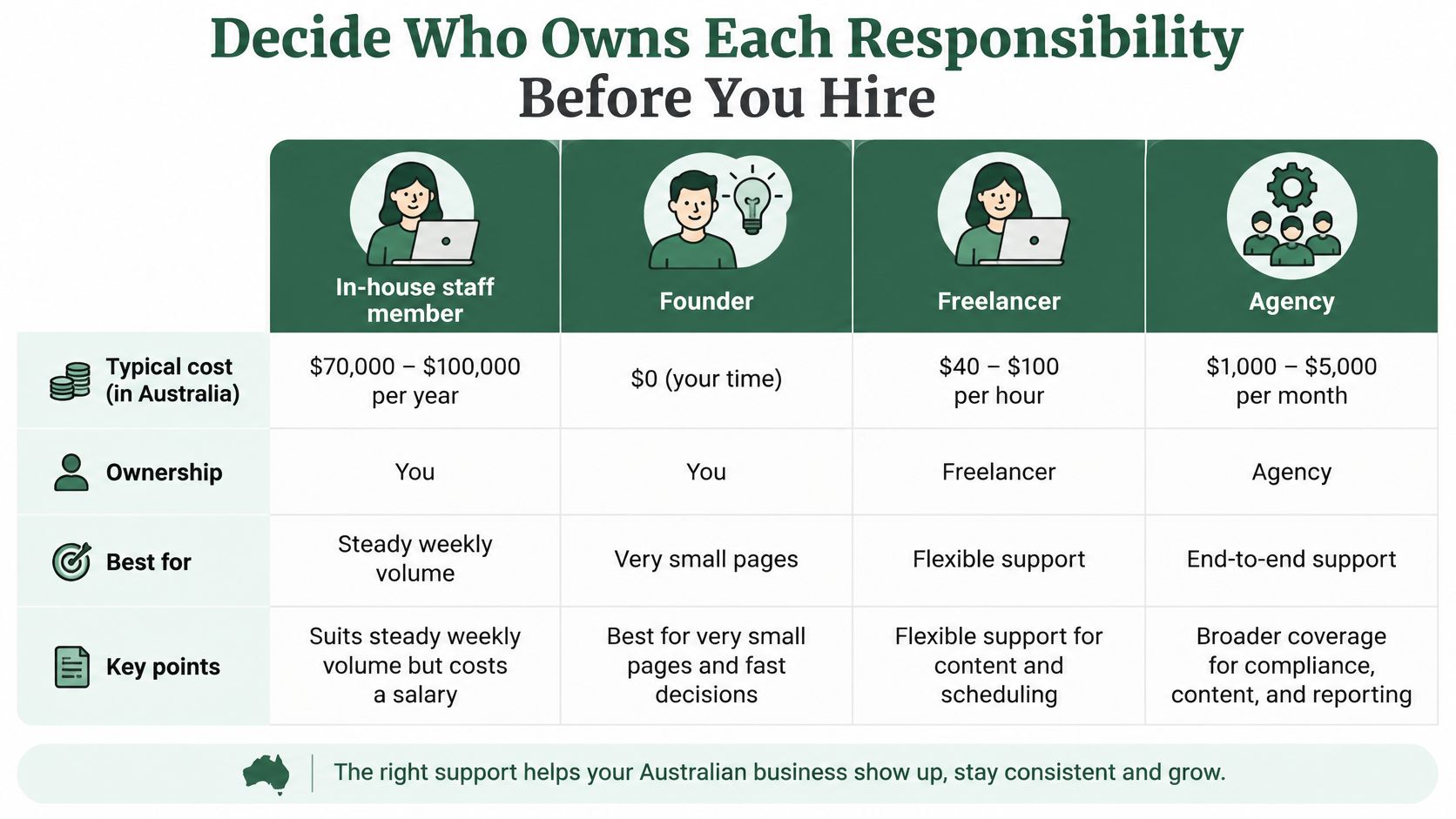
Hiring fails when ownership stays fuzzy. The right question isn't who posts. The right question is who approves posts, who answers messages after hours, who holds the admin password and recovery details, and how results get reported each month. Every option should pass those four tests.
Four Options Compared
| Option | Best for | Owner keeps | Main risk |
|---|---|---|---|
| In-house staff member | Steady weekly volume | Approvals and voice rules | Costly for a small load |
| Freelancer | Content production | Strategy and approvals | Replies and reporting can slip |
| Agency or managed service | Strategy, content, community management and reporting together | Goals and final sign-off | Higher cost and needs a clear brief |
| DIY with scheduling tool | Under three hours a week with clear rules | Everything | Busy fortnights stretch the routine |
Budget discipline helps narrow the field. Owners can outsource only the production tasks eating the most hours, such as writing or design, while keeping approval in-house. Before committing, monthly cost gets compared against hours saved and qualified enquiries gained. This rundown of social media management pricing in Australia gives owners a reference point for that comparison.
For context on how a managed arrangement can be structured, Boocoo assigns one dedicated strategist who knows the client's business, goals and competitors, and Boocoo's social media management includes strategy, content creation and community management. The first step is a free discovery call where Boocoo learns about the client's business, goals and current marketing. That kind of clarity is the standard any provider should meet.
Good looks like a named person accountable for results, a written plan agreed before work starts, and a monthly report of qualified enquiries rather than follower counts.
Any arrangement missing those three elements isn't management. It's delegation without control, and the owner still carries the risk.
Brisbane Next Steps for the Next Four Weeks
Momentum starts with a single 30 minute session. Owners list every responsibility from the three layers, assign one owner to each, check the account access list, confirm multi-factor authentication is on for every login, and set a 90 day review date in the calendar. That half hour removes most of the guesswork.
A Four Week Path
- Week one: Access audit and profile details, including hours, suburbs served and contact information.
- Week two: Platform choice, one quarterly goal and written voice rules.
- Week three: Weekly schedule begins with three posts and daily message checks.
- Week four: First monthly report, with a note on whether enquiries outstrip capacity.
The local base matters too. The Google Business Profile is completed with the Brisbane suburbs served, the enquiry form gains a source question, and the team agrees who replies to Brisbane enquiries after hours. Each step supports Brisbane Digital Marketing that a small team can sustain.
One final habit protects trust from day one. The next customer gets asked for permission before appearing in any photo, testimonial or story. Useful and safe beats fast and regretted, every time.