
Realistic social media management pricing in Australia for small businesses typically starts around the low four figures per month, with a typical SME range of A$950 to A$2,500 rather than a few hundred dollars. Larger or more strategic retainers can reach A$5,000 to A$15,000+ per month.
A Brisbane owner usually reaches this question after another rushed week of taking photos between jobs, writing captions after dinner and wondering why enquiries remain inconsistent. The right budget isn't the cheapest quote. It's the amount that buys a reliable system, useful content and a clear path from local attention to genuine business conversations.
Realistic Social Media Budgets for Small Businesses
A small business owner might begin with a simple plan: publish a few posts, keep Facebook active and make Instagram look less neglected. Then the quote arrives. One provider offers a few hundred dollars, another suggests a four-figure retainer, and a third proposes a much larger package without showing a price at all.
The Australian market supports the higher baseline. Published entry pricing for organic social media management averages A$1,219 per month, with a median of A$960 per month and a typical SME range of A$950 to A$2,500 per month, according to an Australian social media pricing audit. Upper-tier solutions can reach A$7,500+ per month, while broader benchmarks place larger strategic retainers at A$5,000 to A$15,000+ per month.
That range doesn't mean every Brisbane business needs a premium agency. It means the scope must match the fee. A low-cost package may keep accounts active with supplied photos and basic scheduling. A more substantial arrangement may include original content, platform-specific creative, comment and message management, reporting and strategic reviews.
The sensible starting point
For most local trades, clinics, professional services firms and retailers, a realistic outsourced budget starts in the low four figures each month. That level gives a provider room to do more than fill a calendar. It can support planning, writing, design, scheduling and enough account attention to identify what attracts local prospects.
Australia's pricing remains difficult to compare because 78% of agencies don't publish their prices, as reported in the same Australian pricing audit. A business owner should therefore ask for a written scope rather than comparing headline fees alone.
Practical rule: A cheap package that produces no useful enquiries isn't a saving. It's a recurring charge for keeping the account looking occupied.
Before outsourcing, a business can also compare social media tools for SMBs to decide whether scheduling can remain in-house while strategy and content receive external support. Owners who want to compare broader service structures can review small business digital marketing packages before requesting proposals.
What Actually Drives Your Monthly Management Fees
Two providers can quote very different amounts for “social media management” because they may be selling completely different workloads. Posting supplied images is one job. Planning campaigns, creating video, moderating conversations and reporting on leads is another.
The clearest pricing driver is workload intensity. Australian pricing guidance links higher fees to greater posting frequency, more content formats and deeper community management, because every added requirement creates more copywriting, design, scheduling, moderation and reporting work. A second platform doesn't merely add another login. It can require a different caption, crop, creative treatment and publishing workflow.
The work behind the invoice
A static image may need a short brief, copy, design, approval and scheduling. A short-form video can require a concept, filming, editing, subtitles, sound selection, resizing and revisions. Community management adds a response obligation, especially when customers ask service questions through comments or direct messages.
| Service Element | Impact on Pricing | Best For |
|---|---|---|
| One platform and supplied assets | Lower workload, fewer production tasks | Owners who can create photos and ideas |
| Multiple platforms with original captions | More planning, writing and scheduling | Businesses targeting different local audiences |
| Static graphics and regular content batches | Moderate design and approval workload | Retailers, consultants and service firms |
| Short-form video production | Higher creative and editing demand | Businesses where demonstrations build trust |
| Comment and message management | Ongoing monitoring and response time | Businesses that receive enquiries through social |
| Reporting and strategy reviews | Adds analysis and decision-making time | Owners who need marketing tied to enquiries |
A business can reduce cost by choosing fewer channels, supplying usable photos and batching approvals. It shouldn't cut the work that makes the account commercially useful, such as a clear offer, timely replies or a way to track enquiries.
Build a scope that fits
A sensible brief specifies platforms, content formats, approval responsibilities, response coverage and reporting. The guide to doing social media management can help an owner understand which tasks remain internal and which are suitable for outsourcing.
The best quote isn't the one with the most posts. It's the one that explains what the provider will do, how often, and why that workload suits the business goal.
Comparing Freelancers and Local Digital Agencies
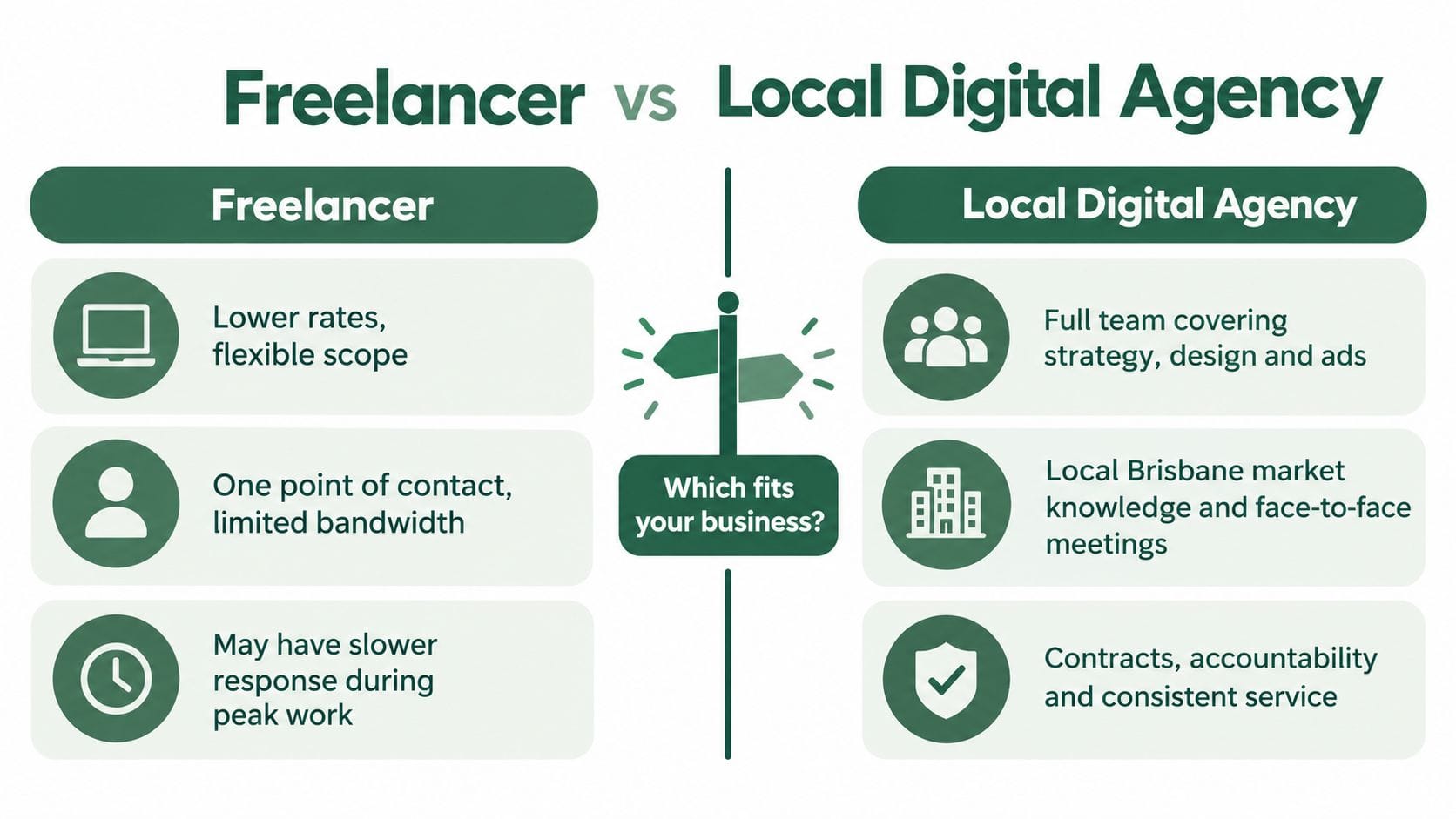
A freelancer and a local agency can both be suitable, but they solve different operational problems. A solo operator may offer a direct relationship and flexible scope. An agency can spread work across strategy, design, advertising and account support.
The first question shouldn't be “which hourly rate is lower?” It should be “what happens when the work becomes urgent, the content needs changing or the usual contact isn't available?” A freelancer may have excellent expertise, but a single-person setup creates a clear continuity risk during illness, leave or periods of heavy demand.
The freelancer model
Freelancers often suit owners who have a narrow requirement, such as caption writing, scheduling or a manageable content calendar. They can move quickly, keep communication personal and adjust the scope without the layers found in larger firms.
The trade-off is capacity. One person may be handling filming, editing, copywriting, account management and reporting across several clients. A business should ask who covers the account during leave, how quickly messages receive a response and whether the freelancer personally performs every task.
The agency model
An agency generally provides access to several capabilities rather than one individual. That can matter when a campaign needs a landing page, search optimisation, paid advertising or a creative format outside routine posting. A Brisbane-based team may also bring practical knowledge of local suburbs, customer expectations and face-to-face communication.
That doesn't make every agency the right fit. A large provider can be excessive for a small business that needs one platform and a modest content rhythm. Owners comparing the two models can use this guide to choose a digital marketing agency for a small business and focus on accountability, scope and business relevance.
A dependable partner should make the business less fragile, not create another task list for the owner.
Understanding Organic Versus Paid Social Costs
Organic and paid social are separate purchases. Organic management creates and maintains the business's regular presence. Paid social management builds, tests and improves campaigns using a media budget paid to platforms such as Meta.
Australian benchmarks place organic social management at AUD $1,200 to $4,000+ per month. Paid social management is often AUD $1,000 to $5,000+ per month, or charged at 10% to 20% of ad spend, with the ad spend billed separately, according to Australian digital marketing cost guidance.
Read the proposal in three parts
A business owner should separate the investment into:
- Organic management fees, covering planning, content, publishing, moderation and reporting.
- Paid campaign management fees, covering audience setup, creative testing, optimisation and analysis.
- Platform media spend, paid to the advertising platform rather than the provider.
This distinction prevents a common misunderstanding. If an agency charges a percentage of ad spend, that percentage pays for management. It doesn't include the money Meta or another platform uses to display the ads.
Why paid management scales
Paid campaigns require more attention as budgets and objectives become more complex. Higher spending can involve more audience groups, creative variations, testing decisions and reporting. A campaign for a local plumber may need different messages for emergency work, renovations and maintenance, while a professional services firm may need separate audiences and landing pages.
Organic content and paid promotion can support each other, but they shouldn't be merged blindly. A strong organic post isn't automatically a strong advertisement, and a campaign that generates clicks may still fail if the landing page doesn't make the next action obvious.
For a closer look at the separate media and management components, owners can review how much Facebook Ads cost. The proposal should state each cost plainly before any campaign begins.
How Brisbane Businesses Can Assess True Value
A Brisbane business shouldn't judge a social provider by follower totals alone. A local audience that recognises the business, asks questions and visits a service page is more commercially useful than a large audience outside the business's delivery area.
Value starts with local understanding. A provider should know which suburbs matter, how customers describe the service, what competitors are offering and whether social activity needs to support SEO, web design or paid advertising. A post that gets attention but sends visitors to a confusing website has limited value.

A practical value test
Ask a prospective provider to explain the connection between deliverables and business outcomes. The answer should cover the offer, the audience, the intended action and the reporting method.
- Local relevance: Can the provider explain how content will speak to Brisbane customers and priority suburbs?
- Lead intent: Will the plan encourage calls, quote requests, bookings, shop visits or another defined action?
- Website alignment: Does the social plan direct people to pages that answer questions and make contact simple?
- Reporting clarity: Will reports explain what changed, what worked and what should happen next?
- Scope control: Does the proposal identify exclusions such as photography, video production, ad spend or website changes?
Avoid vanity traps
Promises of guaranteed followers should raise concern. Follower growth can occur without improving local demand, and a provider who leads with audience size may be avoiding harder questions about enquiries and sales conversations.
A credible partner will ask what a worthwhile lead looks like, how staff handle incoming enquiries and which services deserve attention first. Boocoo offers social media management alongside SEO, web design and paid advertising, so it can be considered where a Brisbane business wants those activities assessed as one digital presence.
A useful test: If the provider can't explain what a prospect should do after seeing the content, the plan is incomplete.
Your Action Plan for Hiring a Social Partner
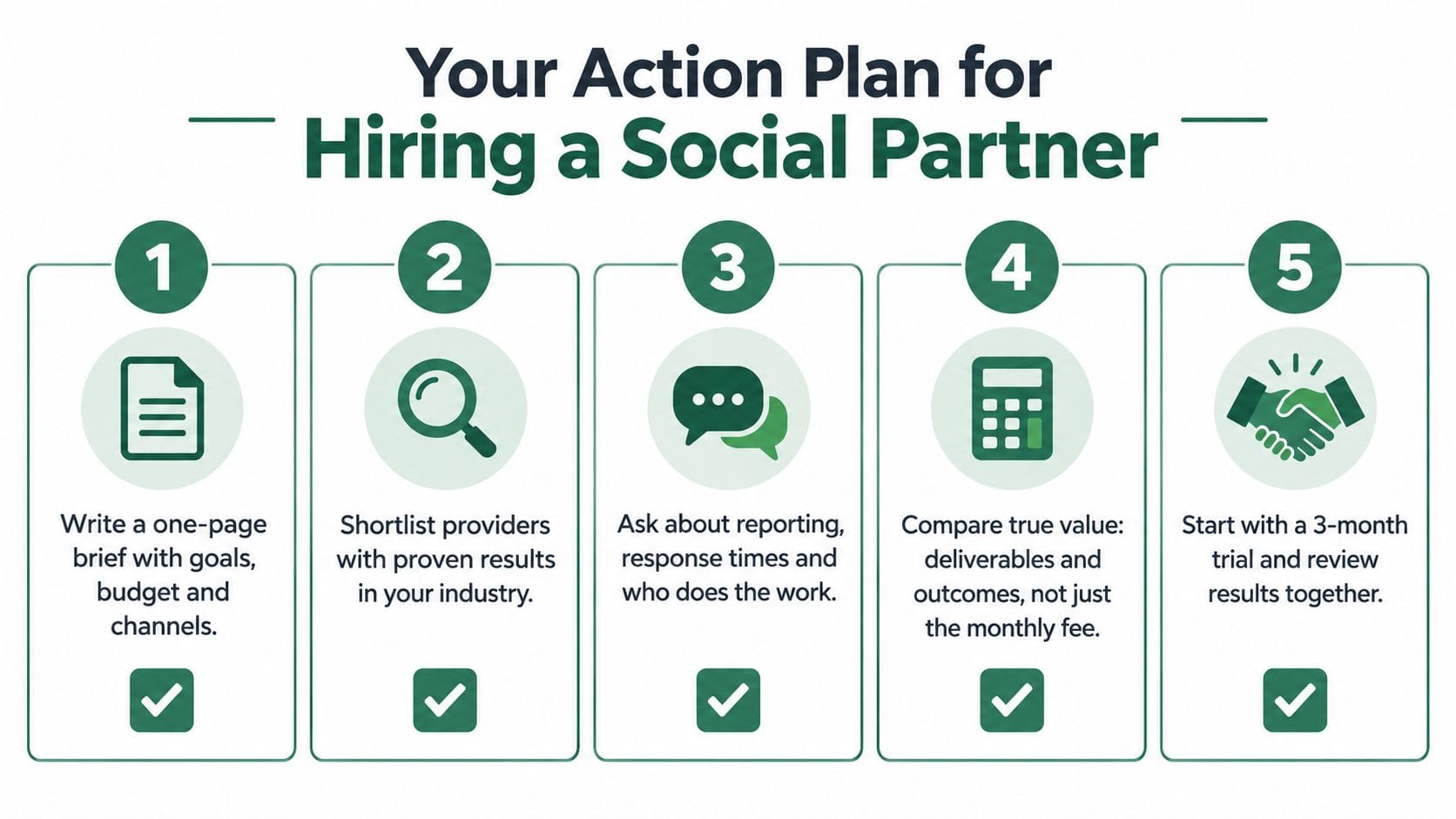
A time-poor owner doesn't need a lengthy procurement process. A clear one-page brief and a focused conversation can expose most scope, communication and accountability issues before a contract is signed.
Start with a one-page brief
The brief should name the business, priority services, target Brisbane areas, current platforms, available assets, preferred channels, monthly budget and the action that matters most. It should also state what the owner can supply, such as photos, approvals, customer questions or access to staff for filming.
A provider can price accurately only when the scope is visible. The brief also stops a sales conversation drifting towards generic promises.
Shortlist for fit, not polish
Review providers that understand the business category and can show relevant work without making unverified performance claims. During the call, ask:
- Who writes and designs the content?
- Is short-form video included?
- Which platforms are covered?
- Who answers comments and messages?
- What response times apply?
- What does the monthly report explain?
- Are ad spend, photography and website work separate?
- How does the provider connect social activity with SEO and website enquiries?
Owners who need practical content planning guides can use them to prepare ideas and identify how much planning support the provider must supply.
Set up the first month properly
The first month should establish access, approvals, brand information, customer questions, content themes and baseline reporting. The owner should appoint one decision-maker and agree on an approval window, otherwise content can stall in an inbox.
A short trial can be useful when both sides define the review criteria in advance. The review should examine content quality, consistency, audience response, enquiry handling and the provider's recommendations, not just the number of posts published.
For Brisbane owners seeking a local option, social media managers in Brisbane can provide a starting point for comparing services and communication styles. The right partner should remove pressure from the business while keeping the owner informed about what the budget is doing.