
A Brisbane business owner usually reaches this point the same way. The phone still rings, staff still need direction, invoices still need chasing, and marketing keeps sliding to Friday afternoon when there's no energy left for it. The website is outdated, Google visibility is patchy, social posts are inconsistent, and paid ads feel risky because nobody wants to burn cash on clicks that go nowhere.
That's why the question isn't just whether marketing matters. It does. The Australian digital advertising market is valued at USD 10 billion according to Research and Markets' Australia digital advertising and influencer economy report, and Brisbane sits inside that broader growth story as a major hub for small business competition online. The practical question is simpler. When does hiring a digital marketing agency for small businesses make sense, and when is a DIY approach the smarter call?
A lot of owners don't need hype. They need a clear line between a sensible investment and an unnecessary monthly cost. For anyone still sorting through the basics, Veo3 AI's small business advertising guide is a useful plain-English read because it helps frame the moving parts before an agency conversation starts.
Is It Time to Outsource Your Marketing
A typical Brisbane operator doesn't wake up wanting to hire an agency. A café owner wants more weekday bookings. A plumber wants better-quality quote requests. A physiotherapy clinic wants a steady flow of local enquiries without having to learn Google Ads at night after closing.
That's where outsourcing becomes a business decision, not a marketing one. If the owner is doing sales, admin, staff management, and customer service already, adding SEO, Meta campaigns, landing pages, email follow-up, and reporting usually means one of two things happens. Marketing gets done badly, or it doesn't get done at all.
For businesses that already know search matters, outsourced SEO services for Brisbane businesses can be worth reviewing because SEO is often the first task owners try to squeeze in themselves and then eventually abandon.
Practical rule: If marketing only happens when the week is quiet, it isn't a system. It's an occasional task, and occasional marketing rarely produces consistent lead flow.
Outsourcing starts to make sense when three things are true:
- Time is tighter than cash: The business can afford help, but can't afford the owner staying buried in admin and half-finished campaigns.
- Lead quality matters more than activity: More posts, more clicks, and more impressions don't mean much if the wrong people are enquiring.
- The business needs repeatable lead generation: Not a one-off boost. A process.
That last point matters. A digital marketing agency for small businesses should remove operational drag. It should help a business spend less time guessing, less time switching between tools, and less time wondering whether any of it is working.
What a Brisbane Digital Agency Actually Does
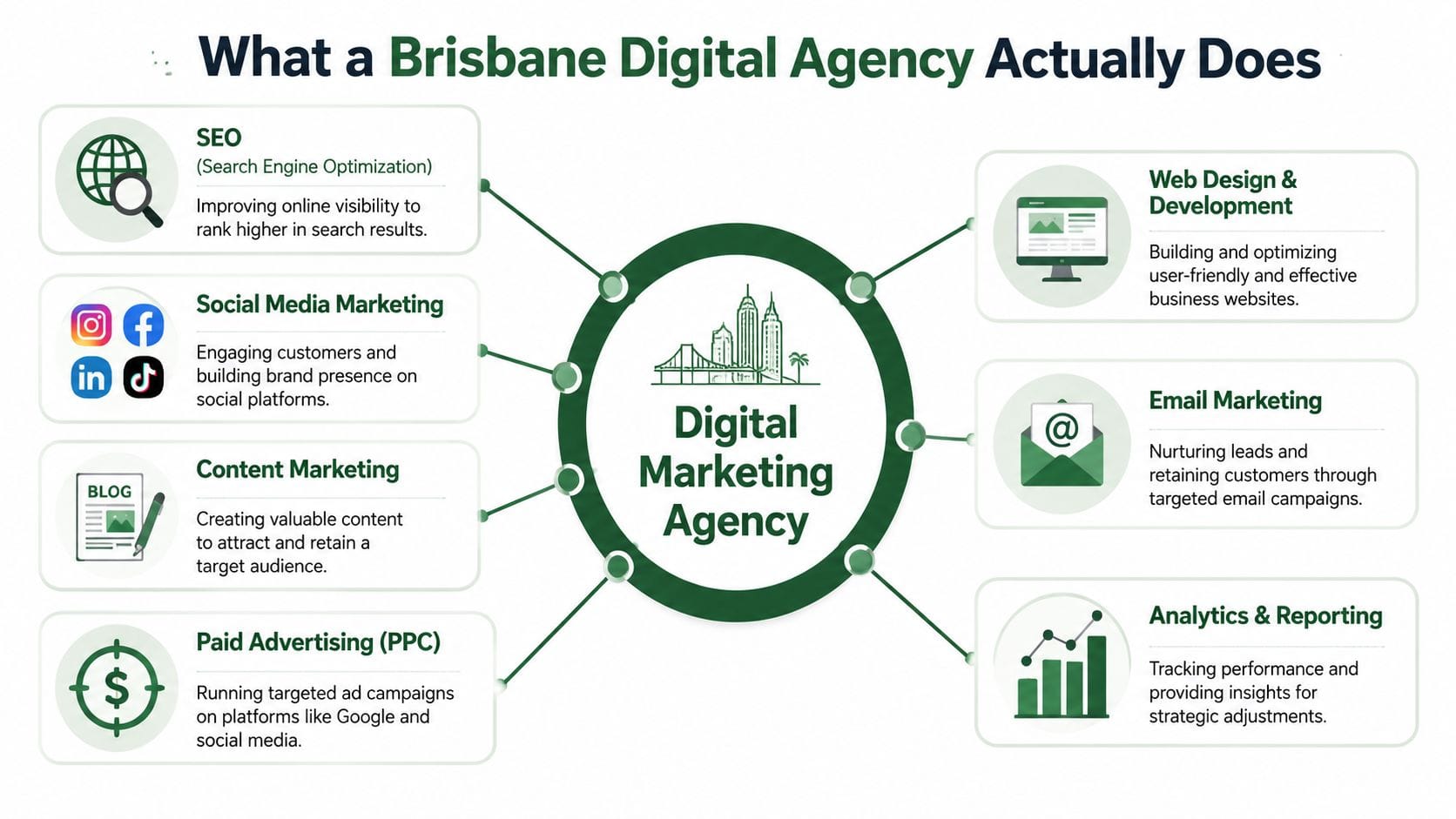
The phrase “full-service agency” gets thrown around a lot. For a small business, the useful version is much simpler. A Brisbane agency should help the business get found, get chosen, and get contacted.
This visual sums up the service mix most owners are paying for.
SEO brings in people already looking
SEO is the channel that helps a business appear when someone nearby searches for what it sells. For a Brisbane electrician, that might mean service pages for suburbs, better page structure, clearer service copy, and a Google Business Profile that isn't neglected.
The goal isn't “traffic” in the abstract. The goal is local intent. A good SEO campaign focuses on pages that answer buyer questions, improve site speed and clarity, and make it easy to call, book, or request a quote.
For businesses comparing providers, Brisbane digital marketing consultants is a useful starting point because consultant-led strategy often sits between full DIY and a bigger retained agency model.
Paid ads buy speed
Paid ads are useful when the business wants enquiries sooner rather than later. Google Ads can capture high-intent searches. Paid social can create awareness, retarget visitors, and support promotions.
There's a benchmark worth keeping in mind here. A well-run paid advertising campaign can deliver a 200% return on investment, and one practical model is the 40-30-20-10 Budget Framework, with 40% going to high-intent ads, 30% to long-term SEO and content, and the remainder to supporting tech, based on Ronin's guide to digital marketing agency success rates.
That doesn't mean every campaign will hit that mark. It means the agency should be able to explain the path to ROI in plain language before a cent is spent.
Social media and content build familiarity
A West End café usually doesn't need random posting. It needs consistent, recognisable content that makes people remember it when they're choosing where to meet, eat, or order from. That can include short-form videos, offer posts, customer photos, menu updates, and local event tie-ins.
Tools matter here because social management gets messy fast. For businesses wanting to understand the systems agencies use behind the scenes, it's worth discovering social media tools with Aicut, especially if comparing DIY scheduling against outsourced management.
Social media works best when it supports a real business objective, such as bookings, repeat visits, event attendance, or enquiry volume.
Web design email and reporting turn attention into leads
Traffic without conversion is wasted effort. That's why agencies often handle the website, landing pages, enquiry forms, and email flows alongside channel management. A tradie site doesn't need to win design awards. It needs clear service areas, trust signals, mobile speed, and a quote form that works properly.
Then comes reporting. The useful questions are basic. Which pages generate enquiries? Which campaigns produce calls? Which suburbs respond best? Which offer gets ignored? If an agency can't answer those questions clearly, it's probably managing activity rather than outcomes.
A digital marketing agency for small businesses earns its place by connecting all of these pieces. SEO gets the business found. Ads create speed. Social and content build trust. The website and follow-up process convert attention into work.
Deciding If an Agency Is Right for Your Budget
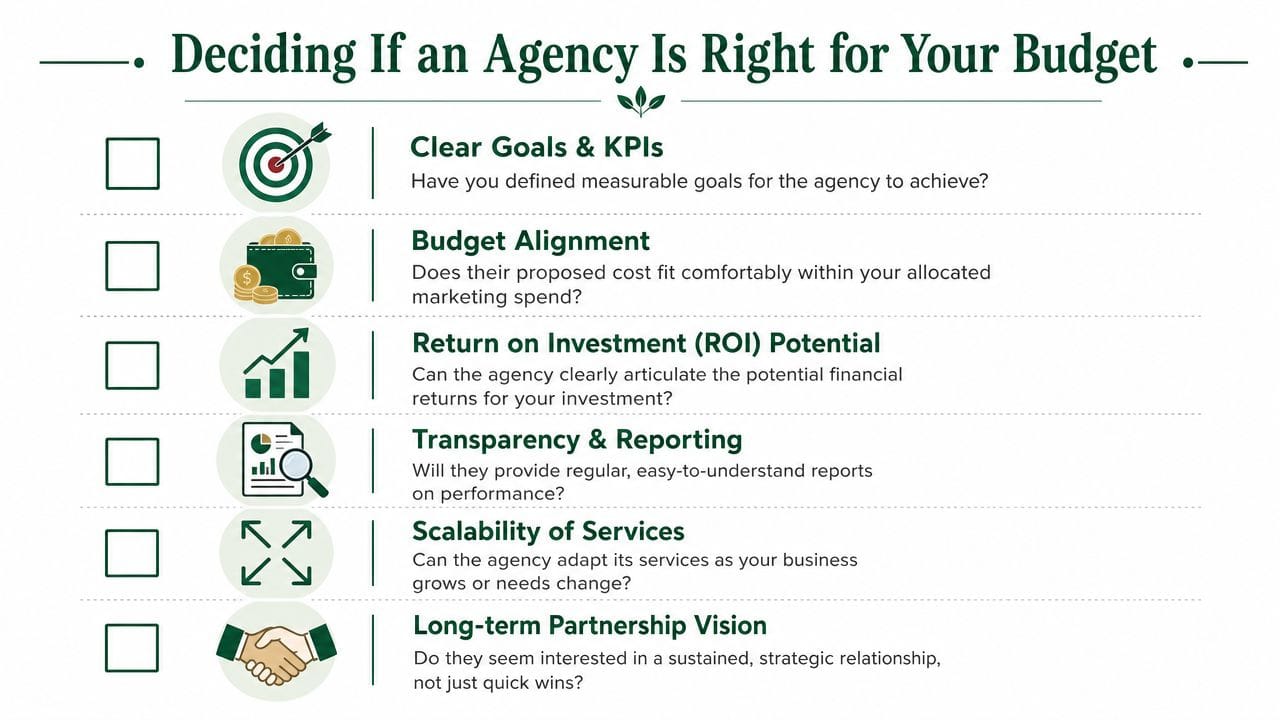
Many agency websites often get slippery. They'll talk about growth, visibility, authority, and momentum, but avoid the blunt question every small business owner is asking. Is this worth paying for right now?
The honest answer is sometimes no.
When DIY is the smarter move
If the total annual marketing spend is under $10k, many small business owners are right to question whether agency fees make sense. For budgets this tight, learning core digital marketing skills internally can often create better long-term value than paying an agency, as discussed in this Reddit thread from an Australian agency owner.
A sole trader with a simple offer often gets further by doing a few basics properly:
- Claim and improve local listings: Keep business details accurate and complete.
- Tighten the website copy: Make services, locations, and next steps obvious.
- Run one channel well: Usually Google Business Profile activity, local SEO basics, or a tightly controlled ad campaign.
- Follow up leads faster: A quicker response often matters more than a fancier campaign.
DIY also makes sense when the business still hasn't nailed its offer. If the owner can't clearly say what service is most profitable, which suburb matters most, or what kind of customer is the best fit, an agency will spend time clarifying basic commercial questions instead of accelerating growth.
When agency support starts to make sense
Agency support usually becomes more logical when the business has some traction and a clear need for consistency. The owner knows which services to push, knows roughly what a new customer is worth, and knows that lost time has become expensive.
For businesses weighing local SEO specifically, affordable SEO in Brisbane can be a helpful comparison point because search is often the first outsourced service that produces compounding value over time.
Honest benchmark: If a business can't tolerate a few months of testing, refinement, and process cleanup, it probably isn't ready for an agency relationship yet.
A quick readiness check
A business is usually closer to “agency ready” if most of these are true:
- The owner is too time-poor to manage campaigns weekly.
- The website already represents the business reasonably well, even if it needs work.
- There's a clear service or product focus.
- The business can track enquiries, bookings, or sales in some form.
- There's enough margin in each sale or job to justify external help.
If only one or two of those boxes are ticked, DIY or a short consulting engagement often makes more sense than a full retainer. A digital marketing agency for small businesses shouldn't be sold as mandatory. For some Brisbane operators, it's the right next step. For others, it's a premature expense.
Finding Your Local Partner and Spotting Red Flags
Once the budget decision is made, the next challenge is choosing well. Brisbane has no shortage of agencies, freelancers, and consultants claiming to do SEO, paid ads, websites, and social. The hard part isn't finding options. It's sorting useful partners from polished sales teams.
This image captures the process most owners go through.

Where to look beyond Google
Google is still a logical place to start, but referrals usually save time. Ask nearby business owners who manage their campaigns. Accountants, web developers, photographers, and CRM implementers often know which agencies communicate well and which ones disappear after sign-up.
Local business groups can help too. The useful question isn't “Who's the best agency?” It's “Who explains things clearly, reports transparently, and understands small business constraints?”
Questions worth asking on a discovery call
Australia has a highly connected online population. With 97.1% of Australians actively using the internet, an agency should be able to explain how it will capture a business's share of that audience instead of hiding behind vanity metrics, based on Sixgun's Australian digital marketing statistics roundup.
A solid discovery call should answer practical questions like these:
- How will success be measured? Ask whether the agency tracks leads, booked jobs, purchases, or calls, not just impressions.
- What happens in the first month? Good agencies can outline setup, research, fixes, content, and campaign priorities.
- Who does the work? Owners should know whether work is handled locally, outsourced, or split across contractors.
- What needs to change on the website? If the answer is “nothing” before any review, that's often a warning sign.
- How often will reporting happen? Monthly is common, but clarity matters more than frequency.
- What will the business need to provide? Photos, service details, approvals, access, pricing info, and customer insights all affect speed.
Ask the agency to explain its strategy as if speaking to a busy café owner between the morning rush and the lunch prep. If the explanation still sounds muddy, execution probably will too.
Red flags that usually show up early
A few patterns tend to signal trouble:
| Red Flag | Why it matters |
|---|---|
| Guaranteed rankings | Search performance depends on competition, site quality, and follow-through. Guarantees are often sales language. |
| Pressure to sign quickly | Good fit takes discussion. Rushed sales usually favour the agency, not the client. |
| Reports full of jargon | If a business owner can't understand reporting, they can't judge value. |
| No questions about margins or lead quality | An agency that ignores business economics may optimise the wrong thing. |
| One-size-fits-all packages | Brisbane businesses have different goals, local footprints, and sales cycles. |
A reliable local partner should sound measured, not flashy. It should talk about trade-offs, not magic. That's usually a better sign than any slick proposal.
Sample Costs Timelines and a Brisbane Case Study
Pricing is where many owners either overcommit or stall completely. The easiest way to make sense of agency costs is to treat them like staffing and systems, not like a mysterious creative expense.
What packages often look like
For Australian small businesses, a basic agency package usually sits at $2,000 to $5,000 per month, and outsourcing can be far cheaper than building a small in-house team, which can exceed $283,550 per year with overheads, according to Digilari's breakdown of digital agency costs in Australia.
That doesn't mean every business should jump straight into a monthly retainer. It means owners should compare agency support against the full cost of hiring, training, managing, and coordinating multiple in-house roles.
Here's a simple planning table.
| Package Tier | Ideal For | Estimated Monthly Cost (AUD) | Core Services Included |
|---|---|---|---|
| Basic Presence | New or small local operators who need a clean foundation | $2,000 to $5,000 | Basic SEO, one to two channels, website updates, basic lead tracking |
| Growth-Focused SME | Established businesses needing multi-channel support | $5,000 to $15,000 | SEO, PPC, CRM automation, lead scoring, content, reporting |
| Project-Based Work | Businesses with a specific website, launch, or setup need | $500 to $50,000 | Scope varies by complexity and deliverables |
The growth-focused range above comes from DesignRush's Brisbane digital marketing agency pricing overview, which also notes hourly rates from $80 for junior teams to $200 for expert consultants.
Agency versus in-house
A lot of small businesses compare agency pricing to “doing it ourselves” and stop there. That's the wrong comparison.
The better comparison is this:
- Agency model: A single monthly cost that gives access to strategy, execution, reporting, and channel management.
- In-house model: Salaries, super, hiring time, software, management overhead, leave coverage, and the risk that one staff member only covers one slice of the work.
A café owner doesn't usually need a full internal team for SEO, paid social, Google Ads, design tweaks, email campaigns, and reporting. A local trade business doesn't need to recruit a mini department before testing whether one suburb page or one search campaign can drive better jobs.
For owners trying to understand how creative and ad performance can scale together, UGC Copilot on scaling agency ROAS adds useful context around the role of content in paid performance.
Better budgeting starts when the owner asks, “What workload am I removing from the business?” not just “What does this cost per month?”
A realistic Brisbane case example
Take a fictional but very typical trade business called Northside Plumbing. It services Brisbane suburbs, has decent word-of-mouth, and gets patchy website leads. The owner has no appetite for filming endless videos or learning ad platforms late at night. The immediate goal is simple. More qualified job bookings, fewer junk enquiries.
A practical starting package would usually focus on local SEO, service-page improvements, Google Ads for high-intent searches, and basic lead tracking. Early work would include tightening location pages, clarifying service categories, improving contact paths on mobile, and making sure paid traffic lands on pages built to convert.
The first few months typically aren't about miracles. They're about cleanup, focus, and channel alignment. The owner should expect clearer reporting, cleaner enquiry pathways, and a better idea of which services deserve more budget. For a business like this, “measurable improvement” usually looks like a stronger flow of qualified calls and bookings rather than broad awareness metrics.
That's the practical value of a digital marketing agency for small businesses. It doesn't just run campaigns. It narrows the field. It helps the business stop spending across too many ideas and start investing in the channels most likely to produce saleable work.
Taking the Next Step Without the Pressure
Most Brisbane owners don't need more marketing noise. They need clarity. They need to know whether outsourcing will save time, whether the spend is realistic, and whether the agency understands the difference between attention and actual enquiries.
That's the decision line. If the business has a tight budget, a simple offer, and enough discipline to learn the basics, DIY can be the smarter move for now. If the owner is already stretched, the offer is proven, and lead consistency matters, agency support becomes easier to justify.
The right agency relationship should feel lighter, not heavier. Communication should be straightforward. Reporting should make sense. Trade-offs should be discussed early. There shouldn't be inflated promises or awkward pressure to sign before the owner is ready.
Boocoo is one Brisbane option for businesses that want support across SEO, web design, social media management, and paid advertising without a hard-sell approach. The team works with local small businesses that want practical help and clearer marketing systems.
A sensible next step is simple. Shortlist a few local providers, ask direct questions, compare how each one talks about goals and budget, and pay close attention to who treats the conversation like a business discussion rather than a sales pitch.
If a partner can explain the plan clearly, set realistic expectations, and show how the work will save time while supporting growth, that's usually a strong sign the relationship is worth exploring.