

A Brisbane cafe owner watches the neighbour's listing take the calls. A plumber in the west sees the same thing happen across suburbs, even after updating the website and running ads. That frustration usually isn't about one bad keyword, it's about a search result scene that rewards the businesses that look more complete, more local, and more trusted in the exact suburb where the customer is searching.
That's why local seo competitor analysis works better as a map-pack exercise than as a generic national report. In Brisbane, the main contest is often happening across CBD, Fortitude Valley, West End, New Farm, and the surrounding suburbs, not under one broad city label. Australian “near me” searches grew by 136% during 2023, and the 2024 Yellow Digital Report found 93% of Australians search online for local brands, which tells any small operator that local discovery is now a normal buying habit, not a side channel (local search behaviour evidence).
A useful audit doesn't start by copying a rival's keywords. It starts by checking what Google already rewards in the exact service area, then comparing that against what a business controls, such as profile completeness, suburb pages, reviews, and website freshness. A broader comprehensive SEO audit can help surface technical issues too, but a local competitor review is the sharper tool when the phone keeps ringing for the shop down the road.
For Brisbane owners who want a sanity check on whether SEO is even worth the effort, this practical guide on is SEO worth it for small business? gives useful context without the fluff.
Why Brisbane Businesses Need a Local Competitor Audit
A small clinic in Coorparoo can do everything right on its website and still lose the map pack to a clinic in Woolloongabba with stronger local signals. The same thing happens with plumbers, cafes, and trades across Brisbane, where proximity, profile quality, and local proof often matter more than who has the flashier homepage. That's why the question isn't “Who ranks in Brisbane?” It's “Who shows up for this suburb, this service, and this kind of customer intent?”
Practical rule: if the customer is choosing between three nearby businesses, the map pack is the battleground, not the homepage.
The market is broad enough that a competitor review has to be split by suburb and service category. A business that only checks “Brisbane SEO” is missing the way people search by micro-neighbourhood, landmark, or urgent need. A local seo competitor analysis becomes a decision tool when it shows where a smaller business can win in an underserved pocket, rather than trying to beat every chain across the whole city.
That's also why a spreadsheet beats a vague impression. One row for each rival, one column for suburb coverage, one for review volume, one for rating, one for photo freshness, one for service-area wording. Once those signals are visible side by side, the opportunity usually becomes obvious.
For a Brisbane owner trying to decide what to fix first, the most useful output is often a short list of gaps, not a long report. A local SEO review can point to one suburb page, one better profile description, or one service-specific proof point that changes what customers see first. For a related example of how search result layouts affect what people click, the internal guide on SERP basics gives a clean, plain-English overview.
Finding Your Real Brisbane Competitors
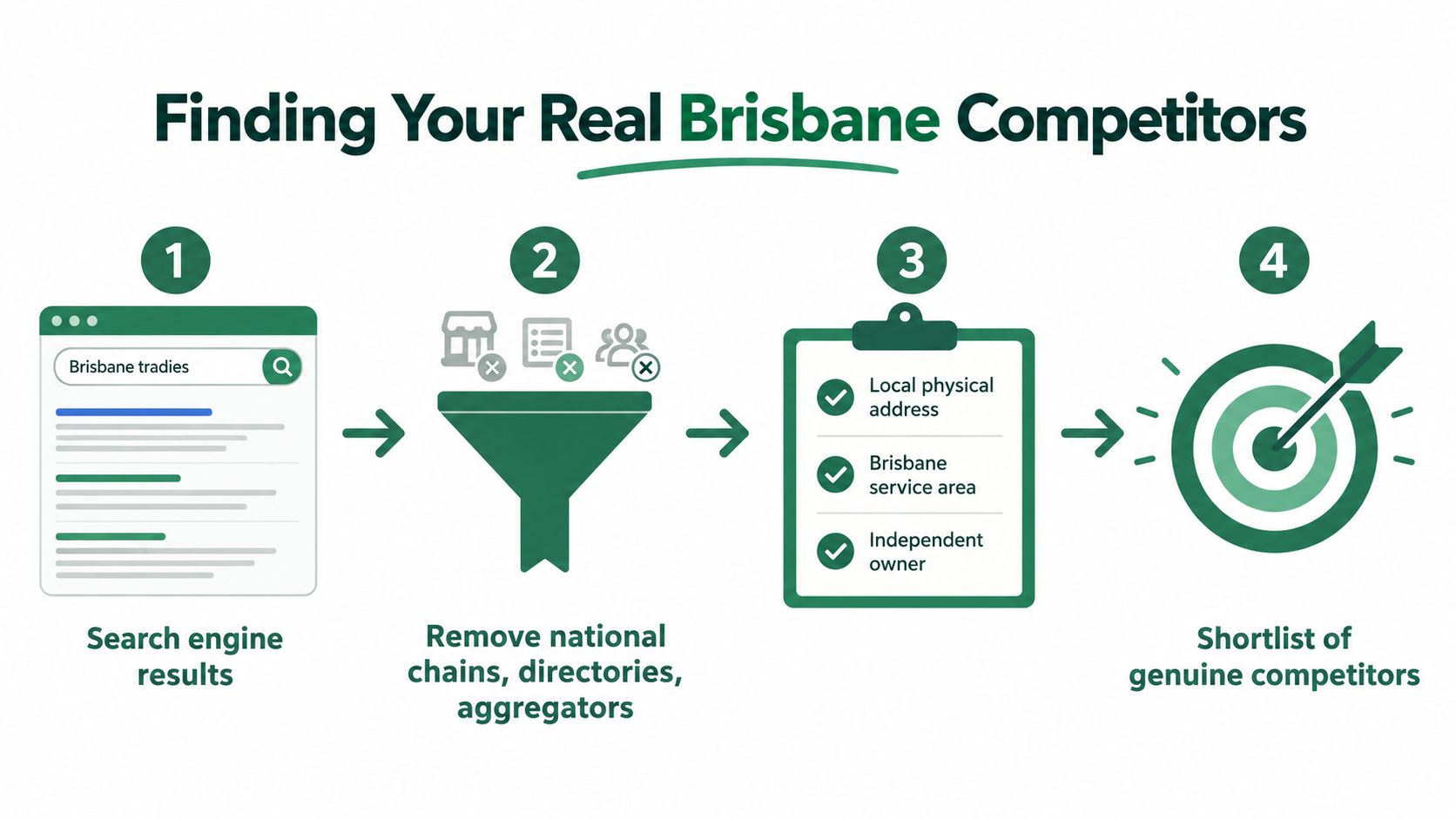
The first mistake is treating every visible result as a competitor. A national franchise page, a Yellow Pages listing, a job board, or a directory site can crowd the screen without being a genuine benchmark for a Brisbane small business. ABS data for 2024-25 reported 51% of Australian businesses used social media for online presence and 32% received orders online, but those are adoption benchmarks, not ranking outcomes, so they're useful for context only (ABS business technology release).
A clean way to build the list
Start with 20 to 40 high-intent queries built from service and suburb combinations. For a plumber, that might mean emergency repair, hot water, blocked drain, and leak detection across suburbs like Paddington, Ashgrove, and Milton. Record the results from a consistent Australian location and classify each visible business by Google Business Profile, local pack, organic result, directory, or review platform.
The point is to separate a true rival from a platform that merely borrows visibility. ABS defines web presence as a website or controlled page and explicitly excludes online listings, directories, and social media, so those surfaces should be tracked separately rather than blended into one score. That distinction matters because a business can look active everywhere without owning a strong website or a proper local search footprint.
What gets disqualified quickly
A result should usually fall out of the shortlist if it lacks a local address, has no Brisbane service area, is clearly not independently operated, or only exists as an aggregator profile. A mobile-only trade business can still compete, but only if the profile and landing pages show clear service coverage and trust signals. A solo owner doesn't need fifty rivals here, just the handful that take the calls.
A short list is more useful than an impressive one. Five genuine competitors across the right suburbs will tell more truth than twenty irrelevant names.
For a simple workflow on Brisbane competitors, keep the shortlist to businesses with a real local footprint, direct customer contact, and a profile or page that can rank against yours. The internal guide on how to add your business to Google helps when a profile itself needs a clean foundation before any comparison starts.
Reading Relevance, Distance and Prominence in the Map Pack
Google says local rankings are driven mainly by relevance, distance, and prominence (Google Business Profile help). That sounds abstract until it's turned into audit fields a business can score on a spreadsheet.
Turn the three factors into checks
| Factor | What it means | Profile fields to check | Audit question |
|---|---|---|---|
| Relevance | How closely the listing matches the search | Categories, services, suburb wording, photos | Does the profile clearly say what the business does? |
| Distance | How close the searcher is, or how close the query points | Service-area wording, suburb pages, map pin accuracy | Does the business show up where the customer actually is? |
| Prominence | How well known the business appears to be | Reviews, links, articles, directories, organic rank | Does the business look trusted compared with the rival next to it? |
A Fortitude Valley plumber and a West End cafe can both lose for different reasons. The plumber might have plenty of reviews but weak service descriptions. The cafe might have decent photos but thin signals that prove it serves a specific local crowd. A good audit separates those problems instead of calling everything “visibility”.
Use the factor, not just the rank
Many dashboards fall apart. They report a position, but they don't explain whether the business lost because the profile is vague, the area is under-defined, or the website is weaker than the competition. A useful comparison asks whether the rival has clearer categories, stronger local wording, more review activity, or a better organic result next to the map pack.
For a deeper look at how ranking signals interact, the explanation of why some businesses win the map is worth reading alongside a manual audit.
Practical insight: distance is the one factor a Brisbane owner can't change directly, so the real levers are clarity, locality, and proof.
A simple scoring sheet can expose where the search results reward weak signals. If a competitor wins with a messy page but strong reviews, that's a signal to improve prominence. If another wins with slim reviews but very clear service relevance, that's a signal to sharpen categories and suburb wording first.
Auditing Google Business Profiles and Citations
A Brisbane business owner can usually tell within a couple of minutes whether a rival's Google Business Profile is being maintained or ignored. Categories, services, hours, service areas, photos, posts, Q&A, and owner replies all signal trust before the website even loads.
The profile fields that deserve a score
Use one simple checklist for each competitor, then score what you can see.
- Categories: check whether the primary category is accurate and whether supporting categories make sense.
- Service list: look for complete service coverage, not one vague line.
- Opening hours: confirm they are correct and believable.
- Service-area wording: see whether the business names suburbs clearly.
- Photo freshness: note whether images look current.
- Posts: check whether the profile is being updated.
- Q&A: see whether questions are answered.
- Owner responses: review how quickly and how helpfully the business replies.
- Click-to-call visibility: check whether the phone path is obvious.
- Website link: confirm it points to the right landing page.
- Review count: record the total.
- Average rating: note the score.
- Recent reviews: check activity, not just lifetime volume.
- Local proof: look for completed jobs, premises shots, or suburb-specific evidence.
- Profile completeness: mark anything left blank, outdated, or generic.
That is enough to fill a spreadsheet without drifting into busywork. An incomplete profile usually shows the same pattern in the wild, missing services, old photos, thin suburb wording, or no owner response at all.
Then check citations separately
Citation work sits beside the profile audit, not inside it. For Brisbane operators, that matters because a business can appear across many directories and still have weak local pages. ABS methodology defines web presence as a website or controlled page and excludes online listings, directories, and social media, so citation consistency needs its own check.
Run a straight NAP sweep, name, address, phone, across the directories and industry sites competitors use. New suburbs, shared offices, and mobile-only trades are common sources of inconsistency, especially for plumbers, cafes, and clinics that serve several parts of the city. The internal guide on how to add your business to Google is a practical companion when a profile needs fixing before the audit starts.
For owners who want a tighter checklist, Google Business Profile tips can sit beside a manual review of each competitor's listing. Log the results in the same spreadsheet with a simple present, weak, or missing score. Keep the sheet honest. If a rival wins with stronger suburb wording and cleaner citations, that is usually enough to explain why they hold the map pack spot over a business with more reviews but less clarity.
Building a Local Keyword and Service Gap Matrix
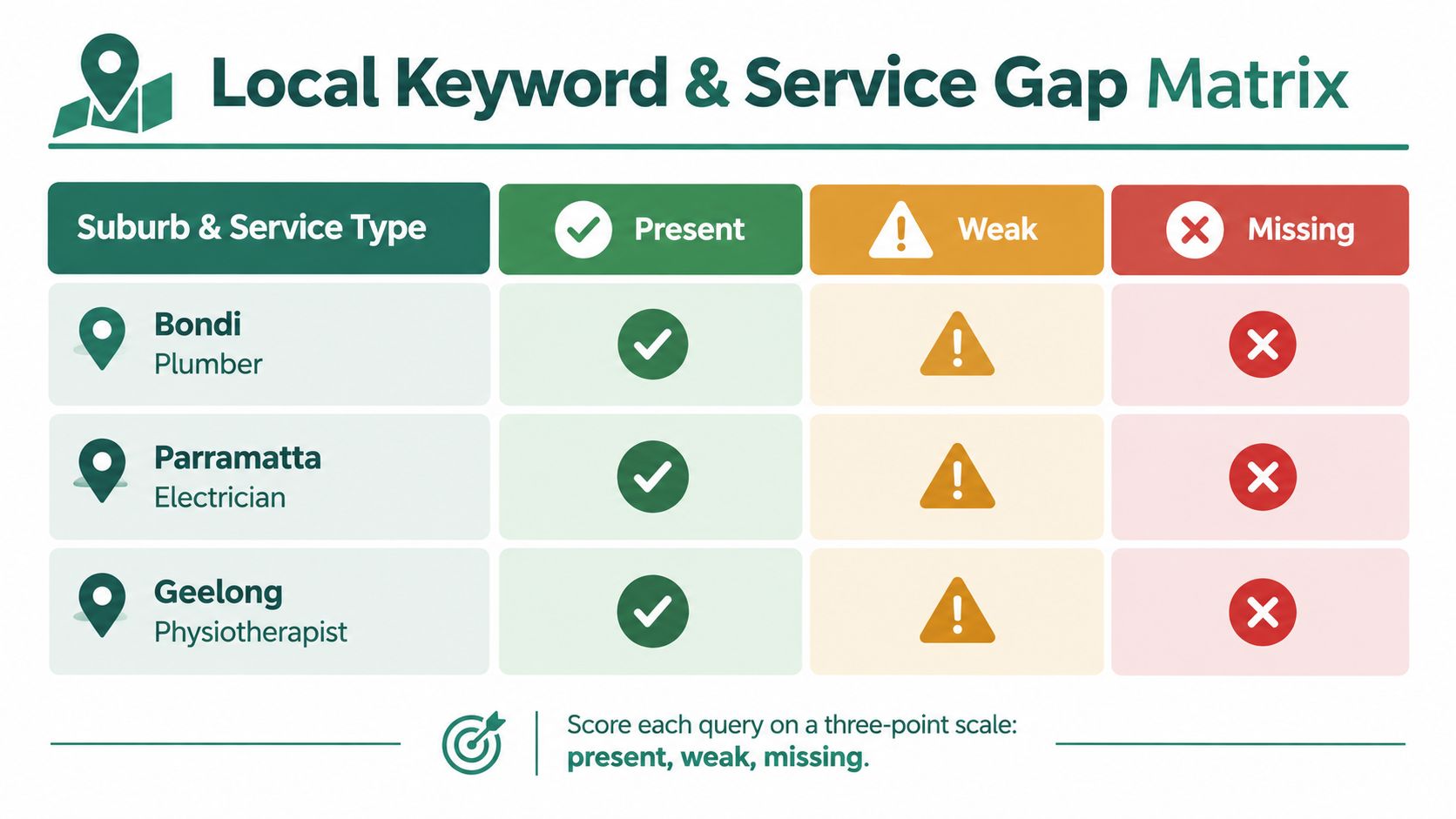
A gap matrix stops the audit from becoming a list of observations with no priority. The simplest version uses three labels, present, weak, and missing, then scores each query against each competitor. That's enough for a solo owner to see which suburb or service is under-served without getting lost in search volume debates.
Weight intent before volume
A query for emergency call-out, booking, or quote request should matter more than a generic curiosity search. A business that ranks weakly for the highest-intent query in one suburb may need to fix that page before writing any new blog content. That's why a gap matrix should be built around action-led phrases, not just broad topics.
A Brisbane electrician is a good example. If larger rivals mention emergency work but don't explain response areas, after-hours coverage, or transparent pricing, the smaller business can win by owning that language across a handful of suburb pages and the Google profile. The edge comes from clarity, not from trying to outrank every chain on a broad city term.
Keep the sheet brutally simple
The spreadsheet only needs a few columns:
- Query: the service plus suburb.
- Competitor: the business being compared.
- Status: present, weak, or missing.
- Intent: quote, booking, call-out, or general.
- Opportunity note: what's missing and what to build.
That format is easy to maintain and hard to overcomplicate. ABS reports that AI use among innovation-active small businesses reached 19% in 2024-25 compared with 4% among non-innovation-active small businesses (ABS AI adoption release), which suggests many Brisbane micro-businesses still benefit more from disciplined manual checks than from fancy tooling.
For a practical local search workflow, the internal guide on SEO for small business in Australia pairs well with a spreadsheet-first approach. Boocoo also uses this kind of competitor gap review as part of local SEO work for Brisbane operators, especially when budget is tight and the owner needs the highest-value fixes first.
Decoding Competitor Reviews for Real Operational Insights
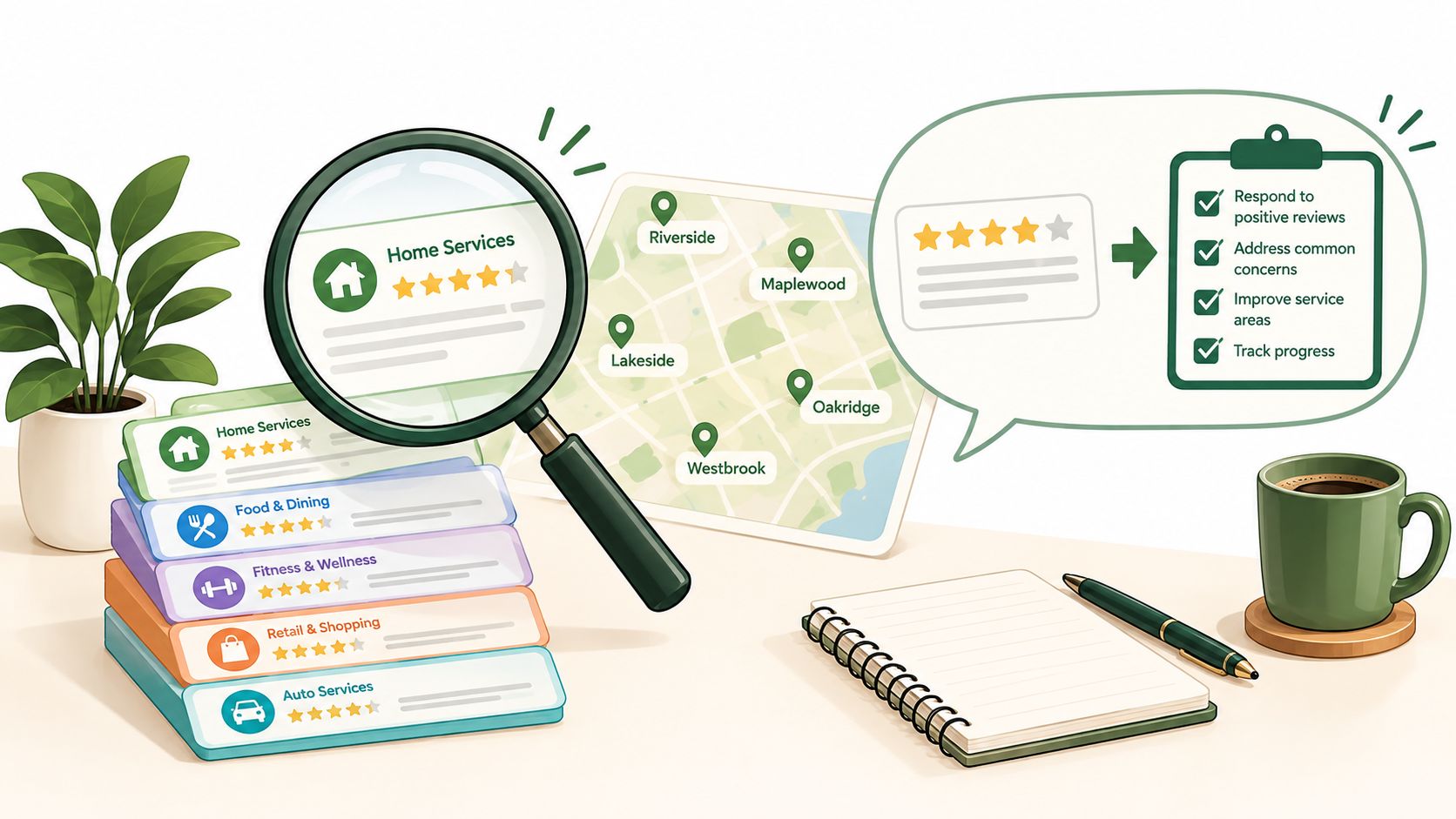
Review counts matter, but they're not the whole story. Australian research reports that 83% of consumers check Google reviews before buying and 62% would avoid a business with consistently poor reviews, while separate Australian figures show 85% or more read product reviews before purchase and 36% check at least two review sites first (Australian review behaviour summary). That means the words inside the reviews can matter as much as the star rating.
Read the themes, not just the score
A good review audit codes recent feedback by service type, suburb, response time, recurring complaint, praised behaviour, pricing expectation, and the language customers use to describe the outcome. A cafe that keeps getting comments about slow lunches has a different issue from one that gets praised for friendly staff but criticised for no weekend hours. A plumber whose reviews keep mentioning punctuality is signalling a different advantage from one whose customers talk about transparent quotes.
Review analysis gets useful when it points to an operational choice, not when it just flatters the business.
That's the trap with review-volume obsession. Copying a rival's review-request wording can look productive, but it's less valuable than fixing the service failure that keeps appearing in the text. If a Brisbane clinic sees competitors getting praised for fast callbacks while its own category is complaints about missed calls, the answer is in the phone process, not the template.
Watch for real language
Genuine reviews tend to sound like customers. They mention the suburb naturally, refer to a job or visit in plain terms, and often include a specific staff interaction. Scripted or incentivised reviews often feel oddly polished, repeat keywords too neatly, or lean on phrases that sound written for search engines.
A better local seo competitor analysis treats reviews as a map of operational pressure points. If several rivals are getting similar complaints, that's a sign of unmet demand. If one rival keeps winning praise for responsiveness or clear quotes, that tells the business what customers in that market reward.
Tracking Results and Knowing When to Get Help
A local competitor audit only earns its keep if it turns into a monthly routine. For a Brisbane owner, the numbers worth watching are the ones tied to enquiries, not the ones that make a dashboard look busy. Track share of local-pack appearances, median organic position, qualified calls and forms per landing page, and cost per qualified lead. If a metric does not help decide what to fix next, leave it out.
Build a simple monthly rhythm
Run the same 20 to 40 queries each month, on the same device and from the same location where possible. Record Google Business Profile changes, note competitor promotions, and mark shifts in review activity or local pack presence. That gives you a cleaner read on normal movement versus a real drop in visibility.
The website still matters. A 2024 Telstra consumer survey found 72% of Australian consumers were less likely to buy from a business if its website was not up to date (Telstra consumer survey). In practice, stale opening hours, weak service pages, broken enquiry paths, and outdated suburb coverage can undermine trust even when the map pack looks decent.
A tight-budget decision list
- Recheck the same queries monthly: keep the suburbs and services consistent.
- Log trust signals: reviews, photos, hours, and response rate.
- Mark page freshness: service pages, pricing cues, contact details, and local proof.
- Spot weak competitors: look for rivals ranking with thin pages or poor service detail.
- Fix the easiest gap first: update the profile, then the service page, then citations.
When time is tight, most Brisbane owners can do the first pass themselves. When the site needs restructuring, the citation picture is messy, or the local pack changes do not make sense, outside help is justified. A local partner such as Boocoo can take competitor gap analysis, mapping the rival scene, and the follow-up updates off the owner's plate, without turning the process into a giant agency exercise. If that sounds like the right handoff, outsourcing SEO services explains what to keep in-house and what to pass on.
Pick five real Brisbane competitors, score them against one suburb and one service, then fix the biggest missing signal this week. If the business needs help turning that shortlist into a working action plan, a short chat with a local SEO partner is the fastest way to stop guessing and close the gap.