
A SERP is the page Google shows after a search, and in Australia Google held 88.21% of search market share in July 2026, compared with Bing at 8.75%. For a Brisbane business, that page is the front door local customers walk through before they call, request directions, or visit a website.
A café owner in West End might search “best coffee near me” during the morning rush. A plumber in Kedron might check “emergency plumber Brisbane” from a phone, only to find paid ads, a map, review stars, and competitors before the first ordinary website listing appears. The business may be excellent, but if its details are hard to find on that page, customers may never reach the shopfront.
The Search Results Page Explained for Brisbane Owners
Consider a Brisbane tradie checking their own service from a mobile. They expect to see the business near the top, but the results page is crowded with advertisements, a map, local competitors, questions, images, and sometimes an AI-generated answer. The experience can feel less like opening a directory and more like trying to spot one sign among many on a busy street.
A SERP, or Search Engine Results Page, is the complete page Google displays after someone enters a search query. It includes more than unpaid website links. The page can contain ads, map listings, review information, direct answers, related questions, videos, images, and other features selected for that particular search.
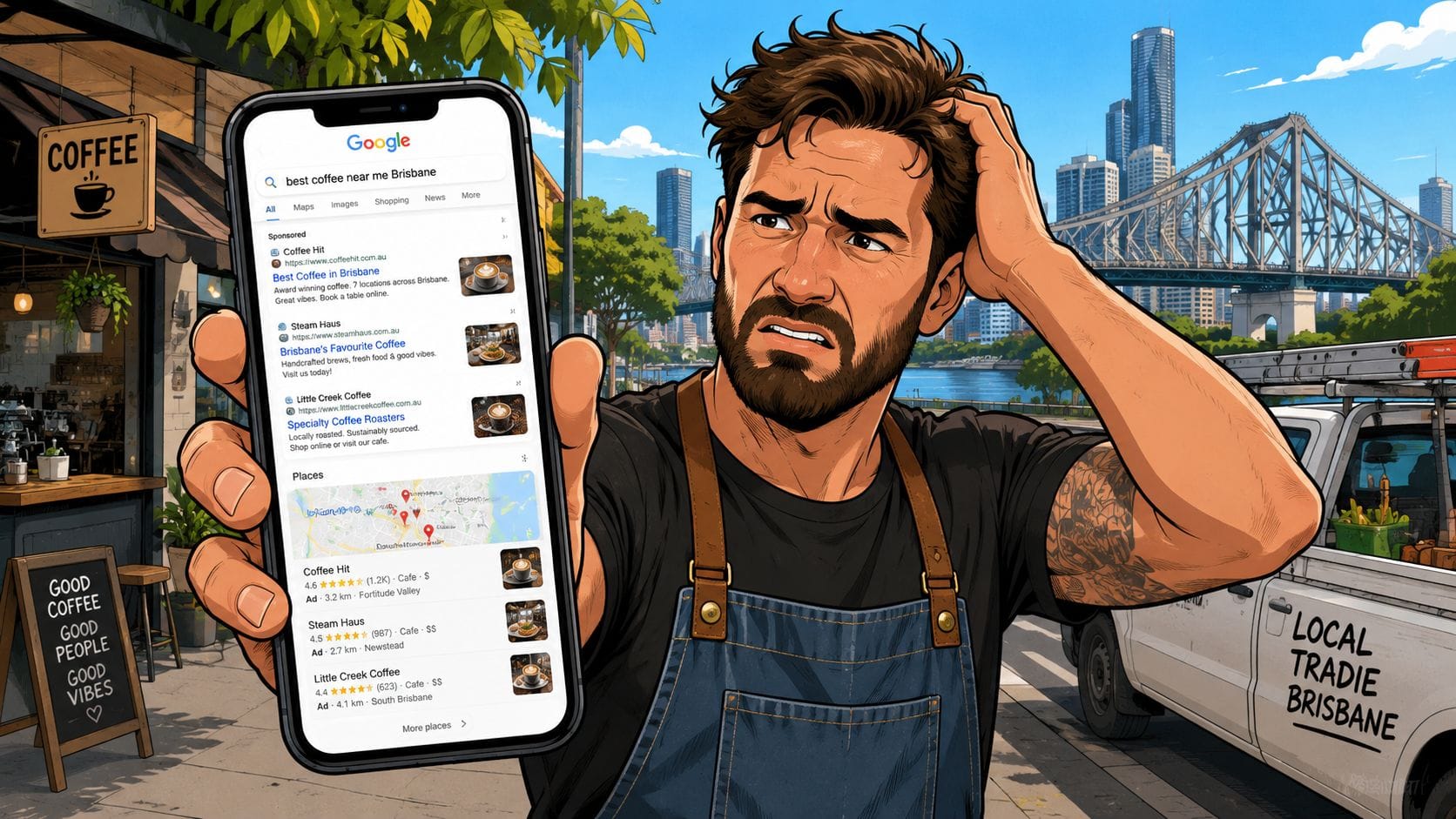
The clearest analogy is a digital shopfront window. The title and description are the sign above the door. The map listing is the location marker. Review stars act like recommendations from people already inside. A phone button gives a passer-by a direct way to speak with the owner, while a weak or missing listing makes the customer keep walking.
A search result's meta description can influence whether someone chooses a listing, even though it doesn't directly determine the ranking position. Businesses that want a plain-language explanation can review this guide to understand what a meta description means, then check whether each important page has a useful description that matches the service and suburb.
Google's Australian search environment is heavily concentrated on mobile. The ACCC reported that Google's mobile search share stayed around 98% from September 2021 to July 2024 (ACCC reporting via the Australian Computer Society). For a Brisbane owner, the practical point is simple: the SERP must work as a quick street sign on a phone, not just as a polished desktop page.
The Main Building Blocks of a Modern SERP
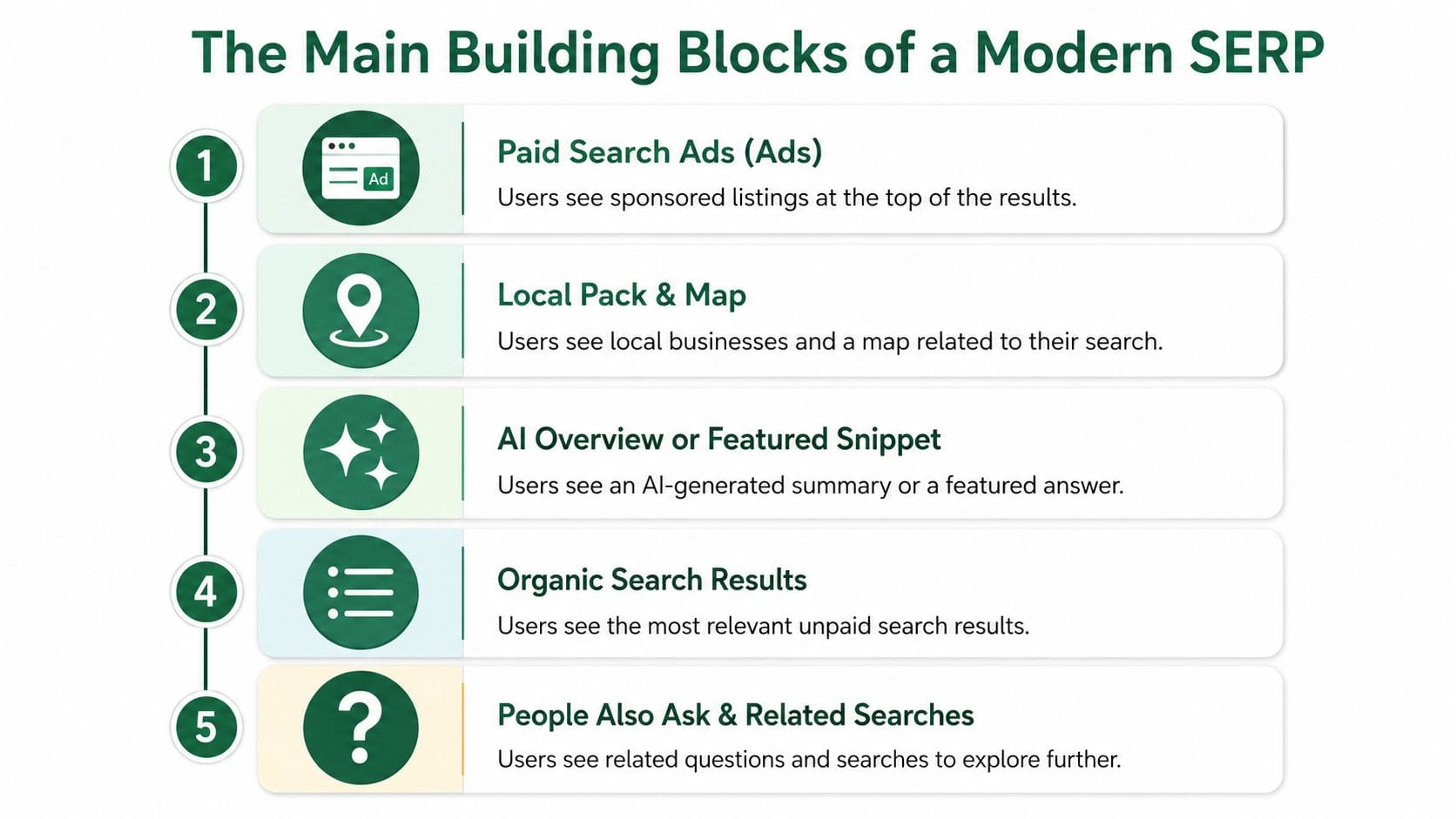
A modern SERP changes according to the search. Someone seeking a nearby café sees a different layout from someone asking how a heat pump works. The main building blocks still follow a recognisable pattern.
Paid search ads
Sponsored listings can appear above or below the unpaid results. They usually carry an “Ad” label and send the searcher to a selected landing page. For a Brisbane electrician, an ad may produce an immediate call or quote enquiry, but each click is part of a paid campaign and needs a controlled budget.
Local pack and map
The local pack commonly shows nearby businesses with names, ratings, categories, opening hours, phone options, and directions. It can drive calls, map visits, and walk-ins without a customer visiting the website. A complete Google Business Profile gives Google clearer information to use in this area of the page.
A local SEO plan should connect the profile with suburb-focused service pages, consistent business details, and useful customer feedback. Brisbane owners can also review this practical guide to Brisbane local SEO for ways to improve local visibility.
AI Overviews and featured snippets
An AI Overview summarises information near the top of some searches. A featured snippet can display a short answer taken from a web page. Both can satisfy a question before the user reaches a standard listing, so visibility may involve being cited in the answer as well as ranking in the blue-link results.
Google launched AI Overviews in Australia in October 2024 and began rolling out AI Mode to Australians on 8 October 2025 (Google's Australia-facing guidance). Australian coverage reported that more than one-third of searches produced an AI-generated summary by October 2025, while local reporting linked those summaries with lower click-through to standard links. For a service business, a clear answer can still build awareness, but the page needs strong contact paths when a customer is ready to act.
Organic listings
Organic results are the unpaid website entries selected for relevance. A typical listing contains a page title, web address, and description, with enhanced details sometimes appearing underneath. These results can bring service-page visits, comparison searches, and quote enquiries.
People Also Ask, knowledge panels, and rich results
People Also Ask boxes contain related questions that expand when clicked. A knowledge panel may show information about an established business or entity. Rich results can add reviews, prices, FAQs, images, or other details.
For a clearer explanation of enhanced search listings, this resource on rich snippets explained for SEO gives businesses useful context. Structured data doesn't guarantee a rich result, but accurate page information helps search engines interpret content.
Practical rule: A ranking position is only one part of the shopfront. The feature holding the phone button, map pin, or direct answer may be closer to the business outcome.
How Google Decides What Appears on a SERP
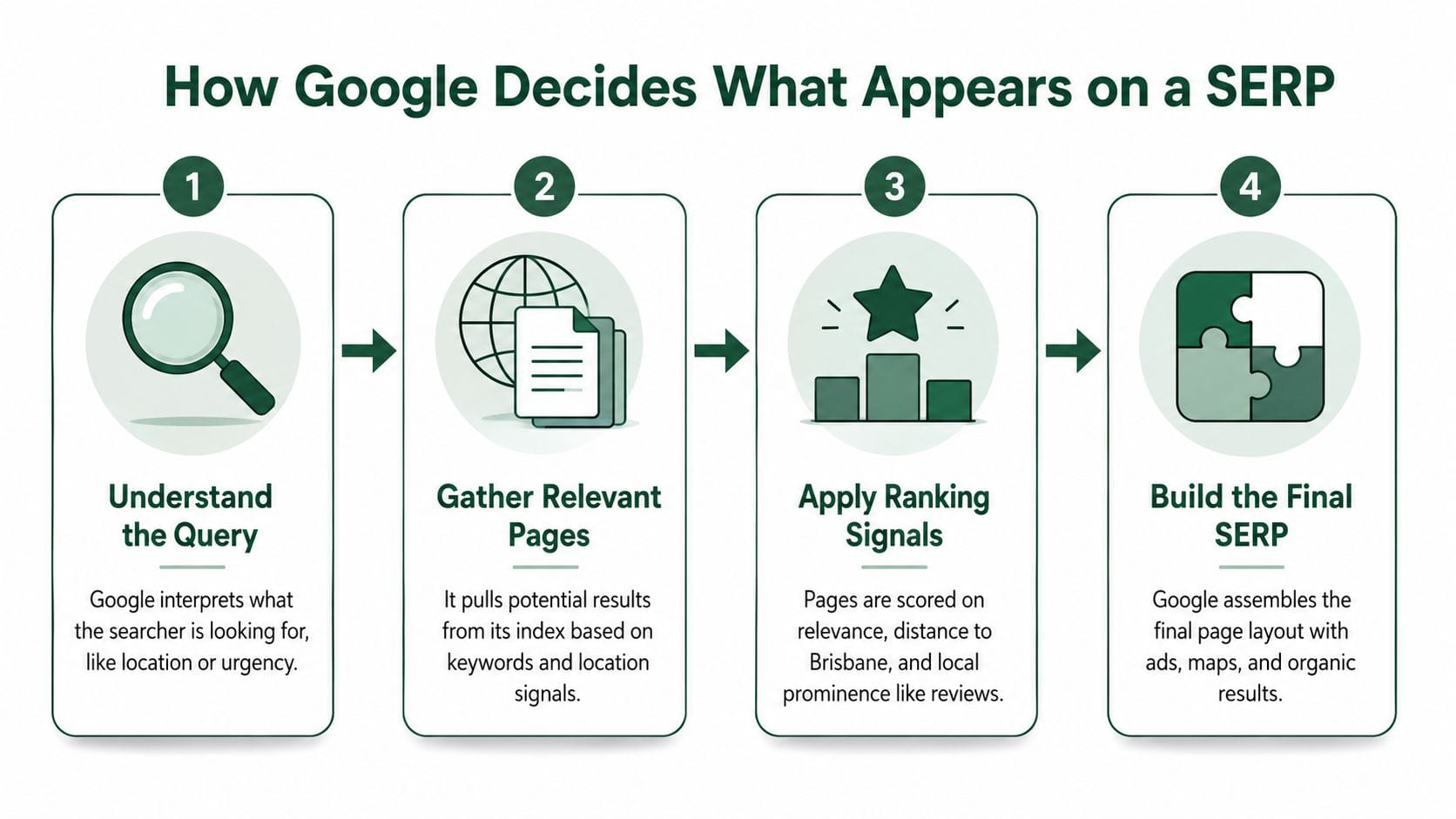
Google builds a SERP by matching a search with information, businesses, and page formats that appear useful for the situation. Brisbane owners don't need to memorise a long list of ranking terms. Four simple stages explain the process.
1. Google interprets the query
The words suggest what the searcher wants. “Emergency plumber Brisbane CBD” signals urgency and a location. “How much does a heat pump cost Queensland” signals research rather than an immediate local call. Google also considers whether the query appears local, informational, commercial, or navigational.
2. Google gathers possible results
Google searches its index for pages and business information that could answer the query. A service page about blocked drains may be relevant to one search, while a suburb page, a profile listing, or an explanatory article may suit another.
3. Google applies ranking signals
Google compares relevance, distance, and prominence. For local searches, an accurate Google Business Profile, correct service areas, strong page information, reviews, and references from other websites can all support visibility. On-page SEO helps Google connect a page with the service and location it describes.
A plumber searching from Kedron at 7am may see businesses close to that area, particularly when the query suggests immediate help. Someone researching renovation costs may see educational pages instead, even if both searches include a similar service phrase.
4. Google assembles the page
Google chooses a mixture of ads, map results, organic listings, questions, images, and direct answers. The final arrangement depends on the query and the searcher's context, including location and device.
Owners looking for a broader introduction can use this guide to understand SEO meaning. The important distinction is that SEO doesn't place a business into one permanent SERP position. Each page can appear differently for different searches.
Why Position One Matters More Than Every Other Spot
Position still matters because users don't scan every result equally. An Australian study covering more than 1,000,000 retail and e-commerce queries found position one received 43.2% of clicks, while position ten received 8.3%, with a sharp decline through positions two to five (Australian position and click data). That older distribution shows why a move lower on the page can reduce visits sharply.
A newer Australian benchmark covering 13 million-plus keywords reports lower averages, with position one at 29.5% CTR, position two at 12.8%, and position three at 8.8%. The same benchmark reports that position-one SEO traffic fell 31% over four years, reflecting the growing space taken by ads and SERP features (Australian CTR benchmark).
| Position | Estimated CTR | Likely Brisbane outcome |
|---|---|---|
| 1 | 29.5% | Strong visibility and a better chance of website visits or enquiries |
| 2 | 12.8% | Valuable exposure, particularly when the local pack or ads appear first |
| 3 | 8.8% | Useful traffic for a well-matched service page |
| 4 to 5 | 15.1% to 19.7% in the older Australian distribution | Visibility can remain useful, but the page layout changes how much attention the listing receives |
| 6 to 10 | 8.3% at position 10 in the older Australian distribution | More impressions may occur than meaningful calls or bookings |
The figures aren't a promise for one Brisbane business. Search type, device, brand recognition, ads, and map features all change click behaviour. A plumber in Morningside may gain more from a prominent map listing and phone action than from a standard organic result several rows lower.
Businesses should track both rank and response. This guide to what CTR means helps owners distinguish being seen from being selected.
A high ranking is useful only when the searcher can find a clear next step, such as calling, requesting directions, or submitting a quote form.
What Brisbane Local Searches Actually Look Like
A search for “emergency plumber Brisbane CBD” may show sponsored results first, followed by a local pack with map pins, business hours, review information, and call options. Organic service pages usually appear beneath those prominent blocks. A business that wants urgent leads therefore needs accurate profile details and a page that explains availability, service areas, and the next action clearly.
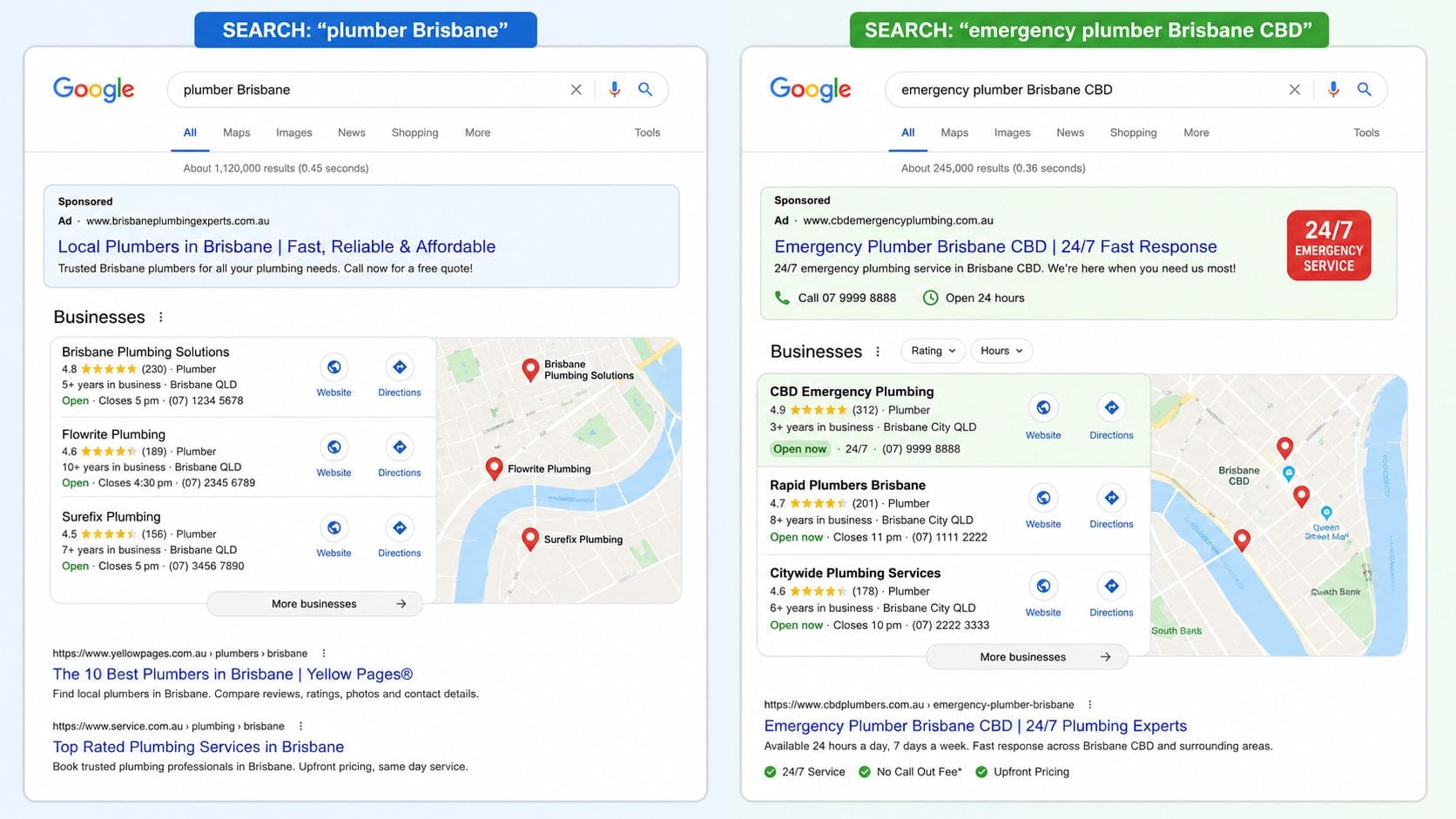
A query such as “plumber near me West End” leans even more heavily on local information. A phone user may tap a call button or directions before opening a website. A business name, category, suburb coverage, current photos, and recent reviews can make the difference between a quick tap and a competitor's listing receiving the enquiry.
A business can inspect its own profile and local competitors without buying an expensive software suite. This guide to a local SEO strategy with GMB data offers context for analysing local listing information, but manual checks remain a practical starting point for a small operator.
Informational searches behave differently
“How much does a heat pump cost Queensland” is not the same type of search as “emergency plumber Brisbane CBD”. The page may show an AI Overview, a featured answer, organic guides, and People Also Ask questions. The searcher may be comparing options rather than calling immediately, so a helpful article can introduce the business before a later service search.
Google's AI Overviews and AI Mode are changing how these pages are arranged. Google's Australian guidance says ads are still expanding into these experiences, so businesses should expect the layout to continue evolving. On mobile, limited screen space makes the order especially important. A map, answer, or ad can appear before the user sees a traditional organic result.
Practical Ways Brisbane Businesses Can Improve Their SERP
A small business doesn't need to rebuild every marketing channel at once. A focused local SEO checklist can improve the information Google and customers see, while keeping the workload manageable.
Quick wins under an hour
- Complete the Google Business Profile: Check the business name, category, phone number, opening hours, website, services, and Brisbane service areas. Remove outdated details and make the profile match the website.
- Add current photos: Upload clear images of the premises, team, vehicles, completed work, or products. A café should show the space and menu items, while a tradie can show genuine project work.
- Review key page titles: Use a clear service and suburb combination where it reflects the page, such as “Emergency Plumbing in West End”. Don't force a suburb onto a page that doesn't serve it.
- Create a review routine: Ask satisfied customers for honest reviews after the job. A request can mention the service naturally, but customers should write their own words rather than receiving fabricated copy.
Weekend improvements
The website should make the local promise obvious within seconds. Each important service deserves a useful page with a clear heading, service explanation, Brisbane coverage, proof of work, contact details, and a visible enquiry option.
Check consistency across business directories, industry associations, supplier pages, and social profiles. The name, address, phone number, website, and service information should tell the same story. Local references can also help discovery, so a business might seek a genuine profile or link from a Brisbane association, chamber, community group, or relevant supplier.
Budget filter: Fix the pages and listings closest to a customer action before commissioning a large content project. A clear service page and working phone path can matter more than a large collection of generic articles.
Ongoing habits
Set a monthly reminder to add a genuine profile update, review new customer feedback, refresh outdated service information, and check important searches from the suburbs served. Search results vary by location and device, so one manual check doesn't provide a complete picture.
Use Google Search Console to identify pages receiving impressions but few clicks. Improve the title and description when the page matches the search but fails to attract attention. A simple rank tracker can monitor a short list of money phrases, while call tracking or a dedicated enquiry form can connect visibility with leads.
Businesses wanting a broader checklist can review how to improve Google search ranking. For local operators that need help across SEO, web design, social media, or paid advertising, Boocoo offers Brisbane-focused digital marketing support, including local SEO audits, on-page work, and visibility improvements.
Measuring Your SERP Progress Without the Overwhelm
Rank reports can become a distraction when they don't connect with sales. A Brisbane owner needs a small set of measures that shows whether search visibility is producing real customer actions.
Four useful signals
- Google Business Profile activity: Watch profile views, calls, and direction requests. These actions show whether local searchers are moving beyond passive visibility.
- Important keyword positions: Check a short list of service and suburb searches with a rank tracker or consistent private-browser checks. Record the trend rather than reacting to one unusual result.
- Website clicks: Use Google Search Console to see which queries and pages generate organic clicks. A page with impressions but weak clicks may need a clearer title, stronger description, or better alignment with the query.
- Enquiries and booked work: Review form submissions, tracked calls, and genuine customer conversations in Analytics or the business's enquiry system. A lower-ranking page that produces qualified jobs can be more valuable than a high-ranking page with no commercial relevance.
Google's results change, and mobile and desktop layouts don't always show the same features. A monthly review gives a more useful direction than checking rankings repeatedly throughout the day.
The right question isn't only “what is SERP position?” It is whether the business appears in the right part of the page for searches that lead to calls, map visits, bookings, and quote requests.