
Search engine optimisation is the practice of making a website easy for Google to find, understand, and show to the right people. In Australia, Google handled about 93.95% of searches in July 2024 and around 90.7% in January 2026, so SEO for a Brisbane business largely means becoming more visible in Google's results.
A suburban plumber may answer the phone after a competitor has already booked the job. A café owner may search for their own business and find another venue appearing first in Maps. Often, the business isn't worse. Its website and local profile give Google clearer information about who it serves, where it operates, and which customer questions it answers.
That's the practical SEO meaning for a small business. It isn't a mysterious trick or a promise of instant rankings. It's a structured way to make a business easier to discover when someone is already looking for its service.
The definition has also widened. Customers may now see an AI-generated answer or a map listing without clicking through to a website, so visibility includes being understood, referenced, and trusted in those search experiences. The sections below translate that shift into sensible Brisbane digital marketing actions that fit a limited budget and a busy schedule.
What SEO Actually Means in Plain English
SEO means improving a website and its wider online presence so search engines can connect it with relevant searches. For a New Farm café, that could mean helping Google understand its menu, location, opening hours, accessibility, and suitability for someone searching for breakfast nearby.
The easiest analogy is a shopfront. A physical shop needs a visible sign, an accessible entrance, clear shelves, and a reputation that encourages people to walk in. An online business needs descriptive page titles, useful service information, a mobile-friendly website, and trusted signals from reviews and other websites.
The Australian context matters
Google's Australian search share was reported at 90.7% in January 2026, while Bing's share was around 6.56%, according to Australian search engine usage reporting. The ACCC also found that Google was the default search engine on more than 91% of mobile browsers and 77% of desktop browsers in Australia as of August 2024, which makes Google's technical requirements commercially important for local operators.
Search is also a normal part of daily behaviour. Australian digital-behaviour reporting found that 88.6% of internet users aged 16 to 64 had used search engines and web portals in the past month as of January 2024 (Australian search statistics). A Brisbane owner therefore isn't optimising for an abstract audience. The owner is trying to be found during a real decision, such as comparing electricians, checking clinic reviews, or finding coffee before work.
Practical rule: If a customer can describe the need in a search box, the business should have a clear page or profile that answers it.
SEO isn't the same as paid advertising. Ads can place a business in a sponsored position while the budget is active. SEO improves the underlying information and experience of the business's online shopfront, helping relevant pages compete for unpaid visibility over time.
The phrase SEO and SEM for agencies can help owners separate search engine optimisation from search engine marketing. For a related explanation of search results pages, the guide on what SERP means is also useful.
AI Overviews and other answer-led results have changed the question. SEO now means making information clear enough for search engines and AI systems to extract, while still giving customers a reason to contact the business when a click is available.
The Three Building Blocks of Every SEO Strategy
A complete SEO strategy has three connected parts: on-page SEO, off-page SEO, and technical SEO. The shopfront analogy keeps the difference simple. On-page work is the sign and the information inside, off-page work is what other people say about the shop, and technical SEO is the building's access, lighting, and structure.
On-page SEO is the signage and shelves
On-page SEO covers the words, headings, page titles, internal links, images, and service information on the business's own website. A New Farm dentist might change a vague page called “Services” to a focused page explaining emergency dental appointments, common patient questions, fees information, and how to book.
The page should use natural language that matches what patients ask. It shouldn't repeat “New Farm dentist” in every sentence. Clear headings and useful answers help both visitors and search engines understand the page.
Off-page SEO is local word of mouth
Off-page SEO concerns signals from outside the website. Reviews, local business listings, supplier directories, community organisations, and relevant websites can all help establish that a business exists and serves a particular area.
A Fortitude Valley tradesperson might earn a legitimate mention from a supplier directory, industry association, or local building resource. That kind of reference is more meaningful than adding the business to every directory available, particularly when the listing is irrelevant or poorly maintained.
Technical SEO is the accessible building
Technical SEO covers the behind-the-scenes conditions that let search engines reach and interpret pages. Mobile usability, loading performance, indexability, secure browsing, sensible site structure, and an XML sitemap all belong here.
If Google's crawler reaches a broken page, can't read important content, or encounters a website that works poorly on a phone, strong writing alone won't solve the problem. A site can have excellent signage but still lose visitors if the entrance is blocked.
For owners building a content plan, blogging and SEO work best when useful articles support core service pages rather than replacing them. A local plumber needs service pages that generate enquiries, then helpful articles that answer related questions and build confidence.
How Search Engines Find and Rank Your Website
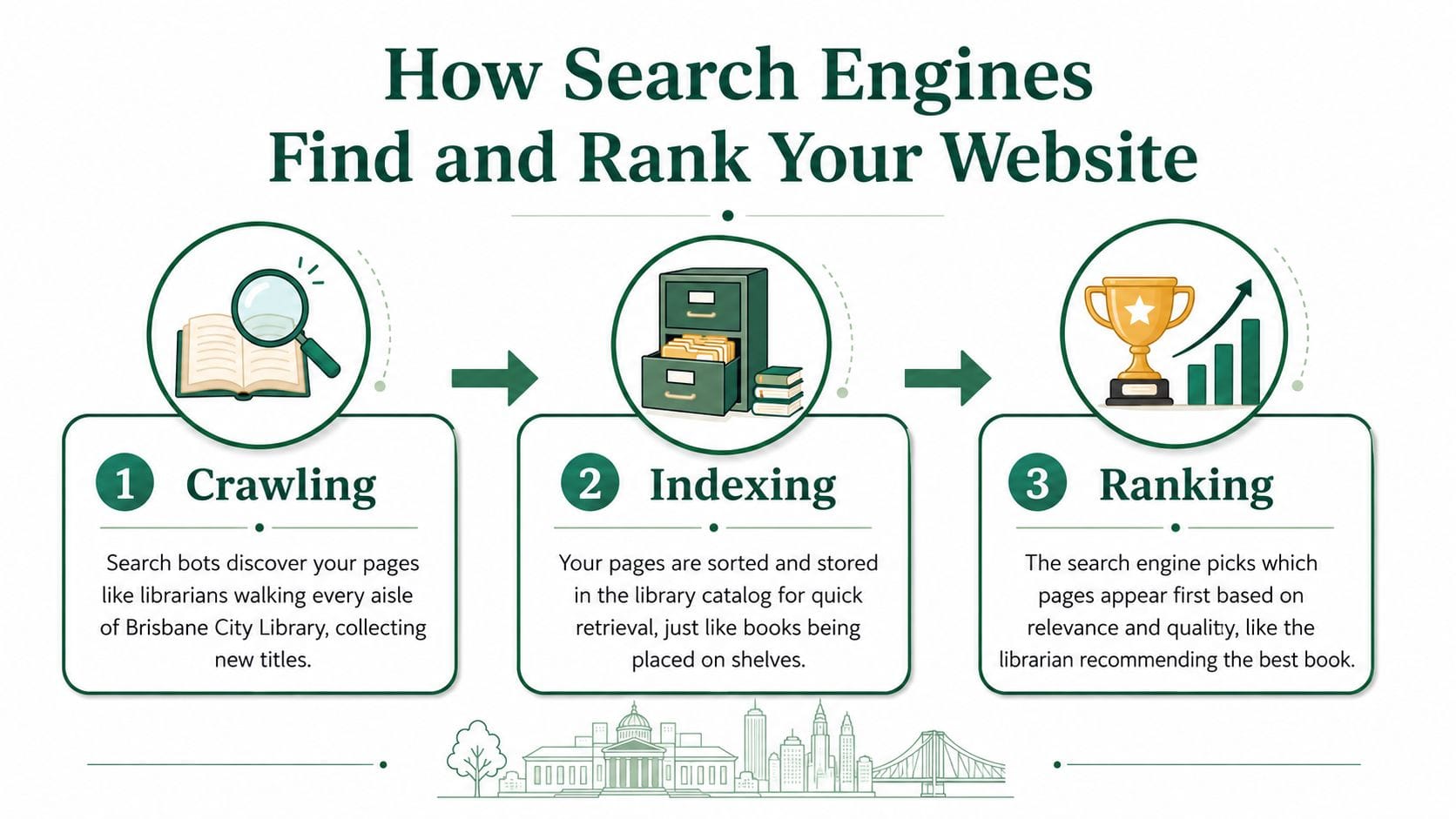
Search engines move through three broad stages: crawling, indexing, and ranking. A Brisbane City Library analogy makes the process easier to follow. Crawlers are librarians walking through the aisles, indexing is the catalogue that stores each title by topic, and ranking is the librarian choosing which book to hand over first.
Crawling and indexing come before visibility
During crawling, search bots discover pages through links, sitemaps, and existing references. They then analyse the page and store information in an index. If a page can't be accessed or isn't eligible for indexing, it has little chance of appearing in ordinary results.
Indexing doesn't guarantee a strong position. It only means the page has been considered for retrieval. The page still needs to match the searcher's intent and provide a useful, accessible experience.
Ranking matches the question with the strongest answer
When someone searches for “best coffee near me”, Google considers information such as relevance, location, the business profile, reviews, website content, and the searcher's context. A café in West End needs consistent location details, accurate opening hours, useful website information, and a credible local presence.
Mobile-friendly design and reasonable loading performance matter because many Australian searches happen through mobile browsers. The ACCC's findings on Google defaults and market dominance make those foundations especially important for a Brisbane site (ACCC search market findings).
The result page may include organic listings, a local map pack, reviews, images, videos, and an AI Overview. Some searches are answered without a website visit. That doesn't make SEO irrelevant. It changes the job from pursuing one blue-link position to building visibility across the places where the result page presents information.
A practical audit can identify which pages Google can access, which queries already create impressions, and whether the site reflects the business's actual location and services. The guide on improving Google search ranking provides a useful starting point for that review.
Common SEO Misconceptions Brisbane Owners Run Into
Many small-business owners understand that SEO matters but still receive advice that wastes time or creates risk. The most useful correction is to treat SEO as a connected discipline rather than a single publishing or link-building task.
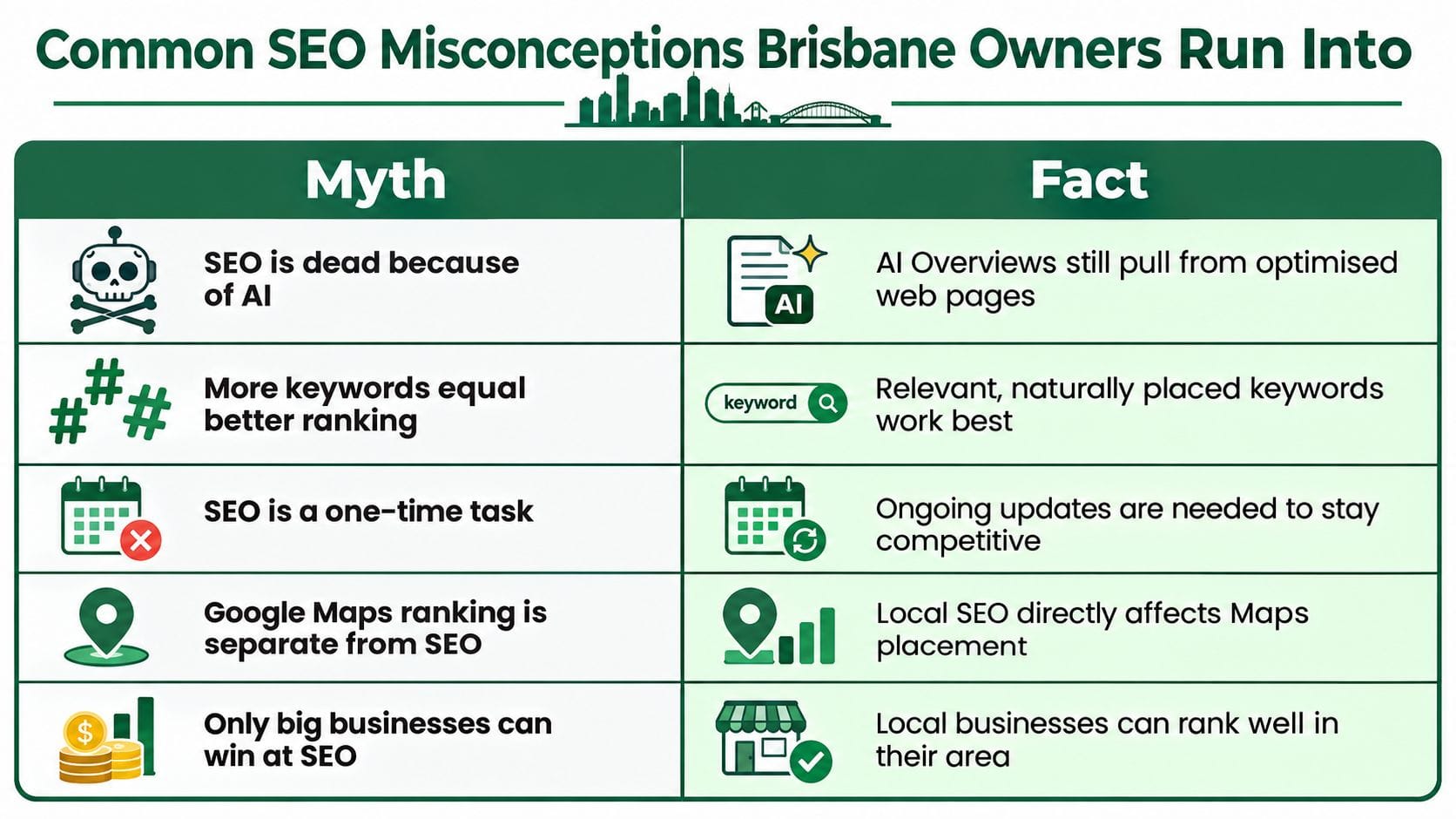
Myth one, “SEO is dead because of AI.” AI Overviews have changed how people receive answers, but they still draw on information from the web. A business needs accurate, well-structured pages if it wants its expertise and services to be understood or referenced. The opportunity has shifted from chasing clicks alone to earning visibility in answers, maps, snippets, and traditional results.
Myth two, “More keywords equal better ranking.” Repeating “Brisbane electrician” throughout a page makes the writing awkward and can obscure the actual answer. One well-organised service page, written around customer intent and supported by relevant internal links, is more useful than several thin pages built around near-identical phrases.
Myth three, “SEO results are instant.” SEO requires discovery, indexing, evaluation, and continued improvement. A business should expect progress to develop over time rather than treating a few quiet weeks as proof that the work failed. Claims of guaranteed immediate rankings deserve caution.
Myth four, “SEO is a set-and-forget task.” Competitors publish new pages, services change, opening hours move, and customer questions develop. A neglected Google Business Profile or outdated service page can weaken trust even when the website once performed well.
Myth five, “Any backlink helps.” Relevant references can support credibility, but indiscriminate directory submissions and spammy link schemes can create problems. A local industry mention, supplier reference, or community partnership is usually a more sensible target than a large pile of unrelated links. The explanation of what domain authority means for backlinks can help owners assess link quality without reducing SEO to a single score.
The disciplined approach is straightforward: fix access issues, answer real questions, maintain local information, earn relevant recognition, and measure actions that support enquiries. Blog volume alone isn't a strategy.
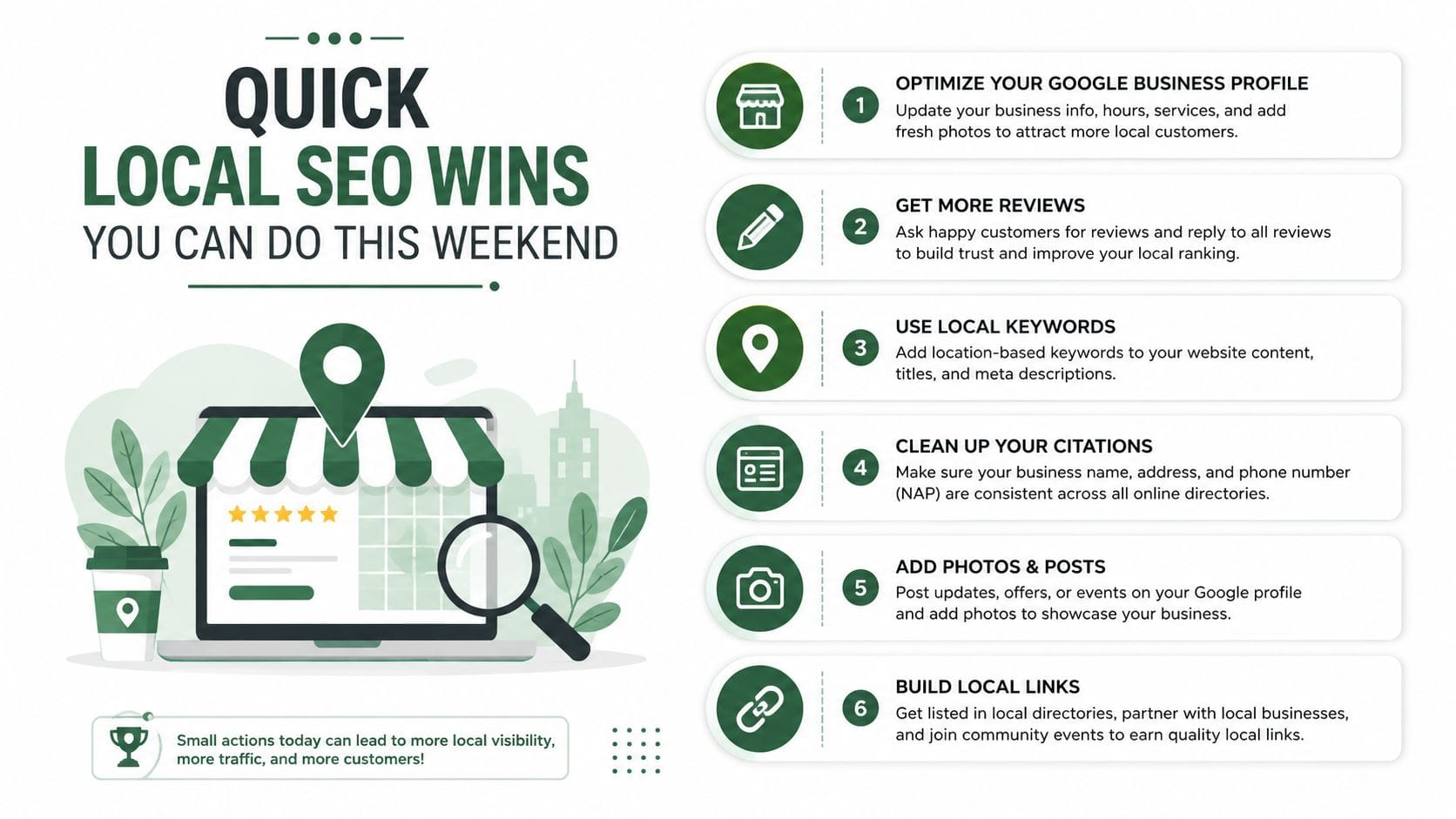
Quick Local SEO Wins You Can Do This Weekend
A time-poor Brisbane owner should start with actions that improve accuracy and customer confidence before chasing advanced tactics. The checklist below prioritises work that can be completed without a large software budget.
Start with the highest-value checks
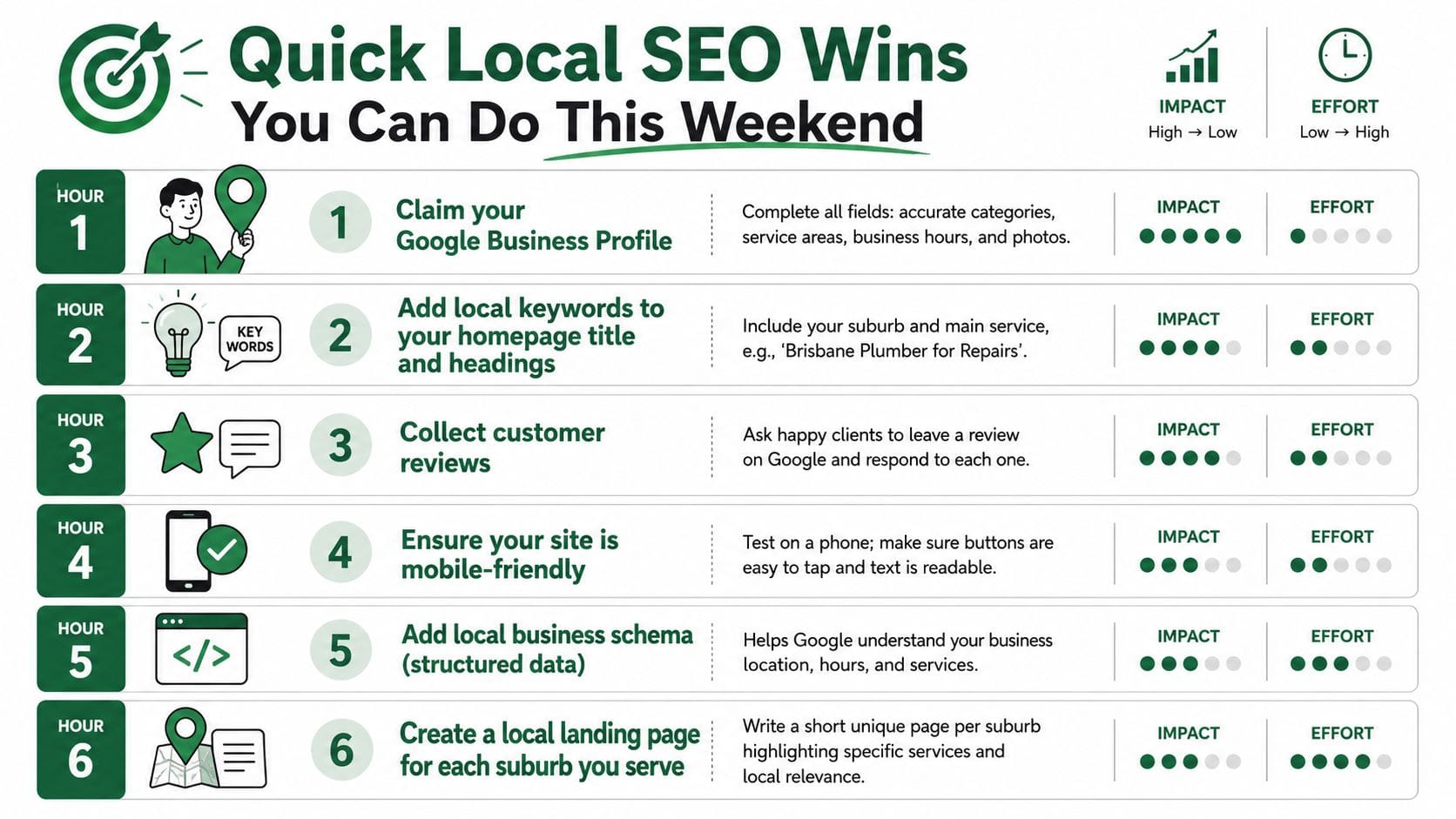
Hour one, complete the Google Business Profile. Confirm the business name, primary category, service areas, hours, contact details, description, and photographs. An incomplete profile leaves customers guessing and gives Google less context about the business.
Hour two, standardise business details. Check the name, address, and phone number across the website footer, contact page, Yellow Pages, TrueLocal, Apple Maps, and other relevant directories. Small differences can create confusion, especially after a relocation or phone-number change.
Hour three, improve one core service page. Use a real customer question as a heading, then answer it plainly. A Brisbane air-conditioning company could explain how it handles split-system repairs in suburbs it serves, with a clear quote request button.
Hour four, add local context. Include a Brisbane-specific FAQ block and an interactive Google Map where it helps visitors understand the service area. The content should be useful, not a list of suburbs inserted for search engines.
Hour five, request reviews ethically. Ask recent, satisfied customers for an honest Google review using a direct link, then respond to each review professionally. The request should never pressure a customer to use particular wording or hide a negative experience.
If the weekend becomes crowded
The first priorities are the business profile, consistent contact details, and one strong service page. Photos, FAQ improvements, and review requests can follow when the owner has time.
Owners can use the local SEO marketing guide to keep the work focused on discoverability in the areas the business serves. Creating a separate page for every suburb isn't automatically helpful. Each page needs unique, useful local relevance and a clear reason for existing.
Why SEO Matters for Brisbane Small Businesses
SEO matters because it connects a business with people who already have a need. A search for a roofer after storm damage, a clinic in West End, or a café in the CBD carries more immediate intent than a general social media impression.
The search result itself also shapes trust. A clear business name, accurate hours, strong reviews, map visibility, useful service information, and an easy contact path can make a small operator look established before the first call. A large competitor may have a bigger advertising budget, but a local business can still compete by being more relevant to a particular suburb and customer question.
Paid advertising has a clear strength: it can create visibility quickly while spending continues. Organic visibility works differently. It requires patience and maintenance, but a useful page can continue attracting relevant searches without paying for each individual visit. That makes SEO a form of digital infrastructure, not merely another campaign.
| SEO channel | Brisbane business outcome | Typical timeframe |
|---|---|---|
| Google Business Profile | Map visibility, calls, directions, and profile actions | Foundational work, then ongoing maintenance |
| Service pages | Quote requests and enquiries from high-intent searches | Builds over time as pages are discovered and improved |
| Reviews and local citations | Greater confidence and clearer local relevance | Accumulates through regular customer and directory activity |
| Technical SEO | Better access for search engines and smoother mobile visits | Initial fixes, followed by periodic checks |
| Helpful local content | Answers early questions and supports future enquiries | Compounds as content earns visibility and updates |
Australian small businesses still have room to improve their online revenue contribution. In the CPA Australia 2025-26 Asia-Pacific Small Business Survey, 44% of Australian small businesses said more than 10% of revenue came through online channels, compared with a 63% survey average, placing Australia tenth out of eleven markets surveyed (CPA Australia survey). That gap reinforces the case for improving the path from search result to enquiry.
Video can support trust alongside search, particularly for demonstrations and service explanations. Businesses assessing that channel can learn how to measure video marketing ROI without treating views as the only meaningful outcome.
Your Next Steps and When to Bring in an Agency
A practical 30-day plan starts small and creates evidence before a business commits to a larger budget.
A manageable first month
Week one: Complete the Google Business Profile, improve three core service pages with natural local wording, and install a free analytics tool. The owner should record the starting position, including calls, enquiries, and the pages receiving attention.
Week two: Request five new honest reviews from recent customers and create three accurate local citations. The aim is consistency, not directory volume.
Week three: Publish one helpful article based on a customer question, then inspect the three slowest pages and reduce unnecessary image or script weight where possible.
Week four: Review Google Search Console impressions, queries, clicks, and indexed pages. Keep the activities that support business outcomes, pause tasks that create work without useful evidence, and choose the next service page or technical fix.
Australian AI adoption is developing but isn't universal. The National AI Centre reported that 43% of Australian SMEs had some level of AI adoption across December 2025 to February 2026, rising to 44% in February 2026 (National AI Centre adoption insights). An owner can use AI to draft a content brief, organise customer questions, or create a first-pass meta description, but a human should check every detail, local reference, claim, and tone.
DIY suits owners with time and confidence using free tools. A freelancer fits defined tasks such as a technical audit or service-page rewrite. A full-service Brisbane agency can combine strategy, content, technical work, and reporting. Boocoo is one local option offering SEO, website, social media, and paid advertising support for small businesses.
Bring in specialist help when rankings plateau for an extended period, the owner can't maintain content, a technical audit reveals site-wide problems, or competitors consistently outrank the business on important service searches. The right partner should explain priorities in plain language, connect activity to enquiries, and work within the available budget.