
A Brisbane business owner can do everything right on a busy day, finish the jobs, answer the phone, and still wonder why the website generated visits but no obvious enquiries. The problem often starts with a simple misunderstanding of organic traffic meaning. Website visits from unpaid search are useful, but only when they come from the right searches, land on the right page, and lead people towards a call, booking, quote request, or shop visit.
For a small business, organic traffic isn't a vanity score. It's the unpaid search audience a business earns before, during, and after a customer makes a decision. That audience can arrive through a normal search result, a local listing, an image, a video, or an AI-generated answer. The practical question isn't “How many visits did the site get?” It's “Which unpaid searches brought people who could become customers?”
What Organic Traffic Actually Means for Your Business
A Brisbane plumber finishes a job on a Tuesday morning and checks the phone while packing the van. The enquiry page received fourteen visits overnight, and none came from an advertisement. Those visits are organic traffic if people reached the page after using an unpaid search listing.
Organic traffic means visits that come from unpaid search engine results. Google's Australian support explanation distinguishes an organic click from a paid result, defining it as a click on an unpaid listing for a particular query, as outlined in this Australian guide to organic traffic. A person searches for a need, sees a result, and chooses it without the business paying for that individual click.
That definition covers clicks, not impressions. An impression means a listing appeared. A visit means somebody selected it and entered the website. In Google Analytics, organic search is a channel label alongside paid search, direct, social, referral, and email. The label describes how the visitor arrived, not whether the visit became valuable.
Why search intent makes the channel useful
Organic visitors often begin with a clear problem. Someone searches for an emergency plumber in Morningside, a café near New Farm, or an accountant for a small business. The search itself gives the business useful context, even though not every visitor is ready to buy.
A small operator can learn more about the broader mechanics through Transactional LLC's organic traffic methods, then apply the ideas to local service pages, location pages, and conversion paths. The related idea of what SEO means for a business helps explain why search visibility and website usefulness need to work together.
Organic visits can come from classic blue links, map packs, image packs, video blocks, AI Overviews, or citations within chat answers. That's why the modern definition is broader than “free Google visits”. It describes an earned search audience across the search ecosystem, with the website visit being only one possible outcome.
How Organic Traffic Shows Up on a Search Results Page
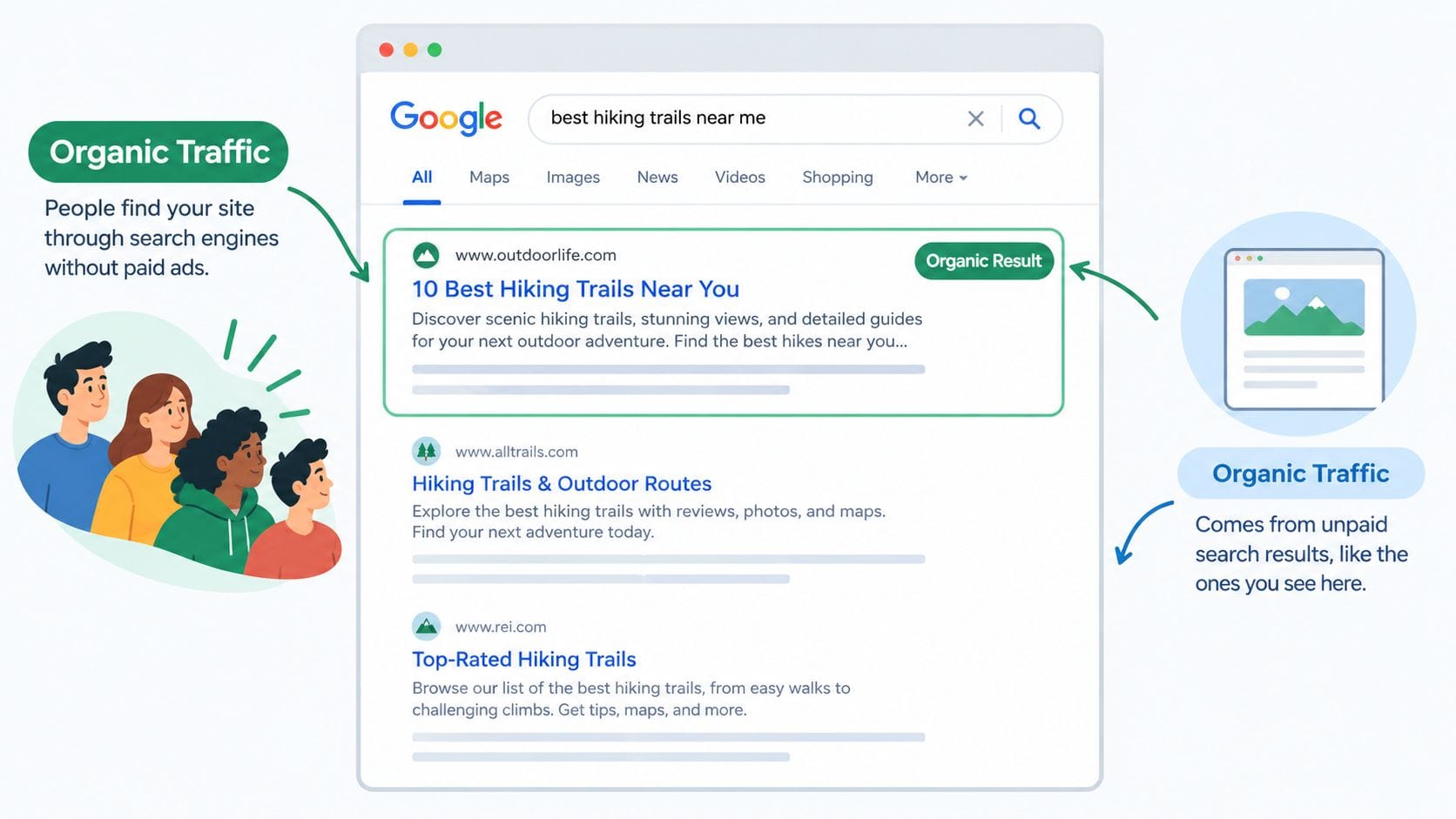
Search for “café New Farm” and the page may contain several different zones. Paid adverts can appear first, followed by a local map pack, an AI-generated summary, traditional listings, images, videos, questions, and related searches. The layout changes, but the distinction remains straightforward.
Read the page like a front desk
A useful analogy is a busy café front desk. Paid ads are skip-the-line tickets. A business pays for that position. Organic results are places in the main queue, earned because the search platform considers the listing relevant and useful.
Organic entries can include:
- Standard listings: The familiar unpaid website results, including service pages, menus, and guides.
- Local results: Map pins and local business profiles that help searchers call, request directions, or visit a website.
- Media results: Unpaid images and videos that answer a visual part of the query.
- AI citations: Links included when an AI answer sends a searcher to a cited page.
The local pack and standard website results are both unpaid search visibility, but they behave differently in reporting. GA4 can merge their traffic under the organic search source, while Search Console separates some search appearances, including local results. A business should therefore avoid treating every organic visit as the same type of action.
The difference between a visit and a zero-click answer matters even more now. If an AI Overview answers a question without a click, the business may receive visibility without a recorded website session. A citation that gets selected is a visit. A summary that answers the searcher's question and ends the journey is zero-click exposure, not organic website traffic.
For a clearer explanation of the page itself, the SERP guide from Boocoo provides useful background on search-result layouts and features.
Why Organic Traffic Matters for Brisbane Small Businesses
Brisbane owners operate in a search market dominated by Google, but that dominance isn't absolute or permanent. Google's Australian search share was reported at 93.67% in August 2024 and 88.04% in June 2026, while Bing reached 9% in the June 2026 reading, according to the Australian search market data reference. The practical lesson is simple: unpaid search traffic can come from more than one engine, so technical quality and relevant content still matter beyond Google.
Search remains foundational because online use is widespread. ACMA reported that 99.7% of Australian adults used at least one device to go online in 2025, up from 90% in 2019, and that access to news and information reached 94% in 2025, as documented in this Australian internet-use and search context. For a local business, that means customers often begin practical decisions online, even when the eventual transaction happens by phone or in person.
The top of the page gets the attention
Organic visibility has commercial value because searchers concentrate their attention near the top of the results. An Australian benchmark reports a 29.5% click-through rate for the first organic position, with positions two and three averaging 12.8% and 8.8%, respectively, in this Australian SEO competitor benchmark.
That gap explains why page-two visibility rarely satisfies a business owner. A page can be accurate and attractive, yet still produce little traffic if searchers don't see it. Moving a strong service page into the first results can change the number of calls and quote requests without changing the service itself.
Organic also builds local equity. A well-maintained Google Business Profile, clear suburb coverage, useful photos, accurate contact details, and genuine reviews give a customer more reasons to choose one operator over another. An advertisement can buy attention today, but it doesn't build the same lasting presence in a suburb.
The trade-off is blunt. Paid search can produce enquiries quickly. Organic search takes sustained work, and often months before the right pages gain traction. Businesses that need immediate demand should use both, rather than pretending organic is a fast replacement for advertising.
Organic Traffic Compared to Paid, Social and Referral Visits
A Brisbane business owner needs different channels for different moments. A paid advert can capture a same-day offer. Social media can introduce a new café or product to people who weren't searching. A referral can arrive with borrowed trust from a builder, supplier, or existing customer. Organic search is strongest when a person already has a need and is comparing options.
| Channel | Typical Intent | Cost to Acquire | Time to Results | Best Job It Does |
|---|---|---|---|---|
| Organic | Existing need, research, comparison, local service search | Investment in site, content, and optimisation | Slower and cumulative | Builds unpaid visibility and qualified enquiries |
| Paid | Immediate or tightly targeted demand | Payment for clicks or campaign activity | Fast | Captures demand quickly |
| Social | Discovery, interest, and brand familiarity | Content effort or paid promotion | Variable | Creates awareness and engagement |
| Referral | Warm interest from a trusted source | Partnership effort or referral arrangement | Depends on the relationship | Transfers trust and introduces customers |
The cost structure is the key difference. Organic traffic doesn't charge for every click, but it still requires work to create useful pages, maintain technical health, earn reviews, and keep local information accurate. Paid traffic can be controlled more directly, but the flow stops when the campaign stops.
Practical rule: Match the channel to the customer's stage, not to the channel that sounds cheapest.
A plumber might use paid search for emergency demand while building organic pages for hot-water repairs and suburb-specific services. A café might use social content for atmosphere and events, while organic listings capture “brunch New Farm” searches. A professional service firm might use referrals for introductions and search content for comparison queries.
Organic underperforms when the offer needs a same-day response or a short promotional window. It also can't compensate for a weak landing page, unclear phone number, poor reviews, or slow follow-up. A useful paid and organic search playbook from Scéaled can help owners think about the two channels as complementary rather than competing budgets. Businesses comparing paid campaigns with organic work can also review Boocoo's explanation of PPC before allocating spend.
How to Measure Organic Traffic in GA4 and Search Console
A time-poor owner doesn't need every dashboard. Two tools provide enough visibility for practical decisions: GA4 shows what visitors do after arriving, while Google Search Console shows how the site appears in search.
Start with GA4
Open the Traffic Acquisition report and filter for the organic search default channel group. Review engaged sessions, conversions, and the landing pages receiving organic visits. A service business should check whether visitors land on the relevant service page, contact page, or a generic blog article.
The most useful comparison is branded versus non-branded demand. Branded searches already include the business name and usually indicate existing awareness. Non-branded searches describe the service or problem, such as a suburb-based repair query. Search Console is better suited to identifying those query patterns because GA4 usually can't show the search phrase behind each visit.
Use Search Console for visibility
The Performance report shows clicks, impressions, average position, and CTR, split by query and page. Google's Australian documentation also defines “organic clicks/query” as organic clicks divided by searches that returned pages from the site, making it a useful efficiency measure, as explained in this organic traffic measurement guide.
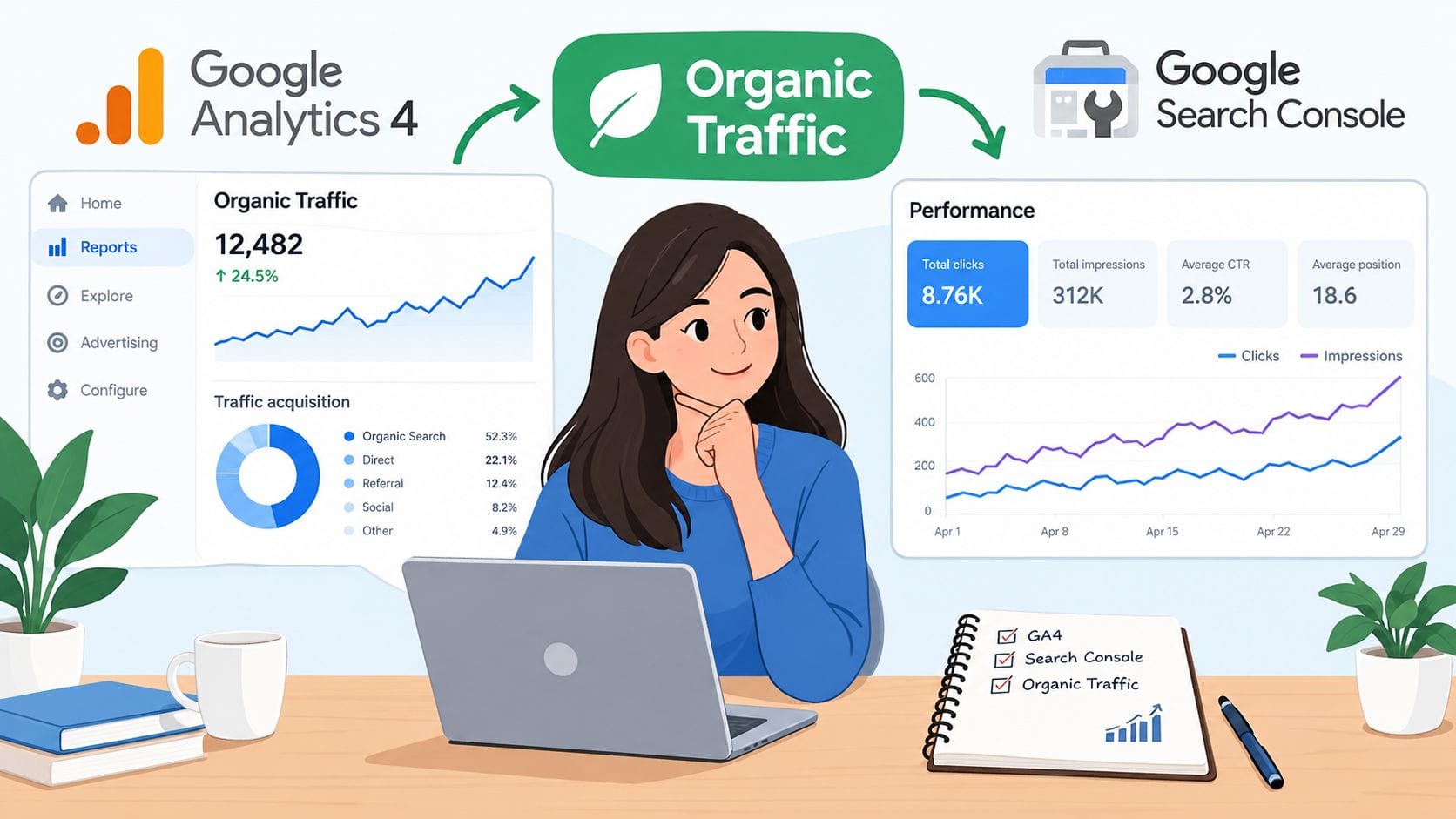
Check the two tools for direction rather than exact agreement. GA4 records site behaviour, while Search Console records search performance, so their totals won't match perfectly. A weekly review should focus on:
- Qualified landing pages: Which service or location pages attract search visitors?
- Conversion activity: Are calls, forms, bookings, or direction requests moving?
- Query relevance: Are impressions coming from searches the business serves?
- CTR movement: Are stronger titles and descriptions earning more clicks?
- Position trends: Are priority pages moving towards the first results?
Owners can use Boocoo's CTR explanation to understand why visibility alone doesn't prove that a page is attracting attention.
Real Examples of Organic Traffic in Brisbane Niches
Organic traffic looks different across industries because customers use different search language and take different actions. A service page, a business profile, and an educational article may all attract unpaid search visitors, but each needs a different conversion path.
A south-side plumber
A plumber serving Brisbane's south side might appear for searches about emergency hot-water repairs in nearby suburbs. The searcher may select the map listing late at night, call from the profile, or visit a service page before requesting help.
The useful entry point is a page that names the service clearly, explains response coverage, displays a phone number, and makes the next action obvious. The local signals include an accurate business profile, genuine reviews mentioning relevant work, current photos, and consistent service-area information.
A New Farm café
A café may attract weekend visitors searching for brunch near New Farm. The Google Business Profile can support discovery through the menu, opening hours, photographs, and customer reviews, while a neighbourhood-focused page can answer questions about booking, dietary options, and nearby access.
The conversion isn't always an online order. It may be a call, a direction request, a menu view, or a walk-in visit. Measuring only website sessions would miss part of the commercial value.
A suburban accounting firm
An accounting firm may reach small-business owners searching for terms such as “tax agent Brisbane fees”. A comparison-style article can attract the initial research, but the conversion page should explain the firm's services, ideal client, process, and consultation option without burying the enquiry button.
Each pattern points to the same principle: the page must match the searcher's job. Informational content earns attention, while a clear local service page turns relevant attention into an enquiry.
Practical Local SEO Actions to Grow Organic Traffic
None of this is glamorous. That's a benefit, because a small business can complete many of the highest-value tasks without paying for a large campaign.
Start with the business profile. Select accurate categories, list relevant services, describe the suburbs served, add current photographs, and keep hours and contact details correct. After each completed job, send a polite review request. The request should make it easy for a real customer to describe the service received, without scripting praise or offering an incentive.
Fix the pages closest to revenue
Choose the three service pages most likely to generate enquiries. Each should have a clear heading, a title that reflects the service and suburb intent, concise explanations, internal links, and useful answers to common questions. Add structured data only when the page supports it, rather than adding markup as decoration.
Build location pages for suburbs the business serves. A useful page should explain local coverage, service relevance, access considerations, and the customer problem. Copying the same paragraphs and swapping suburb names creates thin pages and weakens trust.
A practical starter plan looks like this:
- One-week sprint: Claim or tidy the business profile, install GA4 and Search Console, fix one priority page, and request five genuine reviews.
- One-month sprint: Publish two useful location pages, earn three more reviews, create two relevant Australian directory citations, and repair internal links between service and location pages.
- Ongoing content: Answer real Brisbane questions, such as access, timing, preparation, pricing factors, or service limits, with direct language.
For content ideas and publishing inspiration, the Leaping Lemur Media article archive offers a useful place to review editorial approaches. Businesses needing a broader local search framework can also use Boocoo's local SEO guide for small businesses.
These tasks compound, but they won't replace useful content. A page must answer a real customer question better than a generic suburb page if it expects to earn attention.
What to Do Next and When to Bring in a Local Partner
AI search has changed the meaning of a successful organic strategy. Australian industry coverage estimates that 60% to 70% of searches may be zero-click, and reports that AI Overviews can reduce click-through rates on affected informational queries, as discussed in this Australian AI SEO coverage. A business can therefore gain visibility without receiving a website session. Calls, map actions, branded searches, and enquiries deserve attention alongside traffic.
The next move is a baseline audit. Review the previous 90 days of organic sessions in GA4, business-profile views, and ranking queries in Search Console. Record the pages attracting relevant searches and the actions that lead to enquiries.
A dashboard is useful only when it changes the next business decision.
Set a 90-day DIY threshold. If reviews aren't climbing, location pages aren't gaining visibility, and branded search isn't strengthening, the bottleneck is usually execution time or a technical problem. A Brisbane local SEO partner becomes sensible when the business has multiple locations, the site remains below page two for valuable searches, or competitors are consistently publishing stronger local content.
A first engagement should produce a baseline, priority pages, a local profile review, technical findings, and a practical action schedule. Boocoo is one Brisbane-based option for small businesses seeking support across SEO, website work, social media, and paid advertising, with enquiries available through 1300 093 797 or hello@boocoo.au.
This week, record the baseline and fix the single page closest to an enquiry. That decision will reveal whether the business needs more content, better conversion work, or outside execution.