
PPC, or pay-per-click, is online advertising where a business pays only when someone clicks its ad, commonly on Google, Microsoft, Facebook, and Instagram. In Australia, search advertising reached A$8.0 billion in 2025, representing 43.8% of total internet advertising spend, so PPC is a major marketing channel, not a niche tactic (IAB Australia).
A Brisbane café owner might check the till between breakfast orders, answer a supplier's call, and realise the business hasn't posted an update or reviewed its marketing for days. A tradie may finish one job, drive across town for another, then push every marketing decision to the bottom of the list because cash flow and customers feel more urgent.
PPC can put a business in front of people already looking for its products or services. Someone searching for an emergency plumber in Brisbane has expressed a clear need. A paid search ad can appear at that moment, and the business pays when the person clicks.

Why Brisbane Small Businesses Keep Asking What PPC Actually Is
PPC captures demand while SEO builds visibility
The simplest answer to what is PPC is this: it's a way to buy targeted visits rather than wait for organic visibility to develop. SEO can produce valuable long-term traffic, but it usually needs consistent content, technical improvements, authority building, and patience. PPC can generate visibility much sooner, provided the campaign, offer, targeting, and landing page are ready.
Social advertising works differently again. Facebook and Instagram can introduce a business to people based on interests, behaviour, location, or previous website activity, but users generally aren't searching for a solution at that exact moment. Search PPC captures existing demand. Social PPC often creates or renews interest.
That distinction matters for Brisbane Digital Marketing because a local business rarely has unlimited time or money. A business that needs booked jobs may prioritise search terms with strong commercial intent. A retailer launching a visually appealing product may find Meta more useful for discovery and remarketing.
Speed doesn't guarantee profitable growth
PPC feels attractive because the platform reports clicks, impressions, search terms, and conversions. Campaigns can also be adjusted, paused, narrowed, or expanded without waiting for a new website page to rank. Australia's search advertising category has remained around 43% to 45% of total online advertising spend each year since 2019, which shows how consistently businesses continue buying search traffic (IAB Australia).
The risk is that a campaign can buy activity without producing profitable customers. Broad keywords, weak ad messages, slow landing pages, poor call handling, and missing conversion tracking can turn a limited budget into clicks that never become revenue.
Practical rule: PPC should be judged by profitable enquiries or sales, not by traffic volume alone.
The useful question for a small operator isn't whether PPC works. It's whether the business can buy the right customer, at an acceptable cost, with enough margin left over to make the campaign worthwhile.
How the PPC Auction and Bidding Really Work
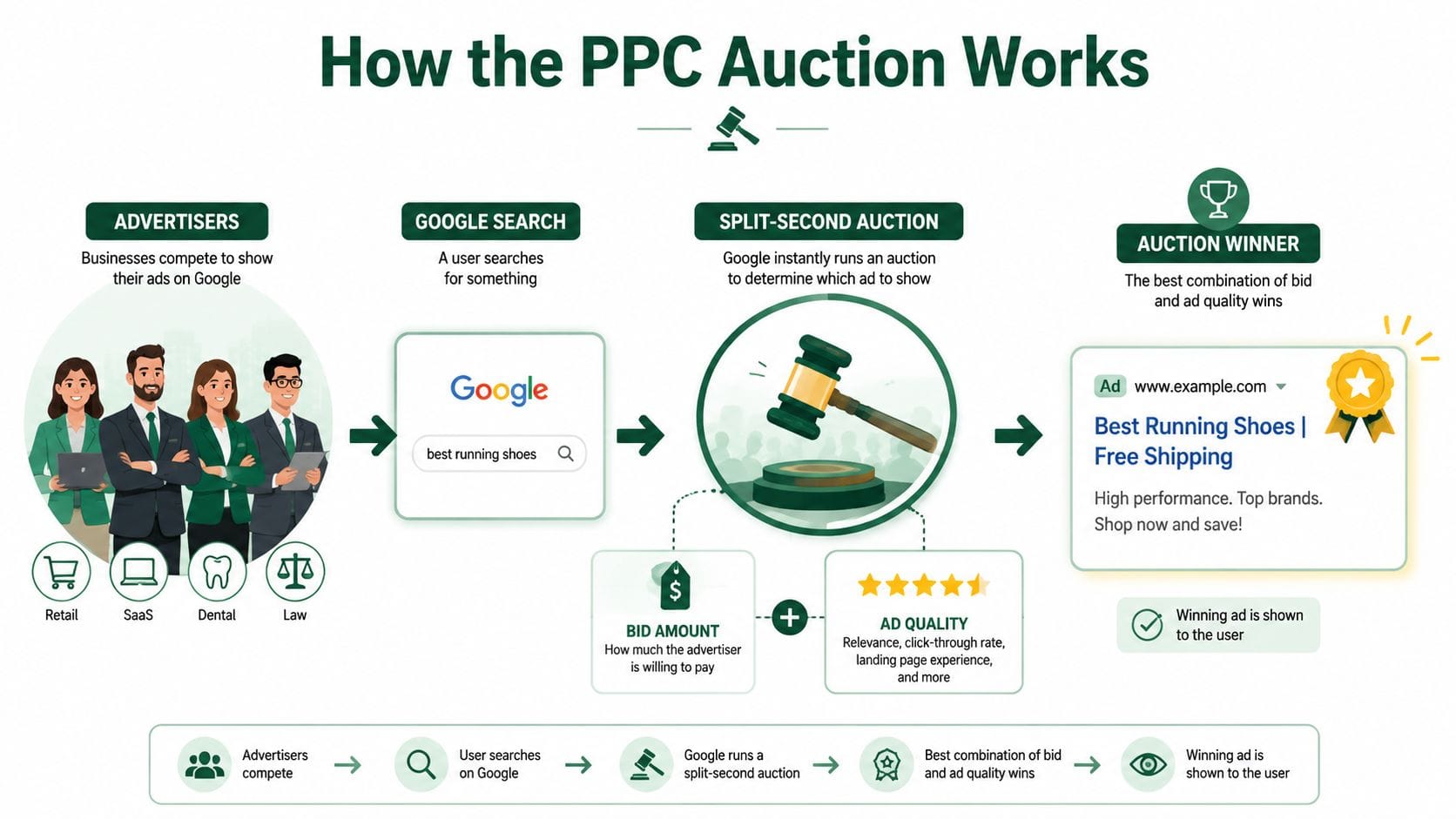
A PPC auction resembles a live auction room, but the process happens in a fraction of a second. When someone searches for “plumber near me”, Google checks which advertisers want to compete for that opportunity, assesses their bids and ad quality, then decides which ads can appear and in what order.
The largest bid doesn't automatically win. Google also considers expected click-through rate, ad relevance, landing page experience, and the usefulness of supporting ad assets. These factors contribute to the campaign's ability to compete effectively, commonly discussed through Quality Score and Ad Rank.
Four parts of the auction
The search triggers an opportunity. A user enters a query, and the platform identifies potentially relevant advertisers.
Advertisers submit bids. A maximum cost-per-click bid tells Google the most the advertiser is willing to pay for a click in that auction. Automated bidding can adjust bids based on signals and the campaign goal, but it still needs accurate conversion data and sensible limits.
The platform evaluates quality. An ad that closely matches the search, leads to a useful page, and is likely to earn a click can compete with a higher bid supported by a poor experience.
The winner pays the auction price. The advertiser's actual CPC can be lower than its maximum bid because the final amount depends on the competition and the quality thresholds involved.
Google defines click-through rate as clicks divided by impressions. Five clicks from one hundred impressions, for example, produces a 5% CTR (Google Ads Help). That metric helps an operator compare whether particular keywords and ad messages attract attention, but it doesn't prove that the resulting visitors are valuable.
Microsoft Advertising uses a similar auction principle across Bing and partner placements. The practical lesson is clear: a small business can improve its position and costs by making the keyword, ad, and landing page more relevant, rather than just raising the bid.
Australia's ad-tech market has also been highly concentrated. The ACCC estimated that in 2020, more than 90% of ad impressions traded through the ad-tech supply chain passed through at least one Google service, while at least 27% of advertiser spend in that supply chain was retained by ad-tech providers (ACCC). That history helps explain why auction settings, tracking, and platform decisions deserve close attention.
The Main PPC Channels and When to Use Each One
PPC channels reach people at different points in the buying journey. Google Search generally captures demand, Microsoft Ads provides another search audience, and Meta interrupts browsing with visual messages that can build awareness or bring previous visitors back.
| Channel | User Intent | Typical CPC (AU) | Best Fit For |
|---|---|---|---|
| Google Ads | High intent, users actively searching | Australian SME benchmarks commonly sit around A$2.10, with category variation (State Globe) | Local services, urgent needs, professional services, product searches |
| Microsoft Ads | Search intent through Bing and partner placements | Often influenced by competition and query demand | A secondary search channel for businesses seeking additional qualified traffic |
| Meta, including Facebook and Instagram | Discovery, interest, remarketing, and visual interruption | Varies by audience, creative, placement, and objective | Retail products, local offers, awareness, events, and retargeting |
A Brisbane electrician with a clear service area will often begin with Google Search because the customer may already be looking for an electrician. A local clothing retailer may combine Meta creative with Shopping campaigns, using product images and remarketing to reconnect with visitors who didn't buy on their first visit.
Search usually carries stronger immediate intent, but competitive categories can make clicks expensive. Meta can reach people before they search, though the business must earn attention with strong creative and a clear offer.
Small operators managing several campaigns may also benefit from practical automation. A managed Google Ads MCP server can be useful for teams exploring structured campaign workflows and account operations. Before adopting any tool, the business should confirm who controls the account, how changes are reviewed, and whether conversion data remains visible.
Channel choice should follow customer behaviour, not platform popularity.
A business owner wanting the basics of Google's paid search system can also review this plain-language explanation of Google Ads. The starting point should remain narrow. One well-targeted channel with reliable tracking is usually easier to manage than several channels competing for a small budget.
Key PPC Metrics You Need to Understand
A Brisbane business can receive plenty of clicks and still lose money. Four metrics reveal where the budget goes: cost per click, click-through rate, cost per acquisition, and return on ad spend.
| Metric | What It Measures | AU Benchmark Range | Why It Matters |
|---|---|---|---|
| CPC | The amount paid for each click | Australian SME Google Search benchmark around A$2.10 average CPC (State Globe) | Shows how quickly traffic consumes the budget |
| CTR | The share of impressions that become clicks | Around 4.0% for Australian SME Google Search campaigns, with top-quartile campaigns at 6.5% or higher | Indicates whether the search, ad, and offer match |
| CPA | The cost of one lead, sale, or other conversion | Around A$46 average cost per conversion, with top-quartile campaigns at A$18 to A$28 | Connects ad spend with a business outcome |
| ROAS | Revenue generated for advertising spend | Australian-focused material commonly targets 4x to 6x for Search and 3.5x to 5.5x for Shopping or Performance Max (3P Digital) | Helps retailers compare revenue with media cost |
Consider a Brisbane plumber spending A$500, receiving 100 clicks at A$5 each, and converting five jobs worth A$300 each. The campaign produces A$1,500 in booked revenue, a A$100 CPA, and 3x ROAS, before wages, materials, travel, overheads, and tax. The account may appear profitable while the actual margin is weak.
CTR shows whether the ad earns attention. CPC shows the price of that attention. CPA is often the clearest measure for a service business because it puts a cost beside each lead or job. ROAS becomes more useful for retailers when transaction revenue is tracked reliably, but revenue alone does not show profit.
A useful check is the maximum CPA the business can afford. If a Brisbane service has limited margin after labour and travel, a campaign can drain budget even when clicks and leads are rising. Compare CPA with customer value, gross margin, and the percentage of leads that become paying customers.
For awareness or reach campaigns, CPM also matters because it measures impressions rather than clicks. This explanation of what CPM measures helps separate impression-based buying from click-based acquisition.
Practical PPC Strategies for Small and Local Businesses
A workable PPC campaign starts with control. A Brisbane business should decide where ads can appear, which searches count as valuable, what action matters, and how much the campaign can spend before launch.
Start with a contained test
A small operator can begin with A$500 to A$1,000 per month to collect initial campaign data, as long as the business treats that amount as a test budget rather than a promise of results. A separate Australian cost guide notes that many small businesses invest around A$1,500 to A$3,000 or more per month in ad spend, reinforcing the need for tight targeting and accurate tracking (Firewire Digital).
The right starting point depends on CPC, conversion rate, margins, and customer value. Conversion tracking should be configured before the first dollar is spent, including forms, phone calls, bookings, purchases, and meaningful contact actions.
Make local targeting do the heavy lifting
A business serving inner Brisbane doesn't need to pay for clicks from areas it cannot service. Location settings can focus delivery on selected suburbs or a radius around a physical location. Operators should inspect the platform's location options carefully so ads reach people in the intended area, rather than people merely showing interest in it.
Keyword intent matters just as much. “Emergency plumber Brisbane” signals a stronger commercial need than a general search about how to fix a leaking tap. High-intent terms can cost more, but irrelevant traffic creates no value at any price.
Remove waste before raising bids
Negative keywords prevent ads from appearing for unsuitable searches. A plumber might exclude employment, training, free instructions, or unrelated product searches. The search-terms report should be reviewed regularly, with irrelevant queries added to the negative list.
Landing pages also need to finish the job. A dedicated service page should match the ad, explain the offer quickly, place the phone number and enquiry action prominently, and provide trust signals such as relevant Google reviews. Guidance on what a landing page should do can help owners assess whether the destination supports the click.
Service businesses that only answer calls during operating hours can schedule ads around staff availability. If every lead receives a delayed response, even strong targeting may produce disappointing results.
What PPC Really Costs and Where Budgets Break
PPC isn't automatically scalable for a small operator. The platform can increase delivery, but the business still needs enough margin, capacity, and conversion efficiency to absorb each new customer.
Australian benchmark content reports a wide spread in Google Ads costs, from roughly A$0.75 to A$2.10 per click for e-commerce and A$4.20 to A$14.20 per click for lead generation. The same source gives indicative ranges of A$48 to A$135 per lead for home services and A$95 to A$310 per lead for B2B services (Carter Media).
Those ranges are not a quote for every Brisbane account. They show why a generic answer to what is PPC misses the harder question: how many clicks can a business buy before its economics stop working?
Find the minimum viable budget
Suppose a campaign's average click costs A$12 and the business needs 20 clicks to generate one lead. The campaign needs at least A$240 to produce that single conversion opportunity. The owner then needs to compare the resulting lead's quality and close rate with the gross profit from the sale.
Common budget leaks include:
- Loose targeting: Broad matching can connect ads with searches that share words but not buying intent.
- Unmanaged brand traffic: Competitors may bid on a business name, while the business may also pay for clicks from people who already know how to find it.
- Missing daily limits: Without clear caps, the account can consume more of the monthly budget than the owner intended.
- Poor response speed: A missed call or slow follow-up can turn paid demand into lost revenue.
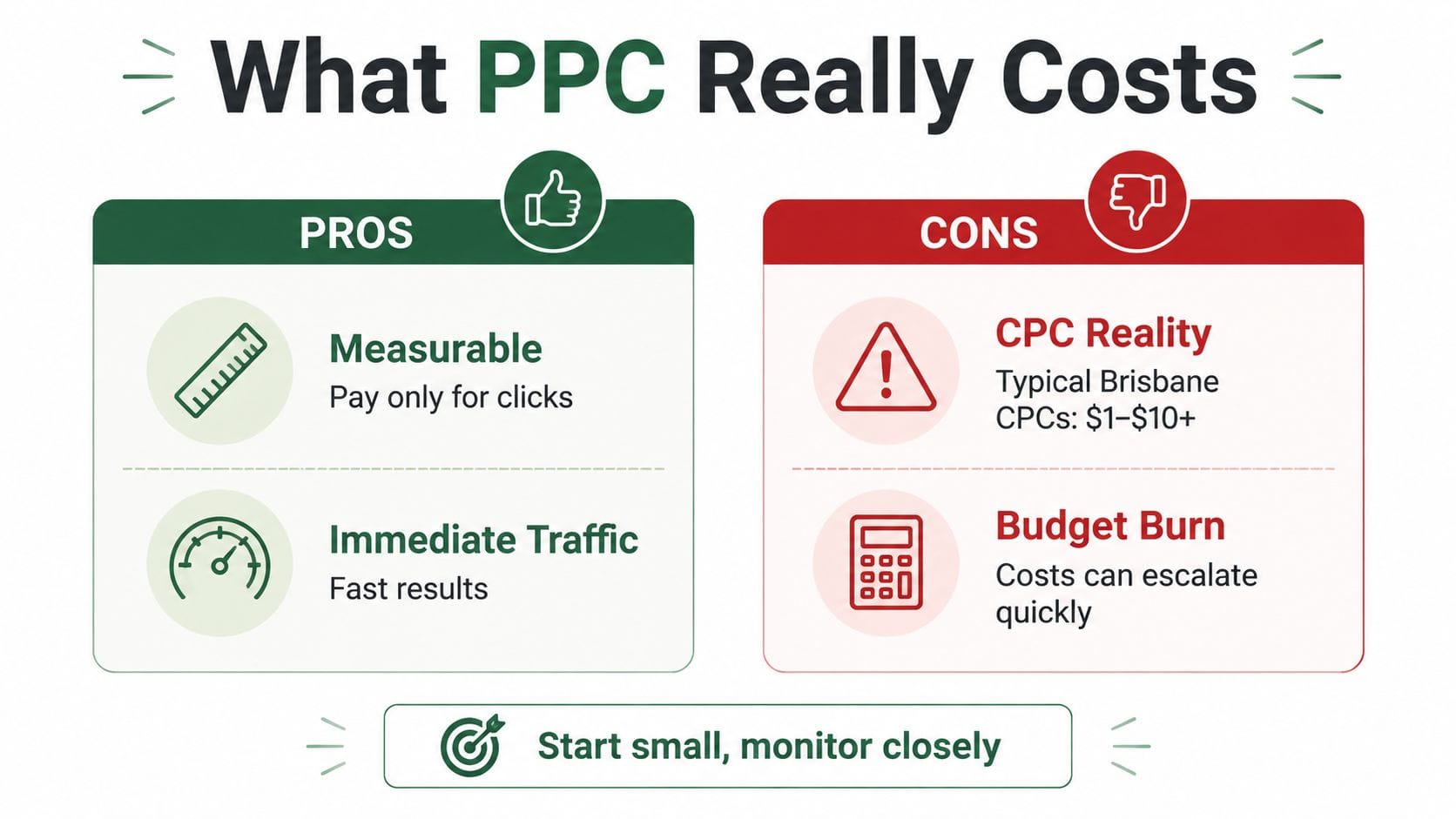
PPC may not suit a low-margin product, a market dominated by national advertisers, or a business that can't respond to enquiries promptly. The owner should calculate customer lifetime value, work backwards to an acceptable CPA, and test whether the expected lead volume and quality support that CPA.
A business comparing paid social with search can also use this overview of Facebook advertising costs to understand why channel selection should reflect intent, margins, and campaign objectives.
Measuring Results and Getting Help in Brisbane
A useful PPC review starts with the business outcome. Impressions and clicks can show whether a campaign is active, but booked jobs, qualified enquiries, sales value, gross profit, and customer quality determine whether the activity deserves more budget.
A practical 90-day optimisation cycle gives the account enough time to develop a useful picture without encouraging daily reactions. The first month establishes baselines and exposes tracking problems. The second refines targeting, ad messages, search terms, and negative keywords. The third provides a clearer view of lead quality and unit economics.
Use a simple operating scorecard
- Spend: Record the actual advertising cost and management cost separately.
- Response: Track calls, forms, bookings, purchases, and response time.
- Quality: Mark whether each enquiry fits the service area, job type, budget, and capacity.
- Revenue: Connect closed jobs or sales back to the campaign where possible.
- Decision: Increase, hold, narrow, or pause based on acceptable CPA and profit.
Daily dashboard checking often leads to premature changes. A single quiet day doesn't establish a trend, while a busy day doesn't prove that a campaign is profitable. Weekly reviews with consistent definitions usually give owners a more useful operating rhythm.
Businesses wanting to connect marketing interactions with customer behaviour can consult this guide to customer experience analytics. The same principle applies to PPC: the account should be assessed alongside what happens after the click.
For a Brisbane business deciding between internal management and outside support, an explanation of how to hire pay-per-click advertising companies provides a useful checklist for reviewing experience, reporting, communication, and commercial fit. Boocoo offers Google Ads and Meta campaign management, including campaign tracking, reporting, and optimisation for local businesses.