
PPC is advertising where a business pays only when someone clicks its ad, rather than paying for the ad to appear. In Australia, search advertising reached A$8.0 billion in 2025, growing 11.5% year on year and representing 43.8% of total internet advertising expenditure.
A Brisbane owner might recognise the situation. The business needs more enquiries, organic search visibility is taking time to build, and every marketing dollar needs a job. Google Ads appears to offer a fast answer, but the phrase “pay per click” can hide important questions: What counts as a worthwhile click? How much does a click cost in Australia? When does PPC beat SEO, and when does it merely pay for traffic that never becomes a customer?
PPC can work well for a local business, but it isn't automatic. The result depends on search intent, the auction, ad relevance, landing-page quality, conversion tracking and the value of a new customer. This guide explains the PPC meaning in practical terms for Brisbane small businesses, including platforms, costs, metrics, setup decisions and the point where professional help makes financial sense.
What PPC Actually Means for a Small Business
A Brisbane owner may need enquiries this week while organic search visibility is still developing. PPC can put an offer in front of people already searching, but each visit has a cost and not every click becomes a customer.
Pay-per-click, or PPC, is an advertising model where a business pays when someone clicks an ad. An impression, meaning the ad appears on a screen, generally does not create a charge in a standard search campaign. The payment buys the visit, not the sale. The website, phone process or checkout must turn that visit into a useful business outcome.
Traditional advertising is closer to buying billboard space. You pay for the display whether or not anyone stops to look. PPC is a performance fee: you pay when a viewer takes the next step. That makes the model easier to measure, but it also means a poorly targeted campaign can spend money on visitors who were never likely to buy.
Australia's paid search market is large. Search advertising reached A$8.0 billion in 2025, up 11.5% year on year, and represented 43.8% of internet advertising expenditure, according to the IAB Australia Internet Advertising Report. Brisbane trades, clinics, professional firms and retailers therefore compete in an active market. Local targeting can narrow the audience, but it does not remove competition or cost.
What a click needs to accomplish
A click is the paid step before the commercial result.
A plumber may want a call from someone seeking urgent service nearby. A café may value directions, an online order or a booking. A consultant may prefer one qualified enquiry over many visits. Define that valuable action before choosing keywords, writing ads or setting bids.
The Brisbane paid advertising examples show how different objectives can shape ad formats and calls to action. Ask one practical question: “What should this visitor do next?”
PPC can also support organic search. Businesses assessing using PPC and SEO together can use paid visibility while SEO work develops a longer-lasting traffic source. The sensible choice depends on urgency, search intent, campaign costs, conversion rates and the value of each new customer.
How the Pay-Per-Click Auction Really Works
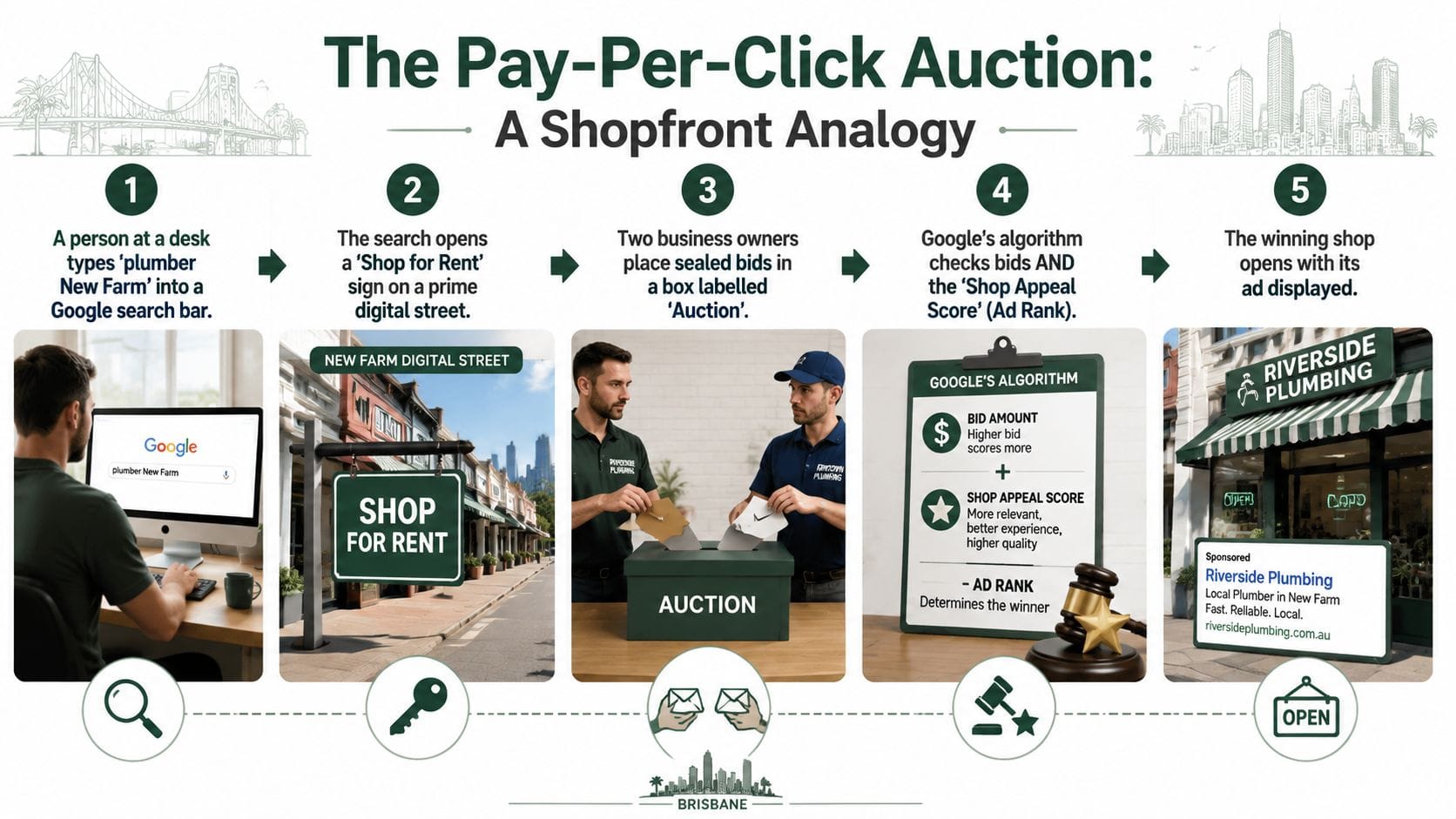
A Brisbane customer searches Google for “plumber New Farm”. Google then runs an auction among advertisers whose targeting makes their ads eligible. The result determines which ads appear, where they appear and what a click may cost. The ACCC Digital Platform Services Inquiry report describes paid search placements as being bought through an auction model, so pricing reflects real-time competition instead of a fixed rate.
The auction works more like a live auction house than a posted price list:
- A search creates an opportunity to show an ad.
- Eligible businesses enter a maximum CPC bid.
- Google assesses each bid alongside ad quality and relevance.
- Ad Rank determines the order of eligible ads.
- The selected ad appears, and the advertiser pays when someone clicks.
A larger bid does not automatically secure the best position. Ad Rank also reflects expected usefulness, including relevance, expected click-through rate and landing-page experience. A plumber bidding $15 with a closely matched service page could outrank a competitor bidding $25 if that competitor sends searchers to a generic homepage. Those figures illustrate the auction principle, not a market benchmark.
Why relevance protects the budget
Advertisers usually set the maximum amount they are willing to pay for a click, while the final charge can be lower. Search advertising is commonly explained as a second-price auction. The winning advertiser often pays only enough to beat the next eligible competitor, sometimes just a small amount above that competitor's bid.
The practical lesson matters more than the auction label. Improve the full path from search term to ad to landing page instead of trying to solve every weakness by bidding higher. Dentistry, law and trade services can face very different CPCs. Australian guidance places many search clicks around AU$2 to AU$4 overall, while higher-competition sectors such as legal, finance and insurance commonly sit around AU$6 to AU$15 or more (Australian paid ads guide).
For a clearer explanation of CPC meaning and click costs, separate the price of a visit from the value of the enquiry it may produce. A cheap click from the wrong searcher is still wasted spend.
Practical rule: A specific promise on a specific landing page can be more valuable than a larger bid attached to a vague message.
The Main PPC Platforms Brisbane Businesses Use
Google Ads is usually the starting point for a business that wants to capture existing demand. Search campaigns reach people actively looking for a service, while Shopping campaigns suit product-led businesses. Performance Max and YouTube extend Google's inventory beyond standard search, but broader reach can require stronger tracking and tighter controls.
Microsoft Advertising provides another search option through Bing. It generally captures a smaller share of search activity, yet it can reach users who don't rely on Google and may offer lower CPCs in some auctions. That makes it worth testing after the core Google campaign has a clear structure, not before.
Social platforms work differently because the user may not be searching for the product at that moment. Meta Ads, across Facebook and Instagram, can build awareness, generate leads and support remarketing through visual creative. TikTok suits product discovery and short-form demonstrations, particularly for brands whose audience responds to video. LinkedIn can suit B2B providers targeting professionals in Brisbane's CBD, although the audience and lead value need to justify the platform's potentially higher cost.
The table below uses qualitative ranges where a dependable Brisbane-specific benchmark isn't available. The published Australian figures include an average Google Ads CPC of A$2.75, a projected A$4.8 billion in total PPC ad spend for 2026, a projected PPC impression share of 78% and an estimated 2.5 million active PPC campaigns (Australia Google Ads CPC statistics). The figures are benchmarks and projections, not guarantees for an individual account.
PPC platforms compared for Brisbane small businesses
| Platform | Best For | Typical Brisbane CPC | Min. Monthly Budget (AUD) |
|---|---|---|---|
| Google Ads | High-intent local searches, Shopping and YouTube reach | Varies by keyword and industry, with Australian Search CPC commonly around A$2 to A$4 | Scaled to goals and auction costs |
| Microsoft Advertising | Additional search coverage and testing lower-cost auctions | Often lower than Google, but varies by query | Scaled to goals and available volume |
| Meta Ads | Visual awareness, lead generation and remarketing | Varies by audience, creative and objective | Scaled to creative and audience size |
| TikTok Ads | Product discovery and short-form video | Varies by audience and campaign objective | Scaled to creative testing needs |
| LinkedIn Ads | B2B services and professional audiences | Varies by audience size and competition | Scaled to lead value and targeting |
Google Ads remains the clearest choice for intent-driven leads. Meta is useful for awareness and remarketing, TikTok fits product brands with strong visual content, and LinkedIn is most relevant to B2B services. Businesses planning a local search campaign can use this Google Ads Brisbane guide to evaluate account structure and campaign priorities before committing budget.
The Numbers That Decide Whether PPC Pays Off
A Brisbane owner can judge whether a campaign earns its keep by linking four measurements. CPC is the cost of one click. CTR, or click-through rate, shows how often an impression becomes a click. CPA, or cost per acquisition, measures the cost of generating a selected conversion, such as a call, enquiry or sale. ROAS, or return on ad spend, compares advertising-attributed revenue with advertising cost. Profit still depends on margin, fulfilment costs and the quality of those conversions.
Australian benchmarks show why averages need context. One Australia-focused source reports average Google Search CPC of about A$2.69 and Display CPC of about A$0.63 (Google Ads cost in Australia). Another lists average Search CPCs of approximately A$6.40 for legal services, A$5.80 for finance and insurance, A$4.10 for home services, A$3.60 for medical and allied health, A$3.20 for real estate, and A$1.40 for ecommerce and retail (Australian Google Ads cost benchmarks). These are Australian reference points, not guaranteed Brisbane prices. The auction, keyword, location, competition and ad quality all affect the amount paid.
PPC metric benchmarks for Brisbane small businesses
| Metric | What It Measures | Brisbane SMB Typical Range | Red Flag |
|---|---|---|---|
| CPC | Cost of each click | Often low single digits, but can be higher in competitive services | Clicks have no realistic path to a sale |
| CTR | Ad clicks divided by impressions | Varies by query, ad position and relevance | Impressions rise while qualified visits remain weak |
| CPA | Cost of each tracked enquiry or sale | Must sit below the business's allowable acquisition cost | CPA exceeds contribution margin |
| ROAS | Revenue generated for advertising spend | Depends on margin, repeat value and attribution | Revenue looks positive but profit does not |
Consider a Brisbane home-services campaign paying around the Australian home-services benchmark of A$4.10 per click. The owner should compare those clicks with qualified enquiries and completed jobs, rather than treating traffic as the result (Australian Google Ads cost benchmarks). Many clicks and few calls can point to broad keywords, weak ad relevance, slow landing pages or broken conversion tracking. Calls that rarely become jobs indicate a sales or offer problem, not automatically a bidding problem.
Budget maths makes the trade-off clear. At A$4 per click, A$1,000 buys about 250 clicks. At A$8 per click, the same budget buys roughly half as many clicks (Google Ads budget guidance). The owner then needs a maximum acceptable CPA based on gross margin and customer value, not revenue alone. The ROI meaning in marketing helps separate advertising returns from genuine profitability.
Before increasing spend, check whether each conversion is recorded accurately and whether the campaign attracts the right search intent. PPC can beat waiting for organic visibility when demand is urgent, but paying for clicks that never become enquiries only makes a weak process more expensive.
PPC Compared with SEO and Organic Marketing
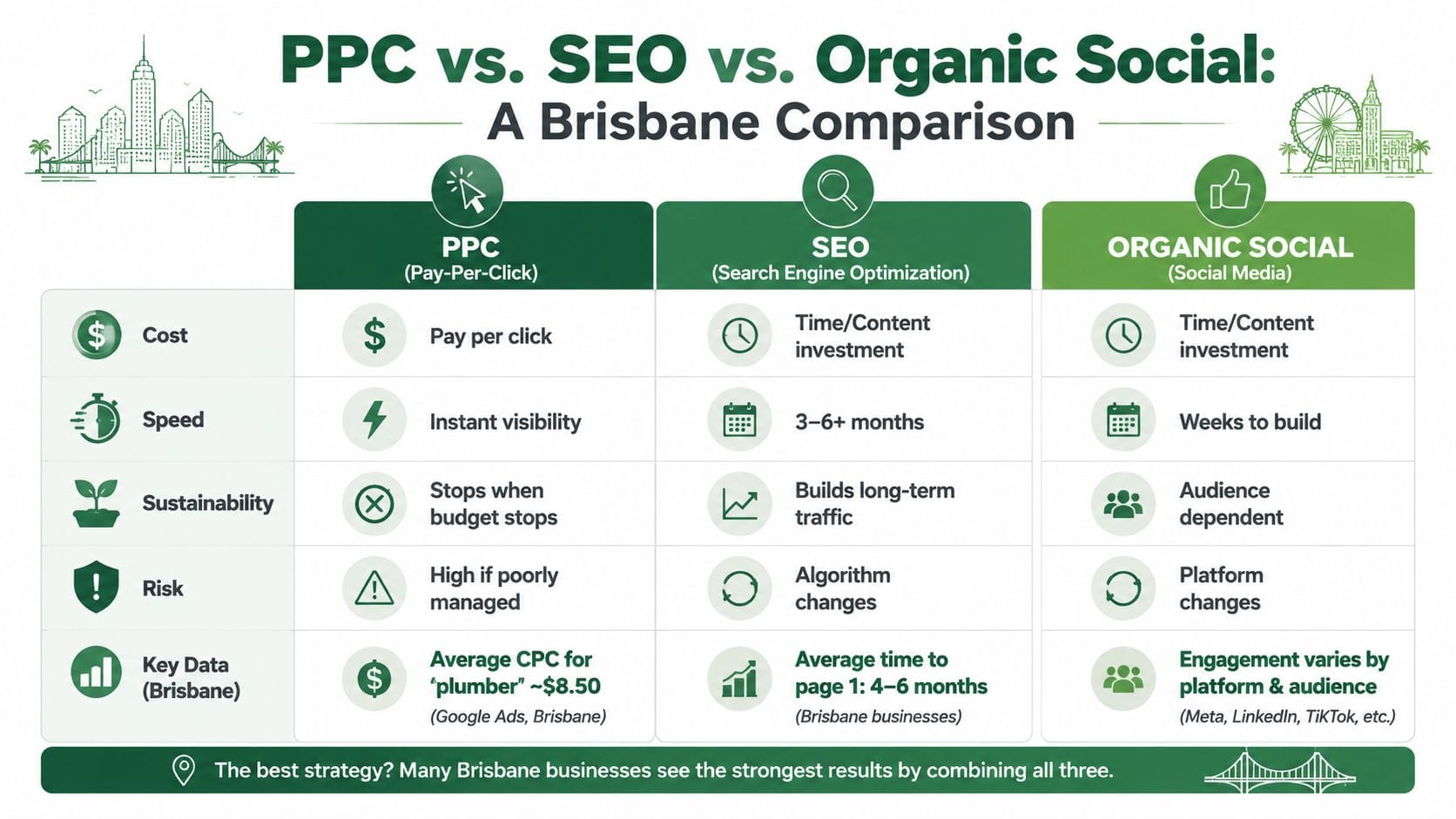
PPC buys visibility quickly. SEO earns visibility through useful content, technical quality, local relevance and authority over time. Organic social builds familiarity and trust through consistent publishing, but it depends on audience attention and platform distribution.
That makes the channels complementary. A new Brisbane business with no search visibility may use PPC to capture urgent demand while creating service pages and local content for SEO. A mature business may use paid campaigns for competitive queries, launches or seasonal demand, while organic search carries more stable informational and local traffic.
Choosing the right job for each channel
- PPC: Suitable when the business needs immediate visibility and can measure the value of calls, forms, bookings or sales. Traffic stops when the budget stops.
- SEO: Suitable for long-term local queries such as “plumber Brisbane”, service education and location pages. Results take sustained work, but successful pages can continue attracting organic visits.
- Organic social: Suitable for brand trust, community presence, product demonstrations and customer relationships. Reach depends on the platform and the quality of ongoing content.
Budget principle: Paid search should fund the demand that matters now, while SEO and organic social build assets that keep working after a campaign ends.
A simple allocation rule is to protect a core organic effort and reserve paid spend for a clearly defined commercial goal. The exact split depends on the business's cash flow, sales cycle and existing visibility, so a fixed percentage would be misleading. Owners exploring broader visibility measurement can also review this guide for AI search marketers, especially when customers discover businesses across several search experiences.
A Practical PPC Setup Checklist for Brisbane Owners
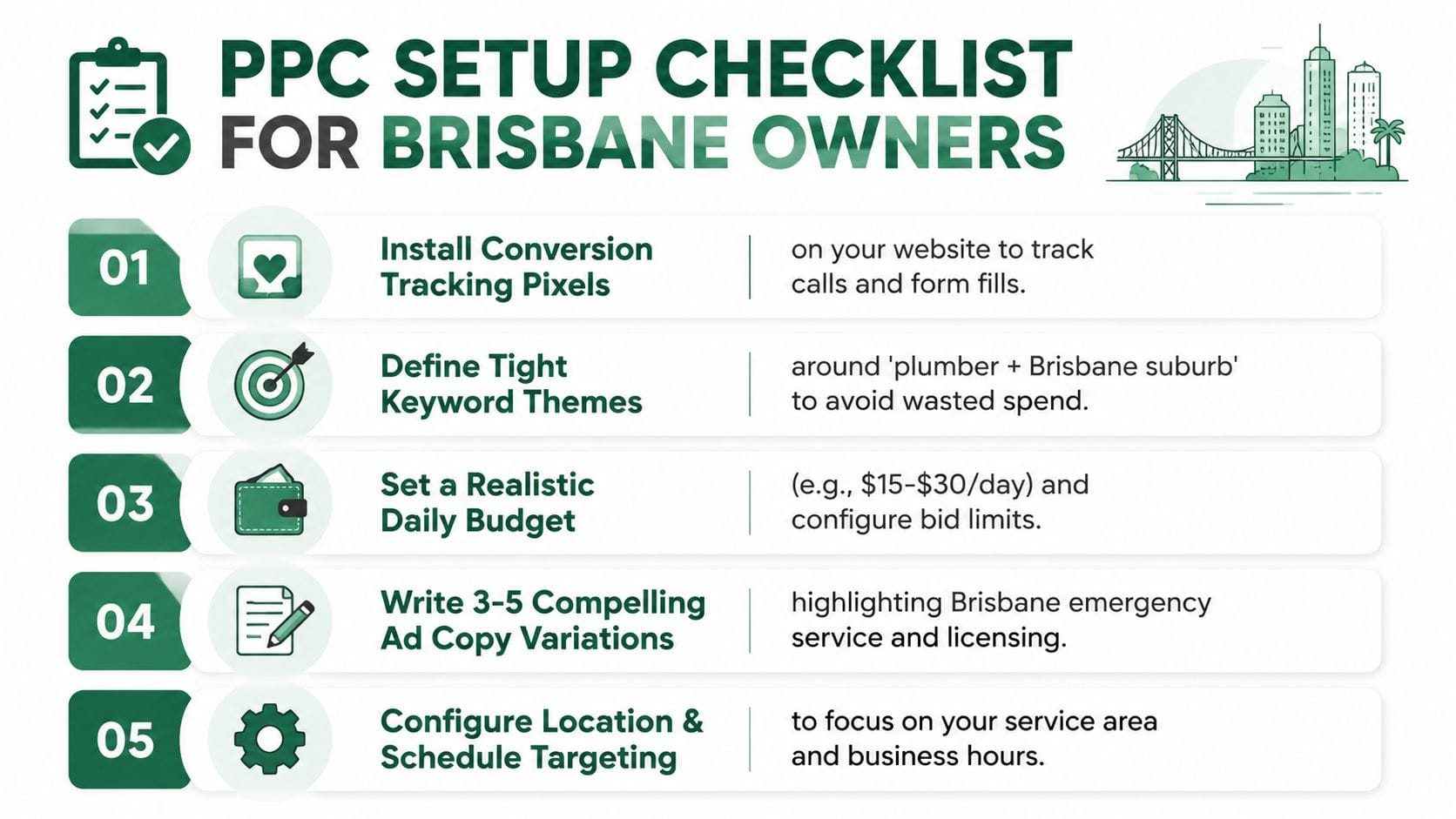
A first campaign should begin with measurement, not ad copy. Before spending, the owner needs to know which actions count as conversions and whether the website can record them accurately.
Start with a controlled account
- Install conversion tracking. Track phone calls, form submissions, bookings and purchases. A click report without outcome data can't tell the owner whether the campaign works.
- Choose tight keyword themes. Group terms around one service and relevant Brisbane suburbs. “Emergency plumber New Farm” gives a clearer intent signal than a broad word such as “plumber”.
- Set a daily ceiling. Decide the maximum affordable daily exposure before launch. A monthly budget should reflect the value of a new customer and the amount of traffic available, not an arbitrary platform recommendation.
- Match each ad to a landing page. A search for emergency plumbing should reach an emergency plumbing page with a clear phone number, service area and next step. Sending every visitor to the homepage weakens relevance.
- Review search terms and exclusions. Negative keywords can prevent ads showing for jobs the business doesn't provide, employment searches, tutorials or unrelated products.
The landing page deserves the same attention as the ad. Visitors should see the promised service immediately, understand the Brisbane coverage area and find a simple way to enquire. Businesses wanting a structured approach to improve conversion with Stimulead can use landing-page testing to compare messages and layouts rather than relying on assumptions.
Use a short test window
A practical first test can run for two weeks, with the owner reviewing search terms, conversion recordings, costs and lead quality rather than changing everything daily. At the end, pause irrelevant terms, improve weak pages, retain useful queries and only then consider expanding coverage.
Your Next Steps With PPC and When to Get Help
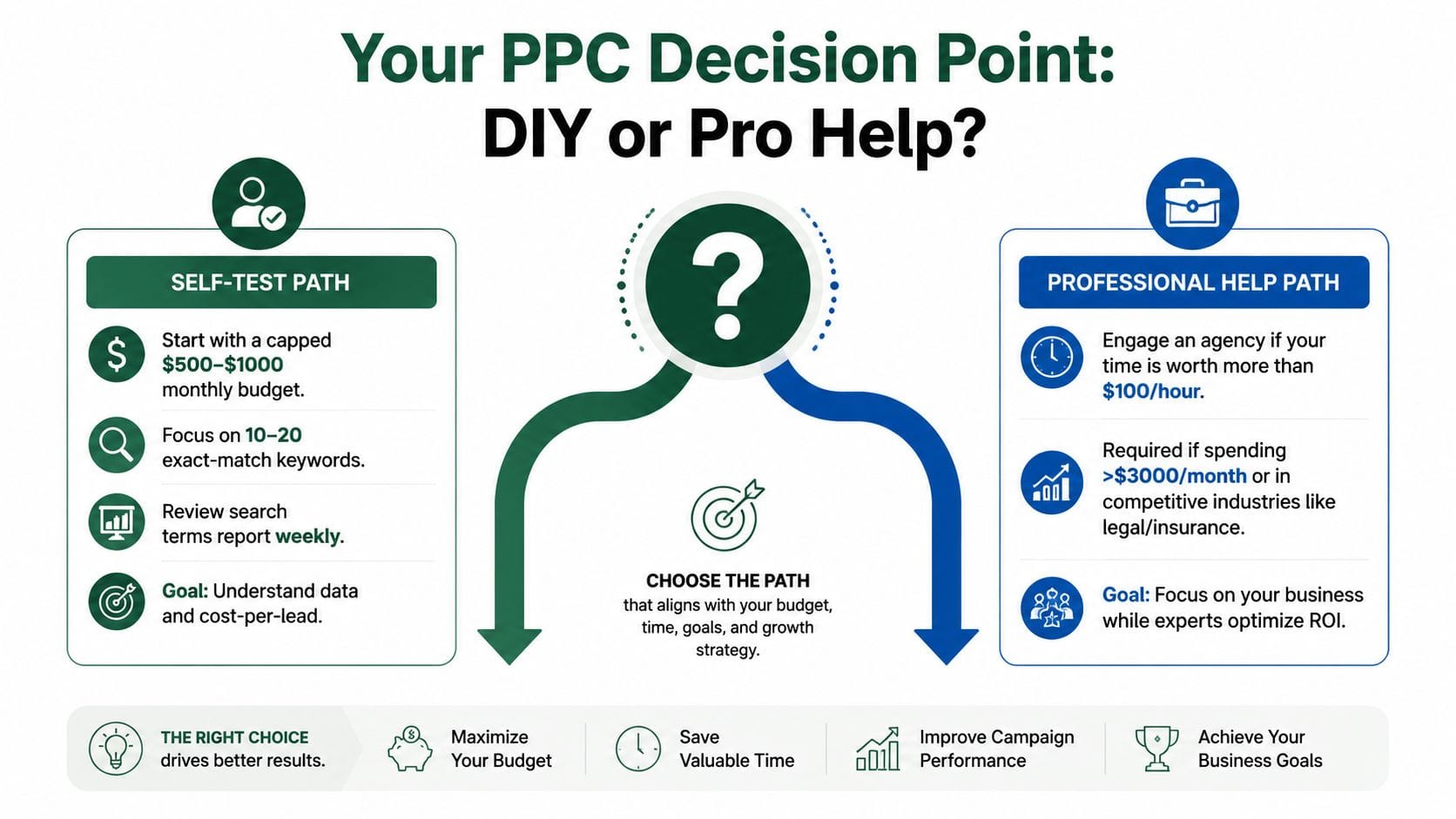
A Brisbane owner can begin with a self-managed test when the offer is clear, the service area is focused and someone can review the account regularly. Treat the budget as a controlled experiment, not an open-ended subscription. Set a spending cap that reflects the value of a new customer and the number of relevant searches available.
A practical test may use A$500 to A$1,000 per month for 60 to 90 days. Compare the cost of each enquiry with the average sale value, then ask whether the campaign is producing profitable opportunities or only clicks and activity. A smaller, tightly focused campaign can reveal more than a broad campaign that spreads the budget across weak searches.
Professional help becomes sensible when account management takes more time than the owner can give it. Look for these warning signs:
- Rising lead costs: CPA moves above the business's acceptable target.
- Missing tracking: Calls, forms or sales are not recorded reliably.
- Irrelevant traffic: Search terms continue to show wasted spend after basic exclusions.
- Limited time: No one can review bids, queries, ads and landing pages consistently.
A Brisbane PPC specialist or agency should report on enquiries, sales or revenue, rather than impressions alone. Ask how conversion quality is assessed, what Google Ads experience the team has and whether it can provide relevant Australian or Brisbane examples. Avoid unsupported promises about performance.
Boocoo provides paid advertising support alongside SEO, web design and social media management, including campaign setup, management and reporting. Businesses comparing providers can review pay-per-click advertising companies before choosing between internal management and agency support.
Start by listing the service, suburb and customer action the campaign should target. Check that conversion tracking works before any budget goes live, so clicks can be judged by business results. For practical help with PPC, SEO and a broader Brisbane Digital Marketing strategy, contact Boocoo on 1300 093 797 or email hello@boocoo.au to discuss the business's goals, timeline and available budget.