
A Brisbane business owner can spend the morning quoting jobs, checking stock and managing staff, then glance at Google Ads and notice that each click costs more than it used to. The campaign may still be receiving traffic, but rising click costs reduce the cash available for wages, materials and follow-up.
That's why the quality score definition matters. Quality Score isn't a decorative number in a Google Ads column. It's a practical diagnosis of how well a keyword, ad and landing page fit together, and it gives small businesses a clearer way to find wasted local advertising spend. For businesses competing for searches such as “plumber Brisbane CBD” or “air conditioning repair Brisbane”, relevance can protect margins before a visitor ever becomes a lead.
Why Quality Score Matters to a Busy Brisbane Business Owner
A café owner in West End, a builder serving the northside and a suburban accountant all face the same problem. They're paying for clicks before they know whether those visitors will call, book or buy. If the campaign's ads and landing pages don't match the searches behind those clicks, the business can spend steadily while receiving less value from every dollar.
Google describes higher quality as a factor that can support lower prices and better ad positions, while also making clear that Quality Score itself isn't used at auction time to determine Ad Rank. The score works as a diagnostic that highlights weaknesses in the search experience, which makes it especially useful for budget-conscious operators. Google's explanation of Quality Score and Ad Rank separates the account-level diagnosis from the live auction process.
A weak result can indicate that the keyword attracts few clicks, the ad doesn't closely answer the search, or the destination page creates friction. That doesn't automatically prove that every click is overpriced, but it does show where the campaign deserves attention. Australian guidance also treats Quality Score as a pricing multiplier, with tightly grouped keywords and directly relevant landing pages more likely to support efficient campaign performance. This Brisbane Google Ads guide offers useful local context for owners deciding whether to manage campaigns internally or seek support.
Practical rule: Before increasing the budget, check whether the existing campaign is paying for relevance problems.
A healthy score won't replace proper conversion tracking, a strong offer or reliable sales follow-up. It can, however, help prevent a business from funding irrelevant searches and poorly matched pages. The rest of the account review should focus on the three inputs behind the score, not on chasing a number for its own sake.
What Quality Score Actually Is in Plain English
A Brisbane business can have a well-written ad and still pay for a weak search experience. Google Ads defines Quality Score as a keyword-level diagnostic measured on a 1-to-10 scale, where 1 is the lowest and 10 is the highest. It assesses the connection between the keyword, ad and landing page through three components: expected click-through rate, ad relevance and landing page experience. Google's Australian Quality Score definition provides the formal explanation.
The simplest comparison is a mechanic's inspection report. It checks whether the business understands the problem, recommends the right service and sends the customer to a workshop ready to do the job. Quality Score checks a similar connection between the search, the ad and the page.
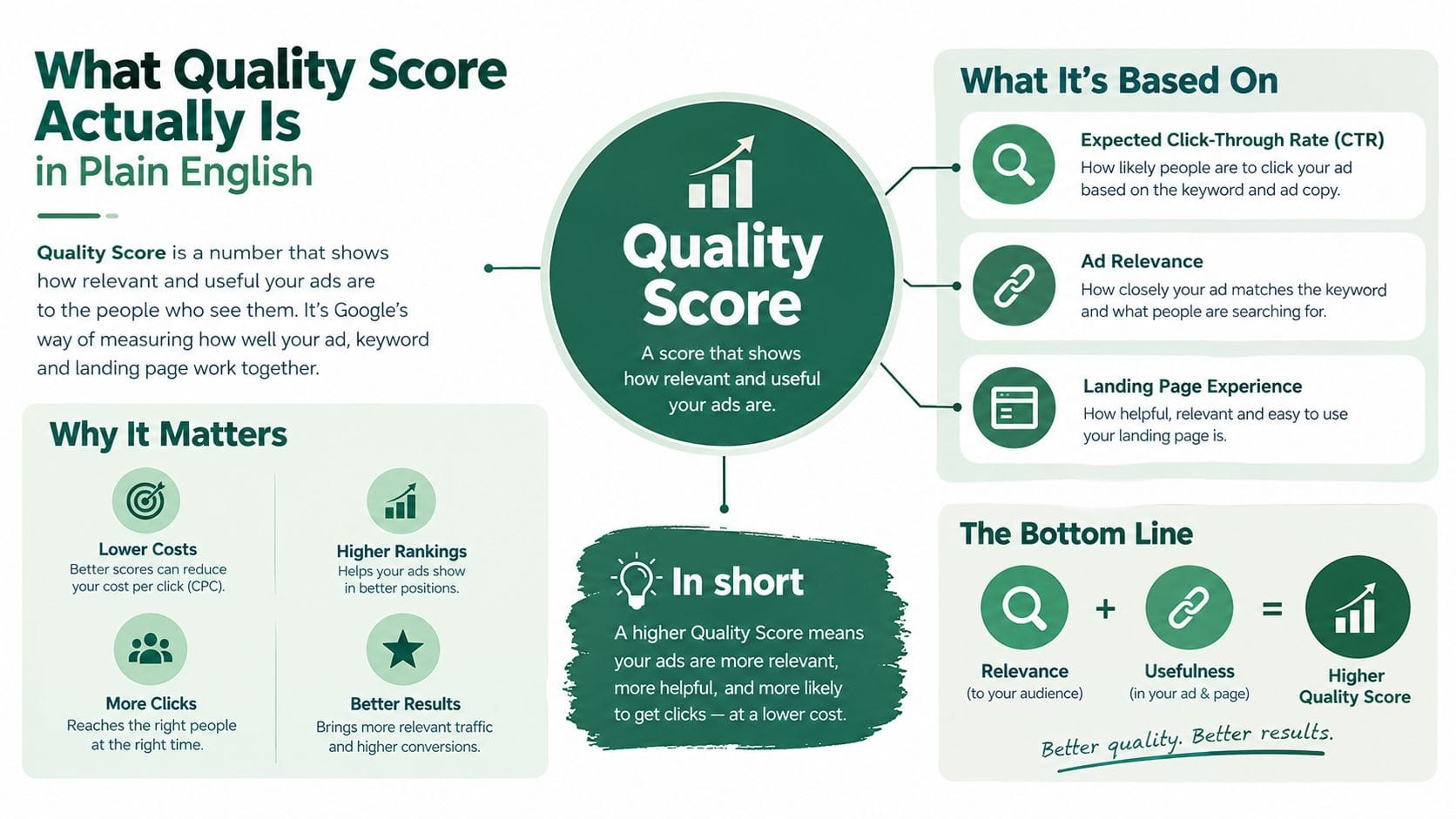
Treat the score as a diagnostic, not a live auction price. Google uses signals such as expected click-through rate, ad relevance and landing page experience when assessing an ad during an auction, while the score shown in the account records historical performance. Google compares the component ratings with other advertisers showing on the same keyword over the previous 90 days, so the result reflects a historical benchmark rather than the exact conditions of the next search.
That distinction matters for cash flow. A higher score can support lower cost per click and stronger ad positions, but it cannot guarantee conversions. A Brisbane electrician may have a relevant ad and page, yet lose enquiries because the phone number is difficult to find or the service area is unclear.
Use the score to find wasted spend, not to chase a perfect number. Ask which part of the customer journey is making Google less confident in the keyword, then fix that weakness first.
How Google Calculates the Three Components
Google doesn't display a single detailed formula for each keyword. Instead, the account shows component ratings as Above average, Average or Below average, compared with other advertisers competing on the same keyword. Those labels are more useful than they may appear because they point towards the part of the campaign that needs work.
| Component | What It Measures | Above Average Means | Below Average Means |
|---|---|---|---|
| Expected click-through rate | The likelihood that people will click the ad when it appears | The ad has historically and predictively attracted stronger engagement than competing ads | The ad is less likely to attract a click for that search |
| Ad relevance | How closely the ad matches the keyword and search intent | The wording directly addresses what the searcher wants | The keyword, ad and intent are poorly aligned |
| Landing page experience | How relevant and useful the destination page is after the click | The page supports the promise made by the ad and helps the visitor continue | The page is mismatched, unclear or difficult to use |
Google defines expected click-through rate as the likelihood that an ad will be clicked when shown. Landing page experience measures how relevant and useful the page is to people who click the ad. Google's Australian component definitions show why the full search-to-page journey matters.
Expected click-through rate
This component reflects expected interaction with the ad, not whether the business has a high bid. A search for “same-day plumber Brisbane” needs copy that makes same-day availability clear if the business provides it. Generic wording such as “Quality Plumbing Services” gives the searcher less reason to choose that result.
Ad relevance
Ad relevance improves when keywords are grouped around a clear service or intent. A campaign that places emergency plumbing, bathroom renovations and commercial maintenance in one loose ad group makes it harder to write precise ads. A campaign organised around distinct services gives each ad a better chance of matching the search.
Landing page experience
The landing page needs to deliver what the ad promised. A visitor searching for a Brisbane air conditioning repair service shouldn't land on a generic homepage and have to hunt through menus. The page should make the service, location, contact path and next action obvious, particularly on mobile.
The three components work together. A Below-average rating in one area can pull attention away from the others, so the account manager should fix the weakest link first. For a broader explanation of click behaviour and measurement, the CTR guide for Google Ads provides a useful reference.
Practical Ways to Improve Your Quality Score Locally
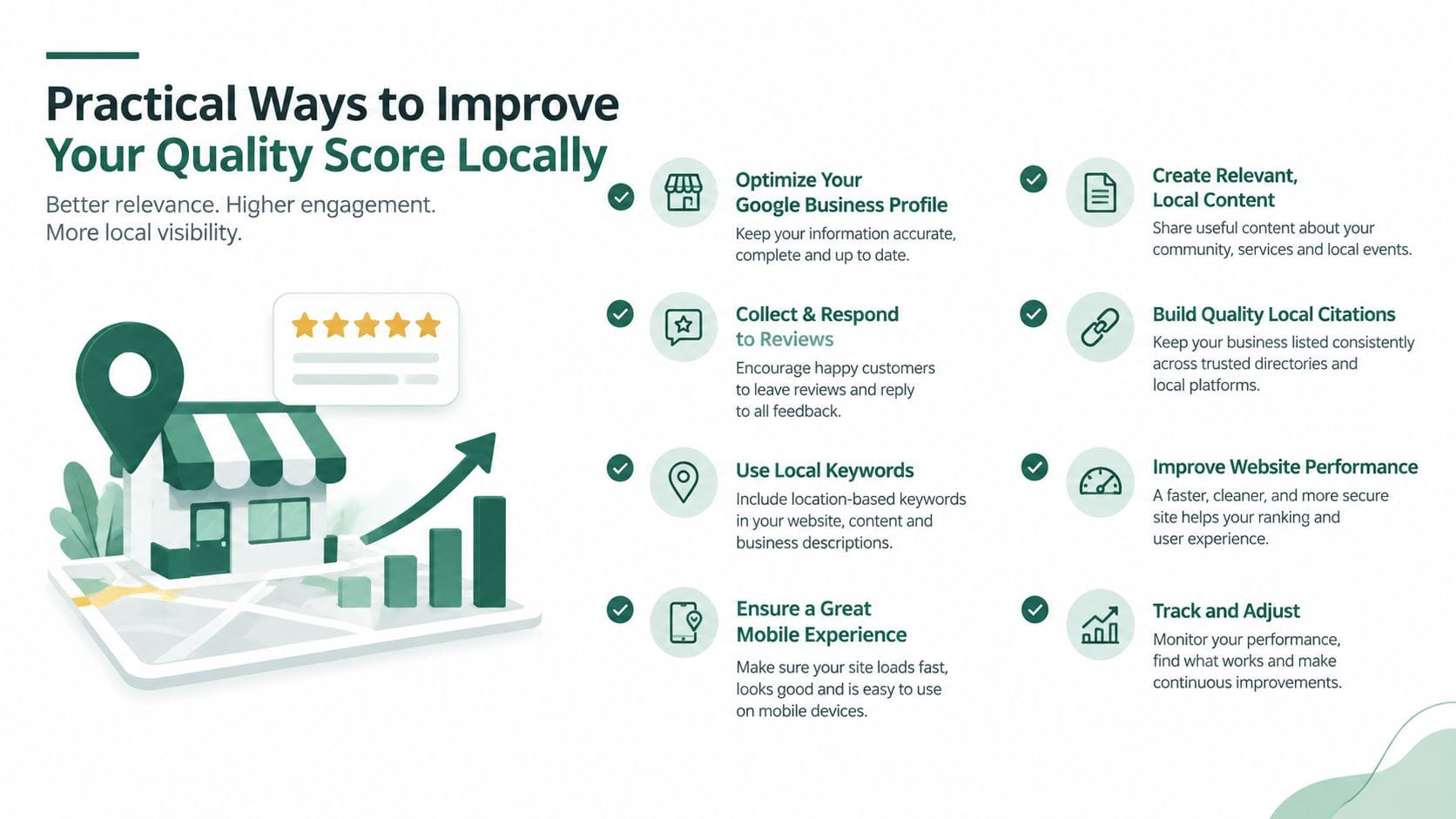
A small Brisbane business doesn't need a full website rebuild to improve campaign quality. The fastest gains usually come from removing irrelevant traffic, tightening ad groups and making the first screen of the landing page match the search.
Start with the cheapest traffic fixes
Open the search-term report and look for queries that have nothing to do with the business. A local painter might find searches from job-seekers, DIY researchers or people looking for a competitor. Add unsuitable terms as negative keywords so the ads stop appearing for those searches.
Then review keywords marked Below average. Don't remove a keyword automatically. First check whether the keyword is commercially relevant, whether the ad addresses it directly and whether the landing page continues the same conversation. A valuable keyword deserves a better setup. An irrelevant keyword deserves removal.
Make the ads sound local and specific
A searcher looking for “plumber Brisbane CBD” should see that service and location reflected in the ad where appropriate. A business offering same-day work can make that benefit clear, provided the claim is accurate and available.
Useful changes include:
- Match the search intent: Use service and location language that reflects the actual keyword theme.
- Test responsive search ad headlines: Give Google several relevant headlines that mention the service, suburb or urgent need.
- Use local callouts: Mention service areas such as Brisbane CBD or relevant suburbs when those areas are covered.
- Remove generic promises: Replace broad claims with clear information about the service, availability or booking process.
The purpose isn't to force keywords into every line. It's to make the ad immediately useful to someone who has already stated what they need.
Organise campaigns around real services
One service or suburb per tightly themed ad group gives the copy a clear job. An air conditioning repair group should not also carry installation and maintenance searches unless the ads and page serve all three intents.
A practical structure might separate:
- Emergency repairs
- Scheduled maintenance
- New installations
- Individual Brisbane service areas
That structure makes it easier to see which component is weak and easier to direct each group to a suitable page. Owners handling follow-up and lead administration can also review automation software for small teams when manual enquiry management starts taking time away from quoting and service delivery.
Fix the destination before commissioning a rebuild
Send each ad group to the most relevant service or suburb page available. The page should show a visible phone number, opening hours, trust signals and a clear next step. It should also load reliably and remain easy to use on a mobile device.
A plumber's “blocked drains Brisbane” ad should lead to a page about blocked drains, not a general plumbing homepage. The landing page explanation for small businesses covers the role that page plays after the click.
Test the headline first, then the call button and enquiry form. These are affordable changes that can expose relevance problems before a business invests in a larger redesign.
Two Competing Brisbane Campaigns Compared
Consider two fictitious Brisbane air conditioning businesses targeting the same search, “air conditioning repair Brisbane”. Both allocate a similar daily budget. The difference sits in the campaign setup, not the amount available to spend.
Campaign A uses broad keywords, generic ad copy and a homepage that takes 7 seconds to load on mobile. Its Quality Score is 4 out of 10. Campaign B uses tightly themed ad groups, suburb-specific pages with embedded reviews and a tap-to-call button. Its Quality Score is 8 out of 10.
The example below uses directional business logic, not a reported case study. The exact auction result will vary by competition, search query, bid strategy and conversion tracking.
| Metric | Campaign A, QS 4/10 | Campaign B, QS 8/10 |
|---|---|---|
| Keyword structure | Broad and mixed | Tightly themed |
| Ad message | Generic air conditioning service | Repair-focused and locally relevant |
| Destination | General homepage | Service and suburb landing pages |
| Mobile experience | 7-second load | Fast, focused page experience |
| Contact path | Visitor searches for contact details | Tap-to-call button is visible |
| Likely budget efficiency | More waste from mismatched clicks | Better alignment between click and enquiry |
Campaign A asks the visitor to do too much work. Someone searching for a repair must find the correct service, confirm Brisbane coverage and locate contact details. The slow mobile experience adds another point of friction. A higher bid might create more exposure, but it won't repair the mismatch.
Campaign B gives each search a more direct answer. The ad speaks to repairs, the page supports the local intent and the phone action is easy to find. That alignment can help the campaign compete more efficiently, with higher quality supporting lower prices and better positions under Google's broader search-quality framework.
The budget is only half the equation. The other half is how much of that budget survives the journey from search term to booked job.
The business owner should compare actual search terms, conversion actions and cost per conversion rather than assume the score alone proves success. For an account with recurring waste or complicated structure, PPC ads management in Brisbane can provide a practical review of targeting, ads and landing pages.
Common Misconceptions Worth Letting Go Of
The first misconception is that 10 out of 10 is always the goal. It isn't. Quality Score is a diagnostic, and a business can waste time chasing a perfect column while neglecting conversion tracking, response speed, pricing or the offer itself.
Australian guidance often flags keywords below about 6 for review, especially when a component is Below average. The Australian Quality Score explainer describes that practical review benchmark and the relationship between relevance, landing pages and advertising efficiency. The useful target is a sound, commercially relevant campaign, not an impressive screenshot.
The second misconception is that Google sets the score secretly and the business can't influence it. The three component areas connect directly to choices the advertiser controls: keyword selection, ad wording and landing page usefulness. Google's support material also frames Quality Score as a diagnostic rather than a direct auction input, as explained in this independent overview of Quality Score and Ad Rank.
A score can move in the right direction when an owner removes irrelevant searches, groups keywords more precisely or improves the page that receives the click. The account column is only the alert. The work happens in the three inputs behind it.
Checking Your Score and Knowing When to Ask for Help
A Brisbane operator can make the review manageable by using the same routine each week. In Google Ads, open the Keywords view, add the Quality Score column and sort from the lowest result upwards. Record keywords with Below-average component ratings, then note whether the problem sits with expected click-through rate, ad relevance or landing page experience.
A simple review sheet can include:
- Keyword: Is the search commercially relevant?
- Ad group: Does the group contain one clear service or intent?
- Ad: Does the wording answer the search directly?
- Landing page: Does the page show the service, location and contact path?
- Action: Should the account manager edit, test, redirect or pause the keyword?
A screenshot can make the review easier to share with a staff member or external adviser.

Owners should ask for help when core keywords remain Below average after focused changes, cost per conversion rises while spending stays steady, or a new campaign is launching without time for a landing-page audit. A specialist review is a budget decision, not an admission of failure. The important comparison is the cost of outside help against the click spend being lost through an unresolved setup problem.
Teams wanting a broader quality-control routine can use this step-by-step quality monitoring guide to organise recurring checks beyond advertising. Brisbane businesses can also consider Google Ads consulting from Boocoo when campaign structure, landing pages and reporting need an external review. Boocoo is one Brisbane-based option that supports small businesses across paid advertising and related digital marketing tasks.
The practical definition is straightforward: Quality Score is a keyword-level, 1-to-10 diagnostic that helps identify whether the ad experience is relevant and useful. It becomes valuable when the business uses it to reduce irrelevant clicks, improve message matching and send visitors to pages built for the searches that generated them.