

Australian benchmarks put typical Google Ads management fees at roughly A$800 to A$2,000 per month or 10% to 20% of ad spend, billed separately from the media budget itself. That means a Brisbane small business can easily receive a quote that sounds affordable until the ad budget, tracking, landing pages and creative work are added.
A common scene plays out across Brisbane. A plumber, dentist or local consultant asks three providers to manage the same Google Ads account, then receives three very different proposals. One quotes a modest monthly retainer, another asks for a percentage of spend, and the third presents a larger package with setup and reporting buried in the fine print.
The right question isn't just, “Which quote is cheapest?” It's, “What work does this fee buy, and does that work fit the account?” This guide breaks down Google Ads management pricing in plain English, so owners can compare quotes against workload, revenue and lead value rather than package names.
Why Google Ads Management Pricing Feels So Confusing
Google Ads doesn't have a fixed price list for clicks. Advertisers compete in auctions, and the cost changes according to the search, location, competition and account conditions. Recent Australian benchmark data recorded a median search CPC of A$3.81 across more than 8,400 Australian service keywords in May 2026, with prices rising 31% between January and May 2026 and 21% year on year. For local-service-style keywords, the same dataset placed Brisbane at a median of A$13.08, compared with A$16.19 in Sydney. The Australian Google Ads cost benchmark provides the market context.
That auction system explains the media bill, but it doesn't explain the management fee. The fee pays for the person doing the work around the clicks. A useful comparison is a mechanic. The parts cost money, but the mechanic also charges for diagnosis, fitting, testing and experience. Google receives the ad spend, while the manager charges for building and improving the campaigns.
Practical rule: The ad budget buys opportunities to appear in search. The management fee buys the decisions that determine where that budget goes.
For a Brisbane business, the two bills might cover very different things:
- Media budget: Money paid to Google when people click the ads.
- Management fee: Campaign planning, keyword selection, bid adjustments, ad testing, negative keyword work, conversion tracking checks and reporting.
- Additional project work: Landing page changes, new creative, CRM connections or major account restructuring, if those items aren't included in the retainer.
The Australian benchmark cited above places typical agency management at A$800 to A$2,000 per month or 10% to 20% of ad spend, separate from advertising spend. Comparing that fee with another provider's all-in figure creates a false bargain. One quote may cover management only, while another may include setup, landing page support and reporting.
The practical lesson is simple. A small account with one service and one suburb doesn't need the same management workload as a business covering multiple services, Brisbane-wide targeting and several campaign types. Google Ads management pricing becomes easier to judge once the quote shows the work behind the number.
The Four Common Fee Models Explained
Most Australian providers use a fixed fee, although percentage pricing remains common. One Australian SEM guide puts agency percentage pricing at 10% to 20% of ad spend, and notes that a flat A$800 to A$1,500 fee can become more cost-efficient as spending grows, while percentage pricing can suit small campaigns that fluctuate. This Australian SEM pricing guide explains the basic mechanics.
The mechanic analogy helps here too. A flat fee pays for the mechanic's regular attention. A percentage model charges more as the parts bill grows, even if the diagnostic work doesn't change in the same proportion.
| Fee Model | Typical Cost | Best Suited To | Main Risk |
|---|---|---|---|
| Flat monthly retainer | An agreed fixed fee, often within the Australian small-business range of A$800 to A$2,000 | Stable campaigns with predictable work | The fee may not change when the workload falls |
| Percentage of spend | 10% to 20% of ad spend | Very small or variable campaigns | The fee rises automatically as spend rises |
| Hybrid | A base fee plus a percentage or agreed variable component | Accounts growing through different stages | The calculation can become difficult to audit |
| Performance-based | A fee linked to agreed outcomes | Partnerships with reliable tracking and clear lead definitions | Disputes over attribution and what counts as a result |
Flat monthly retainer
A retainer works like a gym membership. The business pays the same amount each month for agreed access and service, whether a particular week is busy or quiet. This model makes forecasting easier and means a successful increase in ad spend doesn't automatically increase the management bill.
The proposal should still define the workload. “Ongoing optimisation” is too vague. A useful scope names campaign reviews, search-term checks, ad testing, conversion tracking checks, reporting and communication expectations.
Percentage of ad spend
A percentage model resembles paying the mechanic a cut of the parts bill. If the advertising budget increases, the management fee increases too. That can be straightforward for a very small account with unpredictable spending, but it becomes less attractive when the same account structure continues to produce results at a larger budget.
The threshold effect matters. A flat fee remains stable, while a percentage fee keeps moving upwards with spend. Owners should ask whether more budget truly creates more management work, or whether the provider is charging more only because the account has grown.
Hybrid and performance pricing
A hybrid model can make sense when a provider needs a minimum fee to cover regular work, while larger campaigns need extra oversight. The contract should show exactly when the variable part applies and whether the percentage is calculated on the full budget or only on additional spend.
Performance pricing sounds attractive, but lead quality, phone calls and sales often involve people and systems outside the manager's control. A signed form isn't always a qualified customer. Clear definitions and reliable conversion tracking matter more than a promise to charge only for results.
Businesses comparing providers can also review this guide to pay-per-click advertising companies and these AI advertorial creation tips when assessing how advertising, content and creative work fit together.
Setup Costs Versus Ongoing Management
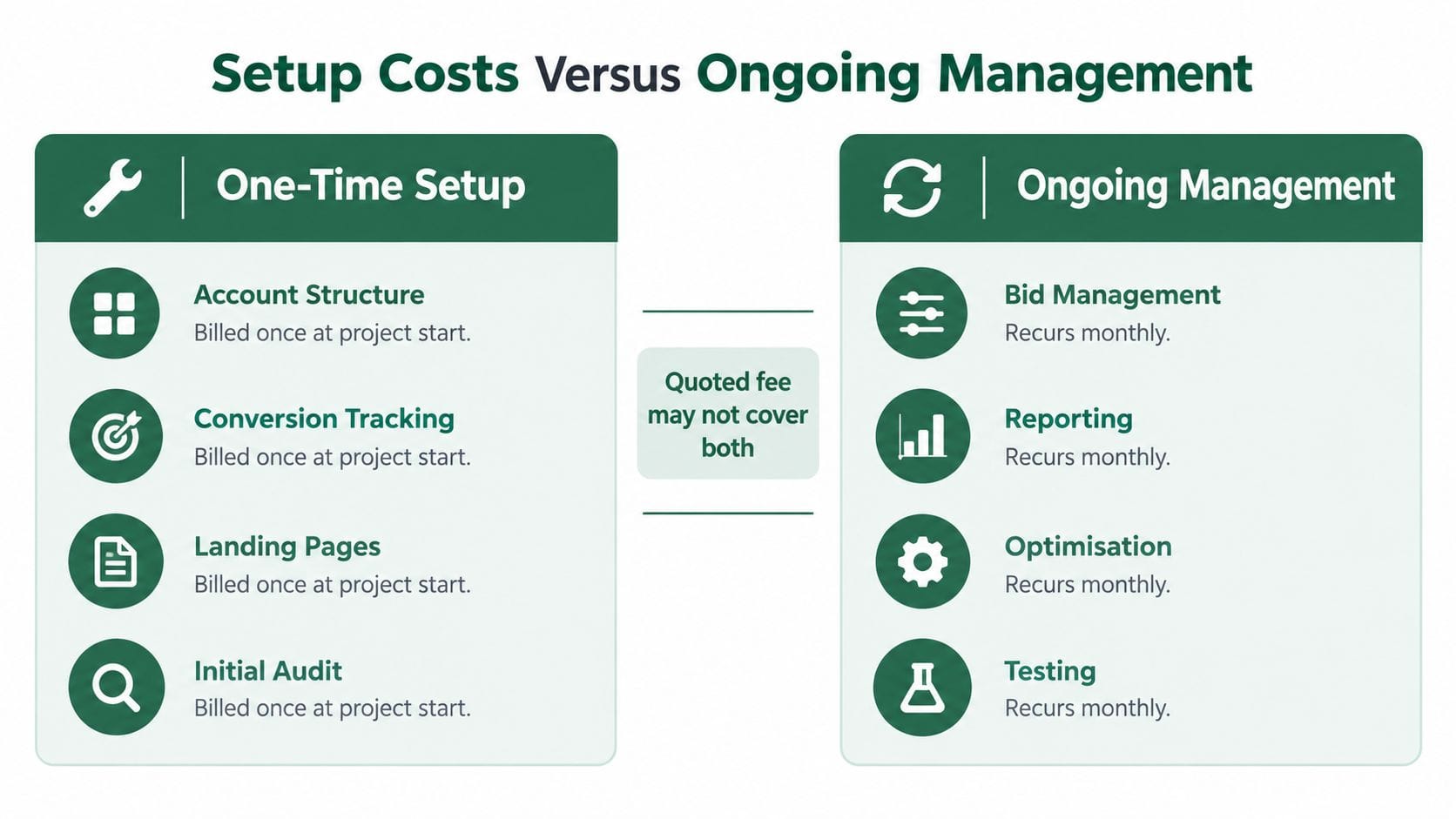
A Google Ads account needs a shop fit-out before anyone can run the shop properly. Setup creates the structure, tracking and initial assets. Ongoing management keeps the shop organised, removes what isn't working and directs attention towards the products that attract worthwhile customers.
The two services shouldn't be blended into one vague line item.
What setup should include
A sensible setup invoice should identify the work completed at the start:
- Account structure: Campaigns and ad groups organised around services, locations or product categories.
- Conversion tracking: Calls, forms, bookings or other meaningful enquiries configured so the account can distinguish activity from business outcomes.
- Initial keyword research: Search terms assessed for relevance, intent and suitability for the budget.
- Initial audit: Existing settings, targeting, search terms and conversion actions reviewed before changes are made.
- Landing page recommendations: Practical changes identified where the page doesn't match the search or make enquiry easy.
A Brisbane plumber might need separate campaign logic for emergency plumbing, blocked drains and hot water services. The setup work should explain which searches belong in each area, which locations are covered and what counts as a valuable enquiry.
What the monthly fee should cover
The retainer should pay for recurring decisions, not just a dashboard login. That normally includes bid management, search-term reviews, negative keyword additions, ad copy testing, budget adjustments, conversion checks and a plain-English report.
One Australian industry summary puts published entry-level management at an average of A$1,391 per month, with a median of A$1,250 and a broader range from A$400 to A$6,000 or more, with ad spend billed separately. If management sits near the median and the ad budget is A$1,500 to A$3,000, total monthly commitment can reach roughly A$2,750 to A$4,250 before landing-page, tracking or creative work. The Australian management pricing benchmark sets out those fee components.
For the plumber's first three months, the quote should make the sequence clear. The first stage establishes tracking and campaigns. The next stage reviews actual searches and enquiries. The following stage shifts budget towards useful patterns and removes waste. A monthly management fee should cover that continuing work, while a new landing page or substantial rebuild should be separately identified.
Businesses can use a PPC ads management overview to compare the language providers use for setup, strategy, reporting and optimisation.
Minimum Budgets and Why Underspending Backfires
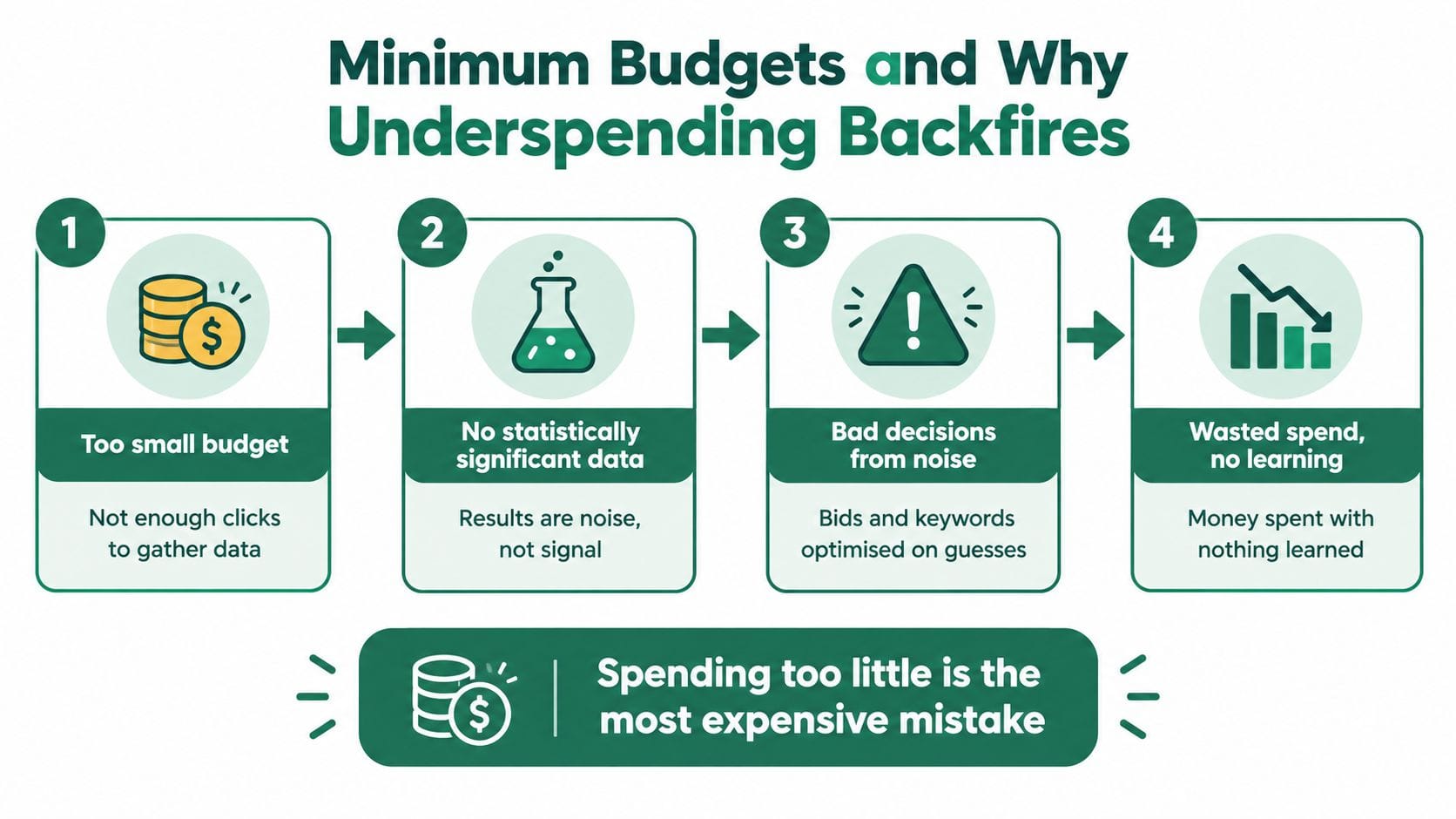
The costliest mistake isn't always paying too much for management. Sometimes it's putting too little money into the media budget to learn anything useful.
Google Ads needs enough activity to compare search terms, ads and landing pages. When only a small number of clicks arrive, one enquiry can make a weak campaign look brilliant, while a good campaign can look poor just because it hasn't had enough opportunity to produce a result.
An Australian benchmark places minimum ad spend at about A$1,000 to A$1,500 per month for collecting enough data to optimise, while many small-business campaigns sit at A$1,500 to A$3,000 total monthly investment once management is included. This Australian guide to Google Ads costs explains why the media budget and management fee need to be considered together.
A time-poor Brisbane trades business can use a staged process:
- Start with a defined service area: Focus the campaign on the service most likely to produce a profitable enquiry instead of spreading a modest budget across every offering.
- Track meaningful actions: Count calls and forms that represent genuine enquiries, not just visits or button clicks.
- Review patterns regularly: The manager should identify useful search terms and exclude irrelevant ones, without making daily changes based on thin evidence.
- Scale selectively: Increase investment only where the account shows relevant enquiries and a sensible commercial fit.
Spending too little creates false certainty. The business still pays for clicks, but it learns almost nothing from them.
A plumber, dentist or professional services firm shouldn't treat the first phase as a permanent budget commitment. The better approach is to regard it as an evidence-gathering period, then direct more money towards campaigns that show real commercial promise. This protects cash flow while avoiding the trap of calling an underfunded campaign a failure before it has generated enough information.
What Actually Drives the Price You Pay
A higher management fee isn't automatically a sign of better work. It should reflect a larger workload, greater account complexity or deeper strategic responsibility.
Australian pricing guides show roughly A$800 to A$2,500 per month for small-to-mid accounts, while more complex Shopping and Performance Max accounts are often priced at A$2,000 to A$4,500 or more. The same market commentary says there is no standard rate card, and that the right fee depends on the work involved, complexity and manager experience. This Australian Google Ads management pricing guide outlines that spread.
What justifies a higher tier
A small Brisbane account may require limited campaign maintenance. A larger fee can be justified when the provider must manage several distinct areas:
- More campaign types: Search, Shopping or Performance Max each create different checks, assets and optimisation decisions.
- Broader geography: A campaign covering Brisbane, surrounding suburbs and other service areas needs tighter location controls than a single local area.
- More services or products: Each category can require separate keywords, ad messages, landing pages and budget decisions.
- More involved measurement: Lead quality, phone calls, bookings and sales may need different tracking and reconciliation.
- Greater strategic input: A senior manager may advise on offer structure, landing page priorities and which services deserve investment.
The important question is direct: “What changes in the work at this price?” A provider charging more should be able to name the additional campaigns, reviews, testing, reporting or strategic meetings included.
What shouldn't justify a jump
A bigger ad budget alone doesn't prove that the manager is doing more. If the account structure, search coverage and reporting remain largely unchanged, a percentage-only increase may just make growth more expensive.
Quality Score is one example of an area that can involve real analysis rather than superficial score chasing. A plain-English explanation of what Quality Score means can help owners understand why relevance between keywords, ads and landing pages matters.
A quote above the lower retainer range should therefore come with a workload map. If the provider can't explain the difference between the basic service and the premium service, the extra fee deserves scrutiny.
Warning Signs and the Questions to Ask Before You Sign
A good proposal makes ownership, activity and measurement easy to understand. A weak proposal uses a low headline fee to get the agreement signed, then leaves the important work undefined.
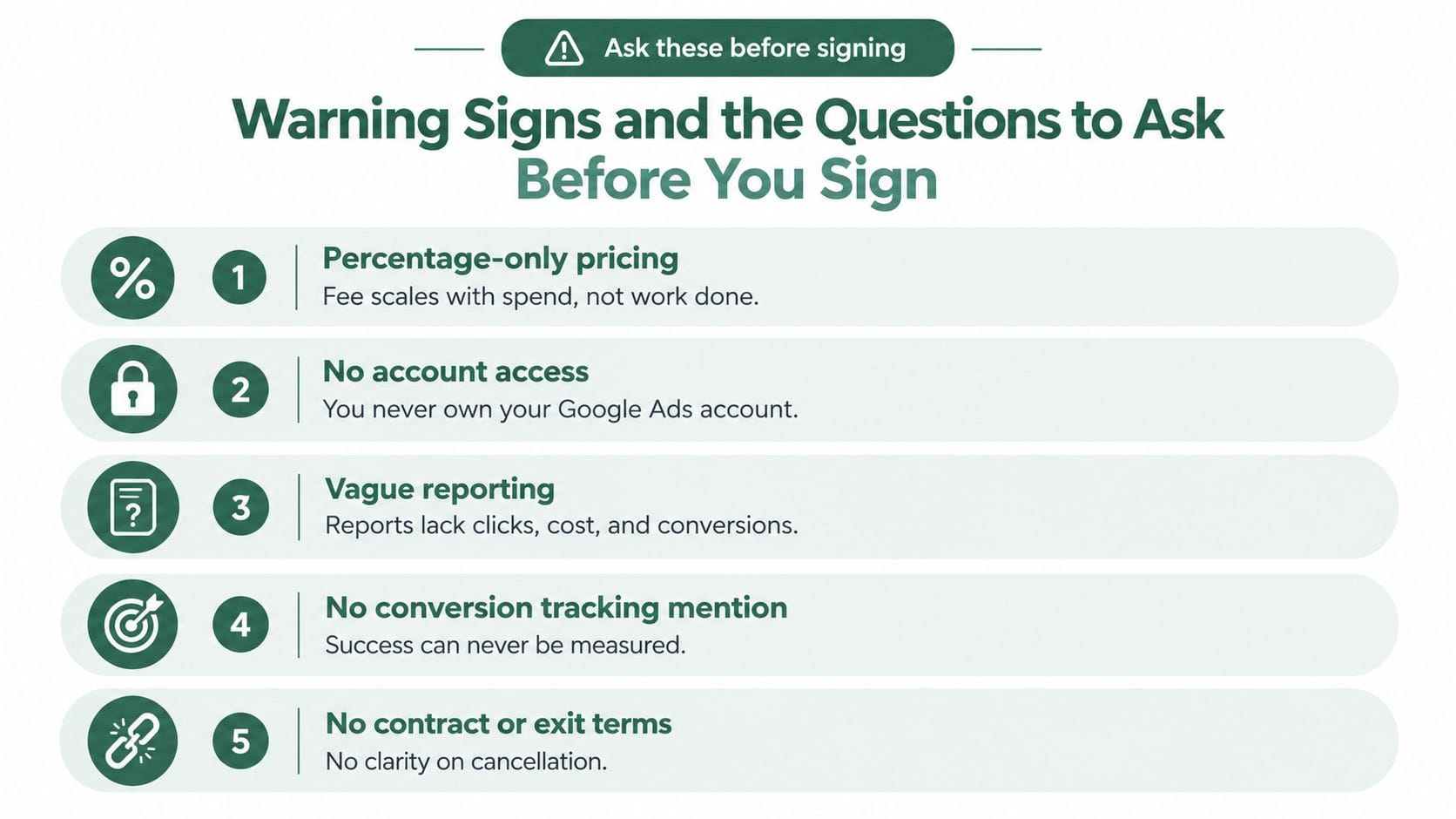
A Brisbane owner can use this short checklist during a proposal call:
- Percentage-only pricing on a small budget: Ask, “What happens to the fee if spending changes, and what extra work is added when it rises?”
- No access to the Google Ads account: Ask, “Will the business retain ownership and administrator access if the relationship ends?”
- Vague reporting: Ask, “Which clicks, costs, conversions and enquiries will appear in the monthly report?”
- No conversion tracking discussion: Ask, “How will the account identify a useful phone call or form rather than a general website visit?”
- Setup presented as management: Ask, “Which tasks happen once, and which tasks will be completed every month?”
- Unclear exit terms: Ask, “What happens if the business pauses, and how can the agreement be cancelled?”
The answers matter more than the sales language. “Optimisation included” doesn't tell an owner whether search terms are reviewed, ads are tested or tracking is checked. A proposal should state the activities, communication process and exclusions in terms that a non-specialist can audit.
Ask before signing: “What do you need from the business each month?” A provider who answers clearly will usually explain approvals, access, sales feedback and lead-quality information without making the process sound complicated.
The final check is whether the provider can discuss a pause without pressure. A business may need to stop campaigns during a seasonal closure, cash-flow squeeze or service-capacity problem. The contract should explain what happens to access, data and unfinished work, so leaving isn't treated as a surprise.
Setting a Budget That Fits Your Business
Google Ads management pricing should be judged against revenue and customer value, not against a package label. An expensive-looking package may be sensible for a high-value service, while a cheap package can waste money if it doesn't track enquiries or manage the account properly.
One Australian business resource says there is no government-set price for SEO or paid advertising. It places Google Ads and paid search in a typical A$1,500 to A$3,000 planning range for small businesses, while citing 5% to 15% of revenue as a starting point for overall marketing spend. At monthly revenue of A$20,000, that percentage range equals A$1,000 to A$3,000 total marketing spend. This Australian small-business marketing resource provides the budgeting comparison.
That doesn't mean every dollar should go to Google Ads. The figure may also need to cover SEO, website work, social media, creative and other marketing activity. The useful test is whether the proposed spend leaves enough room for the business to deliver the customers it hopes to win.
A practical decision sequence looks like this:
- Define customer value: Estimate what one new customer contributes, then set a maximum sensible acquisition cost.
- Separate the bills: Record management, media spend, setup, landing pages and creative as different line items.
- Compare two or three Brisbane providers: Ask each one to describe the work attached to the fee.
- Check ownership and tracking: The business should retain account access and know which actions count as conversions.
- Start lean: A controlled media budget and a clear fixed fee can provide a cleaner test than a large all-in package.
- Scale from evidence: Add budget only when enquiries are relevant and the business can handle the work.
Owners assessing broader marketing choices can also review guidance on how to choose advertising channels wisely, especially when paid search competes with SEO, referrals and social advertising for the same cash flow.
A local Brisbane partner such as Boocoo, reachable on 1300 093 797, can talk through goals and budgets without pressure. The immediate action is to request an itemised quote this week, ask what changes between fee tiers, and reject any proposal that can't show exactly what the monthly payment buys.