
If a Brisbane business owner is staring at a quiet phone, patchy website enquiries, and a marketing budget that can't absorb many mistakes, PPC usually shows up as the obvious next move. It promises speed. It puts a business in front of people already searching. It also burns cash fast when the setup is sloppy, the targeting is broad, or nobody is watching the account closely.
That's why choosing a pay per click advertising company isn't just about finding someone who can launch ads. It's about finding a partner who can help a small business learn quickly, cut waste early, and turn paid search into something predictable instead of stressful. In Australia, Google Search remains the dominant paid-click channel, and Alphabet reported that Google advertising generated US$264.6 billion in 2024 in Salesforce's overview of PPC. For a Brisbane operator, that matters because Google Ads runs on an auction. The more competitive the keyword, the more discipline a campaign needs.
Your Guide to Choosing a Brisbane PPC Partner
A lot of small businesses start looking for PPC help at the same moment. Work has gone soft, referrals have slowed, and there's no appetite for a long marketing experiment. They need leads soon, but they also need to protect cash flow.
That tension is exactly why this decision matters. A pay per click advertising company can help a business appear in front of high-intent searches quickly, but speed isn't the same as efficiency. If the wrong keywords go live, if the ad sends people to a generic page, or if nobody blocks irrelevant searches, the account can chew through budget without teaching the business anything useful.
Practical rule: A small business shouldn't hire an agency just to “run ads”. It should hire one to reduce expensive guesswork.
In Brisbane, that usually means looking for a partner that works in plain English and can explain trade-offs clearly. A service business may need phone calls. A consultant may need booked discovery calls. A local e-commerce shop may want profitable purchases, not just traffic. The right PPC partner knows the difference and builds the account around that outcome.
A sensible shortlist usually comes down to four points:
- Clear commercial focus. The agency talks about enquiries, sales quality, margin, and follow-up, not only clicks.
- Tight process. There's a visible method for keywords, ads, landing pages, tracking, and ongoing cleanup.
- Transparent money handling. Fees, ad spend, and account ownership are easy to understand.
- Local judgement. The team understands Brisbane suburbs, service areas, and the way local search intent changes by location.
That's the filter worth using. Fancy presentations don't save budget. Good judgement does.
First Things First Define Your PPC Goals
Before contacting any pay per click advertising company, the business needs to decide what it wants PPC to do. Without that, every conversation drifts into platform features, ad formats, and jargon. None of that helps if the goal is still fuzzy.

Start with the business problem
A Brisbane plumber with empty gaps in the schedule has a different PPC goal from a family lawyer who only wants a small number of high-value matters. One business needs more volume. The other needs tighter qualification. If both ask an agency for “more leads”, the campaign brief is already too loose.
A more useful starting point is to ask:
- What kind of enquiry matters?
- Which service is worth promoting first?
- Which locations should be prioritised?
- What would make the spend feel worthwhile?
That changes the conversation fast. It also prevents a common trap where an agency drives clicks for broad, low-intent searches that look busy in a report but don't help the owner.
PPC often works best when it's treated as a fast feedback tool, not a magic tap for instant growth.
That framing lines up with Network Solutions' point about PPC being less about buying traffic and more about buying learning. For a small business, that's the useful mindset. The early stage of PPC should reveal which searches lead to real jobs, which offers get ignored, and which suburbs or service lines don't justify the spend.
Turn vague hopes into useful targets
Most strong PPC goals fall into one of three buckets.
- Lead generation. Good for electricians, builders, accountants, mortgage brokers, clinics, and repair services. The business wants phone calls, quote requests, or form submissions from people ready to act.
- Direct sales. Better suited to e-commerce or simple online purchases where the path from click to checkout is clear.
- Targeted visibility. Useful when launching a new service, opening in a new area, or testing whether there's enough search demand to justify a broader push.
A simple goal statement is enough if it's concrete. For example:
- Service business. More quote requests for one profitable service in selected Brisbane suburbs.
- Professional service. Fewer but better enquiries, with clear pre-qualification on the landing page.
- Retail or e-commerce. Paid traffic only to product ranges with healthy margin and strong fulfilment capacity.
The important thing is not perfection. It's focus.
A business owner should also decide what the agency must learn in the first phase. That might include:
- Keyword fit. Which searches bring serious buyers, not tyre-kickers.
- Offer strength. Whether people respond better to a free quote, same-day service, or a consultation.
- Landing page friction. Whether visitors are dropping off because the page is slow, generic, or asking for too much too early.
When those questions are clear, PPC becomes easier to judge. The business can tell whether the agency is improving decision quality, not just spending budget.
Assessing an Agency's True PPC Expertise
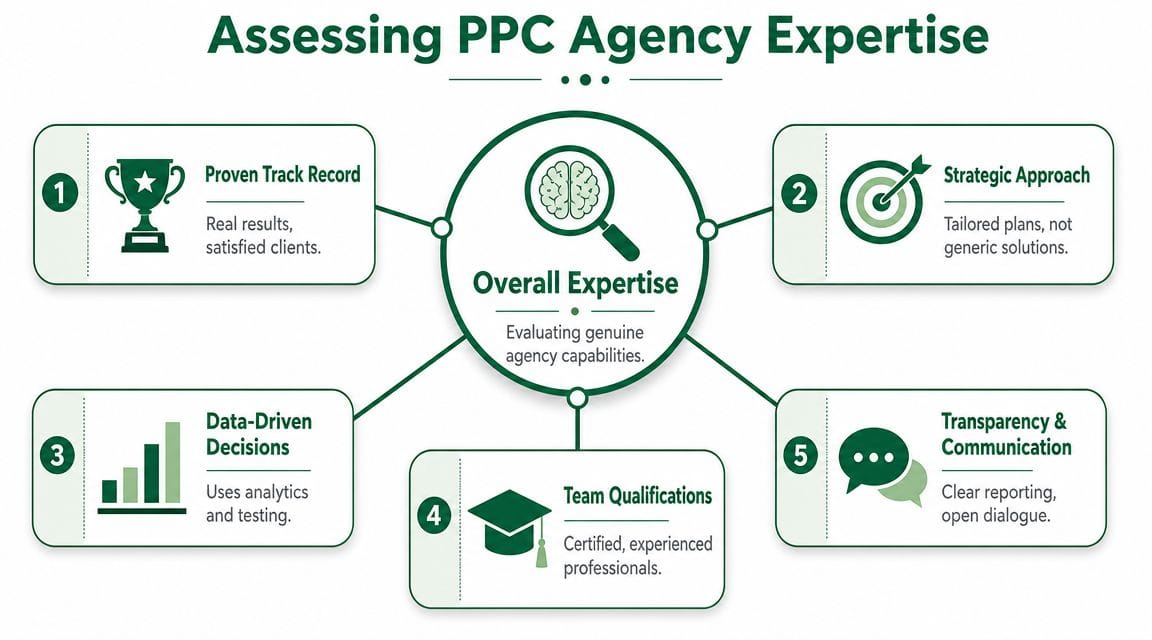
A polished agency can talk confidently about platforms all day and still run an average account. Real expertise shows up in the process. It shows up in the questions asked before launch, the discipline applied after launch, and the speed at which wasted spend gets cut.
The process matters more than the pitch
A technically sound PPC workflow is straightforward on paper and hard to execute well in practice. It starts with intent-based keywords, sends each ad to a dedicated landing page, adds negative keywords, and uses A/B testing on headlines, offers, and page layout. Business.com's PPC guidance also notes that long-tail keywords are usually cheaper and that conversion tracking is essential for measuring real outcomes.
That single paragraph gives a small business owner a practical filter. If an agency can't explain how it handles those basics, the rest of the sales pitch doesn't matter much.
A good PPC team should also be comfortable talking about account hygiene. That includes search term reviews, match-type discipline, ad relevance, and whether the landing page reflects what the ad promised. It doesn't need to sound technical. It does need to sound thought-through.
For businesses comparing providers, Boocoo's paid advertising services are one local example to stack against others on process, reporting, and account structure rather than presentation alone.
Questions that expose real capability
Industry experience helps, but it's not the best first question. Better questions reveal how the agency thinks.
Ask things like these in the meeting:
How do you choose the first keywords?
A serious answer should mention buyer intent, service priorities, and tight initial scope. A weak answer usually leans on broad exposure.How do you stop irrelevant clicks?
The answer should include negative keywords, search term reviews, and ongoing exclusions.Where will ad traffic land?
“Your homepage” is rarely a good answer. The agency should want a page that closely matches the search and the offer.What gets tested first?
Good answers include ad headlines, offer wording, form length, page layout, or call-focused variations.How will you know if leads are good?
This question matters. Clicks aren't customers. The agency should ask how the business qualifies enquiries after they come in.
A competent PPC operator doesn't just chase more traffic. They protect the budget from the wrong traffic.
Another smart move is to check how the agency audits accounts. Even if the business won't do deep analysis itself, it helps to see what a proper review looks like. Resources like Trackingplan's top PPC audit tools can give non-specialists a useful sense of what experienced teams inspect behind the scenes.
A final tell is whether the agency welcomes scrutiny. Strong operators don't get defensive when asked about search terms, tracking, landing pages, or testing cadence. They expect those questions. Average ones steer the conversation back to dashboards and impressions.
Decoding PPC Pricing and Contract Traps
Pricing models sound simple until the invoices start arriving. For a small business, the best setup usually isn't the one with the flashiest label. It's the one that keeps incentives clear, administration light, and surprises to a minimum.
How agencies usually charge
Most PPC agencies use one of three models.
| Pricing model | How it works | Usually suits | Main watch-out |
|---|---|---|---|
| Percentage of ad spend | The management fee rises or falls with the media budget | Businesses already spending consistently and comfortable scaling | The agency earns more when spend increases, even if efficiency doesn't |
| Flat monthly retainer | A fixed fee covers management work each month | Small service businesses that want predictable costs | Scope can get fuzzy if nobody defines what's included |
| Performance-based fee | Fees are linked to leads, sales, or other outcomes | Businesses with strong tracking and clear lead qualification | Poor definitions can create disputes about what counts as success |
A percentage-of-spend model can work when the account is already mature and there's enough activity to justify regular optimisation. It can be less comfortable for a small Brisbane operator with a tight test budget, because it may reward spending more rather than learning faster.
A flat retainer is often easier to budget for. It suits businesses that value consistency and want a stable monthly arrangement. The catch is that the business should know what the agency is doing for that fee. Search term reviews, ad testing, landing page input, reporting, and check-ins shouldn't be vague.
Performance-based pricing sounds attractive, but it needs careful definitions. If the agency gets paid per lead, what counts as a lead? A form fill from the wrong suburb? A junk call? An enquiry for a service the business doesn't want? Without clean rules, this model gets messy.
Contract terms that deserve a hard look
The contract matters as much as the price. A reasonable fee can still hide a poor arrangement.
Watch for these points:
- Account ownership. The business should own its Google Ads account or have full administrative access. If the agency keeps control and the relationship ends badly, continuity becomes painful.
- Fee separation. Ad spend and management fees should be shown separately. If they're blended together, it's harder to see where money is going.
- Lock-in periods. Long contracts can trap a business in an underperforming setup. A short review window is easier to live with.
- Asset access. The business should retain access to ad copy, landing pages, tracking setup, and reporting history.
- Exit process. There should be a plain-English handover path if the arrangement ends.
Some businesses also compare search ads with paid social before locking in a budget split. For a broader view of platform differences, this guide on lower CPA for Meta campaigns can help frame the trade-offs without assuming one channel suits every business.
Red flag: If an agency can't explain its fees in two or three clear sentences, the business should keep looking.
Small businesses don't need complicated contracts. They need transparent ones.
The Value of Local Brisbane Market Knowledge
A generic national PPC setup often wastes money in Brisbane because local demand isn't evenly spread, and neither is competition. Suburbs behave differently. Service areas behave differently. Even the same keyword can perform differently depending on where the search comes from and when it happens.

Brisbane campaigns need local structure
For Australia-focused planning, Google Search data should be segmented by geography because keyword competition and CPC are influenced by location, device, and time of day. Straight North's PPC strategy guide gives a practical method: build Brisbane-area ad groups with separate bids.
That matters more than it may seem. A renovation company targeting Ascot, Paddington, and nearby inner suburbs may need very different messaging from a mortgage broker looking at North Lakes or Springfield. One audience may respond to premium project language. Another may care more about first-home support, speed, or appointment convenience.
A Brisbane-focused agency should be comfortable making decisions like these:
- Suburb prioritisation. Not every area deserves equal budget.
- Service-area exclusions. Some clicks look relevant until travel time or job value makes them unworkable.
- Device and time adjustments. A mobile call-focused campaign may matter more during business hours for some trades.
- Local wording. Search language often changes by audience and area.
For businesses in visitor-heavy sectors, local market nuance matters even more. A specialist with experience in tourism digital marketing in Brisbane will usually structure campaigns differently from a team used only to broad national targeting.
A local operator usually spots waste faster
Local knowledge doesn't replace technical skill. It sharpens it.
A Brisbane-aware pay per click advertising company is more likely to notice when a campaign is attracting searches outside the actual service radius, pushing clicks into low-priority suburbs, or mixing unlike locations into one ad group. That kind of waste is common in accounts built by teams who don't understand the local map.
There's also a practical communication benefit. When the owner says, “We don't want work too far north,” or “The better clients tend to come from these pockets,” a local team can act on that without needing a long explanation.
That saves time. It usually saves money too.
What Great Onboarding and Reporting Looks Like
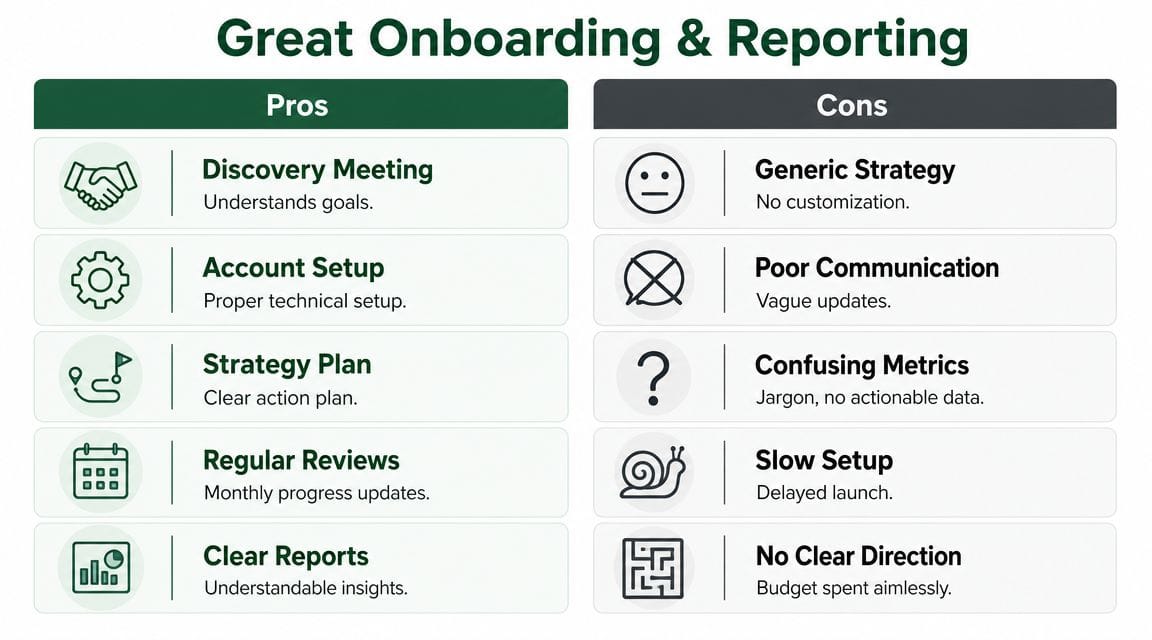
The best PPC relationships don't start with ads. They start with clarity. If onboarding is rushed, tracking is half-set, and nobody agrees on what counts as a good lead, the reporting will be noisy from day one.
A good start removes avoidable waste
A professional onboarding process should cover the commercial basics before any campaign goes live. That means service priorities, target areas, business hours, lead handling, and what the owner already knows about strong versus weak enquiries.
It should also cover the technical side:
- Conversion tracking setup. Calls, forms, and other real actions need to be measured properly.
- Landing page review. The page should match the ad and make the next step obvious.
- Access and permissions. The business should know who owns what and who can see the data.
- Initial exclusions. Early negative keywords and location rules should be considered before launch.
If an agency launches quickly but skips those steps, the account often generates activity without useful insight. That's not speed. That's mess.
Reports should answer business questions
A weak report is full of motion. It lists impressions, clicks, broad commentary, and maybe a screenshot of a graph. It leaves the owner wondering whether the spend is helping.
A strong report answers practical questions:
| Report focus | Weak version | Strong version |
|---|---|---|
| Traffic | More clicks this month | Which searches and ads drove useful enquiries |
| Efficiency | CPC moved up or down | Whether the business is paying a sensible amount for qualified actions |
| Lead quality | Total conversions listed together | Clear distinction between useful and low-quality leads |
| Next steps | Generic summary | Specific changes being made and why |
Industry benchmarks can help provide context. Current PPC research cited by DesignRush notes global Google Ads averages around 6.66% to 7.52% for conversion rates and around 3.17% to 6.66% for click-through rates, which gives Australian advertisers a practical benchmark for performance checks in DesignRush's PPC statistics roundup.
That benchmark shouldn't be treated as a promise. It's a reference point. A local service campaign can sit above or below it for good reasons. The useful question is whether the agency can explain the gap and act on it.
Good reporting doesn't drown the owner in metrics. It shows what happened, what it means, and what changes next.
For businesses that want stronger enquiry quality after the click, it also helps when the PPC team understands conversion rate optimisation in Australia, because the ad account and the landing page should work together rather than being treated as separate jobs.
Your PPC Agency Vetting Checklist
A small business doesn't need a complicated scorecard to choose a pay per click advertising company. It needs a short list of questions that reveal how the agency thinks, how it charges, and how it handles accountability.
The table below works well in real meetings.
| Category | Question to Ask |
|---|---|
| Goals | What business outcome would you optimise for first in this account? |
| Goals | How would you narrow the first campaign so budget isn't spread too thin? |
| Strategy | Which services, suburbs, or search themes would you prioritise first, and why? |
| Strategy | How will you learn quickly what's working and what should be paused? |
| Technical process | How do you choose keywords and stop irrelevant clicks? |
| Technical process | Where will each ad send people, and how do you decide whether that page is good enough? |
| Technical process | What do you test first in ads and landing pages? |
| Tracking | How do you track calls, form submissions, and lead quality? |
| Reporting | What will your reports show beyond clicks and impressions? |
| Reporting | What actions will you take if the campaign is active but lead quality is poor? |
| Pricing | How are management fees separated from ad spend? |
| Contract | Who owns the ad account, data, and campaign assets if the relationship ends? |
A good agency won't hesitate over those questions. It will answer them clearly, without hiding behind jargon. That usually tells a business owner more than any sales deck ever will.