
A lot of Brisbane business owners reach Google Ads at the same point. Referrals have gone patchy, organic traffic is slow to build, and the phone isn't ringing as consistently as it should. Someone has probably said, “Just run ads,” but that advice leaves out the hard part. A campaign can spend money quickly and still produce weak enquiries, time-wasting calls, or forms from people who were never a fit.
That's why good AdWords management in Brisbane isn't really about getting more clicks. It's about building a system that attracts the right searches, sends people to the right page, and tracks whether those leads turn into real work. For local service businesses, that difference matters more than anything else.
Why Your Brisbane Business Needs a Google Ads Plan
A plumber in North Brisbane, a family lawyer near the city, a clinic in the inner south, a tourism operator trying to fill bookings. They all face the same problem. Buyers don't always browse for long. They search when they need something now, compare a few options, and contact the business that looks most relevant and easiest to trust.
That's where Google Ads earns its place. It shows up at the point of intent, not after the fact. When someone types in a service with a local need behind it, paid search can put a business in front of that person while the need is fresh.
This isn't a niche channel either. IAB Australia reported via RankingCo that digital advertising revenue in Australia reached $4.2 billion in the March 2024 quarter, with search advertising alone accounting for $2.0 billion. That matters because it confirms paid search is already a major part of how Australian businesses compete for demand.
Why search works so well for local services
Search traffic is different from interruption-based advertising. A person searching “emergency electrician Brisbane” or “conveyancer Brisbane” is already telling Google what they need. A well-managed account can align ad copy, keyword targeting, and landing pages to that intent.
For small businesses, that creates a practical advantage:
- Higher intent traffic: Searchers often have a problem to solve, not just casual interest.
- Tighter local targeting: Campaigns can focus on Brisbane suburbs, service areas, or specific catchments.
- Better control: Spend can shift toward the services, times, and locations producing stronger enquiries.
Good Google Ads planning starts with commercial intent, not platform features.
A plan also stops a common mistake. Many businesses launch campaigns with broad targeting, generic ads, and no serious tracking. Then they decide Google Ads “doesn't work” when the underlying issue was setup, not demand.
The real reason to have a plan
A Google Ads plan answers a few simple questions before money goes out the door:
- Which services deserve budget first.
- Which searches are likely to bring qualified leads.
- What page should each ad send people to.
- How success will be measured after the click.
For some businesses, that paid search activity should also fit inside a broader channel mix. A tourism operator, for example, might combine search ads with a stronger tourism digital marketing approach so bookings don't rely on one traffic source alone.
Setting a Realistic AdWords Budget for Brisbane
Budget is where most small businesses either get disciplined or get frustrated.
The hard truth is simple. Underfunded campaigns usually don't fail cleanly. They fail noisily. They collect a few clicks, produce patchy data, then stall before anyone can tell what's working. That's why AdWords management in Brisbane needs a budget that's large enough to learn from, not just enough to switch ads on.
What that starting budget really means
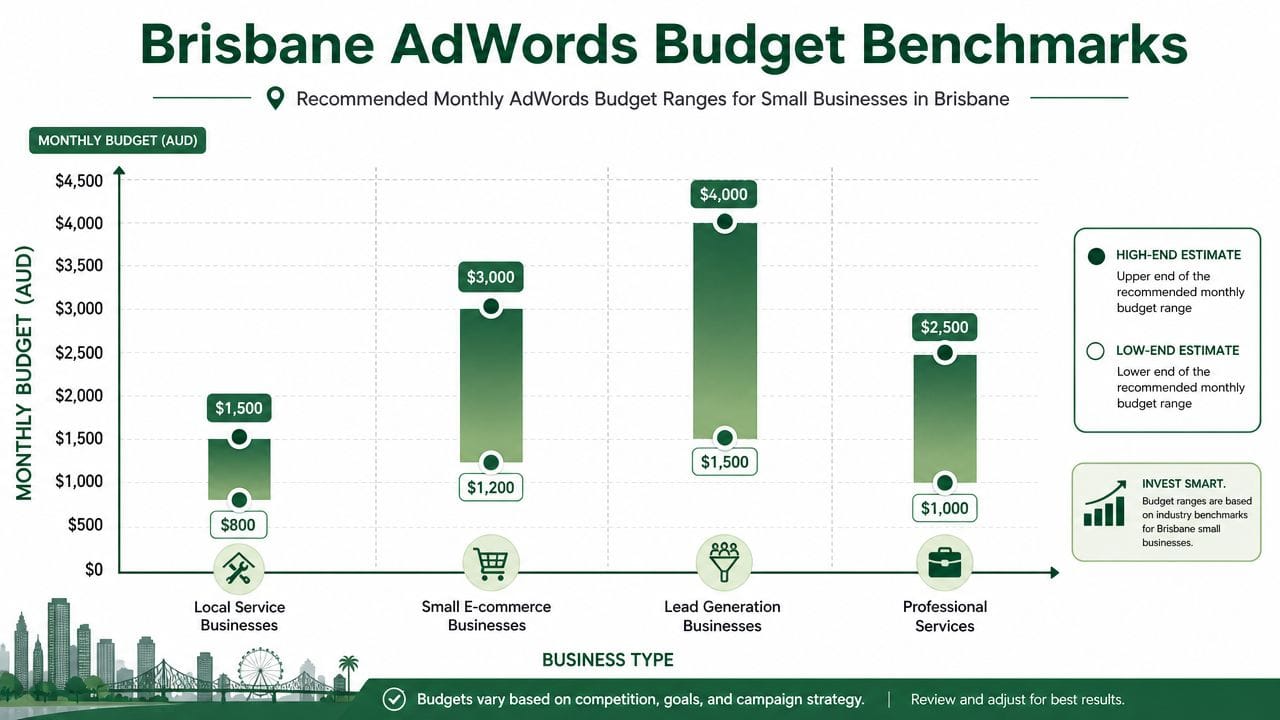
That minimum isn't a promise of results. It's a practical floor for learning. A manager needs enough spend to see which keywords trigger good searches, which ads get clicked, which landing pages convert, and which enquiries are worth following up.
A small budget can still work if the campaign is narrow. For example, a local trades business might focus on one service, one service area, and one conversion action such as phone calls during business hours. What usually doesn't work is trying to cover every service, every suburb, and every match type with a thin budget.
Practical rule: If the budget can't support focused testing, narrow the campaign before increasing complexity.
A simple way to think about budget tiers
Rather than obsessing over a perfect number, it helps to think in operating modes.
| Budget level | What it's best for | Trade-off |
|---|---|---|
| Lean starting budget | Testing one priority service in one tight local area | Less room for broad coverage or fast learning |
| Moderate budget | Running multiple tightly grouped services with cleaner optimisation decisions | Requires stronger landing pages and tracking discipline |
| Larger small-business budget | Expanding reach, testing more ad groups, and scaling proven segments | Waste grows quickly if structure and measurement are weak |
The article brief included budget ranges for an infographic, but those figures should be treated as visual context rather than hard promises. Actual spend should follow business goals, sales value, service margins, and how much lead volume the team can realistically handle.
Before raising spend, check these first
A bigger budget won't fix a weak account. A business owner can save time and money by checking a few basics first:
- Tracking setup: Are calls, forms, and booked jobs being measured properly?
- Search intent: Are ads showing for the services that make money?
- Landing page fit: Does the page answer the exact search, or is it too generic?
- Follow-up speed: Does someone call leads back quickly, or do they sit untouched?
For owners reviewing an existing account, a structured pay per click audit guide can help identify where spend is leaking before more budget gets added.
How to Choose the Right AdWords Management Partner
Choosing a manager isn't really about choosing who can log into Google Ads. It's about choosing who can connect ad spend to revenue decisions. Plenty of providers can talk about impressions, clicks, automation, and “visibility”. Far fewer can explain how they'll separate a good lead from a useless one.
That difference matters most in Brisbane's service economy. A form fill from someone outside the service area, a call about the wrong service, or a price shopper with no intent to book shouldn't count the same as a qualified enquiry. Sonder highlights this gap directly, noting that measurement quality is often overlooked and that the critical question is how an agency will track qualified enquiries from calls and forms, not just clicks or impressions.
Freelancer or agency
A freelancer can be a good fit when the account is narrow, the business needs one clear service promoted, and decision-making is simple. Communication can be faster. Costs can be leaner. The downside is capacity. If tracking, landing page advice, reporting, and creative testing all need attention, one person can become a bottleneck.
An agency usually suits businesses that want broader support across setup, copy, landing page feedback, reporting, and strategy. The risk is getting handed to a junior account manager or trapped in vague reporting.
A practical choice often comes down to this table:
| Option | Usually works well when | Watch out for |
|---|---|---|
| Freelancer | The business has a tight scope and wants direct contact | Limited support depth if multiple issues appear at once |
| Agency | The business needs broader capability and ongoing account hygiene | Sales promises that don't match day-to-day delivery |
For owners comparing options side by side, a Google Ads agency comparison can help frame the shortlist before sales calls begin.
Questions that expose fluff fast
A sales call should leave the owner with a clear picture of method, not just confidence theatre. These questions help.
| Question Category | What to Ask | What a Good Answer Sounds Like |
|---|---|---|
| Tracking | How will qualified leads be tracked, not just raw conversions? | They explain call tracking, form tracking, duplicate filtering, and a process for marking lead quality |
| Lead quality | How will the account tell a good enquiry from a poor one? | They ask about service area, job type, average value, and sales qualification |
| Campaign structure | How do you build campaigns for a local service business? | They talk about tightly grouped services, clear intent, negatives, and relevant landing pages |
| Budget control | What happens if early data shows waste? | They describe search term review, bid control, pausing weak segments, and reallocation |
| Reporting | What will monthly reporting actually show? | They connect platform data to calls, forms, qualified leads, and commercial outcomes |
| Ownership | Who owns the account and data? | They give a direct answer and don't dodge access questions |
If a manager can't explain how lead quality is measured, the reporting will probably look better than the business results.
What to listen for during the conversation
Words matter. So does what's missing.
Good answers usually include discussion of search terms, negatives, landing pages, conversion actions, and sales feedback. Weak answers lean on “Google's AI will handle it”, generic dashboards, or broad promises about traffic.
One practical option for Brisbane businesses is to work with a local provider that also handles the connected pieces, such as landing page improvements and broader digital support. Boocoo offers Google Ads and Meta campaign management as part of its digital advertising services, alongside web and SEO work, which can be useful when ad performance depends on more than the ad account alone.
The Onboarding and Management Process Explained
A lot of business owners sign with an agency and then hit a strange silence. Access gets requested, a few settings change, and after that the account becomes a black box. Good AdWords management in Brisbane should feel a lot clearer than that.
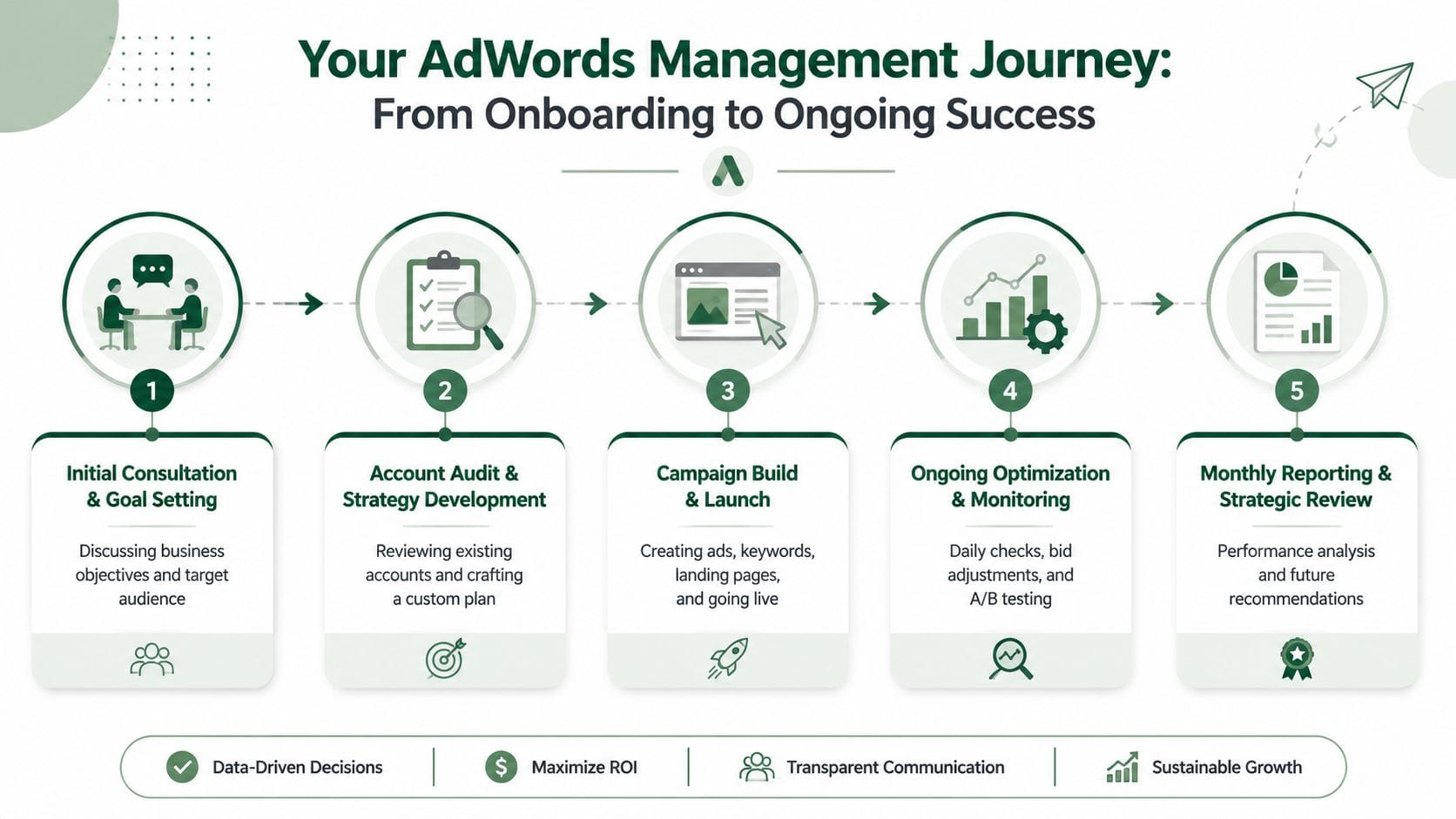
The first stage is usually about alignment. The manager needs access to the Google Ads account, website, analytics, and any existing tracking tools. They also need commercial context. Which jobs are most profitable. Which suburbs matter most. Which services bring headaches and should be deprioritised. Without those answers, even a tidy account structure can drift.
What should happen in the first few weeks
A proper onboarding process often includes several moving parts:
- Business goal review: The manager should identify what counts as success. Phone calls, quote requests, bookings, or online sales.
- Tracking setup: Many accounts often go wrong here. Calls, forms, and thank-you-page events need checking before launch decisions rely on them.
- Keyword and service mapping: Priority services should be split into logical groups rather than dumped into one broad campaign.
- Landing page review: If the ads promise one thing and the page says another, conversion rates usually suffer.
A good manager also sets expectations. Early performance is for learning as much as producing. Some keywords will be paused. Some ads will be rewritten. Search terms will often reveal traffic the business doesn't want.
What ongoing management actually looks like
Active management is not “we checked the dashboard”. It's repetitive, detailed account work. Talk Digital describes sound Brisbane AdWords management as a continuous workflow that starts with tightly themed ad groups, prunes keywords using search term reports, and runs A/B tests on ad copy and landing pages before scaling budget.
That workflow matters because each part fixes a different failure point:
- Tightly themed ad groups improve relevance between keyword, ad, and landing page.
- Search term pruning removes waste and uncovers intent mismatches.
- Ad testing improves message fit.
- Landing page testing lifts the chance that the click turns into an enquiry.
- Budget scaling comes last, after the campaign proves where good demand sits.
A healthy account is rarely dramatic. It improves because someone keeps making small, sensible decisions every week.
What the client should expect month to month
The owner shouldn't need to chase for signs of life. A decent working rhythm usually includes:
- Regular communication: Not endless meetings, but enough contact to explain changes and ask smart questions.
- Clear reporting: Results should be translated into business language, not dumped into a spreadsheet.
- Feedback loop: Sales staff or front desk teams should report lead quality back into the process.
- Decision points: If a service line underperforms, the manager should say whether to fix, narrow, or stop it.
When that rhythm is missing, campaigns often become passive. Spend continues. Learning slows. Nothing meaningful changes.
How to Read Reports and Measure Real Success
Many Google Ads reports look busy enough to feel reassuring. Lots of charts, lots of green arrows, plenty of platform language. That doesn't always mean the campaign is helping the business.
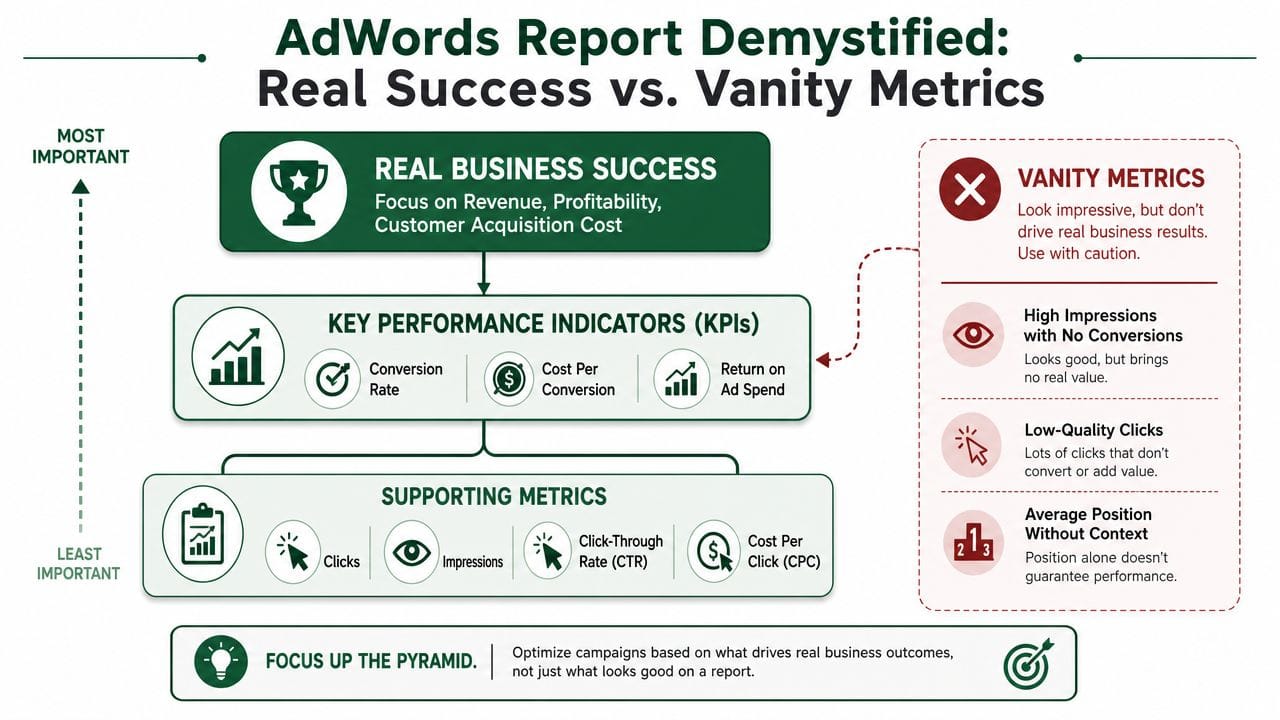
The quickest way to cut through the noise is to separate diagnostic metrics from business metrics. Diagnostic numbers help explain what's happening inside the account. Business numbers show whether the ads are paying their way.
What to look at first
A small business owner doesn't need to become a platform expert. They do need to ask the right questions.
| Metric | Why it matters | What it can't tell you on its own |
|---|---|---|
| CTR | Shows whether ads attract clicks | Whether those clicks are useful |
| CPC | Shows how much each click costs | Whether the lead quality justifies the cost |
| Impression share | Shows how visible the ads are in target auctions | Whether visibility is happening on the right searches |
| Conversion Rate | Shows how often traffic completes the desired action | Whether every conversion is actually qualified |
| ROAS | Helps judge commercial return from ad spend | Whether follow-up quality or fulfilment issues are hurting profit |
A high click-through rate can be fine. A lower cost per click can be fine too. But if the business is getting poor calls, wrong-suburb leads, or forms with no buying intent, those numbers don't rescue the campaign.
The most useful report is the one that helps an owner decide where to spend the next dollar.
What a healthy report should help you answer
A report should make it easier to answer practical questions like these:
- Which service generated the strongest enquiries?
- Which suburb or geo-target produced weak lead quality?
- Did call leads perform better than form leads?
- Is the landing page helping or hurting conversion rate?
- Should budget move toward one campaign and away from another?
For businesses wanting stronger visibility into what happens after the lead arrives, it's worth understanding smarter growth with marketing attribution. Attribution won't fix a weak offer, but it can reduce guesswork around which channels and touchpoints are contributing to sales.
This is also where landing pages deserve attention. If traffic quality is decent but conversion rate is poor, the issue may sit on the website rather than in the ad account. That's why many Brisbane campaigns improve when paired with focused conversion rate optimisation in Australia, especially for service pages that need stronger trust signals and clearer calls to action.
Your Next Step Towards Google Ads Growth
Google Ads can be one of the most useful lead channels a Brisbane small business has. It can also become an expensive distraction if the account is built around clicks instead of commercial outcomes.
The businesses that get value from AdWords management in Brisbane usually keep a few things simple. They start with a realistic budget. They narrow the campaign to the services that matter most. They choose a manager who can explain tracking in plain English. And they judge performance by qualified enquiries and sales, not busy-looking dashboards.
That last point is the one worth holding onto. A click is not a customer. A form fill is not always a lead. A phone call is not automatically a good one. The manager's job is to connect those dots clearly enough that the owner can make sound decisions without living inside Google Ads all week.
For any business that wants a low-pressure next step, the most useful move is often a short conversation about goals, current lead flow, and what's being tracked today. Contact details for that kind of chat are available on Boocoo's contact page.
Frequently Asked Questions About AdWords Management
Should a small business manage Google Ads in-house
It can, but only if someone has time to manage more than the basics. Google Ads isn't just writing ads and picking keywords. It also involves search term reviews, negative keywords, landing page alignment, conversion tracking, and regular decisions about what to pause or scale.
DIY management often works best when the business has a very narrow offer and someone internally can review results consistently. Outsourcing usually makes more sense when time is tight or lead quality needs close attention.
How long does it take to see results from Google Ads
Traffic can start quickly after launch, but useful optimisation takes longer because the account needs enough conversion data to learn from. Early weeks are often about fixing targeting, refining search terms, and improving ad-to-page alignment.
A better question is whether the business can identify good leads early and act on that data. Speed matters, but clarity matters more.
What's the difference between Google Ads and SEO
Google Ads buys visibility in search results. SEO earns visibility over time through website quality, relevance, and authority. Ads are useful for immediate demand capture. SEO is useful for longer-term visibility and compounding traffic.
For many Brisbane businesses, the two channels work better together than separately. Ads can test demand and bring leads sooner, while SEO builds a steadier base underneath.