
Most Brisbane owners don't start the week thinking about metadata, landing pages, ad tracking, or content calendars. They start by trying to get quotes out, serve customers, manage staff, and keep cash flow steady. Then marketing gets pushed to the evening. A few Instagram posts go up, the website gets ignored, Google Ads runs without much oversight, and nobody's quite sure what's bringing in work.
That's usually the moment a business starts searching for a marketing consultant in Brisbane. Not because marketing suddenly became interesting, but because the current setup is eating time and still not giving clear answers.
A good consultant doesn't add more noise. They reduce it. They help a business work out what to stop, what to fix first, and what should be handled by someone else. For a small business, that matters far more than fancy language or big-brand tactics. Time is tight. Budget is tighter. The right plan has to be practical.
Tired of Juggling It All? Your Guide to Getting Marketing Help
It's 8:30 pm. The quotes are sent, the staff questions are done, and the day's real work should be over. Instead, a Brisbane business owner is updating a website, replying to Facebook messages, checking Google Business Profile, and trying to work out whether ads, SEO, email, or a chatbot for marketing should come first.
That pressure is common in Queensland because so many businesses are small and owner-led. Data from mid-2024 showed Queensland's active business count was 481,621 in June 2024, with 97.1% classed as small businesses and 372,100 operating as non-employing businesses, according to the Queensland Government's small business statistics updates.
The problem usually isn't effort. It's that strategy, execution, and owner time get mixed together.
Some businesses need a consultant who can set direction, cut the noise, and tell them what matters now versus later. Some need an agency or freelancer to do the work because nobody internally has the hours. Others need a blend. A few hours of senior guidance each month, plus someone reliable to implement the plan. The right option depends on budget, how involved the owner wants to stay, and whether the current issue is poor decisions or poor follow-through.
Practical rule: If everything feels urgent, the business usually has a prioritisation problem, not a motivation problem.
Marketing jobs do not carry equal commercial value. A service business might get more from fixing its enquiry process than from posting three extra times a week. A retailer might need sharper local ads and cleaner offers before worrying about long-form content. A clinic might need better lead handling before spending another dollar on traffic.
Good marketing help saves time first. Then it improves return.
For a lot of Brisbane operators, the win is not a huge campaign. It's clarity. What to stop. What to keep. What to hand off. And what the owner still needs to own.
What a Brisbane Marketing Consultant Actually Does
A Brisbane business owner usually reaches for a consultant at the same point. Leads are uneven, marketing tasks keep piling up, and nobody is sure what deserves attention first. The real job is not “doing some marketing.” It is deciding whether the business needs senior direction, hands-on delivery, or both.
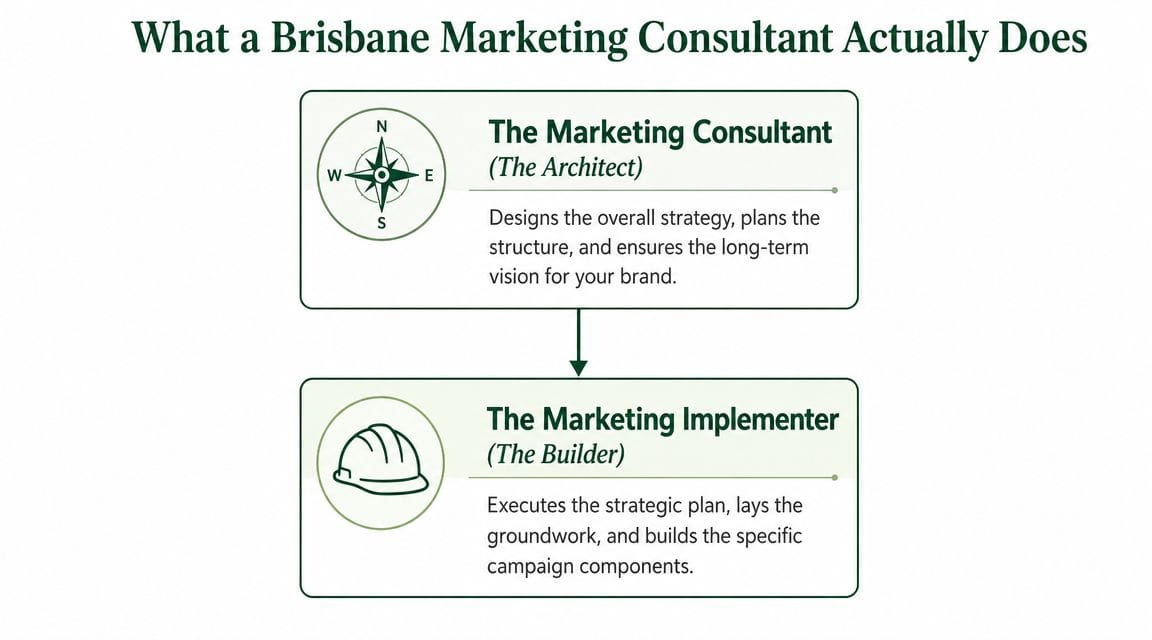
That matters for small businesses because owner time is limited. In Brisbane, plenty of operators can afford a few hours of experienced guidance each month long before they can justify a full internal marketing hire. Some only need a sharper plan. Others need someone to set the plan and keep outside suppliers accountable.
The role in practical terms
A good consultant starts by finding the constraint.
Sometimes it is weak positioning. Sometimes the website is costing enquiries. Sometimes the ads are fine but follow-up is slow, so paid traffic looks worse than it is. I have seen businesses blame Facebook or Google when the underlying issue was missed calls, slow quote turnaround, or a homepage that never answers the buyer's first question.
From there, the consultant helps the owner make three decisions:
What is hurting revenue right now
The first step is diagnosis. Review lead sources, conversion points, sales process gaps, local search visibility, and basic tracking. If a local service business is invisible in map results, work on visibility. If traffic is healthy but enquiries are poor, fix the page, offer, or sales handling first. For businesses that need stronger local visibility, this often overlaps with local SEO and search engine optimisation support.Who should do the work
The strategy versus execution choice takes on practical significance. A pure consultant is a strong fit if the owner or team can implement. An agency is the better fit when nobody has the hours or skill to get campaigns live. A blended setup suits businesses that want senior oversight without paying agency rates for every decision.How involved the owner needs to stay
Some owners want weekly visibility and final say on every campaign. Others want a monthly review and a clear set of numbers. Neither is wrong. The right setup depends on budget, trust, and how close marketing sits to day-to-day sales.
Where consultants usually add the most value
The value is often in prioritisation, not volume.
A consultant can stop a business from spending six months on the wrong channel. For one company, the priority might be cleaning up Google Business Profile, suburb pages, and conversion paths. For another, it might be fixing lead response time and adding a chatbot for marketing to catch after-hours enquiries before spending more on traffic.
Some consultants stay at the strategic level. They audit, advise, and meet monthly. Others also manage freelancers, brief agencies, review creative, check reporting, and pressure-test whether the work matches the commercial goal. That middle ground is often useful for Brisbane businesses that have a web developer, a junior coordinator, or an agency, but still lack senior direction.
Good consulting makes the business simpler to run. The owner knows what to ignore, what to measure, and where execution support will pay for itself.
The Core Services That Drive Local Growth
The services themselves aren't complicated. The hard part is choosing the right mix. For most local operators, growth doesn't come from doing more marketing. It comes from tightening the parts that affect leads and sales closest to the point of decision.

Local SEO comes first
For Brisbane businesses, a consultant's first priority is often technical local SEO. Google Business Profile interactions are driven by proximity, so showing up for “near me” and suburb-specific searches matters when someone needs a nearby provider now. That's noted in this Brisbane marketing consulting guide.
For a small business, that usually means getting the basics right:
- Consistent business details across the website, directory listings, and Google Business Profile
- Clear service-area setup so the business appears in the right locations
- Suburb-relevant pages for actual service areas, not thin pages stuffed with place names
- Strong enquiry paths so visitors can call, book, or request a quote without hunting for the next step
A plumber in Aspley, an accountant in Toowong, and a physio in Chermside don't need broad national visibility first. They need to appear when nearby customers are actively looking.
A practical starting point for that work is a focused search engine optimisation service for Brisbane businesses, especially when the site already exists but isn't bringing in enough relevant traffic.
Websites, ads, and social need to work together
A website should do one main job. Turn interest into action. For a local cafe, that might be bookings. For a trade business, it might be quote requests. For a professional service, it might be qualified consultation enquiries.
What doesn't work is treating the website like a digital brochure. Nice photos won't fix weak structure. If visitors can't immediately see what the business offers, where it operates, and how to take the next step, the site is leaking opportunities.
Paid ads can help, but only when the destination is ready. Sending traffic to a cluttered homepage is one of the quickest ways to burn budget. A consultant will usually narrow the offer, build or refine a landing page, and make sure tracking is in place before scaling ad spend.
Social media plays a different role. It keeps the business visible, familiar, and credible between buying moments. That's why content planning should be tied to actual commercial goals. Helpful before-and-after examples, answers to common objections, team introductions, short educational clips, and customer questions often do more than generic “just posting”.
For owners who need practical ideas, this guide on Create Converting Social Content is useful because it pushes content toward enquiries, not just reach.
A consultant's job is to connect all of that. Local search brings people in. The website converts them. Ads add speed where needed. Social supports trust and recall. When those pieces are managed separately without a clear plan, small businesses end up busy but not organised.
Real Results for Brisbane Small Businesses
The value of a consultant usually becomes obvious in ordinary businesses, not dramatic ones. Most wins come from better focus, fewer moving parts, and cleaner decision-making.
A tradie with too many weak leads
An electrician in Brisbane's western suburbs had a familiar problem. Plenty of activity, poor consistency. Some leads came through Facebook messages, some from old word of mouth, some from a dated website contact form. The business owner couldn't tell which jobs came from where, and enquiries often lacked the detail needed to quote properly.
The fix wasn't flashy. The consultant tightened the service pages, simplified the quote form, clarified the service area, and stopped broad messaging that attracted low-fit work. The result was a steadier flow of enquiries that matched the jobs the business wanted.
Better marketing often means fewer wrong enquiries, not just more enquiries.
A local professional service with no clear funnel
A suburban accounting firm had decent search presence for its name but weak visibility for service-led searches. The homepage tried to speak to everyone. Bookkeeping, tax returns, business advisory, and SMSF support all sat side by side with no clear priority.
The consultant separated those offers, built clearer landing pages, and aligned each page with a simple next step. Instead of one vague contact option, visitors could request the kind of help they needed. Conversion thinking made the difference here, which is why work like conversion rate optimisation for Australian businesses often has more impact than owners expect.
A retail operator stuck in constant posting mode
A boutique retailer near inner Brisbane was posting constantly and still felt invisible. The owner spent hours each week taking photos, writing captions, and responding to messages, but the activity had no structure. New arrivals, promos, and customer questions were all mixed together without a sales path.
The consultant reset the approach. Content was grouped into simple themes: product education, social proof, seasonal offers, and repeat customer prompts. Paid promotion was used selectively around key stock lines instead of boosting random posts. The owner spent less time producing content and had a much clearer sense of what each post was meant to do.
These examples aren't about miracle turnarounds. They show what usually works in small business marketing. Tighter offers. Better pages. Clearer local visibility. Cleaner enquiry paths. More discipline around what gets done and what gets ignored.
How to Choose the Right Marketing Partner for You
The biggest mistake isn't choosing the wrong agency. It's choosing the wrong type of help. Some businesses need strategy. Some need hands-on execution. Some need both, but not at the same level every month.
Start with the model, not the provider
A useful way to frame the decision is this: how much decision-making support does the business need, and how much of the actual work does it want to outsource?
That trade-off matters for Brisbane small businesses because many owners aren't only buying marketing. They're buying decision-making capacity and prioritisation under budget pressure, as discussed in this Brisbane business marketing consulting perspective.
Here's a simple comparison:
| Model | Best for | Watch out for |
|---|---|---|
| Pure consultant | Owners who need clarity, planning, and oversight | It can stall if nobody executes the plan |
| Done-for-you agency | Businesses that want work taken off the plate | It can become task-heavy without strategic review |
| Fractional marketing lead | Teams needing regular senior direction without a full-time hire | It needs internal cooperation and clear scope |
A business in hospitality, tourism, or attractions may also need a partner who understands local seasonality and visitor behaviour. In those cases, examples from tourism digital marketing in Australia can help owners gauge whether a provider understands more than generic lead generation.
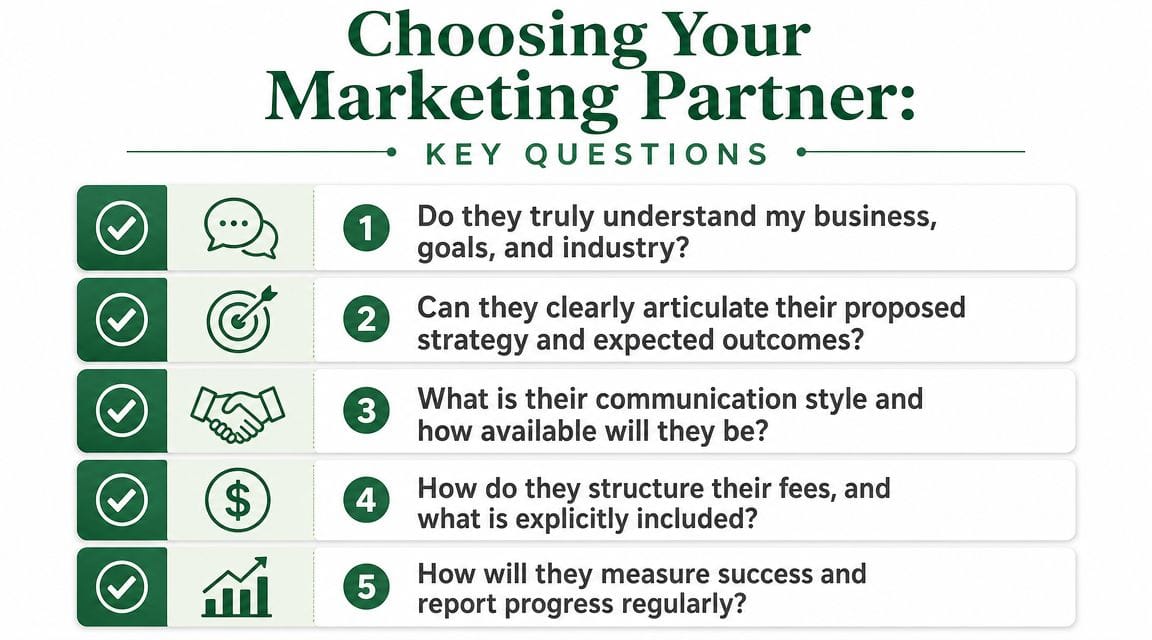
Questions worth asking before signing anything
Some questions cut through sales talk quickly.
What would you fix first if you took this on?
A good partner can usually spot an early priority without pretending to know everything on day one.What will stay on the owner's plate?
This matters more than most proposals admit. Content approvals, reviews, photos, offer decisions, and CRM follow-up still need ownership somewhere.How do you report on progress?
If the answer is all impressions, followers, and vague “brand awareness”, keep digging. The business needs to know what changed and what happened next.Do you adapt to my budget, or do you push a standard package?
Small businesses rarely need the same scope. One operator may need local SEO and a cleaner site. Another may need ads and landing pages. Uniform packages often create wasted work.
The right partner explains trade-offs clearly. The wrong one makes every service sound urgent.
The best fit usually feels calm, not flashy. Clear language, practical recommendations, realistic scope, and no pressure to buy everything at once. That's a far better sign than polished jargon.
Understanding Typical Costs and Engagements
Price matters, but structure matters just as much. A cheap arrangement can still be expensive if the scope is fuzzy or the work doesn't match the business stage.
What the pricing range tells small businesses
A 2026 Australian rate guide reported an average marketing consultant rate of $798 per day, with 68% of rates between $650 and $5,150 per day and 95% between $320 and $5,150 per day. The same guide listed role-based variation including $1,444 per day for Chief Marketing Officer consultants, $820 for Marketing Manager consultants, and $711 for Digital Marketing Manager consultants, according to this Australian marketing consultant rate guide.
That range explains why many Brisbane small businesses don't hire senior marketing staff full time. They usually choose a narrower engagement that solves a specific problem, or an ongoing arrangement with controlled scope.
Which engagement model suits which situation
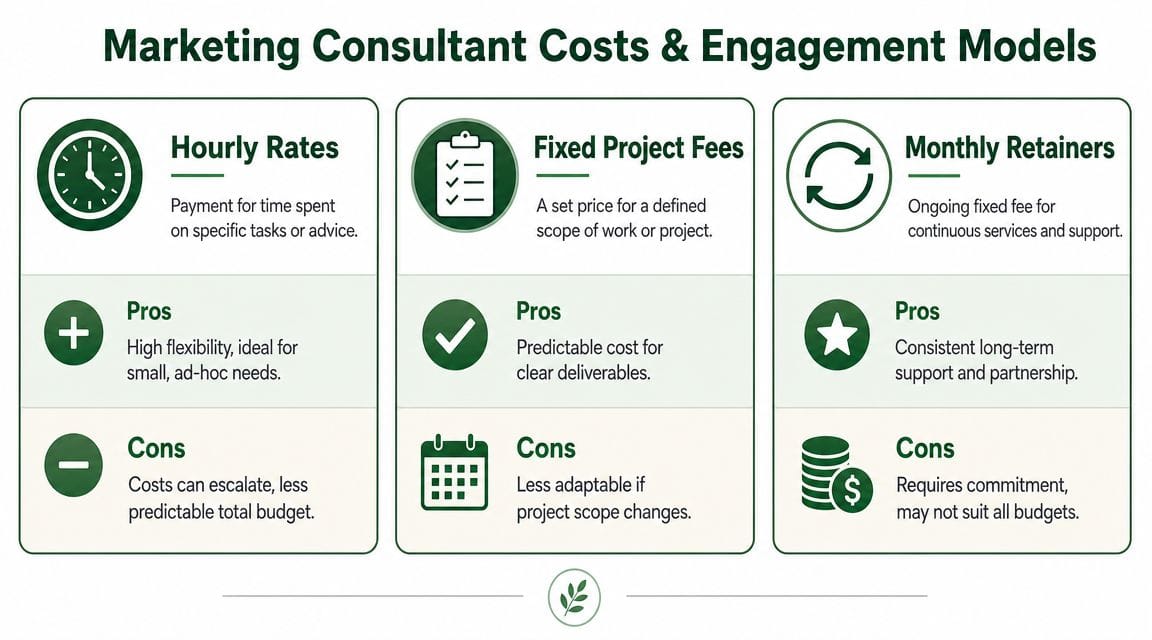
Different pricing models suit different situations.
- Hourly advice works when the business needs targeted input, such as a website review, campaign audit, or second opinion before spending more.
- Fixed project fees make sense for defined work like a website rebuild, local SEO setup, or landing page overhaul.
- Monthly retainers suit businesses that need continuity. Ongoing SEO, ad management, campaign oversight, and regular reporting usually fit here.
For tight budgets, project work often gives the cleanest starting point because the scope is easier to control. Retainers become more useful once the business knows which channels are already producing value and wants steady management rather than one-off fixes.
A healthy engagement should answer three cost questions upfront: what's included, what's excluded, and what would trigger extra work. If that isn't clear, budget drift usually follows.
Frequently Asked Questions
How long does it take to see results
That depends on the channel and the starting point. A landing page fix or enquiry process improvement can affect results quite quickly. SEO usually takes longer because visibility builds over time. Paid ads can generate attention faster, but only if the offer, targeting, and page are already in decent shape.
A better question is whether the business can see progress early. Clear tracking, better lead quality, stronger visibility in the right suburbs, and improved conversion flow are usually the first signs things are moving in the right direction.
How involved does the owner need to be
Less involved than doing it all alone, but not completely hands-off. The owner still needs to provide direction on goals, margins, service priorities, and what a good lead looks like. They may also need to approve offers, share customer insights, or provide photos and examples.
The right setup reduces random interruptions. Instead of constant ad hoc requests, the business gets a clearer rhythm for decisions and approvals.
Is a long-term contract always required
No. Some businesses need a short diagnostic project first. Others are better suited to an ongoing retainer because marketing is already active and needs management. The sensible starting point depends on the problem. If the business doesn't yet know what's broken, strategy first usually makes more sense than locking into broad monthly execution.
Start with the smallest engagement that can produce clarity. Expand only after the priorities are proven.
What should be prepared before the first meeting
A short list is enough:
- Business goals for the next period
- Current marketing activity across website, ads, socials, and search
- Main service areas or suburbs
- Examples of good leads and bad leads
- Budget comfort level so recommendations stay realistic
That's usually enough for a useful first conversation.