

A lot of Brisbane business owners are in the same spot right now. The phone isn't as busy as it should be, referrals come in waves, social posts feel like shouting into the void, and there's never enough time to figure out which marketing job matters most.
That's where Brisbane Digital Marketing often gets overcomplicated. For most small businesses, the key question isn't “Which trendy channel should be tested next?” It's “How does the business get in front of people who are already looking for what it sells?” For many local operators, Google Ads is the shortest path between those two points.
If the business needs leads, bookings, calls, or online sales without waiting months for traction, Google Ads can do that. But it only works when the setup matches the way Brisbane customers search, and when the budget is realistic enough to collect useful data instead of dribbling away in tiny amounts.
Why Google Ads Is a Must for Brisbane Businesses
Running a small business in Brisbane usually means wearing too many hats. One hour goes to quoting jobs, the next to chasing invoices, then replying to enquiries, then trying to update a website that hasn't had proper attention in months.
That's why Google Ads matters. It reaches people at the exact moment they're searching for a service, product, or local provider. It isn't interruption marketing. It's intent marketing.
In the Brisbane market, 86% of consumers search for local businesses on Google, and Google holds 90% of Australia's search market share according to RankingCo's Brisbane Google Ads market overview. For a local business, that changes the conversation. Google Ads stops being an optional extra and starts looking like basic visibility.
Why this matters for small operators
If someone searches for “electrician Northside”, “accountant Brisbane CBD” or “gift hampers Brisbane”, they're not browsing for entertainment. They're trying to solve a problem, often quickly.
That creates a practical advantage over channels that need more warming up:
- Search traffic has intent: The person is already looking.
- Location can be controlled: Ads can focus on the suburbs that the business services.
- Results can be tracked: Calls, form fills, bookings, and sales can be tied back to campaigns.
Practical rule: If the business relies on local demand, it needs to show up where local demand starts.
What works better than doing a bit of everything
A common mistake in Brisbane digital marketing is spreading effort too thin. A business posts on three social platforms, boosts random content, dabbles in SEO, and spends a little on ads. Nothing gets enough attention to work properly.
A tighter approach usually performs better:
- Own high-intent searches first
- Send traffic to a page built for conversion
- Track what turns into real enquiries
- Refine based on that data
For a tradie, clinic, consultant, or local online store, this is often the difference between “doing marketing” and generating leads.
How Google Ads Works The Local Cafe Analogy
Google Ads sounds technical until it's put into plain English. The easiest way to think about it is this: it's like paying for the top spot on the specials board at every local cafe in the suburbs the business wants to reach.
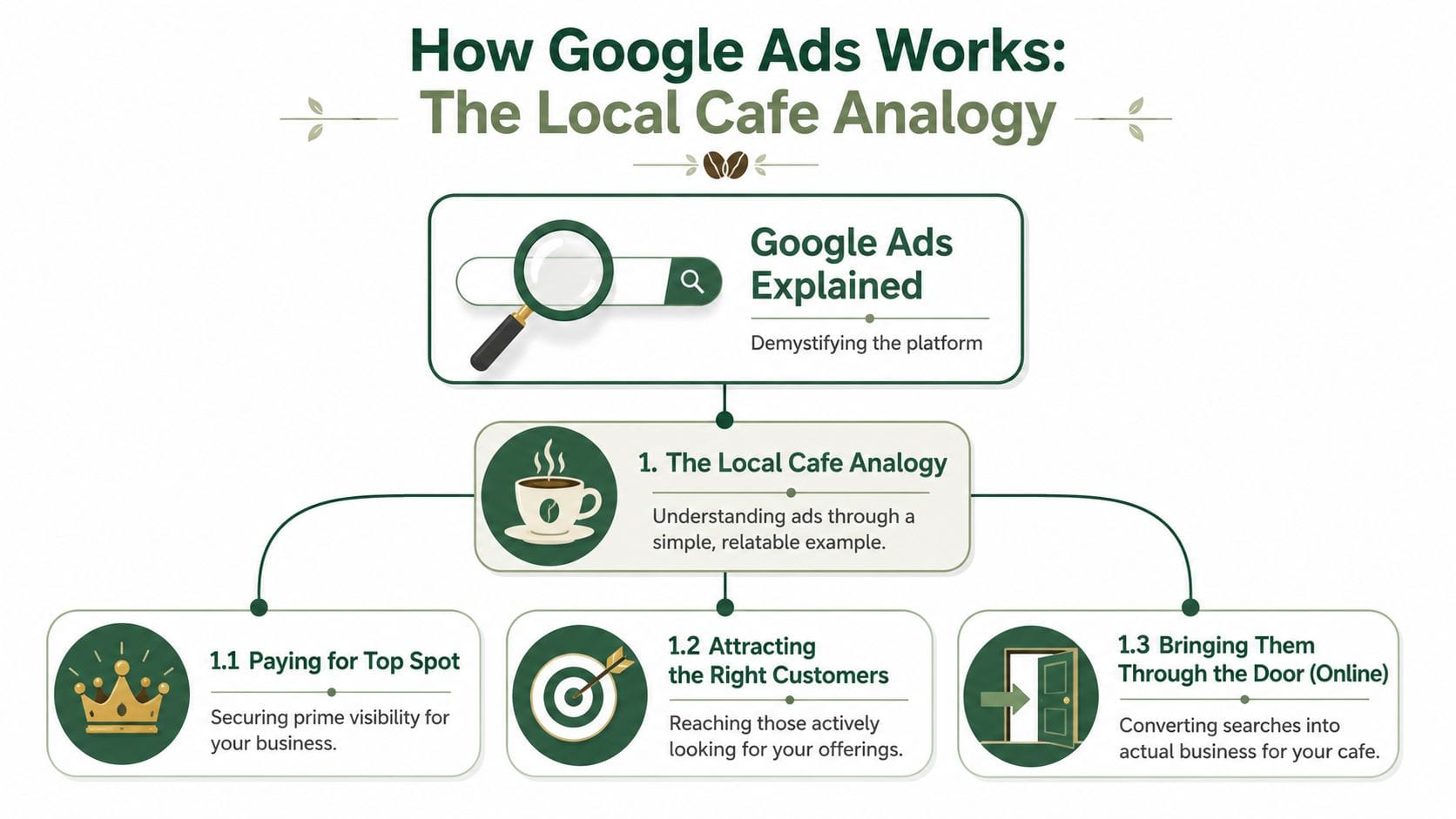
A customer walks in and asks for something specific. If the business has its offer right there at the top, it gets noticed first. Better still, the business doesn't pay just because the board exists. It pays when someone points at the special and wants to know more.
The three parts that matter most
Keywords are what the customer asks for. In Google Ads Brisbane campaigns, these might be phrases like “emergency plumber Brisbane”, “bookkeeper near me”, or “buy pet supplies Brisbane”.
Ads are the offer written on the specials board. They need to be clear, relevant, and easy to trust. If the search is for a Northside service, the ad should speak to that need directly.
Bidding is how much the business is willing to pay for that prime position. It's part auction, part relevance contest. Google doesn't just reward the highest bidder. It also rewards ads and landing pages that match the search well.
Why the auction isn't just about money
Many people often misunderstand this point. They assume bigger businesses always win because they can spend more.
Sometimes they do. But not always.
If one Brisbane electrician runs a vague ad that sends people to a generic homepage, and another runs a focused ad for “same-day electrician Brisbane Northside” that lands on a page built around that service area, the more relevant setup can compete far better. Google wants users to find a good answer, not just the most expensive advertiser.
A strong Google Ads account works like a well-run cafe. The sign is clear, the offer matches what people want, and the staff don't make customers hunt around for the next step.
What a click should lead to
The click isn't the win. It's the start of the next test.
After someone clicks, the landing page should make the next action obvious. That usually means:
- A clear service promise
- A visible phone number or enquiry form
- Suburb or service area relevance
- Simple proof of trust, such as reviews or examples of work
When those pieces line up, Google Ads becomes much easier to understand. The search triggers the keyword, the keyword triggers the ad, and the ad sends the visitor to a page that feels like the natural next step.
Smarter Google Ads Strategies for the Brisbane Market
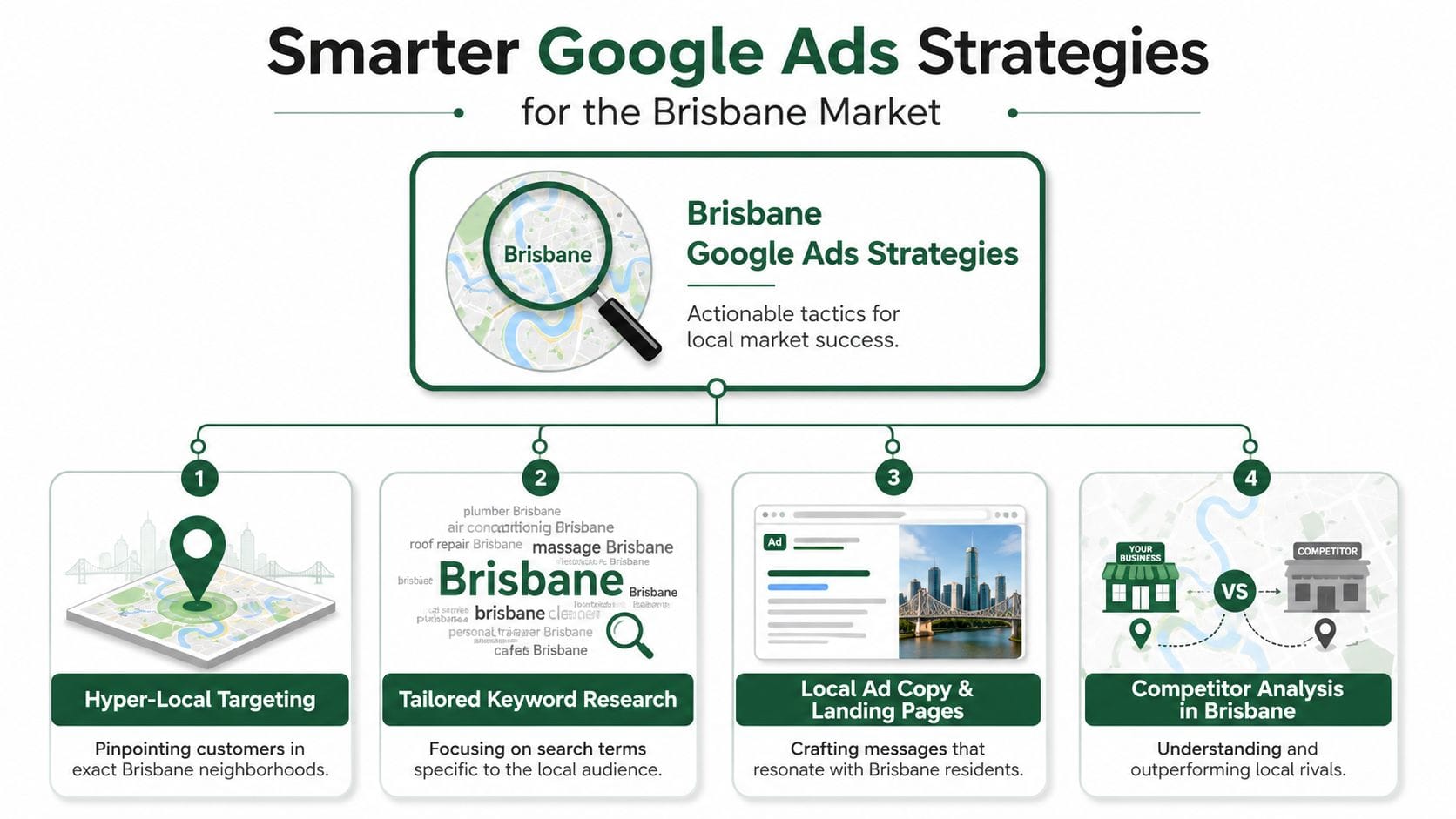
A campaign that targets “Brisbane” as one giant block often wastes budget. Brisbane isn't one uniform market. Search behaviour changes by suburb, by service area, and by how urgently someone needs help.
That's why smarter Brisbane Digital Marketing starts local and specific.
Target the suburbs that actually matter
A Northside business usually shouldn't throw budget across the whole city. If the team mainly services Chermside, Aspley, Carseldine, and nearby suburbs, the campaign should reflect that.
This helps in two ways. First, the ad copy can feel more relevant. Second, the landing pages can match the search better.
A practical setup often looks like this:
- Separate campaigns by service: Plumbing, electrical, bookkeeping, cosmetic treatments, or whichever core offers matter most
- Split by geography where needed: Northside, Southside, CBD, bayside, or tighter suburb clusters
- Send each ad group to a matching page: Not the homepage
For businesses comparing campaign structures, this guide on PPC management in Brisbane is useful because it frames setup around local intent instead of generic account templates.
Build for mobile and near me intent
A lot of local searches happen when someone wants action fast. The customer is on a phone, standing in a driveway, commuting between meetings, or looking for the nearest option that seems trustworthy.
That means the basics matter more than fancy tricks:
- Fast-loading landing pages
- Tap-to-call buttons
- Short forms
- Clear suburb mentions
- Offers that answer urgency
A mobile user looking for a locksmith or a tax agent won't tolerate friction. If the page is slow or vague, they'll bounce and try the next listing.
Use remarketing without being annoying
Most visitors won't convert on the first visit. They might compare providers, check reviews, or get distracted and leave.
Remarketing gives the business a second chance. It's a light reminder to people who already visited the site but didn't enquire. It functions as a polite follow-up, not a hard sell.
This works best when the message is simple. A service business might remind visitors about fast quotes, local service areas, or availability. An e-commerce store might highlight popular product categories or shipping information.
Treat Quality Score like a budget multiplier
One of the most useful levers in Google Ads Brisbane campaigns is Quality Score. According to Digital Nomads HQ's Google Ads cost analysis, a higher Quality Score can lower CPC by up to 50% compared to industry averages.
That matters because small businesses rarely have room for sloppy traffic.
A simple way to think about Quality Score is this. Google gives a discount to advertisers who make searchers happy. Better keyword relevance, stronger ad copy, and a landing page that closely matches the search can all help.
For owners who want a plain-English read on bidding choices before tinkering with campaign settings, a founder's guide to Google Ads bidding is worth bookmarking.
What usually improves Quality Score fastest?
- Tighter keyword groupings
- Ads that mention the exact service
- Landing pages built around one clear topic
- Removing irrelevant searches over time
Realistic Budgets and Costs for Brisbane Businesses
This is the part most business owners want answered upfront. What does Google Ads cost, and what budget gives the campaign a real chance?
The short answer is that Brisbane has an advantage, but small budgets can still disappear fast if they're spread too thin.
What Brisbane businesses are really paying for clicks
In Brisbane, the average CPC for service-based Google Ads ranges from $3.80 to $6.20 AUD, and that's 25–40% lower than Sydney and 15–25% lower than Melbourne, based on Firewire Digital's Brisbane Google Ads cost benchmarks.
That lower CPC is good news for local businesses. It means the same ad spend can often buy more clicks than it would in the bigger southern markets.
But there's a catch. Lower click costs don't automatically mean easy wins. If the account structure is messy, the keywords are broad, or the landing page is weak, the campaign can still chew through spend without producing enough quality leads.
Sample Monthly Google Ads Budgets in Brisbane 2026
The best way to frame budget is by focus, not fantasy. A smaller budget usually needs tighter targeting. A larger budget can support more services, more testing, and broader reach.
| Monthly Ad Spend | Focus for a Tradie (e.g., Plumber) | Focus for a Professional Service (e.g., Accountant) | Focus for Local E-commerce |
|---|---|---|---|
| $1,500 | Concentrate on one or two high-intent services in a defined service area. Prioritise phone calls and urgent job keywords. | Focus on one core offer and one audience segment, such as tax returns or business advisory. Keep geography tight. | Promote best-selling categories only. Limit product spread and send traffic to high-converting collection pages. |
| $3,000 | Cover multiple service lines or a broader service area. Test ad copy variations and stronger landing page alignment. | Build separate campaigns for different services, such as bookkeeping and tax, with clearer intent matching. | Run Search and Shopping-style intent-led campaigns where relevant, with stronger remarketing support. |
| $5,000 | Expand suburb coverage, add more service-specific pages, and test stronger bidding and scheduling controls. | Support a fuller lead generation setup with more keywords, audience refinement, and landing page testing. | Scale top-performing product lines and protect margins with tighter search term control and feed quality improvements. |
Google Ads management in Brisbane generally starts around $1,000 per month excluding ad spend according to AdVisible's Brisbane pricing guide. For broader Australian small business pricing, Perth Digital Edge's Google Ads fee breakdown notes that competent management commonly sits at $800 to $2,000 AUD per month, with setup fees ranging from $750 to $2,000 AUD.
Where small budgets usually go wrong
A lot of underperforming accounts share the same pattern. The business tries to cover too much with too little.
That often looks like:
- Too many services in one campaign
- Too much geography
- Generic ads
- Homepage traffic instead of landing page traffic
- No negative keyword work
Negative keywords are one of the easiest ways to stop paying for irrelevant clicks. This explainer on cutting Google Ads costs with negative keywords gives a practical breakdown of how wasted searches creep into accounts.
For owners comparing channels side by side, this local guide to how much Facebook Ads cost is also useful because it helps clarify when search intent beats paid social for smaller budgets.
The budget isn't just buying clicks. It's buying enough signal to tell the business what's working, what's failing, and where to adjust.
Measuring What Matters From Clicks to Customers
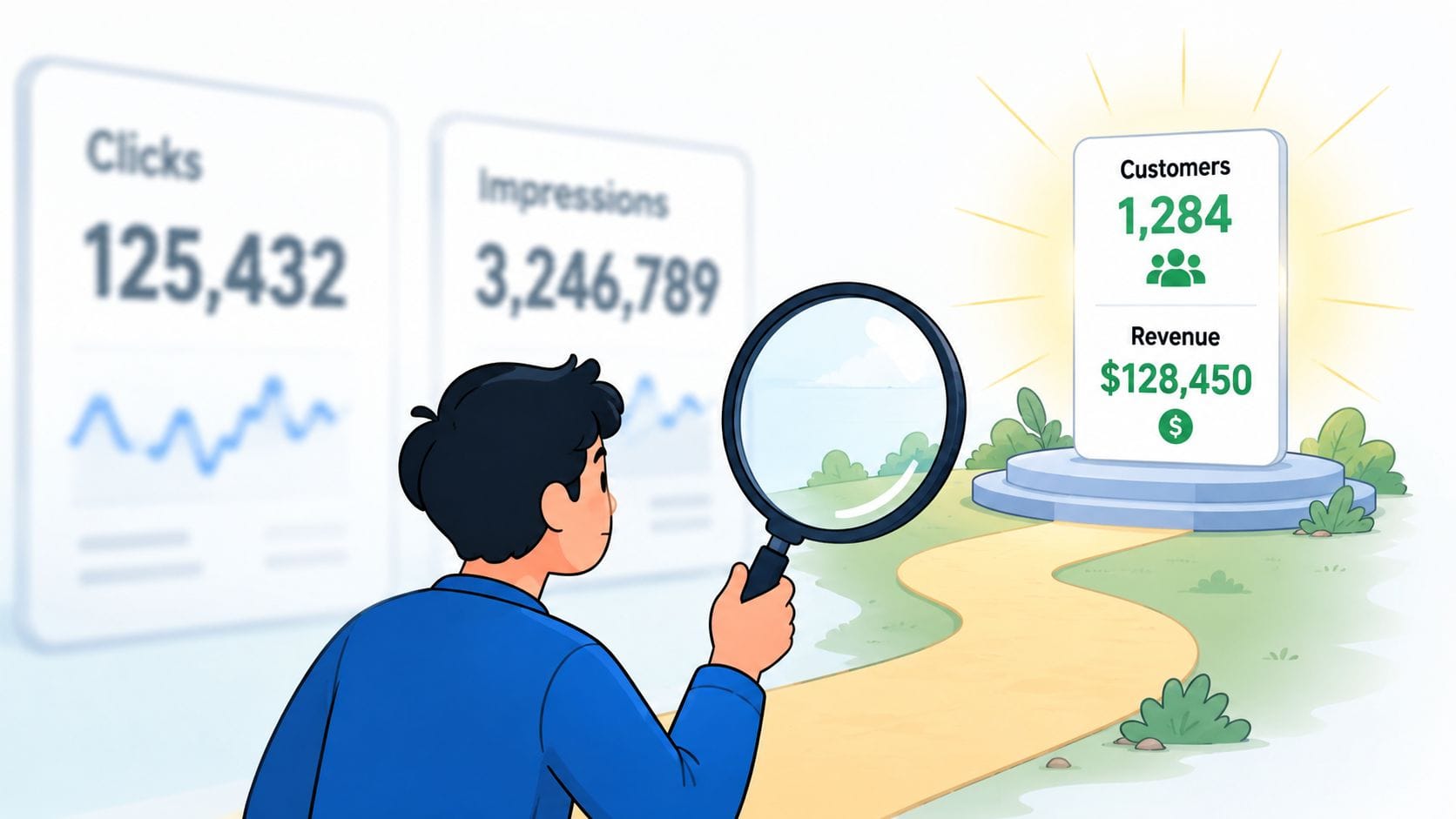
Clicks can feel exciting. Impressions can look impressive. Neither pays wages on its own.
A healthy Google Ads account tracks what happens after the click. That means calls, booked jobs, quote requests, purchases, and qualified enquiries. If that tracking isn't in place, the business is guessing.
What conversion tracking actually does
Conversion tracking connects ad spend to outcomes. It tells the business which keyword, ad, or campaign led to the enquiry instead of just showing traffic volume.
That's especially important when budgets are tight. Website That Sell's Google Ads budget guide notes that Brisbane campaigns need a minimum daily budget of $50, or about $1,520 per month, to ensure professional management viability, and that $10 daily, about $304 per month, is insufficient for algorithmic learning and limits reach.
The reason is simple. Tiny budgets don't collect enough data. Without enough signal, the account can't learn which searches lead to real customers.
A simple way to think about ROAS
ROAS means Return On Ad Spend. It answers one blunt question: for every dollar spent on ads, how much revenue came back?
The formula is straightforward:
- ROAS = revenue from ads divided by ad spend
If a campaign brings in more valuable work than it costs, that's a healthy sign. If it generates cheap clicks but poor enquiries, the campaign needs work.
That's where conversion rate optimisation matters too. Better pages often improve the value of the same traffic. This practical read on conversion rate optimisation in Australia is useful for owners who know the traffic is arriving but the page isn't doing enough to turn that attention into action.
For a more detailed plain-English breakdown of how marketers calculate and improve returns, this piece on boost ad profitability is a solid companion resource.
A campaign should never be judged by traffic alone. It should be judged by what that traffic does.
How to Choose a Brisbane Google Ads Agency
A Brisbane owner usually reaches this point after wasting a few late nights inside Google Ads, getting clicks, and still not knowing which ones turned into real enquiries. That is the decision point. Keep it simple and manage it in-house, or pay for help before more budget slips into the wrong searches.
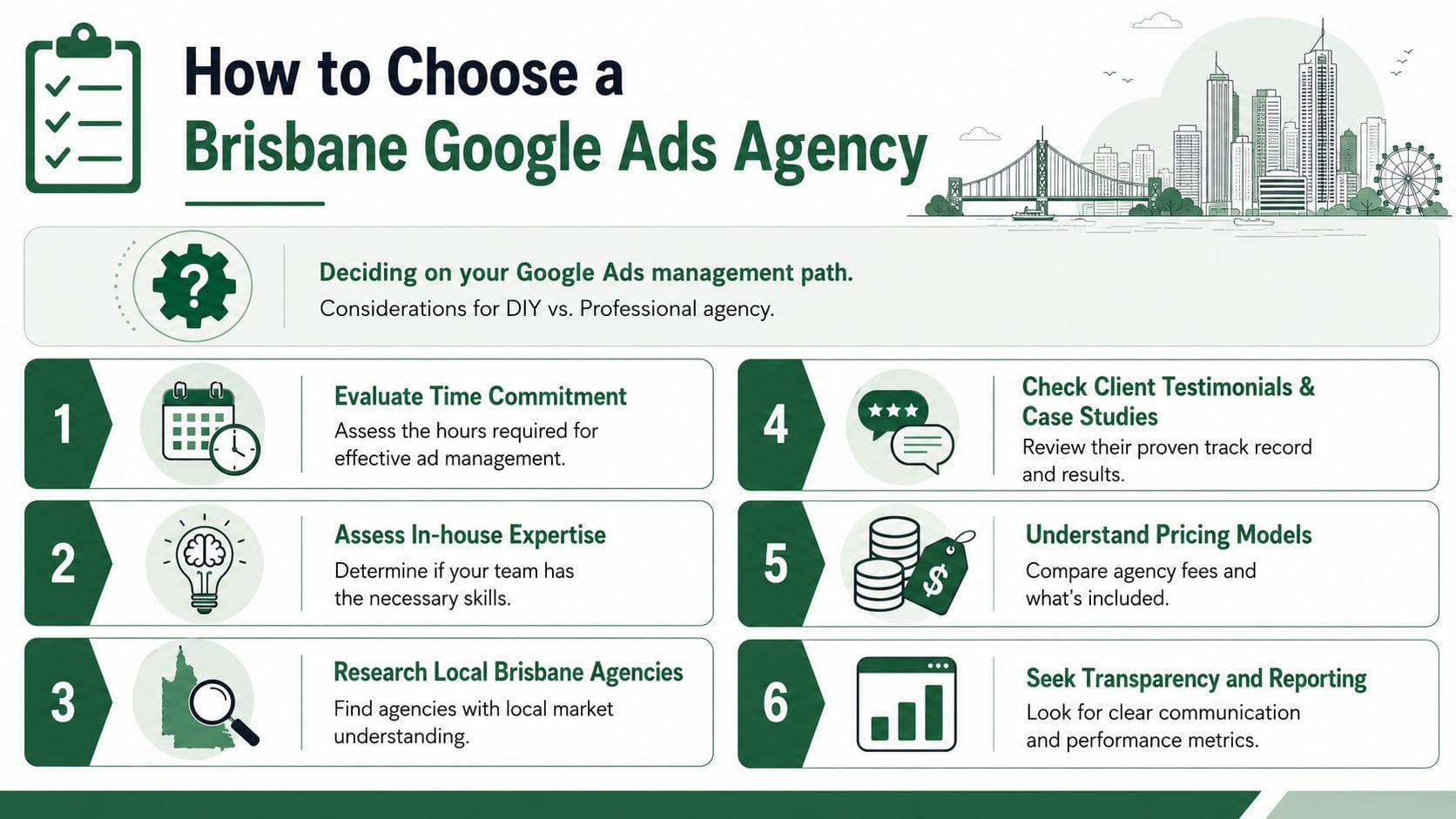
Plenty of Brisbane small businesses can run a basic account themselves for a while. I have seen that work well for a solo tradie, one-location clinic, or service business with a tight service area and one main offer. The catch is consistency. Someone has to check search terms, confirm tracking is working, test ad copy, and keep the campaign focused every week.
That is where many owners get stuck. They do not lack effort. They lack spare hours.
DIY or agency
The fundamental choice is not agency versus no agency. It is whether the business has enough time and skill to manage risk properly.
DIY usually fits if:
- The offer is narrow: One main service, or a very small product range
- The target area is clear: A few Brisbane suburbs, not half of South East Queensland
- One person owns the account weekly: The work is scheduled, not left for quiet afternoons
- The landing pages are already decent: Traffic has somewhere relevant to go
Agency support usually fits if:
- Leads need to be steady: Gaps in enquiries hurt cash flow
- There are multiple services, suburbs, or campaigns: Structure gets messy fast
- Nobody in the business wants to manage Google Ads properly: Fair enough
- The owner wants cleaner reporting: Calls, forms, booked jobs, and sales, not just clicks
If you are comparing providers, this guide to choosing a pay-per-click advertising company gives a useful benchmark for what good support should include.
What good agency support looks like
For Brisbane businesses, good agency work is usually quite practical. It starts with sensible targeting, clean account structure, proper conversion tracking, and regular search term reviews. It also means being honest about trade-offs.
For example, a small budget may be better spent on one high-margin service in Brisbane Southside than spread across six services from Ipswich to Redcliffe. A good agency will say that plainly. They will not pad the account with extra campaign types just to make the setup look bigger than it needs to be.
Local context matters too. Brisbane is often less expensive than Sydney or Melbourne for many search terms, but that does not mean every click is cheap or every suburb performs the same. An agency worth hiring should understand that difference and adjust targeting, ad copy, and landing pages around it.
Red flags to watch for
Price matters, but behaviour matters more.
Watch for agencies that:
- Promise guaranteed number one positions: Google Ads is an auction, not a fixed shelf
- Report on impressions and clicks without tying them to leads: That hides weak performance
- Set the account up under their own control: The business should keep access to its Google Ads account and data
- Avoid clear answers on fees: You should know what setup covers, what monthly management covers, and what is extra
- Never mention landing pages: Traffic quality and page quality work together
- Push broad targeting too early: Small Brisbane businesses usually need focus before scale
One more warning. Cheap management often means very little management. If the fee barely covers an hour of work, the account probably is not getting the attention it needs.
Questions worth asking before signing
A good Brisbane agency should answer these in plain English:
- Who is working on the account each month?
- How will calls, forms, and booked leads be tracked?
- What gets done in month one, and what gets done after that?
- How often are search terms reviewed and negatives added?
- What will the report show besides clicks and cost?
- Will you recommend landing page changes if conversion rates are weak?
- Do I keep access to the ad account, tracking, and historical data?
- What happens if I pause the campaign or leave?
If the answers are vague, keep looking.
Good agencies talk about cost, lead quality, and follow-up. Clicks are only part of the job.
Your Next Steps to Getting Started
For Brisbane small businesses, Google Ads works best when it stays simple. Tight targeting, clear service pages, realistic budgets, and proper conversion tracking beat complicated setups almost every time.
The key lessons are straightforward:
- Show up for high-intent local searches
- Don't spread a small budget across too many services
- Measure calls, leads, and sales instead of vanity metrics
- Choose support that's transparent and easy to work with
SEO still matters for long-term growth, and organic search drives 53% of total website traffic according to Colorlib's digital marketing statistics roundup. But for businesses that need enquiries sooner, Google Ads can fill the gap while longer-term visibility builds.
If the process feels overwhelming, a local partner can take the pressure off. Businesses that want practical help can explore Google Ads consulting and speak with Boocoo about a strategy that fits the business, the budget, and the time available.