
CPC means cost per click, the price an advertiser pays when someone clicks an ad. In Australia, Google Search CPC commonly sits around A$2 to A$4, while display clicks average about A$0.96, although industry costs can vary sharply.
A Brisbane tradie might open Google Ads after a busy week and see charges beside searches such as “emergency plumber Brisbane” or “hot water repair near me”. The number looks simple, but it raises harder questions: Is the price reasonable? Why did one click cost more than another? Would cheaper clicks bring actual enquiries, or just more browsing?
Those questions matter because a small business rarely has room for wasted spend. CPC is a useful budget metric, but it isn't the same as the cost of winning a customer. A low-priced click can still be expensive if the visitor doesn't call, submit a form or buy. A higher-priced click can make sense when it reaches someone actively looking for a service.
This guide explains what is CPC, how the calculation works, why two Brisbane businesses can pay different amounts, and how CPC compares with CPM and CPA. It also translates Australian benchmarks into practical decisions for cafes, clinics, tradies, professional services and online shops.
For owners managing several channels, paid search is only one part of the workload. Content planning and organic social activity can support paid campaigns, and a guide to the best social scheduling tools 2026 can help a small team organise regular publishing without adding unnecessary admin.
A Brisbane business considering search campaigns can also review this Google Ads Brisbane guide before committing budget. The sensible starting point is not “How cheap can each click be?” It's “Which clicks have a realistic chance of becoming profitable customers?”
Introduction What Every Brisbane Small Business Should Know About CPC
CPC is the amount charged for an individual ad click. In practical terms, a business pays when a person chooses the ad and visits the advertised website, landing page or destination.
That sounds much like paying for every person who walks through a shop door after seeing a flyer. The flyer itself may reach many people, but the business pays only when someone takes the next step and enters. Digital platforms record that entry as a click.
Australian benchmarks give the idea some useful context. Google Ads search CPC commonly sits around A$2 to A$4 for average campaigns, while display campaigns can be about A$0.96 per click, according to Australian Google Ads CPC benchmarks. Those are broad reference points, not a quote for every account. Legal and financial keywords can rise well above A$10, while e-commerce clicks are often closer to A$1.40 to A$1.82 from the same benchmark source.
Why the number matters to a small budget
Suppose a Brisbane electrician sees a click price that seems manageable. The test is whether the landing page turns relevant visitors into calls. If the ad attracts people searching for jobs, DIY instructions or services outside the business area, the account can spend money without creating useful demand.
CPC also changes according to the channel. Search visitors have usually typed a specific need into Google, while social users may discover an offer while scrolling. That difference affects both the price and the likelihood of immediate action.
The metric helps answer three practical questions:
- How quickly can the budget be spent? Higher CPC consumes the daily allowance faster.
- Which keywords deserve attention? Commercial local searches may be more valuable than broad information terms.
- Is the campaign producing business results? Clicks need to be connected to calls, forms, bookings or sales.
The budget-smart next step is to record not only the CPC, but also the action that followed each useful click. That simple habit stops “cheap traffic” from becoming the main success measure.
What CPC Means and How to Calculate It
CPC, or cost per click, measures the average amount paid when someone selects an ad. The basic calculation is:
CPC = total ad spend ÷ total clicks
If a Brisbane cleaning business spends A$120 and receives 60 clicks, its average CPC is A$2. That figure describes the average cost of each arrival on the website. It does not show whether visitors booked a clean, called the business or left immediately.
A click records one visitor reaching the page. CPC measures the average price of that arrival, not the cost of producing a sale. A low CPC can still waste money if the visitors are outside the service area or have no intention to enquire.
Average CPC versus the bid
The amount paid for a click can differ from the amount an advertiser is prepared to pay. With Google's manual CPC bidding, an advertiser sets a maximum CPC, the highest amount they're willing to pay for a click, subject to bid adjustments or Enhanced CPC. Google explains that the actual CPC is often lower because the winner generally pays the minimum needed to beat the next competitor's Ad Rank for that position, as described in Google's manual CPC bidding guidance.
A maximum bid works like a spending limit attached to an individual visit. It sets the upper boundary, while the final charge depends on the competition and position at that moment.
Paid social follows a different user journey, so review how much Facebook ads cost before comparing its CPC with search campaigns.
What the formula leaves out
Average CPC does not reveal:
- Whether the searcher matched the service area.
- Whether the landing page answered the search.
- Whether the visitor became a lead.
- Whether the lead was valuable enough to justify the spend.
For a local physiotherapist, ten clicks producing one relevant booking may be more useful than cheaper clicks from people outside Brisbane. The budget-smart next step is to track CPC alongside cost per enquiry, using recorded phone calls, forms and bookings wherever possible.
Why Your CPC Is Not the Same as Your Competitors
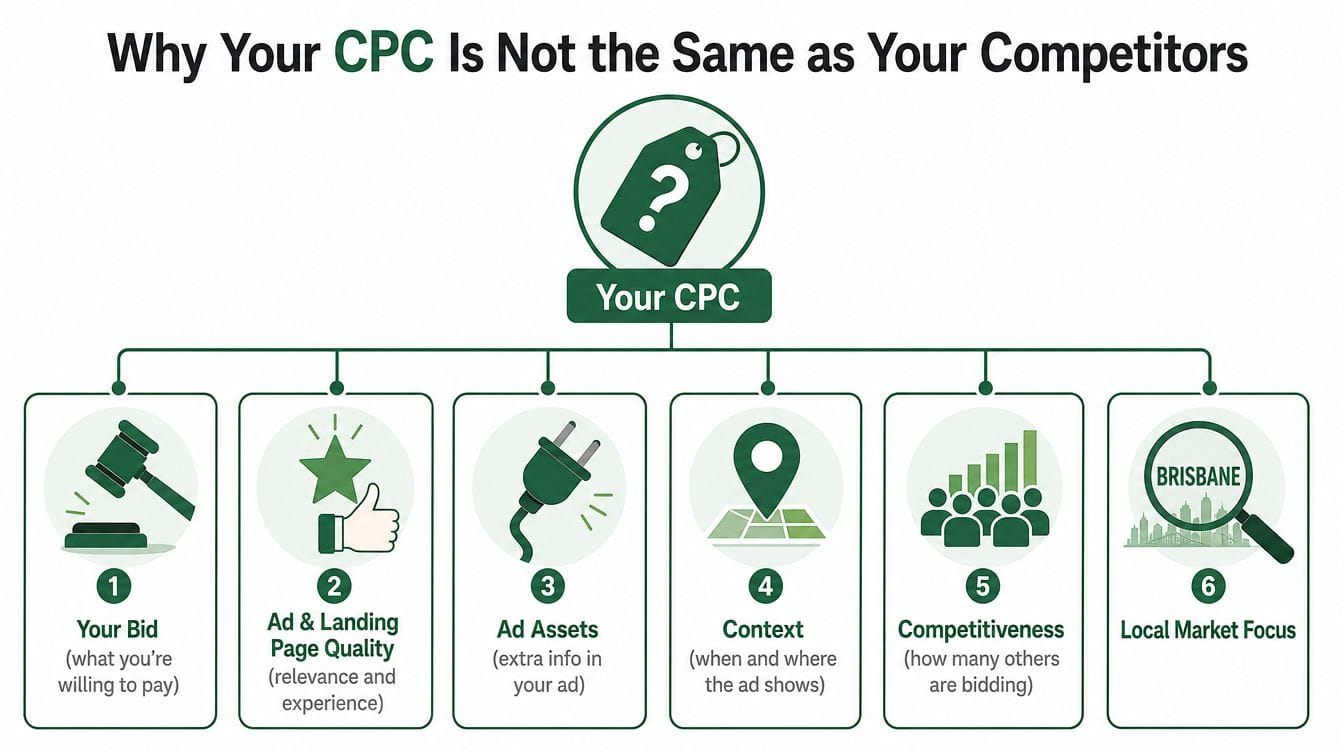
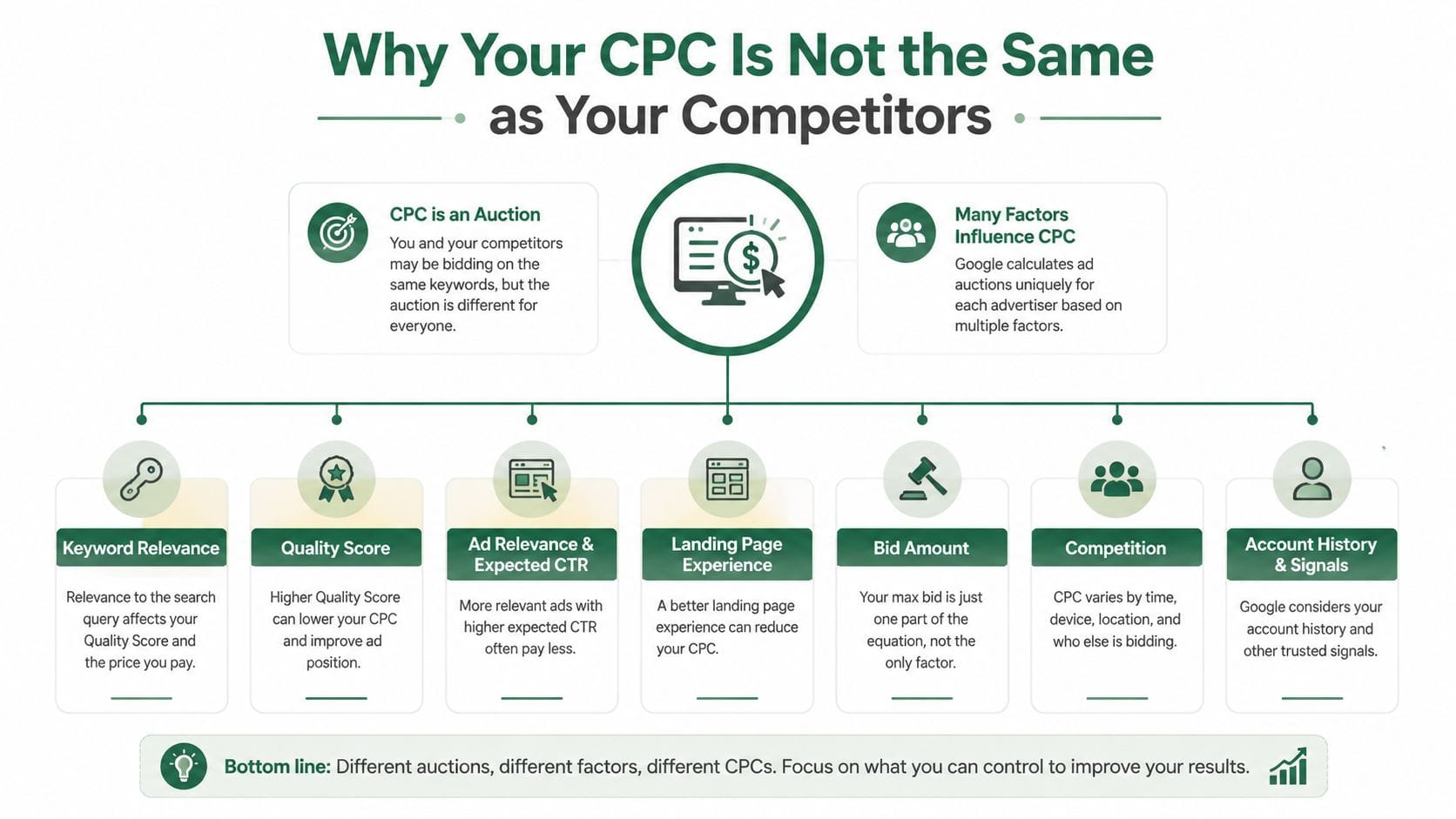
Two businesses can target the same Brisbane keyword and pay different amounts. Google Ads runs a rapid auction whenever someone searches or visits a site carrying ads, and different ad locations use separate auctions. Google identifies six main influences, including the bid, ad and landing page quality, ad assets, context and auction competitiveness, explained in Google's overview of the ad auction.
Six influences behind the price
The bid shows what the advertiser is prepared to pay. A larger bid can support stronger visibility, but it doesn't automatically produce a better result.
Ad and landing page quality show whether the message matches what the searcher needs. A plumbing ad promising same-day Brisbane help should lead to a page that clearly explains the service, service area and contact option. A vague homepage creates friction.
Ad assets add useful details such as extra links, calls or service information. These additions can make an ad more helpful and give a searcher a clearer reason to choose it.
Context includes the circumstances around the search, such as location, timing and device. A search from a Brisbane suburb at a relevant time can carry a different commercial meaning from a broad search elsewhere.
Competitiveness reflects how many advertisers want the same opportunity. Keywords connected to valuable leads attract more bidding pressure because a successful customer may be worth more to the business.
Local market focus helps a small operator avoid competing unnecessarily with national advertisers. A focused campaign for a service in Brisbane can be more efficient than a broad campaign covering every Australian location.
Practical rule: A business shouldn't judge CPC without checking relevance. Better targeting and a more useful landing page can protect budget even when competitors are bidding aggressively.
A search click can cost more than a social click because the searcher has actively expressed a need. The budget-smart next step is to compare CPC with the quality of enquiries, not to copy a competitor's bid.
CPC vs CPM vs CPA Choosing the Right Way to Pay
CPC, CPM and CPA describe different ways an advertising platform can measure or charge for activity. Treating them as interchangeable makes campaign reports harder to interpret.
The distinction is similar to choosing how to pay for local promotion. A business might pay to distribute flyers, pay for people to walk into a shop or pay only when someone becomes a customer. Each option serves a different purpose.
| Metric | What You Pay For | Best Use Case |
|---|---|---|
| CPC | A click on the advertisement | Driving visits, enquiries or product consideration |
| CPM | A set number of ad impressions or views | Building awareness and reaching a defined audience |
| CPA | A completed action, such as a lead, booking or purchase | Optimising towards a measurable business outcome |
When CPC fits
CPC suits a Brisbane business that wants people to visit a service page, call from an ad or browse an online shop. It gives the owner a clear traffic cost, but the business still needs conversion tracking to understand whether those visits are valuable.
A local dental clinic might use CPC for searches around appointments. A retailer might use it to send shoppers to a product category. A cafe could use location-focused campaigns to encourage visits, although the business would need a sensible way to connect online activity with real-world outcomes.
When CPM fits
CPM makes more sense when exposure is the main goal. A new business might want local residents to recognise its name before they need the service. Paying for visibility can support that objective, but impressions alone don't prove that people will enquire.
When CPA fits
CPA is closer to the result a business ultimately wants. It focuses on a completed action, but the platform needs reliable conversion signals and enough useful data to optimise effectively. A business should define the action carefully. A form submission, phone call and purchase aren't automatically equal in value.
Queensland's Business Queensland guidance on digital marketing and advertising recommends developing a digital marketing strategy before getting started. A business can also review paid advertising examples when deciding which channel supports its goal.
The budget-smart next step is to choose the metric that matches the business objective, then track the action that matters after the impression or click.
What CPC Really Costs in Australia for Small Businesses
A Brisbane café can pay less for a social click than a local solicitor pays for a search click, yet the cheaper visit may be less ready to buy. CPC is a reference point for the auction, not a verdict on campaign value. Separate the channel, the customer's intent and the result you need before setting a budget.
Australian channel benchmarks place Google Search CPC around A$2.50 to A$7.00, while Meta or Facebook CPC is roughly A$1.80 to A$3.50, as outlined in Australian channel CPC benchmarks. Search works like a customer walking into a shop with a request already formed. Social advertising reaches people while they browse, so a lower click cost can still bring visitors earlier in their buying process.
Industry changes the budget picture
Auction pressure usually increases where a qualified customer is valuable or where businesses compete strongly for leads. Australian benchmarks place e-commerce and retail around A$1.50 to A$3 per click, legal services around A$6 to A$15, finance and insurance around A$4 to A$8, healthcare around A$3 to A$6, and real estate around A$2 to A$5, according to Australian paid advertising industry benchmarks.
A Brisbane online shop and a commercial law firm therefore need different CPC expectations. The shop may require several product visits before a purchase, while the law firm may accept a higher CPC if a qualified enquiry is worth more. Compare clicks with the value of the next action, not with a competitor's headline figure.
Australia also recorded strong search competition within APAC. Search CPC was reported at US$1.50 in December 2024, the highest in APAC, according to APAC search advertising CPC data. Social CPC figures have varied across datasets and timeframes, with changes of roughly 12% to 48%. A benchmark is therefore a starting reference, not a promise for a Brisbane account.
Use CPC to check auction efficiency, then use qualified enquiries or profitable sales to judge the campaign. Etsy sellers can apply the same logic when reviewing advice to improve Etsy ad ROAS. The budget-smart next step is to set a target cost per qualified enquiry and compare each channel against it, rather than chasing the cheapest click.
Practical Ways to Lower Your CPC and Get More From Every Click
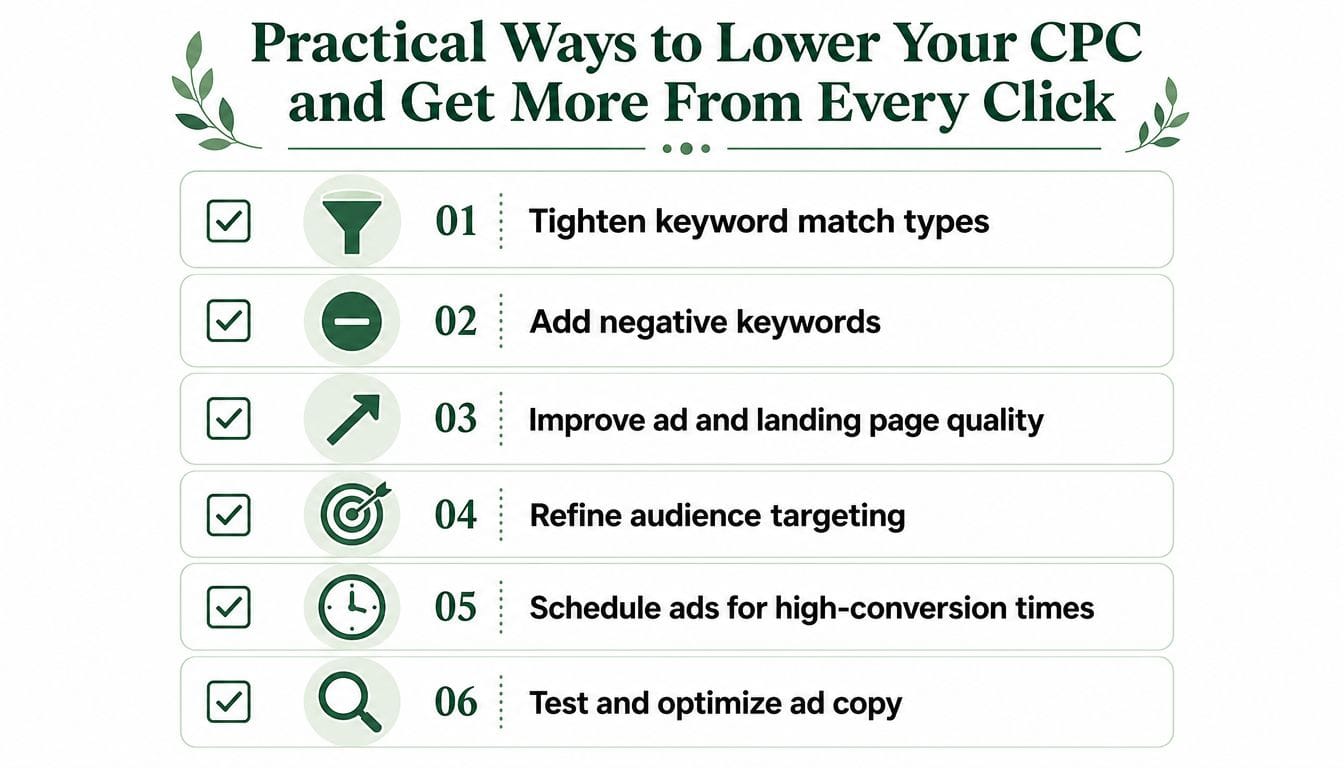
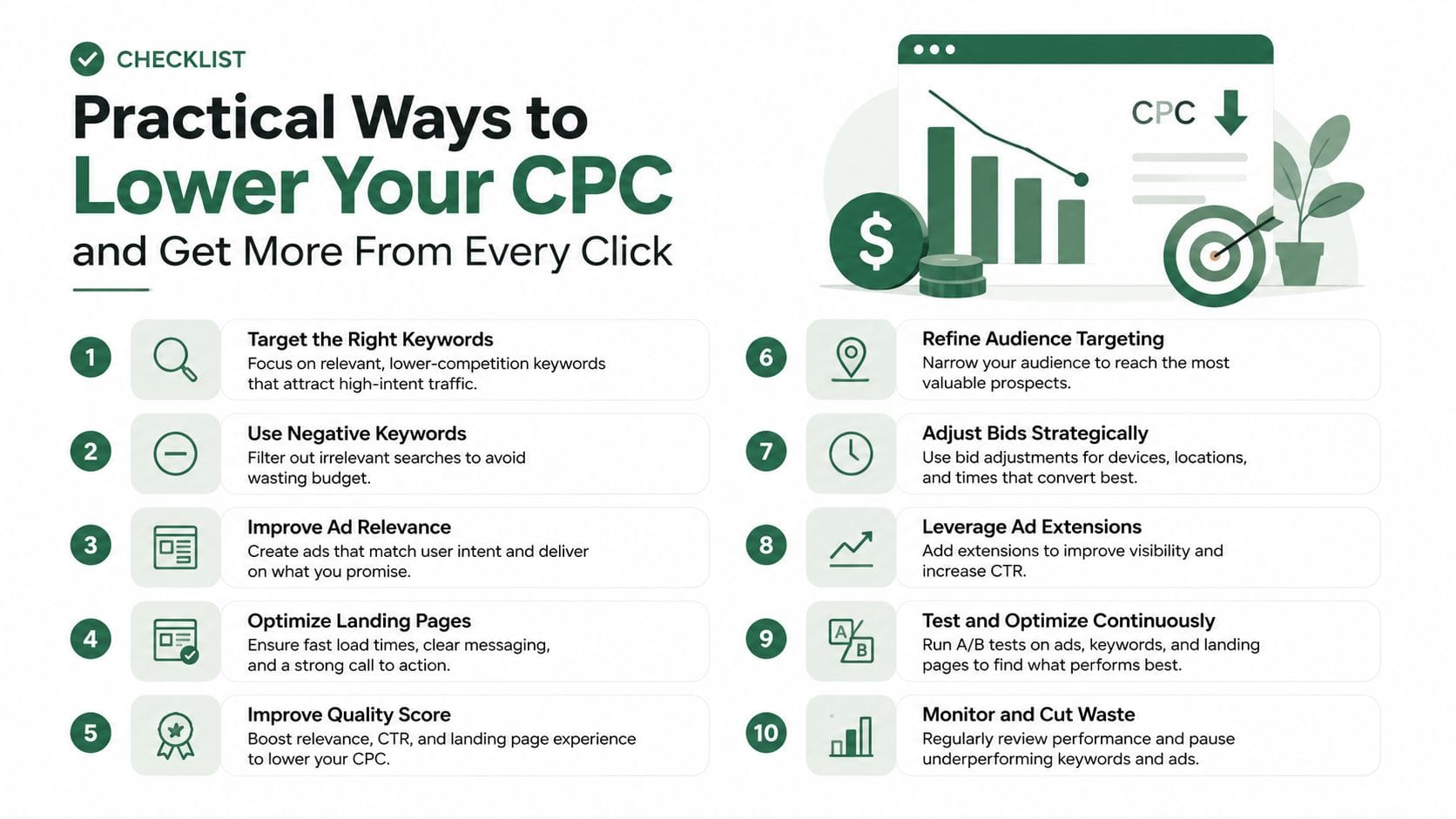
Start with the search-term report. A Brisbane plumber may discover clicks from people looking for training, free advice, employment or areas outside the service zone. Add those terms as negative keywords, then tighten match types so the budget goes towards searches with a realistic chance of becoming a job.
A clinic can separate treatment searches from broad health questions. This works like sorting enquiries into useful and unsuitable folders. The account becomes easier to read, and the owner can see which search themes produce qualified enquiries rather than just more visits.
Improve the path after the click
An ad about emergency drain repairs should lead to a page that explains emergency drain repairs. Sending that visitor to a generic homepage is like directing a customer into a shop without showing where the requested service is located. A slow, confusing or broad page can waste a relevant click.
Use these checks:
- Match the message: Repeat the service language across the keyword, ad and landing page.
- Show the location: Name Brisbane or the relevant suburb where the business operates.
- Reduce friction: Keep the phone number, enquiry form and main action easy to find.
- Remove distractions: Send paid traffic to a focused service page instead of a crowded homepage.
- Test the wording: Compare clear benefits and calls to action, then keep the version that produces stronger enquiries.
Landing-page changes can matter as much as bid changes. Businesses that want a structured review of this part of the journey can explore conversion rate optimisation services.
Measure business outcomes
Record phone calls, form submissions, bookings and sales, not just clicks. CPC is an auction measure, while qualified enquiries and profitable sales show whether the spend is working. A cheaper click can still waste money if it attracts poor-fit visitors, while a higher-priced click may be sensible when the resulting enquiry has stronger commercial value.
Use one clear review cycle. Pause an obviously irrelevant keyword group, add negative keywords from the search-term report and check whether the landing page answers the exact query. Then compare the change in enquiry quality before raising bids or expanding targeting. That keeps the decision tied to cash flow, rather than to a cheap CPC alone.
Making CPC Work for Your Brisbane Business Goals
CPC works best when it supports a defined business goal. Queensland guidance recommends creating a digital marketing strategy before getting started, so paid clicks should sit inside a wider plan that may include SEO, a useful website, social content and follow-up processes.
A time-poor owner can use a simple decision checklist:
- Define the outcome. Is the campaign meant to generate calls, bookings, quote requests, store visits or online sales?
- Choose the strongest intent. Start with searches that show a clear need and a realistic Brisbane service area.
- Set the spending boundary. Use a maximum CPC or campaign budget that protects cash flow.
- Prepare the destination. Make sure the landing page answers the search and gives visitors one obvious next action.
- Track the response. Record which clicks become enquiries, and distinguish genuine prospects from irrelevant traffic.
- Review quality before raising bids. Improve the ad, keywords and landing page before assuming a higher bid will fix performance.
A practical local example
A Brisbane allied health clinic might begin with a small group of treatment and location terms rather than broad health searches. The clinic can then review whether calls and bookings arrive during the campaign, rather than celebrating a rise in visits alone.
A tradie can use the same process for urgent services, while an online shop may separate product searches from broad category discovery. Each campaign needs its own commercial logic because CPC changes with intent, competition and customer value.
Boocoo provides support across SEO, web design, social media management and paid advertising for Brisbane small businesses, including campaign setup, management and reporting. A business comparing providers can also use this guide to pay-per-click advertising companies as part of its research.
Budget check: Before increasing ad spend, confirm that conversion tracking works, the landing page matches the ad and the resulting enquiries are worth pursuing.
The budget-smart next step is to review the last campaign's search terms, conversion actions and landing-page relevance. Brisbane owners who want practical help can contact Boocoo on 1300 093 797 or email hello@boocoo.au to discuss goals, timelines and a manageable next step.