
It's 9pm on a Tuesday. The quote book has two jobs in it for next week and the phone hasn't rung since lunch. You posted a Reel on Saturday, it picked up a few hundred views, and you're trying to work out whether any of those views will ever turn into a call.
That question sits inside a very large market. The ACCC's Digital Platforms Services Inquiry report estimated Meta pulled in between A$4.7 billion and A$5.1 billion of Australian advertising revenue in financial year 2021-22 across Facebook and Instagram combined, more than the combined Australian ad revenue of YouTube, TikTok, Twitter and Snapchat. Instagram Reels advertising is one placement inside that auction. The scale tells you the channel is where the attention is. It tells you nothing about whether your ad will earn its keep.
Set a Test Budget and Timeline First
Say a plumber working across Brisbane's south side boosts a 20-second Reel of a hot water install he's proud of. Thirty days later it has 4,000 views, a few likes from people he'll never meet, and zero phone calls. The video wasn't the problem. Nobody decided, before launch, what that video had to produce.
For a local operator, the number that matters isn't views or likes. It's cost per qualified enquiry, meaning a real call, form or message from someone inside your service area with a job you can quote. Write that target down before you spend anything and the rest of the test becomes readable.
For context on what ad inventory costs across Facebook placements, Boocoo's breakdown of Facebook advertising costs is worth ten minutes before you set a daily figure.
What each starting budget can prove
| Monthly budget | Ad sets | Reels to rotate | Test window | What it proves |
|---|---|---|---|---|
| A$150 (about A$5 a day) | 1 prospecting ad set | 2 Reels | 30 days | Whether the opening hook holds attention |
| A$300 (about A$10 a day) | 2 ad sets (prospecting and retargeting) | 3 Reels | 30 days | Cost per qualified enquiry for one suburb cluster |
| A$500 (about A$16 a day) | 2 ad sets | 4 to 5 Reels | 60 days | Which offer or presenter wins before you scale |
Those are starting suggestions for a test, not Meta minimums. They're built around what one person can realistically film and answer in a normal working week. If a click or a thousand impressions comes in far above the 2026 Instagram ad cost benchmarks compiled by Sup Growth, that's a signal to check your audience settings before you add budget.
Why 30 days and two or three Reels
One Reel is a coin toss. Two or three gives you a pattern, and a pattern is what you're buying. Delivery also needs room to settle, which is why a week of data proves almost nothing and 30 days gives the algorithm enough people to find.
The A$150 row has a hard limit worth stating plainly. With one prospecting ad set and two Reels, you learn whether the opening hook earns the first two seconds. You don't learn whether the offer converts, because there's no retargeting audience catching the people who watched and hesitated.
There's a decent case for testing at all. An AdNews report on Instagram's short-form video found more than 63% of Australians watched short-form video weekly, and 60% messaged a business after watching Reels. Those are reported user behaviours, not a promised conversion rate, and they don't isolate Brisbane or your trade. They do tell you the message-and-enquiry path is already familiar to Australian audiences.
Practical rule: before you launch, write down three things on one line. The goal in enquiries, the monthly figure, and the date you'll read the results. If you can't name the enquiry you're counting, the budget is a donation.
Creative Specs and Scripts That Stop the Scroll
A Reels ad isn't a repurposed television commercial. Meta's Instagram Reels ads guide describes them as full-screen vertical ads that sit between organic Reels, where viewers can comment, like, save, share or skip. The first frame is doing the work of a shopfront sign, and it gets about a second to do it.
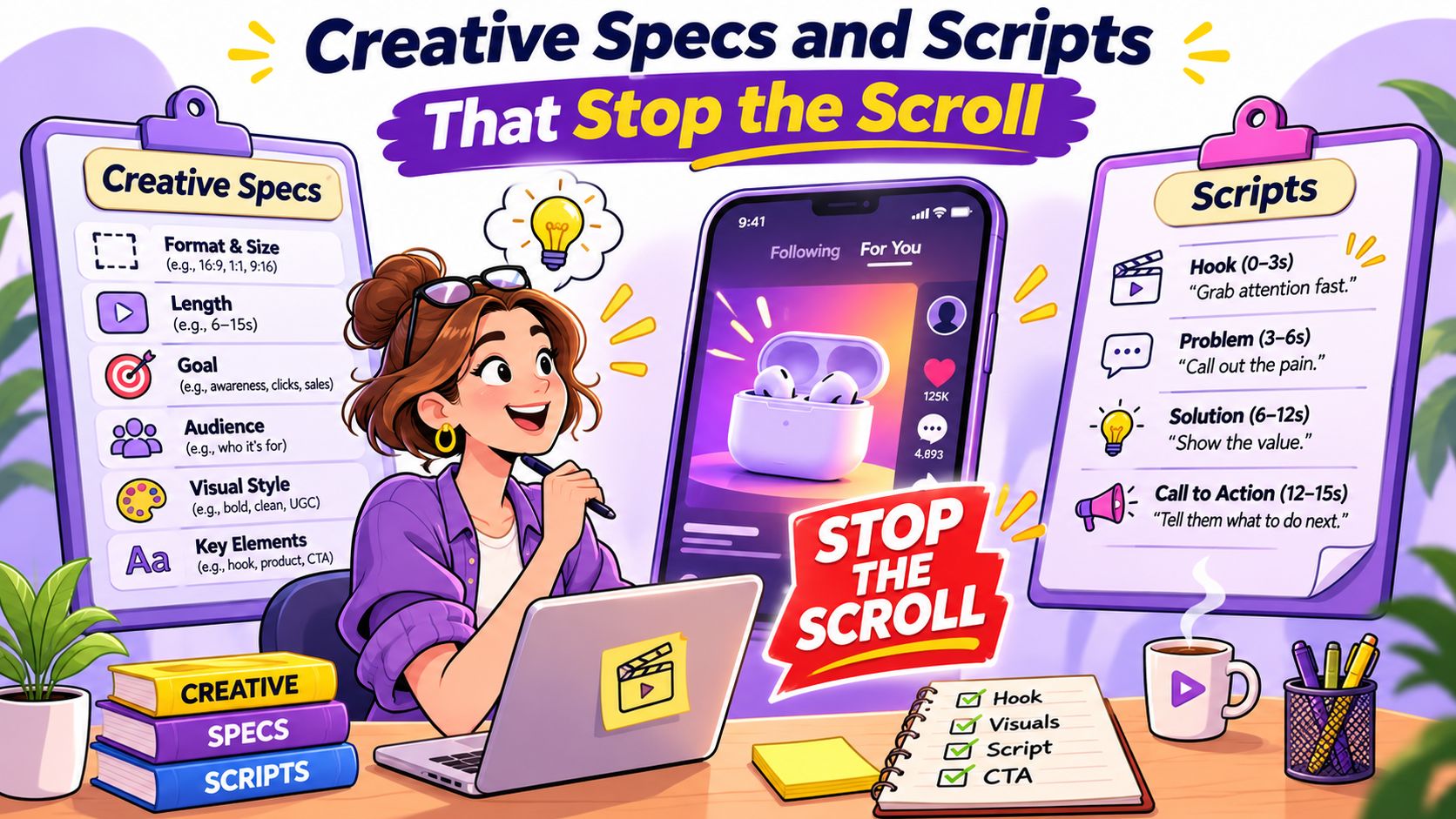
The spec checklist
- Frame: 9:16 vertical, nothing else. Export at a minimum of 1080 × 1920 pixels, and use Meta's recommended 1440 × 2560 pixels where your editor allows. A quick reference for vertical video dimensions for Meta ads from Rapid Ads saves digging through help pages mid-edit.
- Length: 15 to 30 seconds for a modest budget. Meta permits Reels ads up to 15 minutes, but short, focused videos suit time-poor audiences and small spends.
- Captions: burned in, not auto-generated. Meta recommends captions because a large share of viewers watch with the sound off.
- Safe zones: keep text and your logo clear of the top and bottom edges where the interface sits over the video.
The first two seconds decide the result
The offer or the problem has to appear in the first one or two seconds, and the opening frame must make sense with the volume at zero. If your logo animation runs first, you've spent your most valuable second on brand recall that nobody asked for.
This matters more than most owners realise. Sprout Social's Australian social media statistics note that 33.8% of Australians use social networks to research products and brands, and more than 31% of internet users aged 16 and over discover brands through social media advertising. Discovery is happening in-feed. The creative has to carry both the problem and the identity of the business, fast.
The four-part script
A Brisbane electrician can build a full Reel in four beats. Open on "Power keeps tripping?" Then cut to hands testing circuits at a switchboard. Show the finished, tidy board and the suburb. Close with one instruction: call this number for a quote.
The structure underneath that is simple enough to reuse every week:
Script template: Problem: [customer problem as a question]. Show: [the service in action, about 5 seconds]. Proof: [a result, such as a finished job in your suburb]. Action: [call, request a quote or book] on [number].
Three mistakes waste more budget than bad lighting ever will. Text so small it's unreadable on a phone. An offer that arrives at second 12. And two calls to action in one Reel, which splits attention and usually produces neither.
Production doesn't need a videographer. A smartphone, natural light near a window, and one reusable vertical template with your colours and captions will cover a full month. Film three Reels in a single session so the week you're flat out doesn't break the schedule, and lean on the same approach Boocoo's guide to employee generated content uses, where staff on the tools hold the camera instead of a production crew.
How to Build a Reels Ad in Meta Ads Manager
The build itself takes about 20 minutes once your video is exported. What costs money is the small setup decisions, so work through them in order.
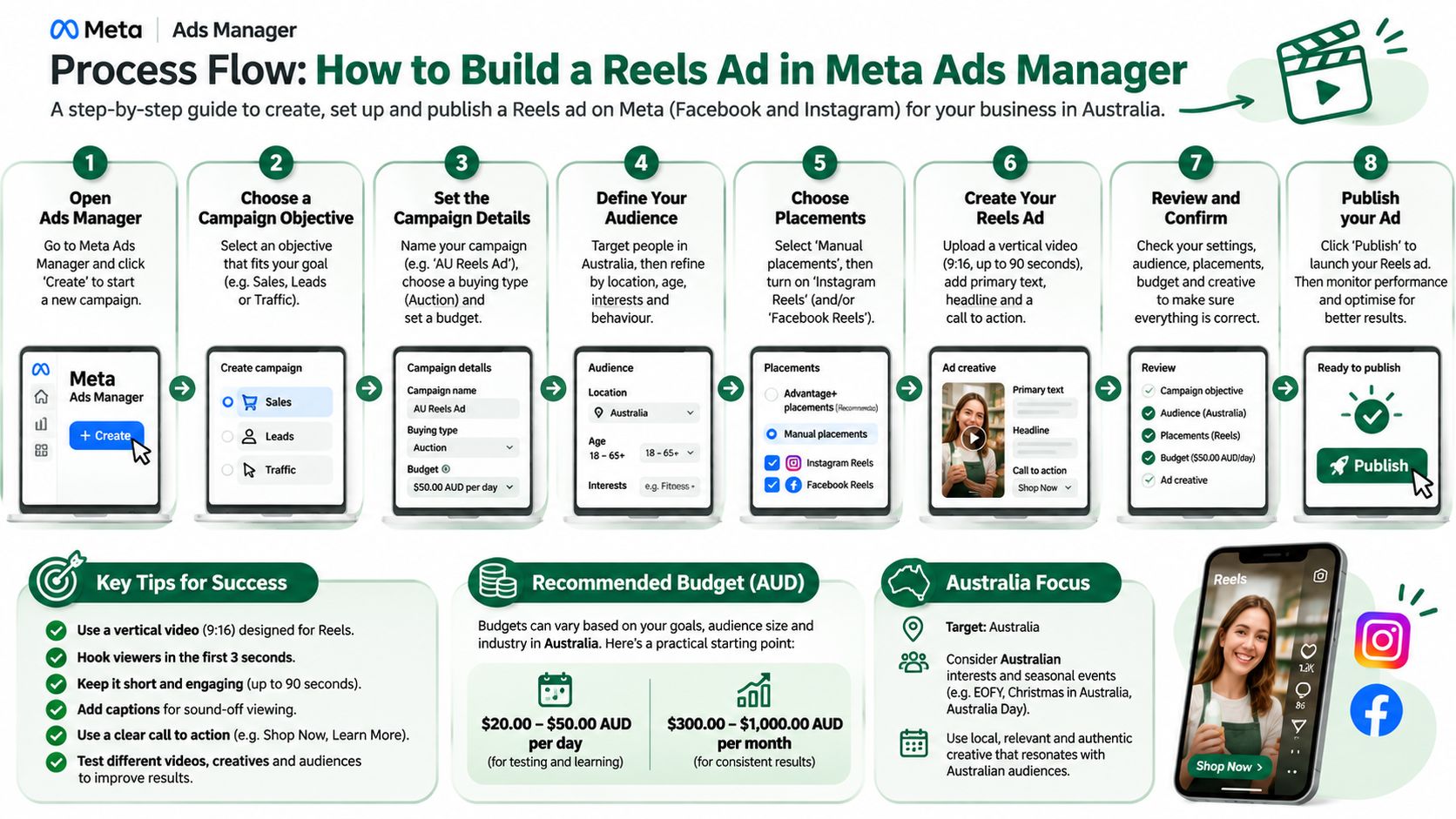
- Choose the objective. Leads if the goal is calls or form enquiries, Traffic if you're sending people to a booking page. The usual slip is choosing Engagement because it looks cheap, then wondering why nobody enquired.
- Name the campaign properly. Month, service and budget, for example "Mar25 HotWater A300". Six weeks later you'll be comparing campaigns, and a row of identical names makes that impossible.
- Set the ad set audience. Location and basic demographics here, with suburb detail covered in the next section.
- Restrict placements to Instagram Reels only. This is the single most useful setting for a clean test. Leave placements on automatic and your results get mixed with Feed and Stories, and you can't tell which one produced the enquiry.
- Set a daily budget and a continuous schedule. Switching campaigns on and off resets learning and muddies the comparison.
- Select an existing Reel or upload a new one, then check the audio status. More on this below, because it blocks more ads than any other rule.
- Add one call to action and one destination. A click-to-call number or a lead form, not both. Two destinations halve the data on each.
- Publish, then check review status within 24 hours. A rejected ad that sits unnoticed burns the first days of budget and leaves you reading results from a campaign that never ran.
The audio rule that blocks more ads than any other
Licensed music can't be used in a Reels ad. Meta's Reels ads course is explicit that if a Reel contains licensed audio, the advertiser may be prompted to select non-licensed sound or use another post, and it recommends original audio or royalty-free tracks from its Sound Collection instead.
This catches small businesses constantly. A song that worked beautifully in an organic post doesn't automatically qualify for paid distribution, so the Reel you planned to boost can stall at the review stage.
A café filming a 15-second lunch special can record the owner speaking over the sound of the kitchen. Keep a small library of approved voice-overs and cleared tracks, and every future ad starts from a safe position rather than a scramble. If you'd rather hand the build over, Boocoo's Instagram ad agency service covers campaign setup, creative and optimisation across Instagram placements.
Targeting Brisbane Suburbs on a Tight Budget
A big audience estimate feels like good news. It isn't proof of anything. A Searchscope round-up of Australian social media statistics puts Instagram reach at roughly 15.2 million people, equivalent to 69.2% of adults. Reach is how many accounts could be served an ad. It says nothing about how many of them need a switchboard replaced this month.
Targeting options compared for small budgets
| Option | Best for | Budget fit | Watch for |
|---|---|---|---|
| Radius around your base (about 10 to 20 km) | Trades and mobile services with one base | From A$150 a month | Overlapping areas that spread the budget thin |
| Three to five named suburbs | Services with a fixed service area | From A$150 to A$300 a month | Small audiences that show rising frequency sooner |
| Broad Brisbane, interest-based | Discovery-led offers such as cafés and retail | From A$500 a month to learn | Viewers outside your service area |
| Retargeting engaged viewers | Converting people who already watched | A small share, about A$50 to A$100 | Audience only builds after the prospecting ad has run |
The sequence that keeps the budget honest
Start with a radius around your base or your real service area. Then open the audience size estimate in Ads Manager and look at the number. If it's small enough that the same people will see the ad repeatedly within a fortnight, either widen the radius or accept that frequency will climb.
Once one area produces enquiries, narrow rather than widen. A named list of three to five suburbs usually beats a broad Brisbane setting for a plumber or an accountant, because you're buying attention where you can turn up.
Keep prospecting and retargeting in separate ad sets. Retargeting often looks like the bargain of the campaign, with cheap clicks and low costs per result, but it's mostly recycling people the prospecting ad already reached. Merge the two and you can't tell whether new customers exist at all.
Frequency warning: if the same people are seeing the ad six or seven times with no enquiry, the answer is a new Reel, not a bigger budget.
Australian audience behaviour backs that caution. Genroe's Australian social media statistics report that Australians opened Instagram an average of 203.5 times per month, against a global average of 331.8, ranking 37th of 52 markets. High reach doesn't automatically mean repeated exposure or strong buying intent, so a tight suburb list plus fresh creative generally outperforms a big spend aimed at everyone.
Before you touch the audience settings, spend ten minutes on a customer sketch. Boocoo's guide to building a user persona walks through the questions that matter, starting with the suburb and the problem, not the age bracket.
Read the Numbers and Fix What Is Failing
Judge a Reels test at 30 days, and judge it on cost per qualified enquiry. Everything above that line in the funnel is a diagnostic, not a verdict.
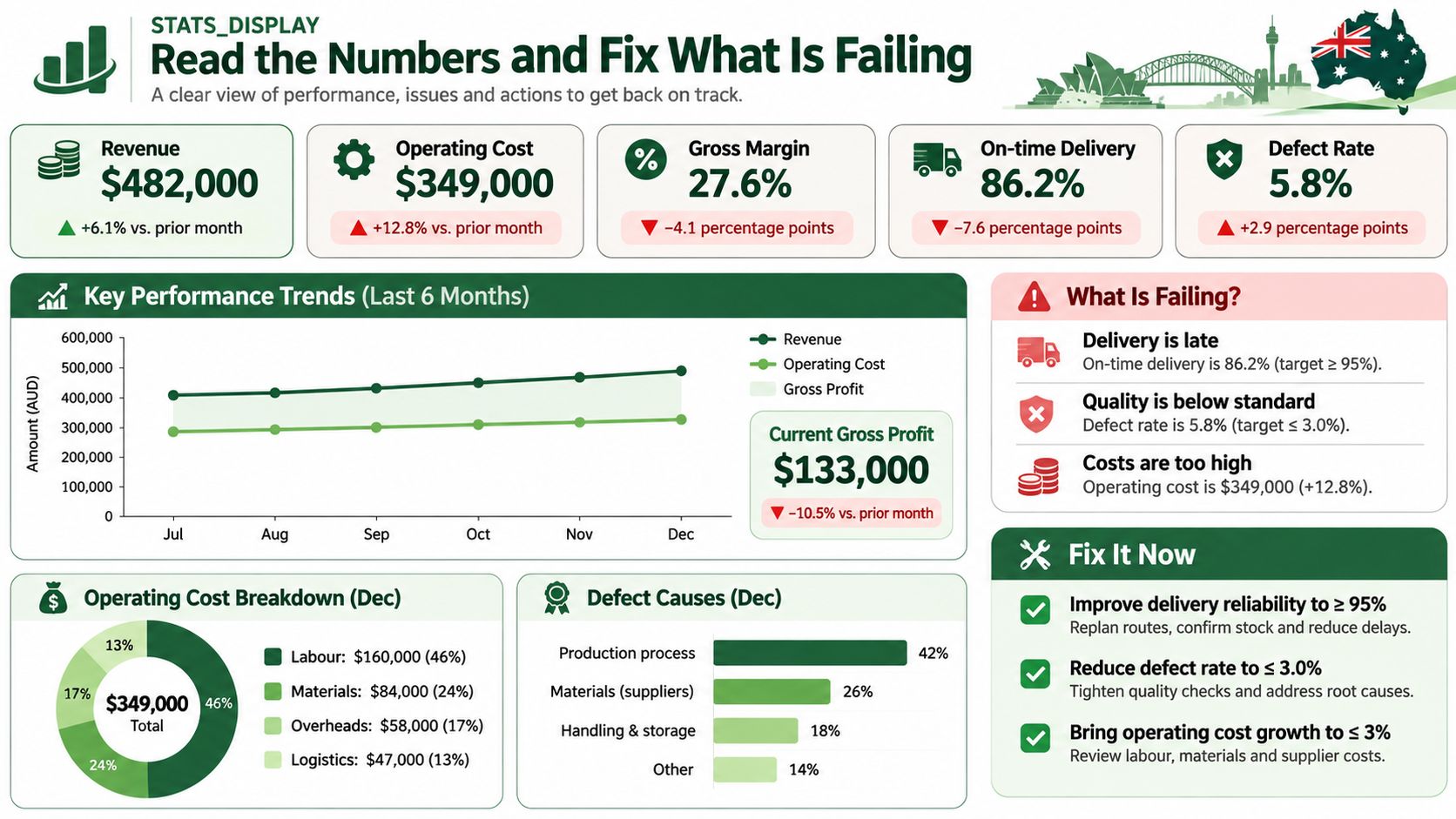
Track the enquiry, not the view
Use a unique phone number or UTM link on the campaign so every call and form can be matched back to it. Without that, the platform takes credit for enquiries that came from your ute signage and you'll over-invest in the wrong channel. Boocoo's guide to measuring marketing ROI shows how to line those tracked enquiries up against the revenue they eventually produce.
KPIs to check and what a weak number means
| Metric | What it tells you | If it is weak |
|---|---|---|
| CPM | Cost to reach 1,000 people | Test a new audience or suburb cluster |
| 3-second view rate | Whether the opening hook stops the scroll | Rewrite the first one to two seconds |
| ThruPlay cost | Cost of a completed view (Reels about A$0.02 to A$0.03, directional) | Shorten the video and check the hook |
| Outbound CTR | Clicks to your booking page or form | Clarify the offer and the call to action |
| Cost per qualified enquiry | Real calls, forms or messages from your service area | Pause the weakest ad set before changing the budget |
| Booked jobs | Revenue outcome matched to tracked enquiries | Check call logs and the lead form before scaling |
An Australian Meta benchmark report puts Reels ThruPlay cost at approximately A$0.02 to A$0.03, against A$0.05 to A$0.07 for Instagram Feed, per Rocking Web's Meta ThruPlay benchmark analysis for Australia. Treat those as directional rather than an official Meta figure. Cheap completed views are worth having, and they are not the same thing as intent.
Change one thing at a time
Between tests, change a single variable: the hook, the offer, the presenter, or the audience. Change two and you'll never know which one moved the result. Hold the budget and the attribution window steady while you do it.
A poor 3-second view rate means the opening frame is wrong, so rewrite the first two seconds rather than filming a whole new ad. Weak clicks point at the offer or the call to action. A high cost per qualified enquiry with healthy clicks usually means the landing page or the form is losing people after the click.
For the A$500 test, extend the window to 60 days before making a call. That budget is buying enough Reels and enough time to see which offer or presenter wins. The A$150 and A$300 tests stay on the 30-day rule.
Launch Your First Reels Test This Week
One service, one suburb cluster, three Reels, one review date. That's the whole project, and it fits inside a week if the filming happens in a single sitting.
- Pick one service and one suburb cluster. Not everything you offer, and not all of Brisbane.
- Film three Reels using the vertical template and the four-part script, with captions and a hook that lands in the first second.
- Set a A$300 test budget across a prospecting ad set and a retargeting ad set, with placements restricted to Instagram Reels.
- Add a unique phone number or UTM link so each enquiry can be traced back to the ad that produced it.
- Book the review date at day 30 and write down the cost per qualified enquiry you're aiming for, next to the campaign name.
If the setup feels like one job too many in a week that's already full, that's the normal reaction and not a reason to skip the test. Boocoo is a Brisbane-based team rather than a faceless offshore agency, and the first step is a free discovery call where the team learns about the business, the goals and what marketing is already running before any campaign starts.