
Most Brisbane small businesses should expect to budget $1,000 to $3,000 plus GST per month for ad spend, with typical agency or setup fees adding $500 to $2,000 or more before campaigns produce usable leads. The final Google Ads bill depends less on a national average and more on the industry, search intent, local competition, tracking quality and the time available to manage the account.
A café owner in West End, a plumber serving Brisbane's northside and an accountant in the CBD can all run Google Ads, yet their costs and results may look completely different. That's why Google Ads pricing Australia isn't a menu with one fixed price. It's closer to booking advertising space in a busy marketplace, where the cost changes according to who else is competing and how valuable each customer is.
Why Google Ads Budgeting Feels Confusing for Small Businesses
A Brisbane business owner often starts with a simple question: “How much does Google Ads cost each month?” The expectation is usually a single figure, perhaps a set fee that covers everything. Instead, the owner finds separate decisions about keywords, locations, bids, landing pages, conversion tracking, GST and campaign management.
A local emergency plumber bidding on “plumber Brisbane” is competing for urgent, commercially valuable searches. A café promoting weekday breakfast may target a narrower location and different search behaviour. Both businesses can set a budget, but the auction determines whether that budget buys a handful of expensive, high-intent clicks or a larger number of lower-cost visits.
The market itself is substantial. IAB Australia's internet advertising revenue report recorded $8.0 billion in search advertising spend in 2025, an 11.5% year-on-year increase, with search representing about 43.8% of Australian internet advertising spend. That scale matters for Brisbane operators because Google Search is a mature purchase channel, not a small experimental platform.

Why averages create poor decisions
A vague CPC average can make a campaign look affordable before the important details are known. It doesn't show whether a click came from someone researching a service, comparing suppliers or ready to call immediately. It also doesn't reveal whether the landing page answers the searcher's question or whether tracking can distinguish a genuine enquiry from a casual visit.
The plain-language guide to Google Ads gives small business owners useful background, but budgeting still requires account-specific planning. A practical Brisbane Digital Marketing strategy starts with the commercial goal, the service area and the value of a qualified lead, then works backwards to an affordable test budget.
Practical rule: A campaign budget should be judged by the cost of a usable enquiry, not by the cheapest available click.
How Google Ads Billing and Ad Spend Work in Australia
Google Ads charges for advertising activity, not for the time a business owner spends thinking about the campaign. The ad spend pays for clicks or other campaign interactions, while account setup, tracking, landing page work and ongoing optimisation may sit outside the media budget.
A campaign usually has an average daily budget, but daily delivery isn't necessarily identical from one day to the next. Search demand changes, and Google may direct more delivery towards opportunities it expects to perform better. That means a business owner shouldn't judge pacing by checking one unusually quiet or busy day. The monthly campaign limit provides a more useful control point.
GST adds another layer to the cash required. Australian businesses need to account for GST on ad spend, so a budget described as “$1,000 per month” shouldn't automatically be treated as the full amount leaving the bank account. A proposal should state clearly whether figures are GST-inclusive or GST-exclusive and whether the quoted management fee includes GST.
The three bills that often get mixed together
The guide to Google Ads agency pricing separates the cost paid to Google from the fee paid to the person or agency managing the account. That distinction should appear in every proposal.
- Ad spend: The money used to enter Google's auctions and generate paid traffic.
- Setup and tracking: The work required to structure campaigns, connect forms or calls, configure conversion actions and check that data is recorded correctly.
- Management: The ongoing work of reviewing search terms, adjusting bids, improving ads, testing landing pages and reporting what happened.
A business can manage the account internally and reduce the cash fee, but the owner still pays with time. Poor tracking can also make an inexpensive campaign wasteful because enquiries aren't connected to the keywords and ads that generated them.
Budget reality: A low media budget with no tracking is not a controlled test. It's an expense that may be difficult to evaluate.
Small businesses should ask for a written monthly view showing media spend, GST, one-off setup work and recurring management. That format makes it easier to compare a freelancer, an agency or an internal arrangement without confusing different services under one headline price.
What Brisbane CPC Data Really Shows About Google Ads Costs
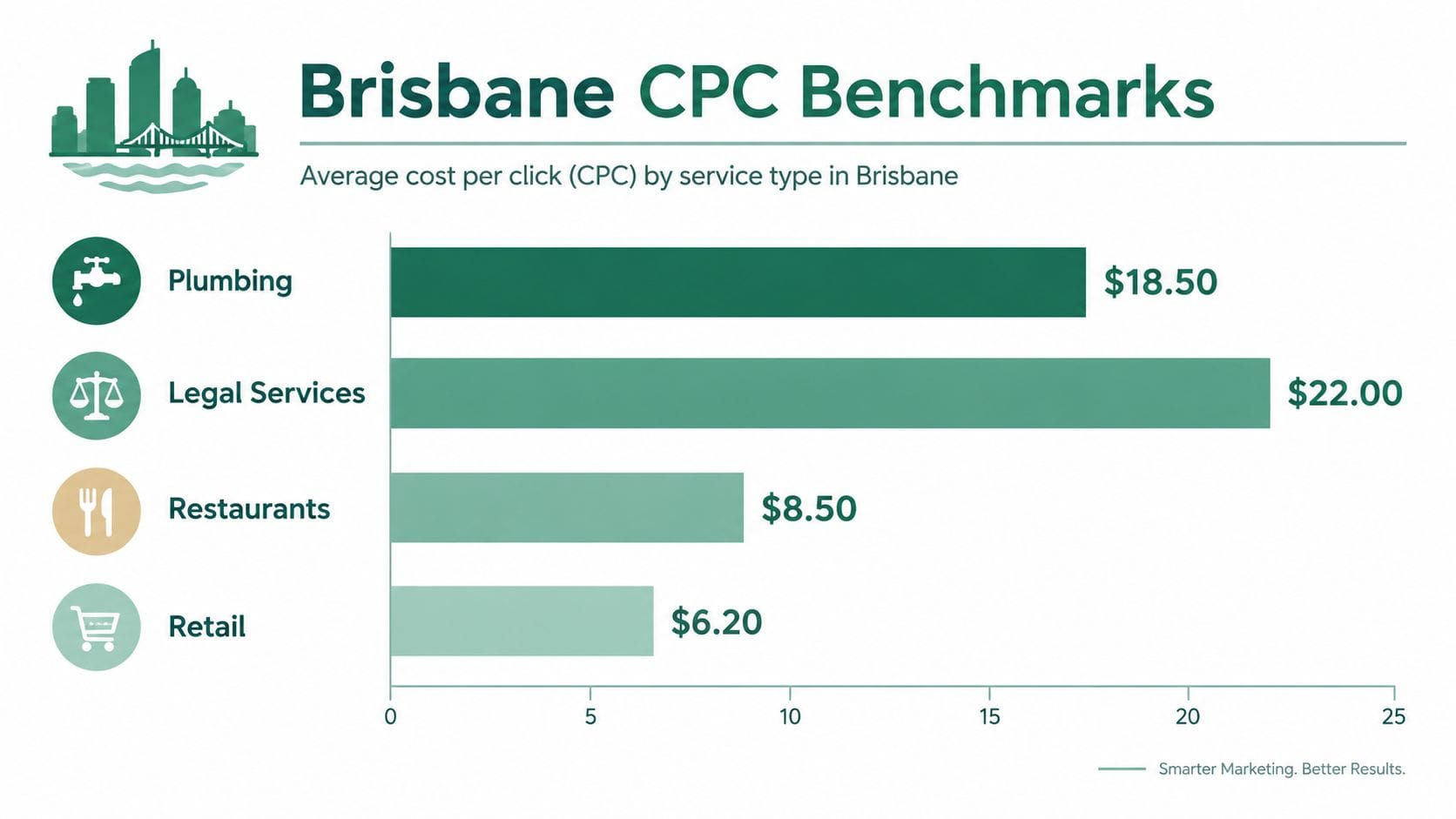
There is no official Australia-wide Google Ads CPC published by Google, so precise averages should be treated as directional. Independent Australian benchmark data shows why a Brisbane campaign needs local and industry-specific planning.
One 2026 Australian benchmark set reported a median service-keyword CPC of $16.19, with Brisbane at $20.24. The same dataset reported $3.96 for medical keywords and $14.37 for property keywords, illustrating how sharply costs can change between categories. The Australian Google Ads benchmark data from Uprise Digital also lists different city medians, including $19.40 for Sydney, $19.44 for Melbourne and $22.03 for Newcastle.
A separate Australian benchmark reported a broader $3.81 median across more than 8,400 Australian service keywords, while listing Brisbane at a $18.75 median CPC and a 26% year-on-year increase. Those results aren't contradictory. They measure different keyword groups and datasets, which is precisely why a single national average can mislead a small business.
Intent matters more than the headline average
A person searching “what is solar panel maintenance” may not be ready to contact a provider. Someone searching “solar electrician Brisbane quote” has a clearer commercial purpose. Advertisers often compete more intensely for the second type of query because a successful lead can be worth considerably more.
This explanation of CPC is useful for understanding the auction, but campaign planning needs a finer breakdown. A service business should separate urgent calls, quote searches, suburb searches, brand terms and research queries rather than placing every keyword into one blended estimate.
Quality Score also affects the practical outcome. Relevant ad copy, a focused landing page and a strong match between the search and the offer can help an advertiser compete more efficiently than a business relying only on a higher bid. That doesn't make expensive categories cheap, but it can prevent relevance problems from adding avoidable pressure.
Budget by keyword cluster
A Brisbane business can build a more useful forecast by grouping terms according to service and intent:
- Core service terms: Searches that directly describe the service offered.
- Location terms: Searches that include Brisbane, a suburb or a local area.
- Problem terms: Searches describing an issue that the service can solve.
- Low-intent terms: Informational searches that may need exclusion or separate treatment.
This approach gives the owner a clearer answer than “the average CPC is X”. It shows which services require the most funding and which searches should be tested cautiously.
The Real Monthly Budget Layers Small Businesses Should Expect
A realistic Google Ads budget has several layers. The first is media spend, commonly reported by Australian sources at around $1,000 to $3,000 or more per month for small businesses. The second is management or setup work, with current Australia-focused guidance placing management fees around $500 to $2,000 or more per month, depending on the account and service scope. Firewire Digital's Australian Google Ads cost guide discusses these costs alongside GST, which is important when calculating the actual cash requirement.
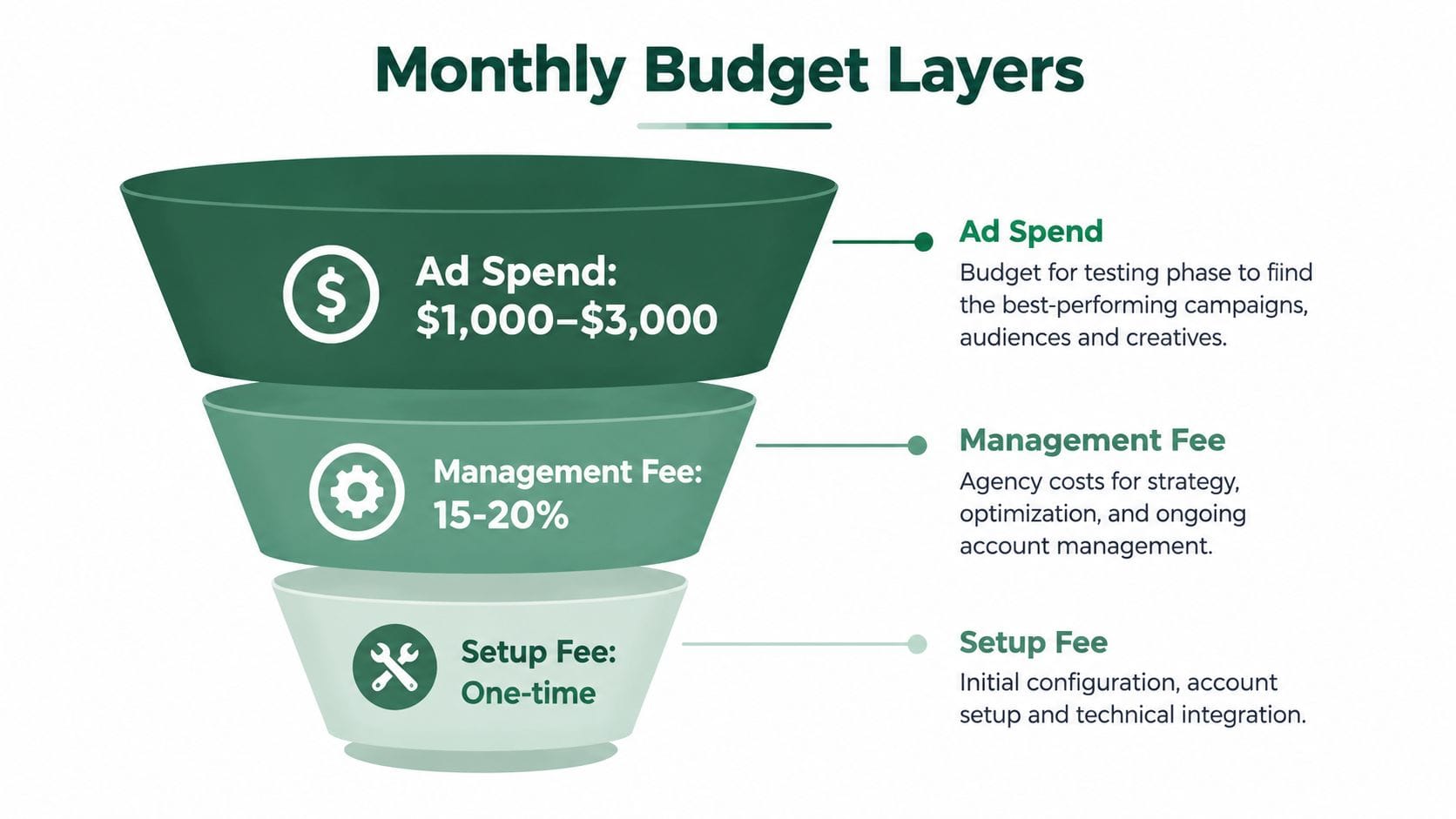
Layer one is the media budget
The media budget buys opportunities to appear in search results. It doesn't guarantee leads, sales or phone calls. A campaign with a modest budget can still work when it focuses on a defined service area and high-intent searches, but spreading the same budget across every service, suburb and audience can make the data too thin to guide decisions.
A business owner should decide what the budget is meant to test. A campaign might prioritise emergency calls, quote requests, appointment bookings or online purchases. Each objective needs different conversion actions and different expectations.
Layer two covers management
Management pays for the work that continues after launch. That can include search-term reviews, negative keyword updates, ad testing, bid adjustments, location checks, budget pacing and reporting. A campaign that receives no attention can keep paying for irrelevant searches or poorly matched landing pages.
Layer three is setup and measurement
Setup may include account structure, keyword research, ad writing, landing page recommendations, call tracking, form tracking and analytics checks. These tasks are easy to omit from a cheap quote, yet they determine whether the campaign can produce trustworthy information.
GST then applies to the relevant Australian charges. A clear budget should therefore show:
- Ad spend before GST
- Management or consulting fee
- One-off setup work
- GST treatment
- Total expected cash outlay
The lower-cost option isn't always the smaller business cost. If setup is skipped, the campaign may collect clicks without showing which searches produce genuine enquiries. That creates a false saving and can lead to poor decisions later.
DIY Google Ads versus Hiring a Brisbane Digital Marketing Partner
DIY Google Ads can be sensible for an owner who has time to learn the platform, review search terms and check conversion data regularly. It can also suit a tightly defined campaign with one service, one location and a straightforward enquiry path. The apparent advantage is a lower cash outlay.
The trade-off is attention. Campaign management involves more than writing an advert and adding a credit card. Owners need to check whether calls are recorded, whether forms arrive, whether search terms match the service and whether the landing page answers the customer's concern. Time spent learning those tasks is part of the campaign cost, even when no invoice is issued.
Hiring a Brisbane Digital Marketing partner adds a management fee but can reduce the operational load. A capable partner should bring structured testing, local market understanding and a clear measurement process. That doesn't guarantee a particular return. It should, however, make the decisions easier to explain and the account easier to improve.
| Consideration | DIY management | Brisbane partner |
|---|---|---|
| Cash cost | Usually lower at the start | Includes a management fee |
| Owner time | Higher and ongoing | Lower after onboarding |
| Tracking | Depends on internal capability | Included when clearly scoped |
| Local insight | Built through the owner's own testing | May come from managing similar local campaigns |
| Reporting | Often limited to platform screens | Can connect spend with enquiries and sales |
A practical decision test
DIY is more suitable when the owner can protect regular time for account checks and is comfortable making changes based on evidence. Outsourcing becomes more practical when missed calls, delayed follow-up or incorrect tracking would cost more than the management fee.
A local agency should also fit the business's working style. Some owners need a hands-off service. Others want to approve ad copy and review search terms. Boocoo, a Brisbane-based digital agency, offers Google Ads setup, management, tracking and reporting as part of its broader small-business marketing support.
The right choice isn't the option with the lowest invoice. It's the option that gives the campaign enough attention, measurement and commercial focus to make the budget useful.
Questions to Ask Before Hiring a Google Ads Agency in Brisbane
The first agency conversation should feel like a working session, not a promise of effortless growth. A small business owner needs to understand what gets done, who owns the account and how performance will be judged.
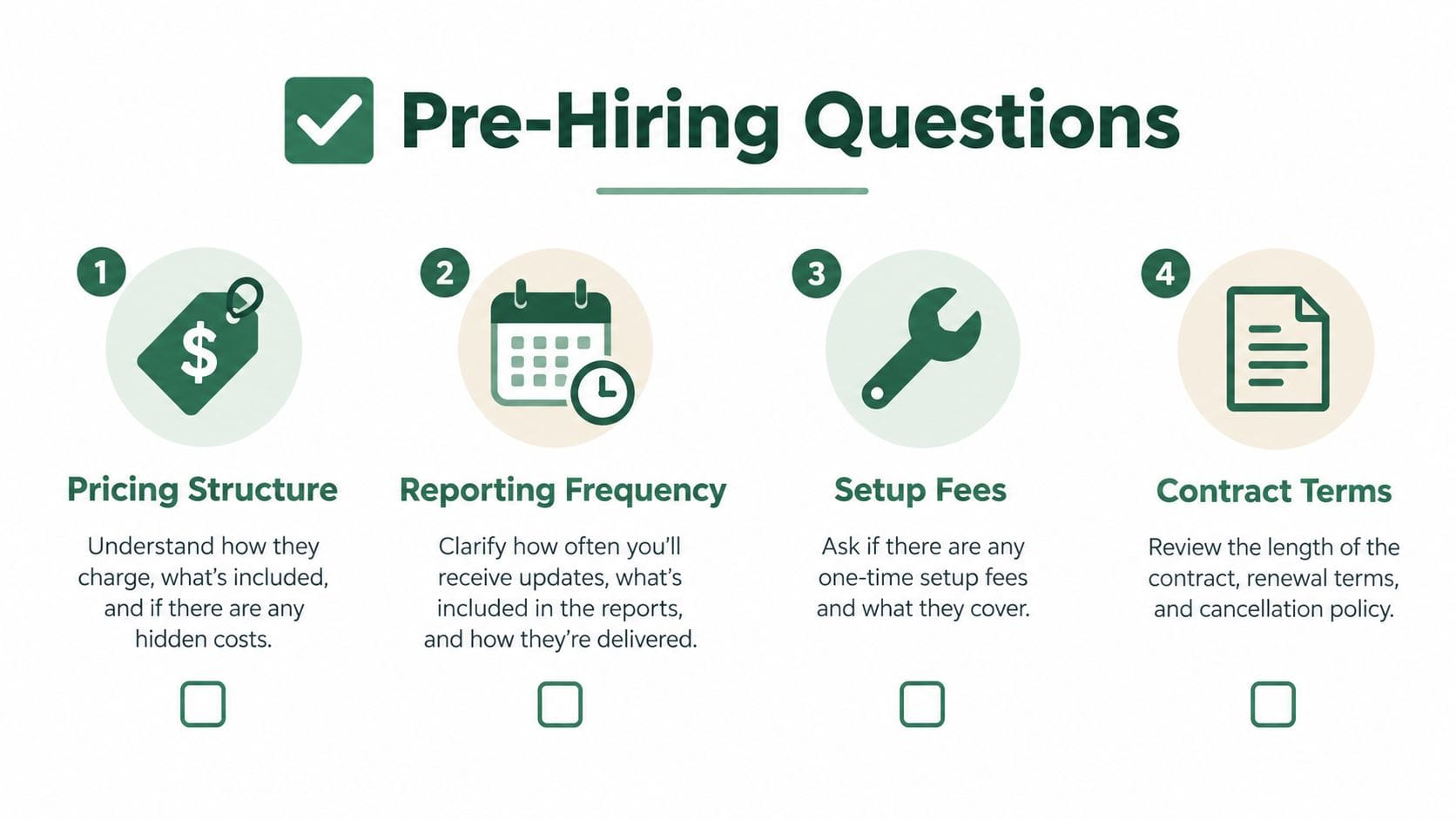
Pricing structure
Ask whether the fee is fixed, based on ad spend or combined with a separate setup charge. The proposal should show the amount paid to Google separately from the amount paid to the agency. It should also explain GST rather than leaving the owner to interpret a total later.
A useful question is: “What will the business pay in a normal month, including media, management and GST?” The answer should be clear enough to compare with another proposal.
Tracking and reporting
Ask which actions count as conversions. A phone call, completed form, booked consultation and online purchase shouldn't automatically be treated as equal outcomes. The agency should explain how tracking will be tested and how the report will distinguish a click from a qualified enquiry.
The reporting format matters too. A list of impressions and clicks may look busy without helping the owner decide what to do next. A better report connects spend, search terms, enquiries and agreed business goals.
Optimisation and ownership
Ask how often the account is reviewed and what changes are included in the fee. The answer should cover search terms, negative keywords, ad variations, location settings and budget pacing where relevant.
The business should retain ownership of its Google Ads account, website analytics and conversion data. If an engagement ends, the owner shouldn't have to rebuild the account from scratch.
Contract terms
Before signing, ask about notice periods, minimum commitments, creative approvals and what happens to campaigns at the end of the relationship. Vague answers can create friction later.
A strong hiring question: “What would make this campaign a poor fit for the business, and how would the agency identify that early?”
An honest partner won't promise a guaranteed number of leads without understanding the service, sales process, location and competition. Clear assumptions are more valuable than confident predictions.
How to Plan a Realistic Google Ads Budget That Actually Works
A workable budget starts with the enquiry, not the platform. Brisbane business owners should define the action that matters, estimate what a qualified customer is worth and identify the service or product with the strongest commercial priority. Only then should the account be divided into campaigns and keyword groups.
A simple planning sequence looks like this:
- Choose one commercial objective. A campaign designed to generate phone calls needs different tracking from one designed to sell products online.
- Define the service area. Start with locations the business can serve profitably, rather than paying for attention from areas that cannot become customers.
- Separate intent. Keep urgent service searches apart from research terms and brand searches so the budget doesn't hide weak traffic.
- Fund measurement first. Forms, calls and bookings need to be recorded before performance can be judged.
- Review the search terms. Remove irrelevant queries and identify useful phrases that deserve their own ads or landing pages.
- Set a review point. Decide in advance which evidence will support maintaining, reducing or expanding spend.
Australian benchmark data also shows why business models need separate treatment. Carter Media's benchmark overview reports approximate CPC ranges of $0.75 to $2.10 for ecommerce and $4.20 to $14.20 for lead generation, with reported cost-per-lead examples ranging from about $48 in home services to $310 in B2B. Those figures are directional, not promises, but they demonstrate why a shop selling products shouldn't use a trades business's budget model.
For a broader perspective on profitability, the Google Ads ROI breakdown for 2026 can help business owners think beyond CPC and towards revenue quality. The practical measurement question is whether the campaign produces customers at an acceptable cost, not whether it generates an impressive volume of traffic.
Conversion tracking deserves particular attention. The guide to conversion rate helps clarify why a landing page that turns more relevant visitors into enquiries can change the economics of the same media budget.
Brisbane small businesses should request a written all-in forecast, confirm GST treatment, protect the account from irrelevant searches and review results against real enquiries. Owners ready to assess their options can contact Boocoo on 1300 093 797 or email hello@boocoo.au to discuss campaign goals, setup requirements and a budget that fits the business.