
Google Ads is Google's paid search and display advertising platform, where Brisbane businesses bid to appear when customers search for their products or services. Australian online advertising reached A$18.4 billion in 2025, including A$8.0 billion in search advertising, so Google Ads sits inside a substantial commercial channel rather than operating as a small side tactic.
A Brisbane owner might be reading this between quoting a bathroom renovation, returning calls and chasing an overdue invoice. Marketing keeps getting pushed to the end of the day, yet potential customers are still searching for “emergency plumber near me”, “Brisbane accountant” or “air conditioning repair north Brisbane”. Google Ads places a business in front of those searches, with the advertiser generally paying when someone clicks.
The important question isn't just what the platform does. It's whether paid search should capture demand immediately, test whether a new service attracts enquiries, or provide a short-term bridge while organic visibility develops. This guide explains the answer in plain language, with the costs, campaign choices and practical safeguards that matter to small businesses considering Brisbane Digital Marketing.
Why Brisbane Small Businesses Keep Asking What Google Ads Actually Is
A local electrician may have a strong website, good reviews and years of experience, but none of that guarantees visibility when a customer searches for an electrician in Brisbane. Search results can include map listings, organic pages and paid placements. Google Ads is the paid layer, allowing a business to compete for attention at the moment a customer expresses a need.
That timing separates search advertising from many broader marketing formats. A social media advertisement may introduce a service while someone is browsing; a Google Search ad can respond when that person is actively looking. The click still needs to become a phone call, form submission or purchase, but the starting signal is often much stronger.
Google dominates Australian search, with StatCounter-based reporting showing around 88% of Australian searches occurring on Google in June 2026 according to Australian Google Ads market statistics. Search advertising represented roughly 44% of Australian internet advertising spend in 2025, with expenditure reported at A$8.0 billion in Australian digital advertising coverage. For a small operator, that scale matters because competitors are already using the channel to reach high-intent customers.
Three useful roles for paid search
Google Ads can serve different purposes depending on the business's current position:
- Demand-capture engine: A Brisbane pest controller with available technicians can target searches from customers ready to request a quote or book an urgent visit.
- Lead-validation tool: A business launching a new consulting package can test whether relevant searches produce viable enquiries before investing heavily in website content or a wider campaign.
- SEO bridge: A newer company can use paid placements while its organic pages build authority, then reduce or refine paid activity as reliable organic visibility develops.
The platform shouldn't be judged by clicks alone. A hundred visits from loosely related searches may be less useful than a smaller flow of people who need the exact service, live in the service area and can become profitable customers.
Practical rule: Google Ads works best when the business knows which enquiry it wants, which areas it serves and what a worthwhile customer is worth.
Owners wanting a broader explanation of paid search terminology can also review this guide to what PPC means. For practical campaign ideas and setup considerations, SourceLoop's Google Ads tips offers another useful reference point.
How the Google Ads Auction and Bidding System Works
Google Ads doesn't sell a permanent position on a results page. It runs an auction whenever a search creates an opportunity for an ad to appear. Google explains that different ad locations are auctioned separately, and an ad may appear more than once across locations on the same results page in its explanation of the Ads auction.
A Brisbane trades auction makes the idea easier to understand. Suppose several roofers want the same job. The roofer offering the highest price isn't automatically the winner if the quote is unclear, the service doesn't match the job or the business has a poor reputation. Google Ads applies a similar principle. Money matters, but relevance and expected user experience matter too.
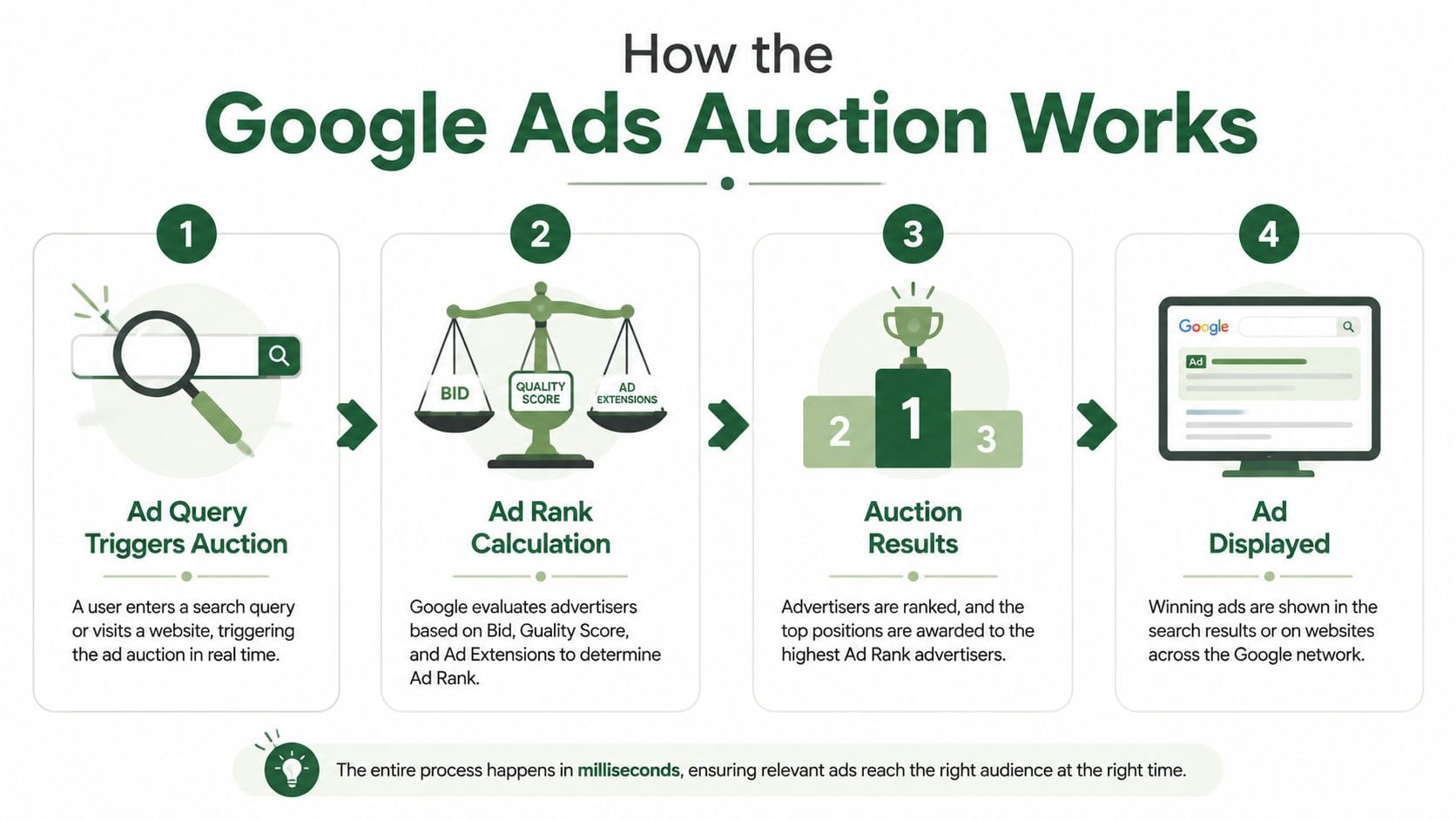
The auction in four stages
- A customer searches. The query might be “blocked drain Brisbane” or “commercial solicitor Fortitude Valley”.
- Google checks eligibility. It considers the keywords, location settings, ad content, budget and other campaign signals.
- Google evaluates the opportunity. Bid, relevance, expected interaction and landing-page experience contribute to the ad's position and eligibility.
- The ad is displayed. The customer sees the winning eligible placements, and the advertiser is charged according to the auction outcome.
Keywords are the connection between a customer's wording and an advertiser's offer. A campaign for “air conditioner installation” shouldn't send every related search to a general home page if a dedicated installation page can answer the query more clearly. Tighter alignment helps the customer understand the offer and gives Google stronger evidence that the ad is useful.
The owner also needs to separate cost per click, or CPC, from cost per acquisition, or CPA. CPC describes what a click costs. CPA describes what the business pays, on average, for a tracked outcome such as a form fill or call. A cheap click can still be expensive if visitors don't enquire, while a costly click can be commercially sensible when it produces valuable jobs.
What small businesses should control
A business shouldn't raise bids just because a competitor appears above it. Better ad wording, a relevant landing page, accurate location targeting and a clear call to action can improve the value of each visit. A plain-English explanation of CPC in marketing can help owners distinguish traffic costs from the cost of generating actual demand.
The highest bid doesn't guarantee the best result. A relevant offer gives a smaller business a chance to compete on usefulness, not just spending power.
Campaign Types and Targeting Options Explained
Campaign type determines where Google looks for potential customers and how the business communicates with them. For most local service businesses, Search is the clearest starting point because it answers an expressed need. Display and broader automated campaigns can support awareness or remarketing, but they shouldn't automatically receive the same budget.
The main campaign choices
Search campaigns show text ads in response to relevant searches. They suit phone calls, quote requests and appointment enquiries. A Brisbane locksmith, conveyancer or dentist can focus on the services and suburbs that matter commercially.
Display campaigns place visual ads across websites and other properties. They can help a business stay visible to previous visitors or reach people earlier in the decision process. Broader benchmark sets report Display conversion rates around 0.59% to 0.77%, while typical Search conversion rates sit near 4.1% across industries, according to Australian Google Ads benchmark data. That difference supports using Display mainly as a reach or remarketing layer rather than assuming it will capture immediate leads.
Performance Max uses multiple Google channels from one campaign framework. It can suit businesses with strong conversion data, suitable creative assets and a clear commercial goal, but it offers less direct control over individual placements than a tightly managed Search campaign.
Local-focused activity can support visits, calls or local discovery where the business has a physical location. The right setup depends on whether customers travel to the premises, expect a technician to visit them or prefer a remote service.
| Campaign Type | Best For | Typical CTR | Typical Conversion Rate |
|---|---|---|---|
| Search | High-intent enquiries | 3.3% to 5% | Near 4.1% across industries |
| Display | Awareness and remarketing | Not specified in the verified data | 0.59% to 0.77% |
| Performance Max | Broader automated reach with conversion goals | Not specified in the verified data | Depends on campaign and tracking |
| Local-focused campaigns | Store visits, local calls and area-based discovery | Not specified in the verified data | Depends on offer and tracking |
Targeting that protects a small budget
Location settings should reflect your service area. A mobile tradie serving inner Brisbane may need suburb-level control, while an online retailer can target more broadly. Keyword groups should reflect intent, not just include every phrase connected to the industry.
Device targeting also matters. A customer searching for emergency plumbing on a phone may be ready to call, while someone researching a complex professional service on a desktop may need more information first. Audience signals can add context, but the search term and location should remain central when the campaign's job is to capture demand.
A business comparing channels can use these paid advertising examples to assess whether a campaign should prioritise immediate enquiries, awareness or remarketing.
Real Costs and KPIs for Australian Small Businesses
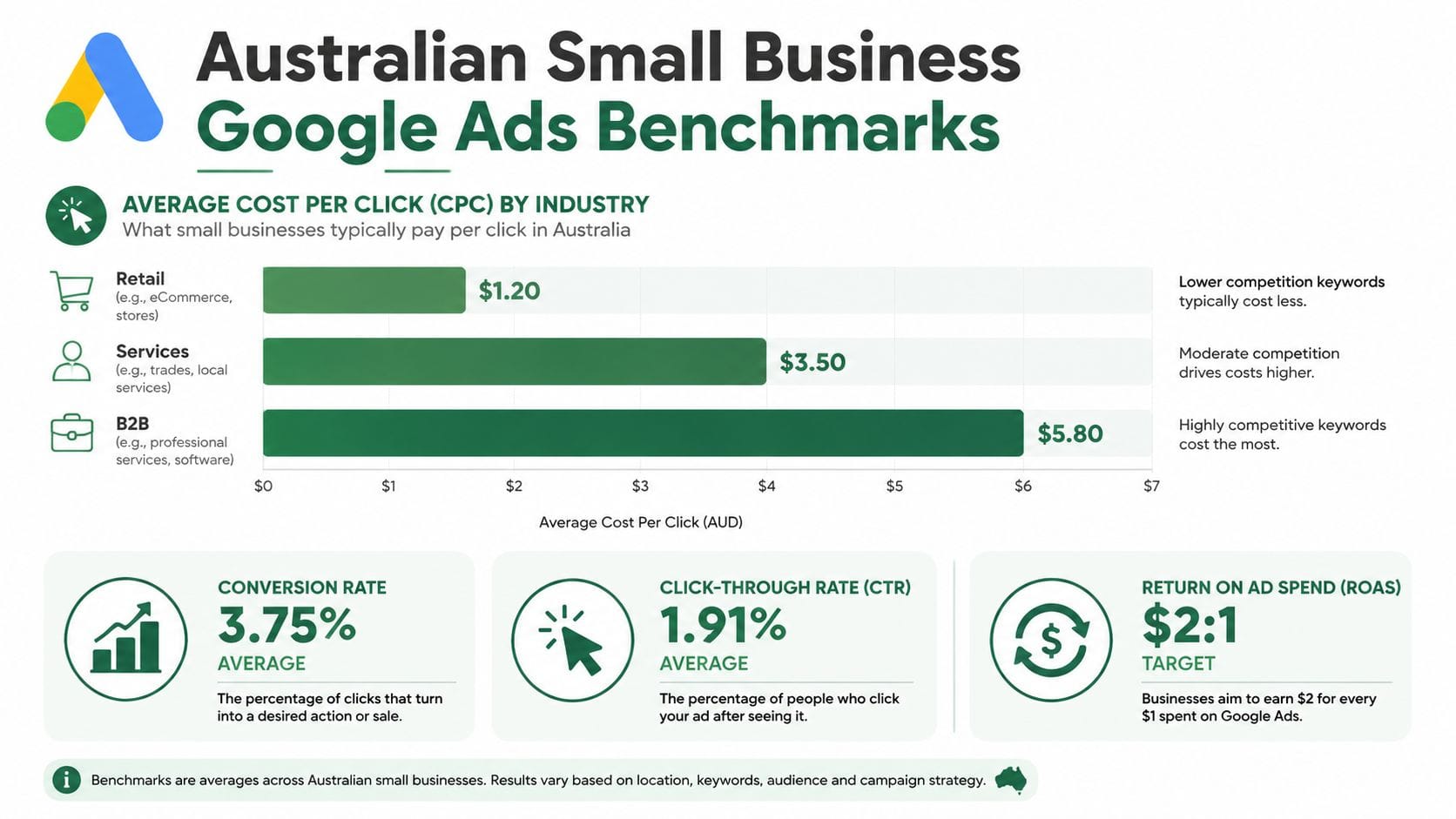
Google Ads costs vary sharply by category because the auction reflects commercial value and competition. One Australian benchmark set reports search CPCs of approximately A$0.75 to A$2.10 for e-commerce, A$5.40 to A$13.00 for professional services, and A$6.80 to A$14.20 for trades and home services in Australian Google Ads benchmarks.
That spread changes the business decision. An online shop may be able to test a larger volume of lower-cost clicks, while a Brisbane plumber may pay more for a search that signals an urgent and valuable job. A professional services firm needs to consider the time required to qualify an enquiry, the value of the eventual engagement and how many enquiries become paying clients.
Set the economics from the outcome backwards
A trades benchmark reports conversion rates of 8.5% to 14% for trades and 4.5% to 9.0% for professional services, from the same Australian source. These figures are benchmarks, not promises. They show why a business should start with a target CPA, then assess acceptable CPC and conversion performance, rather than chase traffic volume first.
For example, a Brisbane plumber should ask how many qualified calls become booked jobs and what profit remains after labour, materials and travel. A Brisbane accountant may need fewer leads, but each lead could require a longer consultation before becoming a client. Their campaigns shouldn't use the same financial assumptions because both businesses want form fills.
Useful KPIs include:
- Cost per qualified lead: Measures the cost of enquiries that fit the service area and customer profile.
- Conversion rate: Shows how often relevant clicks produce the tracked action.
- Cost per acquisition: Connects advertising spend with the completed customer outcome.
- Return on ad spend: Compares attributed revenue with ad spend, where revenue tracking is reliable.
- Search term quality: Reveals whether the campaign attracts genuine buying intent or irrelevant research.
Impressions and clicks help diagnose delivery, but they don't pay invoices. A campaign with strong click-through rate can still fail if the landing page is vague, the phone isn't answered or the conversion action isn't recorded.
A small budget needs a commercial scoreboard. Enquiries, qualified opportunities and profitable customers matter more than visibility on its own.
Owners who need a clear explanation of ROI in marketing can use that distinction to assess whether Google Ads is supporting business growth or merely generating activity.
A Practical Starter Checklist for Your First Brisbane Campaign
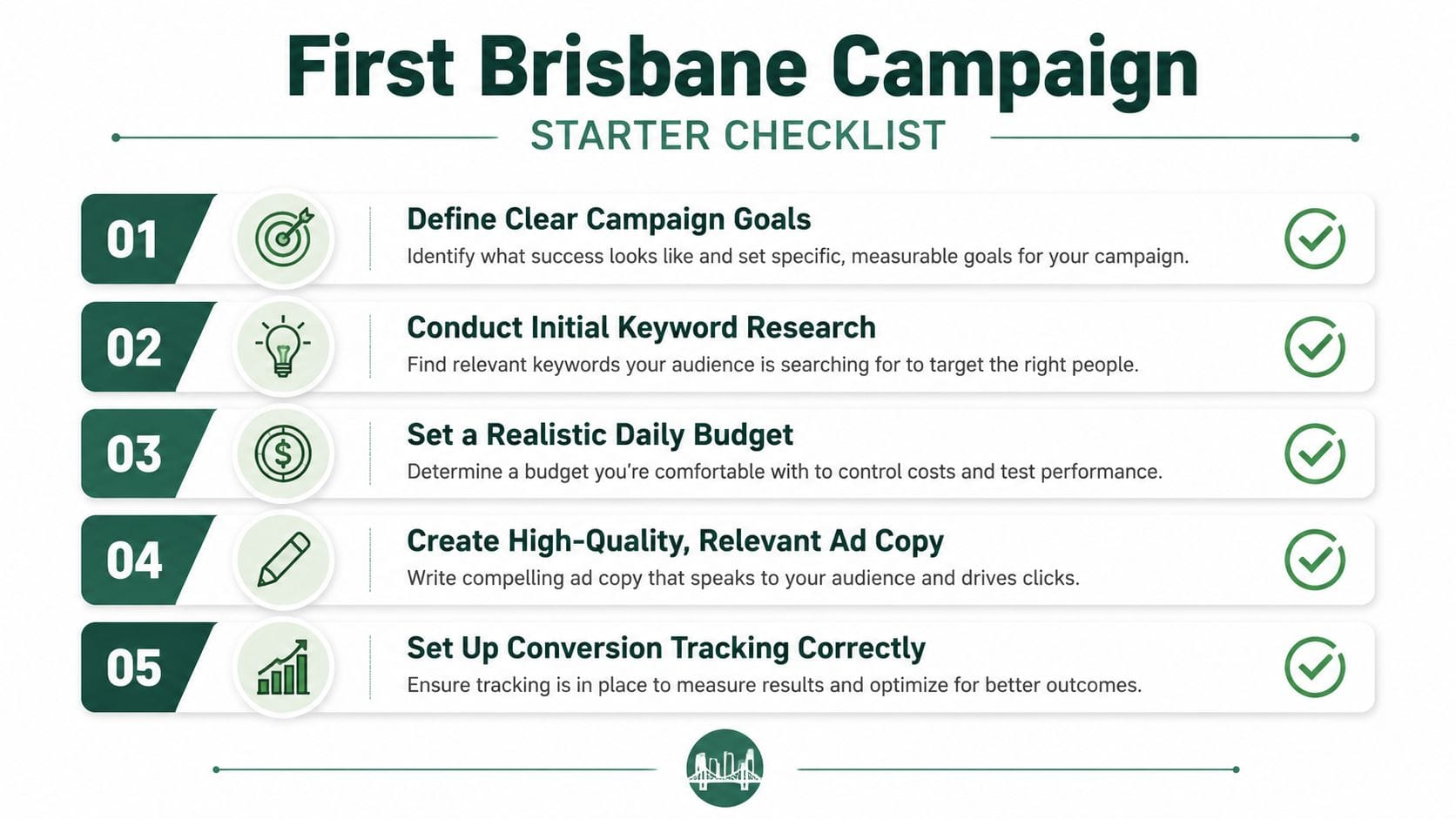
A first campaign should be narrow enough to understand. A sole trader doesn't need to activate every Google Ads feature on day one. The safer approach is to define one commercial outcome, target a realistic service area and check every setting that can send a click outside the intended audience.
Complete these checks before launch
- Define the outcome. Choose calls, quote forms, bookings, purchases or store visits. “More traffic” isn't specific enough to guide bidding or judge success.
- Map search intent. Separate urgent searches, service-specific searches and research queries. “Emergency electrician Brisbane” belongs in a different intent group from “how to fix a power point”.
- Build focused ad groups. Match the wording in the ad to the service and page receiving the click. This reduces confusion and gives the customer a direct next step.
- Set the location carefully. Confirm the campaign targets people in the actual Brisbane service area, not every person showing interest in the region.
- Write a useful landing page. Put the service, service area, proof and contact option where a visitor can find them quickly. This guide to landing pages explains the role that page plays after the click.
Tracking comes before optimisation
Google Ads only collects conversion data on websites and apps where tracking has been configured. Google's documentation explains conversion tracking and the use of conversion value rules for Search campaigns in its conversion tracking guidance. Without that setup, a business may see clicks but won't know which ones generated calls, forms or purchases.
Tracking should be tested before budget is increased. Form submissions need to register once, phone actions need a sensible definition and purchases need reliable value information. A campaign that reports every page view as a lead will teach the system to seek page views, not genuine enquiries.
Landing-page speed, query relevance and tracking accuracy usually deserve attention before impression volume. Negative keywords can also prevent obvious mismatches, such as job seekers, free advice searches or products the business doesn't sell. These small controls protect time as well as money.
When Google Ads Beats Other Digital Channels for Lead Quality
Google Ads is strongest when a customer already knows the problem and is looking for a provider. A Brisbane drain specialist, employment lawyer or commercial cleaner can benefit from appearing when the search itself signals urgency or intent. Social media and Display may reach more people earlier, but broader reach doesn't automatically produce better enquiries.
Australian search advertising reached A$8.0 billion in 2025 and represented roughly 44% of total internet advertising spend, according to Australian digital advertising reporting. Those figures show the channel's importance, but they don't mean every business should put every dollar into Search. The decision depends on whether customers actively search for the offer and whether the business can handle the resulting demand.
Three situations where paid search earns its place
Use Google Ads as a demand-capture engine when the service has existing search demand, the service area is clear and the team can answer enquiries promptly. An available Brisbane trades team may value a call today more than a long awareness campaign.
Use it as a lead-validation tool when a business needs evidence before committing to a larger launch. A small campaign can test the wording customers use, which service attracts interest and whether enquiries meet the owner's quality threshold.
Use it as an SEO bridge when organic content and technical improvements need time to gain visibility. Paid search can expose a new offer while the business builds useful pages, internal links and local relevance. The two channels should be measured separately so paid results don't disguise organic progress.
Search isn't the right answer for every product. A highly visual new product may need awareness before customers know what to search for. A business with weak fulfilment, slow responses or an unclear offer may waste paid clicks regardless of campaign settings.
Choose Search when the customer's query already contains the problem the business solves. Choose broader formats when the main job is creating interest before that query exists.
Managing Google Ads In-House Versus Hiring a Brisbane Agency
Managing a campaign in-house can work when an owner has time to review search terms, test ads, check enquiries and interpret conversion data. The platform is accessible, but the account still needs active attention. Default settings, unverified tracking and loosely matched keywords can lead spend towards low-value visits.
Hiring a Brisbane agency makes sense when the owner's time has a higher commercial value elsewhere or when campaign mistakes affect margins. The comparison shouldn't focus only on the management fee. It should include the cost of missed calls, poor lead qualification, delayed optimisation and the owner's hours spent learning an unfamiliar system.
A practical decision test
In-house management may suit a business that can:
- Protect review time: Someone can inspect performance and search terms consistently.
- Own the numbers: The team knows its acceptable lead cost, conversion definition and customer value.
- Act on enquiries: Calls and forms receive prompt, professional follow-up.
- Test methodically: Changes happen one at a time, with tracking preserved.
External support becomes more attractive when campaigns run unchanged, conversion tracking has never been verified, or the owner can't tell which services and suburbs generate worthwhile enquiries. A local partner should provide transparent reporting, explain decisions in plain language and separate paid results from SEO, social and website activity.
Boocoo offers Google Ads setup, management, tracking and reporting alongside other digital marketing services for Brisbane small businesses. It can be considered alongside independent specialists or an internal hire, provided the business compares scope, communication and reporting rather than choosing on promises of guaranteed results.
The right arrangement is the one that protects margin and keeps decisions visible. A small business owner should be able to answer what was spent, which actions were tracked, which enquiries were qualified and what changed as a result.