
Google Ads agency pricing in Australia usually breaks into two costs, a management fee of about A$500–A$2,000+ per month or 10%–20% of ad spend, plus the budget paid straight to Google. For a Brisbane small business, that means the question is rarely “what does Google Ads cost?” and more often “what am I paying an agency to do with my money?”
A lot of owners get stuck at the same moment. Three agencies send through three quotes, each one looks different, and none of them makes the split between setup, management, and media spend clear. That's where bad decisions start.
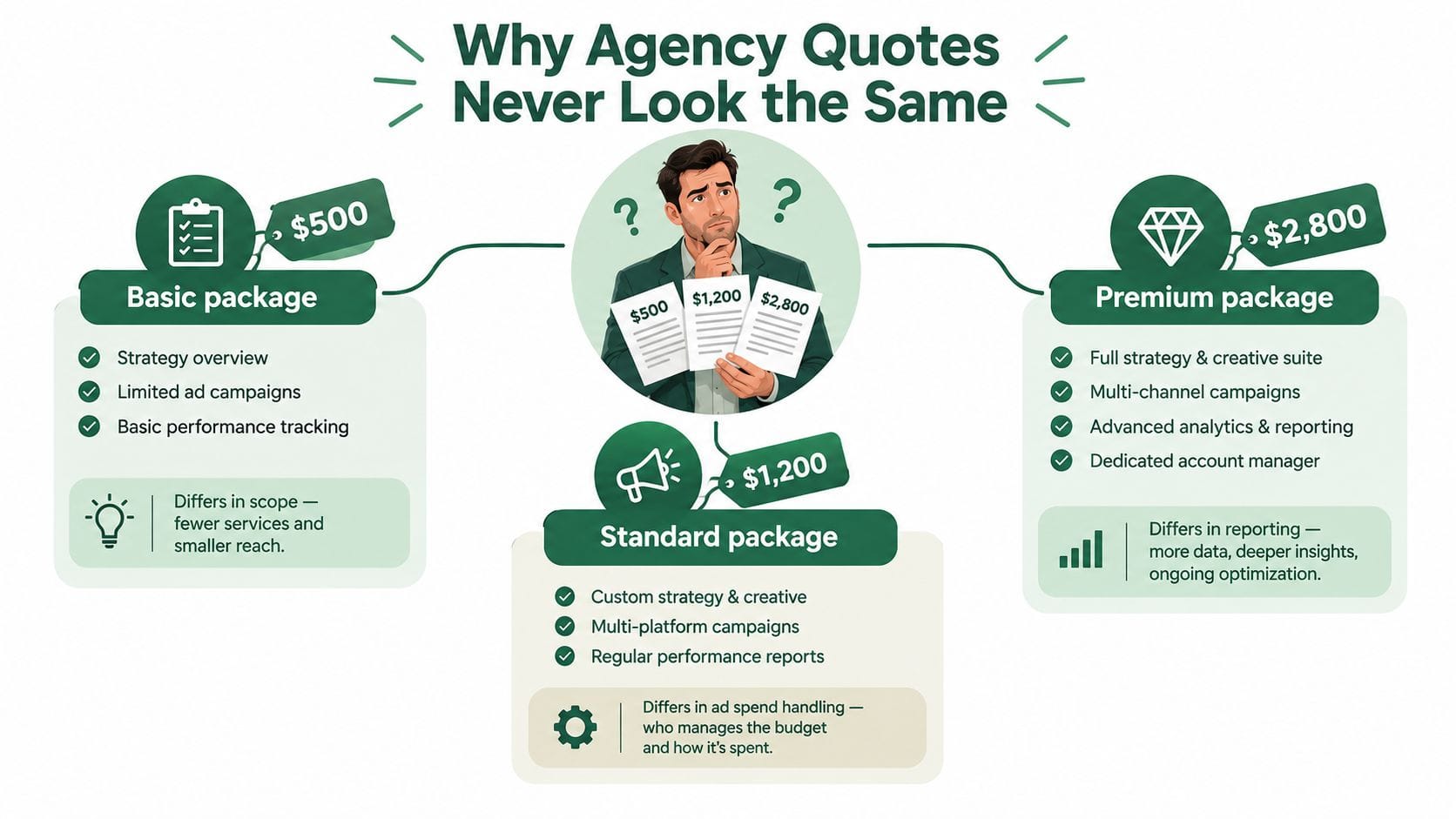
Why Agency Quotes Never Look the Same
A Brisbane tradie, clinic owner, or local service business can ask three agencies the same question and still get three wildly different answers. One quote looks cheap because it only covers monitoring. Another looks expensive because it bundles strategy, reporting, and account build. The third hides the actual cost by making the ad budget sound like the agency fee.
The clean way to think about Google Ads agency pricing is simple, a restaurant bill. The food is one cost, paying someone to cook and serve it is another. Google gets the media spend, the agency gets the management fee.
Practical rule: if a quote doesn't separate setup, management, and ad spend, it's not a proper quote.
That split matters because many small-business buyers compare numbers that are not even the same kind of number. A low agency fee can still be expensive if it excludes the work that drives leads. A higher fee can be fair if it includes structure, tracking, optimisation, and reporting.
A useful outside comparison point is the vetted Google Ads partners list from NotFair, which is handy when a business wants to sanity-check whether a provider looks properly structured. For a broader view of how paid media services are packaged, the internal guide on pay per click advertising companies is a practical companion.
The first three questions to ask any agency are plain ones. What is the fee for? What is separate? What changes the price later? Those questions cut through most of the smoke.
The Four Ways Agencies Charge for Google Ads
A Brisbane trade business spending A$5,000 on ads can get quoted four different ways, and the structure matters more than the headline number. One agency prices for stability, another prices for scale, and the owner needs to know which model matches the workload. If you want a broader look at how agencies package services, the small business digital marketing packages guide is a useful companion.
Flat Monthly Retainer
A flat retainer is a fixed fee every month. It suits owners who want predictable billing and a clear monthly decision.
This model works best when the account is steady and the campaign setup is not changing much. The trade-off is simple. If the account grows in complexity, the agency can end up doing more work for the same fee. If the account stays very small, the fee can feel heavy.
Percentage of Ad Spend
A percentage model links the fee to spend, so the management cost rises as the budget rises. That can suit growing accounts where the workload is expanding with the campaign.
A plumber spending A$5,000 a month on ads will often hear this model framed as fair because the agency is tied to account size. The problem is incentive. When the fee moves up with spend, owners should ask how the agency measures efficiency and whether higher spend is delivering better leads.
Hourly Billing
Hourly billing suits audits, short advisory work, and one-off troubleshooting. It is flexible and easy to start, which makes it handy when the owner needs help for a narrow job rather than ongoing management.
The risk is scope creep. If the work is not tightly defined in writing, the bill can drift fast. Hourly billing only makes sense when the agency spells out exactly what the hours cover.
One-Off Setup or Audit Work
This covers the first build, account review, or a troubleshooting pass before the account settles into a monthly rhythm. It is often added on top of a retainer, which is why month one can look very different from the ongoing fee.
The point is not whether setup is charged. The point is whether the fee is clearly tied to deliverables, such as tracking, structure, or account cleanup. If the agency cannot explain what gets done in setup, the price is not doing its job.
| Pricing model | Typical Australian range | Best suited to | Main risk |
|---|---|---|---|
| Flat monthly retainer | A$500–A$2,000+ per month | Small businesses that want stable billing | The scope can be too thin for complex accounts |
| Percentage of ad spend | Roughly 10%–20% of ad spend | Growing accounts with changing volume | Incentive to spend more, not necessarily better |
| Hourly billing | A$75–A$200 per hour | Audits, strategy sessions, short-term support | Costs can drift without a tight scope |
| One-off setup or audit work | Varies by project | New accounts or account clean-up | Month one can jump if onboarding is separate |
For a Brisbane owner, the easiest comparison is blunt. Ask how the same A$5,000 account would be handled under each model, then ask what is included in setup, management, and reporting. If the answer is vague, the provider is not quoting responsibly.
What Realistic Management Fees and Budgets Look Like
A Brisbane clinic running a tightly focused search account and a tradie chasing local calls should not expect the same bill. In our experience quoting small-business accounts, management usually lands in the low thousands once the account has any real work in it, and tougher campaigns climb from there. For current package examples, see Pricing.
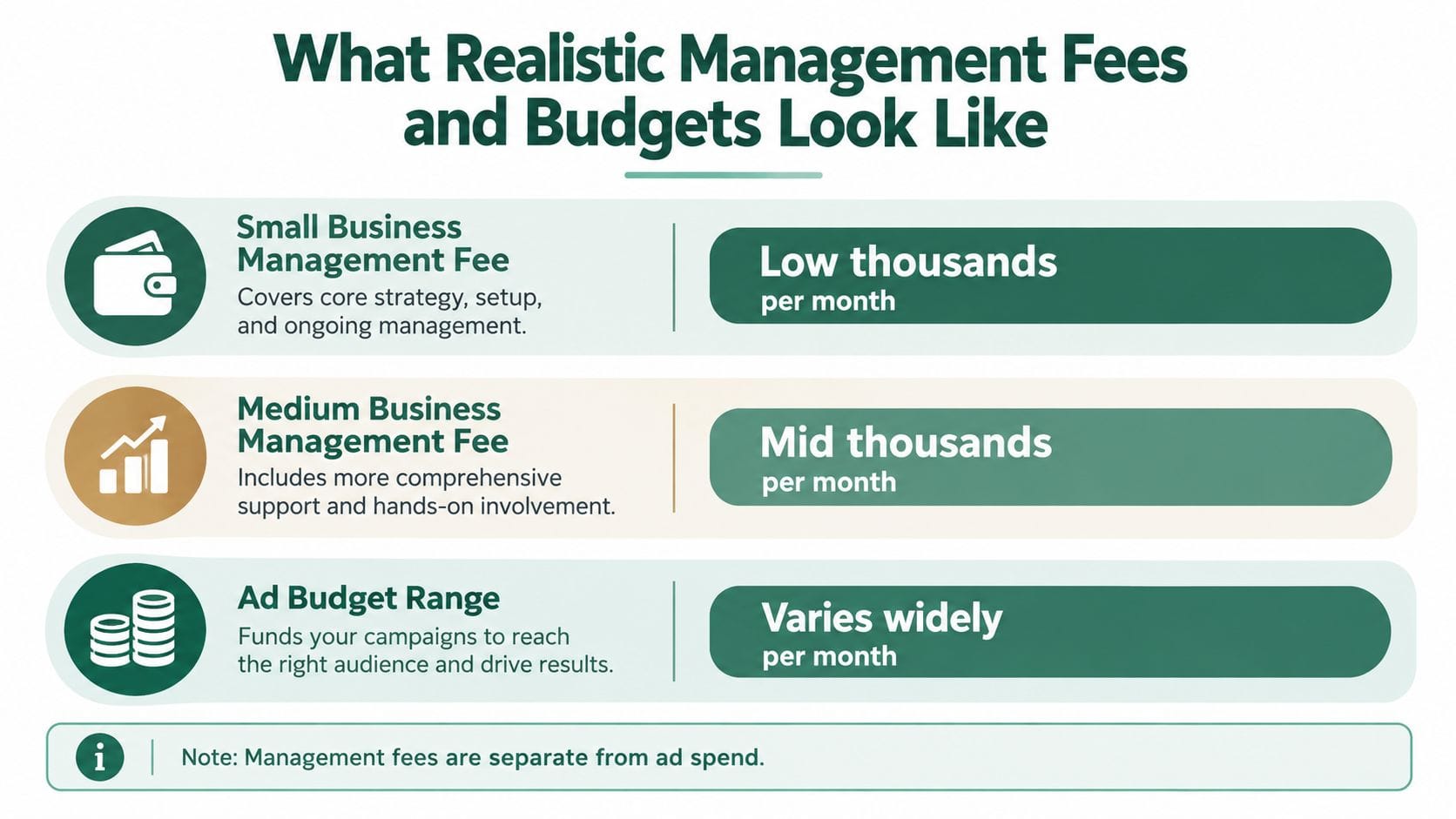
Keep the agency fee and the Google spend separate. A simple working example is A$3,000 in media plus a A$1,200 management fee, which puts the month at A$4,200 before any extra project work. That is the cleaner way to judge whether a quote fits the business, instead of staring at the fee in isolation.
A simple budget worksheet
- Management fee: what the agency charges to run the account.
- Media spend: what goes directly to Google.
- Setup cost: what the agency charges for initial build or cleanup work.
If a quote only shows the management fee and leaves out the media budget, the owner is not seeing the full cost.
Some accounts cost more because they are harder to run. Competitive categories, narrow service areas, and messy account structures all take more testing, more pruning, and more time. A small budget in a crowded Brisbane market can still need careful management if the goal is lead quality rather than cheap clicks.
A clinic targeting one suburb and a tradie covering a wider area will not buy the same result with the same spend. The clinic may need a tighter budget with more control over search terms and call tracking. The tradie may need broader coverage and more room for lead volume. In both cases, the right quote is the one that separates media, management, and any extra work clearly enough for a business owner to compare it without guesswork.
What Your Management Fee Should Actually Include
A fair management fee should buy more than a few dashboard checks. It should cover the work that stops waste, improves relevance, and turns clicks into enquiries. If the agency only “keeps an eye on it”, that's not management, that's supervision.
The basics worth paying for
- Campaign build and structure for a sensible account architecture.
- Keyword research that includes negative keywords, not just search terms.
- Ad copywriting and testing so the ads get sharper over time.
- Conversion tracking so the business knows which leads are real.
- Negative keyword management to cut irrelevant traffic.
- Plain-English reporting that shows leads and next actions.
- Actual human support when questions come up.
A good manager acts like a gardener who prunes, not just waters. Watering alone keeps things alive. Pruning removes waste, improves shape, and makes the whole plant stronger.
The red flags are easy to spot once the owner knows what to look for. Separate setup with no clear scope is a warning sign. No access to the client's own account is another. Reports built around impressions rather than leads are a third.
For a useful lead-quality lens, Recepta.ai's lead cost guide is a solid reference when the conversation turns from clicks to actual enquiry value. The same principle shows up in the internal guide on Google Ads CRM integration, because a lead only matters if the business can track what happens next.
A quick due-diligence checklist helps here. Ask whether the agency builds campaigns, writes ads, tracks conversions, and reviews search terms every month. Then ask who owns the account and what happens if the relationship ends. Clear answers are worth paying for.
Factors That Push Your Google Ads Costs Up or Down
Brisbane businesses are bidding on the same local keywords more often, and that tightens auctions. That is why two agencies can quote very different fees for what looks like the same Google Ads account. One may be covering a narrow setup and light reporting, while another is charging for hands-on optimisation, search term pruning, and regular changes to ads and landing pages.

The variables that move your price
- Industry competitiveness: crowded markets need tighter optimisation and more frequent checks.
- Geographic targeting: Brisbane-only targeting is simpler than covering multiple suburbs, regions, or states.
- Number of services or campaigns: more campaigns create more setup, more copy, and more maintenance.
- Campaign structure: a focused search account is easier to manage than a mixed build with several campaign types.
- How much work the owner wants offloaded: the more the agency handles, the higher the fee usually goes.
A small business should start with the narrowest sensible scope. One clear lead-generation campaign is usually better than five broad ones that split spend and confuse the message. A tradie, for example, needs one path to enquiries, not a messy account trying to chase every keyword under the sun.
Quality matters too. A useful internal reference on what is Quality Score shows why ad relevance, landing page fit, and search term control affect waste. A stronger account does not guarantee a cheap fee, but sloppy structure gets expensive fast.
Complexity should only be added after the first campaign proves it can bring in good leads. That is the point where extra campaigns, extra locations, or extra services may make sense.
Before signing, write down the scope you were quoted and check it against the checklist in the next section.
Choosing a Transparent Brisbane Provider
The best quote is the one that makes the scope obvious. Transparent providers don't hide the account ownership, blur the fee structure, or dodge questions about reporting. They spell out what happens each month and what can trigger a price change.
A large agency often brings process and scale, but it can also bring layers of account managers and less direct contact. A local Brisbane partner is more likely to keep the conversation grounded in real leads, real service areas, and budgets that match a small business reality. For many owners, that lower-pressure approach is the better fit.
Green flags
- Clear ownership: the client keeps access to the Google Ads account.
- Plain reporting: results are explained in leads, calls, and enquiries.
- Defined scope: setup, management, and reporting are listed separately.
- Direct answers: the agency explains what would trigger a fee change.
- Comparable quotes: the agency is willing to quote against the same scope as others.
Warning signs
- Account access withheld: the business can't see what's being done.
- Vanity reporting: the report leans on impressions and clicks without lead quality.
- Scope drift: the proposal stays vague about what is included.
- Pressure to sign fast: no time is given to compare like for like.
For small-business owners comparing local options, the internal guide on digital marketing agency for small businesses is useful because it frames the relationship in practical terms rather than sales fluff.
Three quotes are enough if they're built on the same scope. Without that, the comparison is useless. A cheap number with a vague scope is not a bargain, it's a future argument.
Your Next Steps and a Simple Budget Framework
The next move is straightforward. First, define the lead target and the rough ceiling for monthly spend. Second, ask short-listed agencies for a quote that separates setup, management, and media spend. Third, run the due-diligence checklist before signing anything.
A Brisbane service business could start with a three-month frame like this. Month one pays for setup and account build, month two tests the first structure, and month three judges whether the management fee is producing enough qualified enquiries to justify the spend. That kind of staged thinking protects cash and stops rushed decisions.
The goal is not the cheapest agency. The goal is the clearest one, the one whose fees make sense, whose reporting can be understood without a decoder, and whose structure leaves enough budget for the ad spend that brings in leads.