
Most Brisbane owners start the same way. A roofer, café owner, or local service business gets three agency quotes, two of them sound identical, one is suspiciously cheap, and all of them promise leads. The hard part isn't finding a pay per click advertising company, it's figuring out which one can protect a tight budget and prove the work is worth doing.
That's where Brisbane Digital Marketing gets messy for small firms. PPC looks simple on the surface, but the test is whether the agency can connect clicks to actual enquiries, sales, or booked jobs. If they can't do that, they're selling traffic, not growth.
Why Hiring the Right PPC Partner Feels So Hard
A Brisbane electrician doesn't need a glossy deck full of platform jargon. They need calls that turn into booked jobs, and they need to know whether every dollar spent is doing real work. That's why the first conversation with a pay per click advertising company should not be about features, it should be about outcomes.
PPC is a pay-for-performance model, which means advertisers only pay when someone clicks the ad, and the core pricing mechanic is cost-per-click, or CPC, calculated as advertising cost divided by number of clicks, so spend can be capped and tracked clearly, much like a taxi meter that only runs while the car is moving pay-per-click advertising model. That sounds straightforward, but agencies often hide behind platform talk because it's easier than explaining how clicks become revenue. A good partner should be able to describe the path from search term to lead form to sale without dodging the awkward parts.
The buying decision is usually not “Which platform is best?” It's “Can this business measure enough to know whether the channel is working?” That's why tools that help teams prove ROI with AI in agencies are only useful if the tracking is already sound. Without that, even a clever campaign just creates expensive noise.
For small operators comparing options, a practical starting point is a clear brief, not a long sales process. A local agency explainer from Boocoo's guide for small businesses is the sort of resource that helps owners think in terms of fit, not just price. The right question is simple: does the agency understand the business problem, or just the ad platform?
Practical rule: if the agency starts with impressions, reach, and click volume, the owner should ask how those numbers connect to booked work.
Setting Goals and Budget Before You Shortlist Anyone
A small business should not ask for proposals until it knows what success looks like in plain business terms. That means leads per week, target cost per acquisition, or a revenue goal tied to a real campaign window. If the brief only says “more traffic”, the agency will sell traffic because that's the only target it has.
The uncomfortable part is budget. Many established agencies expect $5,000 to $10,000 in monthly ad spend and often recommend at least $3,000 before engagement, which leaves a gap for micro-businesses and sole traders who need lighter support agency minimum spend guidance. That's not a moral failing, it's a fit issue. A plumber running a narrow suburb campaign has different needs from an e-commerce store with a larger media budget.
A simple decision filter
Use the budget and complexity together, not one or the other.
- Full-service agency: better when the business has enough spend to support testing, tracking, and regular optimisation.
- Lightweight local support: better when the budget is modest but the owner still wants a second set of eyes on keywords, ads, and tracking.
- In-house with audits: better when the business already knows the market and only needs periodic checks, not ongoing management.
A one-page brief should say who the ideal customer is, which suburbs matter, what counts as a lead, and what the budget ceiling is. That brief forces a real response instead of a templated sales pitch. It also makes it obvious when an agency is trying to oversell the account.
For businesses weighing paid social as an alternative or add-on, Boocoo's Facebook ads cost guide is useful because it frames spend in practical terms rather than hype. Budget conversations get easier when the owner compares channels by business fit, not by the loudest promise.
Understanding the Australian Search Market and Channel Fit
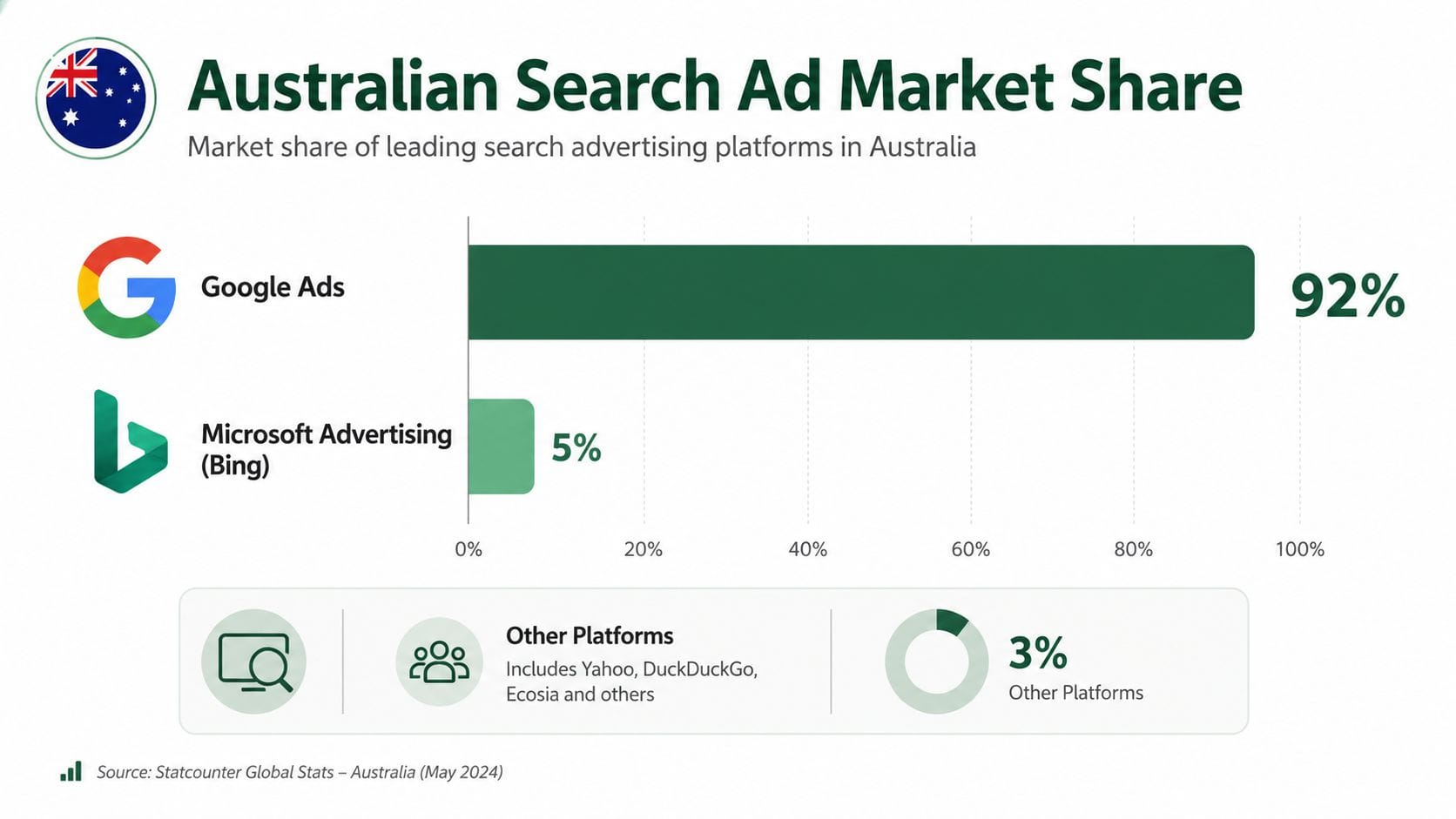
Australia's search market is concentrated enough that local strategy has to start with Google. During the ACCC inquiry period, Google held roughly 97% of Australian general search engine queries, while Microsoft Bing sat at about 2% ACCC search concentration context. That concentration explains why most Australian PPC companies build around Google Ads first, then add other placements only when the tracking is stable.
The same market context also explains why channel recommendations should be challenged. If an agency says a Brisbane service business needs YouTube, LinkedIn, or Meta before getting search right, the owner should ask what problem that channel is solving. For local services, the issue is often not more traffic, it's better measurement, cleaner lead quality, and fewer wasted clicks.
Channel fit is usually a measurement question
A service business can run Google Ads and still fail if the phone calls are not tracked, form fills aren't qualified, or CRM data never gets tied back to the ads. That's why channel advice should be tested against the lead system, not the platform dashboard. A useful perspective on this comes from channel attribution for ecommerce, because attribution problems don't magically disappear just because the business isn't selling online checkout carts.
Mobile behaviour matters too. Research roundups show 52% of PPC clicks come from mobile devices, and 90% of internet users see Google ads mobile PPC and ad exposure benchmark. For Brisbane owners, that means pages need to load quickly, calls need to be one tap away, and forms need to be short enough that a person can complete them on a phone without frustration.
If the landing page is awkward on mobile, the campaign is paying for impatience.
The other mistake is treating “Google Ads” as a complete answer. Google is usually the starting point, not the finish line. A strong agency should explain whether the primary blocker is channel choice, attribution, or the business's own follow-up process.
A useful internal benchmark for this thinking is Boocoo's Google Ads Brisbane guide, because channel choice only matters once the local search strategy matches the way people enquire.
The PPC Audit Checklist That Separates Experts from Generalists
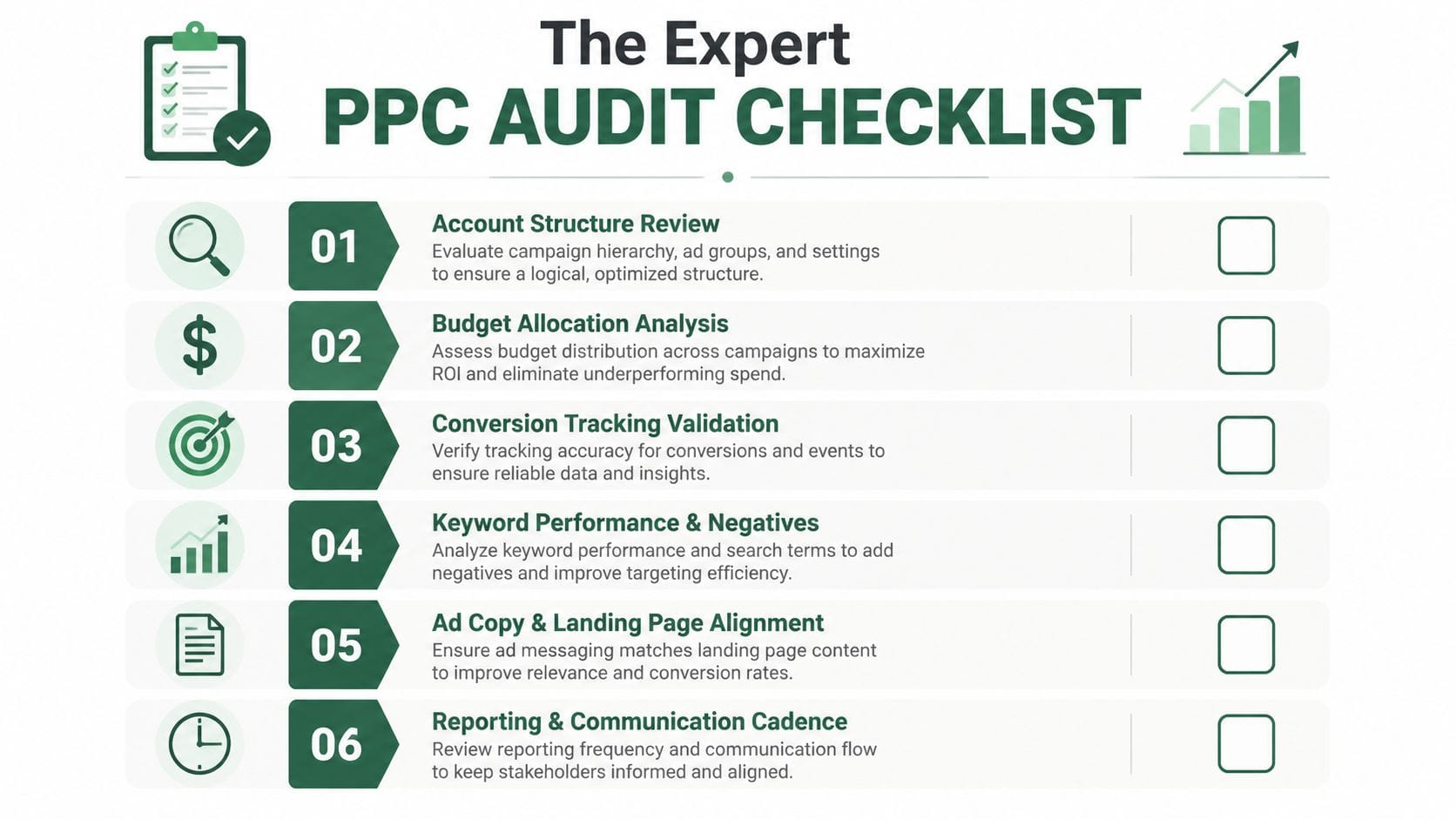
A real PPC audit starts with evidence, not opinions. Open the account and check whether conversion tracking is working, because without that, nobody can tell if the spend is producing revenue or just activity. Then move to search-term hygiene, bidding strategy fit, and the performance of individual ads and assets. If an agency skips straight to creative opinions, it is usually covering for a measurement problem.
The order matters
Smaller accounts need stricter judgment on bidding strategy. Target CPA campaigns usually need 30+ monthly conversions before anyone should expect steady signals, while Target ROAS campaigns need 100+ monthly conversions for reliable signals PPC audit conversion volume requirements. That does not mean smaller Brisbane accounts should avoid paid search. It means Smart Bidding needs enough data to stop guessing. Agencies that ignore this and keep spending often blame the market when the issue is noise in the data.
Asset review also needs enough exposure before anyone calls a headline a winner or a dud. Ad headlines and descriptions should only be treated as meaningful after they have had roughly 500+ impressions per asset Google Ads asset performance thresholds. Before that, the sample is too thin to separate weak copy from low delivery. For micro-businesses, that matters because a few hundred impressions can disappear quickly, especially in tight local service categories.
A proper audit also separates performance by audience, device, and geography, then checks keyword and query results on their own. Guidance on PPC analysis warns against mixing branded and non-branded traffic, because that hides waste and makes the account look cleaner than it is. In Brisbane, that split matters even more for businesses serving different suburbs or chasing a local service area, because one pocket of traffic can perform while another burns budget.
What a good audit call should cover
- Conversion tracking verification: are calls, forms, and qualified leads being captured?
- Search-term review: are irrelevant queries being filtered before they burn budget?
- Bidding fit: does the account have enough conversion volume for the bidding strategy chosen?
- Geography split: are suburbs or service areas being compared separately where needed?
- Creative alignment: do the ads match the landing page promise?
- Revenue connection: do platform results line up with actual business outcomes?
A good audit call should also get specific about where the business sits on the spend and measurement curve. If the account is too small for the platform to learn properly, the answer is not more dashboards. It is either a lighter-touch setup, or a cleaner data foundation before more money goes in. For Brisbane owners weighing that choice, Boocoo's PPC management page shows how a local agency frames ongoing optimisation around the account itself, not just around traffic. The Oviond PPC fee guide is also useful here, because it keeps the pricing conversation tied to the amount of work and measurement discipline the account needs.
If the agency cannot explain how it tests waste before scaling spend, it is guessing.
Vetting Questions and Pricing Benchmarks for Brisbane Agencies
Start with the questions that expose weak operators. Who owns the ad account, how often does reporting land, what happens when a campaign underperforms, and what data does the agency need from the business to judge results properly? If those answers are fuzzy, the work after launch will be fuzzy too.
Pricing needs the same straight talk. A small business does not need a fancy fee structure, it needs to know exactly what it is paying for and how that fee changes as the work gets harder. Oviond's PPC fee guide is a practical reference because it frames management pricing as a service decision, not a mystery markup.
PPC Agency Fee Models Compared
| Fee Model | Typical Range | Best For | Watch Out For |
|---|---|---|---|
| Percentage of ad spend | Varies with spend level | Larger, stable accounts | Can reward higher spend more than better results |
| Flat monthly retainer | Fixed fee | Small businesses that want predictable costs | Scope creep if reporting and strategy aren't clearly defined |
| Performance-based model | Tied to agreed outcomes | Businesses with clean tracking and clear conversion value | Can create disputes if attribution is weak |
The fee model matters less than the discipline behind it. A flat retainer can work well for a Brisbane trades business or clinic if the scope is tight and the reporting is plain English. A percentage model can suit a larger account that needs constant optimisation. A performance model only works when tracking is clean enough that both sides agree on what a lead is worth, and that is where many small businesses get burned.
The budget question is whether the account has enough volume to justify full agency management. If spend is tiny and conversions are thin, a heavy retainer is wasteful. In that situation, lighter local support, tighter campaign structure, or a cleaner tracking setup usually makes more sense than paying for broad ongoing management. The Oviond PPC fee guide helps anchor that discussion in the actual work required, not in agency fluff.
A good onboarding conversation should also cover the first few weeks of work. The agency should explain what it will set up first, what access it needs, and when the business can expect the first useful read on performance. If the agency promises instant certainty, that is a sales line, not a management plan.
Ask how the agency separates strategy time from ad spend. A serious firm can explain both without hiding one inside the other.
Brisbane owners who only need lighter support should still ask the same questions. A local agency's approach to small business marketing support, like the one outlined on Boocoo's page on digital marketing for small businesses, can be a better fit than full-service management when the account is small, the goals are narrow, and the owner wants less overhead. The right provider should support the account without turning every conversation into a pitch.
Red Flags and How to Run a Low-Risk Trial Campaign
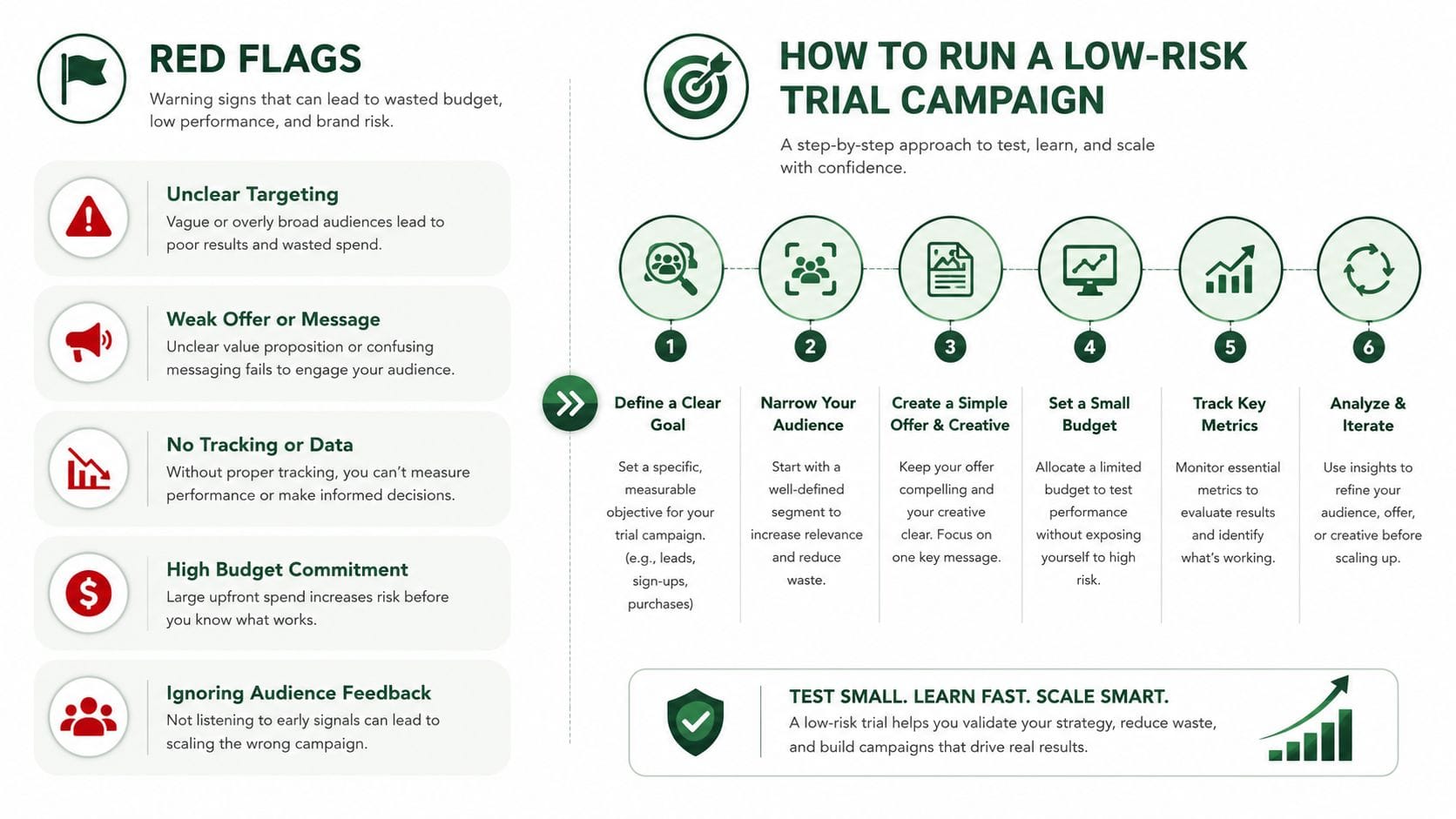
Certain warning signs should end the conversation quickly. If the agency refuses account access, promises specific rankings or lead volumes, or bundles in services the business clearly does not need, the owner should walk away. Those are not signs of confidence, they're signs of control.
The better alternative is a trial that limits downside. A pilot campaign should have a defined budget cap, a short list of target services, and success criteria written down before launch. That keeps the conversation focused on evidence rather than the agency's sales deck.
What a sensible trial protects
- Account ownership: the business should control the account from day one.
- Data portability: tracking and historical data should not be trapped inside the agency.
- Defined test scope: one or two services, not the whole business at once.
- Pre-agreed outcomes: leads, call quality, or form completions, not vague engagement.
- Review timing: enough time to collect real data, but not so long that waste compounds.
A twelve-month contract is not the only way to work with an agency. A well-structured pilot can prove fit without locking the owner into a long commitment. That matters most for Brisbane micro-businesses, where cash flow is tight and every bad month hurts.
The pilot should also separate lead quantity from lead quality. A flood of cheap leads can still be a poor outcome if the owner spends hours filtering them out. That is why the trial needs a clear follow-up process, not just ad settings.
Onboarding and Measuring What Actually Matters
The first month should be about setup, not celebration. Access needs to be confirmed, tracking checked, baseline performance documented, and campaign structure kept simple enough that the numbers can be trusted. If the agency starts making big claims before that work is finished, the owner should treat those claims as premature.
Measurement should focus on profit, qualified leads, and the path from click to sale. The platform can show clicks and conversions, but the business has to decide which actions matter. For service businesses, that often means tying ad data back to a CRM, call logs, or a booked-job system so the agency is judged on actual outcomes, not vanity reporting.
A simple reporting rhythm
A time-poor owner does not need a dashboard addiction. A monthly summary, a short call, and a clear list of actions are usually enough if the tracking is sound. Anything more elaborate should serve a business decision, not just fill a slide deck.
Brisbane adds its own layer too. Suburbs behave differently, local trust signals matter in ad copy, and seasonal swings can shift where budget should sit. A sensible agency notices those patterns early and adjusts without drama.
For owners who also care about what happens after the click, Boocoo's conversion rate optimisation guide for Australia is a useful companion piece, because PPC only pays off when the landing page does its share of the work. Strong ads with a weak page are still wasted money.
The right choice isn't the loudest agency or the cheapest one. It's the pay per click advertising company that can prove tracking, speak plainly, and work within the budget the business has.