
A lot of Brisbane business owners are in the same spot right now. They've boosted a few Instagram posts, watched the likes dribble in, and then wondered why the phone still isn't ringing. The café gets heart emojis. The electrician gets a few follows from people outside the service area. The physio sees views, but no bookings.
That gap is where most small businesses lose money. Instagram can work. It clearly has reach, attention, and ad demand. But a boosted post isn't the same thing as a real ad strategy, and hiring an Instagram ad agency without knowing what to look for can waste even more cash than doing it alone. For Brisbane service businesses in particular, local targeting, offer clarity, and cost control matter far more than pretty reports.
This guide gives the practical version. No fluff. Just what a small business owner in Brisbane should know before hiring an Instagram ad agency, how to set a realistic budget, what to ask in a sales call, and what to measure if the goal is actual growth rather than vanity numbers.
Why Your Boosted Posts Are Failing
A Brisbane café owner boosts a nice photo of latte art, picks a broad audience, spends a bit, and gets a handful of likes. No bookings. No catering enquiries. No noticeable lift in foot traffic. That story plays out every week because boosting is built for convenience, not for disciplined customer acquisition.
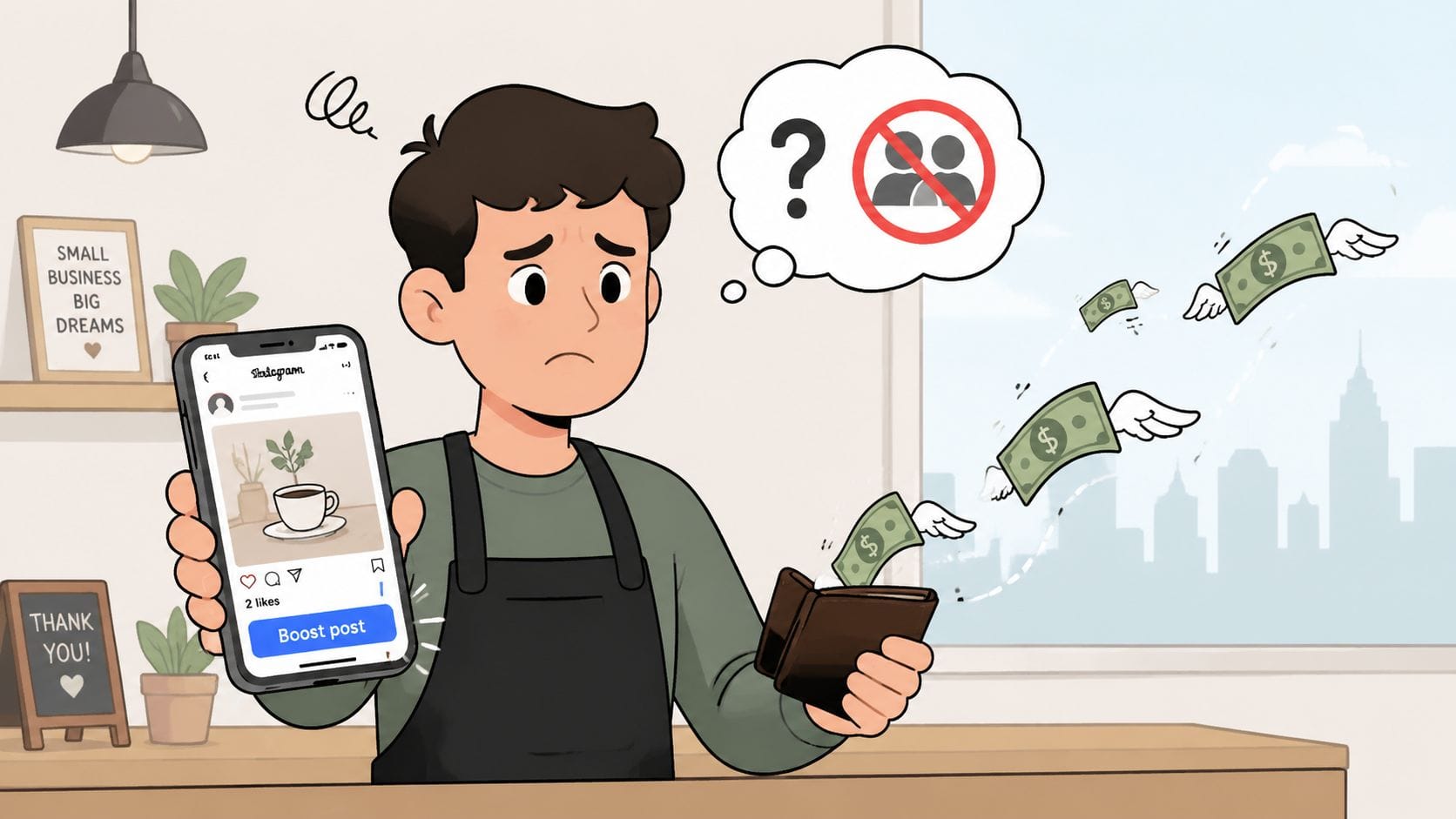
The main problem is that boosted posts usually start with the content someone already published, not the message, offer, audience, and conversion path needed to generate business. A post that looks fine in the feed often isn't built to stop a cold local prospect, explain value fast, and push them to take a next step. It's content first, strategy second.
The real issue isn't Instagram
Instagram is too important to dismiss. As of January 2024, nearly 80% of marketing professionals globally integrated Instagram into their digital marketing campaigns, making it the most popular social media platform used by marketers outside of Facebook, according to Statista's data on social media platforms used by marketers worldwide. That tells a small business owner something useful. The platform isn't the problem. Poor setup usually is.
For local service businesses in South East Queensland, boosted posts often fail for a few simple reasons:
- The targeting is too loose: Ads drift beyond the actual service area, so the budget reaches people who can't buy.
- The creative is too passive: A nice image isn't the same as a strong ad. People need a clear reason to act now.
- There's no offer: “Check us out” is weak. “Book a weekday consult” or “Get a quote this week” gives people a next step.
- There's no tracking: If calls, forms, or bookings aren't tracked properly, the business can't tell what worked.
Practical rule: If the ad can't answer who it's for, what problem it solves, and what the person should do next within seconds, it usually won't pull its weight.
Why an Instagram ad agency can help
A proper Instagram ad agency doesn't just press boost with better graphics. It should build campaigns around the business goal. For a Brisbane plumber, that might mean suburb-specific lead generation. For a clinic, it might mean enquiries for a profitable service line. For a café, it might mean local promotion tied to a specific offer, not general awareness.
That's the shift that matters. Small businesses don't need more activity. They need ads that line up with how people buy.
Decoding Agency Services What to Expect
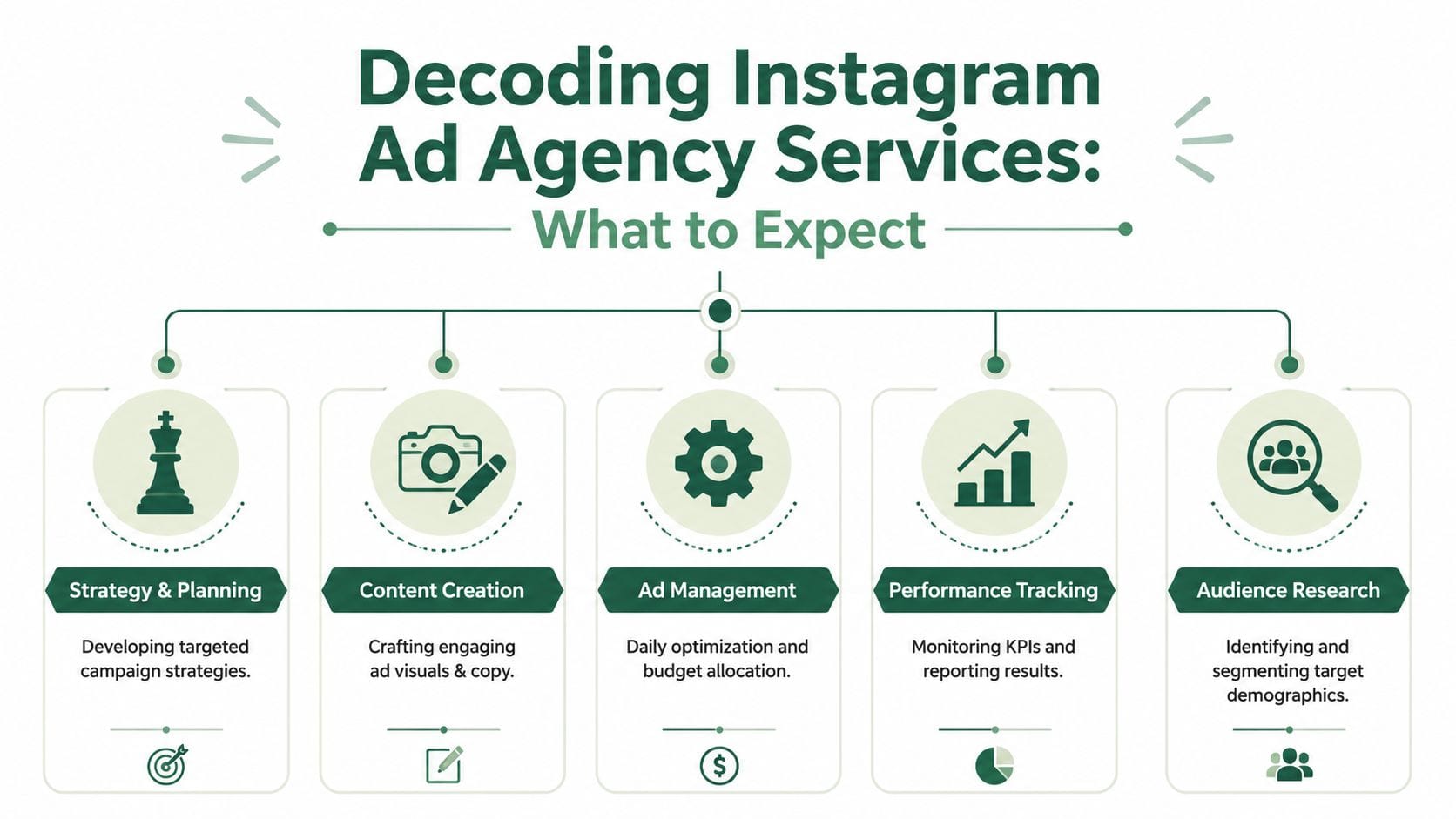
A solid Instagram ad agency should feel more like a small growth team than a button-pusher. If the agency mostly talks about posting frequency, follower growth, and “engagement” without asking about margins, booking value, service area, or lead handling, it's not doing the full job.
Strategy comes before ads
The first deliverable should be a strategy. That includes audience research, offer planning, competitor review, funnel thinking, and deciding what success looks like. A Brisbane mortgage broker and a West End restaurant shouldn't get the same campaign template, even if both want more enquiries.
A good agency should be able to explain:
| Service area | What it should include | Why it matters |
|---|---|---|
| Strategy | Audience, offer, campaign objective, landing path | Stops random ad spend |
| Audience research | Local service area, buyer intent, exclusions | Reduces wasted reach |
| Creative planning | Hooks, offers, Reels ideas, Stories concepts | Improves ad response |
| Campaign setup | Objectives, placements, tracking, testing plan | Gives the campaign structure |
| Reporting | Business outcomes, not just platform metrics | Helps owners make decisions |
Some Brisbane operators also want broader small business support beyond Instagram. In that case, a practical read on social media marketing for small business can help clarify where Instagram fits versus other channels.
Creative that fits how people use Instagram
Creative is where many agencies either save a campaign or sink it. Static graphics can still have a place, but short-form video is carrying a lot of the attention. Expert Instagram ad agencies achieve a 2.3x higher success rate by prioritising short-form video, and Reels account for 35% of all time spent on Instagram in Australia. Agencies using AI-driven video marketing strategies report an 82% increase in ROI compared with static creative, based on Goat Agency's social media marketing statistics.
That doesn't mean every business needs polished studio video. It usually means simple, useful footage done well:
- Trades: before-and-after jobs, common mistakes, quick trust builders
- Clinics: service walkthroughs, team intros, treatment FAQs
- Hospitality: product close-ups, specials, atmosphere, customer moments
- Professional services: myth-busting, short explainers, founder credibility clips
Management and reporting that actually help
Once campaigns are live, the agency should manage targeting, budget allocation, creative testing, and landing page alignment. It should also explain changes in plain English. “We narrowed location targeting because too much spend was leaking outside the service area” is useful. “We optimised the funnel architecture” isn't.
The best reporting makes the owner's next decision easier. Keep spending, fix the offer, improve lead handling, or pause.
Practical agencies also use tools that save time. Meta's built-in campaign tools matter. Canva AI can help speed up creative production. Google Analytics 4 helps verify what happens after the click. Boocoo is one Brisbane option that handles this kind of paid social setup for small businesses that want Instagram ads managed alongside broader digital work, without needing to juggle separate freelancers and platforms.
How Much Should You Budget in Brisbane
This is usually the first real question. Not “How much do agencies charge?” but “What's the total monthly cost once everything is included, and will it still make sense after a few months?”
For small businesses in Australia, the average agency charges a flat monthly retainer rather than a percentage of ad spend, according to EmberTribe's guide to Instagram marketing agency pricing. That matters because Brisbane business owners usually need predictable monthly costs more than fancy pricing structures.
Retainer versus percentage of spend
A flat retainer is easier to budget for. A percentage-of-spend model rises as ad spend rises, which can be fine for larger campaigns but often feels slippery for smaller operators.
Here's the simple trade-off:
- Flat retainer: Better for cost planning, especially when cash flow is tight.
- Percentage of spend: Can align incentives in some cases, but it can also make costs creep up as budgets rise.
- Hybrid model: Sometimes used when setup, creative, and management are split into separate fees.
The same source notes that percentage models typically range from 10 to 20% plus ad spend billed separately. For a small operator, that's worth checking line by line before signing.
A business comparing platforms and pricing structures may also find it useful to read how much Facebook ads cost, because many agencies manage Instagram and Facebook through the same Meta ad account.
The hidden costs that catch small businesses
Plenty of agency deals go sideways. 68% of AU small businesses report unexpected cost escalations within 12 months due to ad spend inflation and platform fees not covered in fixed retainers, based on the verified data provided. That doesn't mean retainers are bad. It means a retainer only works when the scope is clear.
The usual hidden costs are qualitative, not mysterious:
- Creative fees: New Reels, editing, copywriting, or monthly shoots may be extra.
- Landing page work: If the agency runs ads but doesn't fix the page, conversion issues remain.
- Tracking setup: Pixel work, UTM tagging, and GA4 configuration may sit outside the monthly fee.
- Reporting layers: Basic reports may be included, but strategy calls or deeper analysis can cost extra.
If a proposal looks cheap, check what's been left out. Cheap management with no creative, no tracking, and no landing page input often becomes expensive later.
A simple Brisbane budgeting lens
A micro-business should ask one blunt question before signing. If retainer, ad spend, and extra production costs are added together, can the campaign realistically generate enough profitable work to justify the effort?
That matters even more for sole traders and low-ticket services. A small monthly budget can work when the offer is sharp, the service area is tight, and the sales process is simple. It struggles when the business is vague about its ideal customer, sends people to a weak page, or expects one generic campaign to fix everything.
A sensible Instagram ad agency should be willing to say when the budget is too thin for the goal. That's a good sign, not a red flag.
The Vetting Process 10 Questions to Ask
This is the part that saves the most money. Most agency problems don't start in month three. They start in the sales call, when the business owner doesn't know what to ask and the agency gets away with broad answers.
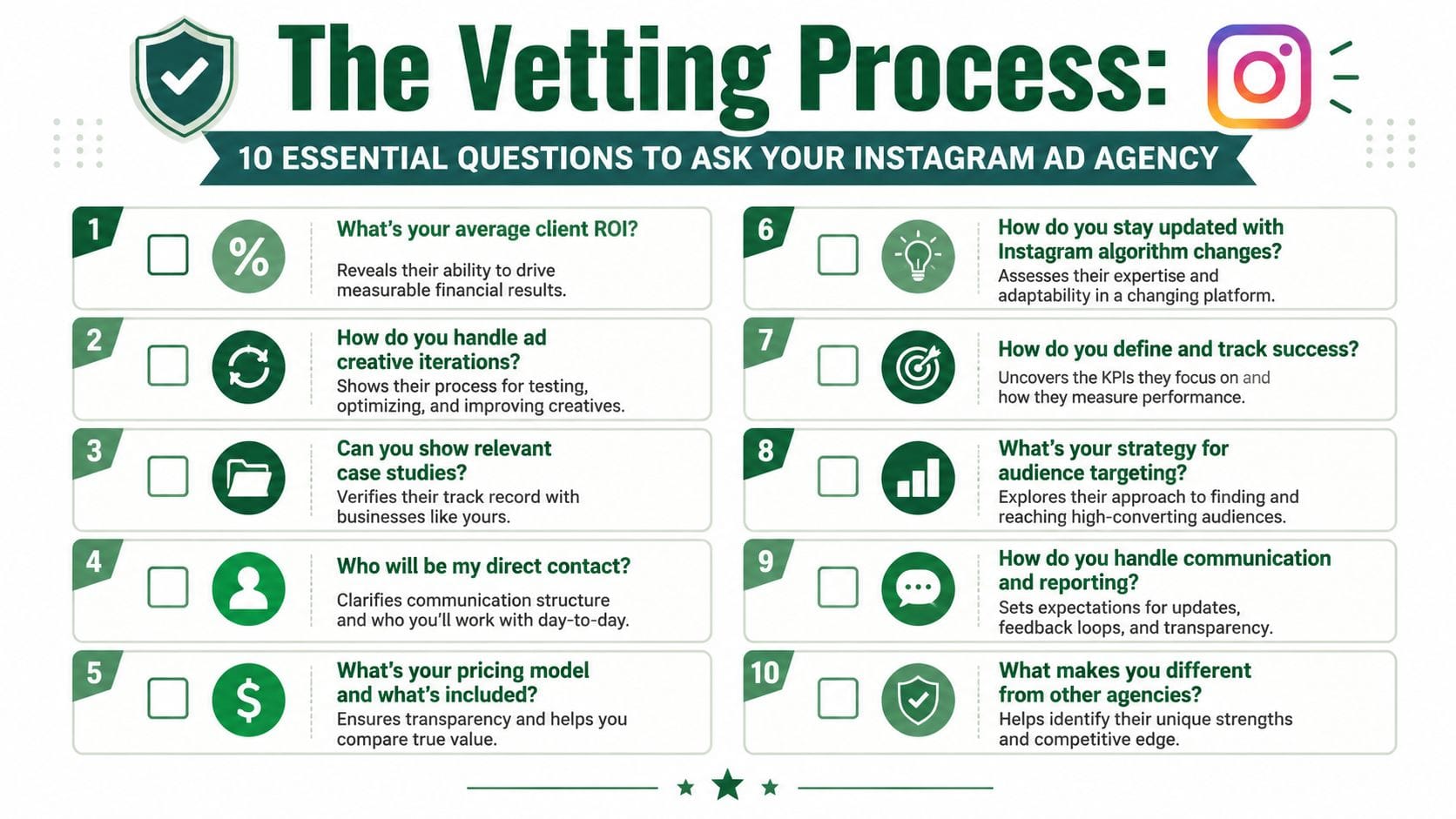
A Brisbane business should push for specifics. That matters because 73% of AU small businesses using Instagram ads target audiences outside their service region, leading to 52% lower conversion rates, according to the Brisbane City Council business and economy resource. If an agency can't talk confidently about hyper-local targeting, suburb selection, exclusions, and service-area logic, it's not ready for local lead generation.
Questions that expose real local knowledge
Ask these in a call and listen for direct answers, not polished waffle.
How would you target a business like this inside Brisbane and SEQ?
A real answer should mention local service areas, postcode logic, exclusions, and likely buyer intent.What would you do differently for a West End café versus a North Lakes trade service?
This exposes whether the agency adapts messaging to context.What happens if leads come from outside the service area?
Good agencies already have a cleanup plan for wasted reach.What creative would you test first?
The answer should include examples such as Reels, Stories, before-and-after clips, proof, offers, or testimonial angles.Who writes the ad copy and who approves it?
This tells the owner how much control they'll keep.
A business owner who wants extra points of comparison can also compare Instagram marketing agencies to get a broader sense of service models, specialisations, and what different firms emphasise.
Questions that expose reporting fluff
Plenty of agencies can talk about impressions. Fewer can talk about business outcomes in a grounded way.
How do you measure success beyond likes and reach?
If the answer stays vague, that's a warning.What tracking setup do you require before launch?
The agency should mention basics like conversion tracking, UTM tagging, and clean account access.How often do you change budgets or creative, and why?
This reveals whether the agency has a process or just reacts emotionally to daily results.What does your first month usually look like?
Useful answers include setup, testing, creative rollout, reporting cadence, and decision points.Who will be the day-to-day contact after the sale?
The owner needs to know whether the strategist disappears after signing.
A strong answer sounds plain, local, and specific. A weak answer hides behind jargon and promises “brand awareness” without explaining how that turns into enquiries.
The best agencies don't mind these questions. They welcome them.
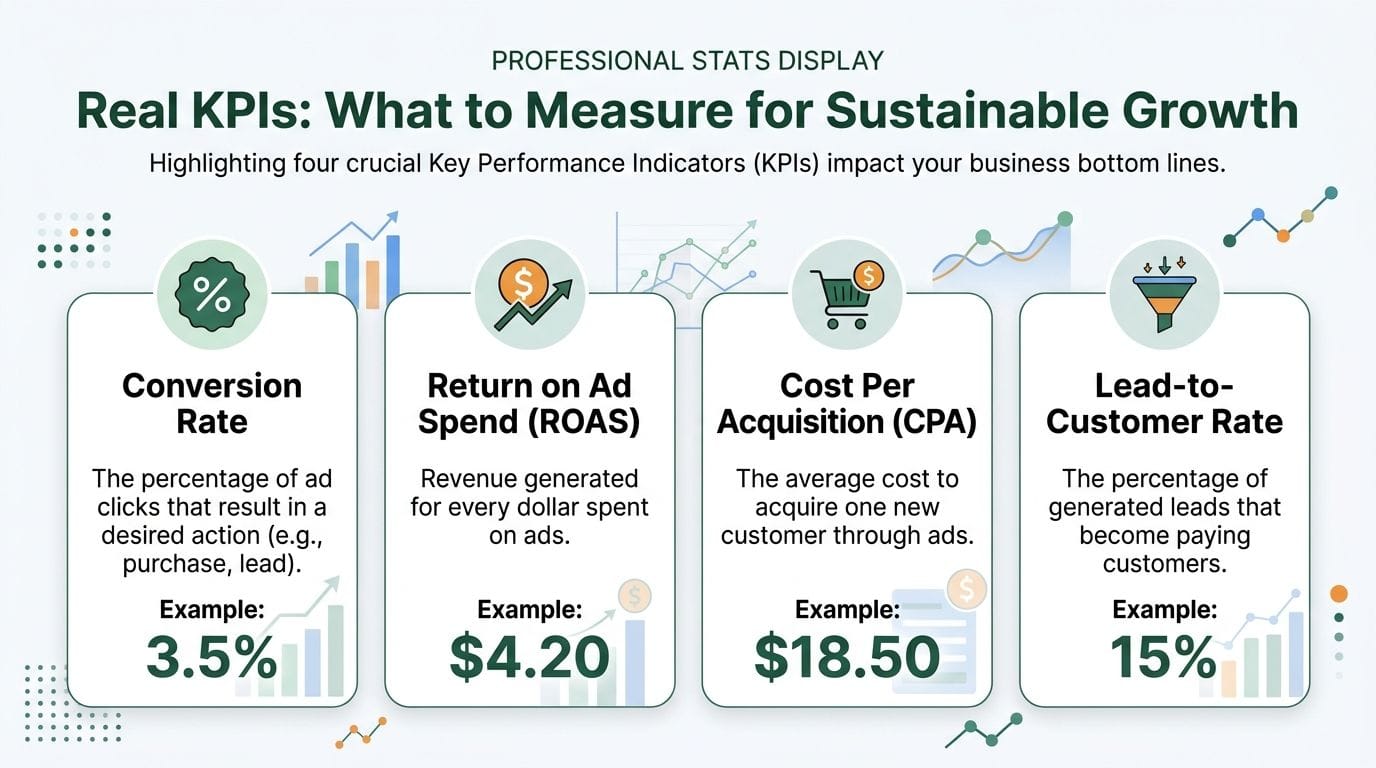
Real KPIs What to Measure for Growth
Most small businesses don't need more Instagram activity. They need more profitable work. That's why likes, followers, and views should sit well below revenue-linked KPIs in any report.
The numbers that matter
A decent Instagram ad agency should report in language the owner can use.
- Return on ad spend: How much revenue came back relative to ad spend.
- Cost per acquisition: What it cost to generate a customer or lead.
- Lead quality: Whether the enquiries were relevant and winnable.
- Lead-to-customer rate: Whether the leads turned into paying jobs.
- Conversion rate: Whether the landing page, form, or booking process pulled its weight.
For service businesses, lead quality is often the hidden lever. A campaign can look fine in-platform and still be poor if the leads are outside the area, price shopping, or not ready to buy. That's why platform metrics should never sit alone. Businesses that want a simpler primer on measuring social media ROI can use that as a basic framework, then ask their agency how those ideas apply to local lead generation.
A lot of this thinking also overlaps with paid search. For owners comparing channels, Google Ads consulting is worth reviewing because the same questions about lead quality, conversion tracking, and commercial intent show up there too.
When incrementality testing matters
Some agencies stop at Meta's default reporting. Better ones go a step further and ask a tougher question. Did the ads create new business, or did they capture people who were already on the way?
That's where incrementality testing comes in. Expert agencies implement incrementality testing to isolate true ad-driven conversions, and this approach shows a 15 to 20% increase in ROI when campaigns are properly funded during the learning phase, with a minimum of $1,500 AUD per week, based on Infinity MKT's article on effective social media advertising strategies.
Not every Brisbane small business needs that level of rigour on day one. But the principle matters for everyone. Measurement should be designed to prove business impact, not just platform activity.
If the report says the campaign is “performing well” but the owner still can't see better leads, stronger bookings, or more sales, the report isn't doing its job.
Your First 30 Days An Onboarding Checklist
Once the agency is chosen, the first month sets the tone. In this initial period, a lot of businesses either get organised fast or spend weeks chasing passwords, approvals, and missing brand files.
A clean onboarding process saves time on both sides. It also stops the agency from launching with weak information and then blaming the market when results are patchy.
What to prepare before kickoff
The business owner should have the basics ready before the first proper strategy meeting.
- Account access: Instagram, Facebook page, Meta ad account, website, and analytics access where relevant.
- Brand assets: Logo files, service photos, videos, colours, fonts, and any past ad creative.
- Offer clarity: Which service needs promotion first, what the margin looks like, and what action counts as a win.
- Service area detail: Suburbs served, areas to exclude, and whether work is metro-only or broader SEQ.
- Sales handling notes: Who answers calls, how fast leads are followed up, and what usually closes a customer.
One extra document helps a lot. A simple one-pager on the ideal customer. Not a fluffy persona. Just the practical version: what they need, what they worry about, what they ask before buying, and what usually gets them to say yes.
What should happen in the first month
The agency should drive this part. If it doesn't, the owner often ends up paying for drift.
A useful first month usually includes:
Kickoff meeting
Goals, target service, service area, constraints, approvals, and what success will look like.Tracking and account audit
Check whether conversion tracking, forms, and website paths are usable before spending hard-earned budget.Creative and message plan
The agency should present hooks, ad angles, offer ideas, and a testing approach that matches the business.Initial launch
Start with a focused campaign rather than trying to advertise every service at once.Early review and adjustment
Tighten targeting, replace weak creative, and fix any landing-page friction.
The first month should produce clarity. Which message is landing, which audience is responding, and what needs fixing next.
A small business doesn't need a perfect campaign in 30 days. It needs a structured start, transparent communication, and enough clean data to make better decisions in month two.