
CPM is the cost an advertiser pays for one thousand ad impressions, and an Australian Meta campaign averaged A$9.80 CPM in 2026. In practical terms, that means roughly A$9.80 to place an ad in front of every 1,000 counted impressions, before clicks or enquiries are considered.
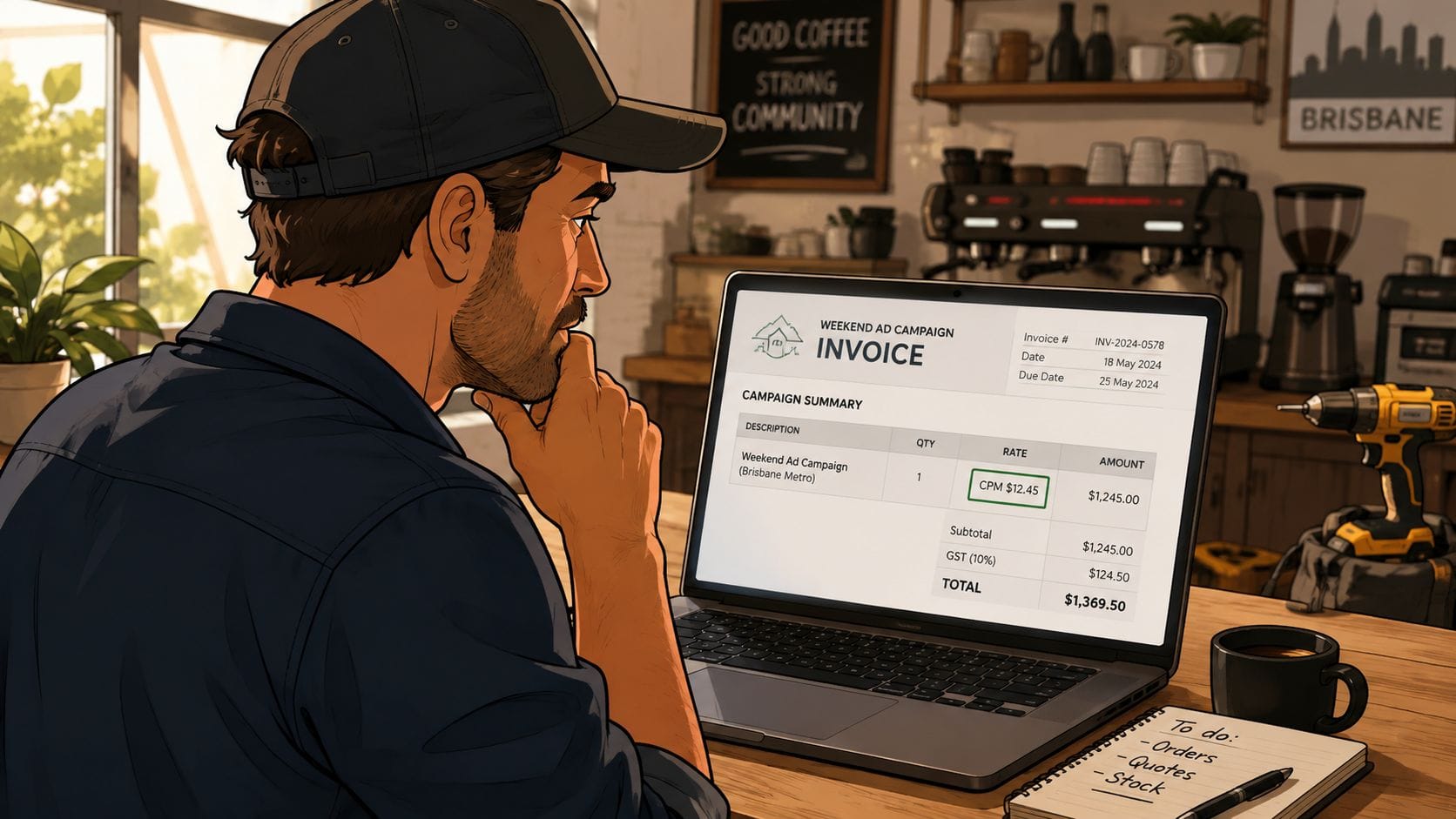
A Brisbane café owner checking a weekend campaign might see a line such as “CPM A$12.45” beside the spend, then wonder whether the campaign is expensive or performing well. A tradie promoting a new service area may face the same question in Meta Ads Manager, Google Display reporting, or an agency invoice.
CPM becomes useful once the number is treated as a reach rate, not a complete campaign result. The important decisions are whether paying for visibility suits the campaign goal, how the result compares with Australian benchmarks, and which setup mistakes can waste a limited small-business budget. The broader paid advertising examples for small businesses can also help place CPM inside a wider marketing plan.
CPM Explained for Small Business Owners
The number on the invoice
CPM means cost per mille, or cost per thousand impressions. An impression is counted when an ad is loaded and registered by the advertising platform. It doesn't prove that someone read the words, watched the full video, remembered the brand, or clicked through to a website.
That distinction matters. A billboard near a busy Brisbane road may be seen by many passing drivers, but the owner can't confirm how many noticed it. Digital advertising offers a measurable impression count, although an impression still isn't the same as human attention.
The CPM line is a rate, not the full media bill. If a campaign spends A$100 and produces 10,000 impressions, the rate is A$10 CPM. If the campaign spends A$100 but delivers fewer impressions, the CPM rises. The total spend tells the owner how much money left the account. CPM explains how efficiently that money bought counted reach.
A simple Brisbane mental model
Think of CPM like paying for a stack of 1,000 flyers to be distributed around a local area. The price tells the business what the distribution costs, but not whether every recipient needed the service or acted on the message.
Australian Meta data provides a useful local anchor. The 2026 average CPM was A$9.80 across industries, compared with A$8.60 in 2025, an increase of about 14% year on year, according to the Australian Meta ads benchmark for 2026. Instagram Feed averaged A$11.40, Facebook Feed averaged A$8.90, and Reels placements averaged A$6.20 to A$6.30 in the same benchmark.
Those figures show why placement matters. A lower CPM can buy more distribution, but the cheapest placement isn't automatically the right one. A local retailer may prefer an engaging Instagram format, while a service business may value broad Facebook reach among an older local audience.
Practical rule: CPM answers “How much did the campaign pay for reach?” It doesn't answer “Did the campaign generate profitable work?”
The CPM Formula and a Worked Example
The calculation is straightforward:
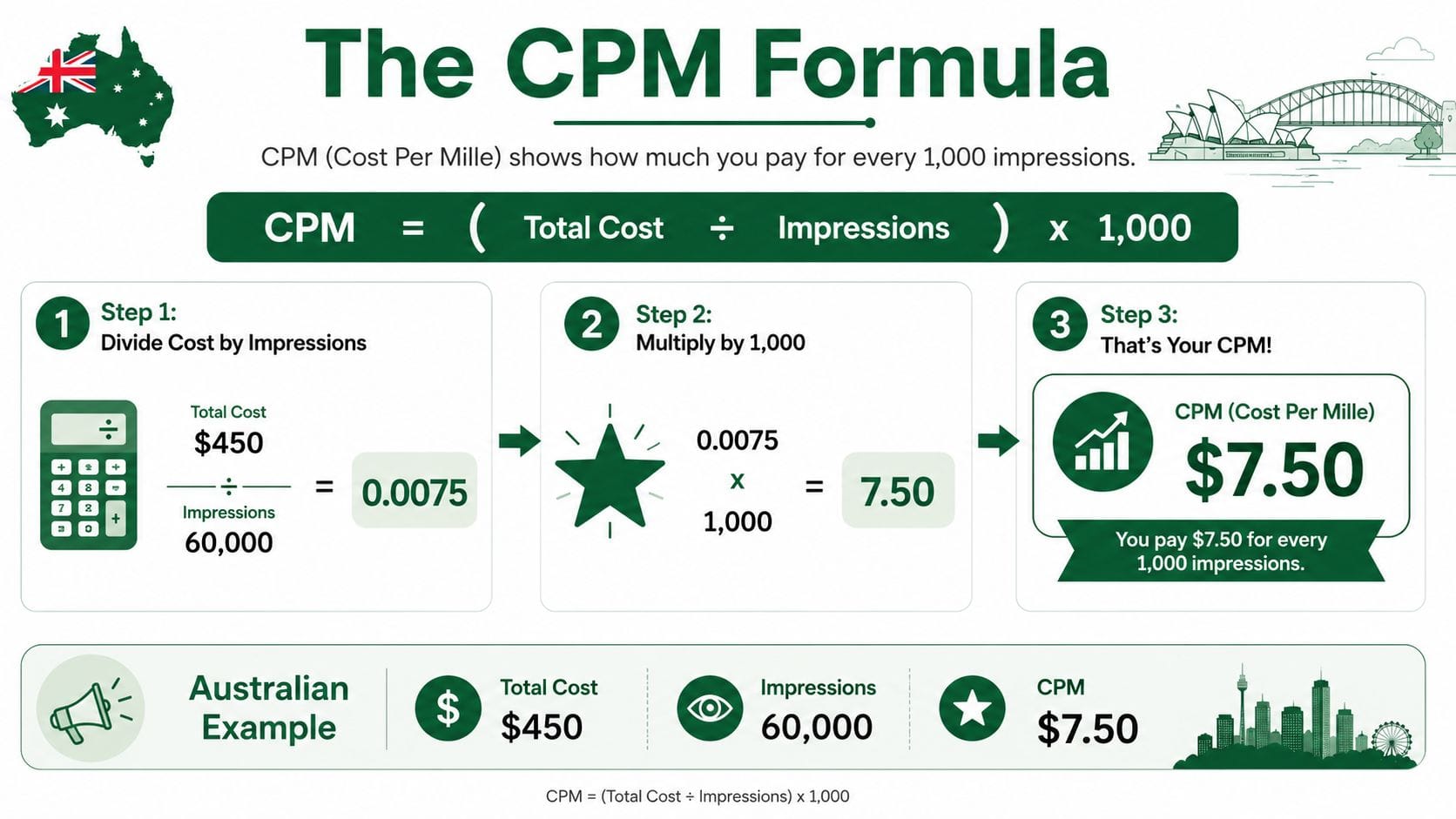
CPM = (total campaign cost ÷ total impressions) × 1,000
The Australian CPM calculator guidance from Media Guides describes CPM as the cost per 1,000 impressions and notes that it can be used to compare reach costs across display, video, social, and connected TV inventory. The Australian CPM explanation from Apparate uses the same formula.
Step one, divide the spend
Suppose a Brisbane business spends A$450 and receives 60,000 impressions.
A$450 ÷ 60,000 = A$0.0075 per impression.
That tiny per-impression figure isn't usually useful for reporting, so the formula multiplies it by 1,000:
A$0.0075 × 1,000 = A$7.50 CPM.
The campaign therefore paid A$7.50 for every 1,000 impressions.
Step two, use CPM to estimate delivery
The same relationship works backwards. A business with a A$1,200 monthly budget and a A$15 CPM can estimate delivery like this:
A$1,200 ÷ A$15 = 80 blocks of 1,000 impressions.
That produces an estimated 80,000 impressions. If the campaign delivers only 40,000 impressions on the same spend, the calculation becomes A$1,200 ÷ 40,000 × 1,000, resulting in an A$30 CPM. The higher rate signals that the campaign bought fewer impressions for the same money.
The change might come from a narrow audience, competitive demand, weak creative, or a costly placement. CPM identifies the symptom, so the operator still needs to inspect targeting, delivery and audience quality before changing the budget.
Screenshot takeaway: Bigger spend doesn't automatically produce a better CPM. Better audience targeting and placement do.
How CPM Compares to CPC, CPA and CPV
Small businesses often get stuck because each pricing model measures a different event. CPM measures impressions, CPC measures clicks, CPA measures completed actions, and CPV measures video views.
| Model | What the advertiser pays for | Best suited to |
|---|---|---|
| CPM | One thousand impressions | Awareness, launches, rebrands and broad reach |
| CPC | A click to a website or landing page | Traffic, quote-page visits and content promotion |
| CPA | A completed action, such as a lead or sale | Direct response and lead generation |
| CPV | A video view | Video-first storytelling and demonstrations |
A Brisbane retailer launching a new collection may choose CPM because the first job is to get the product in front of local shoppers. A roofing business sending people to an enquiry form may prefer CPC because the click is the immediate step that matters. A lead-generation campaign can use CPA when the platform has enough conversion information to optimise towards completed enquiries.
CPV suits a business with a message that needs motion, such as a renovation before-and-after, a cooking demonstration, or a short workshop preview. The business still needs to decide what counts as a valuable view within the chosen platform, because not every view represents the same level of attention.
No universal price anchor can be applied safely across CPM, CPC, CPA and CPV without a verified benchmark for each model. The practical comparison should therefore begin with the event the owner wants to buy, not a race to find the cheapest-looking rate.
A business focused on clicks should also assess the creative and landing-page factors behind those clicks. A useful resource is Aicut's video CTR optimization framework, which provides a structured way to think about improving click-through performance in video campaigns. For a more detailed explanation of the click-based model, see what CPC means in digital advertising.
If success is measured by who saw the message rather than who clicked, CPM is the natural starting point.
What CPM Really Costs in Australia Right Now
Australian benchmarks show that CPM can move considerably by platform, placement, season and account quality. The clearest Meta reference for small operators is the A$9.80 average CPM across industries in 2026, with Instagram Feed at A$11.40, Facebook Feed at A$8.90, and Reels at A$6.20 to A$6.30, as reported in the 2026 Australian Meta benchmark.
Another Australian dataset tracked Facebook CPM from July 2025 to July 2026. The median began near A$15.52, reached A$12.92 by the end of the period, and averaged about A$14.38, with a low of A$9.63 in May 2026 and a high of A$21.73 in November 2025. The Australian Facebook advertising cost benchmark attributes the movement to changing market conditions and seasonality.
What the quartiles tell an owner
The same source reports an Australian SME average Meta CPM of A$11.20. Top-quartile performance sits between A$6.50 and A$8.60, while bottom-quartile accounts pay A$16 or more per 1,000 impressions. The Australian 2026 SME marketing benchmark presents the same figures.
This doesn't mean every business should chase the lowest rate. Low-cost delivery may bring weaker audience relevance, while a higher rate may reflect a tightly defined local audience or a premium placement. Brisbane operators should compare audience quality, frequency, creative fit and useful reach alongside CPM.
The requested cross-platform planning ranges for programmatic display, YouTube and TikTok don't appear in the verified Australian data supplied for this guide, so responsible budgeting should avoid presenting them as confirmed benchmarks. Google Display, YouTube, TikTok and programmatic buying can each vary materially by inventory, audience and buying arrangement.
Budgeting around demand
Christmas retail activity and EOFY promotions can increase competition for attention, while quieter periods may create different delivery conditions. Those effects should be treated as planning considerations, not fixed percentage adjustments, because the verified data demonstrates movement but doesn't establish a universal Brisbane seasonal multiplier.
A programmatic quote also needs careful reading. Australian media guidance explains that an all-in CPM may include media fees, platform fees and data costs, meaning the quoted price can be higher than the raw media rate. The Australian digital advertising practices update makes the same distinction for guaranteed audience CPMs.
For a Brisbane owner, the sensible approach is to set a test budget, record the delivered CPM by placement, and judge whether the people reached match the intended market. The Facebook advertising cost guide offers additional context for assessing Meta spend before a campaign goes live.
When CPM Is the Right Choice for Brisbane Campaigns
CPM earns its place when visibility is the campaign outcome. A tradie opening a second service area between Brisbane's inner west and Ipswich may need local households to recognise the name before they are ready to request a quote. A new shop location, rebrand or product launch has a similar challenge. The business needs a broad, relevant introduction, not only a small group of people already searching.
Three situations favour CPM
New-location announcements benefit from repeated local exposure. A campaign can introduce the address, service area and opening date to a selected Brisbane audience.
A rebrand needs recognition before it needs a conversion. If existing customers see the new colours, name and signage consistently, future search or direct visits have a stronger context.
Brand-building also suits repeat-service categories such as dental, legal and hospitality. Customers may not need the service on the day they see the ad, but familiarity can influence the next search or recommendation.
The model becomes less suitable when every dollar needs to produce a measurable enquiry immediately. CPC can be more direct for website traffic, while CPA can be appropriate when a completed lead or sale is the central event.
A simple budget comparison
A A$1,200 monthly CPM campaign targeting Brisbane metro adults aged 25 to 54 on Meta could be planned around approximately 60,000 to 80,000 impressions, depending on the delivered rate and placement. Those figures are scenario estimates for planning, not a verified benchmark or guaranteed outcome.
A CPC approach aimed at the same reach would require a known click price. For illustration, a A$5 CPC would buy 240 clicks from A$1,200, but clicks aren't equivalent to impressions, so the two models are purchasing different outcomes.
CPA needs similar caution. A small conversion volume can make the reported acquisition cost unstable, particularly when only a few leads arrive in a month. No verified threshold has been supplied for a reliable CPA result, so the owner should compare CPA over a longer period and avoid treating a single short campaign as conclusive.
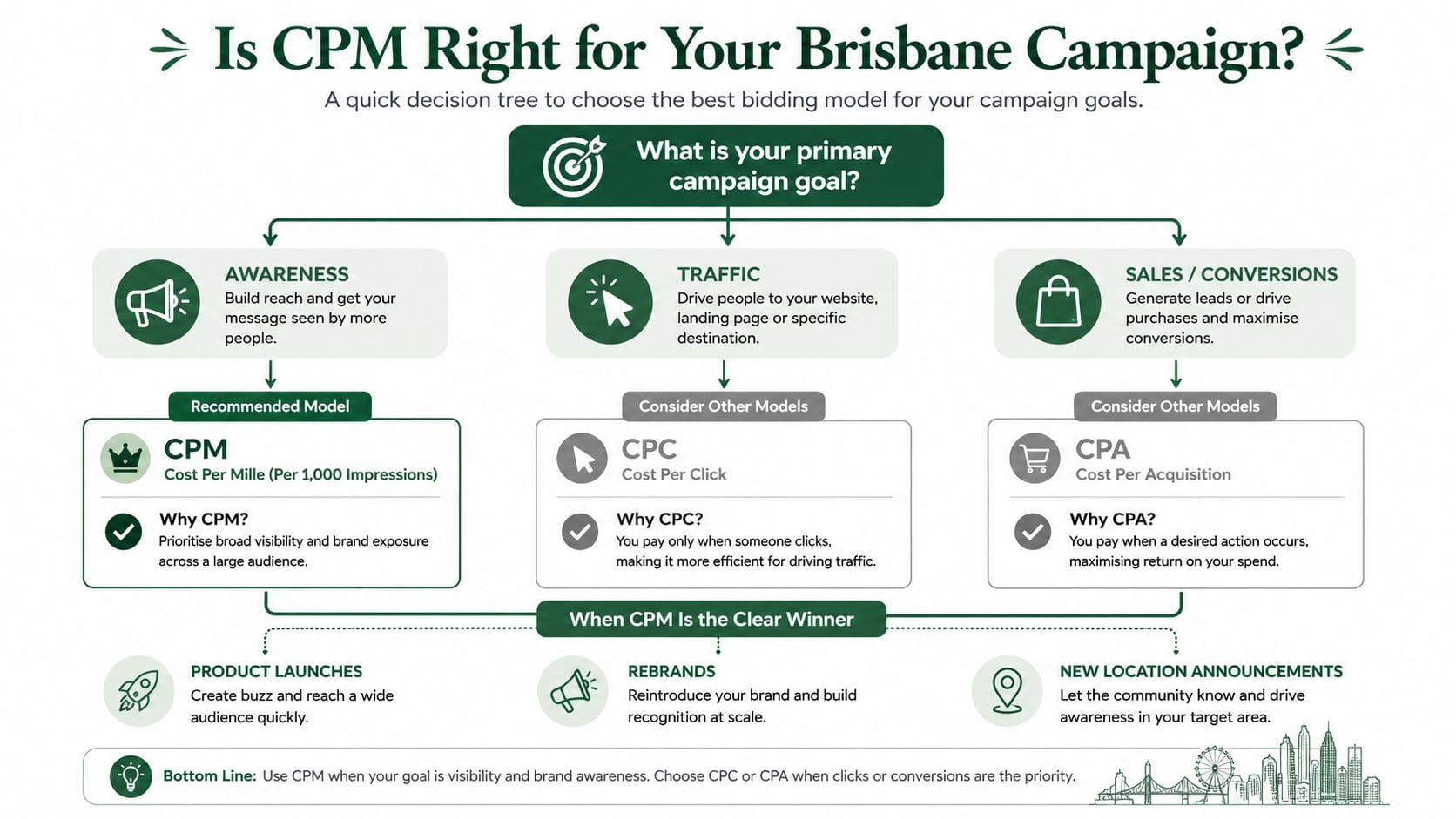
Decision test: Choose CPM when broad, relevant visibility matters first. Choose CPC or CPA when a click, enquiry or sale matters more than exposure.
Common CPM Mistakes That Drain Small Budgets
A low CPM can look attractive while the campaign does little for the business. Small operators should inspect what the impressions represent before congratulating the account on efficient delivery.
The placement problem
Raw reach isn't enough if ads appear beside unsuitable content, on low-value sites or in placements that don't match the audience. Managed placements, channel exclusions and approved site lists can help keep delivery aligned with the brand.
Viewability deserves separate attention. An impression can be registered even when the ad receives limited human attention, so reporting should distinguish delivered impressions from viewable exposure where the platform or buying partner provides that information. Fraud controls, ads.txt and independently verified reporting can add useful safeguards in programmatic campaigns.
The audience problem
Overly narrow targeting can raise the price of reaching a small group without improving the result. A Brisbane business may need to test a broader metropolitan audience, relevant regional radii or fewer stacked interests rather than forcing the platform to find an extremely specific slice.
That doesn't mean targeting should become careless. The corrective move is controlled expansion, followed by checks on location, age, creative response and the quality of traffic or enquiries that follow.
The objective problem
CPM is a poor fit when the campaign is judged entirely on completed leads or sales. In that situation, CPC or a conversion-focused bidding approach may give the platform a clearer instruction.
Fees create another blind spot. A quoted CPM may include publisher charges, platform fees and data costs, as explained in the Australian media fee guidance. An owner should ask for a transparent split between media spend, management fees and other charges. The PPC ads management guide provides further context for assessing paid campaign management.
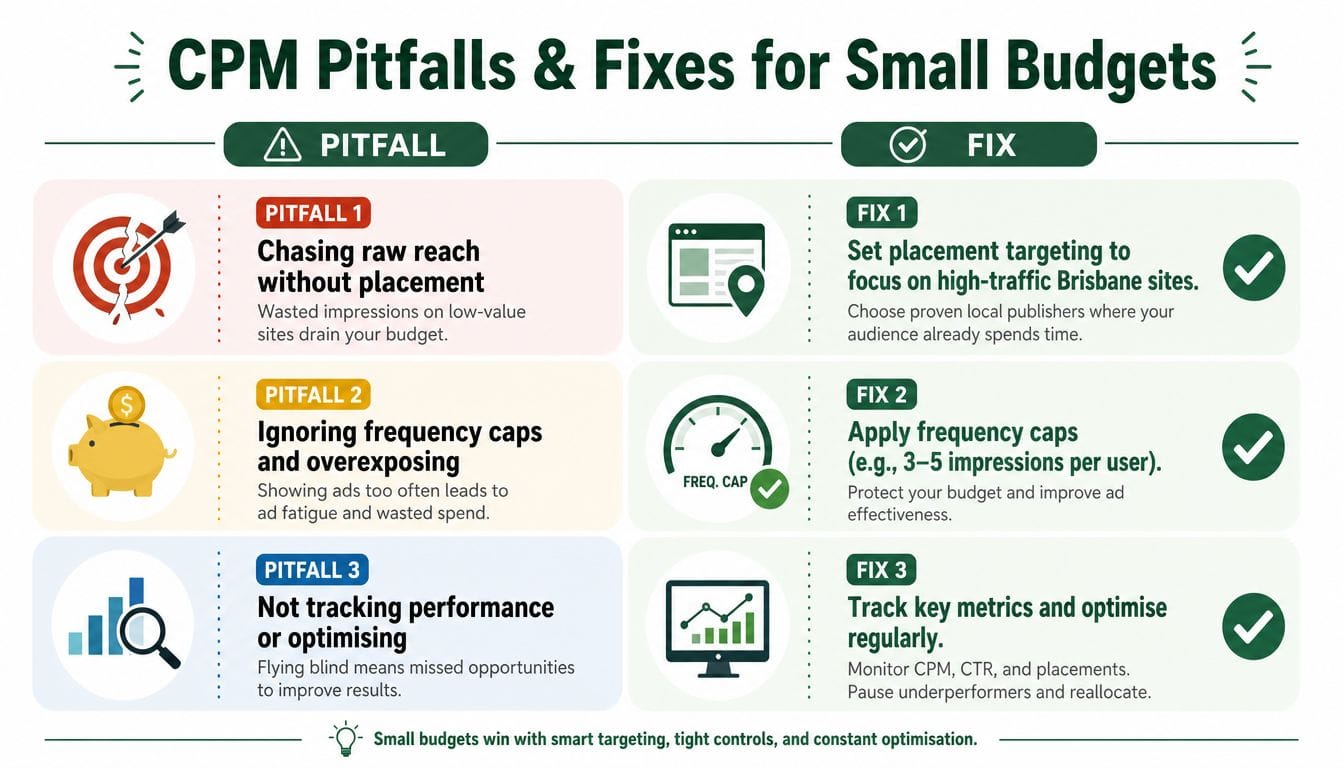
Budget discipline: If the campaign can't be measured beyond impressions, CPM is probably the wrong model.
Putting CPM to Work for Your Brisbane Business
The next move depends on the stage of the campaign. A store opening, new service area, product launch or seasonal push across Brisbane and South East Queensland often needs awareness before retargeting and conversion activity can do their work. Meta, TikTok or YouTube placements may provide the reach, but the choice should follow the audience and creative rather than platform habit.
A sole trader or small retailer can begin with a controlled awareness test that the business can afford to monitor. The starting amount should reflect available cash flow, the size of the Brisbane audience and the value of the service, rather than a borrowed rule from another company.
A four-step rollout
Set the awareness objective. Choose an in-platform goal that prioritises reach or awareness when visibility is the intended outcome.
Define the service area. Start with Brisbane metro, then add relevant regional radii only when the business can serve those locations profitably.
Cap daily spend. A daily limit prevents a short burst of activity from consuming more cash than planned.
Review after seven days. Inspect on-target reach, placement delivery and viewable video indicators where available. If the audience is relevant, the business can consider layering CPC retargeting for people who engaged with the awareness activity.
Creative quality affects the value of every impression. A clear offer, recognisable branding and local context can make the same placement more useful than a generic advertisement. A small business producing short-form video can also explore the ShortGenius AI ad generator as a way to create ad concepts efficiently, while retaining human review of the final message and local claims.
Boocoo is one Brisbane-based option for owners who need support with SEO, Meta and Google Ads strategy, campaign management and reporting. The team can help interpret CPM results, separate useful local reach from inflated impression counts, and decide whether a campaign should move towards CPC retargeting. Businesses comparing support models can also review pay-per-click advertising companies before choosing a partner.
For a practical next step, a Brisbane business owner can gather the last campaign's spend, impressions, placements and audience locations, then contact Boocoo on 1300 093 797 or hello@boocoo.au to discuss whether CPM, CPC or CPA best matches the next marketing objective.