
A Brisbane business owner often reaches the same point. The phone isn't ringing as steadily as it should, referrals come in waves, and the website looks fine but doesn't bring in enough enquiries. A café in West End, a plumber in Chermside, or a family law firm in Indooroopilly can all face the same problem. Customers are seeking solutions, but competitors keep appearing first.
That's where search engine optimization services for small business become useful. Not as a mystery service hidden behind reports and jargon, but as a practical way to help the right customers find the business at the right time. For a small business, SEO isn't just about “ranking higher”. It's about showing up when someone searches for a service, reads a quick answer in Google, checks reviews, and decides who to contact.
Many owners get stuck because SEO sounds bigger than it is. They hear terms like backlinks, technical audits, and AI search, then assume they need a huge budget or a full in-house team. In reality, most small businesses need a clear plan, realistic expectations, and a provider who can explain the work in plain English. A helpful starting point is this guide on whether SEO is worth it for small business, especially for owners weighing SEO against ads, social media, or word of mouth.
The key is understanding what moves the needle, what costs extra, and what tends to get left out of “affordable” packages. That matters even more in Brisbane, where local intent, suburb targeting, and Google Business Profile visibility can have a direct effect on enquiries.
Introduction to SEO Services for Small Business
A small business usually doesn't need every digital marketing tactic at once. It needs the basics working together. If a Brisbane electrician has a website, a Google Business Profile, a handful of reviews, and service pages for each suburb, that business already has the foundation for stronger search visibility. If those pieces are missing or inconsistent, SEO work fills the gaps.
That's why SEO services are better understood as a set of jobs rather than a single product. One part improves the website itself. Another shapes content around what customers ask. Another strengthens local visibility so the business appears for suburb-based searches. When those parts work together, search becomes less random.
Practical rule: SEO should never feel like a black box. If a provider can't explain what they're doing, why they're doing it, and how it connects to enquiries, the service probably isn't organised around small business needs.
Budget and timing matter here. A sole trader doesn't have time to approve ten blog topics a week or chase a long technical report with no clear action list. A small team usually needs a lean plan, monthly priorities, and a clear view of what's included. That becomes even more important when providers leave out things like review workflows, suburb pages, or FAQ content built for AI-generated search results.
The Brisbane market adds another layer. People don't always search in neat textbook phrases. They search by need, by area, and by urgency. That's why small business SEO works best when it's grounded in how local customers talk and search.
Understanding SEO Services for Small Business
The strongest SEO campaigns for small businesses are usually the simplest to understand. They help a business become easier to find, easier to trust, and easier to contact.
The broader market reflects how important this has become. The Australian SEO industry is projected to reach a market valuation of approximately $2.5 billion in 2025, up from $2.1 billion in 2024, reflecting a $400 million increase driven by small business demand in competitive markets like Brisbane, according to Australian SEO industry statistics and data trends.
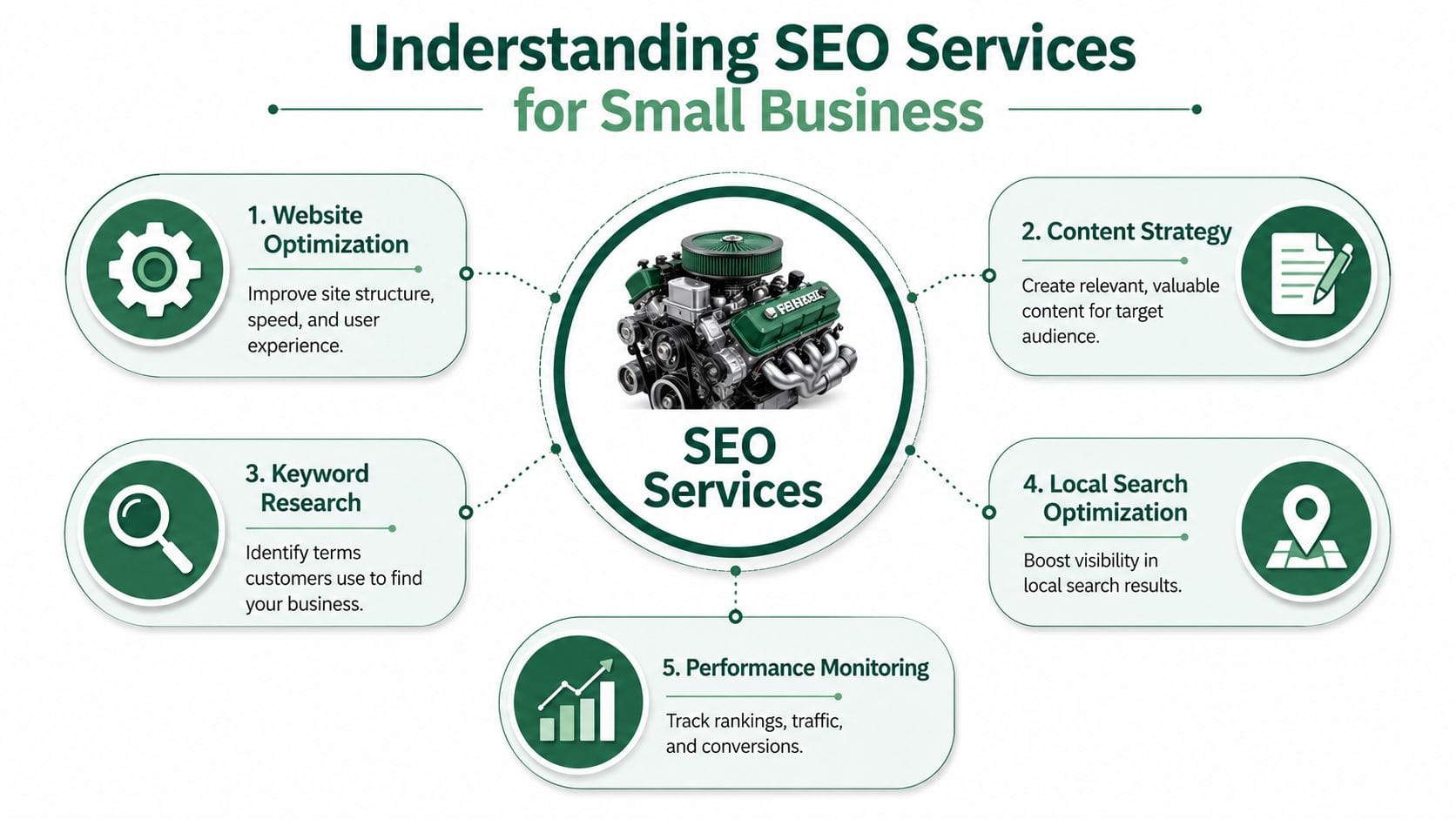
SEO works like tuning an engine
A useful analogy is a car engine. If one part is off, the car still runs, but not efficiently. The same applies to SEO. A website might load slowly, target the wrong phrases, or bury key service details. It still exists online, but it won't perform as well as it could.
For a small business, search engine optimization services for small business usually involve tuning five main areas:
- Keyword research: finding the phrases customers use when they're ready to compare options, ask questions, or book a service
- On-page optimisation: improving headings, page titles, service copy, and internal links so each page has a clear job
- Technical SEO: fixing crawl issues, mobile problems, duplicate pages, and speed barriers
- Content creation: publishing useful pages and articles that answer real customer questions
- Performance tracking: measuring whether visibility is turning into calls, quote requests, or bookings
A business running a Divi website, for example, may also need theme-specific adjustments to optimize Divi for Google rankings so design choices don't get in the way of search visibility.
The core services most small businesses need
Most owners don't need hundreds of pages. They need the right pages. That often starts with service pages, location pages, and a well-structured homepage. A Brisbane pest control business might need one page for termite inspections, another for general pest treatment, and separate location relevance woven into content where it makes sense.
A practical SEO service often includes work like this:
- Customer-question keyword mapping: using common questions from calls, emails, and quote forms to shape page topics
- Page refinement: improving meta tags, headings, and copy so pages match search intent
- Google Business Profile support: adding posts, service details, and visual updates to support local visibility
- Review strategy: helping the business ask for and respond to reviews in a consistent way
- Reporting in plain language: showing what changed, what improved, and what still needs work
For owners wanting more hands-on ideas, this collection of SEO tips for small business gives a useful practical baseline.
Good SEO should answer one simple question each month: what changed that will help the business earn more qualified enquiries?
Why AI-focused content now belongs in the mix
Search is no longer only a list of blue links. AI-generated answers are changing what gets surfaced first. That affects small businesses because pages built only around keyword repetition can miss the formats AI systems favour.
ANZ advises small businesses to structure content as direct answers to common customer questions and add FAQ sections, noting that AI models prioritise these formats over older content habits centred only on backlinks and page titles, as covered in their guidance on small business search engine optimisation.
That means a solid SEO service today should include content like:
Short answer blocks near the top of a page
These help both readers and AI-generated summaries.FAQ sections written in natural language
A plumber's page might answer “How quickly can emergency plumbing help arrive in Brisbane?” in direct, readable language.Clear service explanations
Avoid vague brand copy. State what the service is, who it's for, and what happens next.Trust cues built into the page
Reviews, service areas, licensing details, and contact options help users move from search to enquiry.
A small business doesn't need to chase every trend. It does need content that sounds like a real answer to a real question. That's increasingly what modern search rewards.
Local SEO Strategies for Brisbane Businesses
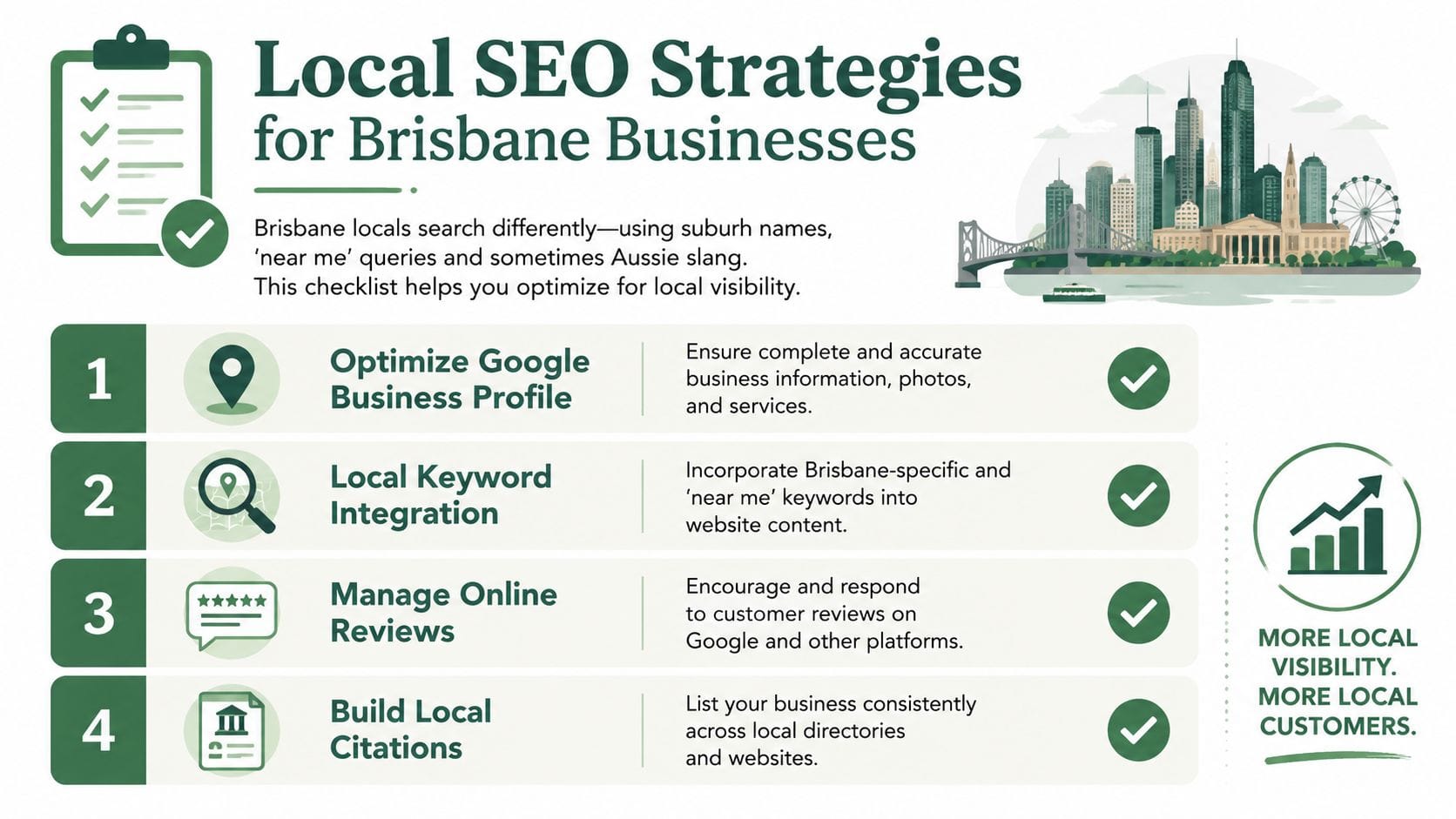
Brisbane local SEO works best when it mirrors the way people search in daily life. They often include suburb names, “near me” wording, urgent service terms, and conversational phrasing. A generic page that says “quality services across Australia” won't compete well against a page that clearly speaks to a Brisbane area and a specific need.
Technical work matters here too. In Brisbane, technical SEO execution often starts at $155 per hour, with a strong focus on local keyword integration in meta tags and content to turn visibility into real enquiries, as outlined in this guide to local SEO in Brisbane.
A practical local checklist
A time-poor owner can keep local SEO manageable by focusing on a short checklist.
- Google Business Profile first: keep the business name, address, phone number, services, and opening hours consistent. Add photos and publish regular updates.
- Suburb relevance on key pages: include service areas naturally in headings, body copy, and page titles where appropriate.
- Review management: ask happy customers for Google reviews and respond to each one in a professional tone.
- Local landing pages: create pages for important suburbs only when there's enough unique content to make them useful.
- Conversational phrasing: include the kinds of terms people speak into phones, including “near me” wording and natural question formats.
Birdeye also notes that voice search works better when businesses target local language and conversational phrasing, which is useful context for owners reviewing broader NZ small business SEO strategies and adapting the practical ideas to Brisbane conditions.
Where Brisbane businesses often waste effort
Many small businesses spend time on the wrong local tasks. They write one broad service page and expect it to rank everywhere. Or they create suburb pages with nearly identical text, which adds clutter rather than value.
A better approach is to build depth where demand is strongest. A mobile mechanic might prioritise pages around the suburbs where most callouts already happen. A family dentist might invest more effort into review collection and FAQ content than into thin location pages.
For businesses wanting a more Brisbane-specific roadmap, this guide to Brisbane local SEO is a useful next step.
Common SEO Packages and Pricing Ranges
SEO pricing can feel confusing because packages often use the same labels while including very different work. One provider's “local SEO setup” might include Google Business Profile optimisation, page updates, and review support. Another might only include basic keyword research and a monthly report.
In the AU region, small business SEO services typically cost $1,000–$5,000 per month, with most Brisbane trades and service businesses investing $1,500–$2,500 monthly for combined local SEO and Google Ads, according to this breakdown of small business SEO in Brisbane.
What package ranges usually look like
The range below gives a practical way to think about package types.
| SEO Package Comparison | |
|---|---|
| Package Range (AUD) | Typical Inclusions |
| $1,000 to lower-range monthly plans | Basic keyword targeting, a small number of page edits, light reporting, limited local optimisation |
| $1,500 to $2,500 monthly | A balanced mix of local SEO and Google Ads support, on-page improvements, Google Business Profile activity, and content work aimed at qualified enquiries |
| Up to $5,000 monthly | Broader campaign scope, deeper technical work, larger content output, stronger reporting, and more hands-on strategy across multiple services or areas |
That middle range is often the practical sweet spot for service businesses. It's usually enough to support local visibility without stretching into enterprise-style retainers that many small operators don't need.
The hidden costs that catch owners off guard
The headline package price doesn't always tell the full story. That's where many owners get frustrated.
A major issue in the Australian market is that pricing often lacks detail. Some “affordable” packages leave out essentials like Google Business Profile optimisation, suburb-specific landing pages, and review management, which creates uncertainty around true costs for Brisbane businesses, as discussed in this overview of SEO package transparency issues.
Common hidden gaps include:
Setup fees not clearly separated
Initial audits, page rewrites, or profile clean-up may sit outside the monthly fee.Location targeting sold separately
A package may cover one area but charge extra for additional suburbs.Review workflows excluded
Asking for and managing reviews might not be included at all.AI content not included
FAQ sections and direct-answer formatting may require extra copywriting work.Reporting without action
A report can look detailed while saying very little about next steps.
Owners comparing options can save time by using a checklist from this guide to small business SEO packages. It helps reveal what's included before signing anything.
Cheap-looking SEO often becomes expensive when the business has to pay extra for the parts that generate local enquiries.
How to Choose the Right SEO Provider
A Brisbane business owner often reaches this point after sitting through a few sales calls that all sound convincing. One provider promises quick rankings. Another offers a low monthly fee but stays vague about the work. A third talks in technical language that is hard to connect to real enquiries. Choosing well means treating SEO like hiring a long-term adviser, not picking the neatest package on a price sheet.

The easiest way to judge a provider is to ask one practical question: can this team explain what it will do, why it matters for your business, and what success should look like over time? If the answer stays fuzzy, the relationship usually becomes frustrating later.
The five checks that matter most
Local market understanding
Brisbane SEO has its own patterns. A provider should be able to talk clearly about suburb intent, service-area searches, and the difference between ranking for broad city terms and ranking for the jobs that bring leads. For example, a plumber targeting Ashgrove, Chermside, and Indooroopilly needs a different page plan from a citywide e-commerce store.
Local knowledge also affects budget decisions. A provider that understands Brisbane competition can usually tell you where a lean budget can still work and where stronger investment is needed because the search results are crowded.
Pricing clarity
A good proposal reads like a scope of work, not a menu with missing ingredients. You should be able to see whether the monthly fee covers technical fixes, content updates, Google Business Profile work, reporting, and review support.
Hidden costs rarely show up on the first call. They appear later, when you learn that new suburb pages, FAQ writing, or AI-friendly content formatting sit outside the quoted fee. The cheaper option can become the more expensive one if your provider charges extra each time the strategy needs basic additions.
Relevant proof
Proof should match your type of business. A provider with strong results for national online stores may still struggle with a Brisbane electrician, clinic, or law firm that depends on local trust and service-area visibility.
Ask for examples that show the provider understands your sales process, not just rankings. If you want a useful comparison framework, this guide to SEO companies for small business helps small owners compare agencies by fit, service scope, and business type.
Communication style
Good SEO communication works like a clear progress report from a builder. You want to know what was fixed, what is being built next, and whether the work is tracking against the plan.
That does not mean long reports filled with charts. It means clear updates in plain language. A solid provider can explain technical issues without hiding behind jargon, and it can answer basic questions without making the owner feel out of depth.
AI readiness
Search visibility now depends on more than classic rankings. Pages also need to answer questions clearly enough for AI-driven search features to understand them. That includes structured FAQs, concise service explanations, strong page headings, and content written to match real customer questions.
Many providers still treat AI-focused content as an add-on. For a small business, it should be part of the planning from the start, especially when budgets are tight and every page needs to do more than one job.
A simple way to compare providers
A scorecard helps keep emotion out of the decision. Rate each provider from one to five on local knowledge, pricing clarity, communication, relevant proof, and AI content capability.
Then add one more question. Would you trust this team to explain a disappointing month truthfully?
That final test matters because SEO rarely moves in a straight line. A reliable provider will talk about trade-offs, realistic Brisbane timelines, and what can be achieved within your budget. One local option in this space is Boocoo, which offers SEO, web design, social media, and paid advertising support for Brisbane small businesses. That broader service mix may suit owners who want search work connected to the rest of their marketing, rather than handled in isolation.
The right provider should feel like a steady teacher and operator. You should leave the sales conversation with more clarity than you had before, not more confusion.
Implementation Timeline with Measurable KPIs
SEO gets easier to manage when the work is placed on a timeline. Without that, small business owners often expect too much too early, then lose confidence before the work has had time to compound.
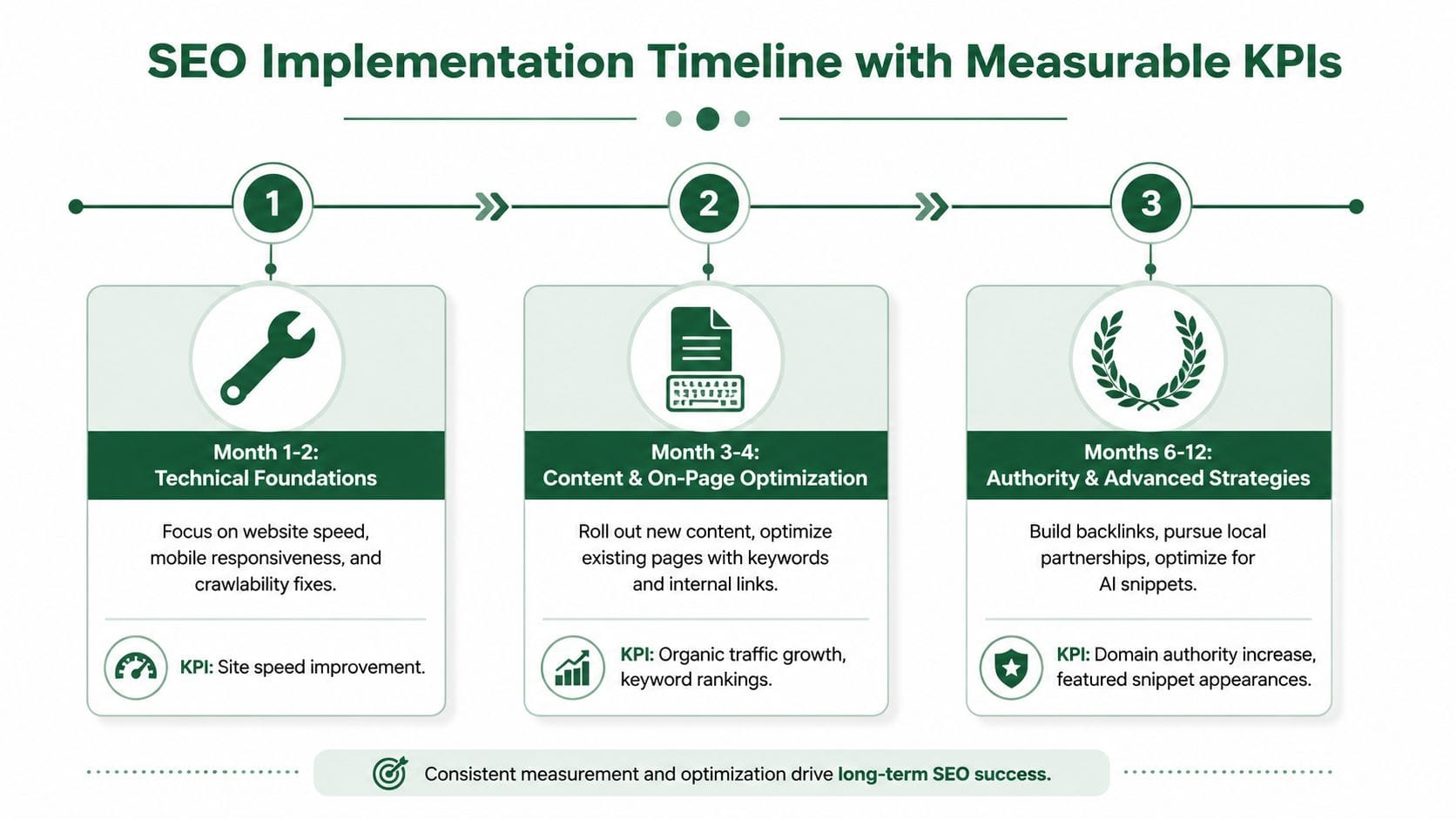
Brisbane businesses typically observe initial SEO improvements within 3 to 4 months, but stronger, authority-driven results that solidify keyword rankings usually require a 6 to 12-month timeline, according to this overview of SEO services in Brisbane.
What to expect across the timeline
The first phase is usually about fixing the foundation. That means technical cleanup, page structure improvements, Google Business Profile corrections, and deciding which services and search terms matter most.
Months three and four often focus more on page updates and content rollout. This is when service pages, FAQs, local relevance, and internal linking start doing visible work. Owners may begin to notice movement in search placement, better-quality traffic, or more consistent map visibility.
Months six through twelve are where stronger authority work starts to matter. That can include review growth, stronger supporting content, better local prominence, and pages becoming more established for target terms.
SEO works best when the business treats the early months as setup and the later months as momentum.
KPIs that matter more than vanity metrics
A small business doesn't need a dashboard full of noise. It needs a few measures tied to enquiries.
Useful KPIs often include:
- Technical health checks: fewer crawl issues, better page indexing, improved mobile usability
- Priority keyword visibility: movement for the key service and local phrases that matter to the business
- Google Business Profile activity: calls, direction requests, message activity, and profile interactions
- Lead quality signals: quote requests, contact form submissions, and phone calls from relevant prospects
- Page engagement: whether core pages hold attention and move visitors towards contact
A helpful way to use KPIs is to assign each one to a business goal. If the goal is more local calls, profile activity and service-page conversions matter more than broad blog traffic. If the goal is educating higher-value clients, FAQ engagement and enquiry quality may matter more than raw impressions.
The timeline stays realistic when each phase has one clear purpose. Fix the site first. Strengthen the pages next. Build credibility over time.
Real World Examples and Case Studies
A Brisbane business owner usually asks a practical question at this point. What does SEO look like once the work starts, the invoices arrive, and the business needs to see whether the investment is paying off?
Real examples help because they show the difference between activity and progress. Two businesses can spend a similar monthly amount and get very different outcomes depending on their starting point, their market, and whether the strategy covers the hidden costs competitors often skip over. Those costs can include fixing weak service pages, cleaning up duplicate listings, improving conversion tracking, and updating content so it can surface in AI-driven search results as well as standard rankings.
Example one local service business
A Brisbane trades business with a basic website and an underused Google Business Profile often starts with foundational local work. That usually means rewriting core service pages, adding suburb-specific detail where it is useful, building out FAQs from real customer questions, and setting up a simple process for review follow-up.
The first gains are often modest but meaningful.
Instead of chasing broad traffic, the business starts appearing more clearly for the jobs it wants in the suburbs it serves. That can lead to better-quality calls, fewer mismatched enquiries, and more map interactions from nearby customers. If the site also tracks phone clicks and form submissions properly, the owner can see whether SEO is bringing work, not just visits.
There is also a budget lesson here. A low monthly fee may cover page tweaks and profile updates, but it often leaves out photography, developer fixes, call tracking, or the extra content needed to answer AI-style search queries well. Those extras affect results, even when they sit outside the line item called "SEO."
Example two professional services firm
A smaller professional services firm usually needs a different approach. A law firm, accountant, or consultant is not only trying to get found. It is also trying to reduce hesitation.
That changes the content plan. Stronger pages explain who the service is for, what the process looks like, what documents or information a client may need, and what happens after first contact. Clear FAQ sections matter here because they work like a front-desk staff member answering common questions before the phone rings.
This also connects to AI-focused content strategy. Search tools increasingly pull short answers, summaries, and direct explanations from pages that are easy to interpret. A thin service page with a city name repeated several times may still exist on many small business websites, but it does little to build trust or support visibility in newer search formats. A page written in plain English, with specific questions and useful detail, has a better chance of helping both human visitors and AI-assisted search systems understand the business.
The pattern in both examples is simple. SEO works best when the business chooses work that matches how customers decide. For Brisbane small businesses, that usually means realistic timelines, local relevance, and a budget that accounts for the hidden work behind the visible ranking gains.
Frequently Asked Questions
How soon should a small business switch SEO providers?
A business usually shouldn't switch providers just because results aren't instant. SEO often needs time to take hold. A switch makes more sense when the provider can't explain the work, misses agreed deliverables, or reports on activity without linking it to business goals.
Can a business handle Google Business Profile posts in-house?
Yes, many can. A team member can post updates, photos, and service highlights if there's a simple process. Outsourcing becomes useful when the business struggles to stay consistent or wants the profile tied more closely to website and local SEO work.
What's the difference between local and national SEO packages?
Local SEO focuses on a defined service area, map visibility, suburb relevance, reviews, and Google Business Profile strength. National SEO aims at broader visibility across larger markets and usually needs a wider content and authority strategy.
What should a small business ask before signing an SEO package?
Three questions help immediately. What deliverables are included each month? What local SEO items are excluded? How is progress measured in enquiries, not just rankings?
Does AI change what a small business should publish?
Yes. Businesses should publish clearer answers, stronger FAQ sections, and service pages that explain topics directly. Pages written only for old-style keyword placement can miss newer search opportunities.