

A lot of Brisbane business owners are sitting in the same spot right now. The phone isn’t dead, but it isn’t reliably busy either. Referrals still come through, but not often enough to trust. Paid ads feel expensive. Social media takes time. Someone has said “you need SEO”, but nobody has given a straight answer on whether it’s worth the money.
The short answer is yes, SEO is worth it for many small businesses. But not for every business, not in every season, and not as the first move in every case.
That’s the part most articles skip. A plumber in The Gap, a café near South Bank, a suburban accountant, and a new online store should not make the same marketing decision. They have different margins, different urgency, and different cash flow pressure. Good advice has to reflect that.
What SEO Really Means for a Small Business
A plumber in The Gap gets a burst pipe call at 7:15 am. A family lawyer on the northside gets a web enquiry after dinner. A café near South Bank gets found by someone searching where to meet a mate this afternoon. That is what SEO is for a small business. It puts you in front of people who are already trying to choose.
For a Brisbane business owner, SEO is less about technical jargon and more about whether your business shows up at the right moment. If customers use Google before they call, book, or visit, search visibility affects revenue. Plain and simple.
Google explains that its local results are shaped by relevance, distance, and prominence in its guidance on how local ranking works. In practice, that means a small business usually needs three things in order. Clear service pages on the website, a properly set up Google Business Profile, and enough trust signals, such as reviews and accurate business details, to look like a safe choice.
That matters differently depending on the business model.
A trade business often needs suburb-level visibility and quick contact paths. A professional service, like accounting or law, usually needs stronger service pages and more credibility on the site because the buyer takes longer to decide. A café, clinic, or local retail shop leans harder on map visibility, reviews, and location signals. Tourism operators have their own mix again, which is why a tourism digital marketing approach usually looks different from local SEO for a suburban electrician.
Here is the practical version of what SEO does when it is set up properly:
- Makes you easier to find for the services you want to sell
- Helps you look credible before anyone contacts you
- Filters out some poor-fit enquiries by matching better searches to better pages
- Keeps producing leads after the page is published, unlike ads that stop the moment you stop paying
That last point is where small businesses get confused. SEO is not the best first move for every business. If you need leads next week, paid ads are usually the faster choice. If your margins are strong, your average job value is decent, and customers search the same services every month, SEO usually earns its keep over time.
So the essence of SEO for a small business is straightforward. It is not online popularity. It is a channel for capturing demand that already exists, then turning that visibility into calls, bookings, and walk-ins.
The Honest Costs and Timelines of SEO in Brisbane
Most business owners ask two fair questions straight away. What does it cost, and how long will it take?
The blunt answer is this. Local SEO services typically range from $500 to $2,000 monthly, and initial traction usually takes 3 to 6 months, according to Flying V Group’s overview of Brisbane small business SEO. Anyone promising overnight results is selling fantasy.
A transparent breakdown helps more than vague promises.
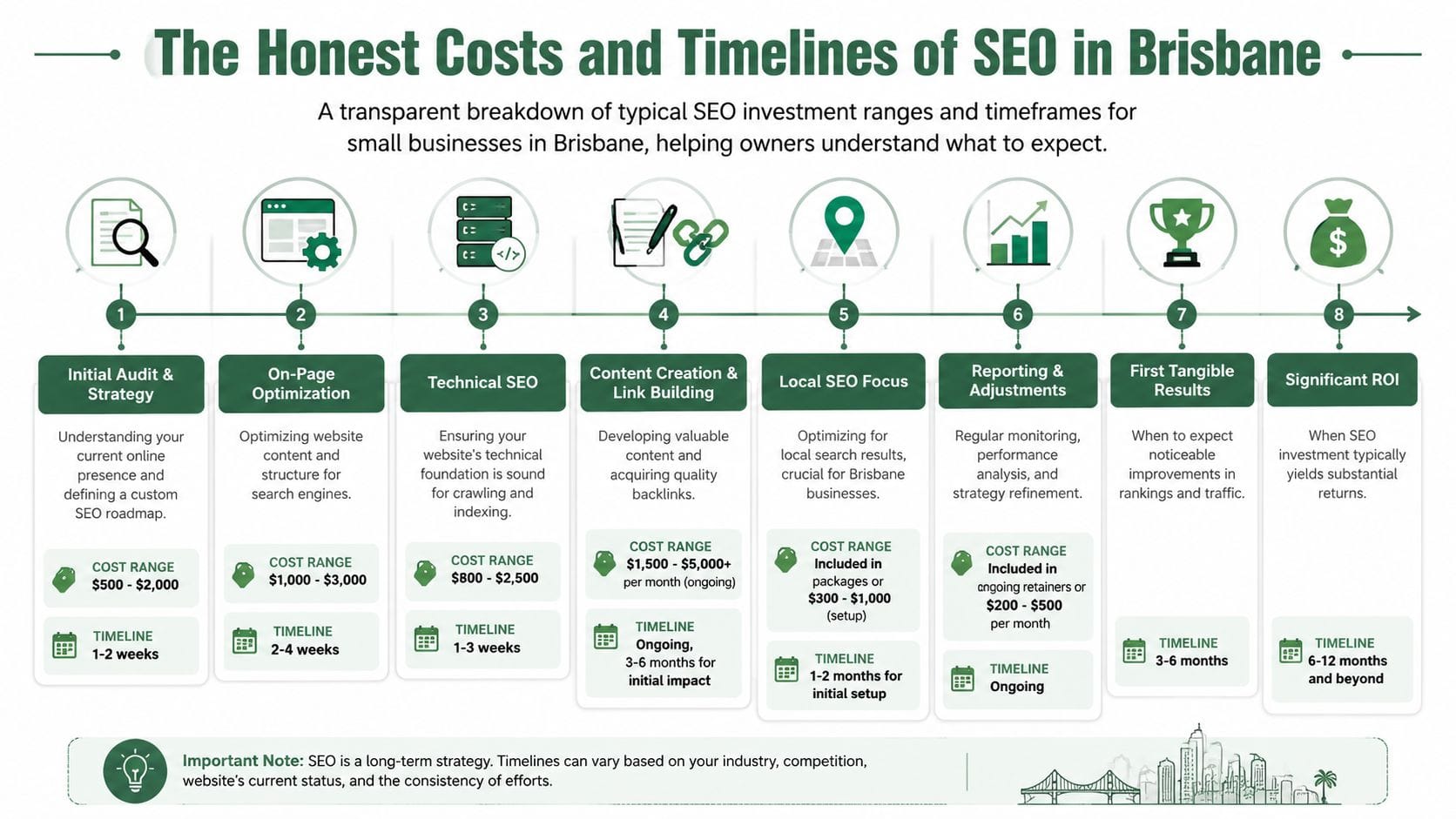
What the monthly spend usually looks like
At the lower end of the range, businesses usually get the essentials. That might include a site review, local page improvements, Google Business Profile work, and basic content updates. It can be enough for a single-location operator with a simple offer and low competition.
At the middle of the range, the work usually becomes more consistent. More pages can be improved, content can be added regularly, and technical issues can be fixed instead of ignored. That’s often where a service business starts getting a proper system instead of occasional tweaks.
At the upper end, there’s usually room for a broader push. That may suit multi-service businesses, businesses targeting several suburbs, or those competing in crowded categories.
A tourism operator, for example, has different search behaviour from an emergency trade business. The way search demand peaks and shifts can affect content priorities, local landing pages, and conversion paths. That’s why a broader digital plan matters in sectors like tourism, where SEO often works best alongside channel planning such as tourism digital marketing support.
What traction actually means
The biggest mistake small businesses make is expecting SEO to look dramatic too early.
In the early months, traction usually looks like this:
- More useful search visibility: The website starts appearing for more relevant searches.
- Better local presence: The business becomes easier to find in map results and suburb-based searches.
- Improved page quality: Service pages become clearer, more targeted, and more persuasive.
- Cleaner data: Phone calls, forms, and enquiries become easier to track.
That’s progress, even if the phone hasn’t exploded yet.
SEO usually feels slow right before it starts feeling sensible.
When SEO feels slow but is still working
A local business should think about SEO the way it thinks about fitting out a shop properly. The first few weeks don’t create a line out the door. They create the conditions for customers to buy.
A realistic approach looks like this:
| Stage | What it usually feels like |
|---|---|
| Early work | Fixing basics, cleaning up pages, sorting local signals |
| Initial traction | More visibility, better search relevance, clearer reporting |
| Growth phase | More qualified visits and stronger enquiry flow |
| Longer-term payoff | A steadier stream of organic leads without paying for every click |
That’s why cash flow matters. If a business needs leads immediately to keep the doors open, SEO alone may not be the right first move. But if the business can invest patiently, it can become a strong long-term asset.
How to Measure SEO Success Without an MBA
A lot of small business owners get sent reports full of rankings, impressions, and graphs that look impressive but don’t answer the only question that matters. Is this turning into real business?
That’s the filter. If the campaign isn’t producing more calls, more bookings, more walk-ins, or more qualified forms, the reporting isn’t helping.

Ignore vanity metrics first
Rankings matter, but only because they affect clicks and trust. Visibility on page one is valuable because people choose from those results. According to Fort Lewis College’s explanation of why SEO matters for small businesses, the top Google result captures around 28.5% of all clicks.
That number explains why good rankings can change a business fast. The same source also notes that strong rankings signal credibility, and that matters just as much as traffic. Buyers often assume the businesses they see first are more established and more trustworthy.
So yes, ranking reports have a place. But they are not the scoreboard.
The numbers that actually matter
For a small business, the useful scorecard is simple:
- Phone calls: Did calls from Google and the website increase?
- Contact forms: Are more people asking for quotes or appointments?
- Online bookings: Are service pages leading to real bookings?
- Direction requests or visits: Is local search leading to people turning up?
A practical setup usually includes Google Business Profile insights, website form tracking, and a clear record of where leads came from. Even a basic spreadsheet can beat an overcomplicated dashboard if it shows which enquiries became paying customers.
For service businesses, another useful test is lead quality. If SEO brings fewer tyre-kickers and more people ready to book, that’s progress. It saves admin time and protects margins.
A decent SEO campaign should make the business easier to trust, easier to contact, and easier to choose.
When the website starts getting traffic, it also needs to convert that traffic. Clear service pages, stronger calls to action, and simpler enquiry paths often matter as much as the ranking itself. That’s where conversion rate optimisation work in Australia becomes relevant. More visitors only help if more of them enquire.
A Simple Framework for Your SEO Decision
The wrong question is “Should every small business invest in SEO right now?”
The right question is “What should this business prioritise first, based on urgency, cash flow, and how customers buy?”
That changes the answer completely.
SEO vs paid ads for real Brisbane businesses
Here’s the practical comparison.
| Factor | SEO (Search Engine Optimisation) | Paid Ads (e.g., Google Ads) |
|---|---|---|
| Speed to results | Slower build | Faster visibility |
| Upfront pressure | Needs patience and consistency | Needs budget from day one |
| Long-term value | Builds an asset over time | Stops when spend stops |
| Lead intent | Strong for ongoing search demand | Strong for urgent demand |
| Predictability | Improves over time | More immediate but more dependent on budget |
| Best fit | Established operators playing the longer game | Businesses that need leads now |
That table is the reason blanket advice is useless.
A trade business with urgent jobs can’t always wait. If the diary is empty this week, paid ads may be the sensible short-term move. A law firm or accounting practice with higher-value clients can often justify a longer runway because one good client can repay the investment more comfortably.
Which channel suits which business model
According to BSB Marketing’s discussion of SEO for small business, 78% of location-based mobile searches result in an offline purchase. That’s a strong reminder that local search matters. But the path to purchase differs by business type.
A simple decision framework helps:
Urgent lead need
If the business needs calls this month to steady cash flow, paid ads deserve serious consideration first. That often applies to new operators, seasonal trades, and businesses recovering from a slow patch.
Margin and customer value
Higher-margin professional services usually have more room to invest in a channel that compounds over time. A law firm, accountant, or consultant can often afford patience better than a low-margin operator.
Search behaviour
If customers compare options, read service pages, and check reviews before enquiring, SEO becomes more valuable. If they need someone immediately, ads may win the first click.
Existing website strength
A weak site can make both SEO and ads underperform. If the website is outdated, slow, or unclear, fixing that should happen before expecting great results from any traffic channel.
Owner capacity
A time-poor sole trader usually shouldn’t attempt a half-DIY, half-neglected strategy. That tends to waste both time and money.
A practical read on common Brisbane business types looks like this:
- Emergency trades: Start with paid ads if leads are urgent. Add SEO to reduce long-term dependence on ad spend.
- Professional services: SEO often deserves a bigger role because trust, research, and local visibility drive enquiries.
- Cafés and hospitality: Local SEO matters, but reviews, maps visibility, and current business info matter more than pumping out blog content.
- E-commerce: SEO can be valuable, but product margins and competition should shape the pace of investment.
The answer isn’t SEO or ads forever. For many businesses, the sensible move is ads for immediate demand and SEO for future stability.
Your Practical Next Steps for Getting Started with SEO
A Brisbane business owner usually hits this point after the decision is made. SEO seems worthwhile, but the main question is who is going to do the work, how much control you want, and how long you can wait for it to pay off.
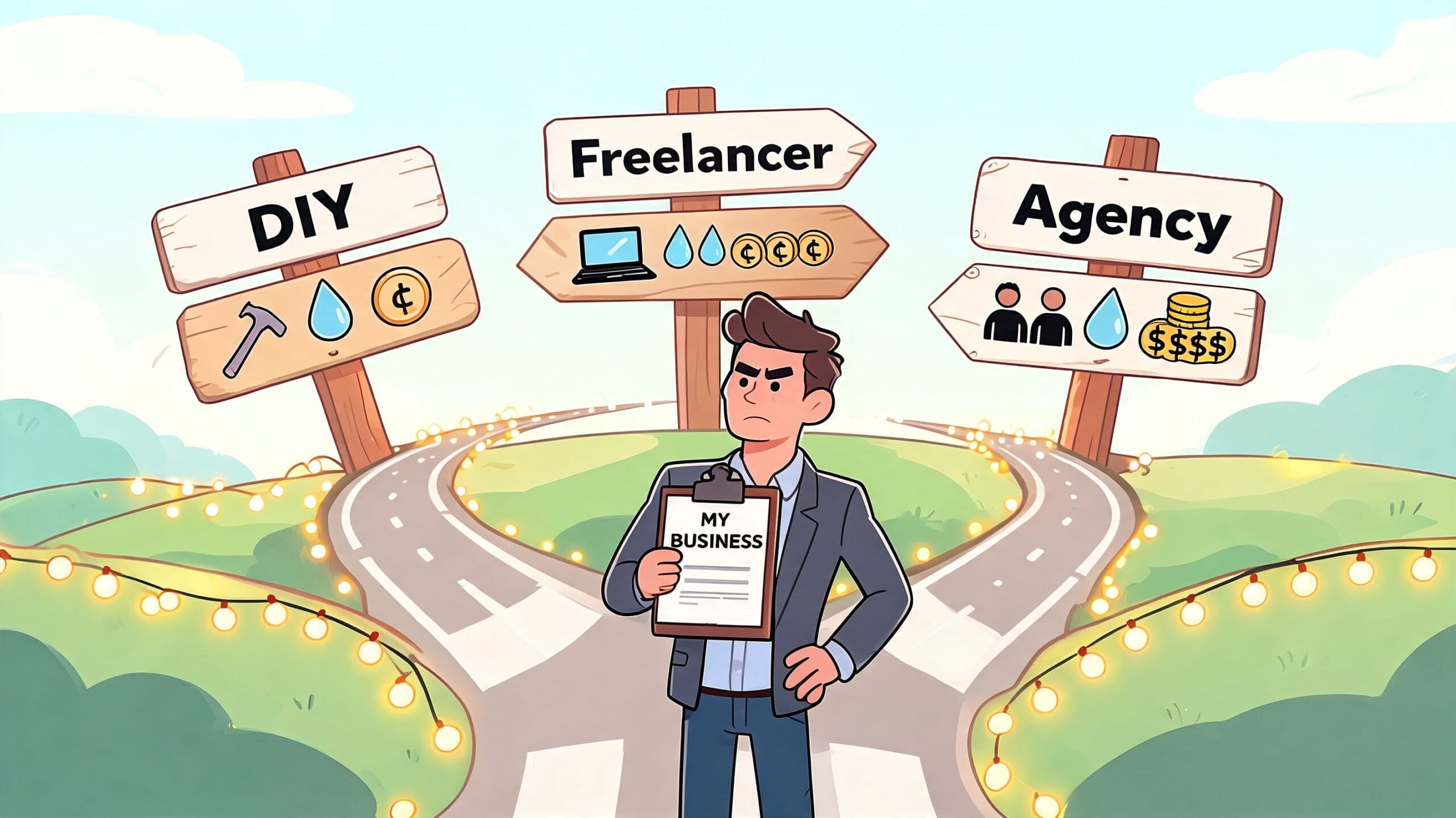
Pick the delivery model that matches your time, margins, and urgency. Getting this wrong is like buying a ute for a job that needs a van. You can still get to site, but you make life harder than it needs to be.
Option one, do the basics in house
DIY suits a small operator with tight cash flow, a simple service offer, and someone in the business who will keep at it every month. That usually means a sole trader, a family-run service business, or a small local shop with a manageable area and limited competition.
Start with the jobs that move the needle fastest:
- Google Business Profile: keep hours, phone number, service areas, and categories accurate
- Service pages: give each main service its own page instead of cramming everything onto the homepage
- Reviews: ask happy customers regularly, not in random bursts
- Contact clarity: make it easy to call, enquire, or book from a mobile
- Local relevance: mention the suburbs or areas you serve
DIY falls over for one reason. It gets pushed aside when the phone rings and staff are flat out. If that sounds familiar, do not pretend a half-hour on Friday afternoons will build steady search visibility.
Option two, hire a freelancer or consultant
This is the best fit when the business needs direction, clean-up work, or a sharper website, but does not need a full monthly retainer yet.
Use a freelancer or consultant for defined outcomes. Fix technical issues. Rewrite key service pages. Set up tracking. Improve local search basics. Get a clear 90-day action plan.
That approach works well for accountants, buyers' agents, psychologists, and other professional services where a few better pages and cleaner enquiry tracking can make a real difference. It can also suit trades that already get word-of-mouth leads but need their website to stop leaking opportunities.
If your site is clunky, slow, or unclear, deal with that before expecting SEO to perform. A better-structured site gives both SEO and ads a fair chance. If you need help on that side, website design and development for small businesses is often the first fix before more traffic becomes worth paying for.
Option three, hand it to an agency
Agency support suits owners who are time-poor, want consistent execution, and are ready to treat SEO like an ongoing marketing channel rather than a one-off tidy-up.
This is usually the right call when:
- the business has multiple services or locations
- nobody internally will manage SEO properly
- leads are valuable enough to justify steady monthly work
- the website, content, local SEO, and reporting all need attention at once
For a Brisbane law firm, accounting practice, or specialist medical clinic, agency support often makes financial sense sooner because one extra client can cover a decent chunk of the monthly cost. For a café or a low-margin operator, full-service SEO is harder to justify unless local search visibility is already proving it brings bookings or foot traffic.
Straight advice: If you keep saying, "We know we should do this, but nobody has time," pay for help or focus on ads first. Good intentions do not rank.
A simple way to choose:
| If the business has... | The better fit is usually... |
|---|---|
| Low budget, spare time, simple local offer | DIY basics |
| Moderate budget, some internal capacity, clear priorities | Freelancer or consultant |
| Limited time, multiple moving parts, need for consistency | Agency support |
Use one final test before deciding. Ask whether SEO needs to produce leads soon, or whether you can give it several months to build. If the business needs enquiries this month, start with paid ads and tidy up the website alongside them. If the business can invest steadily and wait for compounding returns, start SEO now and stick with it.
The right option is the one you will fund, maintain, and follow through on.
So Is SEO Worth It? The Final Verdict
Yes. For most small businesses, SEO is worth it.
But that answer needs a condition attached. SEO is worth it when the business can commit to a realistic budget, a realistic timeline, and the right channel mix for its model. It is not a magic fix for poor cash flow next week. It is not a substitute for a weak website. And it is not the best first move for every operator.
For a Brisbane professional service business, SEO is often a smart long-term investment. It builds visibility, trust, and a more durable flow of enquiries. For a trade business that needs urgent phone calls, paid ads may need to come first, with SEO built alongside or shortly after. For hospitality businesses, local visibility, accurate listings, reviews, and a clean mobile site often matter more than grand content plans.
That’s why the best answer to “is seo worth it for small business” is this: usually yes, but only when matched to the business’s timing and cash flow reality.
A sensible next step is simple. If the business isn’t ready for a full campaign, start with the basics. Clean up the Google Business Profile. Fix service pages. Make the website easier to use. Get lead tracking in place. If the business needs immediate demand, prioritise paid ads first. If it’s ready to build a longer-term asset, start SEO with clear expectations.
The businesses that get value from SEO usually aren’t the ones chasing hacks. They’re the ones making a calm, practical decision and sticking with it long enough for it to work.