

If a Brisbane accountant, mortgage broker, or insurance broker is still surviving on referrals and the odd Google Maps enquiry, the warning signs usually show up. A competitor starts appearing above them for the exact service they sell, the inbox slows down, and the phone stops ringing with the same reliability it once had. That's the moment Finance SEO Services stops sounding like a marketing extra and starts looking like a practical business decision.
For small finance firms, search isn't a vanity channel. It's where local buyers compare trust, service, and convenience before they ever make a call. With 18.3 million Australians aged 14+ using the internet for banking or financial services and 2.9 million using the internet to buy or sell shares or other financial investments in 2023–24, finance-related search behaviour is clearly mainstream, not niche, and 96.4% of households had internet access in the same period according to the ABS data cited in this market overview.
For a small business, that means SEO is not about chasing random traffic. It's about showing up when someone in Brisbane is ready to choose. That could be a family looking for a mortgage broker, a tradie needing an accountant, or a couple comparing insurance options. The firms that win are usually the ones that make their website easier to trust, easier to find, and easier to act on.
What Finance SEO Services Mean for a Small Business
A small finance business usually meets SEO through frustration. Referrals still arrive, but not enough to keep the pipeline full. A mortgage broker checks Brisbane search results and sees comparison sites, banks, and stronger local competitors above them. An accountant looks at a tidy website and still finds that the service pages nobody can discover are the ones that matter most.
finance SEO services exist to fix that gap. The job is to make a finance business visible for the searches that bring in enquiries, then make the site convincing enough that people take the next step. For a small firm, that means keyword planning, website cleanup, local visibility, and trust-building working together instead of separately.
What the work looks like month to month
A proper engagement usually starts with the basics. Someone checks whether search engines can crawl the site properly, whether service pages are thin or duplicated, and whether the business appears in local search with accurate information. Then the content gets tightened so each page answers one clear commercial question instead of trying to do everything at once.
Practical rule: if a page would make a busy business owner scroll for two minutes just to find the service, it probably isn't doing its job.
For a small firm, finance SEO has to work differently from generic SEO. It usually targets three kinds of searches, local intent queries like “mortgage broker in Brisbane”, high-intent product or service searches, and trust-driven research queries where a buyer is checking whether the business looks legitimate. That mix matters because finance buyers rarely convert after one visit.
Treating SEO like a side project is a mistake. Finance content deals with money, compliance, and trust, so a half-finished approach usually creates more noise than leads. A good provider should focus on service pages, suburb pages, FAQ content, reviews, and technical cleanup, then put the pages with the best chance of producing enquiries first.
For Brisbane operators, the test is simple. Does the work help the business appear for the right searches, answer the right questions, and turn local visitors into enquiries without wasting their time? If the answer is no, the package is padded with activity instead of outcomes. A small business SEO package from https://boocoo.au/blog/small-business-seo-packages/ should still be judged by the same standard.
The Five Core Components Inside Most Finance SEO Packages
A finance site has two jobs at once. Search engines need to crawl it cleanly, and people need to move through it without guessing where the service sits, what it does, or why they should trust it. The packages that work for small firms in Brisbane usually cover five streams, and each one has a clear job.
The technical layer comes first
Technical SEO is the plumbing, and it has to be right before anything else can perform. It covers crawlability, page structure, schema markup, speed, redirects, and the obvious errors that stop search engines from reading the site properly. For finance firms, broken paths cost enquiries because a user who hits a dead page often leaves for good.
Simple hygiene often does more than owners expect. A guide aimed at financial services specifically calls out fixing 404 errors and bad 301 redirects so users reach relevant pages instead of dead ends as noted in the Polaris Agency financial services guide. That may sound basic, but small firms skip it all the time, then wonder why content never gains ground.
Content and on-page work turn visibility into intent
Service pages, comparison pages, FAQs, and explainers make the site relevant to the search query. They help search engines match the firm to what the buyer is looking for, and they give the visitor a fast answer. A mortgage broker does not need one catch-all loans page if the business offers different products. A better structure is a separate page for each loan type, with copy a real person can scan quickly.
Local SEO handles the “near me” reality
For accountants, insurance brokers, and small planners, Google Business Profile, suburb pages, and citation consistency are often the fastest route to visibility in the right part of town. That matters because local search brings in enquiries that national comparison brands usually ignore. The website should support the map listing and give the same signals about location, service area, and trust.
Reputation management protects trust
Reviews, third-party mentions, and directory listings belong in the package because finance buyers check proof before they enquire. A business can rank well and still lose the lead if the reviews look thin or outdated. Search visibility gets the visitor. Reputation gets the call.
Compliance-aware review keeps the package usable
Finance content cannot be handled like generic lifestyle content. It needs disclosure hygiene, accurate claims, named authors, and regular review. That is the part that earns the fee, because sloppy finance pages can create more work later than they save now. A useful reference like Boocoo's small business SEO packages shows how a structured package is usually framed, but the true test is whether the scope covers the work that brings in finance enquiries.
Common Finance SEO Pricing Models Compared
| Pricing Model | Best Fit For | Main Risk |
|---|---|---|
| Monthly retainer | Firms that want steady growth and ongoing content, local SEO, and maintenance | Can get padded with vague activity if deliverables are not clear |
| Project-based pricing | Site rebuilds, audits, content sprints, or one-off clean-ups | The work stops once the project ends, so gains can stall |
| Performance or hybrid | Owners who want some budget protection and measurable milestones | Incentives can get messy if the provider chases the wrong metric |
For small budgets, the default should usually be a modest retainer with a tight scope. The quote needs to spell out what is included, who writes the content, whether revisions are counted, and whether tools or stock images are extra. If the provider cannot explain that clearly, the proposal is probably hiding cost somewhere.
For a practical cost context, an owner comparing marketing spend can also look at an accountant cost guide like EndureGo Tax's small business accountant cost resource, not because it is an SEO service, but because it helps frame what small businesses already expect to pay for specialised professional work. SEO should be judged the same way, by scope, expertise, and ongoing value, not by headline price alone.
Realistic Timelines and Outcomes for Small Finance Firms
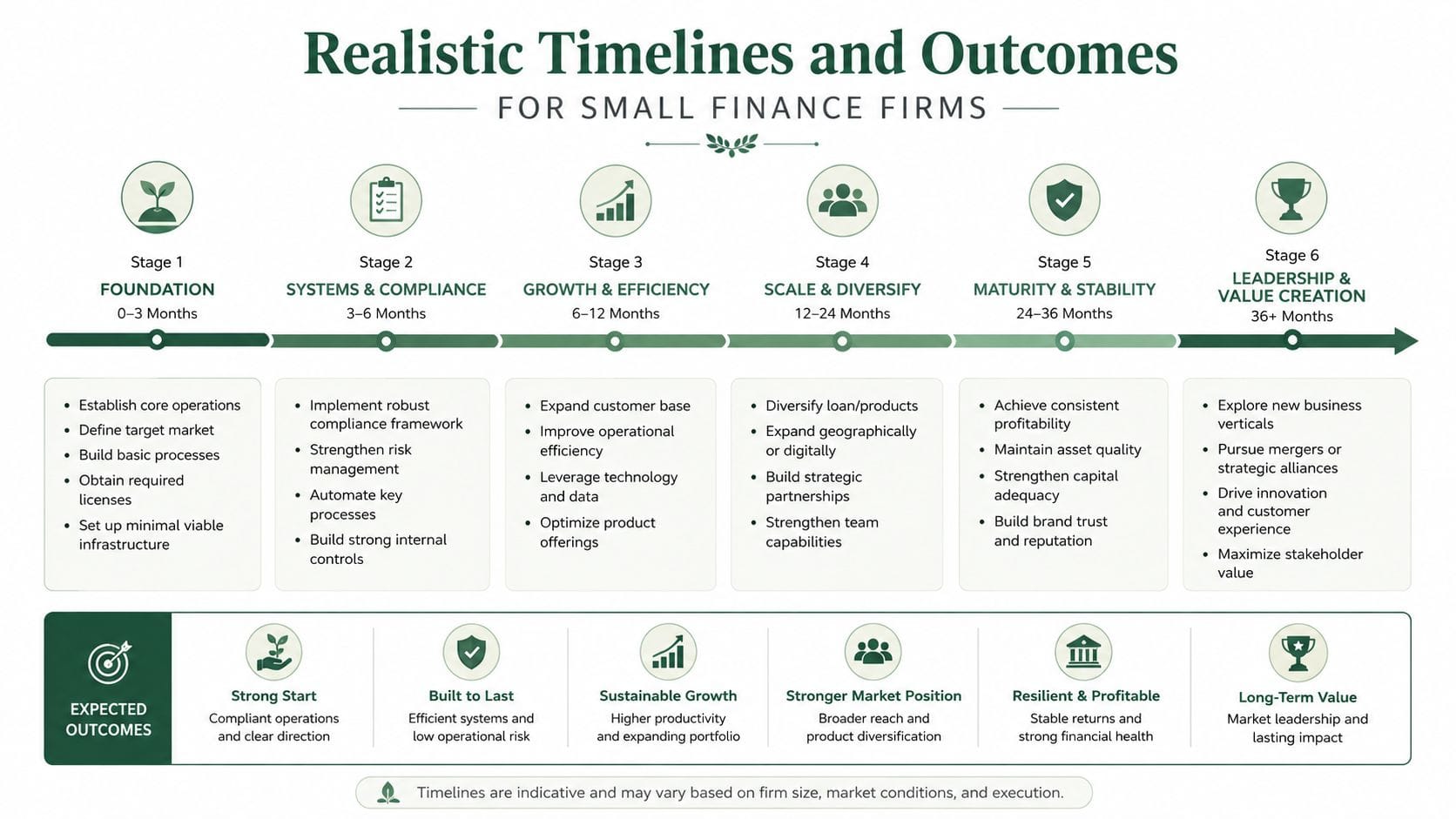
A finance SEO campaign doesn't fail because the strategy is wrong. It usually fails because the owner expects lead flow before the search engines have any reason to trust the site. That's a bad bet for a small finance firm, especially one starting with a thin site, weak local presence, or outdated service pages.
The first wins are usually unglamorous. Technical fixes, better indexing, a cleaner Google Business Profile, and basic page repairs can improve how the site is seen and served. That's not the same as becoming a lead machine. It just means the shopfront is finally open and tidy.
What to expect early
In the early phase, the sensible metrics are impressions, crawl health, local listing visibility, and the first lift in branded searches. Those are signs that the site is becoming easier to discover. They're not vanity metrics when they map to a real improvement in search access.
What starts compounding later
Content, links, and authority take longer because they depend on trust. A Brisbane financial planner with a serviceable site might see small improvements quickly, but the stronger gains usually come once the site has enough content depth and internal linking for search engines to understand what the business does. That's why pulling the plug in month three is a common mistake.
A finance firm that quits after the setup phase often mistakes “noisy progress” for “no progress.”
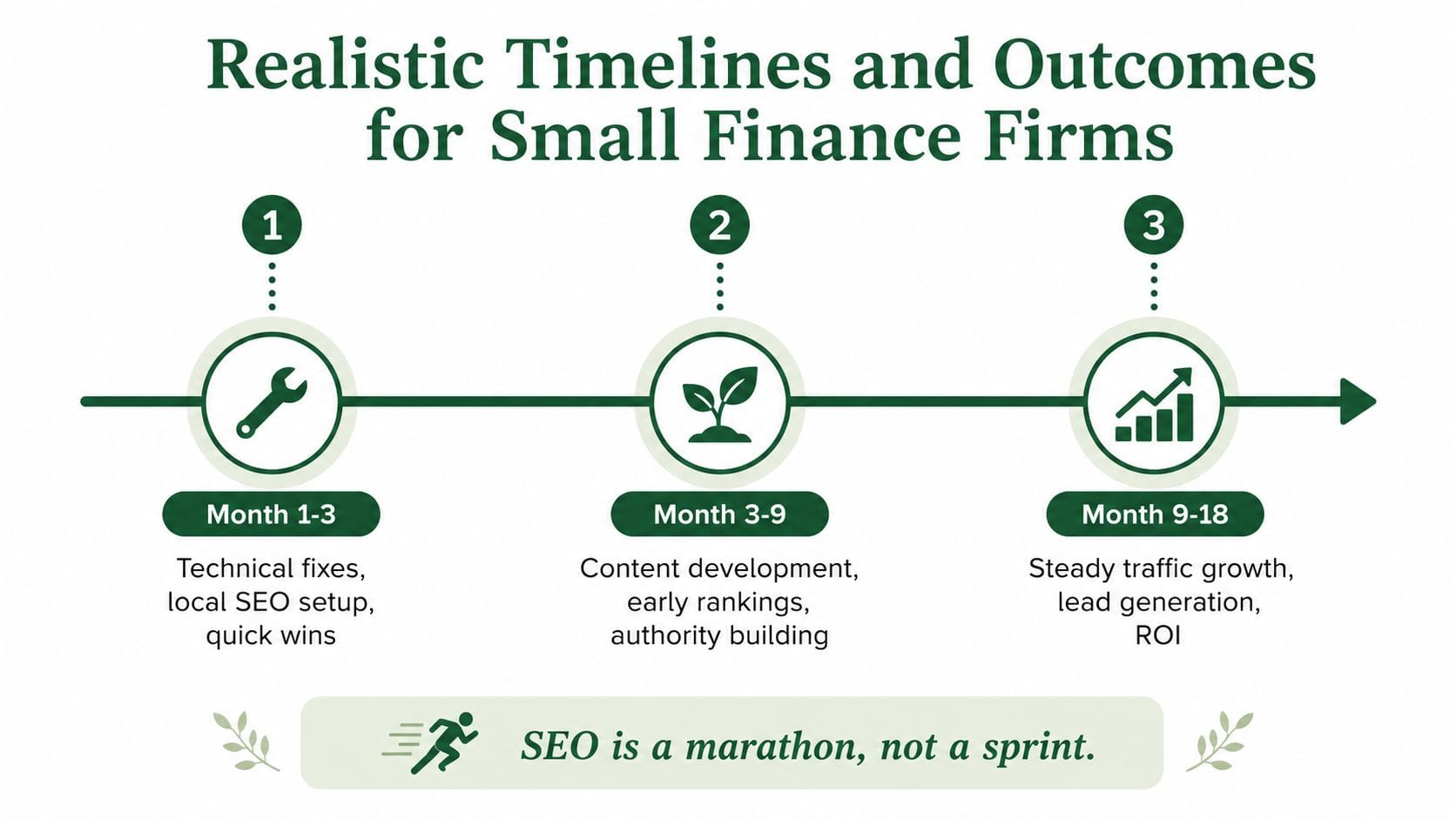
The other trap is judging everything by enquiries in the first month. That's like planting a hedge and checking for privacy the next morning. SEO works differently. A business should expect the first phase to improve visibility, the second to build relevance, and the third to bring steadier lead generation.
The most useful outcome metrics are enquiry volume, assisted conversions, and branded search growth. If those trend in the right direction, the campaign is doing real work. If the provider keeps talking only about rankings without connecting them to leads, the reporting is too shallow.
For a small finance firm, realistic expectations protect the budget. A clean strategy won't create instant miracles, but it should create a better search footprint quickly and a stronger lead engine over time. That's the trade-off worth paying for.
How Finance SEO Pricing Models Compare for Small Budgets
A cheap SEO quote often looks tidy until the work starts. Then the business finds out the fee does not cover content, revisions, technical fixes, or local optimisation, and the extras start piling up in separate invoices.
Small finance firms usually see three pricing models. Retainers spread the cost and keep the work moving each month. Projects suit a site audit or a full rebuild. Performance deals sound attractive on paper, but they can push the provider toward easy wins instead of the pieces that move finance leads.
What a sensible budget conversation sounds like
A proper quote should spell out what gets produced, how often it gets reviewed, and whether writing is included. If a provider talks about SEO without mentioning service pages, internal linking, local listings, or compliance review, the scope is too vague. The same warning applies when the quote hides a long list of extras that only appear after the contract is signed.
A better value check is simple. Ask what the business gets in the first 90 days. That should mean clear priorities, not just activity. A mortgage broker may need technical clean-up first, then service page expansion, then suburb-specific support. An accountant may need fewer pages, but more refinement on the pages already on the site.
The right budget conversation is also about fit. A Brisbane firm that wants local leads should pay for work that helps it show up in suburb searches and on the service pages that convert, not for broad activity that looks busy and does little else.
Where hidden costs creep in
Stock imagery, specialist copywriting, paid tools, and design tweaks can blow out a budget if they are not discussed upfront. That is normal. It is also why the cheapest proposal rarely stays the cheapest.
A useful comparison is a local SEO package next to a broader service mix. A Brisbane owner comparing low-cost options can read Boocoo's low cost SEO services guide and then test whether the same logic still works for finance, where trust and compliance make shortcuts more dangerous. The same cost question shows up in other service industries too, and the EndureGo Tax cost guide is a good reminder that price only makes sense when the scope is clear.
The safest default for small finance firms is still a modest retainer with a clear deliverable list. That gives the business ongoing optimisation without turning the engagement into a blank cheque.
Compliance, E-E-A-T, and Trust Signals Finance SEO Cannot Skip
Finance content sits in YMYL, the category search engines treat as Your Money or Your Life material. That matters because the site isn't just trying to win attention, it's trying to earn trust around decisions that affect people's money. For a small business, that means every public page needs to be accurate, current, and easy to verify.
What E-E-A-T looks like on a real finance site
In practice, E-E-A-T means named authors, clear credentials, transparent sourcing, and content that reads like it was written by someone who understands the service. A mortgage article with no author bio, no disclosure, and no review date is a weak signal. A service page with a verifiable author or reviewer, a clear disclaimer, and language that avoids overpromising is much stronger.
Compliance also affects the words on the page. Finance businesses can't be sloppy with rates, comparisons, or claims about outcomes. The safest pages separate education from promotion and make disclosures obvious. That's where a provider with compliance-focused call handling can be relevant as a supporting tool, because the way a business answers finance enquiries needs to stay consistent with the promises made on the site.
What to audit on the site today
- Author details: every money-related page should show who wrote or reviewed it, with a real bio.
- Disclosure hygiene: any assumptions, limitations, or affiliate relationships need to be visible.
- Freshness: rate-sensitive and regulation-sensitive content needs scheduled review, not a “publish and forget” approach.
- Clear intent: educational content should teach, while service pages should sell without exaggeration.
- Support infrastructure: if the business takes calls, the answering process should match the tone and compliance standards of the website.
AI search makes this more important, not less. Generic explanatory pages are easier for answer summaries to replace, so small firms need content that has local detail, original insight, and proof that can't be copied into a generic summary. That's also why a small business should keep a close eye on review workflows and legal review for content touching finance, lending, or regulated advice.
A helpful internal reference for the overlap between finance marketing and legal caution is Boocoo's legal SEO services guide, because the same discipline around accuracy, review, and risk-aware wording applies across both spaces. In finance, trust is the ranking asset that never goes out of date.
Why Local-Intent Finance SEO Beats Competing With National Brands
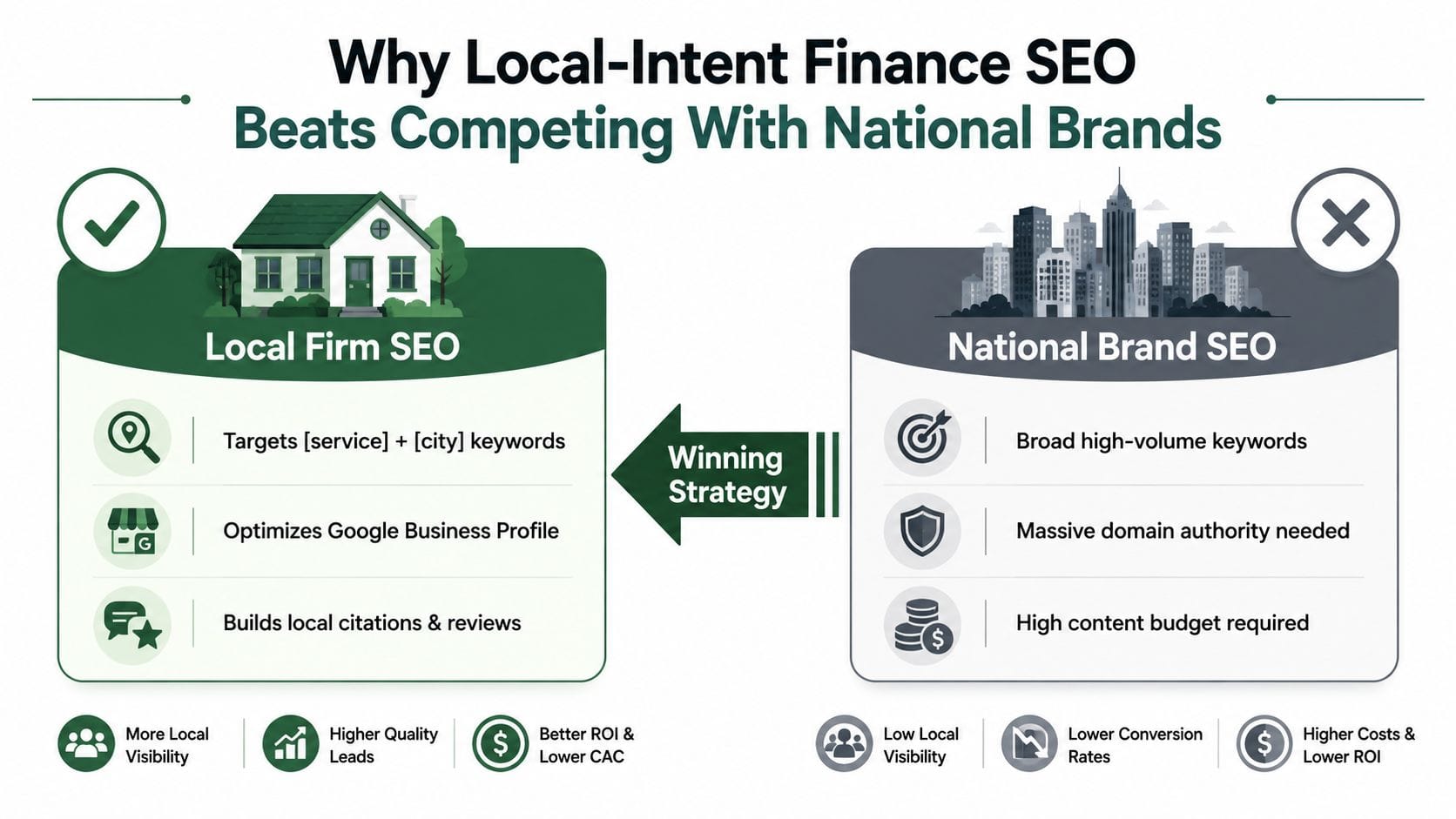
A small finance firm should stop trying to win every bank, comparison site, and national aggregator. That fight burns budget fast. The better move is to own the searches that signal a buyer is close to choosing someone local.
A Brisbane accountant in Camp Hill does not need national visibility for broad accounting terms. They need nearby searchers who are looking for a service and a suburb. The same logic applies to a mortgage broker in Chermside or a planner serving North Brisbane. Those searches bring less volume, but they sit much closer to a call, a form fill, or a booked appointment.
How to find the right local queries
The clue sits in the service plus location pattern. These pages work only when the business can serve that area and when the content gives people a real reason to trust the firm over a generic national result. That means no copy-paste suburb pages with only the place name swapped out.
A dedicated page makes sense when the business has a real location or a clear service area with enough demand to justify it. If that is missing, the better move is to strengthen the main service page with local proof, local language, and clear contact details. Thin content spread across ten suburbs looks cheap and usually performs that way too. One solid page that answers the searcher's question is worth more than a pile of weak location pages.
What local dominance usually needs
- Google Business Profile support: accurate categories, services, opening hours, and contact details.
- Suburb relevance: natural references to nearby areas, not forced keyword stuffing.
- Local citations and reviews: enough consistency for search engines to believe the business is real and active.
- Unique content: different angles for different services, not duplicated text across locations.
For a practical reference on building that kind of local page structure, see local SEO for small businesses. For banks and lenders, a useful companion guide is geographic content for banks and lenders. Local content wins when it reflects the geography of the buyer, not the size of the brand.
A local-first strategy changes the competitive field. Instead of fighting the biggest names in the country, a small firm focuses on the area it can serve well. That is where a modest budget goes further, and where a Brisbane agency with local market context often has an edge over a remote team forcing a one-size-fits-all approach.
How to Choose a Finance SEO Provider in Brisbane
The right provider should sound practical, not theatrical. If they promise instant rankings, vague “growth,” or a secret formula, walk away. Finance SEO is methodical work, and small businesses need someone who can explain the trade-offs in plain English.
A Brisbane owner should ask four things up front. Have they worked in finance-adjacent services before. Do they have a compliance-aware content process. How often do they report progress. What exactly is included in the fee. If the answers are fuzzy, the proposal is probably too.
A good comparison point is Boocoo's SEO companies for small business guide, because it helps frame what a local operator should expect from a practical service partner. Boocoo is a Brisbane-based option that handles SEO, web design, social media management, and paid advertising, which suits owners who want fewer vendors and less admin.
A simple decision checklist
- Finance experience: ask for examples from accountants, brokers, planners, or similar professional services.
- Scope clarity: check whether technical, content, and local work are all included.
- Compliance process: ask who reviews the content before it goes live.
- Reporting: make sure the provider talks about enquiries, not just rankings.
- Local fit: a Brisbane agency should understand suburb dynamics, service areas, and small-business budgets.
The first 90 days should feel organised, not exciting. There should be a technical audit, a short priority list, clear content work, and reporting that shows whether the site is becoming easier to find and easier to trust. That's the kind of start that usually leads to something useful.
If a finance business in Brisbane wants a grounded next step, the smart move is to compare two or three providers against the same checklist, then choose the one that can explain what they'll do, why it matters, and how it fits the budget. For a direct conversation, Boocoo can be reached on 1300 093 797 or hello@boocoo.au.