

A Brisbane firm can do excellent work, keep clients happy, and still feel strangely hard to find online. The phone rings from referrals, the inbox gets the odd enquiry, the website looks professional enough, and yet Google sends almost nothing useful. That gap is where legal SEO services either become a smart lead engine or a quiet budget leak.
For small firms, the problem usually isn't “we need more marketing.” It's that the firm needs a reliable way to attract the right people before a competitor, a directory listing, or a paid ad gets there first. In legal search, that matters because 96% of people seeking legal advice start with a search engine, and 70% of mobile searchers call a firm directly from the results, according to legal-services research cited in industry analysis (legal-services consumer search behaviour). That's not a branding issue. It's a pipeline issue.
If the firm's online reputation also feels scattered, it's worth reading the Digital Footprint Check reputation guide alongside the search strategy. A strong website without trust signals is like a well-lit shopfront with the door half hidden.
When a Good Law Firm Is Invisible Online
A sole practitioner in suburban Brisbane can be doing solid work every day, getting thank-you emails from clients, and still be invisible where it matters most. The website might load fine, the service pages might look polished, and the firm might even have a decent logo. None of that helps if nearby people searching for family law, conveyancing, or a practical first consultation never see the firm in Google.
Referrals feel safe, then growth stalls
Referral work is comfortable because it arrives with trust already attached. The trouble is that it also caps growth, because it depends on other people remembering to send work and on the firm staying front-of-mind. That's fine for a while, but it's a fragile base for a practice that wants more control over lead flow.
Search changes that equation. It gives a firm a chance to show up the moment someone types a problem, a suburb, or a practice area into a browser. For Brisbane firms, that matters because local and suburb-level searches often map directly to a call or consultation, which is exactly why legal SEO services exist in the first place.
A helpful way to think about it is this, referral marketing is a handshake, search visibility is the sign out front. A firm can be excellent at both, but only one of them works while the partners are in court, on leave, or too busy to network.
Practical rule: if Google is not sending qualified enquiries, the firm does not have a visibility problem alone, it has a demand-capture problem.
A lot of firms discover this too late, after paying for a website refresh that looks better but behaves the same. The site becomes a nicer brochure instead of a lead source. That's why marketing planning should be tied to how clients search, not just how the firm wants to describe itself, and the Boocoo law firm marketing overview is useful as a broader context for that decision.
Why legal SEO exists at all
Good SEO for lawyers is not about chasing vanity rankings. It is about making the firm findable at the moment of intent, then making the page convincing enough to earn the call. In other words, the site has to do the part a receptionist, a front counter, and a first consultation would normally do together.
That is why legal SEO services are built around search behaviour, local relevance, and trust. They are meant to plug the hole between “the firm does good work” and “the market can find the firm.” Without that bridge, even capable firms stay dependent on word of mouth, and word of mouth rarely scales cleanly.
What Legal SEO Services Actually Include
A proper legal SEO engagement is less like buying one product and more like hiring a small crew to fix a building. One person checks the foundation, another makes the signage clear, another polishes the street frontage, and another makes sure the address is the same everywhere. Miss one of those jobs and the whole thing feels off.
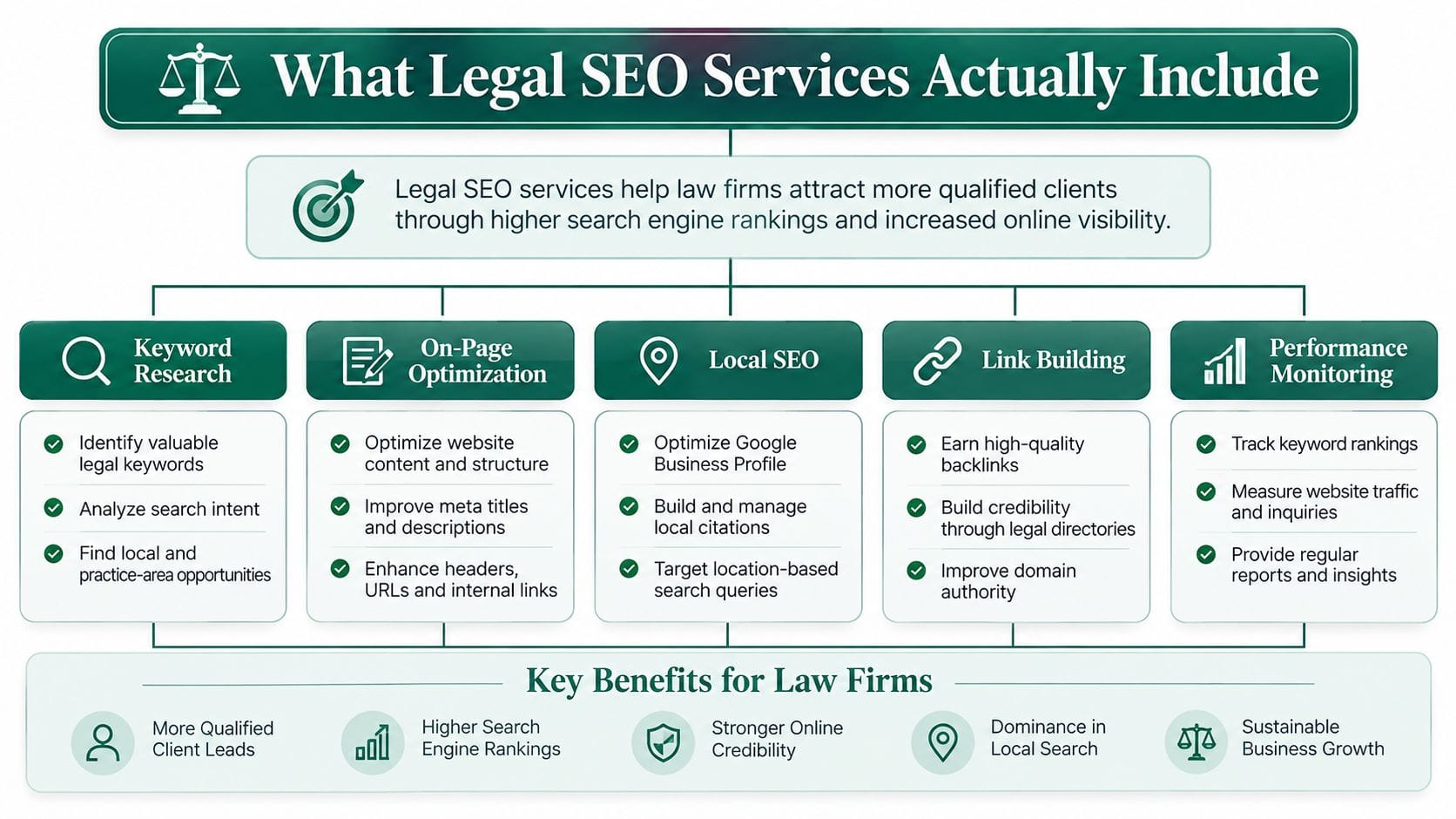
The five jobs that matter
Technical SEO is the wiring and plumbing. It checks whether search engines can crawl the site cleanly, whether the pages load properly, and whether the structure helps or confuses the machine. If the site is clunky underneath, no amount of polished wording will fully fix it. A decent technical audit should lead to a clear list of repairs, not a vague score.
Local SEO is the street address and storefront. For Brisbane firms, that means Google Business Profile management, suburb relevance, office consistency, and service-area clarity. A strong local setup helps the right office appear for the right search, which matters when a firm has more than one location or serves nearby suburbs.
Content strategy is the way the firm explains itself in plain English. The best legal content does not read like a lecture. It answers the question a real person is asking, then points that person towards the next step. That is where SEO content writing services become useful, because content without intent is just expensive typing.
Citations and reviews are the reputation layer. Search engines look for consistency across directories, and people look for proof that the firm is active, credible, and easy to contact. Good legal SEO services treat reviews as part of the trust system, not as a vanity extra.
Authority building is the networking layer. It covers links, references, and mentions from relevant sites that help establish the firm as a legitimate entity in its field. This work is slow, but it matters because legal search is crowded and trust-sensitive.
A quick comparison helps make the priorities clearer.
| Service | What it covers | Typical output |
|---|---|---|
| Technical SEO | Crawlability, site structure, speed, mobile usability | Audit notes, fixes, prioritised action list |
| Local SEO | Google Business Profile, suburb signals, map visibility | Cleaner local presence, location pages |
| Content strategy | Practice-area pages, FAQs, service explanations | Page briefs, updated copy, topic plan |
| Citations and reviews | Directory consistency, review management | NAP cleanup, citation list, review workflow |
| Authority building | Links, mentions, relevant references | Outreach targets, earned links, brand mentions |
The strongest proposals do not try to sell all five as equal on day one. They sequence the work. A small firm usually needs the foundation and local visibility sorted before it worries about broader authority building.
Bottom line: if a vendor can't explain which job comes first and why, the proposal is probably too generic to be useful.
Ethics, Trust Signals, and the Lines SEO Must Not Cross
Legal marketing in Australia does not reward clever shortcuts. A firm's website, profile pages, and directory presence need to build trust without misleading the public, and that changes the way SEO should be handled. The safest approach is the one that can stand up to scrutiny from a client, a regulator, and a competitor at the same time.
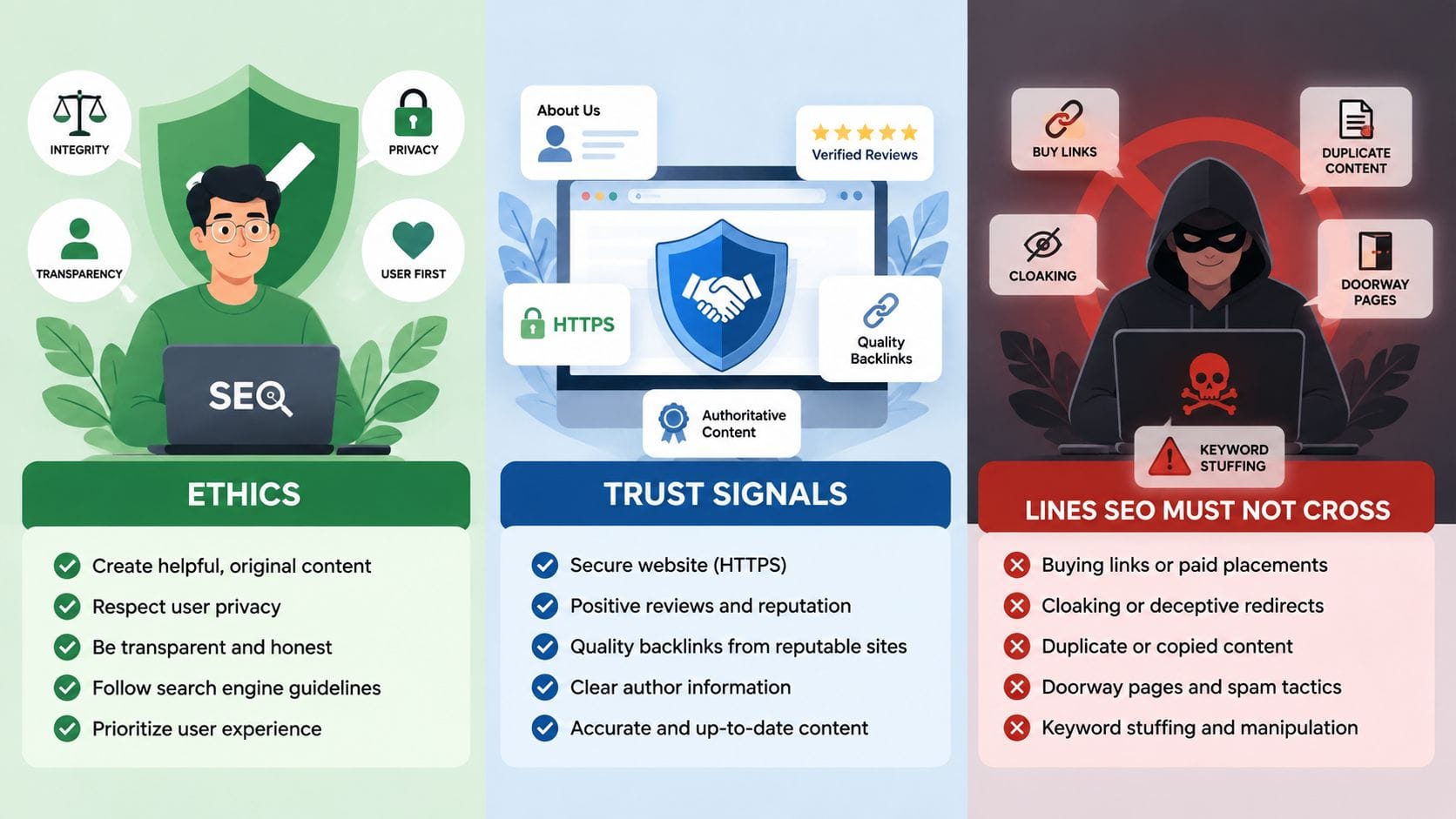
Trust signals are part of compliance
A competent SEO team does not split compliance from visibility. It keeps the firm name, practitioner details, service descriptions, and location information aligned across the website and business profiles. Structured data and local entity consistency matter here, because legal SEO checklists emphasise LegalService and LocalBusiness schema, attorney or person schema, and identical NAP details across citations so search engines can connect the firm's website, Google Business Profile, and directories (legal SEO checklist on structured data and NAP consistency). If the firm is still setting up its presence, start with how to add your business to Google before you worry about anything more ambitious.
The practical point is simple. Inconsistent online footprints make it harder for search engines to decide what the firm is, where it is, and what it offers. That weakens trust signals and blurs local relevance.
Aggressive optimisation is not the same as good optimisation
Legal SEO crosses the line when it starts using promises, comparisons, or signals that create a false impression. Inflated claims, vague practitioner identity, and content that sounds persuasive while obscuring the firm's real experience all create avoidable risk. Strong agencies avoid that work because risky optimisation creates cleanup later, and that bill usually lands on the client.
A court brief offers the cleaner model. Strong arguments persuade because they are organised, specific, and credible, not because they shout louder than everyone else. The same logic applies online, and how to write a persuasive brief is a useful reminder that clear structure beats noise.
Reviews, awards, and history should support the truth
Reviews help because they show human proof. Awards can help if they are real and relevant. Discipline history, if it exists, should never be hidden or dressed up by sloppy marketing language. A serious SEO provider builds around facts, not spin.
That is why legal SEO should feel calm, not flashy. The right vendor improves clarity, consistency, and discoverability without pushing the firm into claims it cannot defend. That approach is safer, and it usually converts better because people trust firms that sound like they know exactly what they are doing.
Pricing, Timelines, and KPIs That Drive Results
Most SEO conversations go sideways the moment price enters the room. A low quote can look attractive to a small firm with a tight budget, but cheap legal SEO usually means thin strategy, recycled content, and reporting that flatters the vendor more than it helps the client. The better question is not what it costs, it is what work will happen every month.
What credible budgets and timelines sound like
Industry benchmark data reports that law firms typically invest around $120,000 to $150,000 per year in SEO, with an average 7.4% visitor-to-lead conversion rate, a 14-month break-even period, and a 526% three-year ROI. Those figures are not Australia-specific dollars, but they are widely used benchmarks in mature English-speaking legal markets, and they show that legal SEO has become a serious acquisition channel rather than an experimental side project (legal SEO benchmark data).
Brisbane firms should not copy those numbers blindly. The point is the shape of the spend, because real SEO takes time. Search engines do not reward a fresh page on faith alone, they reward steady improvement, so meaningful movement tends to show up over months, not days.
A vendor quoting a miracle turnaround is selling comfort, not strategy. A better partner will explain which work starts immediately, which work compounds later, and what the firm should expect to see first.
Practical rule: if the proposal sounds cheaper than the labour required to do the job properly, something important has been left out.
A useful budget conversation also includes scope. Compare different pricing plans and check what is included, because one-off fixes, ongoing content, local optimisation, and link work are not interchangeable line items. If a vendor can only sell a bundle without explaining the moving parts, the firm is buying a black box.
Boocoo offers one practical model here, technical audits, on-page content, link building, and Brisbane suburb-focused local SEO. A firm does not need every tactic at once, but it does need a provider who can say which part of the engine is being tuned.
The KPIs that matter for a law firm
Traffic is useful, but it is not the scoreboard. Rankings are useful, but they are not the scoreboard either. A legal practice should care more about qualified consultations, signed retainers, and matter value, because those are the outcomes that pay the bills.
Monthly reporting should show which pages produced calls, which enquiries were relevant, and which sources brought in work the partners would want more of. That is the core value of legal SEO services, and it is why cheap search engine optimisation services often disappoint small firms. Cheap reporting usually measures activity, not revenue.
A useful report also separates visibility from conversion. A page can rank well and still miss the mark if it attracts the wrong search intent. A page that drives fewer visits but more consults is the stronger asset, and a serious agency will say that plainly.
Boocoo's mix of technical audits, content, links, and local suburb targeting points in the right direction because it ties work back to commercial outcomes. That is the standard to hold every proposal to, because lead volume alone does not keep a Brisbane practice profitable.
How to Evaluate a Legal SEO Vendor in Brisbane
A Brisbane law firm should treat vendor selection like a due diligence exercise, not a personality contest. Polished slides are easy. Clear answers are harder. The right questions quickly separate a specialist from a generalist who has merely read a few legal SEO articles.

Ask for proof, not promises
Start with legal-sector examples. A vendor should be able to explain what changed, what was prioritised, and how success was measured without hiding behind vague language. If the only proof is “we do SEO for everyone,” that is not proof. It is positioning.
The reporting format matters just as much. A useful report should show work completed, pages improved, visibility changes, enquiry trends, and next actions in language a partner can skim quickly. Anything that needs a translator is a waste of time.
Find out who actually does the work
Many firms are sold by a senior person and serviced by a junior team that never appears in the pitch. That is not automatically a problem, but it should be clear up front. Ask who writes the pages, who handles technical fixes, who manages links, and who answers questions when the firm needs a fast response.
Link building deserves special scrutiny because it can be handled badly. A proper approach should sound measured, relevant, and relationship-based, not like a churn machine. The same applies to content, which should be written by someone who understands legal search intent rather than by a generic copywriter trying to sound authoritative.
Use a simple red-flag checklist
- No legal examples: If the vendor cannot point to legal-sector work, the learning curve will likely fall on the client.
- Guaranteed rankings: Guarantees usually mean shortcuts, and shortcuts in legal marketing rarely age well.
- Vague reporting: If the monthly update avoids calls, enquiries, and page-level actions, it is mostly decoration.
- Unclear ownership: If no one can say who writes, edits, and approves the work, delays are coming.
- Overblown link talk: If the proposal focuses on link volume more than relevance and quality, caution is sensible.
For smaller firms comparing options, a small business SEO firm may be a better fit than a large agency that spreads attention too thinly. The issue is not size alone. It is whether the team can stay practical, responsive, and grounded in how a Brisbane practice sells.
Short test: if a vendor cannot explain the first month in plain English, the firm should not expect clarity by month six.
A Brisbane Example and What Ninety Days Should Look Like
A three-partner Brisbane suburban firm wants more family law and conveyancing enquiries. The partners are busy, the website looks dated but functional, and most new work still comes from referrals. They do not need a fancy brand campaign. They need the firm to show up properly when local people search for help.
The first move is usually boring, and that is a good sign. Technical fixes come first, because a site that is difficult to crawl or awkward to use does not deserve content expansion yet. The Google Business Profile gets cleaned up, the practice areas get clarified, and the citation list gets checked for mismatched names, addresses, and phone numbers.
The next layer is the money layer. Core practice-area pages need to match how people search, not how lawyers label themselves internally. That means pages that answer immediate questions, explain the process in plain English, and make it easy to contact the firm without digging through menus.
By the end of month one, the partners should expect cleaner foundations, not miracles. They should be looking for fewer technical issues, clearer local signals, and a site that finally feels aligned with the practice instead of just attached to it. Month three should look more organised at the page level, with more relevant enquiries and fewer random contacts from people who were never a fit in the first place.
The measure is not whether one keyword moved a little higher. It is whether the firm's visibility became more useful. If the phone starts ringing with the right sort of matters, the strategy is working. If traffic rises but the inbox fills with poor-fit leads, the pages are attracting attention without earning trust.
A good agency will explain that difference without defensiveness. That is the kind of accountability Brisbane firms should demand from any SEO partner, because it keeps the work tied to actual revenue instead of reports that look busy.
Putting It All Together and Your Next Move
The decision usually comes down to three things. First, the problem is real, because legal search starts with intent and the first page gets the attention. Second, the budget needs to be honest, because proper SEO is labour, not magic. Third, the vendor has to understand legal-sector constraints, because generic SEO can waste months before anyone notices the fit was wrong.
Brisbane firms do not need louder marketing. They need clearer positioning, cleaner local signals, and content that turns search intent into real enquiries. That is the practical value of legal SEO services when they are done properly. They make the firm easier to find, easier to trust, and easier to contact.
The next move is straightforward. Pull one proposal apart line by line, ask what will be done in the first ninety days, and check whether the reporting focuses on enquiries that matter rather than vanity numbers. If the answers feel fuzzy, keep looking. If the answers are specific and grounded, the firm is probably talking to the right kind of partner.
For Brisbane owners who want a low-pressure conversation about search, content, and local lead generation, Boocoo's team can walk through goals, timelines, and the next steps without the hard sell.