
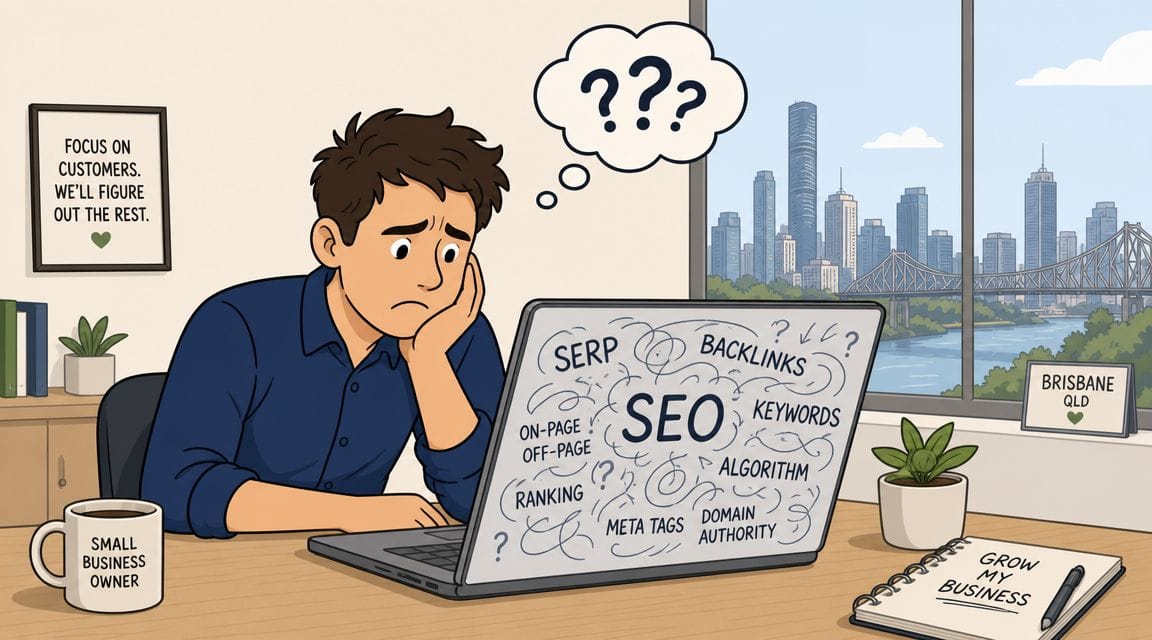
A Brisbane business owner usually reaches SEO at the same point. The website exists, the Google Business Profile was set up at some stage, a few competitors keep showing up ahead in search, and every agency pitch sounds like a different language. One talks about authority. Another talks about technical fixes. A third promises leads but won't explain what they'll do each month.
That confusion is normal. SEO for a small business isn't hard because every part is mysterious. It's hard because there are too many moving parts when time is already tight. A tradie in Chermside, a physio in Indooroopilly, or a café in West End doesn't need more jargon. They need a practical way to decide what matters, what can wait, and who can help without turning it into a bloated project.
Feeling Lost with SEO? You're Not Alone
A lot of Brisbane owners know SEO matters, but they haven't had the time to turn that into a proper plan. That's not unusual. A national industry report noted that 70% of small businesses do not have an SEO strategy, while 53% said they began their SEO strategy in the last three years, which shows many owners are still in the early stages of getting organised, as outlined in this small business search marketing survey.
Why SEO feels harder than it should
Most small businesses don't struggle because they're careless. They struggle because SEO gets sold as an all-or-nothing service. One firm says content is the answer. Another says links matter most. Another wants a long retainer before touching the basics.
That leaves owners stuck between two bad options. They either do nothing, or they sign up for work they don't fully understand.
Practical rule: A small business SEO firm should make the process simpler, not more confusing.
What a smart buyer looks for
A smart buyer doesn't need to become an SEO specialist. They just need enough clarity to ask better questions. That means knowing whether the business needs local search cleanup, stronger service pages, technical fixes, or a more complete campaign.
For some businesses, SEO isn't only about Google search results either. If a business relies on tutorials, demos, or product walkthroughs, it may also help to understand how to optimize YouTube content so search visibility improves across another channel customers already use.
The useful shift is this. The goal isn't to “learn SEO.” The goal is to avoid wasting money on the wrong scope, the wrong expectations, and the wrong partner.
First Steps Before You Search for a Firm
Before searching for a small business SEO firm, a Brisbane owner should sort out one issue first. Does the business need a full SEO engagement, or just local SEO hygiene? That question matters because many businesses don't need a big monthly campaign straight away, and guidance from this local SEO strategy guide makes the same point while noting that 70% of small businesses lack an SEO strategy.
Decide what “success” actually means
SEO only works when the target is clear. “More visibility” sounds good, but it's too vague to guide a firm.
A better starting brief is one of these:
- More calls: Good for plumbers, electricians, pest control, locksmiths, and mobile services.
- More bookings: Useful for clinics, salons, consultants, and classes.
- More walk-ins: Relevant for cafés, retail, and local hospitality.
- Better quality leads: Important for legal, finance, accounting, and other higher-consideration services.
A New Farm café and a northside roofing business shouldn't buy the same SEO package. One cares about local discovery and map visibility. The other may care more about suburb service pages and phone enquiries.
Work out whether the issue is visibility or conversion
Sometimes the business doesn't have an SEO problem first. It has a website problem.
If visitors arrive but don't call, book, or enquire, the site may need stronger page structure, clearer service messaging, or better mobile usability. If hardly anyone finds the site at all, then search visibility is the first gap to fix.
A simple self-check helps:
- Search the business name. Does the business show up clearly and consistently?
- Search a service plus suburb. Does the site appear anywhere useful?
- Open the site on a phone. Is it fast, readable, and easy to contact?
- Check the Google Business Profile. Are hours, categories, photos, services, and reviews current?
A business that skips this homework often gets sold a bigger campaign than it needs.
Build a one-page brief before talking to agencies
This saves time on every sales call. It also makes it easier to compare proposals.
Include:
- Core services: The main money-making services, not every minor task.
- Target areas: Brisbane suburbs or regions that matter most.
- Main goal: Calls, leads, bookings, foot traffic, or online sales.
- Current assets: Website, Google Business Profile, blog, social pages.
- Constraints: Limited budget, limited staff time, slow website, old CMS, no content writer.
This brief doesn't need polished language. A plain list is enough.
Know when local SEO hygiene is enough
For many service businesses, local SEO hygiene covers the highest-value basics. That usually means a complete Google Business Profile, accurate business details across directories, solid service pages, review management, and a mobile-friendly website.
A full SEO firm makes more sense when the business has multiple services, several target suburbs, stronger competition, or a website that needs technical and content work at the same time. The point is prioritisation. A small business should buy the smallest useful solution first, not the biggest package on offer.
How to Vet a Brisbane SEO Firm Like a Pro
Not every agency that says “local SEO” understands Brisbane buying behaviour. A firm might rank for broad marketing terms, but that doesn't mean it knows how to help a plumber in Chermside, a lawyer in the CBD, or a medical clinic in Carindale win local search demand.
That local experience matters because in Australia, 99% of people have used the internet to find information about a local business, and a verified Google Business Profile can receive around 200 clicks or interactions per month, according to these local SEO statistics. For a Brisbane operator, local visibility isn't optional. It's often the first place a customer decides who to contact.
Start with signs on their own website
A firm's website should tell a clear story. It should explain services in plain English, show the types of businesses it works with, and make it obvious how reporting and communication work.
Look closely at these areas:
- Service pages: Do they explain local SEO, technical SEO, content, and Google Business Profile work in practical terms?
- Location relevance: Do they show Brisbane knowledge, or could the copy belong to any city?
- Proof of process: Do they describe what happens after onboarding?
- Contact path: Is it easy to start with a simple call, or does everything feel like a hard sell?
If the website leans on buzzwords and avoids specifics, the sales call usually goes the same way.
Read reviews for detail, not just sentiment
A review that says “great team” is fine, but it doesn't reveal much. More useful reviews mention communication, transparency, responsiveness, and the type of business served.
Brisbane owners should pay attention to whether reviews sound relevant to their world. A suburban electrician, a café, and a bookkeeping practice all have different lead flows. A small business SEO firm that has worked with similar operators will usually speak more concretely about practical priorities.
For agencies exploring faster content workflows or reporting systems, this overview of AI tools for digital marketing agencies is useful background, but tools alone aren't a substitute for local judgement.
SEO firm vetting table
| Green Flag (What to look for) | Red Flag (What to avoid) |
|---|---|
| Explains work in plain English | Hides behind jargon |
| Shows Brisbane or similar local business examples | Only shows broad or irrelevant examples |
| Talks about leads, calls, and enquiries | Talks only about traffic |
| Reviews mention communication and clarity | Reviews are vague or feel generic |
| Can explain Google Business Profile work clearly | Barely mentions local SEO |
| Sets realistic expectations | Promises instant results or guaranteed top rankings |
| Audits before prescribing solutions | Sells a package before seeing the website |
| Gives a clear scope of work | Says the method is “secret” |
If a firm can't explain what it will do in month one, it probably won't explain month three either.
A Brisbane-specific test
Ask how the firm would approach a business that serves distinct areas like West End, Paddington, Chermside, or Logan. The answer should change based on service area, competition, and whether customers visit a physical location or book a mobile service.
A local firm doesn't need a flashy script. It needs to understand how suburbs, intent, and service pages fit together.
Critical Questions to Ask Your Potential SEO Partner
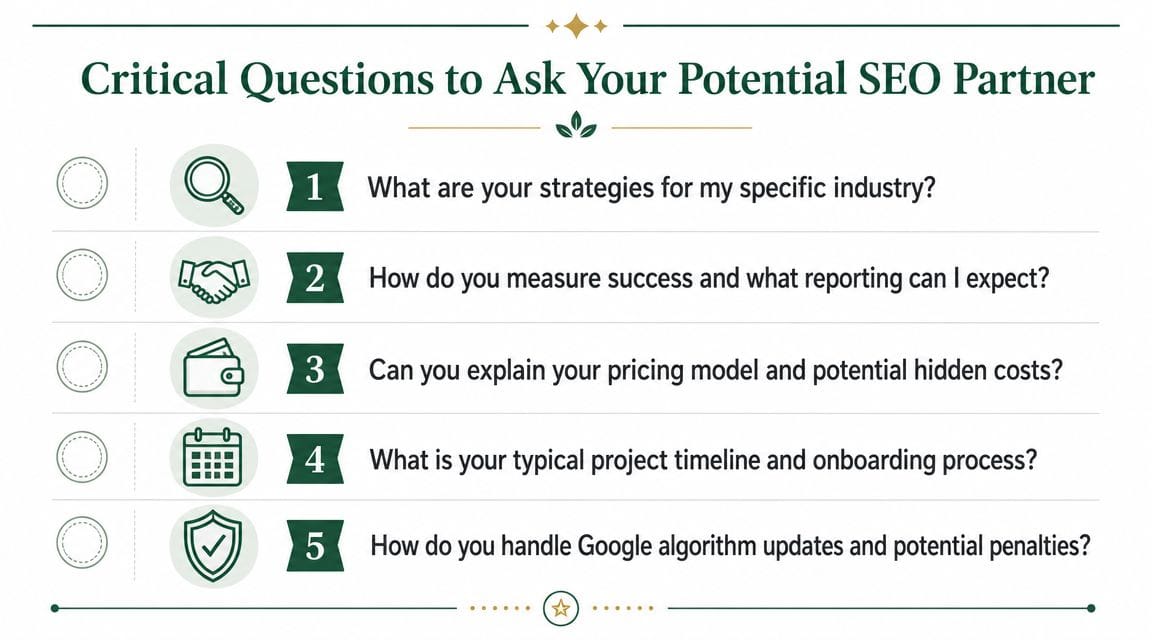
The sales call is where weak firms usually reveal themselves. A polished proposal can hide a lot. A direct question can't.
Questions that expose real strategy
Take these into the meeting and listen for practical answers.
How would you approach SEO for this specific business in Brisbane?
A good answer mentions services, target suburbs, local search intent, website pages, and Google Business Profile. A weak answer sounds copied from a generic deck.What would you fix first if the budget is limited?
This shows whether the firm can prioritise. A useful partner knows what can wait.What do you need access to before work starts?
Serious agencies usually ask for website access, Google Business Profile access, Search Console, and analytics access. That signals they're planning real work rather than guessing.
Questions about reporting and accountability
A business owner shouldn't be left wondering what's happening after signup.
What will you report on each month?
The best answer ties reporting to enquiries, calls, booked jobs, lead quality, and visibility for target services.Will the business have access to its own data?
The answer should be yes. Owners should retain access to accounts and performance tools.Who will be the day-to-day contact?
If the salesperson disappears after the contract is signed, that's worth knowing upfront.
Businesses comparing providers may also want a clearer view of what structured SEO services usually include in practice. A simple reference point is this overview of search engine optimisation services.
Questions about risk and decision-making
These questions protect the business from bad shortcuts.
“What won't you do?” is often more revealing than “What will you do?”
Ask:
- How do you handle backlinks?
- What happens if rankings drop after a Google update?
- Do you outsource content writing?
- How often do you revise strategy?
- Is there a minimum commitment, and why?
Good answers are calm and specific. Poor answers lean on certainty, guarantees, or vague claims about proprietary systems.
A capable small business SEO firm should sound like a partner making sensible decisions with limited resources. Not a magician selling shortcuts.
Decoding SEO Pricing and Common Deliverables
SEO pricing gets messy when owners can't tell the difference between setup work, monthly work, and work that should never have been included in the first place. The label on the proposal matters less than the scope.
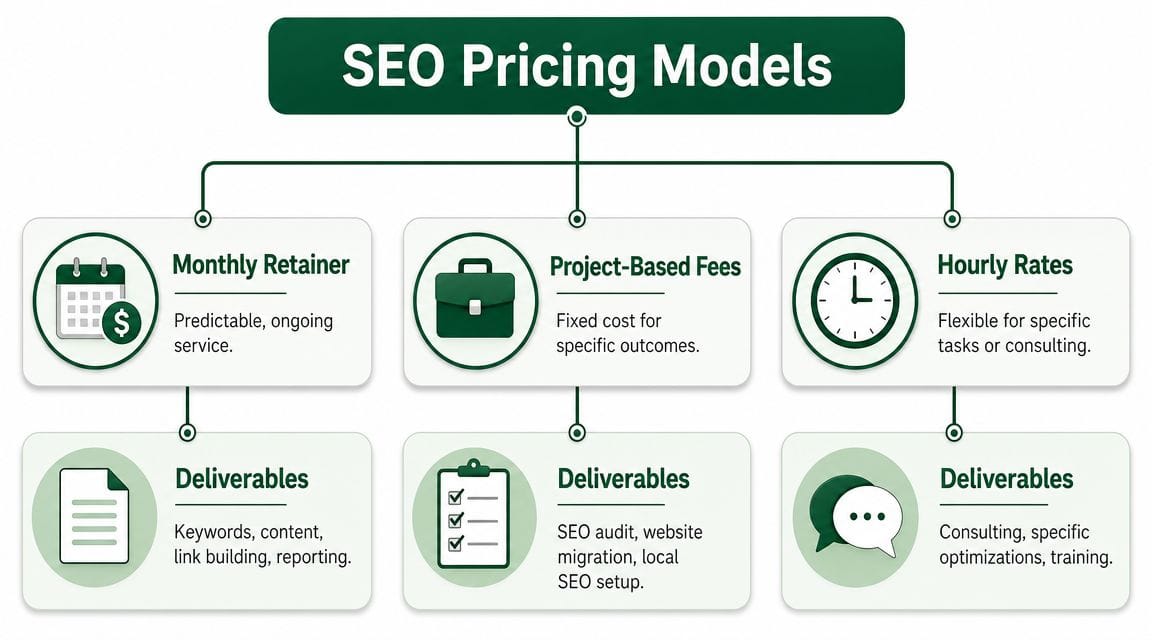
The three common pricing models
Monthly retainer suits businesses that need ongoing support. That may include content updates, Google Business Profile work, monitoring, technical fixes, and reporting over time.
Project-based fees work well for one-off jobs. Examples include a technical audit, local SEO setup, website migration support, or cleanup of broken page structure.
Hourly consulting fits businesses that want expert guidance but can handle implementation internally. This can work well for lean teams with a capable admin or web person.
No one model is always right. A small business SEO firm should recommend the model that matches the work, not the one that locks in the most revenue.
What a legitimate local SEO scope usually includes
A practical small-business workflow starts with a technical audit, then on-page and Google Business Profile optimisation. It should also involve identifying 20–50 high-value service and location keywords and mapping them to pages, as recommended in this BDC guide to SEO for small businesses.
That usually translates into deliverables like these:
- Technical review: Indexing issues, broken pages, mobile usability, speed concerns, and crawl problems.
- Keyword mapping: Matching service and suburb terms to the right pages.
- On-page improvements: Titles, meta descriptions, headings, internal links, FAQ copy, and page clarity.
- Google Business Profile work: Categories, services, photos, updates, and review response guidance.
- Citation consistency: Making sure business details are accurate across relevant directories.
- Reporting: Clear monthly updates tied to business outcomes.
If conversion is also part of the plan, a business may need support that connects SEO traffic to better enquiry outcomes. In that case, this explanation of conversion rate optimisation in Australia helps show where SEO ends and on-site conversion work begins.
What to question in a proposal
A cheap proposal can still be expensive if it produces no useful work. A premium proposal can also be poor value if it buries the basics under vague deliverables.
Watch for these issues:
- Too much content too early: Publishing a stack of thin pages before fixing structure and intent usually creates clutter.
- No audit phase: If the firm doesn't inspect the site first, the proposal is mostly guesswork.
- Backlink-heavy plans with little context: That often means shortcuts.
- Reporting without action: Pretty dashboards don't improve rankings on their own.
Boocoo is one Brisbane-based option that offers practical local SEO support for small businesses, alongside web, paid, and social services, which can be useful when SEO work overlaps with broader digital issues.
Your First 90 Days with an SEO Agency
The first three months shouldn't feel dramatic. They should feel organised. If a business expects instant rankings, the relationship usually gets tense before the work has had time to settle.
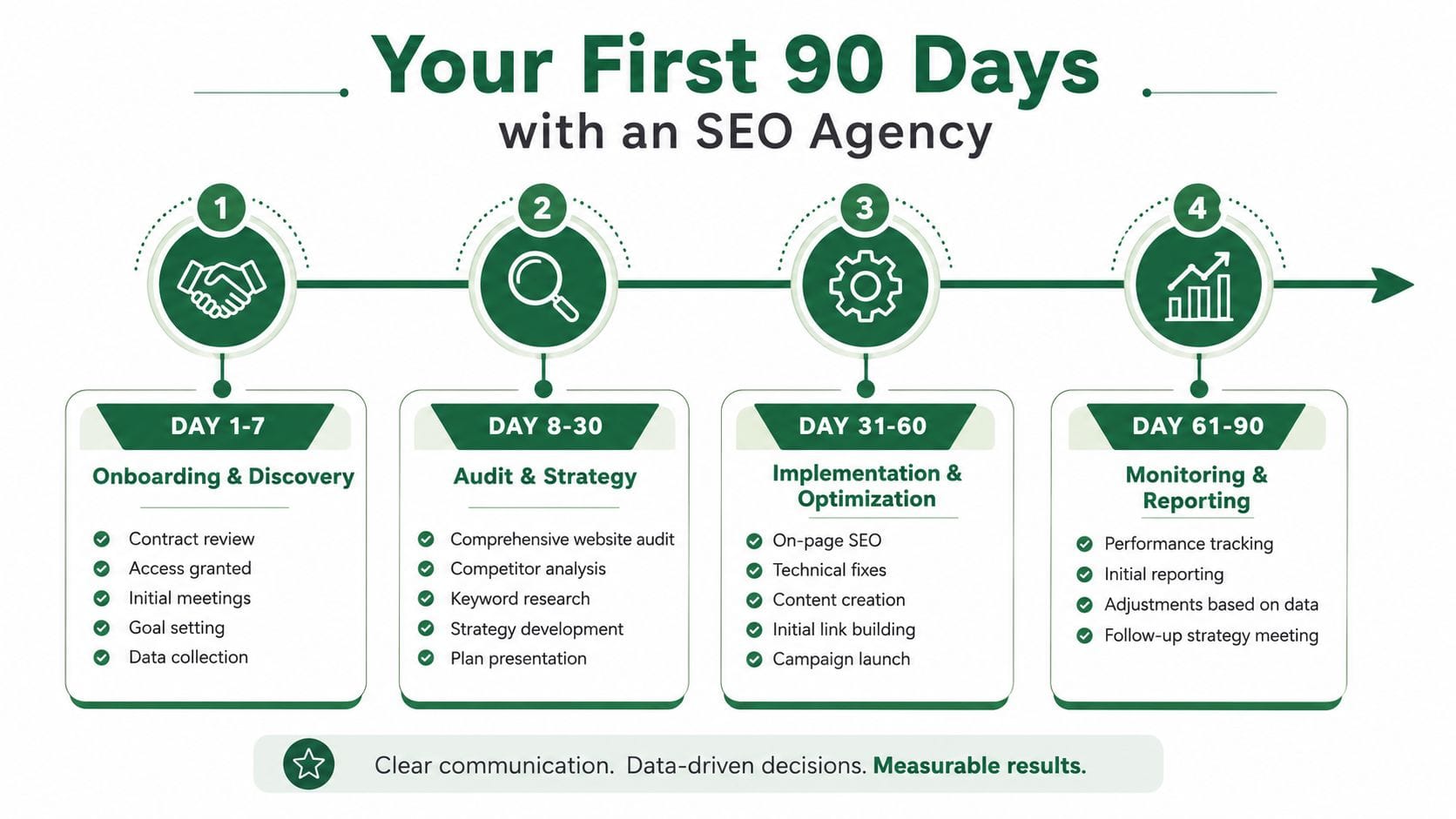
Days 1 to 30
The early stage is mostly about access, review, and diagnosis. The agency gathers access to the website, analytics, Search Console, and Google Business Profile, then checks what's already working and what's getting in the way.
This is also where priorities should get narrowed. A Brisbane electrician might need stronger suburb service pages. A local café might need better Google Business Profile activity and clearer mobile information. A clinic might need cleaner service architecture before any new content is written.
Days 31 to 60
This period is usually where the foundational fixes happen. Titles are cleaned up, pages are mapped properly, internal links improve, technical issues get addressed, and local profile work starts to tighten.
The best agencies don't try to do everything at once. They sequence the work so the site becomes easier for both users and search engines to understand.
The first visible wins often come from cleaning up what already exists, not from publishing more pages.
Days 61 to 90
By now, the business should see a clearer pattern in the data, even if major ranking gains haven't arrived yet. Reporting should start showing whether the right pages are getting attention, whether profile actions are improving, and whether enquiries are becoming more relevant.
For small businesses, a realistic benchmark is staged traction, with early movement often seen in 3–6 months and stronger results over 6–12 months, according to this guide to small business SEO benchmarks. The same guidance stresses that success should be measured by lead quality and conversions, not just raw traffic.
What progress should feel like
The business should feel more clarity, not less. There should be a visible plan, cleaner pages, better local signals, and reporting that makes sense to a non-specialist.
That's the true test in the first 90 days. Not whether every target keyword has jumped to the top, but whether the agency is building a sensible system that can produce compounding gains.
Your Next Step to Getting Found in Brisbane
Choosing a small business SEO firm isn't about luck. It's a buying decision that gets easier once the business knows what it needs, what questions to ask, and what weak proposals look like. That alone can save months of wasted spend.
For Brisbane operators who want a practical second opinion, a useful next step is a simple review of goals, website gaps, and local visibility priorities. Businesses comparing SEO with broader growth work can also look at how digital strategy connects across sectors through this guide to tourism digital marketing, then use the same decision logic for their own market.
Frequently Asked Questions About Small Business SEO
| Question | Answer |
|---|---|
| Should a small business hire a specialist firm or a full-service agency? | It depends on what's broken. If the main issue is local search visibility, a specialist or local-focused firm may be enough. If the website, ads, content, and conversion path all need work together, a broader agency can make sense. |
| Is SEO still worth it if the business already runs Google Ads? | Usually yes, because ads and SEO do different jobs. Ads can create immediate visibility, while SEO builds a stronger long-term presence in local search, branded search, and service discovery. |
| Can a business do some SEO in-house and outsource the rest? | Yes. That's often the most sensible setup for small businesses. An external partner can handle strategy, audits, and technical direction, while the business supplies local knowledge, photos, service detail, and review follow-up. |