

It's closing time, there are unanswered enquiries on the phone, and the website has brought in visitors without enough orders. Another marketing platform probably isn't the answer. A busy Brisbane owner needs to know which fix will save administration time, protect profit and turn existing interest into paid work.
A useful Brisbane Digital Marketing strategy starts with those constraints, not whichever channel is trending. The practical answer to how to increase online sales is to fix the purchase journey first, then attract more suitable buyers. Each task should earn its place through hours saved and margin protected, rather than clicks alone.
Find Where Online Sales Leak Before You Spend Anything
Think of online sales as a bucket: visitors pour in at the top, while potential orders leak out between the first visit and the paid order or booked job. Buying more traffic before finding the holes makes the waste more expensive.
The Australian Bureau of Statistics reported that e-commerce retail activity grew 41.5% in 2020–21. That historical growth establishes the channel's commercial importance, but it isn't a useful sales target for an individual Brisbane business. The owner's own records offer a better starting point.
Start with a one-hour audit
The first hour should produce a decision, not a complicated dashboard.
- Export the last 90 days. Pull visits from Google Analytics 4, enquiries from the inbox or customer system, and completed orders from sales records.
- Separate discovery sources. Group Google search, Google Maps, social, paid ads and direct visits. Use tagged links where available, rather than assuming all Google traffic came from the same place.
- Find the weakest handover. Look for product views without cart additions, form views without submissions, or enquiries without sales.
- Check the history. A sudden decline calls for checks on broken forms, stock availability or campaign changes. A longstanding problem needs a different response.
- Choose one outcome. Select the measure closest to money changing hands.
Audit metrics and what a weak result looks like
| Metric | Where to find it | Rough benchmark | Action if weak |
|---|---|---|---|
| Monthly visitors | Google Analytics 4 traffic report | Watch the trend, not a single number | Check whether rankings or ad spend changed |
| Conversion rate | Analytics conversions or enquiry log | About 1–3% for most online stores, as a rough screening guide | Fix the page with the biggest drop-off |
| Add-to-cart or enquiry rate | Cart events or form submissions | Compare with the business's own last quarter | Shorten the form or add a clear button |
| Checkout or booking completion | Funnel report in analytics | Track week to week | Test delivery costs and payment options |
| Traffic source split | Acquisition report | No single right mix | Shift spend towards sources that convert |
| Repeat purchase rate | Order export or customer list | Higher is better when margin holds | Start a simple email follow-up |
The conversion guide isn't a pass-or-fail score. Product price, purchase frequency and the definition of a conversion affect the comparison, so the previous quarter remains the more useful reference.
For hospitality owners, 10Seat's a revenue playbook for busy restaurateurs offers a business-specific companion when deciding which revenue opportunities deserve attention.
Priority rule: Fixes that remove repeated customer questions and recover existing buying intent deserve attention before tasks that create more traffic.
Finish with one commercial goal: paid online orders, qualified quote requests or booked appointments. A professional-services firm might choose completed consultation bookings rather than brochure downloads.
Fix Website Friction That Costs You Sales
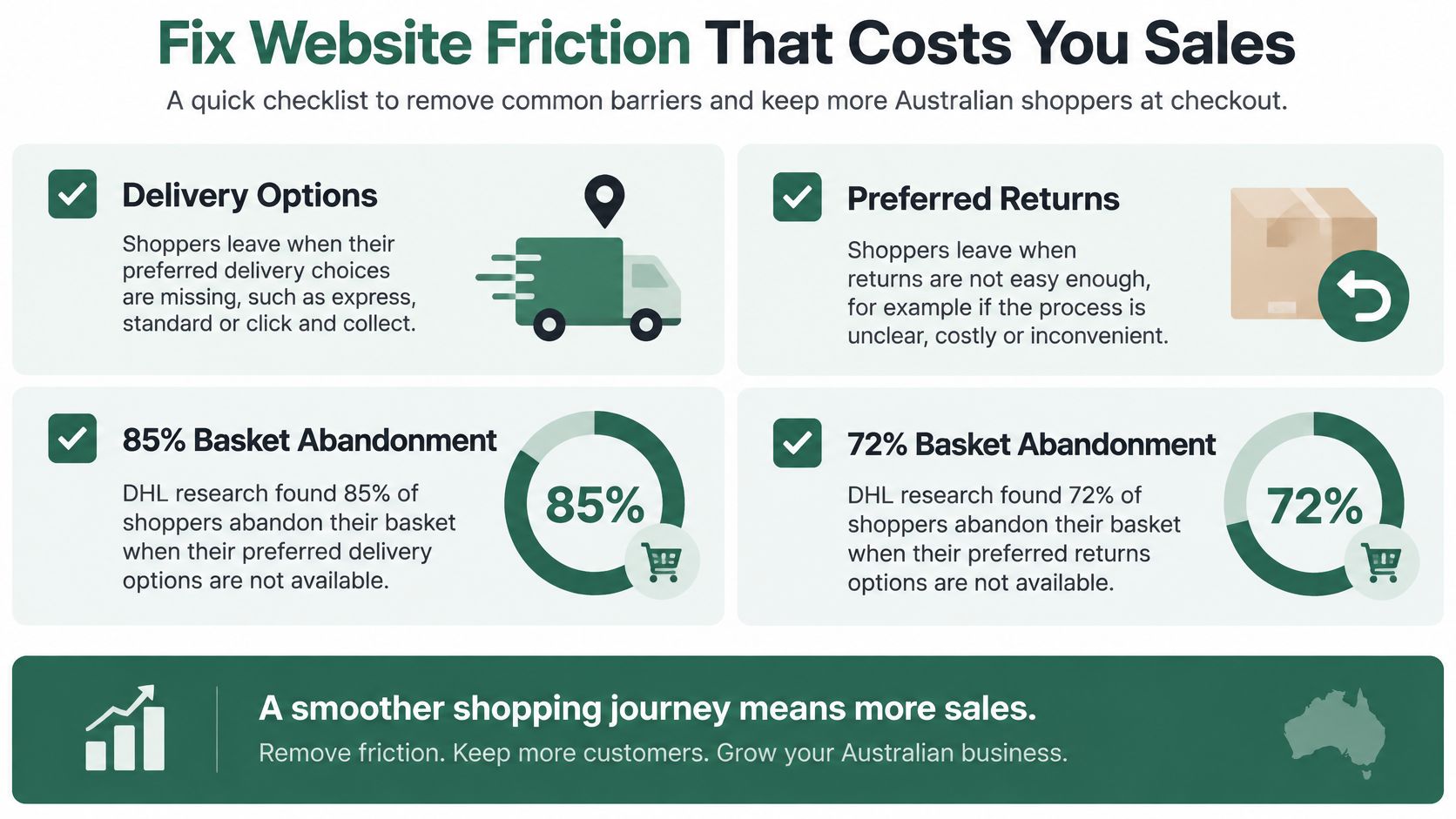
Delivery deserves early attention. DHL's Australia 2025 findings report that 85% of shoppers may abandon a basket without preferred delivery options, while 72% may abandon without preferred returns options.
Those findings describe potential abandonment, not a guaranteed recovery opportunity. The sensible response is to make the buying conditions clear and test whether customers complete more profitable orders.
Work through the purchase checklist
- Show delivery costs and arrival estimates early. Put postcode restrictions, dispatch timing and likely charges on product and cart pages. This reduces surprises and repetitive delivery enquiries.
- Make contact easy on mobile. Place a tap-to-call number or short enquiry form near the top. Only request information needed to assess or fulfil the enquiry.
- Offer at least two suitable payment methods. Include a common digital wallet alongside card payments where the checkout supports it. Check processing fees before adding options.
- Summarise returns or cancellation terms plainly. Give a clear sentence near the decision point, linked to the full policy. The summary must accurately reflect the terms, not replace them.
- Position three or more genuine reviews near the action. Select relevant reviews without altering their meaning. Avoid a bulky review widget that makes the page harder to use.
- Reduce competing choices. Keep the main purchase or enquiry action prominent on campaign landing pages. Necessary navigation, contact details and policy links should remain accessible.
- Test on a real phone using mobile data. Complete the journey, including payment or form submission. Check awkward keyboards, unreadable text, oversized images and error messages.
For a Brisbane florist, the useful change might be placing the same-day order cut-off beside the buy button. That answers a practical question before the shopper leaves to call, but the promise must match actual delivery capacity.
Protect profit while removing friction
Free delivery isn't automatically the best offer. Calculate what remains after product costs, freight, packaging, payment fees, discounts and expected returns before choosing a threshold.
Validate carrier coverage across Brisbane suburbs and regional Queensland before promising speed. A convenient pickup option may protect margin better than subsidising express freight on every order.
The web design best-practices guide provides a useful checklist for reviewing layout and usability. Prioritise clear delivery wording and working forms ahead of cosmetic changes: both can remove customer-service work without requiring a full redesign.
Change one element at a time and record the date. Compare completed orders, retained profit and delivery-related support contacts, rather than celebrating a busier checkout alone.
Win Brisbane Local Searches Without a Big Budget
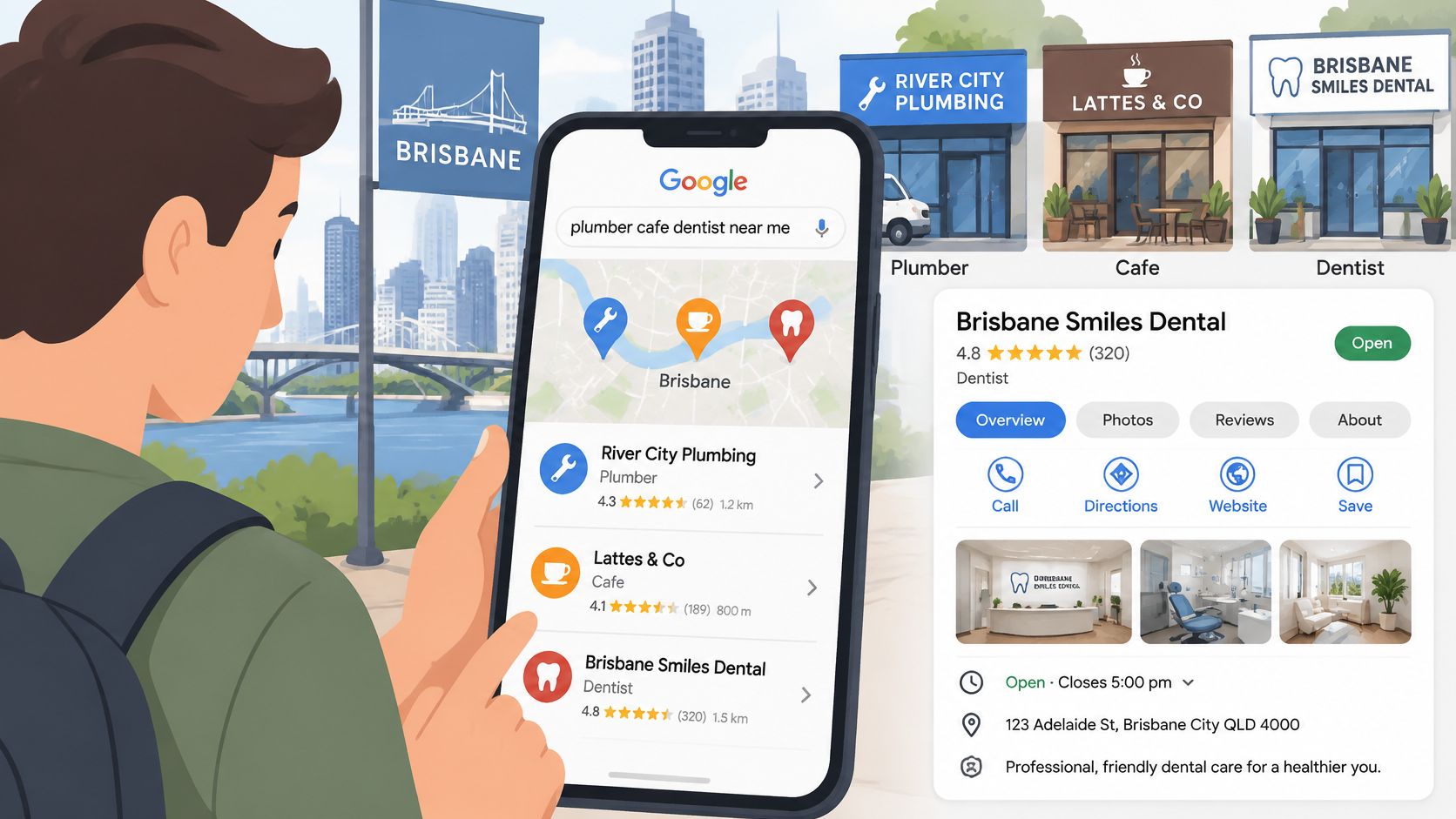
A Google Business Profile is the digital shopfront sign: incorrect hours or unclear services can send a potential customer elsewhere before the website gets a chance.
The ABS retail history records online retail at 11.4% of Australian retail sales in 2024, compared with 6.3% in 2019. Small operators don't need a national retailer's reach, but they do need accurate information wherever customers investigate them.
Maintain the listing in a sensible order
- Claim or verify the profile. Check the business name, phone number, hours and website against the site itself. Businesses without a customer-facing location should use appropriate service-area settings rather than displaying a private address.
- Choose an accurate main category. Add secondary categories only for services offered. A broad collection of loosely related categories doesn't explain the business clearly.
- Refresh photos at least monthly. Use current work, team and premises images, with permission where needed. Keep a shared folder so updating the profile doesn't become a separate photography job.
- Schedule a short weekly update. A completed job, seasonal service or event gives customers useful context. Treat updates as customer communication, not a guaranteed ranking shortcut.
- Request honest reviews consistently. Send a convenient review link after completed work, ideally the same day. Invite feedback from customers generally, not only those expected to leave positive ratings, and don't offer rewards.
Accuracy should rank ahead of posting frequency. Correcting holiday hours can prevent wasted calls and disappointed visitors; another generic update usually won't solve either problem.
Build local pages with something real to say
Create suburb pages only where the business works and can provide useful detail. A Carindale page might explain service availability, access considerations and a relevant completed project, with customer permission.
A Paddington page shouldn't be the same copy with a different suburb name. Where there isn't enough distinct information, a stronger service-area page is a better use of limited writing time.
For a tradesperson, the page should identify the service, show credible work and offer one clear enquiry action. State a realistic response time beside it, then ensure somebody can meet that commitment.
The Brisbane local SEO guide can help organise profile and website work. Keep directory details consistent, and prioritise profitable service areas over publishing pages for every suburb.
A local page earns its maintenance time when it helps a suitable customer decide whether the business can do the job.
Run Paid Ads and Social Posts on a Small Budget
Start with one paid channel and one commercial goal. Google search ads are a sensible first test when customers already search for the service; Meta retargeting becomes an option once there's a suitable audience of previous visitors.
The following time allowances are lean planning budgets, not promises. Tracking repairs, competitive markets and account setup can require substantially more work.
Channel time and budget for a small business
| Channel | Weekly time | Starting budget | Best use |
|---|---|---|---|
| Google search ads | Allow 1 hour for a simple setup, then 15 minutes a week for routine checks | The owner's daily cap | Buyers searching now |
| Meta retargeting ads | Review delivery, audience size and frequency during the weekly marketing check | The owner's daily cap | Visitors who left without enquiring |
| Organic social posts | Budget 2 hours a month, batched | Free publishing, excluding labour | Trust, reviews and local visibility |
| Short phone video clips | Budget 1 hour a month filming | Free publishing with an existing phone | Showing work and process |
Put limits around the experiment
- Set an affordable daily cap. Choose an amount the business can lose without affecting essential bills. Check the platform's charging rules rather than assuming identical spending every day.
- Begin with exact and phrase match keywords. Review actual search terms weekly and add negative keywords for irrelevant searches. These match types still require supervision.
- Use a relevant destination. Send the ad to the matching service or product page, not a general homepage that makes visitors search again.
- Review non-performing ads after two weeks of steady spend. Pause and investigate when there are no enquiries. Check tracking and the normal buying cycle before deciding that the channel can't work.
- Batch organic content monthly. Turn completed work, common questions and customer feedback into reusable posts rather than inventing content every morning.
The paid advertising examples can help distinguish an offer from a vague brand message. Clear service scope and location often do more for lead quality than clever wording.
Restaurant owners considering delivery platforms can also consult OrderOut's guide to Uber Eats before treating another ordering channel as equivalent to direct website sales. Platform fees, operational work and ownership of customer relationships belong in that decision.
Social posts should demonstrate credibility and prompt useful conversations. Saves, review activity and attributable enquiries are more informative than likes alone.
For an owner with little spare time, search-term cleanup ranks ahead of daily posting because it can stop wasted spend directly. Reusing existing job photos ranks ahead of elaborate video production because it keeps content work manageable.
Turn One-Off Buyers Into Repeat Customers
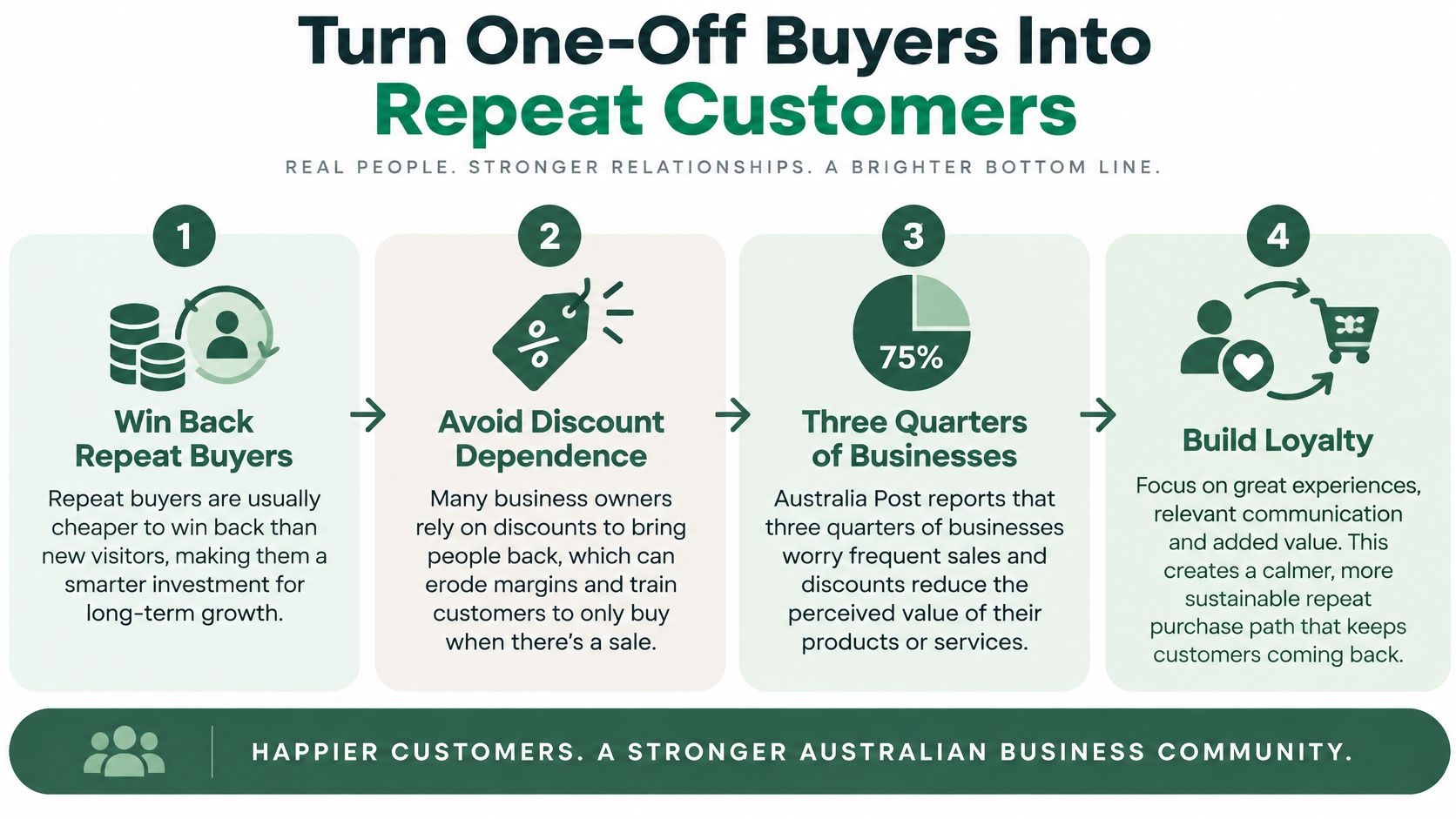
Constant discounting can teach customers to postpone full-price purchases: Australia Post's 2025 eCommerce report found three-quarters of businesses were concerned that frequent sales events were teaching shoppers to purchase only when products were discounted.
A better retention offer can reduce uncertainty or make the next purchase easier. Bundles, practical advice, suitable guarantees and convenient booking options deserve testing before another blanket price cut.
Build a useful follow-up sequence
The following is a starting schedule to adapt to the product's use or service cycle, not a universal purchasing timetable.
- Day 1, thank the customer and help them succeed. Include a care instruction, setup tip or explanation of what happens next.
- Day 7, answer a likely question. Send a relevant guide or short demonstration. Keep it connected to the purchase rather than introducing unrelated offers.
- Day 30, offer an appropriate next action. Use a reorder reminder where replenishment makes sense, or request an honest review.
- After 90 days of silence, check relevance. A reactivation message can ask whether the customer still needs help. Suppress messages when the timing doesn't suit the buying cycle.
A cleaning service could trial a reminder every three months with a simple option to arrange a regular schedule. The useful promise is convenience and continuity, not an automatic discount.
Use permission-based marketing lists and provide an easy unsubscribe. Transactional updates and promotional emails serve different purposes, so an order confirmation shouldn't become an excuse to send unwanted campaigns.
Diagnose before rewriting everything
A free-tier email tool can be enough initially, provided its automation and contact limits suit the list. Review opens, clicks, replies and resulting purchases monthly; open rates alone aren't a reliable measure of buying interest.
If opens look weak, test the subject line first, but also check delivery. MailGenius's free inbox placement test offers a diagnostic step before spending time rewriting the whole sequence.
The customer retention guide provides further ideas for making follow-up relevant. Prioritise reusable care instructions and reminders because they can replace manual messages while preserving the normal selling price.
Margin check: A retention campaign succeeds when customers return profitably, not simply when more coupon codes are redeemed.
Track Results and Decide What to Change Next
Posting more often and receiving more clicks are activities, not proof of business growth. A useful monthly review connects marketing spend and owner time to completed sales and the money retained.
Even national totals have boundaries. The ABS retail methodology defines its online-sales series around internet purchases from employing Australian retailers primarily selling to households, excluding direct overseas website purchases and household-to-household transactions through third-party platforms.
Keep channel records separate
Record website orders separately from marketplace orders. For enquiries, retain the discovery source alongside the eventual outcome, so a phone call generated by organic search doesn't disappear into a generic telephone category.
A plumber should distinguish completed jobs originating from organic search from those generated by ads. A retailer should keep marketplace revenue separate from website revenue while avoiding duplicate entries for the same sale.
Monthly results and the next move
| Result pattern | What it usually means | Next move |
|---|---|---|
| Traffic up, enquiries flat | The page or offer may not be persuading | Rewrite the headline and simplify the form |
| Enquiries up, sales flat | Lead quality or follow-up may be weak | Tighten targeting and aim to reply within one hour during staffed hours |
| Sales up, margin down | Discounts may be doing the work | Test a financially viable free delivery threshold instead |
| Cost per enquiry rising for three weeks | Audience fatigue or rising competition may be involved | Refresh the ad or pause the ad set |
These patterns are investigation prompts, not diagnoses. Margin can also fall because freight or product costs rose, while poor enquiry tracking can make a working campaign look unsuccessful.
Make the review short and decisive
Reserve 30 minutes each month to compare results with the starting baseline. Calculate cost per enquiry as advertising spend divided by enquiries, and cost per sale as advertising spend divided by completed sales.
Assess the money remaining after fulfilment, returns and other variable costs, not revenue alone. Add owner hours spent managing each channel so a labour-heavy campaign doesn't appear cheaper than it is.
Use the marketing ROI guide to organise the calculation. Log the change, date, intended outcome and result, then test one meaningful adjustment at a time.
At the next review, retain the change only if it supports the intended outcome. Check that there's enough comparable activity before reversing it or increasing spend.
Choose Your First 30-Day Plan Today
The best plan is small enough to finish alongside running the business. A full website rebuild, several advertising channels and daily content production shouldn't all compete for the same owner's attention.
Choose work in this order: remove wasted effort, protect the money earned from each sale, then expand customer acquisition. That keeps the first month focused on commercial usefulness rather than a longer task list.
A manageable monthly sequence
- Week 1, establish the baseline. Complete the one-hour audit, select one commercial goal and identify the person responsible for recording results.
- Week 2, remove two purchase obstacles. Choose website changes that answer repeated questions or prevent failed transactions. Leave cosmetic work for later.
- Week 3, strengthen local relevance. Tidy the Google Business Profile and create a useful page for the strongest service area, provided there's genuine local detail to include.
- Week 4, run a controlled test. Launch one focused search ad and prepare the three-email follow-up. Delay the launch if tracking or fulfilment still isn't ready.
At the first monthly review, compare completed work with the baseline and record how much ongoing administration it created or removed. A campaign that needs constant attention may not suit a sole trader, even if it generates enquiries.
Optional support without a bigger commitment
Boocoo has helped small and medium Brisbane businesses grow online for over 15 years. The first step is a free discovery call to discuss the business, its goals and current marketing.
Bring the last quarter's sales figures and an analytics export to make that conversation practical. To arrange a call, phone 1300 093 797, email hello@boocoo.au, or complete Boocoo's contact form, selecting phone or email as the preferred contact method.