
A lot of Brisbane business owners are in the same spot right now. They do solid work, answer the phone, turn up on time, and still lose jobs to competitors that seem to appear everywhere on Google Maps.
It usually looks like this. A plumber in Pullenvale gets referrals but wants steadier enquiry flow. An accountant in Ascot has a decent website but barely shows up for suburb searches. A café owner in Ashgrove has loyal regulars, yet nearby customers still walk into the place down the road because that business appears first when someone searches on their phone.
That's where local SEO for small businesses stops being a marketing buzzword and becomes a practical lead system. Done properly, it helps a business show up when a customer is already looking for help nearby. Not someday. Right now.
The catch is that local SEO has changed. It's no longer just about getting website clicks. Google is answering more questions inside the search results, and local listings often do the selling before anyone visits a site. That means Brisbane operators need a playbook built for calls, direction requests, bookings, and trust at first glance.
Why Your Brisbane Business Needs Local SEO Now
At 7:15 on a Tuesday morning, a homeowner in Kenmore finds a burst pipe, grabs their phone, and searches for “emergency plumber near me”. They are not comparing ten brands. They are scanning the map, checking who services the area, and calling the business that looks close, credible, and ready to answer.
That is why local SEO matters now. For a Brisbane small business, search visibility is no longer just about getting website visits. Google often answers the question before the click happens. AI Overviews, Maps results, review snippets, opening hours, service areas, and call buttons all shape the decision on the results page. If your business is absent or looks incomplete, you can lose the lead before anyone reaches your site.
A business does not need to rank across all of Brisbane to grow. It needs to appear in the suburbs and service areas where customers are ready to act. A Chapel Hill electrician needs visibility for searches like “electrician Chapel Hill” or “switchboard upgrade Brisbane west”. An Indooroopilly accountant needs to show up when someone nearby wants tax help this week, not after scrolling past national firms with stronger domains but weaker local relevance.
I see the same pattern across service businesses. The company that gets the enquiry is often the one that looks easiest to contact and easiest to trust in search results.
A polished website helps, but it does not solve this on its own. If your Google Business Profile is incomplete, your service areas are unclear, or your business details vary across the web, Google has less confidence in what to show. Customers notice the same gaps. In local search, presentation and accuracy work together.
For trades and mobile service businesses, a more specific walkthrough like this local SEO guide for contractors is useful because it reflects how people search when they need someone on-site, often with suburb intent and time pressure.
Local SEO becomes urgent in three common situations:
- Phone enquiries are inconsistent: referrals still happen, but search is not bringing in steady work.
- Competitors keep showing in Maps first: even average operators can win more leads if their local signals are clearer.
- You serve defined suburbs or corridors: visibility improves when Google can match your business to the exact areas customers type.
The trade-off is straightforward. Broad SEO can build reach over time. Local SEO brings you closer to the searches that turn into calls, bookings, quote requests, and walk-ins. For a time-poor Brisbane owner, that is usually the faster win.
If customers cannot find your business where they search, many will assume you are not nearby, not active, or not the best option to call first.
Your Foundation Google Business Profile Optimisation
Google Business Profile is the first thing to fix because it influences how a business appears in Maps, branded search, and many local-intent results. For local SEO for small businesses, it's not just a directory listing. It's a structured source of trust signals.
Independent local SEO guidance recommends treating Google Business Profile as a core data asset. That means validating name, address, and phone consistency across the website, the profile, and major citations, choosing a clear primary service area and category set, and building location-intent pages around that structure, as outlined in BrightLocal's local SEO strategy guide.
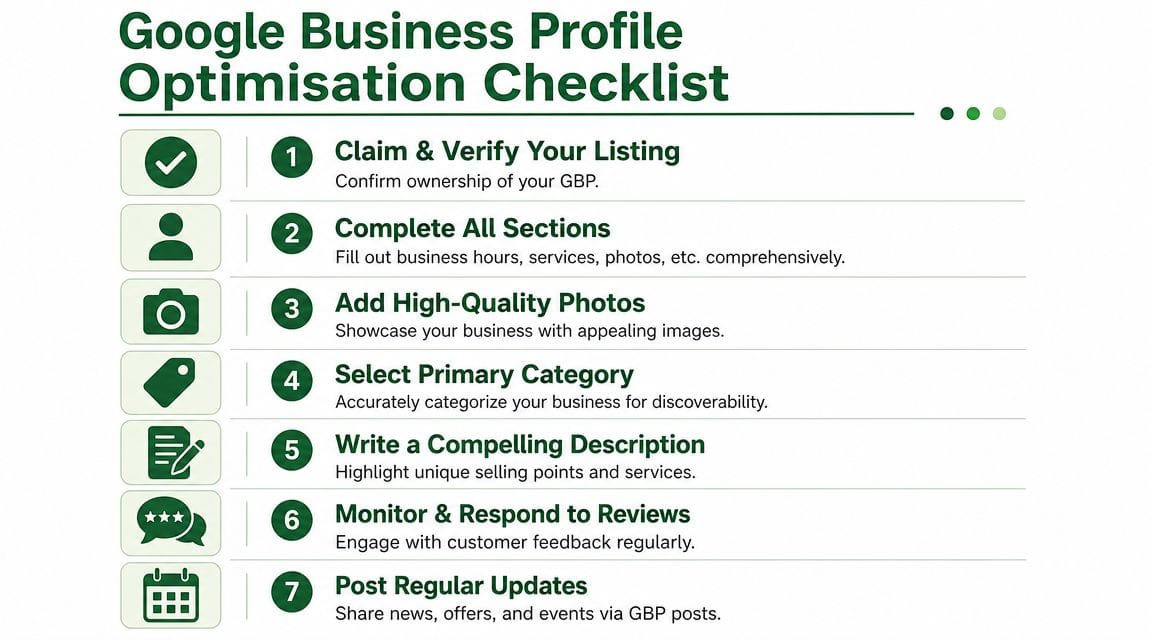
Here's the basic checklist small business owners can follow.
Treat your profile like a business asset
A Brisbane electrician is a good example. If the profile name says “ABC Electrical Brisbane”, the website footer says “ABC Electrical Services”, and an old directory still lists a different mobile number, Google gets mixed signals. So do customers.
Start with the essentials:
- Claim and verify the profile. No optimisation matters if the business doesn't control the listing.
- Set one accurate primary category. Don't try to be everything. An electrician should choose the closest core category, then add relevant secondary categories where they are appropriate.
- Define the service area. Keep it grounded in where the team operates. Overreaching here weakens relevance.
What to fill in and how to do it well
Most underperforming profiles aren't missing one magic feature. They're half-finished. Google rewards completeness because it helps match the listing to real searches.
A strong profile usually includes:
- Business description: Write in plain language. Mention the main services, the areas served, and what makes the business useful to a local customer.
- Services list: Add individual services instead of leaving this broad. “Hot water repairs” is better than a vague “plumbing services”.
- Opening hours: Keep regular hours current, then update holiday trading times as needed.
- Photos: Use real photos of the team, vehicles, premises, signage, and work completed. Stock images weaken trust.
- Q&A: Seed common questions if needed. For example, “Do you service Kenmore and The Gap?” or “Do you offer same-day callouts?”
- Posts: Share updates, seasonal offers, or service reminders. These aren't the highest priority, but they help show the business is active.
A complete profile often wins before a customer ever reaches the website.
For a suburban service business, the profile should also align with the site. If the business profile says it services Brisbane Northside, but the website only has one generic homepage with no suburb mentions, that connection is weak. The stronger setup is a clear homepage plus useful location pages for real service areas such as Chermside, Nundah, or Carindale.
The mistakes that weaken local visibility
Several habits drag down performance even when the business itself is solid.
| Mistake | Why it hurts | Better move |
|---|---|---|
| Too many categories | Relevance gets diluted | Choose one core category and a small set of accurate secondary ones |
| Keyword stuffing in business name | Can create trust and compliance issues | Use the real trading name |
| Old phone numbers online | Confuses search engines and customers | Audit and fix every listing |
| No recent photos | Makes the profile look neglected | Add fresh, real images regularly |
| Generic service descriptions | Doesn't match how locals search | Use specific services and local language |
The biggest trade-off is time. A business owner can spend weeks tinkering with logos, posts, and cover images while ignoring the items that move visibility. The higher-value work is consistency, category accuracy, services, reviews, and matching location pages on the site.
Finding Keywords Your Brisbane Customers Actually Use
Keyword research for local SEO doesn't need expensive software to be useful. Most Brisbane small businesses can build a solid keyword list by listening to customers and using Google's own prompts.
The easiest mistake is starting with industry jargon. Customers rarely search the way business owners describe their own services. They search by problem, urgency, suburb, and convenience.
Start with suburbs and service intent
A simple way to build a keyword list is to combine three things:
- Core service: plumber, mortgage broker, café, physiotherapist
- Location: Brisbane, South Brisbane, The Gap, New Farm, Chermside
- Intent modifier: emergency, open now, near me, same day, best, affordable
That produces phrases a real person might type, such as:
- Emergency plumber The Gap
- Tax accountant Ascot
- Café near Ashgrove
- Family lawyer Brisbane northside
- Air conditioning repair Carindale
This works because the searcher is already narrowing the choice. They're not researching the whole market. They're trying to find someone suitable nearby.
A useful shortcut is to review the language customers already use on calls, enquiry forms, and reviews. If people keep asking about “blocked drains”, “same-day appointment”, or “after-hours electrician”, those phrases belong in the keyword list and probably on the website too.
Use Google's own hints before paid tools
Google's search bar is one of the most practical keyword tools available. Start typing a service and suburb, then look at autocomplete suggestions. After searching, scan the “People also ask” box and related searches at the bottom of the page.
That process helps uncover terms like:
- Service plus suburb
- Service near a known area
- Problem-based searches
- Comparison searches, such as “best accountant Brisbane” or “coffee shop near Suncorp Stadium”
Good local keywords don't sound clever. They sound like a customer who needs help and wants it nearby.
Competitor websites also help. Look at their title tags, service page headings, and Google Business Profile categories. The goal isn't to copy them. It's to spot the phrases Google already associates with businesses in the same market.
One warning matters here. Don't build a giant list and try to use every phrase on one page. That usually produces awkward, repetitive copy. A better structure is one clear service page, then separate location pages or sections where there's a genuine local angle.
Building Trust with Citations and Online Reviews
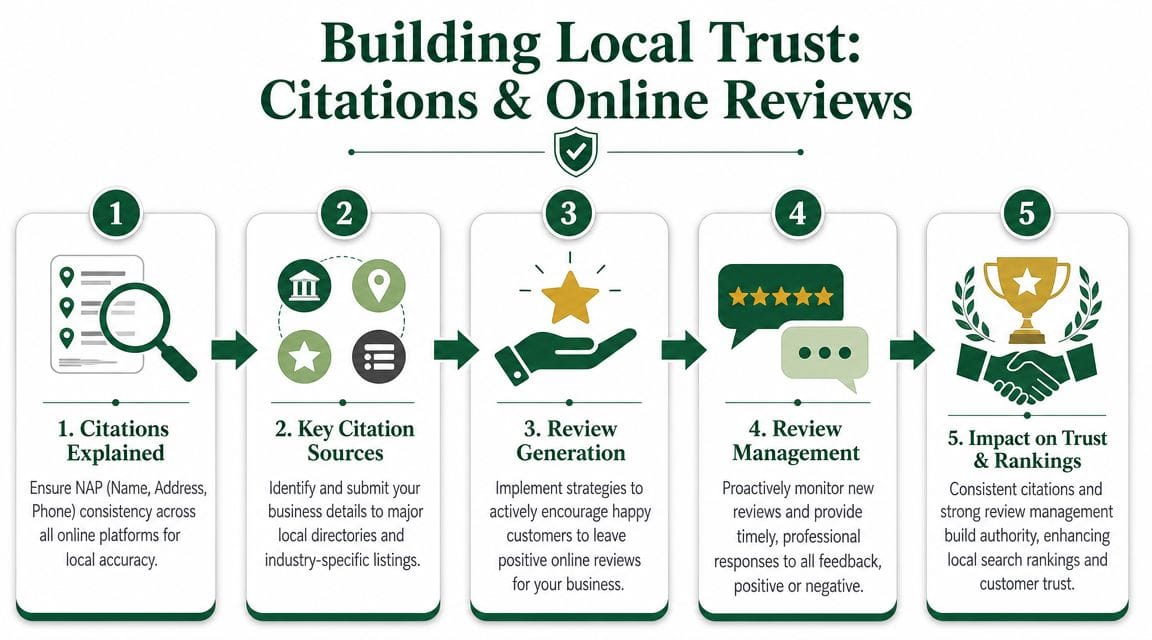
Local rankings improve when Google can verify that a business is real, established, and active in its area. Two of the clearest trust signals are citations and reviews.
Australia-focused guidance notes that local online visibility, including Google Maps and business listings, strongly affects how consumers find nearby providers. It also highlights that the foundation for small businesses is consistent name-address-phone information, review collection, and localised content, as summarised in Collective Alternative's overview of local SEO for small businesses.
Clean business data comes first
A citation is any online mention of the business name, address, and phone number. That can sit in directories, map services, industry listings, social profiles, or association websites.
The work here isn't glamorous, but it matters. If a Brisbane physiotherapy clinic moved from one suburb to another and half the web still shows the old address, that inconsistency weakens trust.
Start with a short audit:
- Website footer: Make sure the trading name, address, and phone are correct.
- Google Business Profile: Match the website exactly where appropriate.
- Key directories: Update major Australian and industry-relevant listings first.
- Social profiles: Check Facebook, LinkedIn, and any booking platforms.
For most small businesses, a manageable first pass is enough. Fix the biggest listings, standardise formatting, and keep a simple spreadsheet so future changes don't create new inconsistencies.
Reviews influence both ranking and choice
Reviews do two jobs at once. They help reinforce local trust signals, and they shape whether a customer contacts the business at all.
A review strategy doesn't need to be complex. It needs to be repeatable.
Try this simple system:
- Ask soon after the job: A happy customer is most likely to respond while the experience is still fresh.
- Use a direct link: Don't make people search for the profile.
- Prompt for detail: Ask them to mention the service and suburb if they're comfortable doing so.
- Respond to every review: Thank positive reviewers and reply calmly to criticism.
A basic request can be short and human:
“Thanks again for choosing us. If you've got a minute, a Google review would really help. Mentioning the service and your area can make it easier for other locals to find us.”
That's enough. Overwriting the ask usually lowers follow-through.
Negative reviews need a different approach. Don't argue in public. Acknowledge the issue, offer to resolve it offline, and keep the tone measured. Future customers often care more about the response than the complaint itself.
What doesn't work is buying reviews, blasting every customer with generic follow-ups, or ignoring feedback once it's live. Those shortcuts usually create more damage than benefit.
Creating Local Content and Links That Attract Customers
A Brisbane homeowner searches “retaining wall repair Paddington”, scans the map results, sees a few recent project photos, reads one clear service summary, and taps to call. That decision often happens before a website visit. Local content now has two jobs. It needs to help your business appear for the right suburb-and-service searches, and it needs to give enough proof in the search results to trigger action.
As noted earlier, nearby searches often lead to a fast store visit or purchase. For small businesses, that changes what “good content” looks like. The goal is not to fill a blog with generic advice. The goal is to publish pages, photos, updates, and mentions that answer buyer questions quickly and support zero-click conversions from Google's results page.
Local content should answer buying questions
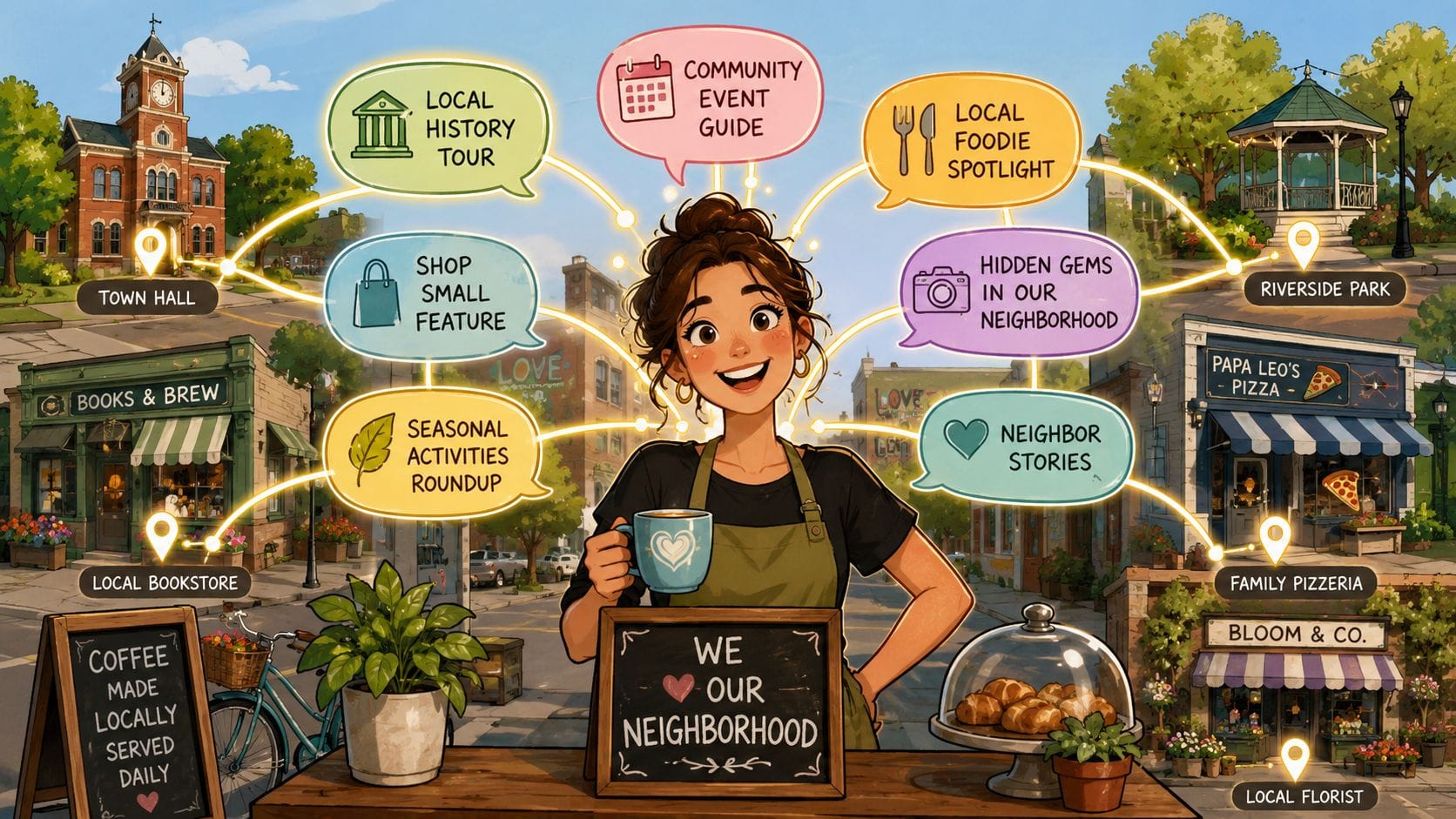
The strongest local pages make it easy for someone to decide, “Yes, this business handles my type of job in my area.”
For a Brisbane garden services business, that usually means content such as:
- Project spotlights: A completed retaining wall in Paddington or new turf laid in Camp Hill, with photos, timing, and the scope of work.
- Suburb service pages: Real pages for the areas you serve, written with useful details about access, property types, common problems, and travel coverage.
- Local advice: Practical guidance on storm season prep, drainage issues, or council considerations that affect Brisbane homes.
- Pre-sale FAQs: Response times, quote process, parking constraints, callout zones, and what happens at the first visit.
This same approach works for professional services. An accountant might publish tax advice for Brisbane sole traders. A tourism operator can build landing pages around visitor intent and local decision-making, similar to the approach in this tourism digital marketing guide, where place, timing, and conversion intent all matter.
One trade-off is worth being honest about. Ten thin suburb pages can dilute trust and create maintenance work. Three or four strong pages with original details, real examples, and current photos usually perform better than a long list of near-duplicates.
Local links come from real community activity
Local links still matter, but the best ones rarely come from cold outreach to random websites. They come from things the business is already doing in Brisbane, then making those activities visible online.
Useful link opportunities include:
- Sponsoring a local club, school, or fundraiser
- Joining a chamber of commerce or industry association
- Partnering with complementary businesses in nearby suburbs
- Providing expert comments to a local media outlet
- Publishing a genuine community update or media release
If you send out announcements, structure matters. A short release with a clear local angle, a named suburb, a useful quote, and a link to the relevant service page gives publishers something they can use. PBJ Stories' optimization strategies is a practical reference for turning business updates into assets that support search visibility as well as publicity.
The pattern I see most often is simple. Businesses get better local links after they start documenting real work, real places, and real involvement.
Buying random backlinks, publishing generic guest posts, or spinning out copy-paste suburb pages usually wastes budget. Strong local authority grows when your content matches the communities you serve, and when other local sites have a real reason to mention you.
Measuring Success in a Zero-Click and AI World
A lot of small businesses still judge SEO by one question. “Did website traffic go up?” That used to be a decent shortcut. It's no longer enough.
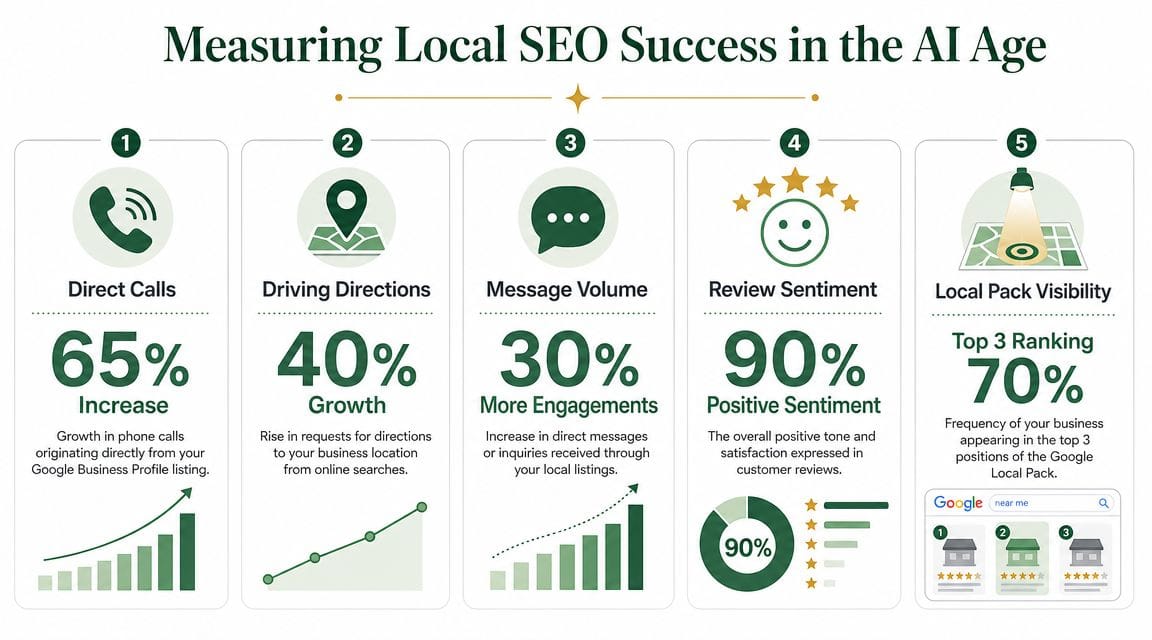
Industry guidance on current local search behaviour points out that many business owners now face a different problem: AI-generated results and zero-click searches reduce website visits, especially for local intent queries. The better question is how a business earns calls, direction requests, and booked work when the search results page does more of the selling, as discussed in Boulder SEO Marketing's local SEO best practices.
Traffic is no longer the main scorecard
If someone searches “accountant near me”, sees the reviews, taps the phone number in Google, and books an appointment, the website may barely be involved. That's still a win.
The same applies to a mobile search for a locksmith, café, dentist, or cleaner. In many cases, the local pack, map result, review summary, and booking options create enough confidence for the customer to act immediately.
That shifts the job of local SEO for small businesses. It's not only about ranking pages. It's about making the listing easy to trust and easy to use.
The metrics that matter now
A better measurement setup focuses on actions that lead to revenue or enquiries.
Track these first:
- Calls from Google Business Profile: A direct sign that the listing is generating intent.
- Direction requests: Especially useful for clinics, retail, hospitality, and office-based services.
- Booking link clicks: Important where appointments can be made without a phone call.
- Messages and contact form quality: Not just volume, but whether the leads are relevant.
- Review flow and response rate: Trust compounds when new reviews arrive steadily and get replies.
A conversion-focused mindset matters on the website too. If the traffic does reach the site, the page should make the next step obvious. Click-to-call buttons, quote request forms, suburb-specific proof, and clear service summaries all help. That's the same thinking behind practical conversion rate optimisation in Australia, where visibility only matters if the visitor can act easily.
Some businesses also add chat tools so enquiries aren't missed after hours. For teams comparing options, AI chat for customer support teams is one example of how businesses can handle common questions when staff are unavailable.
If search results answer the basics, the business that wins is often the one with the clearest next step.
The old obsession with pageviews can hide what's really happening. Fewer clicks don't always mean weaker SEO. Sometimes they mean Google is pre-qualifying the lead before contact happens.
When to Hire a Brisbane SEO Agency
A lot of local SEO work is absolutely doable in-house. A small business owner can claim a Google Business Profile, clean up contact details, ask for reviews, and improve a few core pages without needing an agency.
The issue is rarely knowledge alone. It's execution. Time-poor owners often know what should be done, but the work keeps sliding behind quoting, staff, job scheduling, and customer service.
DIY versus outsourced support
DIY usually makes sense when the business has one location, a simple service range, and someone internally who can update the website and maintain listings. It also suits owners who want tight control and are willing to work through the details consistently.
Agency support makes more sense when:
- The business serves multiple suburbs or service areas
- The website needs coordinated SEO and conversion work
- Listings, reviews, and content have become inconsistent
- Leads matter more than learning the technical side
- No one internally owns the process
Hiring help isn't a failure. It's an allocation decision.
For Brisbane businesses that want outside support, options range from freelancers to specialist consultants to agencies. One local option is Boocoo's search engine optimisation service, which focuses on practical SEO support for small businesses. The important part isn't the label. It's whether the provider can connect local visibility to actual enquiries.
Agency Evaluation Checklist
A good agency conversation should feel clear, grounded, and a little specific to Brisbane. If every answer sounds recycled, that's usually a warning sign.
| Question to Ask | What a Good Answer Looks Like | Red Flag |
|---|---|---|
| How would you prioritise work in the first phase? | They talk about Google Business Profile, website alignment, citations, reviews, and key service pages before chasing extras | They jump straight to “more traffic” or vague promises |
| How do you measure results for a local business? | They mention calls, leads, booking actions, map visibility, and enquiry quality | They focus only on rankings or pageviews |
| Have you worked with businesses serving specific suburbs? | They understand service areas, suburb pages, and local intent differences | They treat all SEO as national SEO |
| What do you need from the business owner? | They ask for access, service details, customer insights, and operational realities | They claim to handle everything with no input |
| How will you report progress? | Reporting is simple, regular, and tied to business outcomes | Reports are overloaded with jargon and vanity metrics |
| What won't you do? | They set boundaries, avoid shortcuts, and explain trade-offs | They guarantee instant results or use evasive language |
The best choice depends on capacity. Some businesses should keep it lean and handle the basics themselves. Others are better off handing the channel to someone who can keep it moving without constant chasing.
Local SEO for small businesses works when the fundamentals stay maintained. That's true whether the work sits with the owner, a staff member, or an outside partner.
For a Brisbane small business, local SEO is no longer just about getting found. It's about making it easy for the right customer to trust the business and act from the search results themselves.
The playbook is practical. Tighten the Google Business Profile. Use the phrases customers type. Clean up citations. Ask for reviews in a repeatable way. Publish local content that helps people decide. Measure calls, bookings, and real enquiries, not just traffic.
That's what works when time is short and every marketing task has to justify itself.