
A Brisbane principal can have a tidy Google Business Profile, fresh blog posts, and a dashboard that looks busy, yet still be staring at a quiet inspection book on Friday afternoon. That gap is the whole problem with seo optimization real estate when it's treated like a rankings hobby instead of a lead system. The work only matters if it moves someone from search, to click, to enquiry, to inspection.
For real estate, the stakes are obvious. Industry summaries cited in the brief say 97% of home buyers begin their search online, with older NAR data showing that share rose from 44% in 2001, and that organic search drives about 52% to 53% of traffic to real estate websites, while the top organic result captures 27.6% of clicks (real estate SEO statistics). That means search visibility isn't a side channel. It's where discovery starts, especially for suburb searches around Paddington, Red Hill, Bardon, Ashgrove, New Farm, and the rest of Brisbane's fragmented market.
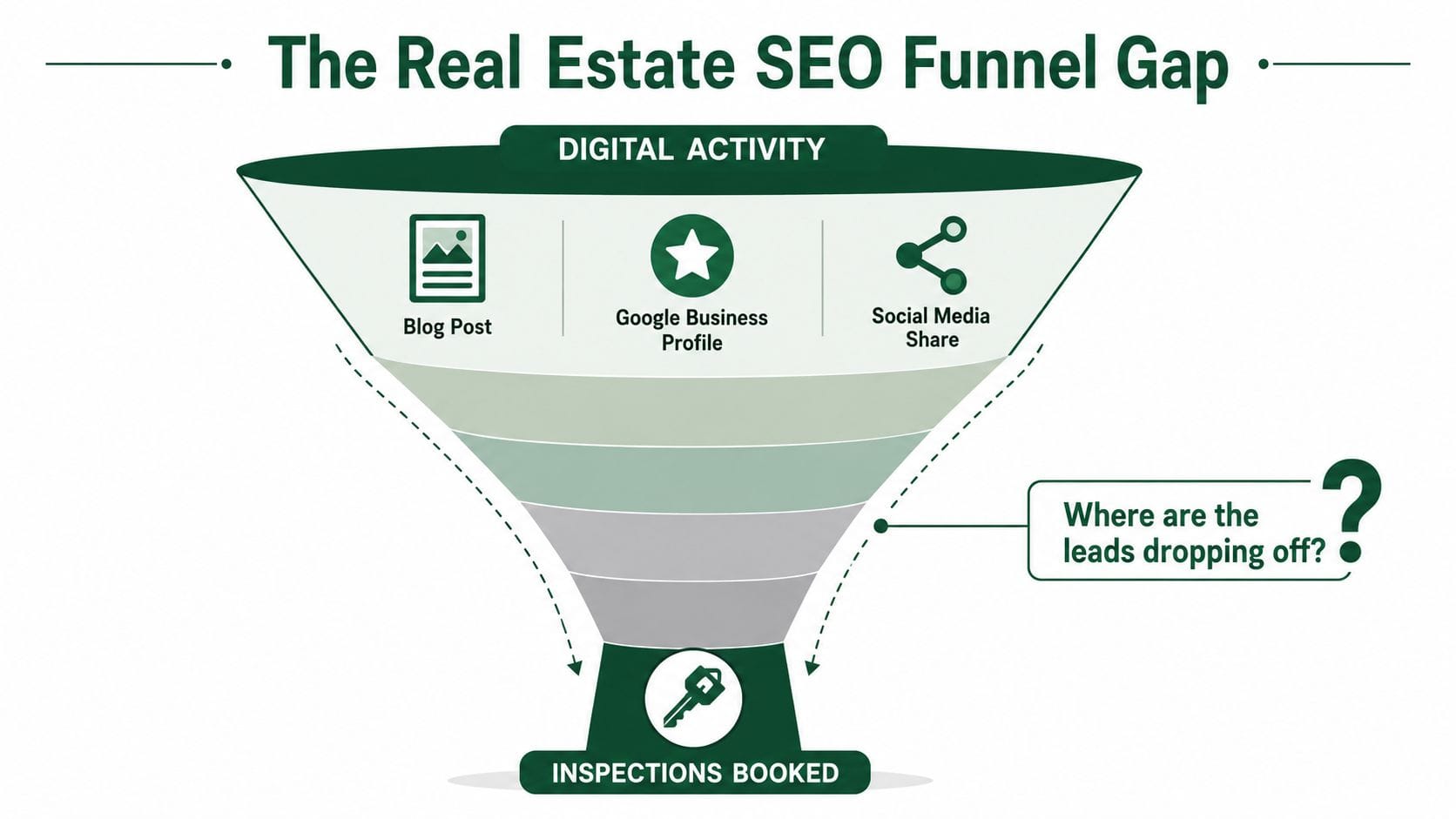
The better way to think about it is simple. A listing page, a suburb page, and a Google Business Profile are not separate chores. They're the same funnel wearing different clothes.
Why Real Estate SEO Looks Busy but Books Few Inspections
A Brisbane agent often spots the problem in the most annoying place possible, on a dashboard that looks healthy. Traffic is up, a few pages are ranking, the team has posted another blog, and the Google Business Profile has fresh photos. Yet the inbox is thin, appraisal requests are flat, and the inspection calendar still needs filling.
That usually means the agency is optimising activity, not outcomes. Search users don't care how much content was published last month. They care whether the page they found answers a suburb question fast enough to make them click, call, or fill in a form.
Practical rule: if a page does not move a user closer to a suburb enquiry, it's decoration, not marketing.
The first decision is geographic. A Brisbane agency doesn't need to “own” the whole city. It needs to own the suburb clusters where buyers are already comparing homes, streets, schools, and commute patterns. The second decision is page quality. A strong New Farm listing page should do more than describe the kitchen. It should make the case for a next step. The third decision is profile discipline. Google Business Profile needs consistent identity, fresh visuals, and review momentum. The fourth is measurement. The team needs to know whether calls, listing-page forms, and blog leads are coming from the right place, not just whether traffic exists.
For a simple bridge between rankings and revenue, Boocoo's overview of digital marketing for real estate fits the broader local lead-generation picture, but the fix is sharper than a generic marketing mix. The agency has to stop asking, “Are we visible?” and start asking, “Which pages and profiles are producing enquiries?”
That shift matters because the buyer journey starts online, and the top results capture the clicks that most agencies want but never earn. Brisbane teams that ignore that reality end up publishing more and converting less. The ones that win choose fewer pages, better suburb coverage, and a cleaner reporting habit.
Mapping the Keywords Brisbane Buyers Use
Suburb keyword research gets messy when teams chase everything at once. Start with three buckets and force every term into one of them. That gives a busy principal something usable, not a spreadsheet full of loose ideas.
Start with the buckets that match intent
The three seed buckets are straightforward, suburb intent, property-type intent, and lifestyle intent. Suburb intent covers queries like “houses for sale in Paddington” or “real estate agent Red Hill”. Property-type intent catches terms like “four-bedroom house New Farm” or “townhouse Bardon”. Lifestyle intent captures the queries that mention schools, cafes, parks, and commute time.
For a deeper framework on mapping search intent for SEO, group phrases by what the searcher wants next, not by keyword volume alone. That matters in real estate because a generic city page rarely beats a suburb page when the person wants local detail.
A quick way to expand each bucket is to use Google autocomplete, People Also Ask, related searches, and the agency's own enquiry emails. Search terms should then be grouped into buyer questions such as “looking to buy in Paddington”, “[suburb] vs [suburb]”, “best streets in Red Hill”, and “median house price Bardon”. Those groups tell the content team what page to create, or whether a page already exists and just needs a stronger title, header, and intro.
| Suburb Keyword Bucket Example for a Brisbane Agency | Example queries | Intent | Page type to create or optimise |
|---|---|---|---|
| Suburb intent | looking to buy in Paddington, real estate agent Red Hill | Local buying or seller intent | Suburb page or agent page |
| Property-type intent | four-bedroom house New Farm, townhouse Bardon | High-value property search | Listing page or property-type page |
| Lifestyle intent | best streets in Ashgrove, schools near The Gap | Research and comparison | Neighbourhood guide |
| Comparison intent | Paddington vs Red Hill, Bardon vs Ashgrove | Decision-making | Cluster comparison page |
A Brisbane agency should rank priorities by enquiry value, not by ego. A live Paddington listing page is more valuable than a broad Brisbane blog post because it matches a sharper search. The user persona work matters too, because the page has to speak to the actual buyer, not an abstract “traffic audience”.
A practical 12-week cadence keeps the research from dragging on forever. Weeks one and two are for keyword lists and Google Business Profile setup. Weeks three to six are for the top pages, neighbourhood guide, and site-speed fixes. Weeks seven to 12 are for publishing, reviews, and ranking checks. After that, the research stops and the page work starts.
Fixing Listing Pages Before Anything Else
A homepage rarely wins the enquiry. A listing page does, because that's where the buyer decides whether the property is worth a click, a call, or a Saturday inspection. Brisbane agencies that keep polishing the homepage while listing pages stay thin are fixing the wrong thing.
Take a four-bedroom home in New Farm. A normal agent description might read like a brochure, with lines about “stylish living” and “modern convenience”. A search-optimised listing description has a job to do. It needs the main keyword early, the suburb name more than once, and enough context to match the searcher's intent without sounding stuffed.
Place the phrase where search engines and people expect it
The primary phrase should appear in the page title, the meta description, at least one header, and within the first 100 words of the page content. That rule is blunt, but it works because it gives search engines a clean signal and helps the user know they've landed on the right page.
A stronger structure for a New Farm listing might look like this:
- Title tag: Four-Bedroom New Farm Home for Sale, Riverside Living in Brisbane
- Meta description: View this four-bedroom New Farm home with river-side appeal, open living spaces, and easy access to Brisbane's inner-city lifestyle.
- H1: Four-Bedroom Home for Sale in New Farm
- Opening paragraph: This four-bedroom New Farm home sits in one of Brisbane's most searched inner-city pockets, with practical space for families, professionals, or buyers chasing a low-fuss lifestyle close to the city.
That's the difference between a listing that exists and a listing that ranks. It also lines up with the rule that the primary keyword should appear in the page title, meta description, header, and early body copy, which is the concrete on-page placement guidance from the brief's source set (keyword placement guidance).
The best listing pages sound like an agent who understands the market, not a robot trying to tick boxes.
Boocoo's broader advice on conversion rate optimisation in Australia is relevant here because a listing page only earns its keep if the path to enquiry is obvious. That means visible contact details, a clear inspection call-to-action, and internal links back to the relevant neighbourhood page and suburb cluster page. No orphan pages. No dead ends.
A clean internal link pattern helps Google understand the site, but it also helps a buyer move from one property to the next without getting lost. For Brisbane real estate, that's the point. The page should sell the listing and feed the rest of the site at the same time.
Technical SEO for Real Estate Sites Built on IDX
Technical SEO for a real estate site is not a generic health check. It's a list of failure modes that pop up again and again on IDX-heavy property sites. If a developer fixes the wrong thing, the site still underperforms, just with cleaner code.
Four problems that quietly block visibility
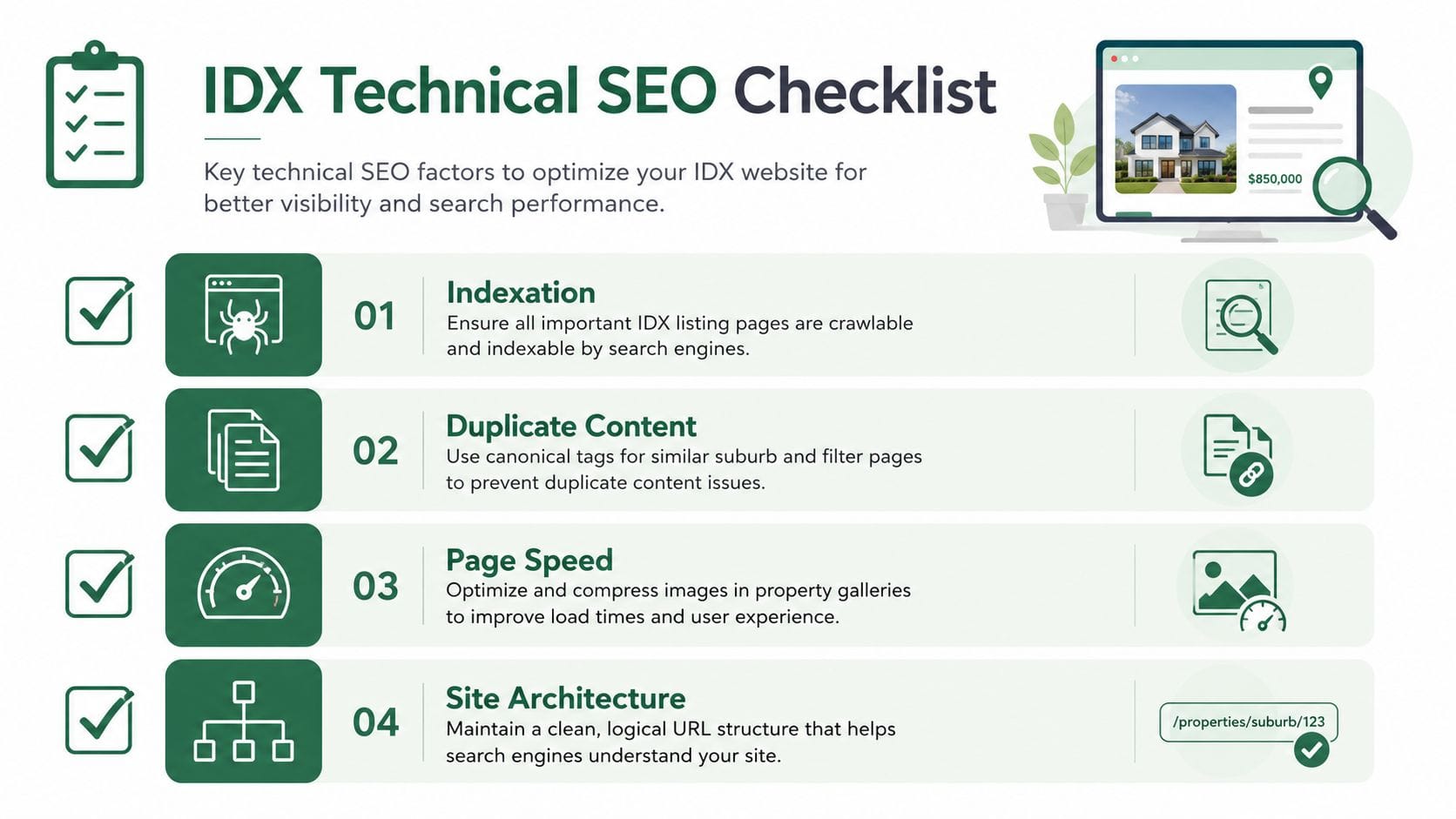
The first problem is unindexed listings. If IDX feeds aren't properly included in the sitemap and submitted through Search Console, search engines may never crawl the pages that matter most. The second is blocked resources. CSS, JavaScript, and images can stop search engines from rendering pages properly, which is a common headache on image-heavy property sites. The third is redirect chains, especially when old listing URLs point to new addresses through multiple hops. The fourth is duplicate content from MLS or IDX feeds, where too many pages look nearly identical and search engines struggle to know which one deserves attention.
The practical controls are blunt, and they're the right ones. Compress property images. Use caching and a CDN. Minify CSS and JavaScript. Keep the site responsive on mobile. Force SSL redirects. Submit XML sitemaps in Google Search Console. Ask the developer about canonical handling for repeated listing patterns and about RealEstateAgent and Property schema markup so the site gives search engines more context.
For a broader technical reference, the property management SEO guide on crawlability, mobile performance, HTTPS, and schema aligns with the same controls, but the important thing is to treat this as a one-week sprint, not an endless rebuild. That keeps the work focused on the actual blockers.
A Brisbane agency does not need to obsess over perfection here. It needs to stop wasting crawl budget on broken structure, bloated galleries, and pages that look identical across suburbs. Fix those first, then measure again. If the site is still slow, or pages still aren't getting indexed, the technical work was cosmetic, not useful.
Treating Your Google Business Profile as a Lead Channel
For a Brisbane agency with a defined service patch, Google Business Profile is the most useful asset in the stack. Not the prettiest. Not the most talked about. The most useful. It sits right where local intent, trust, and contact behaviour meet.
That starts with consistency. The business name, address, and phone number need to match everywhere, across the website footer, directory listings, and social profiles. That's not branding polish. It's a discoverability signal that helps search engines connect the business across the web. A Brisbane principal who splits time between two offices needs to be especially careful here, because sloppy address data makes the profile look weaker than the business really is.
Build the profile like a local trust page
The profile needs the right categories, a realistic service area, and recent photos that show the office, team, and actual sales stock. Weekly Google Posts tied to listings keep the profile fresh. Reviews should be requested steadily, with suburb and street detail where appropriate, because that language helps reinforce local relevance. Q&A can be seeded with the questions buyers ask most often, such as inspection hours, service areas, and whether the team works across specific inner-west and inner-north suburbs.
A useful companion guide is the 2026 guide for realtor GBP optimization, but the discipline itself is simple. Keep the profile alive. Don't let it sit there like a digital business card.
Boocoo's page on how to add your business to Google is a practical reference for the setup side, though the true gain comes after setup. Fresh photos, accurate service areas, and a steady review habit compound over time. In Brisbane, that often matters more than a broad content push, because local buyers and sellers are comparing nearby agents, not generic agencies.
The hard truth is that most agencies underuse GBP because it feels administrative. It isn't. It's a lead channel that happens to look like a profile. Treat it that way and the calls, directions, and website clicks start to make more sense.
Building Neighbourhood Pages That Earn Suburb Rankings
Suburb pages are where real estate content either becomes an asset or turns into a pile of duplicate copy. Brisbane agencies serving multiple areas need a decision rule, not a blank template. If that rule is weak, the site fills up with thin pages that say almost the same thing in different suburb names.
Decide whether the suburb deserves its own page
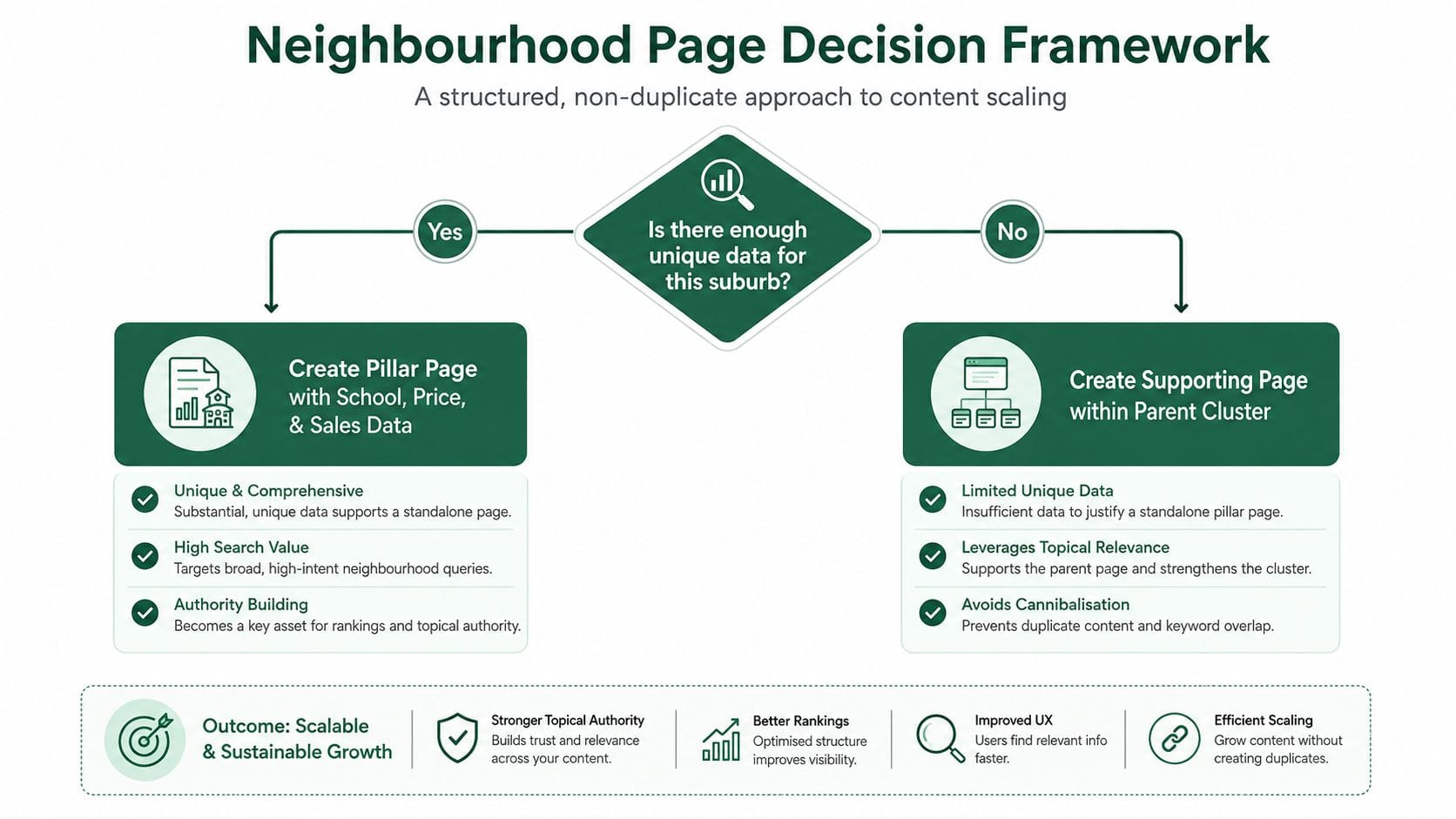
The first question is simple. Is there enough unique data for this suburb? If the answer is yes, build a strong pillar page. If the answer is no, fold it into a parent cluster page. If the suburb has almost no search value and little difference from nearby areas, skip it for now.
Ashgrove and The Gap are a good example. A team may decide to keep them separate if each suburb has enough distinct market detail, schools, amenities, and buyer behaviour. Another agency may treat them as one western Brisbane cluster if the content would otherwise become repetitive. The right choice depends on unique value, not on how many pages a team feels like publishing.
A solid page should include dated market information with sources, named schools and amenities, commute patterns, and active listings embedded dynamically. It should read like a local guide written for buyers, not like a suburb name stitched into a generic template. That's also how to stay clear of AI-generated suburb spam, because named entities and precise details beat vague filler every time. The source brief's guidance on structured, factual content is exactly right here, especially where geographic scope and limitations matter.
Boocoo's article on local SEO for multiple locations lines up with this approach, because the content model has to match how the agency serves its patch. One page per suburb sounds tidy. One useful page per real market is better.
The rule is blunt. If the suburb page cannot say something concrete that a buyer would care about, it should not exist yet. That keeps the site clean, credible, and easier to rank.
Links, PR and a Weekly Measurement Routine That Closes the Loop
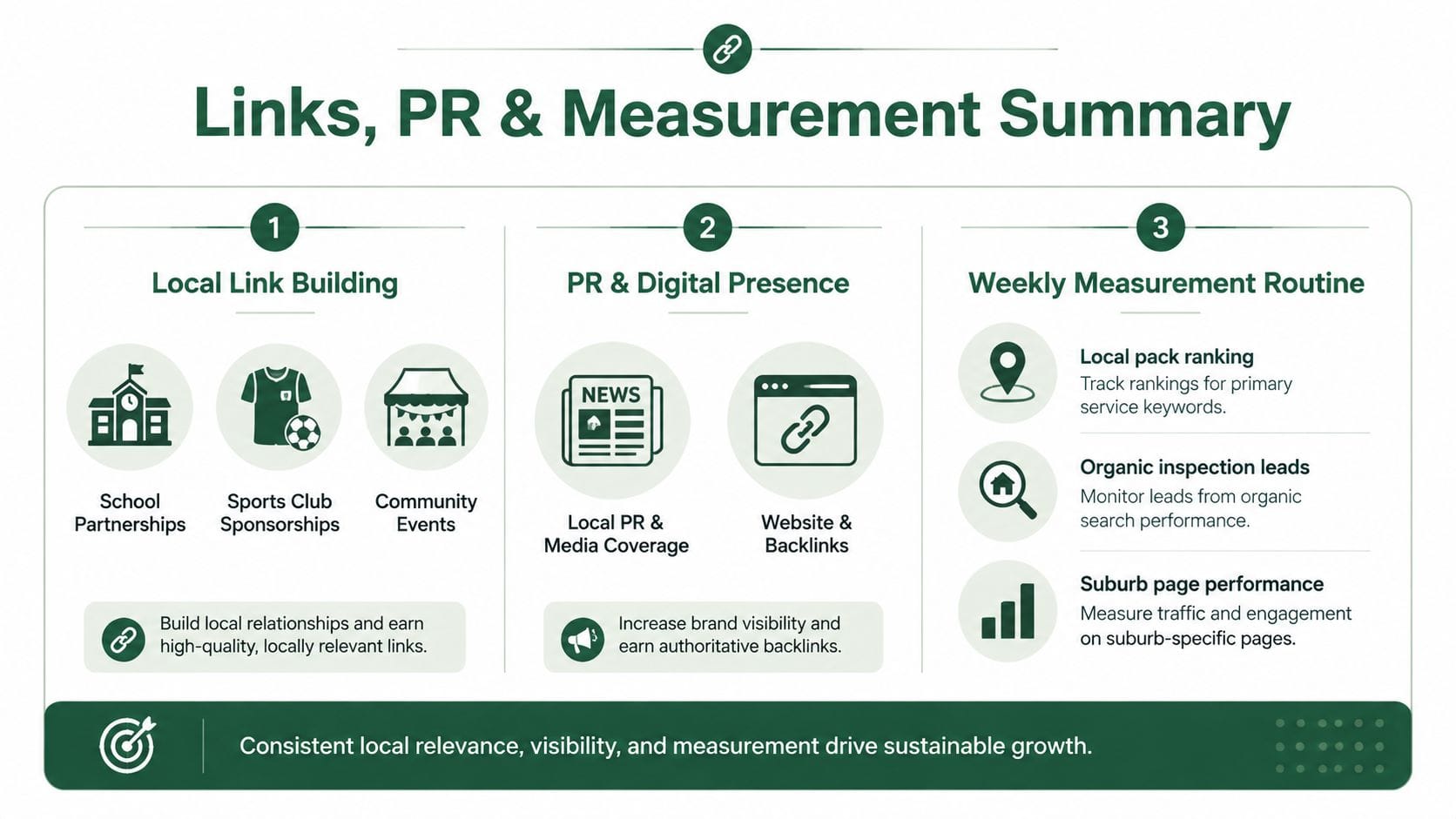
A real estate brand earns local links only when the links make sense in the local market. Sponsoring a school event, partnering with a local cafe, supporting a trade partner's community work, or earning coverage around a notable sale all create local trust signals. Digital PR around market commentary works the same way. It gives the agency something worth citing beyond its own site.
Reviews belong in that same workflow. They are part of local trust, and they should be handled with the same discipline as links and profile updates.
Keep the reporting simple enough to use on a Friday morning
The measurement problem is where most agencies fall apart. They look at traffic and rankings, then guess about enquiries. That is a poor way to run SEO. A better weekly table should separate local pack rankings, organic inspection leads, and suburb page performance so the owner can see what moved and what did not.
| Weekly Real Estate SEO Measurement Snapshot | Metric to log | What “good” looks like | Where to find it |
|---|---|---|---|
| Local pack | Calls and direction requests | Consistent activity from the right suburbs | Google Business Profile Insights |
| Organic | Listing-page form fills and inspection enquiries | Leads tied to specific suburb or property pages | Website analytics and form records |
| Suburb pages | Page visits and engagement | Interest from target suburb clusters | Analytics and Search Console |
For a clean way to think about what engagement metrics mean in practice, the Stage AI's guide to engagement metrics is a useful reference, but the Brisbane version should stay lean. One sheet. One review meeting. One owner who knows what to do next.
The 90-day plan is plain. In week one, fix GBP consistency and the worst listing pages. In month one, publish the first suburb pages and clean the technical blockers. By day 90, the agency should have a clearer picture of which suburb clusters, listing pages, and GBP actions are pulling their weight. That is what good looks like, not vanity traffic and not a pile of tasks.
If a Brisbane agency wants search to produce actual enquiries, the next move is obvious. Audit the Google Business Profile, choose the suburb clusters that matter, and fix the listing pages before publishing anything else. Boocoo can help tighten that stack into something the team can manage, so call 1300 093 797 or email hello@boocoo.au to map the next 90 days around leads, not just rankings.