
The pattern is familiar. A small Brisbane firm gets busy, stops marketing, then the pipeline thins out a few months later. Someone boosts a few Facebook posts, pays for a directory listing, asks a cousin to tweak the website, and hopes enquiries pick up. Some do. Most don’t. The result is the same. Money goes out, the phone stays patchy, and nobody can say which activity brought in a client.
That’s why so much law firm marketing feels disappointing. The issue usually isn’t effort. It’s that the effort sits in the wrong order. Firms jump to tactics before they’ve nailed the basics: who they want to attract, what message they need to send, how a prospect checks them out online, and what happens when that person finally calls or fills in a form.
For a small firm in Brisbane, that matters even more. A suburban family lawyer, a commercial solicitor in the CBD, and a migration practice in Sunnybank don’t need the same marketing plan. They need a practical one that fits the way local clients search, compare firms, and decide who seems credible enough to trust.
Good marketing for a law firm isn’t flashy. It’s visible, clear, compliant, and easy to act on. It helps the right person find the firm, understand what it does, and make contact without friction.
Introduction Why Most Law Firm Marketing Fails
Most failed law firm marketing starts with random activity. A firm launches a new website without fixing the contact process. It runs ads before working out which matters are profitable. It writes blog posts that answer questions no prospective client is typing into Google.
That creates a feast-or-famine cycle. The firm gets a burst of enquiries, then silence. Marketing starts to feel like gambling.
The fix is less dramatic than many might assume. A small practice doesn’t need a giant brand campaign. It needs a system that does four jobs well:
- Gets found locally
- Builds trust fast
- Makes contact easy
- Tracks which enquiries turn into real matters
Practical rule: If a marketing activity can’t be tied to a likely client action, it probably belongs lower on the priority list.
A Brisbane firm working in family law might be tempted to spread effort across Instagram, networking breakfasts, sponsorships, a blog, Google Ads, and email newsletters all at once. That usually means none of them gets done properly. A tighter plan works better. Pick the channels that match buyer intent first, then add the rest later.
Small firms also face a trust hurdle that bigger firms often solve with brand recognition. A local prospect may not know the difference between three firms on the first page of search results. They compare websites, look at service pages, scan reviews, check whether the firm seems established, and decide who feels easiest to contact.
That’s where practical law firm marketing wins. Clear service pages beat vague brand language. A well-run Google Business Profile beats a neglected one. Fast response times beat a polished brochure site with no follow-up.
Building Your Foundational Marketing Strategy
A firm can save a lot of money by getting the foundation right before paying for traffic. Strategy doesn’t need a workshop, a slide deck, or a dense marketing document. For a small law firm, one page is enough if it answers the right questions.
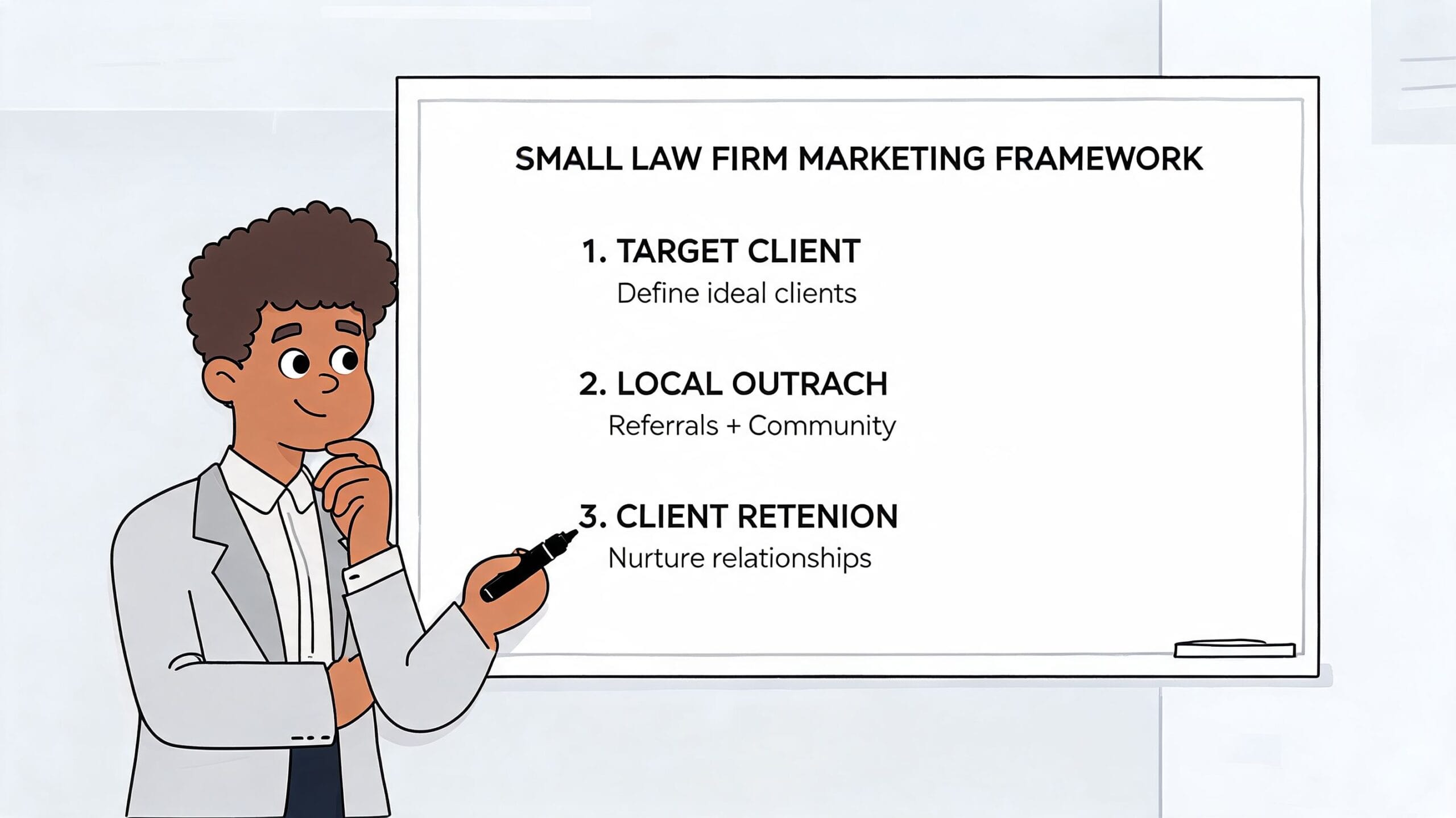
Start with one client, not everyone
“Businesses” is not a target market. Neither is “families” or “people who need legal help”.
A workable target looks more like this:
- Family law example: Separated parents in Brisbane’s inner north who want clarity on parenting arrangements and property division.
- Commercial example: Small business owners signing leases or dealing with contract disputes in Fortitude Valley and nearby suburbs.
- Property example: Buyers and sellers who want fixed-fee conveyancing and regular updates without chasing the office.
The more specific the client profile, the easier everything else becomes. Website copy gets sharper. Content ideas come faster. Ad targeting improves. Intake staff know what questions to ask.
A simple way to define the ideal client is to write down:
- The legal problem they usually have
- The situation around it such as stress, urgency, confusion, or cost concern
- The location they’re in or searching from
- The type of matter the firm most wants more of
Define the value in plain English
Most firms describe themselves with language that sounds respectable but says very little. “Trusted legal solutions” and “client-centred advice” don’t help a prospect choose.
A better message explains what the firm does and why someone should contact it. For a Brisbane family law practice, that might mean focusing on calm communication, fixed-fee initial advice, or experience handling urgent parenting issues in Queensland. For a business solicitor, it might be practical turnaround times and direct partner contact.
This is the test. If the wording could sit on any competitor’s website, it isn’t specific enough.
The strongest message usually answers the prospect’s private question: “Why this firm instead of the next one?”
A short positioning statement often works best. For example:
| Question | Working answer for a Brisbane family law firm |
|---|---|
| Who is the firm for | Parents and spouses needing practical family law help in Brisbane |
| What does it do well | Clear advice, steady communication, efficient matter handling |
| Why choose it | Straight answers, less jargon, no confusing intake process |
Choose the channels your clients already use
Once the firm knows who it wants, channel choice gets simpler. Search matters most when someone already needs a lawyer. Social content helps when the firm needs to build familiarity or support referrals. Email helps nurture existing contacts and referral partners. Community networking can still work, but it works better when backed by a solid digital presence.
A small firm doesn’t need to be everywhere. It needs to be present in the few places that influence hiring decisions.
A practical one-page strategy can include these points:
- Primary audience
- Main services to promote
- Core message
- Main acquisition channels
- Response process for new enquiries
- Monthly review habit
That’s enough to stop reactive marketing and start making deliberate decisions.
Winning Locally with SEO and Your Website
A Brisbane firm can spend months posting on social media and still get beaten by a competitor with a better Google Business Profile, clearer service pages, and a receptionist who calls back fast. That is how local legal marketing usually plays out on a small budget. The firms that win nearby searches tend to be the ones that make it easy to find them, trust them, and contact them without friction.
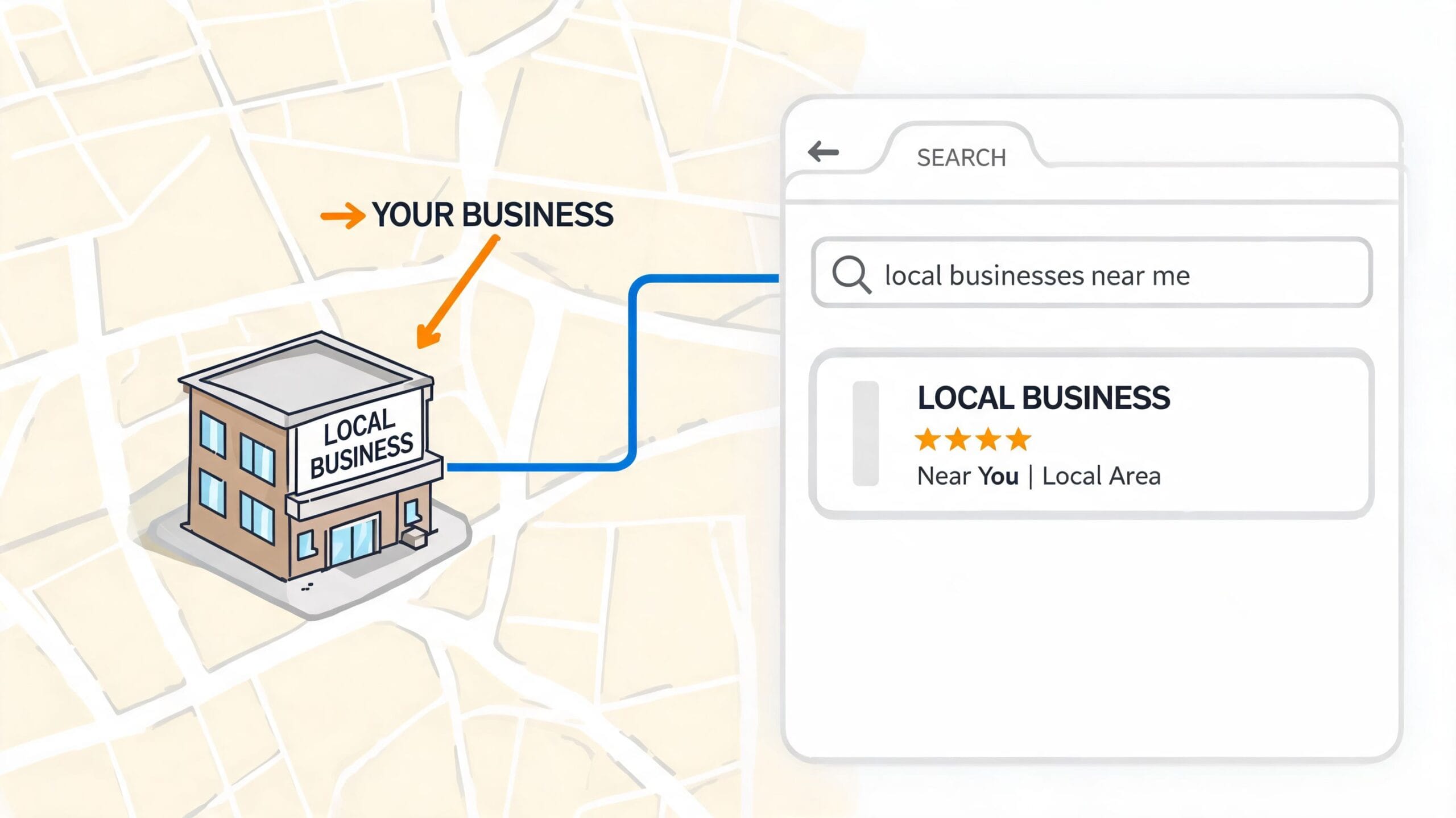
Treat local SEO like the firm’s public frontage
For a small Brisbane practice, local SEO usually starts with three assets. Google Business Profile, service pages, and intake paths. If one is weak, the others have to work harder.
Google Business Profile does more than display a phone number. It shapes whether someone sees the firm as active, current, and credible. A profile with the wrong category, old hours, no recent photos, or patchy review responses often underperforms before anyone even reaches the website. That matters in Brisbane suburbs where prospects may compare only three or four firms before making contact.
The practical work is straightforward:
- Keep core details consistent: Firm name, address, phone number, and office hours should match the website exactly.
- Choose categories carefully: Lead with the main service people search for, not a vague catch-all.
- Write service descriptions in client language: “Parenting arrangements” usually works better than internal practice labels.
- Maintain the listing: Check suggested edits, add current photos, and respond to reviews in a way that stays professional and compliant.
If the firm wants help without turning this into a major project, a focused search engine optimisation plan for Brisbane service businesses is often enough to fix the parts that affect visibility first.
Your website has one job. Turn local interest into qualified enquiries
Search rankings matter. Conversion matters more.
A small law firm website does not need flashy design or long lawyer bios on every page. It needs to answer the questions a cautious prospect asks in the first minute. Am I in the right place? Does this firm handle my problem in Queensland? How do I make contact, and what happens after I do?
The pages that usually carry the load are simple and specific:
- One page per core service: Family law, criminal law, conveyancing, wills and estates, or whatever the firm wants more of.
- Clear local signals: Brisbane, Queensland process, and service coverage used naturally where relevant.
- Fast contact options: Click-to-call, short forms, and obvious enquiry buttons on mobile.
- Low-friction reassurance: Explain next steps, likely response times, and whether the first call is a short screening chat or a booked consultation.
This is also where compliance and intake start to overlap with marketing. A page that promises too much, uses risky wording about outcomes, or creates confusion about fees may increase enquiries but lower quality and create problems later. Better pages attract the right matters and set expectations early.
Build service pages for intent, not for appearances
One of the most common mistakes I see is sending every visitor to the homepage. That wastes good search traffic.
Someone searching for a divorce lawyer in Brisbane wants a page about divorce and separation. Someone looking for help after a drink driving charge wants a page that speaks directly to that issue, in plain English, with Queensland context. Service pages perform better when they match the search closely and remove guesswork.
A good page usually includes four things. What the firm helps with, who it helps, how the process begins, and how to contact the office. Add a short FAQ if the team keeps hearing the same objections or timing questions on the phone.
Use location pages selectively
Location pages can work for firms serving Brisbane plus nearby areas such as Logan, Ipswich, Redcliffe, or Moreton Bay. They only help when each page reflects something real about how the firm services that area.
Thin pages with suburb names swapped out rarely rank well and often weaken the site overall. A stronger option is fewer pages with more substance. If the firm has one Brisbane office and regularly acts for clients across South East Queensland, one strong Brisbane page plus well-written service pages is often the better use of budget.
Useful location pages usually cover:
- the service offered in that area
- practical local context
- realistic service coverage
- a clear next step for someone nearby
For small firms, local SEO is rarely a technical mystery. It is a discipline problem. Keep the profile accurate, publish pages that match real search intent, and make intake easy once someone is ready to call.
Becoming a Trusted Voice with Content
A common Brisbane pattern looks like this. A potential client gets referred by an accountant, a former client, or another solicitor. Before they call, they visit the website, scan a few pages, and look for signs the firm handles their problem every week, not once in a while.
That is where content helps. Done properly, it builds trust before the first conversation, shortens basic intake questions, and gives hesitant prospects a reason to contact the office.
For a small law firm, content does not need to mean constant publishing or long opinion pieces. It means answering the questions people already raise in consultations, emails, and phone calls, in plain English and with Queensland context. That is especially useful in Brisbane, where many smaller firms compete in the same suburbs and practice areas, often with similar service pages and similar fee pressure.
Useful content beats polished filler
The firms that get value from content usually stay close to real client concerns. The firms that waste time often publish vague articles about legal rights, court systems, or broad legal updates that never connect to a paying matter.
Useful topics are specific, local, and tied to intent. For example:
- Family law: What to sort out first after separation in Queensland
- Commercial law: What Brisbane business owners should review before signing a retail or commercial lease
- Traffic matters: What happens after a drink driving charge in Queensland
- Property law: Delays that commonly affect Brisbane conveyancing files
- Wills and estates: What an executor does under Queensland law
These topics do more than fill a blog. They help a prospect decide whether the firm sounds clear, practical, and safe to contact.
They also support intake. If reception keeps getting the same pre-appointment questions, content can answer them earlier and save fee earner time.
Content should earn its place
I would rather see a Brisbane suburban firm publish one solid article a month than push out four rushed posts no one reads. On a tight budget, every piece should do at least two jobs. It should help attract search traffic, support referral conversion, answer intake questions, or give the team something useful to send after an enquiry.
A strong article can then be reused as:
- a follow-up link after an initial call
- a short FAQ for the relevant service page
- a LinkedIn post from the principal
- a brief video script
- a resource for referral partners who want something clear to send on
That is a better use of time than treating content as a separate marketing channel with its own endless to-do list.
A practical workflow for time-poor lawyers
The easiest content plan starts with the matters the firm wants more of and the questions that come up before someone engages.
A simple process works well:
- Review enquiry notes and email questions from the last two to three months.
- Pick the questions tied to profitable, realistic work in the firm’s target area.
- Write the first draft in plain language, as if explaining it to a new client in a meeting.
- Add local detail where it matters, including Queensland process, common timing issues, and practical next steps.
- Have a lawyer review accuracy and risk before publishing.
- Use the piece in intake, not just on the blog.
That last step matters. If content never gets used by the front desk or the lawyers, it is probably too generic.
Compliance and clarity matter more than volume
Legal content is marketing, but it is also part of how the firm presents professional judgment. That means accuracy, careful wording, and sensible disclaimers matter. Avoid promises about outcomes. Avoid oversimplifying timeframes or costs. Keep the language clear enough for a prospective client who is stressed, busy, or embarrassed about the issue.
AI can help with outlines, transcripts, and first drafts. It still needs supervision. Queensland legal content has to sound local, reflect the firm’s actual process, and avoid creating compliance headaches for the principal later.
If the firm later wants to turn high-performing topics into campaigns, these same articles often become the basis for law firm advertising and remarketing work. Starting with content first usually makes paid promotion cheaper to test because the message has already been proven in real client conversations.
A smaller firm does not need a content machine. It needs a repeatable habit of publishing useful answers that help the right Brisbane clients take the next step.
Accelerating Growth with Paid Advertising
A small Brisbane firm usually turns to ads after a familiar run of events. Referrals slow down for a month. Organic rankings are still patchy. The principal wants more matters, but there is no appetite for burning $5,000 on a campaign that sends junk enquiries to reception.
Paid advertising can help in that situation. It just needs a tighter brief than most firms give it.

Google Ads captures active demand. Social ads support recall and retargeting
Google Ads works best when the searcher already wants legal help. That makes it a better fit for urgent, high-intent matters such as family law, criminal defence, drink driving, bail applications, or certain disputes. The person is not browsing. They are trying to solve a problem now.
Social ads do a different job. They are better for staying visible in a local catchment, retargeting previous website visitors, or promoting a useful resource that helps a hesitant prospect take the next step. For many suburban Brisbane firms, social ads rarely produce strong results as a cold lead channel unless the offer is very specific and the targeting is tight.
A conveyancing practice in Brisbane’s southside is a good example. Google Ads can target people searching for help with a contract review or settlement. Facebook or Instagram is more useful for reminding recent website visitors that the firm handles fixed-fee conveyancing in their area.
| Channel | Better use case | Typical message style |
|---|---|---|
| Google Ads | Urgent, service-specific searches from people ready to enquire | Direct, local, service-led |
| Facebook or Instagram | Retargeting, local awareness, education-based offers | Simple, helpful, lower-pressure |
Firms that need support with campaign setup, landing pages, and tracking usually get better results from a focused law firm paid advertising strategy than from spreading budget across too many channels at once.
What usually wastes budget
The mistakes are rarely complicated. They are usually basic setup issues that sit between the ad click and the first conversation.
Common problems include:
- Sending ad traffic to the homepage: A person who searched "Brisbane family lawyer free initial phone call" should land on a page about that service, not the firm’s general site.
- Targeting too broadly: Suburban firms often pay for clicks from outside their service area because location settings were left too open.
- Using broad keywords without enough filtering: Terms like "lawyer" or "solicitor" can trigger a lot of irrelevant searches.
- Weak message match: If the ad mentions fixed fees, local experience, or urgent advice, the landing page needs to carry the same promise carefully and clearly.
- Poor compliance review: Ad copy and landing pages still need the same caution as the rest of the firm’s marketing. No inflated claims. No careless statements about likely outcomes.
- No intake capacity behind the campaign: Paid traffic is expensive if calls go unanswered at lunch, after 5 pm, or during court-heavy days.
Small-budget firms either get disciplined or get disappointed.
A sensible campaign usually starts with one service, one location cluster, and one clear conversion action. That might be "book a callback" for criminal defence, or "request a fixed-fee conveyancing quote" for property work. The narrower setup gives the firm a real chance to judge lead quality before increasing spend.
Brisbane firms usually do better with narrow geography and sharper intent
Hyper-local targeting matters more here than many agencies admit. A small firm in Chermside, Mount Gravatt, Ipswich, or Logan does not need statewide visibility to make paid ads work. It needs visibility in the pockets where the right matters come from, backed by ad copy that sounds local and credible.
That often means using suburb names carefully, excluding areas the firm will not service profitably, and scheduling ads around when somebody can answer the phone or return an enquiry promptly.
Paid ads work best as an amplifier. They expose weak pages, vague offers, and slow intake very quickly.
Used well, paid advertising gives a small Brisbane firm a controlled way to test demand and bring in matters faster than SEO alone. Used poorly, it buys clicks from the wrong suburbs, for the wrong services, at the wrong time.
Optimising Client Intake and Ensuring Compliance
It is 4:40 pm on a Thursday. A solicitor is still out of the office, reception is covering three things at once, and a prospective client in Carindale fills out the website form after comparing a few Brisbane firms. If that enquiry sits overnight, the marketing did not do its job.
For a small law firm, intake is part of marketing. A good website, local SEO, and paid ads only create the opportunity. The result depends on what happens in the first 15 minutes, the first phone call, and the first reply.
That is why small-budget firms should treat intake as a conversion system, not a back-office task.
Marketing and intake need to be built together
A lot of wasted spend comes from a simple disconnect. The campaign targets the right suburb and service. The website gets the enquiry. Then the handoff falls apart because nobody owns first response, the form asks the wrong questions, or the prospect cannot tell what happens next.
In Brisbane, that problem gets expensive quickly. Smaller firms often compete on responsiveness and clarity, not brand size. A practical, well-run intake process can beat a bigger competitor with a flashier website if the prospect gets a prompt, useful reply and a clear path to book.
Urgent matters make that even more obvious. Family law, criminal matters, and some dispute work often come with short decision windows. Delay the first response, and the prospect usually keeps calling.
A simple intake audit
Most firms do not need new software first. They need fewer points of friction.
Start with a basic audit:
- Response speed: How long does it take to return a missed call or web enquiry during business hours?
- Ownership: Who handles first response each day, including lunch breaks and court-heavy periods?
- Qualification: What details are collected before booking, and which questions can wait?
- Conflict process: How can the firm do a sensible early check without turning the first interaction into paperwork?
- Expectation setting: Does the prospect know fees, timing, documents to bring, and what the next step is?
Then test the process yourself. Submit the firm’s own web form. Call the listed number at 8:30 am, 12:15 pm, and 4:45 pm. Use a mobile, because that is how many prospects will contact you. Small Brisbane firms often find avoidable problems fast. Long forms, generic auto-replies, voicemail with no callback timeframe, or a receptionist who cannot explain the next step.
A stronger setup usually looks like this:
| Intake point | What good looks like |
|---|---|
| Phone answering | Clear greeting, prompt pickup, backup if unavailable |
| Web form | Short form, obvious next step, confirmation message |
| Follow-up | Same-day acknowledgement where possible |
| Consultation booking | Simple options, minimal back-and-forth |
Firms that want more booked consultations from the same traffic often benefit from reviewing conversion rate optimisation for Australian service businesses.
Compliance needs to shape the message early
Compliance should be built into the campaign, the landing page, and the intake script from the start.
For Queensland firms, the risk usually shows up in ordinary marketing decisions. A headline overstates likely outcomes. A staff member describes someone as a specialist when the firm is not entitled to use that wording. A fee message sounds fixed until the prospect gets the fine print. A testimonial creates the wrong impression about results.
The safer approach is also the more credible one, especially for a local firm relying on trust and referrals:
- Describe services in plain English
- Keep outcome language restrained
- Use expertise and specialisation terms carefully
- Check fee wording, testimonials, and review use against current professional obligations
- Make sure intake staff do not say things the website avoids
That last point matters. I have seen compliant websites undermined by rushed phone handling. If the page is careful but the first call sounds like a hard sell, the firm creates both trust issues and compliance risk.
A good test is to read the page, then listen to the intake call script side by side. The tone should match. Clear, measured, and helpful beats aggressive every time.
For small Brisbane firms, that balance matters more than clever marketing language. Good law firm marketing gets the right enquiry, handles it properly, and keeps the message within the rules from first click to signed matter.
Measuring What Matters and Setting a Realistic Budget
A Brisbane principal might spend months updating the website, paying for SEO, and testing a few ads, then still have no clear answer to a basic question. Which activity is producing profitable matters?
That reporting gap is common in small firms. In Market My Market’s article on small law firm marketing problems, the authors note that 68% of firms with fewer than 50 lawyers operate without a written marketing plan. The same article also says only 22% of small firms track marketing ROI beyond basic lead counts. That figure comes from the Market My Market source, not Australian-specific reporting. For a smaller Brisbane practice, the result is familiar. Spend gets approved on instinct, while intake staff and matter value tell a different story.
Track qualified leads, not noise
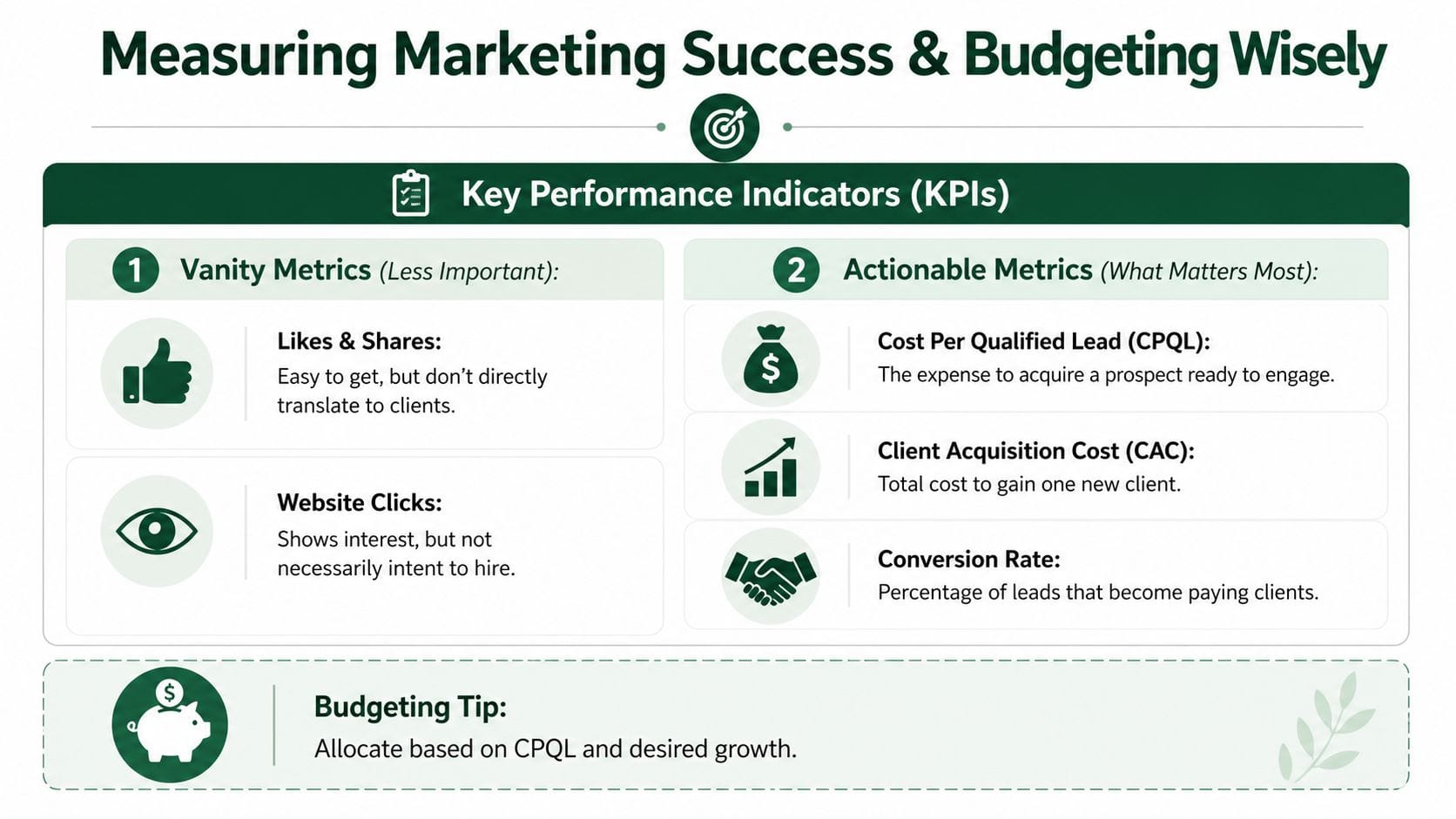
Traffic, impressions, and raw enquiry numbers have their place. They do not tell a small law firm enough.
The numbers that usually matter most are:
- Cost per qualified lead
- Client acquisition cost
- Lead-to-client conversion rate
- Lead source by matter type
- Average fee value by source, if the firm can track it
A qualified lead is not every phone call or form fill. It is an enquiry the firm would seriously consider taking on, subject to conflicts, budget, urgency, location, and fit.
The basic formulas are simple:
- Cost per qualified lead = total marketing spend ÷ number of qualified leads
- Client acquisition cost = total marketing spend ÷ number of new clients
- Lead-to-client conversion rate = new clients ÷ total qualified leads
Small-budget marketing becomes more practical. A campaign that produces 12 low-value enquiries is often worse than one that produces 4 matters the firm truly wants. I would rather see a suburban Brisbane family or property firm get fewer calls and sign better files than chase volume that ties up reception and goes nowhere.
Every enquiry should be tagged at first contact. Use plain categories such as Google Business Profile, organic search, referral, Google Ads, Facebook, repeat client, email, or local event. Then add the service type. Without that step, it is hard to tell whether the firm is attracting the right work or just attracting attention.
A simple budget model for a small Brisbane firm
A realistic budget starts with capacity. If the firm can only handle five new matters a month without service slipping, there is no point buying ten.
For small Brisbane firms, I usually suggest starting with the core pieces that improve both visibility and conversion. That means the website, local search presence, intake process, and a modest content rhythm. Paid ads can help, but they should not swallow the budget before tracking and intake are sorted.
For a sample firm with $300,000 annual revenue, a 3% annual marketing budget equals $9,000. That is not a large number, but it is enough to improve the basics and test one or two channels properly.
| Category | Budget Allocation (%) | Annual Spend (at 3% of Revenue) | Focus / Key Activities |
|---|---|---|---|
| Website improvements and conversion fixes | 30% | $2,700 | Service page rewrites, contact form cleanup, mobile usability, call tracking setup |
| Local SEO and Google Business Profile | 35% | $3,150 | Profile optimisation, local service pages, review process, technical cleanup |
| Content creation | 20% | $1,800 | FAQ articles, short videos, repurposed social posts, intake support resources |
| Paid advertising test budget | 10% | $900 | Small Google Ads trial for one service area, landing page testing |
| Reporting and review tools | 5% | $450 | Analytics setup, monthly reporting, source tagging |
That split will not suit every firm. A criminal defence practice that needs urgent-call enquiries may put more into tightly controlled search ads. A wills and estates firm in a competitive Brisbane suburb may get better returns from local SEO, referral support, and stronger service pages. The point is to match budget to likely client behaviour, matter value, and how quickly the firm can respond to leads.
What to review each month
Monthly reporting does not need a boardroom pack. A one-page review is usually enough if the numbers are clean.
Check:
- How many qualified leads came in
- Where they came from
- Which service pages or campaigns produced contact
- How many became clients
- How quickly the firm responded
- Which enquiries were poor fit and why
- Whether signed matters justified the spend
That last point matters more than many firms expect. If response times are slow, the marketing can look weak when intake is the problem. If a page generates regular enquiries but they are the wrong suburb, wrong matter type, or wrong budget, the messaging needs adjustment. Marketing and intake should be reviewed together because, in a small firm, they are part of the same system.
Small firms do not need more dashboards. They need a steady reporting habit, consistent source tracking, and enough discipline to stop funding channels that produce noise instead of good matters.