

You've got a business to run, the phones are ringing, quotes are going out, and at 9pm you're still staring at Google, trying to work out why SEO quotes are all over the place. One provider says a few hundred dollars, another wants a long contract, and half the wording sounds like it was written for a tech company in Sydney, not a Brisbane tradie or professional services firm.
That confusion is exactly why low cost SEO services need a proper definition. Low cost should mean focused, practical, and tied to local leads. It should not mean lazy, vague, or paper-thin work that disappears into a monthly report no one reads.
What Low Cost SEO Actually Means for a Brisbane Business
A Brisbane owner Googles “SEO services” at night and gets buried under retainers, jargon, and grand promises. That's the moment they realise they don't need more noise, they need a smaller, clearer decision.
For a local business, low cost SEO usually means work aimed at one thing, getting found by nearby customers who are ready to call, book, or enquire. That is very different from a national campaign built to grow organic traffic across a whole country. The local version leans on Google Business Profile optimisation, a few core page fixes, basic citations, and maybe one or two useful local pages. The national version usually needs more content, more links, more competition analysis, and a much bigger budget.
The scale matters because Australia is packed with small operators. The Australian Small Business and Family Enterprise Ombudsman says there are about 2.6 million small businesses, and the Australian Bureau of Statistics defines small businesses as those with fewer than 20 employees. That market is dominated by owners who need work that moves the needle, not broad retainers that read well in a proposal. Ahrefs' pricing research shows 23% of SEOs charge $500–$1,000 per month, 63% of businesses spend between $500 and $5,000 monthly on SEO, and local SEO averages $1,557 per month. Those figures show that “low cost” is usually a focused monthly retainer, not bargain-bin marketing. See the broader Brisbane framing in Boocoo's affordable SEO Brisbane guide.
Practical rule: if a quote is built for local leads, it should explain exactly which local actions are included, not just promise “growth”.
For a plain-English comparison of budget-friendly site work, the guide to affordable site SEO is useful because it separates lean essentials from full-scale campaigns. That distinction is the whole game here. A Brisbane plumber in one suburb doesn't need the same scope as a company trying to rank ten service pages across the east coast.
Decide What You Actually Need Before You Buy

The quickest way to overpay is to ask for “SEO” before deciding what success looks like. A provider can always sell more work than you need if the brief is vague.
Start with the outcome, not the tactic
A one-person tradie in Morningside usually needs calls and quote requests from a tight service area. A five-person accounting firm in Fortitude Valley might care more about ranking key service pages and building trust around specialist searches. Those are not the same buying decisions, even if both businesses say they want “better SEO.”
A simple self-assessment helps. Score each of these as low, medium, or high:
- Urgency of leads. Is the business chasing calls this month, or building for later?
- Current setup. Does the site already exist, does the Google Business Profile exist, and are citations consistent?
- Area of focus. Is the business local to one suburb, multiple Brisbane suburbs, or broader than that?
If two or more of those sit in the low band, the business probably needs a tidy local setup, not a heavy retainer. If the site already has pages, a verified profile, and a few citations, the money should go into fixes and consistency before new content. That is the most common mistake, paying for new material while the basics are still broken.
For a useful way to think about who the business is trying to reach, the user persona guide is worth a look. A service business that knows its best customer will always spend more sensibly than one trying to rank for everything.
Short answer: buy SEO around the business model, not around the provider's favourite package.
Use a brief before any sales call
A one-page brief saves time and forces clarity. It should cover the service area, the main money pages, the current online assets, and the budget ceiling. That single page makes every quote easier to compare because the provider is responding to a real need, not a fuzzy wish list.
Realistic Brisbane Pricing and What It Buys You
The pricing benchmarks tell a blunt story. Ahrefs says 23% of SEOs charge $500–$1,000 per month, and local SEO averages $1,557 per month. Clutch's agency data puts most SEO agencies at $100–$149 per hour, with monthly fees typically ranging from $2,000 to $20,000, and the usual project cost being less than $10,000. For a Brisbane owner, that means affordable SEO still has labour behind it, and the work has to be chosen carefully.
What a sane local retainer usually covers
A smaller monthly budget should usually buy the foundations first. Think Google Business Profile, on-page fixes, citations, and a small amount of content support. If the quote is trying to include everything, strategy, content, links, reporting, and technical work at a rock-bottom price, something is being skipped.
The most useful benchmark is not the headline price, it's the scope. A local business with one location needs a different package from one with several service areas. A trades business in a less competitive pocket can often get further with a tighter plan than a law firm in a crowded suburb. That is why local scope matters more than a generic “SEO package.”
The RecensioAI plan details are a helpful reminder that pricing should always map to visible scope, not hidden effort. The same logic applies here, if the provider can't explain what the monthly work buys, the quote is too soft.
| Typical Brisbane local SEO deliverables by spend band | Typical deliverables | Best for |
|---|---|---|
| Lower end of a local retainer | GBP optimisation, basic on-page fixes, core citations, simple reporting | Sole traders and very small local firms |
| Mid-range local retainer | Everything above, plus a few locally relevant pages and cleaner tracking | Service businesses wanting steady lead flow |
| Higher local retainer | Stronger content support, more location coverage, more involved optimisation | Multi-location businesses or tougher local competition |
What to defer until later
Most owners don't need a big content machine on day one. They don't need endless blog posts either. They need the pages that sell, the profile that shows up properly, and consistent business details across the web.
If the budget is tight, the first dollars should go to visibility and conversion basics. That means making the current site easier to find and easier to trust before chasing bigger organic ambitions. For a more package-level view, the small business SEO packages guide helps frame how scope changes with business size.
DIY, Freelancer, or Local Agency
The wrong model wastes money even when the SEO work itself is decent. A business owner who has time but no cash should not buy the same setup as a company with staff, multiple jobs, and a messy website.
Match the model to the business reality
A sole trader with a few quiet hours a week can often handle a DIY-plus-toolkit approach. That works when the site is small, the service area is clear, and the owner can follow a checklist without getting lost. The hidden cost is time, because every task still has to be learned, checked, and updated.
A ten-person services firm usually sits in the middle. A freelancer can handle execution, keep the work moving, and give occasional strategy without the overhead of a full agency. The hidden cost there is scope, because freelancers often work well in a narrow lane but can struggle when content, technical cleanup, and local visibility all need attention at once.
A business with multiple locations, or a growth target that stretches beyond the basics, usually needs a local agency. That setup costs more, but it also brings coordination. Someone has to keep the GBP work, on-page changes, citations, and reporting moving in the same direction.
Rule of thumb: if the owner is the only marketer, DIY makes sense for narrow scope. If the business needs steady execution, use a freelancer. If the business needs coordination across channels, use an agency.
Boocoo sits in the agency lane as a Brisbane-based option for businesses that want SEO, web, social, and ads handled in one place. That matters when the owner wants fewer moving parts, not more meetings.
Why the cheapest option is often the most expensive one
DIY looks cheap until the owner burns every Saturday fixing the wrong pages. Freelancers look efficient until the work stalls because one person gets overloaded. Agencies look dear until the business realises the cost was missed opportunity, not the invoice.
That is the trade-off. Time, reliability, and predictability sit in different places depending on the model.
The outsource SEO services guide is a good reference point for owners deciding when to hand the work over instead of keeping it all in-house. The right model is the one that protects the owner's time without creating new chaos.
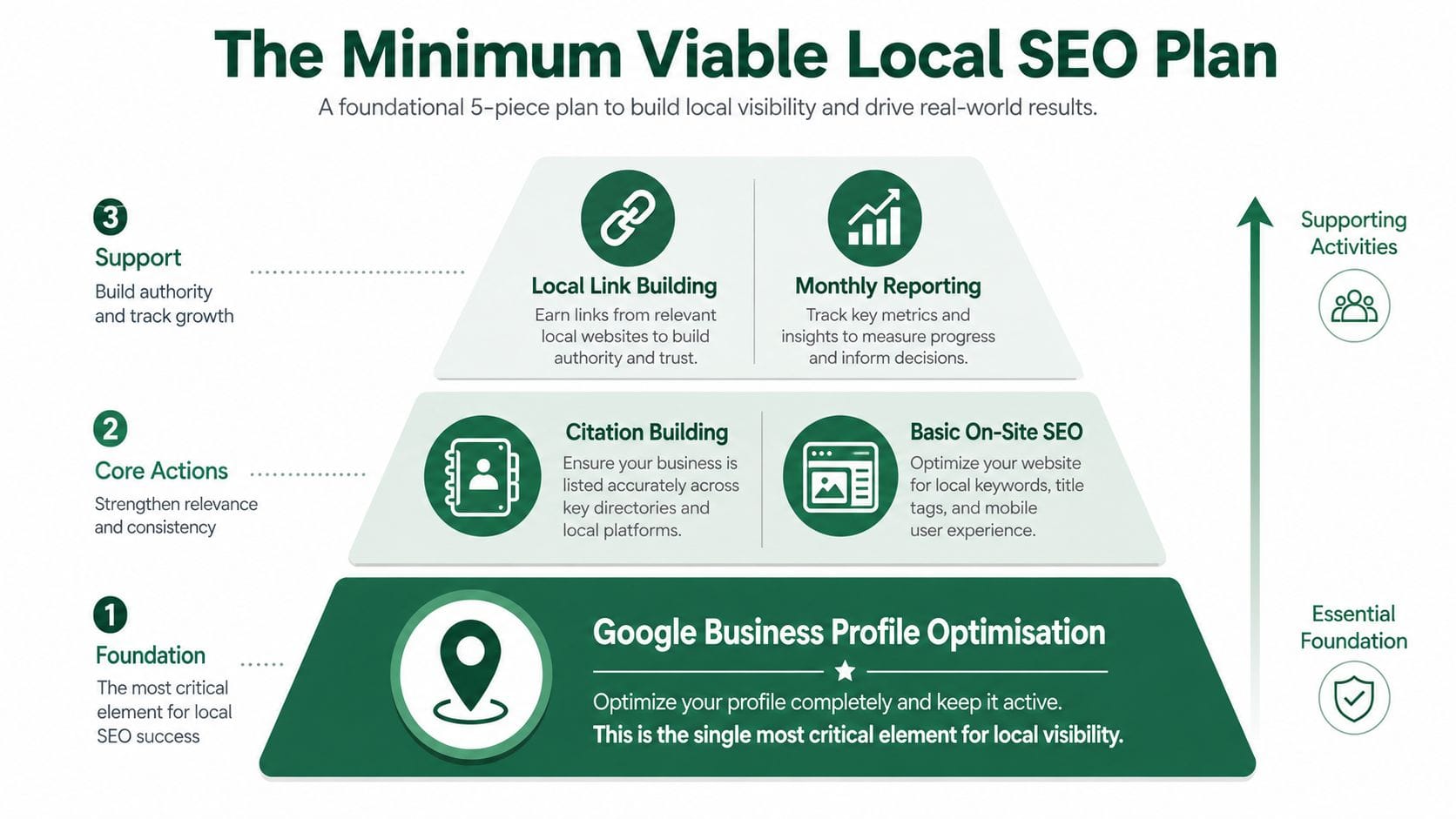
The Minimum Viable Local SEO Plan
A low-cost package should be simple enough to audit in one sitting. If the provider can't walk through these components, the offer is bloated or vague.
The four things worth funding first
Google Business Profile optimisation sits at the top of the list. For most local trades and services, it's the biggest lever because it directly affects how the business appears in local search and maps.
On-page fixes come next. The money pages need clear headings, better copy, stronger calls to action, and tidy technical basics so search engines and humans can both understand them.
Citations matter because they reinforce consistency. The business name, address, and phone number need to line up across the relevant directories, not drift all over the place.
Light content support can come after the basics are stable. That usually means one or two locally relevant pages a month, not a flood of articles that nobody searches for.
A sensible budget split often looks like this, roughly 30% to GBP, 40% to on-page and technical work, 20% to citations, and 10% to content. That split keeps the money on the foundation instead of the garnish. If a proposal leans heavily into content before GBP and site fixes are sorted, the order is wrong.
What a lean quote should be able to explain
The provider should be able to say which pages will be fixed first, which directories matter, and how the local profile will be improved. That conversation should feel practical, not theatrical.
If a business also sells software or a digital product, the free submission directories for SaaS can be a useful reference for understanding how directory work fits into visibility building. For a Brisbane local business, the same principle holds, start with the listings that support discovery and trust.
Good SEO is mostly boring work done properly. That is exactly why it works for small businesses.
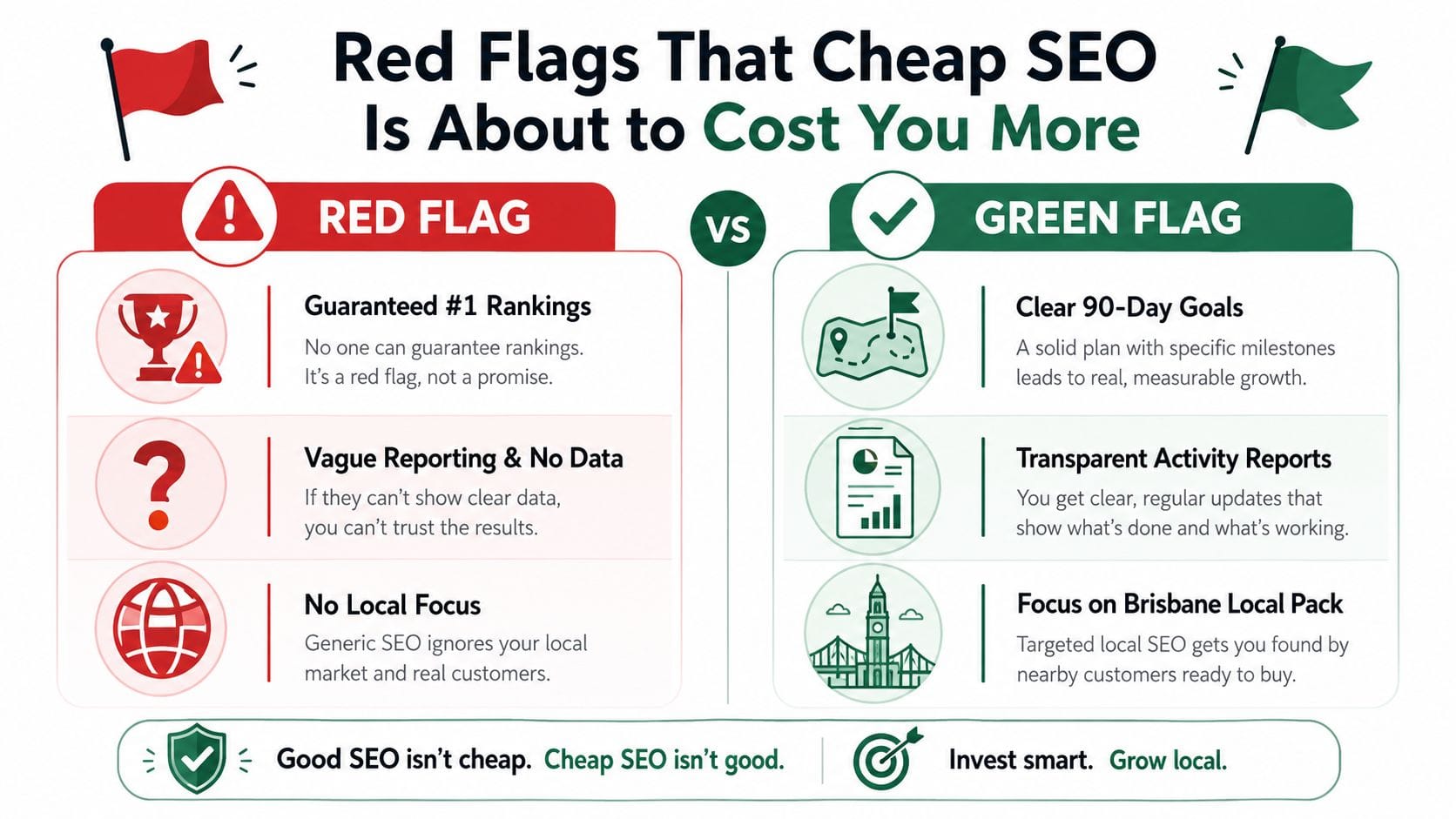
Red Flags That Cheap SEO Is About to Cost You More
Cheap SEO often fails before the first invoice is paid in full. The warning signs show up in the pitch, the contract, and the reporting style.
The questions that expose weak providers fast
Guaranteed #1 rankings should end the conversation. Nobody controls Google's algorithm, so anyone making that promise is selling confidence, not capability.
Vague reporting is just as bad. If the report doesn't show what changed on the site, what was published, what got fixed, or what traffic and leads did, the owner is paying for decoration.
Secret link building is another problem. If a provider won't explain where links come from or why they matter, the business may be buying risk instead of authority.
Long lock-ins with no milestones should also raise eyebrows. A contract can be reasonable, but there should be clear review points and a practical exit path if the work isn't delivering.
The earlier section on pricing makes one thing obvious, real SEO has labour behind it. That's why underpriced work often comes with shortcuts. The cheap search engine optimisation services guide is a useful comparison point if the quote feels too good to be true.
Ask three things before signing, what exactly gets done each month, how success gets measured, and what happens if the scope changes.
How to recover the conversation
If a provider says the right things but the proposal is still fuzzy, ask for a sample monthly report and a list of deliverables. Ask what gets fixed first, what gets ignored for now, and how the work will be tied to local visibility.
If those answers stay broad, walk away. A decent provider can make a lean plan look clear in minutes.
Your 30-Day Action Plan and First-Call Checklist
The next move should be simple enough to do on a Monday morning. Complexity is the enemy here, not effort.
What to do first
Audit the current setup. Check the website, Google Business Profile, and citations. If any of them are broken, inconsistent, or missing, that becomes the starting point.
Write a one-page brief. Include the service area, the main goal, the budget limit, and the pages that matter most. That stops the sales process from drifting.
Shortlist two or three Brisbane providers. Pick them for fit, not fame. One should be able to explain local work clearly, one should be comfortable with your industry, and one should be transparent about scope.
Run a short discovery call. Keep it tight and practical.
Use these questions:
- Scope: What gets done each month, exactly?
- Reporting: What will be measured, and how often?
- Contract length: Is there a lock-in, and what is the review point?
- Exit terms: How does the business leave if the fit is wrong?
- Relevant examples: Have they worked with businesses like this one before?
If the answers are clear, the provider is worth a second conversation. If the answers are slippery, the business has already saved money.
For owners who want the work handled without a lot of fuss, Boocoo is a Brisbane option built around SEO, web, social, and ads in one local relationship. The practical next step is simple, call 1300 093 797 or email hello@boocoo.au and ask for a short, low-pressure conversation about goals, timing, and the smallest sensible SEO package for the business.