

A lot of Brisbane small business owners are in the same spot right now. The website is live. The service is good. Customers who find the business are happy. But the phone isn't ringing often enough, the enquiry form stays quiet, and a competitor across town keeps showing up first on Google.
That problem usually isn't the business itself. It's visibility. In Australia, 93% of online experiences begin with a search engine, and a 2023 AU-specific study found that small businesses with optimised SEO strategies saw a 14.6% increase in conversion rates according to CAE Marketing's summary of small business SEO data. For a Brisbane electrician, accountant, physio, café, or online shop, that matters because the customer is already looking. SEO helps the business appear at that exact moment.
SEO packages for small business can sound more complicated than they are. Most owners don't need jargon. They need to know what they're paying for, what results are realistic, and which package fits their budget without adding more admin to an already full week.
The guide below breaks that down in plain English, with a Brisbane lens and practical examples.
Why Your Brisbane Business Needs More Than Just a Website
A website on its own is often just an online brochure. It tells people who the business is and what it offers, but it doesn't automatically bring visitors in.
That's where many Brisbane operators get stuck. A local tradie might have a clean site with a service page, contact form, and a few project photos. A suburban accounting firm might have a polished homepage and solid credentials. If neither site is showing up when someone searches for those services, the website isn't doing enough commercial work.
The gap between good service and online visibility
Take a simple local search. Someone in Ashgrove needs a blocked drain fixed. Another person in Chermside is looking for a tax accountant before EOFY. Most won't ask around first. They'll search on a phone, scan the map results, compare a few listings, and click the option that looks trustworthy and nearby.
If the business doesn't appear, the customer can't choose it.
That's why SEO packages for small business matter. They close the gap between a capable operator and a ready-to-buy customer. They help Google understand what the business does, where it serves, and why it deserves to appear in search results.
A strong local business can still lose work every day if the search results don't reflect the quality of that business.
Why SEO matters more in a local market
Brisbane isn't a one-size-fits-all market. Search behaviour changes by suburb, service type, and competition level. A plumber serving North Lakes has different keyword targets from a family lawyer in Indooroopilly or a café in West End.
A proper SEO package deals with those specifics. It doesn't just chase broad terms. It builds pages, local signals, and supporting content around the searches that lead to calls, bookings, and store visits.
For time-poor owners, that's the key appeal. SEO isn't just a marketing activity. It becomes a system that keeps improving visibility while the owner gets on with quoting jobs, managing staff, or serving customers.
What this looks like in practice
A useful local SEO setup often includes:
- Service pages tied to suburbs: A pest control business might need clear pages for Brisbane Northside, Southside, and specific core suburbs.
- Google Business Profile work: The listing needs accurate categories, business details, photos, and regular attention.
- Clear contact pathways: Click-to-call buttons, enquiry forms, and suburb mentions need to be easy to find on mobile.
- Content that answers real customer questions: Not fluff. Useful, local, service-led information.
The aim isn't to make SEO feel technical. The aim is to make the business easier to find and easier to contact.
Choosing Your Path DIY vs Agency Project vs Retainer
Most small business owners don't start by asking, “Which SEO methodology is right?” They ask a more practical question. “Should this be done in-house, fixed once, or handed over properly?”
That's the right question.
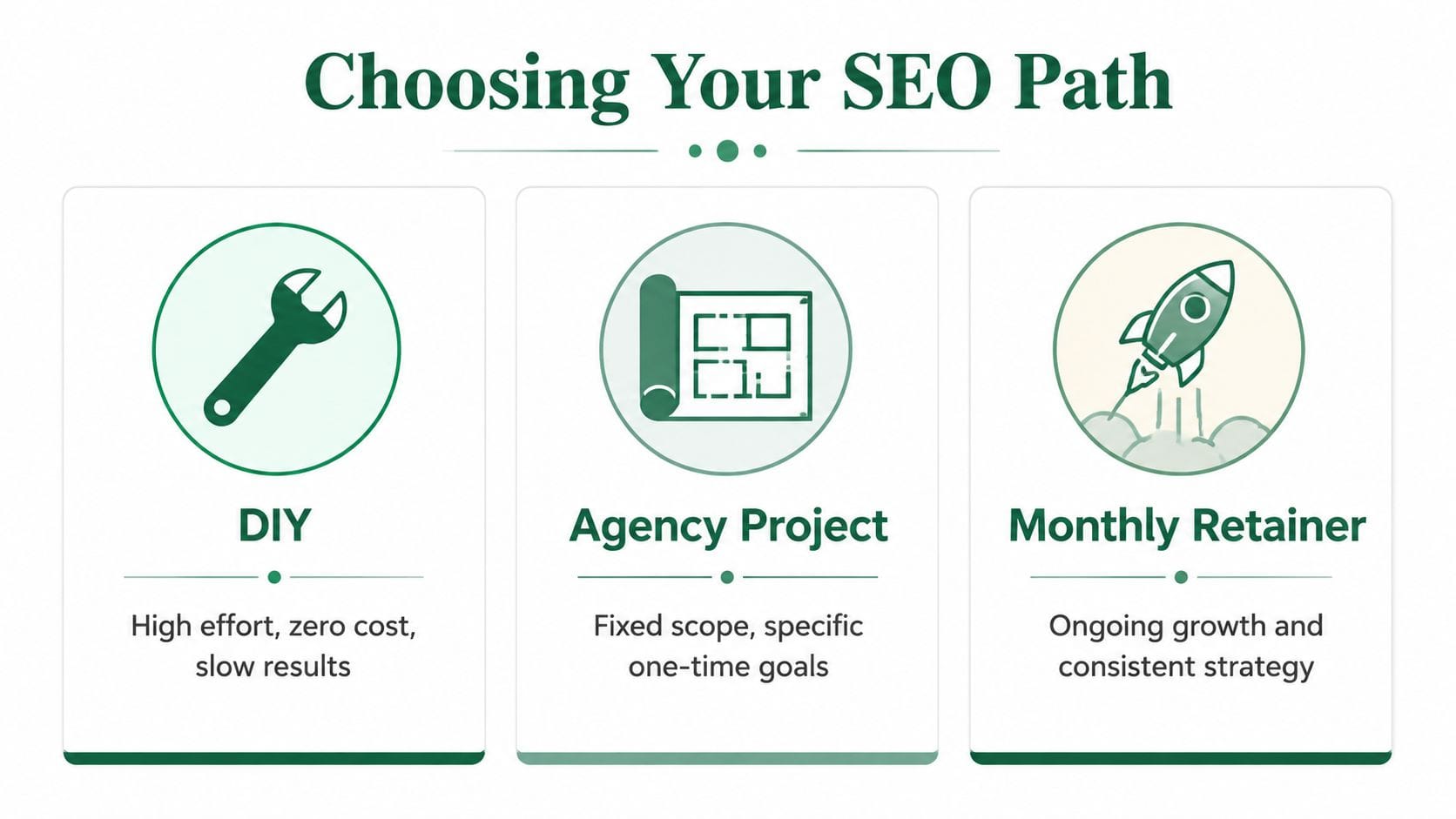
Quick comparison for time, cost and momentum
| Option | Best for | Strengths | Trade-offs |
|---|---|---|---|
| DIY | Owners with time, patience, and some technical comfort | Lowest cash outlay, full control, useful for basic maintenance | Slow, easy to stall, hard to prioritise the right work |
| Agency project | Businesses with a clear one-off need | Defined scope, easier budgeting, good for audits or site fixes | Momentum often stops once the project ends |
| Monthly retainer | Businesses that want steady lead growth | Ongoing improvements, reporting, accountability, long-term compounding | Higher monthly commitment |
When each option makes sense
DIY can work when the owner is comfortable inside WordPress or Shopify, can update a Google Business Profile, and has enough spare time to learn the basics. That usually means handling page titles, writing service copy, uploading photos, fixing obvious content gaps, and keeping business details consistent.
The problem isn't that DIY never works. The problem is that it competes with everything else on the to-do list. Jobs, staff, quotes, supplier issues, and customers usually win. SEO gets pushed to next month.
Agency project work suits a business that has one clear issue. Maybe the site has technical problems. Maybe the service pages are thin. Maybe the Google Business Profile setup is poor and the local listings are inconsistent. A defined project can clean that up without locking the owner into monthly work before the basics are in place.
This option is often sensible for:
- New websites: A launch with proper on-page setup and local structure
- Website rebuilds: Preserving search value during redesign work
- Technical clean-ups: Fixing crawl issues, broken metadata, or messy site architecture
- Local SEO resets: Correcting business details across major directories and maps
Monthly retainers are usually the right fit when the business wants ongoing enquiries rather than a one-off tidy-up. SEO isn't static. Competitors update their sites. Search results shift. Reviews change. New keywords appear. A retainer gives the campaign room to keep improving instead of freezing after the first round of fixes.
The real trade-off is time, not just money
The biggest decision factor for small business owners is usually time. Many can do some SEO tasks. Fewer can do them consistently, in the right order, and with enough follow-through to matter.
That's why the cheapest option on paper isn't always the cheapest in reality. DIY can become expensive if six months pass with no meaningful progress. A one-off project can also lose value if no one keeps building on it.
Practical rule: If the business needs leads consistently, SEO usually works best as an ongoing operating function, not a task that gets “finished”.
How to self-select the right model
A simple way to choose:
- Pick DIY if the owner has more time than budget and is happy learning tools like Google Search Console, Google Business Profile, and GA4.
- Pick a project if the business needs foundational work before committing to ongoing SEO.
- Pick a retainer if the owner wants the channel managed properly and measured month after month.
For many Brisbane businesses, the most practical path is a project first, then a lighter retainer once the technical and local foundations are in place.
What a Good SEO Package Should Actually Include
A proposal can look impressive while saying very little. Terms like “optimisation”, “authority”, and “technical improvements” sound useful, but a small business owner needs to know what those items mean in practice.
A good package should connect each task to a business outcome. Better rankings aren't enough on their own. The work should help the business become easier to find, easier to trust, and easier to contact.
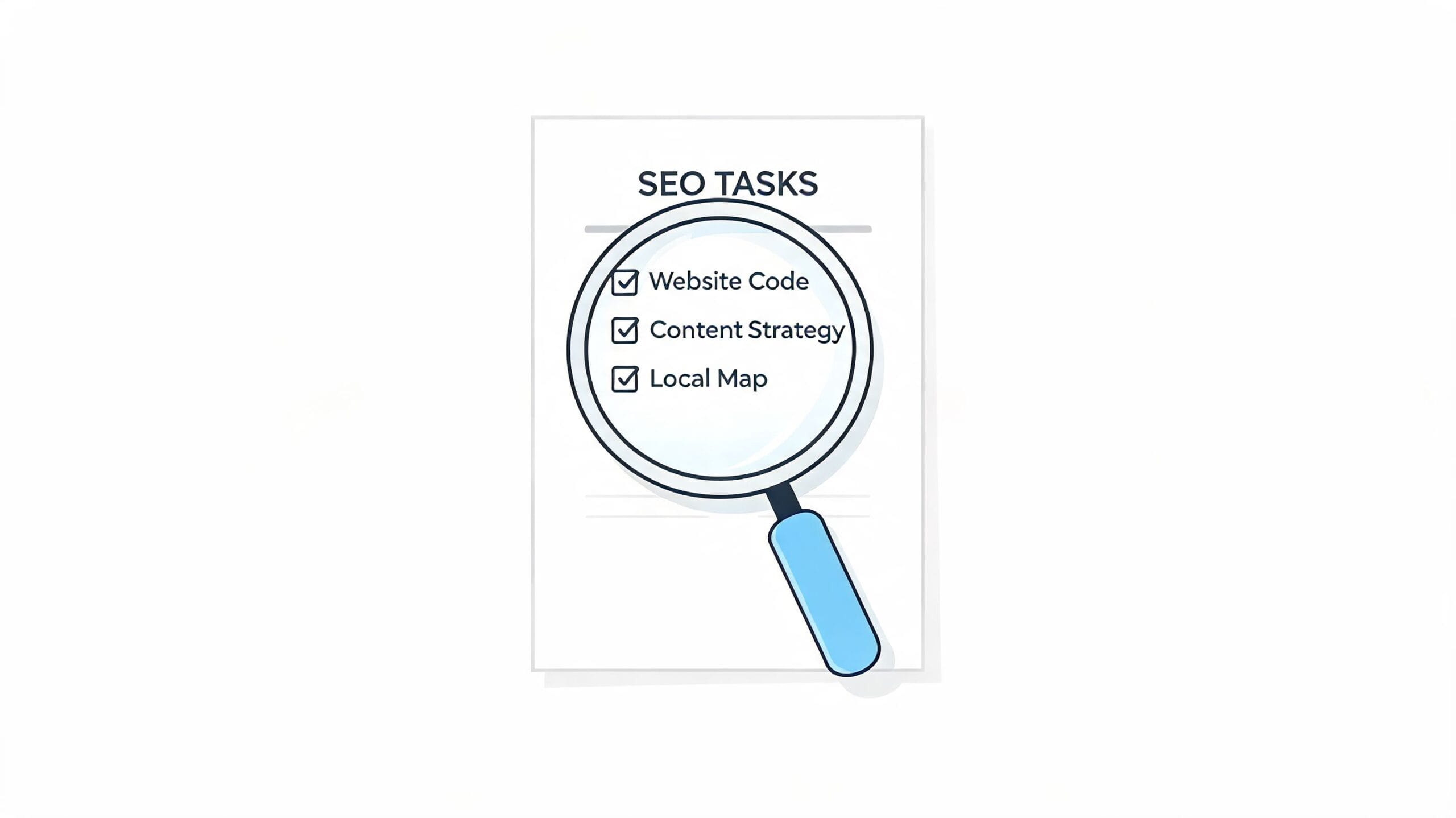
In Queensland, small businesses using comprehensive SEO packages that include on-page optimisation, technical audits, and authority backlinks have seen organic search traffic increase by an average of 214% within the first year, and 75% of AU small businesses rank on the first page of Google after 4 to 6 months of consistent SEO efforts according to Page Optimizer's summary of AU small business SEO benchmarks.
The parts that directly affect visibility
On-page SEO is the wording and structure on the website itself. For a Brisbane electrician, that means the page should clearly explain the service, mention the service area naturally, include helpful headings, and make it obvious how to contact the business.
Technical SEO is the site health layer. This covers things like crawl issues, broken pages, slow mobile load times, poor indexing, or messy internal linking. A customer in Fortitude Valley searching on a phone won't wait around for a clunky site.
Local SEO is what helps the business appear in map results and suburb-focused searches. That includes Google Business Profile work, accurate business details, local citation consistency, review support, and location relevance.
What small business owners should expect to see in a proposal
A solid package usually includes a mix of these deliverables:
- Keyword research tied to commercial intent: Not random high-volume terms. Search phrases that align with actual services and local demand.
- Page optimisation: Titles, headings, body copy, internal links, image text, and service page improvements.
- Technical checks and fixes: Search Console issues, indexing problems, redirect errors, and performance basics.
- Google Business Profile management: Category review, service updates, image refreshes, and profile improvements.
- Content support: New service pages, suburb pages where appropriate, FAQs, or blog topics that answer buyer questions.
- Reporting: Clear monthly updates on visibility, traffic quality, leads, and key actions completed.
What doesn't usually deliver much value
A few things often appear in cheap SEO packages without doing much for the business:
| Low-value inclusion | Why it disappoints |
|---|---|
| Generic blog posts | They fill a content calendar but don't target real buying intent |
| Huge backlink promises | Volume without quality often means weak or risky links |
| Ranking reports without lead data | Nice-looking graphs don't show business impact |
| One-size-fits-all “local SEO” | A café, a law firm, and a tradie need different setups |
The best proposal is usually the one that is easiest to understand. If an agency can't explain the work plainly, the owner will struggle to judge whether it's valuable.
Sample SEO Packages Tailored for Brisbane Businesses
Pricing needs to become practical. Small business owners don't need vague labels like “bronze” or “growth plus”. They need a package that matches the business model, the local competition, and the amount of support the team can handle each month.
For Brisbane businesses, local SEO packages with strong Google Business Profile optimisation have shown a 35% increase in local map pack visibility within 3 months for service-based trades, while also resolving 80% of contact detail inconsistencies across key AU directories according to Rankai's overview of small business SEO packages.
A practical pricing table for common Brisbane business types
| Package Tier | Ideal For | Key Inclusions | Typical Monthly Price (AUD) |
|---|---|---|---|
| Local Tradie Starter | Sole traders and service businesses focused on calls from local suburbs | Google Business Profile optimisation, citation cleanup, service page updates, local keyword mapping, basic reporting | $800 to $1,500 |
| Professional Services Growth | Accountants, lawyers, consultants, allied health clinics | Everything in Starter, plus content creation, stronger service page structure, review support, conversion-focused updates, ongoing reporting | $1,500 to $2,500 |
| Brisbane E-commerce Competitor | Shopify and WooCommerce stores competing across Brisbane or beyond | Technical SEO, collection and product optimisation, content support, internal linking, category strategy, tracking setup | $2,500+ |
What each package tends to look like
Local Tradie Starter works best for plumbers, electricians, painters, removalists, and similar operators who mostly need calls and quote requests. The focus should stay tight. A handful of core service pages, strong suburb targeting, accurate business listings, and map visibility usually matter more than pumping out lots of blog content.
Example inclusions might be:
- Google Business Profile work
- Suburb and service keyword targeting
- Contact detail consistency across directories
- Basic lead tracking
- Monthly ranking and visibility updates
This sort of package is often enough to get a single-location business moving without creating unnecessary complexity.
Professional Services Growth suits businesses with a longer decision cycle. Think accounting firms, mortgage brokers, clinics, and legal practices. These businesses usually need stronger trust signals, clearer service explanations, and content that supports higher-consideration buyers.
That can include more detailed service pages, helpful articles, FAQ content, and tighter alignment between SEO and website conversion points. A business in this category may also benefit from adjacent strategy work like tourism digital marketing in Australia if it operates in hospitality, attractions, or local experience-based services.
Brisbane E-commerce Competitor is different again. Online stores need more technical depth. Collection pages, product categories, internal linking, duplicate content risks, filters, and site speed all become more important. For a Shopify or WooCommerce business, SEO packages for small business should include both search visibility and shopping journey basics.
A store with 200 products doesn't need the same package as a local mobile mechanic. The right package follows the business model, not a generic agency template.
How to choose the right tier without overspending
The easiest way to avoid waste is to buy only the complexity the business needs.
A local service business usually doesn't need a heavy content engine in the first stage. An e-commerce site usually does need stronger technical support earlier. A professional services firm often needs trust-building pages before it needs aggressive link outreach.
Good package selection comes down to three questions:
- Where do leads come from now
- What's blocking more of them
- What work will remove that bottleneck first
That approach keeps SEO grounded in business priorities rather than agency upsells.
Setting Realistic Goals and Measuring What Matters
SEO works best when expectations are sensible from the start. It's not a switch that gets flipped. It's a process of improving visibility, building relevance, and making the website better at turning visitors into enquiries.
That's why monthly reporting should focus on business signals, not vanity metrics.

Benchmark data for AU small businesses shows top performers track organic traffic with a target of 25% QoQ growth, user experience such as bounce rate below 45%, and conversions above 3% from SEO, while packages with real-time AU rank tracking show 18% higher ROI than DIY efforts according to RankYak's benchmark summary for small business SEO.
The metrics worth checking each month
The best KPIs for most Brisbane small businesses are simple:
- Organic traffic from relevant locations: Not just more traffic. Better traffic from Brisbane and the areas the business serves.
- Visibility for high-intent keywords: Searches tied to services and suburbs, not broad vanity phrases.
- Google Business Profile activity: Calls, direction requests, and profile visibility matter for local operators.
- Leads from the website: Form submissions, phone clicks, booked consults, and quote requests.
- User behaviour: If visitors leave quickly or don't act, the issue may be page quality rather than rankings.
A useful report should also explain what changed and why. If a service page improved, the owner should know whether that drove more enquiries. If traffic went up but leads stayed flat, the next step might be messaging or page layout, not more keywords.
This is also where SEO starts to overlap with conversion work. Better rankings help, but so do stronger calls to action, cleaner forms, and more persuasive page structure. For businesses focused on turning visits into enquiries, conversion rate optimisation in Australia often complements SEO well.
Timelines that make sense for local SEO
Some changes can have a visible effect sooner. Google Business Profile improvements, local citation cleanup, and service page fixes can start shifting local visibility within the early months. Broader authority growth and stronger organic coverage usually take longer.
A practical way to think about timing is:
| Period | What usually happens |
|---|---|
| Early stage | Technical cleanup, page improvements, local profile work, baseline tracking |
| Mid stage | Better keyword positioning, stronger map visibility, improved lead quality |
| Later stage | More consistent organic lead flow, deeper service coverage, compounding gains |
Straight advice: If an SEO provider talks only about rankings and never asks how enquiries are tracked, the reporting is probably too shallow.
Owners don't need perfect attribution to judge progress. They do need a reasonable line of sight between search visibility and business outcomes.
Your Decision Checklist and SEO Red Flags
Choosing an SEO provider shouldn't feel like a gamble. A decent agency will answer direct questions clearly, explain the trade-offs, and talk about Brisbane conditions rather than hiding behind generic sales language.
Local benchmarks matter here. A 2025 Brisbane Chamber of Commerce survey found that local SMEs often see more predictable gains of 2 to 5x ROI within 6 to 12 months, which is one reason a trustworthy provider should be able to discuss realistic Brisbane-specific expectations, as noted in this Brisbane-focused SEO ROI discussion.
Questions worth asking before signing anything
These questions usually reveal a lot, quickly:
- How do they approach Brisbane local SEO: The answer should mention suburbs, service areas, Google Business Profile, and local intent.
- What will the first few months involve: A serious provider should outline early priorities, not just promise “ongoing optimisation”.
- Can they show a sample report: The owner needs to see how work and outcomes are communicated.
- Who is doing the work: Outsourcing everything without clear communication is different from having a local strategist with a clear process.
- How do they handle content and links: The answer should sound deliberate, not automated.
- What happens if the website also needs conversion improvements: SEO and site performance often need to work together.
Red flags that usually mean trouble
Some warning signs are easy to miss because they're dressed up as confidence.
- Guaranteed #1 rankings: No credible SEO provider controls Google.
- Vague deliverables: If the proposal sounds polished but the actions are fuzzy, it's hard to hold anyone accountable.
- Reporting that hides business outcomes: Ranking screenshots without lead tracking don't help much.
- Mass link promises: Cheap links in bulk usually create more risk than value.
- Long lock-in contracts without clarity: If the provider needs a long commitment before proving process and communication, caution is sensible.
Good SEO usually sounds measured. Bad SEO often sounds absolute.
A provider doesn't need to be flashy. They need to be clear, consistent, and realistic about what will be done each month.
Take the Next Step with a Local Brisbane Partner
The right SEO package isn't the one with the longest feature list. It's the one that fits the business, respects the budget, and removes work from the owner instead of creating more of it.
For Brisbane small businesses, local context matters. Search behaviour in this market is shaped by suburb intent, map visibility, mobile users, and practical service-led searches. A provider who understands that can build a plan that feels much more grounded from day one.
Boocoo is a Brisbane-based small business digital agency that helps local operators simplify marketing and focus on running the business. The approach is low-pressure, practical, and transparent. That means clear advice, sensible package options, and reporting tied to real outcomes rather than noise.
For owners who want to talk through options, ask questions, or get a second opinion on a quote, the next step is simple. Reach out through Boocoo's contact page, call 1300 093 797, or email hello@boocoo.au.
A short conversation can often clarify what kind of SEO support makes sense, what can wait, and where the quickest wins are likely to be.