

Some Brisbane business owners know the pattern too well. One week the phone won't stop. The next week it's referrals, old clients, and a bit of hope holding things together. The work itself isn't the problem. Getting found consistently is.
That's where a search engine optimisation service can help, but only when it matches the business, the suburb, and the actual demand in the market. For a busy tradie, clinic, consultant, or shop owner, SEO shouldn't feel like a mystery box. It should feel like practical work that helps the right people find the business when they're ready to book, call, or buy.
Tired of the Feast-or-Famine Lead Cycle?
A roofer in Redcliffe gets smashed with calls after a storm. A few weeks later, things go quiet. A café in the CBD stays busy when foot traffic is strong, then wonders why weekdays have fallen flat. A solo accountant in the suburbs gets a handful of solid referrals, but not enough to build steady growth around.
That stop-start pattern is common. Good operators often rely on word of mouth, repeat business, and whatever happens to come in. The problem is that none of those channels gives much control. When leads dry up, the stress shows up fast.
A search engine optimisation service is one way to smooth that out. It helps a business show up when someone is already looking for the service. Not when they're half interested. Not when they're scrolling aimlessly. When they've opened Google and typed what they need.
In Australia, Google holds 81.95% of the search engine market, and the first organic result gets an average click-through rate of 31.7%, according to Supple Digital's SEO statistics infographic. For a Brisbane small business, that's the game. If the business is visible in the right searches, it has a much better shot at enquiries from people with intent.
Practical rule: SEO works best when it's treated as lead generation, not as a vanity project about rankings alone.
For a local operator, that usually means focusing on the basics first:
- Service pages that match real searches: A generic homepage rarely does the heavy lifting.
- Local relevance: Suburbs, service areas, and clear contact details matter.
- A site that loads properly on mobile: Many prospects won't wait around.
- Calls to action that are obvious: If the phone number is buried, leads leak out.
SEO won't fix a weak offer, bad reviews, or slow response times. It can, however, put the business in front of people who are already in buying mode. That's why it matters so much when the goal is a steadier pipeline, not just more website visits.
What Is a Search Engine Optimisation Service Really?
The simplest way to think about it is this. A website is like a shopfront. If it sits on a busy street, has clear signage, opens easily, and tells people exactly what's inside, customers walk in. If it's hidden, slow, confusing, or vague, people keep moving.
A search engine optimisation service is the work that makes the website easier for Google to understand and easier for real people to use. That includes the words on the page, the page structure, the local signals, the speed, and the trust built around the site over time.
It's not just about “getting traffic”. Plenty of traffic is useless if it comes from the wrong people. A Brisbane electrician doesn't need random visitors from Perth reading a blog post and bouncing. That business needs local searchers looking for switchboard upgrades, emergency call-outs, or smoke alarm compliance.
What the service is trying to do
A solid SEO service usually aims to improve three things at once:
Visibility
The business appears in searches that matter to its services and location.Relevance
The pages match what the searcher wants. If someone searches for “commercial painter Brisbane”, they should land on a page about commercial painting in Brisbane, not a broad “welcome to our website” page.Conversion
Once the visitor arrives, the site should make the next step easy. Call. Book. Request a quote. Visit the store.
A good SEO campaign doesn't chase everyone. It helps the right customers find the right page at the right moment.
What it isn't
SEO isn't magic. It isn't instant. It isn't a secret formula that only one agency understands.
It also isn't a substitute for everything else in marketing. If a business has no reviews, no clear offer, slow follow-up, and a clunky website, SEO alone won't carry it. It works best when the business is already decent at serving customers and just needs more qualified people to discover it.
For time-poor owners, the most useful way to judge a search engine optimisation service is with plain questions:
- Does it target searches that can lead to calls or bookings?
- Does it improve pages people land on?
- Does it help the site show up in the local market the business serves?
- Does it save time by focusing on work that matters first?
If the answer is yes, it's doing its job. If it's all vague reports, jargon, and talk about “algorithm mastery”, it's probably noise.
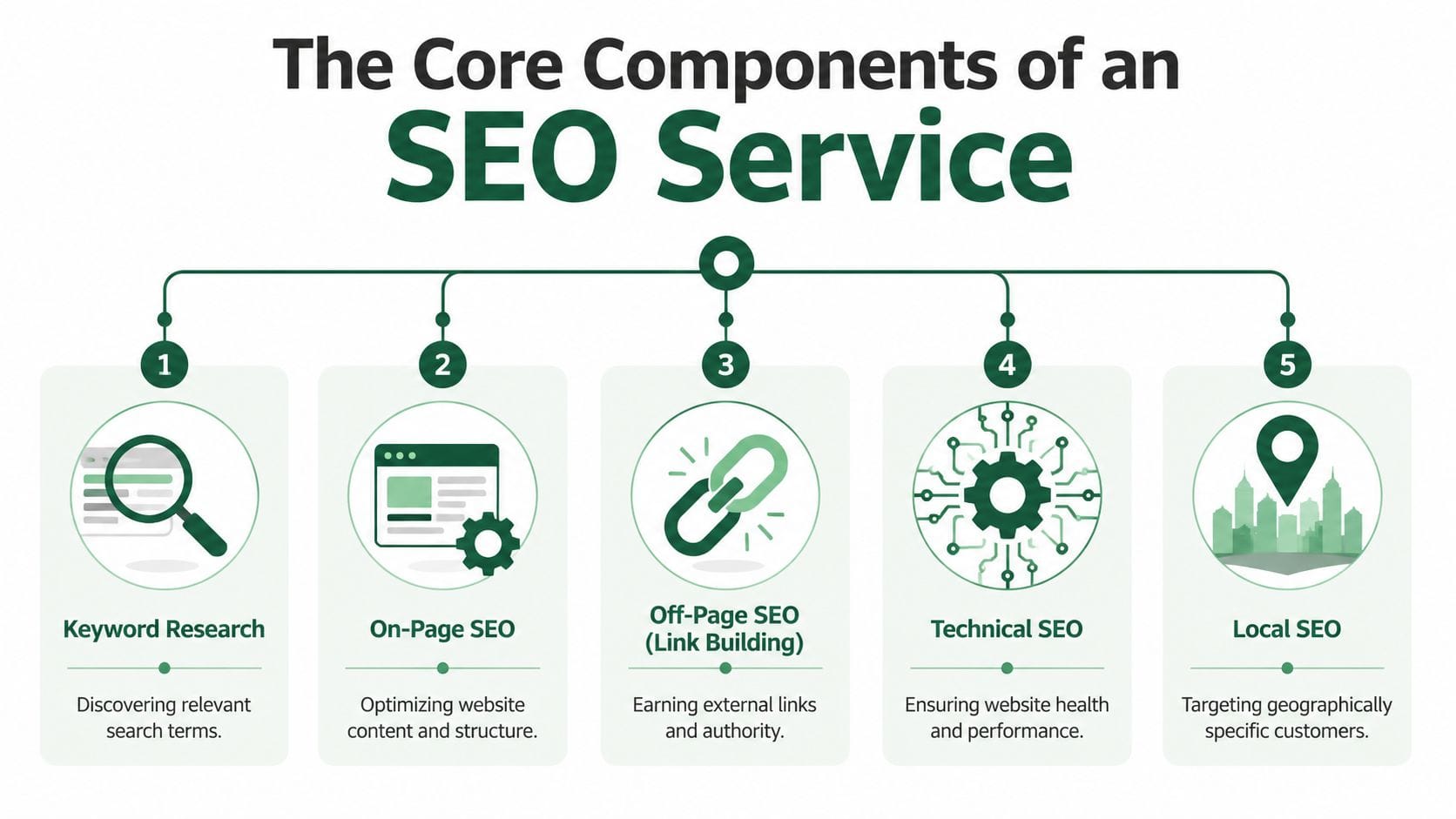
The Core Components of an SEO Service
SEO isn't one task. It's a handful of connected jobs working together. If one part is weak, the whole thing tends to underperform.
Technical foundations first
Technical SEO sits underneath everything else. If the site is hard for search engines to access or understand, strong copy and nice design won't rescue it. As Search Engine Journal's technical SEO guide notes, technical SEO is built on crawlability, performance, and indexation. Poor crawlability can stop search engines from finding pages in the first place.
For a small business site, that often shows up in practical ways:
- Crawlability: Broken links, orphan pages, messy menus, or important pages buried too deep.
- Performance: Slow mobile load times, oversized images, bloated themes, and too many scripts.
- Indexation: The wrong pages getting indexed, duplicate pages competing with each other, or valuable pages being ignored.
A provider doing this properly should be checking tools such as Google Search Console, page speed reports, crawl tools, and the site's own CMS setup. This is the unglamorous work, but it matters.
The parts customers actually notice
After the foundation comes the visible layer. Many owners first recognise what SEO is doing at this stage.
Keyword research is the planning step. It identifies what people are typing into Google, then maps those terms to useful pages. For a plasterer, that might mean separate pages for repairs, new work, commercial jobs, and local service areas rather than one catch-all page.
On-page SEO is the tuning of each page. That includes headings, page titles, service wording, image alt text, internal links, and the way information is organised. The best on-page work feels natural. It reads clearly and helps the visitor move forward.
Content supports trust and breadth. That might be service pages, suburb pages, FAQ sections, or blog articles answering common questions. Good content helps the site cover more search intent and gives prospects confidence that they're dealing with someone who knows the trade.
Local SEO helps the business appear for location-driven searches. That includes the Google Business Profile, service area clarity, local landing pages where appropriate, and consistency across contact details and business information.
Link building is about earning trust signals from other websites. For small businesses, this usually means quality over quantity. Local directories, relevant partnerships, industry listings, chambers of commerce, suppliers, and community mentions can all play a role.
What works: tightening the technical setup, sharpening service pages, and improving conversion paths together. SEO and conversion work often overlap, which is why many businesses pair search improvements with conversion rate optimisation support in Australia.
A useful way to think about these pieces is like a building site:
| Component | What it does | Why it matters |
|---|---|---|
| Keyword research | Chooses the searches worth targeting | Stops wasted effort |
| Technical SEO | Makes the site accessible and usable | Gives content a chance to rank |
| On-page SEO | Improves page relevance and clarity | Helps both Google and visitors |
| Local SEO | Connects the business to place-based searches | Drives nearby leads |
| Link building | Builds authority and trust | Supports stronger visibility over time |
When a provider skips straight to blog writing or backlinks without sorting the basics, the campaign often drifts. The strongest results usually come from doing the boring work first, then building outward.
Real SEO Results for Brisbane Businesses
Results look different depending on the business model, the suburb, and how people search for the service. A plumber, a wedding venue, and a financial adviser won't follow the same path.

What success can look like locally
Take a hypothetical electrician based in Aspley. If the website has a clear emergency page, a well-set-up Google Business Profile, suburb-relevant service wording, and fast mobile performance, that business has a better chance of appearing for searches tied to urgent local jobs. The lead quality tends to be stronger because the searcher already needs help now.
A boutique clothing store in Paddington has a different challenge. The site may need category pages that line up with the way shoppers search, stronger product descriptions, and local content that supports branded and discovery searches. If the store also wants to attract visitors from outside the neighbourhood, the SEO has to work alongside social content, email, and paid promotion rather than trying to do all the lifting alone.
A professional service firm in the inner city often benefits from a trust-first approach. Clear service pages, biography pages, FAQs, and practical articles can all help remove doubt before someone books an appointment. That's especially true for businesses where buyers compare a few options before making contact.
Some sectors also need broader digital support around SEO. Tourism operators are a good example, where search visibility often works best when paired with content, local intent strategy, and campaign planning such as tourism digital marketing support.
Where local SEO hits a wall
Many businesses get poor advice. A lot of providers talk as if ranking in one suburb automatically opens the door to the next ten. That's not how local search works.
According to Digital Harvest's analysis of what SEO can't fix, 46% of Google searches have local intent, and organic SEO has a less than 10% success rate for multi-suburb expansion without a physical presence or a properly configured Google Business Profile. Google heavily prioritises proximity for local searches.
That means a Nundah business trying to rank in the Gold Coast map results is likely to struggle if it doesn't have a real presence there.
For Brisbane operators, that creates a few practical choices:
- Own the home patch first: Rank strongly where the business is based.
- Use Google Business Profile properly: Service areas, categories, and business details need to be accurate.
- Be realistic about expansion: Organic local SEO has limits when geography works against the business.
- Use other channels when needed: Geo-targeted ads can be the better play in outer areas.
Local SEO is powerful inside a real service footprint. It gets much weaker when a business tries to pretend it's local everywhere.
That honesty matters. The best SEO plan for a Brisbane small business isn't the biggest one. It's the one that fits how customers search.
SEO Pricing Models and What to Budget
Most owners don't want a lecture on SEO pricing. They want to know what they're paying for, how long it runs, and whether it's likely to bring enquiries.
There isn't one standard model. The right fit depends on the state of the website, the competitiveness of the market, and how much internal time the business can spare.
The three common ways providers charge
The table below is the simplest starting point.
| Pricing Model | Typical Cost (AU) | Best For | Key Consideration |
|---|---|---|---|
| Monthly retainer | Varies by scope and provider | Ongoing SEO work, competitive local markets, businesses wanting steady improvement | Best when SEO needs consistent technical, content, and local work over time |
| Project-based fee | Varies by project size | Website rebuilds, technical clean-ups, migrations, or one-off page optimisation | Good for defined tasks, but momentum can stall after the project ends |
| Hourly consulting | Varies by provider expertise and task complexity | Small audits, strategy sessions, second opinions, and in-house teams needing guidance | Useful for control and flexibility, but execution can fall back on the owner |
A monthly retainer usually makes sense when the business needs regular work across several fronts. That might include technical fixes, ongoing content updates, Google Business Profile work, page improvements, and reporting. It suits businesses that want someone actively moving things forward each month.
A project fee is often better when there's a specific problem to solve. Examples include fixing a messy site structure, cleaning up duplicate pages, rewriting core service pages, or preparing a site relaunch. It can be a budget-friendly way to sort the fundamentals before committing to ongoing work.
Hourly consulting works well for owners who want guidance without handing over everything. It's also useful when a business has a web developer, admin support, or internal marketer who can implement recommendations.
How a small business can choose the right model
A useful budgeting question is not “What's the cheapest SEO?” It's “What work needs doing first?”
For many small businesses, the sensible order looks like this:
- Start with an audit or scoping session: Find out whether the site has technical issues, weak pages, or local visibility gaps.
- Fix obvious blockers first: There's no point paying for content month after month if core pages are broken or hard to use.
- Move to ongoing work only when there's a real roadmap: A retainer should fund planned activity, not vague “ongoing optimisation”.
- Compare SEO with paid options: Sometimes a business needs short-term lead flow while SEO builds in the background. In those cases, comparing organic work with paid advertising options can help shape a realistic budget mix.
Budget filter: If a proposal can't clearly explain what gets done in month one, it's probably too fuzzy to trust.
The cheapest quote often leaves out strategy, technical work, and conversion thinking. The most expensive quote isn't automatically better either. A tight, well-prioritised plan usually beats a bloated package full of busywork.
How to Choose a Provider and Spot Red Flags
A decent provider should make SEO feel clearer, not foggier. If every call leaves a business owner more confused than before, that's a warning sign.

Questions worth asking before signing anything
The strongest conversations are usually the plainest ones. A small business owner doesn't need to sound technical. The provider should be able to explain the work in normal language.
Good questions include:
- What would be fixed first on this site, and why?
- Which pages are most important for enquiries?
- How will local visibility be handled for the areas the business serves?
- Who writes or edits the content?
- How will success be measured in a way that connects to leads, not just traffic?
- What work is included each month?
The answers should be specific. If the provider can't point to likely priorities such as service pages, technical cleanup, local profile work, or conversion issues, they may be selling a generic package.
Bright red flags are usually easier to spot:
- Guaranteed rankings: No one can promise a specific position.
- Instant results claims: SEO can build strong momentum, but it's not a switch.
- Secret methods: If the value can't be explained, that's a problem.
- No questions about the business model: A provider should care about service areas, margins, job types, and lead quality.
- Reports with no business meaning: Fancy graphs are useless if the phone still isn't ringing.
“If the strategy sounds identical for a plumber, a law firm, and an online shop, it probably isn't a strategy.”
When SEO is the wrong first move
This is the part many agencies skip. Some businesses shouldn't start with SEO.
According to Search Engine Land's discussion of when a business doesn't need SEO, 62% of small businesses in specialised niches have fewer than 100 monthly searches for their services in Australia. For some Brisbane trades and niche professional services, that makes SEO a slow and inefficient first investment.
If hardly anyone searches for the service, even excellent rankings won't create much demand.
In those cases, better first moves can include:
- Direct outreach: Useful for B2B operators who win work through relationships.
- Hyper-local social ads: Handy for visually driven or community-based services.
- Referral systems: Sometimes improving follow-up and asking for referrals beats chasing search traffic.
- Google Ads for high-intent terms: This can work when there are a few valuable searches but not enough breadth for a full SEO campaign.
One local option in Brisbane is Boocoo, which offers SEO alongside web, social, and paid support. That kind of mixed-service setup can be useful when a business needs the flexibility to choose SEO, ads, or both based on actual demand rather than defaulting to one channel.
The honest answer is simple. If search demand is weak, SEO may belong later, not first.
Your Next Steps to Get Found in Brisbane
A search engine optimisation service works best when it solves a real business problem. For most small businesses, that problem isn't “low impressions”. It's inconsistent leads, too much reliance on referrals, and not enough visibility when locals are ready to buy.
The smart next step is to look at the basics without overcomplicating it. Check whether the site clearly explains the services, whether the important pages are easy to find, whether the business shows up properly in local search, and whether there's enough real search demand to justify ongoing SEO work.
If the answer is yes, a focused plan can turn the website into a steadier source of enquiries. If the answer is no, that's useful too. It can save time, money, and a lot of frustration.
A Brisbane business doesn't need more digital noise. It needs a sensible channel mix, a site that pulls its weight, and marketing that matches how people search. That's what gets the phone ringing more consistently.