

A Brisbane owner can pour money into posts, ads, and SEO, then still sit there wondering why the phone stays quiet. The usual problem isn't a lack of traffic. It's a leaky website, a weak local footprint, and an enquiry journey that asks too much of busy people on mobile.
That's why web site marketing works only when it acts like a full local discovery system. For Brisbane small businesses, the job is simple to state and hard to do well, get found locally, be understood fast, make contact effortless, and measure what turns into work.
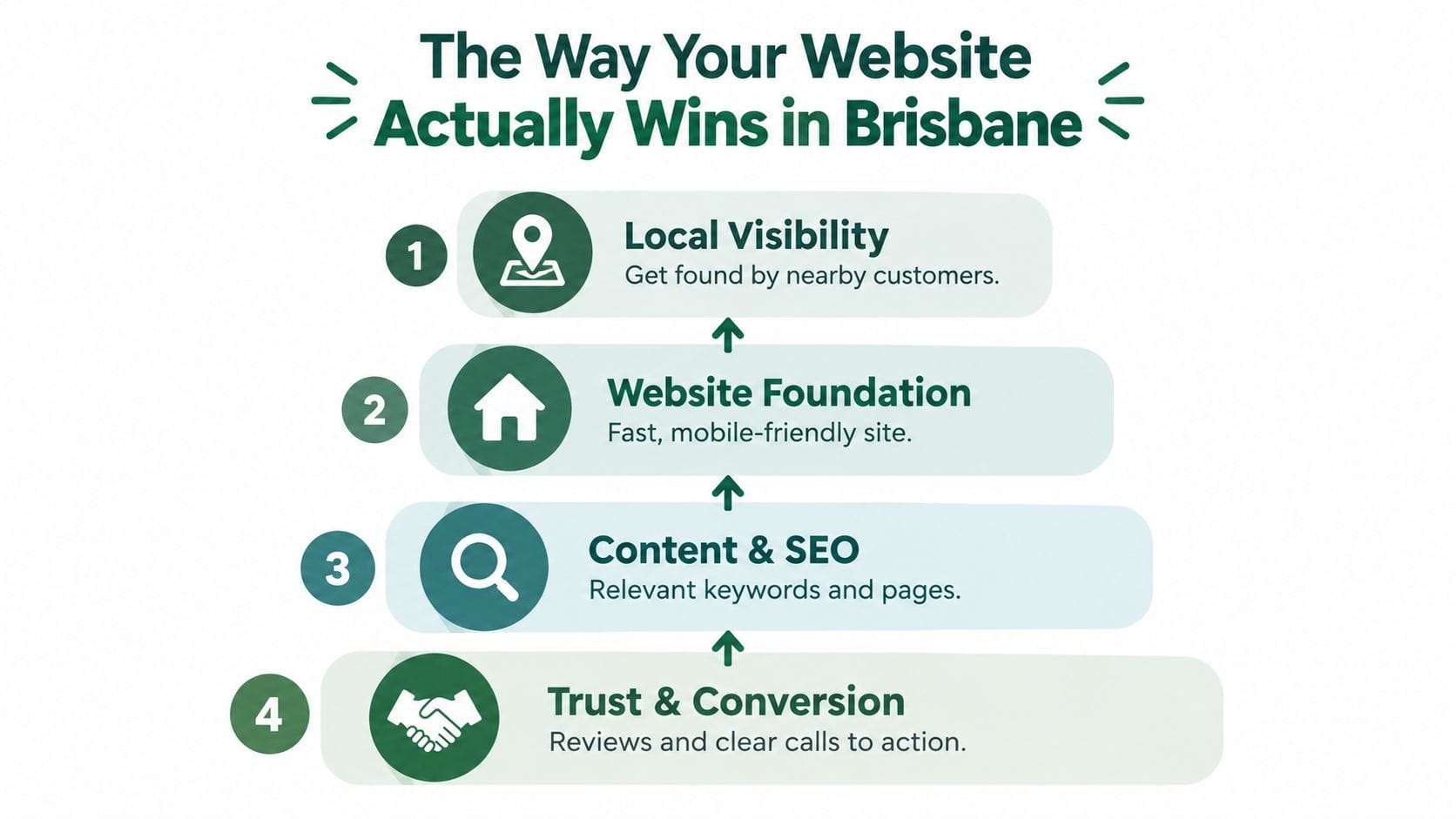
The Way Your Website Actually Wins in Brisbane
A plumber in Aspley, an accountant in Fortitude Valley, and a skin clinic in Indooroopilly do not win online the same way a national brand does. They win when a local customer searches, scans, and decides within a few seconds. That means the website is only one part of the sale, not the whole sale.
In early 2025, 26.1 million Australians used the internet, equal to 97.1% of the population, and 20.9 million Australians used social media, equal to 77.9% of the population DataReportal Australia 2025. That's why a Brisbane business shouldn't think in terms of “getting online” anymore. The key question is whether the business is easy to discover, easy to trust, and easy to contact once someone finds it.
Shopfront versus online stall
A physical shopfront has signage, opening hours, a front counter, and a person who can answer the door. A website should do the same job online. Too many small businesses treat it like an online stall with no price tags, no directions, and no one standing there to help.
Practical rule: if a visitor can't tell what the business does, where it serves, and how to make contact in under a minute, the website is losing money.
| Lens | Question it answers | Most common Brisbane mistake |
|---|---|---|
| Local Visibility | Can nearby customers find the business? | Relying on a homepage alone |
| Website Foundation | Does the site load fast and work on mobile? | Designing for desktop first |
| Content and SEO | Does the site match local search intent? | Writing generic pages with no suburb context |
| Trust and Conversion | Does the site make it easy to enquire? | Hiding the phone number and CTA |
A better mental model is this, web presence is having a website or homepage, while web performance is whether that presence produces calls, bookings, and quote requests. The Australian Bureau of Statistics distinguishes those two ideas clearly, and that distinction matters because ownership beats dependence ABS web presence data. If a business only relies on social pages, the core message, enquiry path, and analytics sit on someone else's platform.
For Brisbane operators, the local advantage is focus. A city, a suburb, a service area, or a specific customer problem is enough. The mistake is trying to look broad when the actual win comes from looking relevant.
Brisbane website design for small business
Getting Found Locally With Your Website and Google Business Profile
Local discovery starts with one boring truth, people trust what they can verify. A Brisbane business should claim the Google Business Profile, check the business name, address, and phone number everywhere they appear, and match those details on the website. If the basics conflict, local search becomes messy fast.
The Australian Consumer Barometer found that 39% of Australian consumers use a smartphone to find local information and 91% use a mobile device or smartphone, which is why mobile usability and local intent matter so much Google Consumer Barometer Australia. For that reason, the phone number should be tappable, the opening hours should be visible, and the service area should be obvious without hunting through menus.
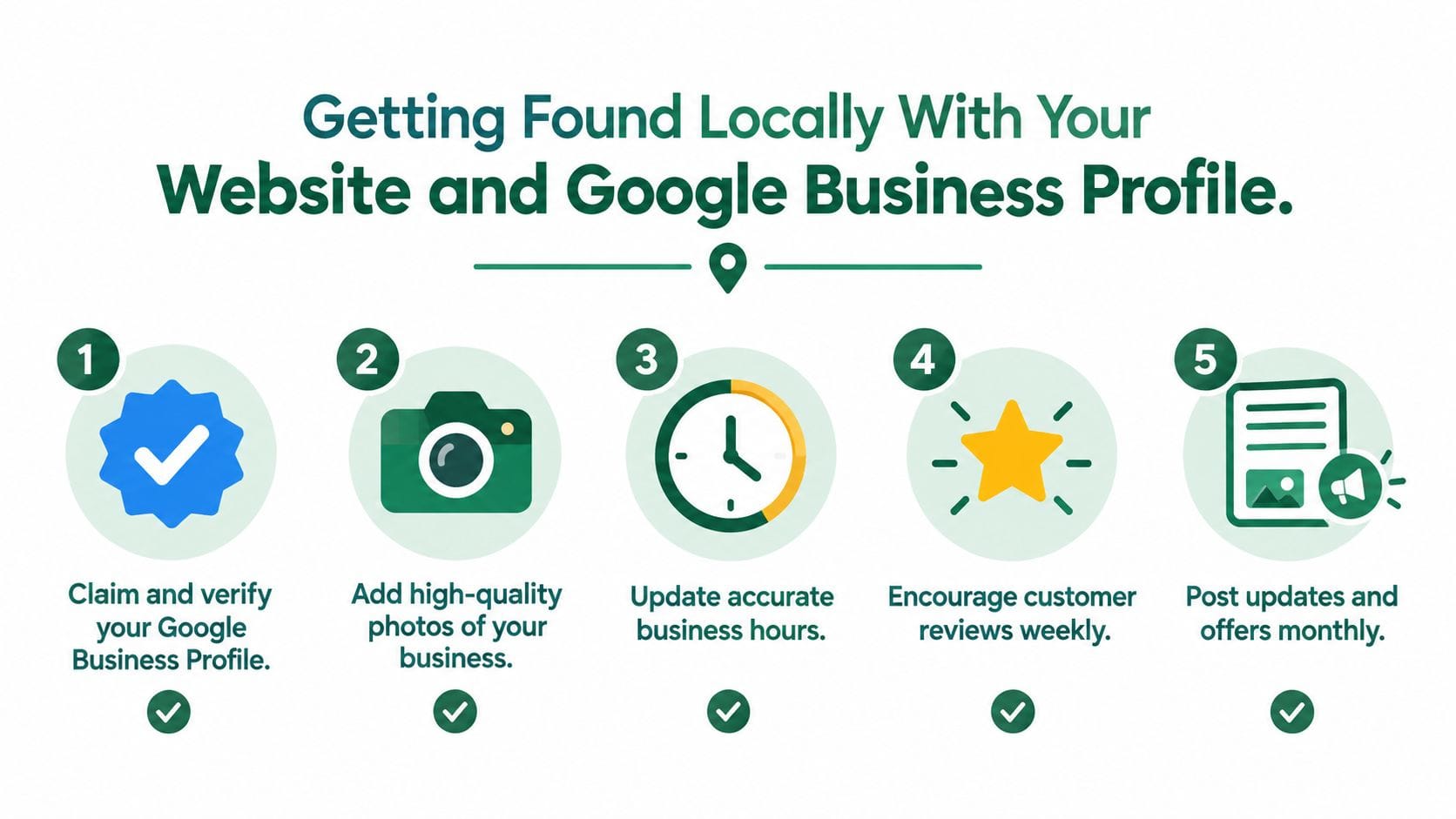
The week-one setup that actually matters
Start with the profile, then the site. A Brisbane plumbing business, for example, should list the core service areas, use service categories that match what customers search for, add real photos of vehicles, team members, and completed work, and link each major service to a matching page on the website.
Then build location and service pages that do one job each. A page for blocked drains should not try to sell every service the business offers. It should answer the local question, explain the process, show proof, and give one clear next step.
A practical structure looks like this.
- Claim and verify the profile: make sure the business can control hours, categories, and photos.
- Use consistent details everywhere: name, address, and phone should match across site and profile.
- Create suburb or service pages: give each page one clear intent and one primary action.
- Put contact actions above the fold: phone, form, and directions should be obvious on mobile.
- Ask for honest reviews: build a repeatable follow-up process instead of chasing praise.
A clean local profile does more for a small business than another month of vague posting.
Reviews deserve care, too. The ACCC says reviews must be independent and reflect the genuine opinion of someone who experienced the product or service, and businesses must not fake, manipulate, or mislead with them ACCC online reviews guidance. That means asking every real customer for feedback is fine, but rewarding only positive reviews is not.
How to add your business to Google
Building Brisbane Content That Attracts the Right Visitors
Most small businesses don't need more content. They need better content that reflects how customers search. One industry compilation reports that 68% of website visits come from organic search, which is why page choice matters so much Australian search behaviour compilation.
Three page types are enough for most small teams
The first page is the service pillar page. That's the main page for a service, like “electrical repairs” or “chiropractor for back pain,” and it should do the heavy lifting. It needs clear language, suburb cues where they make sense, proof, pricing context if possible, and one action that matches the buyer's intent.
The second page type is suburb or service-area pages. These are not copied pages with the suburb swapped out. They should explain how the business serves that area, what jobs are common there, and why local customers should care.
The third page type is FAQ content pulled from real conversations. The business already hears the same questions every week, so those questions are the content plan. “How fast can you come out?”, “Do you service this suburb?”, and “What does the job include?” are better topics than another generic blog about “why SEO matters.”
A one-person team can keep this simple. Publish one strong service page, then build a few support pages around the most profitable questions and service areas. That's enough to stay useful for a year without drowning in a content calendar.
A simple example for a Brisbane electrician
A Brisbane electrician could run:
- A service pillar page for emergency repairs.
- Suburb pages for the main service zones.
- FAQ posts on power outages, safety switches, and booking times.
Good content earns the click. Better content earns the call.
The strongest pages are written for humans first, not for keyword stuffing. They explain what the business does, where it operates, and what happens next if someone gets in touch. A business can publish plenty of words and still fail if those words don't help a stressed customer make a decision.
Blogging and SEO for Brisbane businesses
Turning Visitors Into Calls, Quotes, and Bookings
For most Brisbane small businesses, the fastest gain comes from reducing friction, not adding more traffic. Australian benchmark data puts average landing-page conversion rates at roughly 2.35% to 4.14%, with the top 10% of pages exceeding 11.45% Andava Australian digital marketing statistics. That gap is where the money sits.
Fix the enquiry journey before you chase more clicks
Start with a four-week baseline. Track sessions, landing-page engagement, form-start rate, form-completion rate, calls, and sales-qualified enquiries. Then find the biggest drop-off point and test one change at a time.
A quote form with eight fields is often too much. Dropping it to four fields can remove enough friction to matter, especially on mobile. A real team photo usually beats a generic stock image because it signals there are actual people behind the service.
The pages that matter most are usually the homepage, the top service pages, the suburb or location pages, and the contact page. On mobile, the business name, phone number, service area, proof, opening hours, and main CTA should be visible quickly. If the page makes someone pinch, scroll, and guess, the sale is already in trouble.
For a practical framework on testing and prioritising fixes, the conversion rate improvement guide is a useful reference point, especially for small teams deciding what to change first.
| Australian SME Conversion Benchmarks | Average | Top quartile |
|---|---|---|
| Landing-page conversion rate | 2.35% to 4.14% | Above 11.45% |
A measurement-led cycle beats guesswork every time. Establish the baseline, identify the worst point, form one hypothesis, test it, segment the result by mobile and desktop, then keep the change only if completed enquiries improve, not just clicks.
Conversion rate optimisation services
Choosing the Right Channels for Brisbane Paid and Social Reach
Once the website works, the next dollar should go where intent is highest. For a local service business, Google Ads on suburb and service terms often makes more sense than broad social campaigns because the customer is already looking for help. Social can still work, but it usually plays a support role, not the main lead source.

Match the channel to the job
Organic social is cheap in cash terms but expensive in attention. It needs consistent posting, and for many time-poor Brisbane operators, that is the true cost. It works better for businesses with visual appeal, recurring offers, or a community angle.
Paid search is more focused. It suits emergency repairs, booked services, and anything people search for with intent. A tradie bidding on urgent repair terms is usually closer to revenue than a café boosting a generic post.
Local partnerships can be even more efficient when they're specific. A clinic might swap referrals with nearby practitioners, or a café might work with a neighbourhood event. These channels don't scale like ads, but they can be easier to maintain on a small budget.
A small business should pick based on three filters, budget required, time required from the owner, and match to local intent. That keeps the decision practical instead of emotional. A broad-reach social campaign may look busy, but if it doesn't produce qualified visits to the website, it's just noise.
One Brisbane-friendly option is Boocoo, which handles website design, search work, social management, and paid advertising for local businesses. It belongs in the same category as other outsourced help, a way to remove work from a small team when the time cost starts to outweigh the benefit.
Spend where the customer is already close to action. Awareness is nice, but enquiries pay the bills.
Measuring What Matters Without Drowning in Data
Most small business dashboards are full of the wrong things. Sessions, followers, and impressions feel comforting, but they don't tell a Brisbane owner whether the website is earning its keep. The useful view is much smaller, and much more honest.
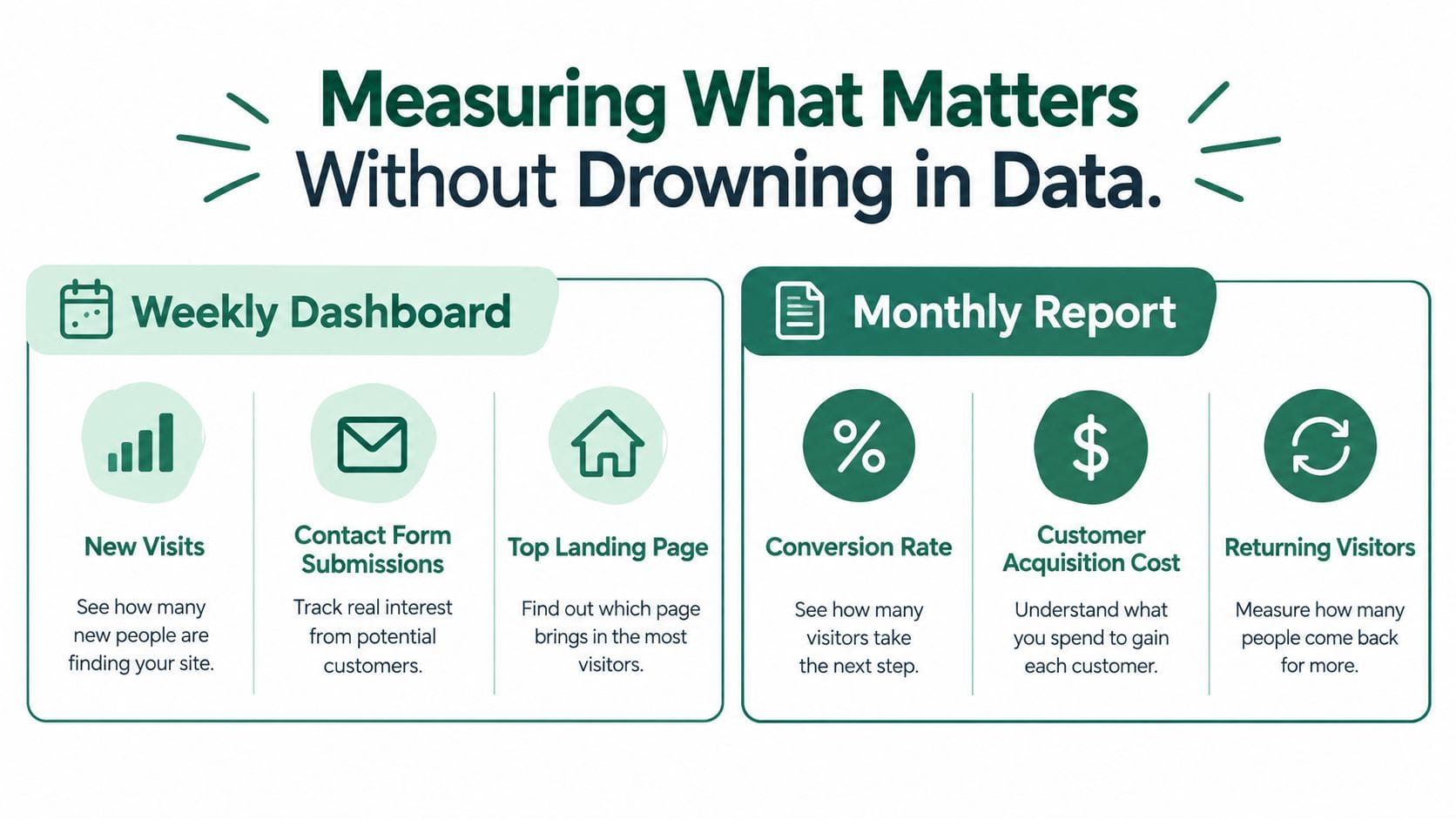
Weekly and monthly numbers that change decisions
Weekly, track new visits, contact form submissions, and the top landing page. Monthly, look at conversion rate, customer acquisition cost, and returning visitors. Those are enough to tell whether the website is moving in the right direction.
A simple monthly review can be done in under an hour. Note the main change made that month, such as a Google Business Profile update, a new suburb page, or a pricing change, then compare the enquiry pattern before and after. That kind of labelling matters because otherwise the owner ends up guessing which change helped.
For a broader way to think about return, the content marketing ROI guide is a useful companion when a team wants to connect content work to business outcomes. The point is not to worship a spreadsheet. The point is to connect effort to revenue.
| Weekly Dashboard | Monthly Report |
|---|---|
| New Visits | Conversion Rate |
| Contact Form Submissions | Customer Acquisition Cost |
| Top Landing Page | Returning Visitors |
A useful test of any metric is simple. If the number changes, does the business do anything differently next week? If not, it's probably vanity data.
Your First 90 Days of Web Site Marketing
A small Brisbane team doesn't need a giant plan. It needs order. Month one should clean up the website basics and Google Business Profile, month two should tighten the enquiry journey and publish the pages that support local search, and month three should test paid or social channels only after the site can convert the traffic.
For budget, a lean setup might sit around A$500 a month, a steadier effort around A$1,500, and a more active program around A$4,000. The number matters less than the split. Spend first on fixes that stop leakage, then on content that matches search intent, then on traffic once the site can handle it.
Common mistakes are predictable. Teams count duplicate form submissions, treat low-intent phone calls as wins, stop tests too early, or obsess over CPC while ignoring whether the lead ever became a customer. Reviews and advertising claims also need regular checking, because the ACCC notes that courts can impose penalties of up to A$1.1 million for misleading or deceptive conduct under the Competition and Consumer Act 2010 ACCC review guidance.
A good next step is brutally simple. Write a one-page marketing brief with the service areas, top three enquiries, current weak points, and the one metric that matters most right now. Then spend 30 minutes walking through the enquiry journey on a phone, from search result to call or form, and fix the first obvious point of friction.
If the business can't keep up with that work, outsource the parts that consume time without moving revenue. The point of web site marketing is not to stay busy. It's to make it easier for the right Brisbane customers to find the business, trust it, and get in touch.