
A Brisbane business owner often hits the same wall around midweek. Quotes need sending, staff need answers, customers are calling, and then a “quick” Facebook graphic or brochure update somehow eats the next two hours. The logo file can't be found, Canva starts fighting back, the colours look wrong, and the post still doesn't feel ready.
That's usually the point where design stops being a branding issue and becomes an operations issue.
For small businesses, especially lean service businesses, marketing rarely falls over because nobody has ideas. It falls over because nobody has the time, the files, or the spare headspace to turn those ideas into finished assets. A sale starts late. A website banner sits in draft. A price list stays outdated. Social posts become inconsistent because every new graphic starts from scratch.
Graphic design as a service solves that problem in a practical way. Instead of treating design as a one-off project every few months, it turns design support into an ongoing service that helps a business keep moving. That matters in Australia, where small businesses make up 99.3% of businesses according to Australian business data referenced in this design systems discussion. Most of those businesses don't have the time or structure for a full internal design setup.
For a Brisbane owner trying to stay visible without hiring a full creative team, that's its appeal. This isn't about buying fancy artwork for the sake of it. It's about reducing admin, removing bottlenecks, and getting usable marketing assets out the door without drama.
Introduction
A lot of small business owners don't need “more marketing”. They need fewer loose ends.
The work already exists. There's a website that needs fresh graphics, a promo that needs ad creative, a capability statement that needs updating, and social channels that need something more polished than a rushed screenshot and a block of text. The problem is that design jobs arrive in dribs and drabs, usually when the day is already full.
That's why graphic design as a service has become a practical fit for smaller Brisbane businesses. It gives a business ongoing access to design help without turning every small request into a new sourcing exercise. No chasing random freelancers for availability. No stopping to build every asset internally. No wasting staff time trying to patch together “good enough” visuals.
Practical rule: If design tasks keep delaying marketing activity, the business doesn't have a design problem. It has a workflow problem.
This matters even more in a local market full of lean teams. Queensland operators often rely on a mix of owners, admin staff, marketers, and contractors to keep things moving. When no one owns design properly, jobs bounce between people. Files get lost. Feedback gets messy. Turnaround slows down.
A service model fixes that by making design repeatable. Instead of buying one logo, one flyer, or one ad set at a time, the business gets a support structure for recurring creative work. That structure is usually where the value sits.
What Exactly Is Graphic Design as a Service
At 4:30 pm, a sales PDF needs updating, tomorrow's Facebook ad still has last month's offer on it, and someone has asked for a pull-up banner before Friday. None of these jobs is big enough to justify a hiring decision on its own. Together, they slow down the week.
Graphic design as a service solves that operational problem. It gives a business ongoing access to design support through a monthly arrangement or retained service, instead of treating every brochure edit, web graphic, or ad variation as a separate project to quote, brief, and chase.
The simple version
The model is straightforward. A business pays for design capacity over time, not just a single finished asset.
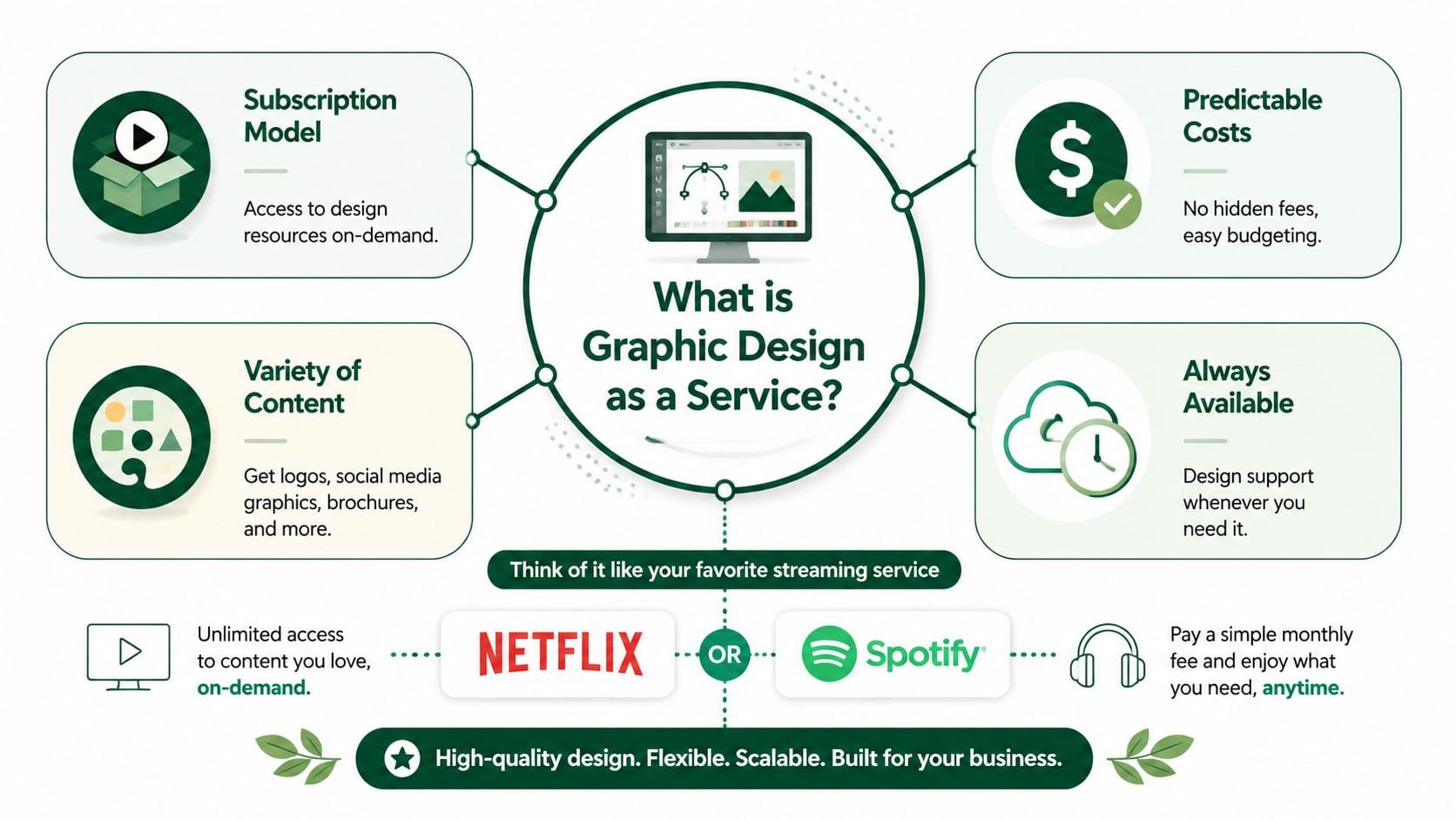
That usually covers recurring work such as social media graphics, brochure updates, digital ads, website banners, sales PDFs, presentation slides, signage concepts, email graphics, and branded templates. The exact deliverables vary by provider. The structure stays consistent. The business has a design function available when work comes in.
That matters because the cost of design is rarely the artwork alone. It is the admin around it. Someone has to find a designer, explain the job, gather files, answer questions, review drafts, request changes, and keep the final version stored somewhere useful. Graphic design as a service cuts down that repeated setup work.
A good provider also applies clear visual reasoning, not personal preference. For owners who want a plain-English explanation of why some layouts work better than others, these foundational design principles are worth reading.
What makes it different from hiring project by project
The biggest difference is continuity.
With one-off design buying, each task starts close to zero. The designer may not know the brand, the preferred formats, the audience, or who approves what. Even a small update can turn into extra messages, file hunting, and avoidable revisions.
With a service model, that context builds over time. Brand assets are already on hand. Common formats are familiar. Feedback patterns become clearer. The result is not just more output. It is less stop-start admin for the owner or team member coordinating the work.
For a time-poor Brisbane business, that distinction matters more than the creative theory. Hiring in-house can make sense if there is enough steady volume to keep a designer busy and managed properly. Using freelancers can work well for occasional specialist jobs. Graphic design as a service sits in the middle. It gives regular access to design help without the fixed overhead of a staff hire or the repeated sourcing effort that comes with ad hoc outsourcing.
In practice, businesses are buying consistency, response capacity, and fewer bottlenecks. The design files matter. The reduced workload around them often matters more.
Understanding the Different Service and Pricing Models
Not every provider sells graphic design as a service the same way. Some run on a monthly subscription. Others use hours, credits, or bundles. The right fit depends less on what sounds generous and more on how often the business needs work.
For owners already comparing outsourced marketing support more broadly, it can help to compare social media management options in the same way. The same rule applies. A good package matches workflow, not just price.
Unlimited subscription model
This is the model often pictured first. The business pays a flat monthly fee and can submit ongoing requests, usually with limits around how many tasks are active at one time.
This setup often suits a business that always has something small to create or update. Think regular social graphics, web banners, ad variations, simple collateral edits, or sales material refreshes.
The upside is obvious:
- Predictable budgeting means the monthly cost is easier to plan for.
- Steady output works well when the pipeline of small jobs never really stops.
- Simple request flow can cut down the back-and-forth of quoting each task.
The trade-off is that “unlimited” rarely means everything happens at once. Most services queue work. If a business suddenly needs a brochure, five ad sets, and new website graphics in the same week, that queue matters.
Retainer model
A retainer usually gives the business a set amount of design capacity each month. That might be measured in hours, credits, or agreed recurring deliverables.
This can be a strong fit for a company with a stable monthly pattern. For example, the same number of campaign assets, the same website updates, and the same recurring sales support pieces.
Retainers are often easier to manage when the work includes strategy or collaboration, because there's room for planning rather than just task processing.
Still, there are practical catches:
- Unused capacity can feel wasteful if a quiet month rolls through.
- Scope creep becomes a problem if the business expects more than the monthly allowance really covers.
- Over-customisation can slow delivery if every task becomes a mini strategy session.
On-demand package model
Some businesses don't need ongoing support every month. They need bursts of help.
In that case, a packaged model can work better. A business might buy a fixed batch of ad creatives, a branded social template set, a brochure refresh, or a launch pack for a new service. This keeps spending tighter when needs are uneven.
A simple way to choose between the three is to match the model to the pattern of work:
| Business situation | Model that often fits |
|---|---|
| Ongoing small requests every week | Unlimited subscription |
| Consistent monthly workload | Retainer |
| Infrequent bursts or launches | On-demand package |
Useful test: Look back over the last three months. If design requests were regular but scattered, a service model will usually save more time than one-off project buying.
The wrong choice is usually buying a large monthly arrangement when requests are patchy, or trying to run frequent marketing activity through one-off project fees. Both create friction.
From Request to Reality What You Actually Get
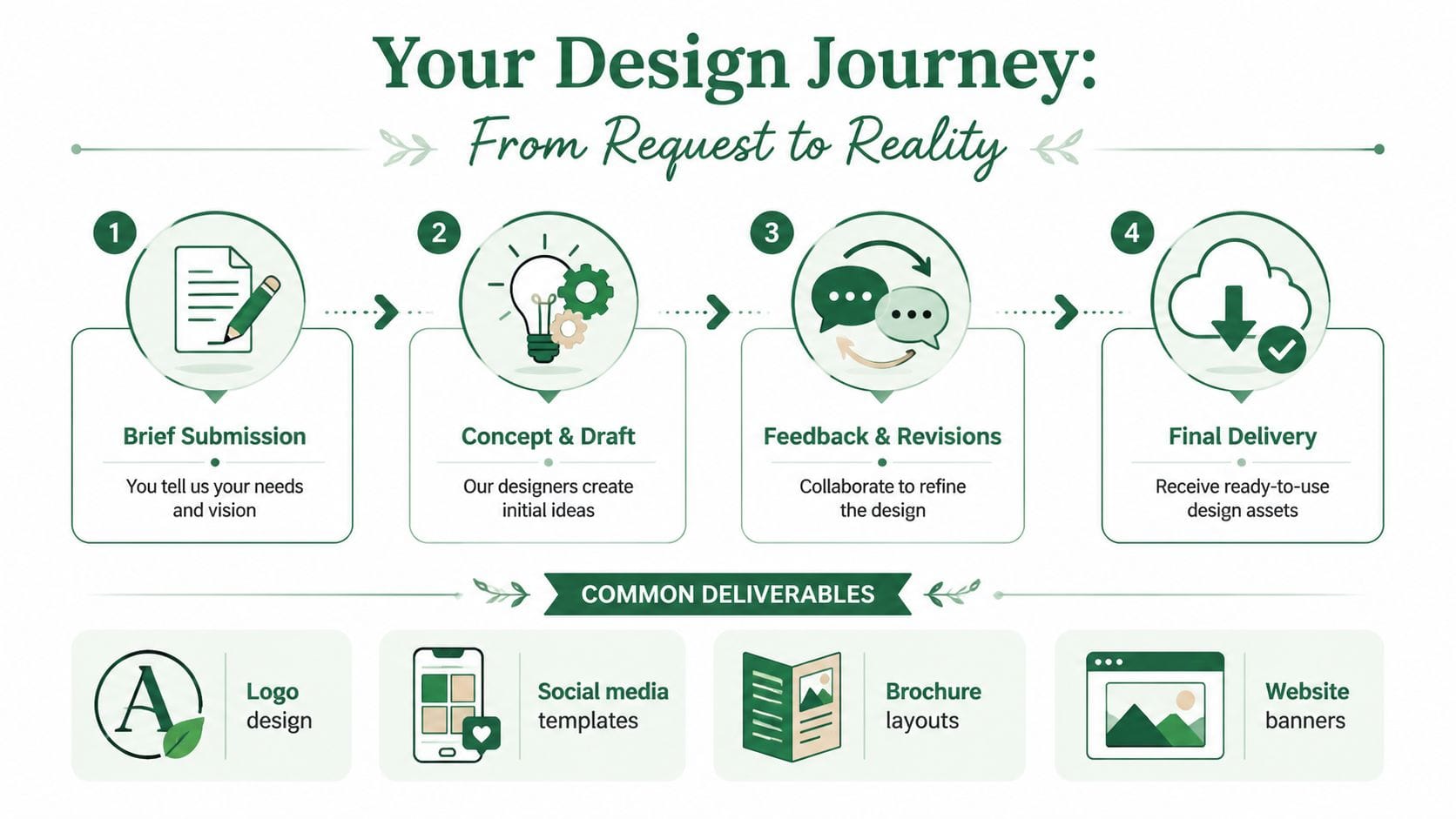
A Brisbane business owner sends through a quick brief on Monday morning. By Tuesday, the first draft is back. After one round of clear feedback, the finished files are ready to post, print, upload, or hand to the sales team. That is what a good design service looks like in practice. It removes back-and-forth, cuts waiting time, and turns scattered requests into repeatable output.
Typical deliverables
The work that saves the most time is rarely the flashy one-off piece. It is the recurring design jobs that keep marketing and sales moving without dragging the owner back into admin every few days.
That usually includes:
- Social media templates for offers, updates, testimonials, and seasonal campaigns
- Digital ad creative for Meta, Google Display, and remarketing campaigns
- Website graphics such as hero banners, service icons, landing page sections, and downloadable guides
- Sales collateral like capability statements, proposals, one-page flyers, and price lists
- Print-ready artwork for business cards, signage, brochures, and event handouts
The strongest services also build reusable assets, not just finished files. Brand kits, editable templates, ad variations, and standard layouts reduce repeat briefing and make it easier for a business to keep output consistent across channels. One well-built set of campaign templates can remove hours of small decisions over the next few months.
That operational value matters more than novelty. A custom graphic that wins praise once is less useful than a library of ready-to-go assets the team can use every week.
Some providers now pair this production work with tools like AI software for marketing campaigns, but the useful part is still human judgement. Someone still needs to shape the brief, apply the brand properly, and make sure the final asset fits the channel and the offer.
How the workflow usually runs
A reliable process is simple and predictable.
The request goes in
The business sends a brief through email, a client portal, or a project board. The useful basics are the goal, format, deadline, copy, dimensions, and any examples.Questions get handled upfront
Good designers check gaps early. That saves a lot of wasted time later, especially when the wrong audience, format, or offer has been assumed.Draft and review
The first version comes back for feedback. Specific comments speed things up. “Increase the price, shorten the headline, and make the call button clearer” is far easier to action than vague direction.Final files are delivered
The completed asset arrives in the formats needed for use. That might mean web-ready images, print-ready PDFs, editable Canva files, or source files, depending on the agreement.
The difference between a helpful service and a frustrating one usually sits in the handover details. If files arrive named properly, sized correctly, and ready for the next step, the business avoids extra admin. If they do not, the owner or marketing coordinator ends up finishing the job anyway.
Timing matters too. A promotion designed after the copy is finalised and scheduled around a realistic posting plan will perform better than rushed artwork requested the night before. For example, pairing creative production with a schedule based on the best times to post to Facebook for business content helps campaigns go live with less scrambling.
Design works best when each request is tied to a business action. Call, book, enquire, download, or visit. If the next step is unclear, the asset usually creates more clutter than value.
The Real Benefits for a Time-Poor Brisbane Business
The biggest win isn't prettier graphics.
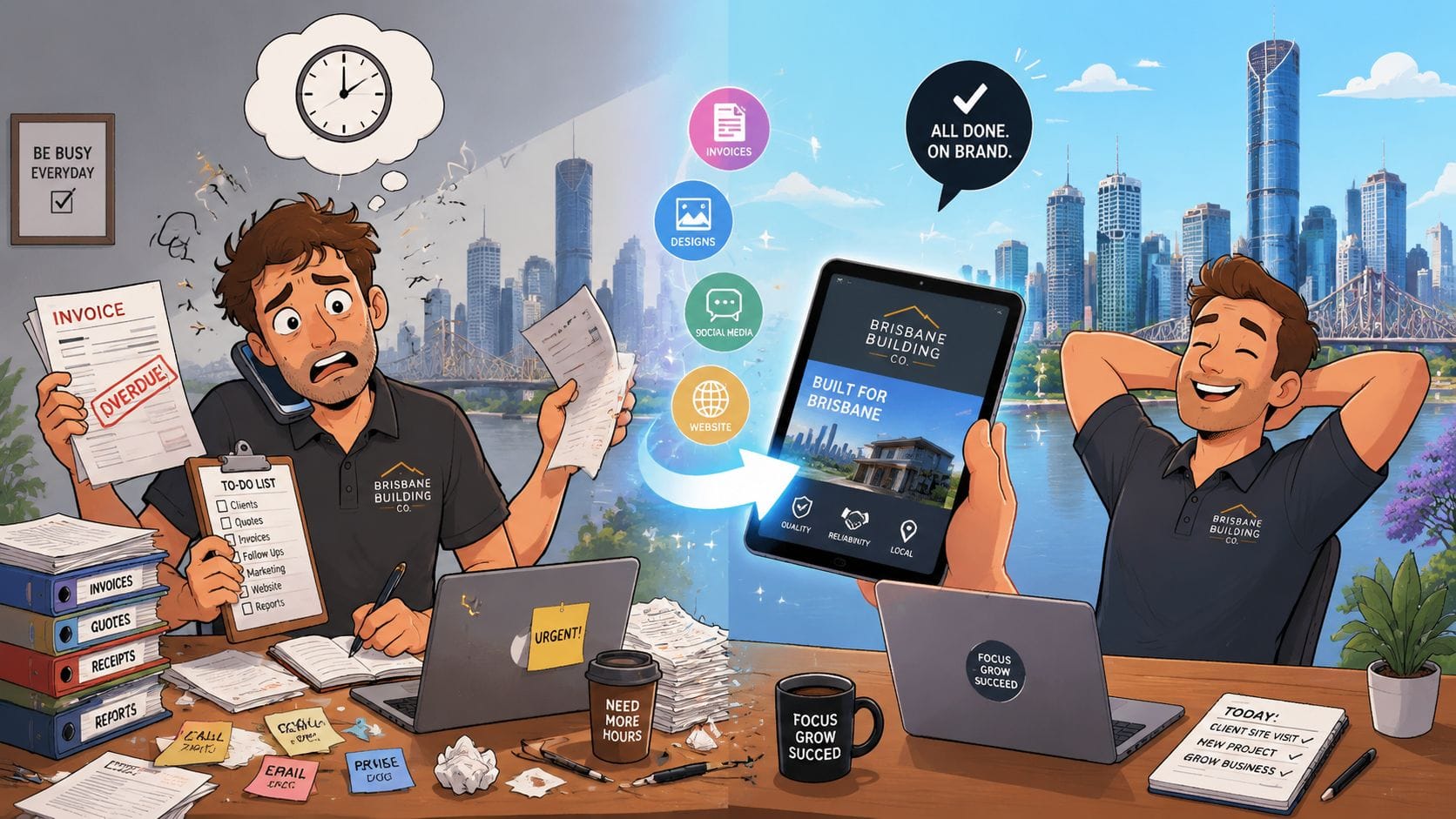
It's that the business stops burning expensive owner time on low-value creative admin. For lean Queensland businesses, design-as-a-service works best as an operational support service that reduces internal admin, keeps assets consistent, and helps teams launch faster, as discussed in this service design perspective.
Less admin and fewer stalls
A business owner shouldn't have to become the in-house traffic manager for every social tile, flyer edit, and website graphic. But that's exactly what happens when there's no reliable design support in place.
Common bottlenecks look like this:
- Briefing from scratch each time slows down routine work
- Chasing files and brand assets turns simple updates into scavenger hunts
- Too many decision-makers create messy feedback and repeated revisions
- DIY tools for everything make every task take longer than expected
When a provider already knows the brand, the channels, and the common deliverables, each request gets lighter. The owner spends less time explaining basic context. Staff spend less time patching things together.
That matters just as much as the final visual quality.
Better budgeting and faster launches
Cost control is another practical advantage. A service model gives a business a clearer monthly line item than unpredictable one-off design jobs. It also avoids many of the overheads that come with building internal capability for sporadic work.
There's also a speed benefit. When social campaigns, landing pages, and ad sets rely on timely creative, any delay in design delays the whole campaign. That's why design should sit close to conversion goals, not float off as a separate aesthetic exercise. For businesses tightening enquiry paths, this guide to conversion rate optimisation in Australia is a useful reminder that layout, clarity, and calls to action need to work together.
Some teams also pair ongoing design support with automation and creative production tools. For owners exploring that side of workflow, this overview of AI software for marketing campaigns is useful background. The practical point is simple. AI can speed up parts of production, but it doesn't replace the need for brand-consistent design decisions.
Outsourcing vs In-House vs Freelancer The Right Fit
There isn't one perfect model for every business. The right choice depends on volume, urgency, internal capacity, and how much management time the owner wants to spend on creative work.
The most useful comparison starts with in-house hiring, because that's the option many growing businesses consider first. According to Australian government occupational data published through the BLS handbook, the median annual wage for a graphic designer was $61,300 in May 2024. That gives small businesses a real benchmark before adding the practical extras that come with an employee, such as leave, equipment, software, onboarding, and management time.
Where each option works
In-house designer
This can work when design demand is constant and broad enough to keep one person fully occupied. The business gets day-to-day access and strong familiarity with the brand. The downside is commitment. If design needs rise and fall, the role can become inefficient or overloaded.
Freelancers
Freelancers suit project-based work well. A business can hire for a logo refresh, a brochure, or a campaign burst without ongoing commitment. The trade-off is inconsistency. Availability changes, styles vary, and each new freelancer often needs a fresh onboarding process.
Graphic design as a service
This tends to suit small businesses that need repeat support but don't need a full-time design hire. It offers continuity, a simpler request process, and less management overhead than stitching together multiple project contractors.
A local business comparing options should also think beyond cost. The hidden issue is coordination. Who writes briefs, checks files, consolidates feedback, follows up, and makes sure each asset matches earlier work? When that load falls back on the owner, the cheapest option often stops being the cheapest.
Design Support Cost & Effort Comparison Annual Estimate
| Factor | In-House Designer | Freelancers Project-based | Design as a Service |
|---|---|---|---|
| Core cost structure | Salary-based, with $61,300 median annual wage as a benchmark | Paid per project or task | Usually monthly or packaged |
| Flexibility | Lower | High | High |
| Brand consistency | Often strong | Depends on who's hired each time | Usually stronger than ad hoc project hiring |
| Turnaround reliability | Good if workload is manageable | Variable | Usually steadier for recurring work |
| Management overhead | High | Medium to high | Lower |
| Best fit | Constant daily design demand | Infrequent specialist jobs | Ongoing small to medium business needs |
For many Brisbane SMEs, graphic design as a service lands in the practical middle ground. It won't replace a full internal creative team at scale, and it isn't ideal for every specialist project. But for recurring business-as-usual marketing, it often gives the best balance of cost control, consistency, and owner time saved.
How to Choose Your Brisbane Design Partner
A design provider should make marketing easier, not add another layer of chasing and clarifying. The shortlist matters less than the questions being asked before signing anything.
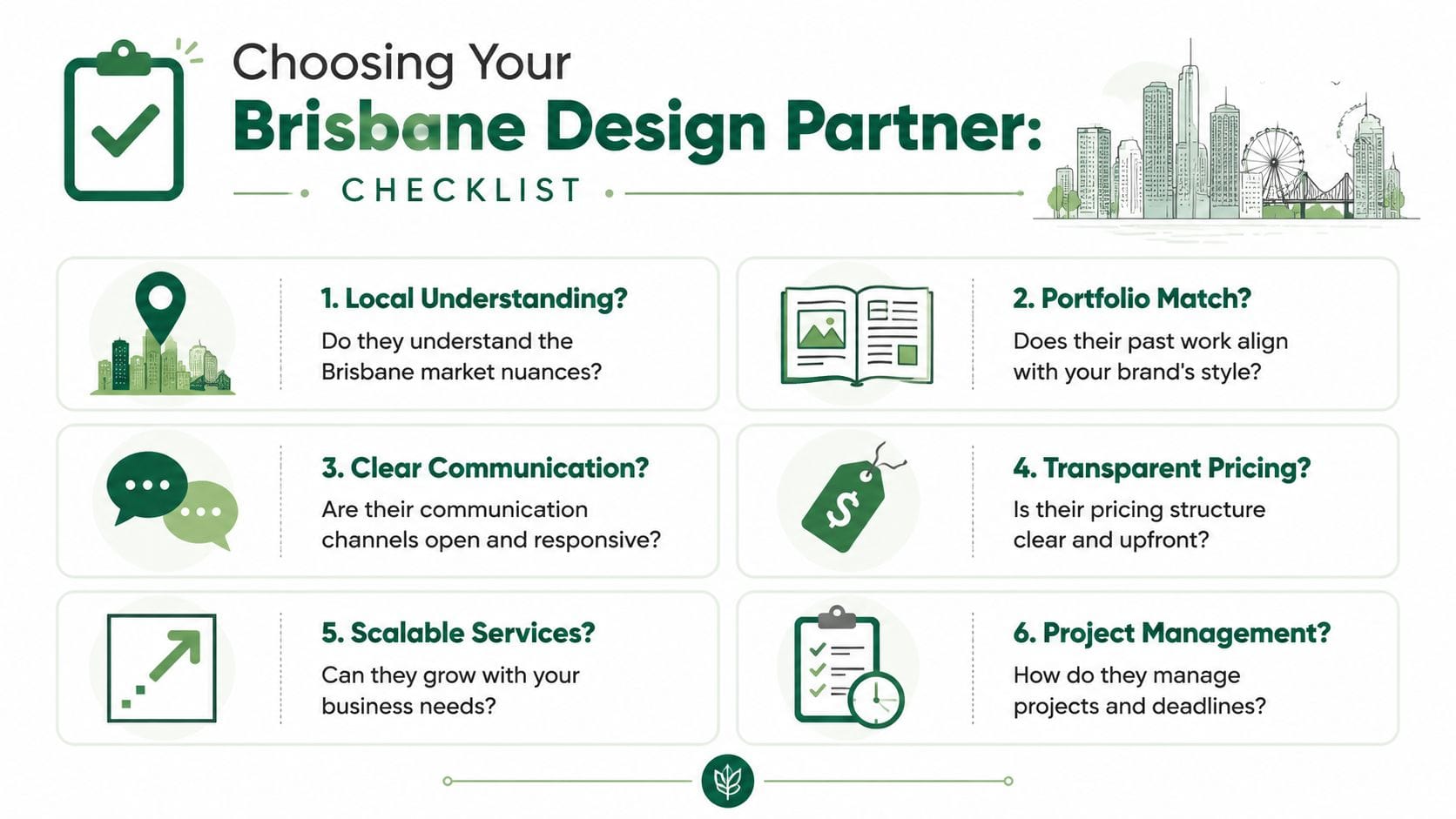
Questions worth asking before signing
Start with the practical side, not the portfolio glamour.
How do requests get submitted
If the process is clunky, the relationship will feel clunky too. Email can work, but a shared task board or client portal often keeps things cleaner.What does a normal turnaround look like
The answer doesn't need to be flashy. It just needs to be clear and realistic.How are revisions handled
A good system should explain what counts as a revision, what counts as a new task, and how feedback should be given.Will the provider build reusable assets
Templates, brand kits, and repeatable layouts usually deliver more long-term value than a pile of disconnected files.Can the work support the website as well as social and print
Many businesses need one design partner who can help across channels, not just in one narrow format.Do they design with accessibility in mind
For Brisbane service businesses that rely on online enquiries, accessible design is both a compliance and conversion issue. Poor accessibility can suppress leads, which is why it's worth asking whether the provider builds to modern standards from the start, as raised in this discussion on accessible design risk.
A polished design that's hard to read on a phone or confusing to navigate doesn't help the business. It just hides the problem behind better colours.
One practical option in Brisbane is Boocoo's website and digital support services, which sit alongside broader marketing delivery. That sort of setup can be useful when a business needs design tied closely to web updates and lead generation rather than handled in isolation.
A practical next step
The right partner is usually the one that reduces friction fastest. Clear communication, organised files, sensible turnaround, and reusable assets matter more than flashy creative language.
For a Brisbane business that's tired of doing rushed design in spare moments, graphic design as a service can be a smart way to buy back time and keep marketing moving without hiring internally.