
A lot of Brisbane principals know the feeling. The listings are decent, the photos are polished, the logo looks sharp, and yet the competitor with the simpler presentation keeps showing up in Google, getting the calls, and turning up at the appraisal table first. That gap usually isn't a design problem, it's a real estate brand marketing problem, and it's happening because buyers and sellers now judge agents on discoverability, response speed, and trust signals long before they ever meet them.
Australia's digital behaviour makes that shift impossible to ignore. The Australian Bureau of Statistics' 2024 Household Use of Information Technology data shows 96.2% of households had internet access and 86.5% had a smartphone, while 74.4% of internet users bought goods or services online in the previous 3 months, so most brand touchpoints are now mobile-first and always-on (ABS data referenced in this real estate marketing summary). In practical terms, branding is no longer a coat of paint. It's the system that decides whether a local searcher trusts the agency enough to enquire.
Why Most Real Estate Branding Fails in Local Markets
A Brisbane agent can spend money on a new headshot, a fresh colour palette, and a tidy slogan, then still lose the listing to a smaller competitor. That happens when branding is treated like a brochure, not a demand-capture system. The agency looks polished, but the market can't find it, can't verify it, and can't reach it quickly enough when intent is high.
The modern market is search-led. The ACCC's Digital Platform Services Inquiry reported that Google Search accounted for about 95% of search queries in Australia, which explains why search visibility, Google Business Profile management, and review signals carry so much weight in real estate discoverability (ACCC search dominance summary). When a seller compares agents in a local area, the first impression often comes from a map result, a review snippet, or a mobile listing page, not a printed flyer.
Practical rule: if the branding doesn't help a seller find the agency, trust it, and contact it from a phone in under a minute, the branding isn't doing its job.
What generic branding misses
Generic branding tries to look premium to everyone. Local branding wins by being clearly relevant to someone specific, such as downsizers in a heritage pocket, landlords in an inner-city corridor, or families comparing agents across a school catchment. That's why the most useful resources for broader local business marketing strategies are often the ones that start with audience, location, and buyer intent, not with visual polish.
The old playbook leaned on awareness tactics such as bus shelter ads and broad sponsorships. Those can still support visibility, but they rarely fix the core issue in a local property market, which is that people already have too many choices and too little patience. Mobile-first decision-making rewards the agency that answers the question, “Why this agent for this suburb, right now?”
A stronger model is simple. Brand assets should reduce friction. That means local search visibility, fast pages, consistent visual identity, clear service areas, and response systems that don't let hot enquiries go cold. In real estate, the logo is the wrapper, but the brand experience is what decides whether a lead becomes a listing conversation.
Finding Your Local Perception Gap
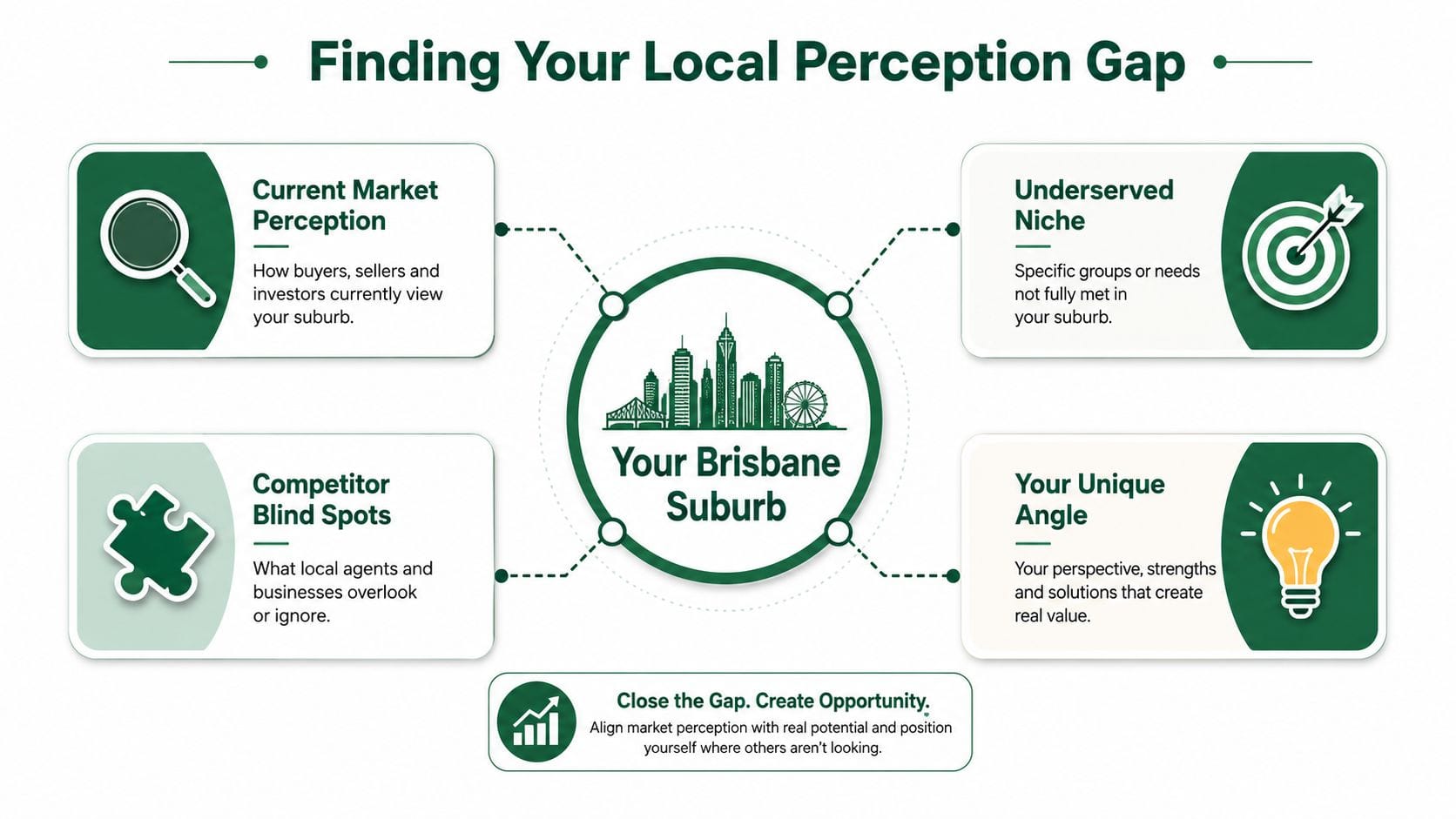
The best Brisbane positioning usually doesn't come from trying to look more luxurious. It comes from spotting what the local market is under-served on, then owning that gap with discipline. A lot of agencies in the same suburb sound interchangeable, which is why the first job is to map where they overlap.
Audit the local message, not just the logo
Start with the top five agents or agencies in the target suburb or corridor. Review their homepage copy, Google Business Profile, listings pages, suburb pages, social bios, and review language. Look for repeated claims like “local expert,” “trusted agent,” or “personal service,” because those phrases often signal sameness rather than differentiation.
A useful shortcut is to sort what you find into four buckets. Current market perception, underserved niche, competitor blind spots, and your unique angle. For a Paddington office, that may reveal that every competitor talks about prestige homes, while few speak directly to downsizers who want a low-friction move. For a bayside-focused operator, the gap might be relocations, school catchments, or lifestyle-led buyers who need suburb context more than property hype.
The strongest positioning often sits where competitor language gets vague and buyer questions get specific.
A simple worksheet helps keep this grounded. Write down the suburb, the buyer type, the main pain point, and the proof the agency can show. If the answer is weak on proof, the positioning will sound like marketing copy instead of a usable promise. For a deeper audience-mapping process, the internal guide on what is user persona is a good companion.
Turn the gap into a brand system
Once the gap is clear, the messaging needs to be consistent everywhere. That means the homepage, suburb pages, social captions, review request language, and listing descriptions all need to echo the same angle. The visual identity should support that angle too, but the words matter more than the palette.
The best real estate branding doesn't say, “We're premium.” It says, “We understand this buyer segment, this suburb, and this transaction type better than the next agency.” That's the difference between a broad-awareness brand and a local conversion brand. The first looks nice. The second gets enquiries.
Building Local Search Visibility That Brings Enquiries
Google is where local intent gets translated into action. If the agency doesn't show up cleanly there, branding effort leaks away into the gaps between search, maps, and mobile browsing. That's why SEO for real estate has to be treated as an operating system, not a one-off task.
Fix the profile before chasing content
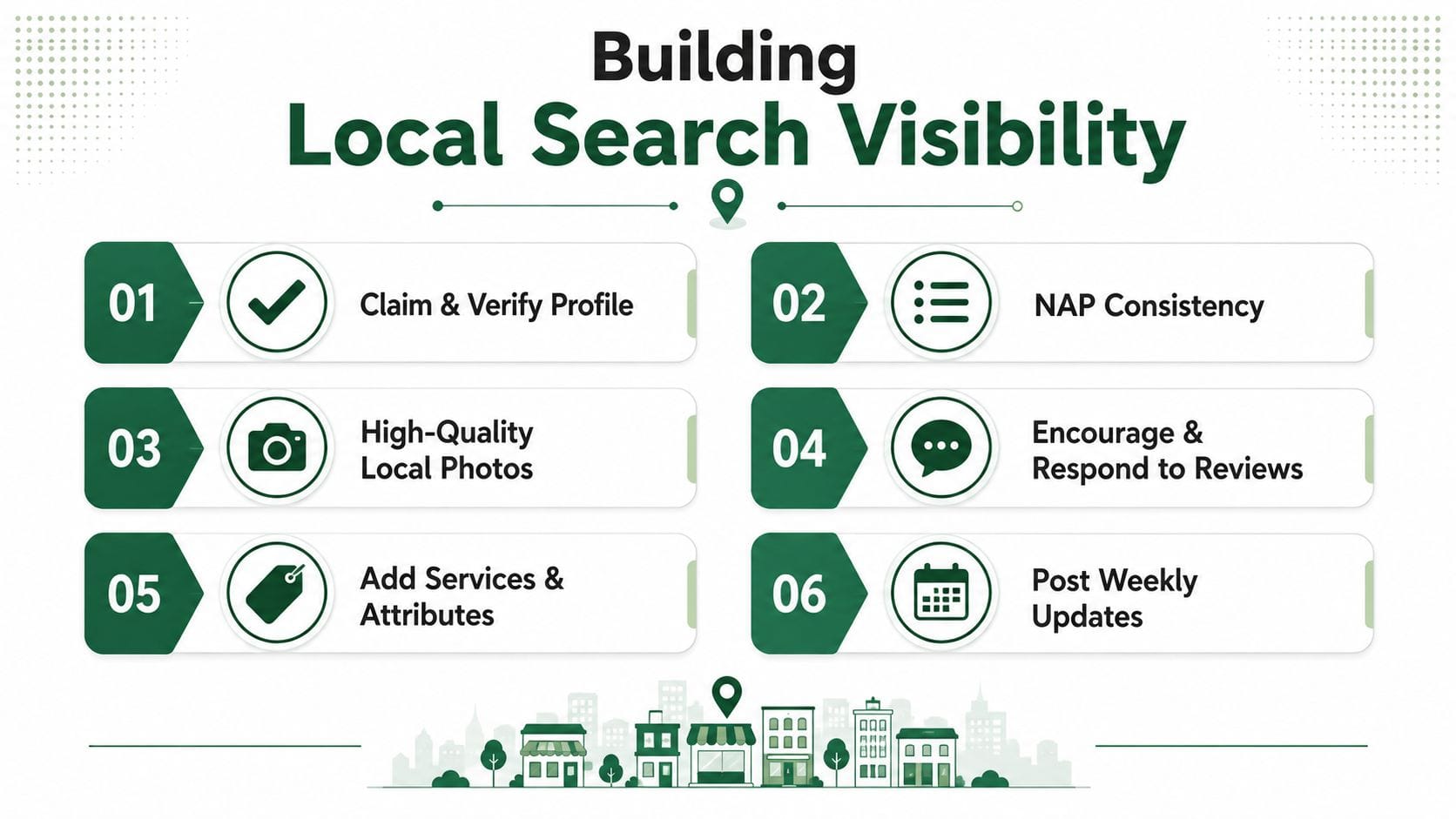
A Google Business Profile should be accurate, complete, and easy to trust. Category choice matters, service areas need to match the actual working footprint, and photos should show actual team members, recent listings, street context, and local landmarks. The aim isn't to create a glossy gallery. It's to make the profile feel active, genuine, and locally anchored.
A small agency can keep this manageable with a repeatable routine. Use review requests after appraisals and open homes, then respond quickly and consistently. If the agency already has a content workflow, the best place to slot this work is into a standing weekly admin block rather than leaving it to whoever has spare time.
For agencies that want a planning structure, build your SEO plan template is a helpful way to keep the work organised without overcomplicating it. That matters because local SEO falls apart when it becomes a scattered to-do list instead of a routine.
Make the website do suburban work
The website should support suburb-specific searches, not just describe the agency in general terms. That means location pages, service pages, and listing pages with clear page titles, fast mobile performance, and visible contact options. If a visitor can't tell within seconds where the agency operates and why it's relevant to their suburb, the site is underperforming.
The earlier section on local perception gap gives the strategic angle. The site then needs to reflect it in a practical way, with consistent language, a clear service footprint, and proof points that back the promise. One useful reference for broader search positioning is what is local SEO marketing, especially when the goal is to connect suburb relevance with enquiry flow.
Working standard: every important local page should answer three questions quickly, where the agency works, who it serves, and why that audience should trust it.
The monthly maintenance checklist doesn't need to be complicated. Check profile accuracy, add fresh photos, request and reply to reviews, publish a short update, and review which suburb pages are getting attention. That's enough to keep the system alive without hiring a full-time marketer.
Content, Social and Paid Ads That Work Together
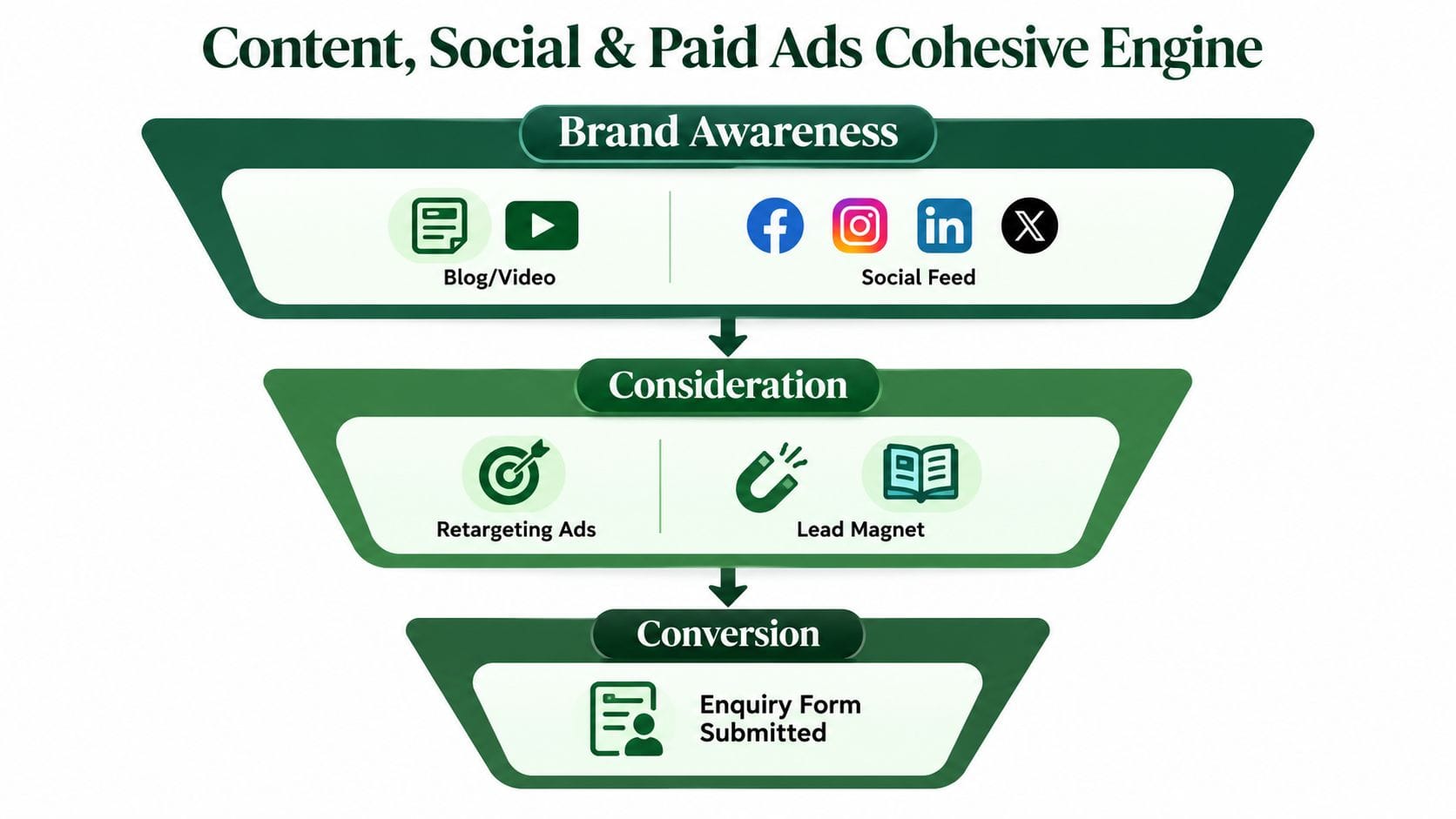
A lot of agencies split content, social, and paid media into separate tasks, then wonder why the message feels thin. The stronger approach is to run them as one system. Content creates the proof, social carries it into the market, and paid media puts it back in front of the right local audience once interest starts to rise.
Use proof, not polish, to earn attention
Buyers and sellers are already drowning in portal noise and generic agent language. What cuts through is proof-based content, local market commentary, suburb guides, review snippets, and short client stories that show how the agency works. The job is not to publish more. It is to publish material that helps a stressed seller feel safer making contact.
For a small Brisbane team, a weekly rhythm is usually enough. One suburb insight, one testimonial-style post, one short property video, and one call to action tied to a local service page can keep the agency visible without swallowing the week. The agency does not need to behave like a media company. It needs a publishing habit that a busy principal can keep running through auction day and beyond.
If the team needs help keeping that engine moving, a page on content marketing services should explain how the work turns into usable assets for listings, social posts, and paid campaigns. The same discipline applies to production. Clean footage and tight edits matter, which is why video editing for property listings is useful when listing video needs to be sharpened without turning the process into a full creative department job.
Make each channel support the others
Social media should not just repost listings. It should reinforce the same positioning theme the website uses, so the audience keeps seeing a consistent story wherever they meet the brand. Facebook, Instagram, and short video work best when they carry local proof and behind-the-scenes credibility, not just polished property shots.
Paid ads are stronger when they push high-intent pages, retarget site visitors, or present a clear enquiry offer to people who have already shown interest. A lead form can work well, but only if follow-up is fast and tidy. Slow response turns a workable campaign into wasted spend. That is why the earlier brand work matters. Ads usually succeed or fail on the message that was already established, not on media spend alone.
A practical content stack looks like this:
- Suburb guide: build one detailed local page, then cut it into social captions, a short video, and a paid retargeting message.
- Client result story: turn one transaction into proof for listings, reviews, and landing pages.
- Market commentary: use one insight across the website, Google Business Profile, and social channels so the message repeats without feeling repetitive.
The point is simple. Content, social, and ads work better together than they do on their own because each channel gives the next one more credibility. In a Brisbane office with limited time and a real budget to protect, that matters more than chasing clever creative for its own sake.
Measuring What Actually Drives Listings and Sales
A lot of real estate reporting stops at clicks, impressions, or raw leads. That leaves out the parts that decide whether a campaign produces listings. A brand can look active on paper and still miss the mark if call handling is weak, follow-up is slow, or the tracking setup fails to capture phone enquiries.
Build a measurement stack that reflects reality
A practical stack should use UTM-tagged links, dedicated landing pages, phone-call tracking, and CRM reconciliation. The reason is simple. Phone enquiries are a real part of the conversion path, and form fills only tell part of the story. If your tracking only counts web forms, you will understate branded search and paid search performance, then make budget decisions on incomplete numbers.
A visitor-to-lead benchmark in real estate sits at about 2.2%, which gives small agencies a useful floor for campaign review. If a page is getting visits but not enquiries, the issue may be weak intent match, weak trust cues, or slow response handling, not just traffic volume. The more practical question is whether the page and the phone process are working together, because that is where listings are won or lost.
| Metric | Benchmark | Why It Matters |
|---|---|---|
| Phone-based conversion share | 27.6% | Captures enquiries that form tracking misses |
| Form-based conversion share | 72.4% | Shows the main digital enquiry path |
| Visitor-to-lead rate | About 2.2% | Gives a baseline for page performance |
| Follow-up contact speed | Within 5 minutes | Better response timing supports qualification |
| Lead follow-up rate | Only 52% of agents follow up on a lead at all | Reveals how much pipeline is lost before sales work even starts |
Treat speed as part of brand performance
Branding gains disappear when leads sit untouched. A brand perception tracking framework notes that only 52% of agents follow up on a lead at all, and that leads contacted within 5 minutes are 21x more likely to be qualified than those contacted after 30 minutes (Zigpoll brand perception framework). That is an operations issue and a brand issue at the same time, because the customer's first experience of the brand is often the speed and quality of the first reply.
A strong brand promise means little if the first phone call rings out and the email sits unanswered.
The measurement rhythm should be weekly. Review calls, forms, appointment bookings, lead quality, and response time compliance. Then reconcile that with CRM outcomes such as lead-to-visit and visit-to-listing progression. For agencies setting up the system, what is a CRM system helps frame how enquiry management connects to the rest of the pipeline.
A Practical Brisbane Budget Template for Small Agencies
A small Brisbane agency doesn't need a sprawling budget to improve brand performance. It needs a clear split between visibility, proof, and follow-up. The biggest mistake is spreading spend so thin that nothing gets enough traction to matter.
Three budget tiers that fit real workloads
A starter setup should prioritise the essentials, Google Business Profile upkeep, basic local SEO content, and simple review collection. That keeps the agency visible where intent is highest, while still leaving enough time to run the business. A growth setup can add paid retargeting and more content production, while an established setup can support stronger creative, more frequent publishing, and better automation.
A simple way to think about it is this, the smaller the budget, the more the agency should invest in assets that compound. That means search visibility, suburb pages, review management, and one or two repeatable content formats. Vanity spend, such as overproduced brand assets with no enquiry path, usually burns cash faster than it builds demand.
For agencies weighing ad spend, how much do Facebook ads cost is a useful internal guide when social promotion needs to stay within bounds.
A quarterly allocation that stays manageable
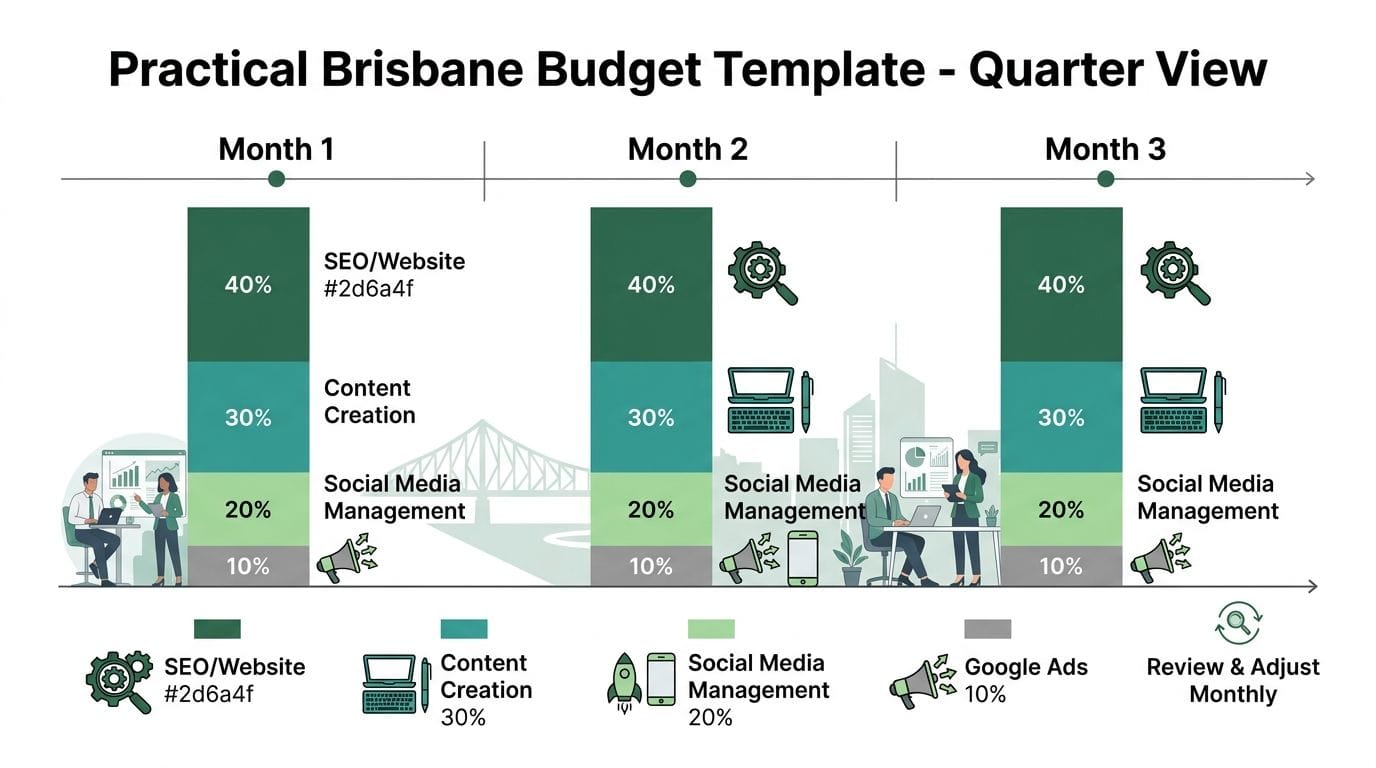
The quarterly split should stay disciplined, with SEO and website work at 40%, content creation at 30%, social media management at 20%, and Google Ads at 10%. That distribution keeps the core brand assets funded while still allowing a small amount of paid traffic to test demand and retarget interest. Review and adjust monthly, because a Brisbane market can change faster than a quarterly plan.
A practical 90-day rollout looks like this. Month 1 locks in the positioning, profile, and website basics. Month 2 pushes suburb content, review collection, and social proof. Month 3 brings the paid layer in more deliberately, then checks which pages and calls are producing real conversations.
Boocoo is one local option that supports SEO, web, social, and paid ad work for Brisbane small businesses, including real estate marketing support, if a principal wants a single team to handle the moving parts. The useful part is not the promise, it's the reduction in admin.
The agencies that win locally usually don't outspend everyone. They out-focus them. They know which perception gap they own, they show up where the market is searching, and they measure the enquiry path all the way to the phone ring.
For a Brisbane principal who's tired of guessing which part of the marketing is working, the next step is simple, tighten the positioning, clean up the Google presence, and install a measurement stack that tracks calls, forms, and follow-up speed. If that sounds like the gap holding the business back, contact Boocoo on 1300 093 797 or hello@boocoo.au and ask for a practical review of the agency's search visibility, content, and paid lead flow.