
A lot of Brisbane business owners sit in the same spot. The work is solid, customers are happy, referrals still come through, but the website feels quiet and Google seems to favour someone else. On top of that, there's social media to keep up with, reviews to answer, pages to update, and a constant stream of advice about SEO that sounds more complicated than it needs to be.
That's where content marketing services can help, if they're handled properly. Not as a pile of random blog posts, and not as a vanity exercise built around likes, but as a practical system that helps a small business get found, build trust, and turn attention into enquiries. For those seeking Brisbane Digital Marketing support, the biggest win usually comes from simplifying the process, understanding the trade-offs, and choosing work that fits the budget instead of draining it.
Why Good Businesses Can Feel Invisible Online
A business can be excellent offline and still look ordinary online. That disconnect happens all the time. The owner knows the team does great work, but the website is thin, the service pages are vague, the Google Business Profile hasn't been touched in months, and no one has had time to publish anything useful.
Small business owners usually aren't short on effort. They're short on hours. Running jobs, replying to clients, managing staff, and handling cash flow already fills the week. Marketing gets pushed into the leftover gaps, which means it often becomes reactive instead of organised.
That's why content marketing services matter. Done well, they turn marketing into a system. Instead of posting whenever there's spare time, the business starts building useful pages and articles that answer customer questions, support SEO, and make the next enquiry easier to win.
Why visibility often breaks down
A few patterns show up again and again:
- The website talks about the business, not the customer. Visitors want answers about pricing, timing, process, and trust signals.
- Service pages are too broad. A page for “plumbing services” is weaker than clear pages around specific problems and locations.
- No one is publishing helpful content. Google can't reward expertise it can't see.
- Marketing is scattered. A few posts on Facebook, a boosted ad, and an old blog rarely work together.
Good visibility usually comes from consistency, not noise.
There's another layer now as well. Search isn't only about old-style rankings. People are discovering businesses through broader search experiences, summaries, and AI-assisted results. A useful primer on that shift is AI SEO Tracker's visibility guide, which explains why clear, trustworthy content matters more than adding more pages.
For a Brisbane small business, the practical takeaway is simple. The goal isn't to become a publisher overnight. The goal is to create a lean body of helpful content that proves the business knows its work and serves the right local audience.
What Content Marketing Really Means for Your Business
A Brisbane business owner can be excellent at the work, have a solid website, and still lose enquiries because prospects cannot quickly find clear answers. Content marketing fixes that gap. It gives people the information they need before they call, request a quote, or compare you with the business down the road.
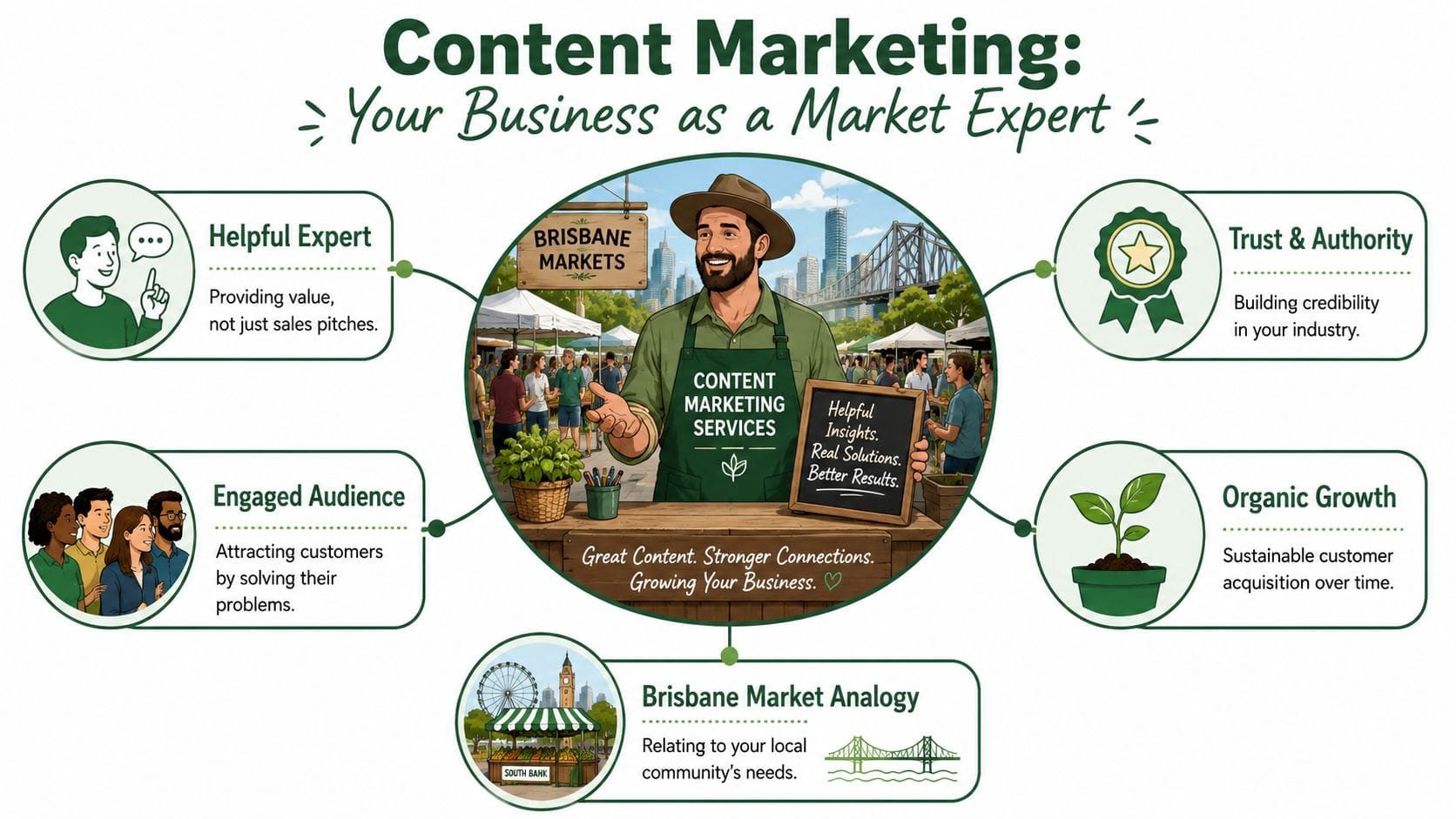
At a practical level, content marketing means publishing useful material that helps a buyer move from unsure to ready. It is usually less about chasing attention and more about removing hesitation. For a small business, that often means answering the questions people ask before they buy, explaining your process in plain English, showing proof that you know the job, and staying visible long enough to be remembered.
That sounds simple, but there is a real trade-off. Good content takes time, planning, and subject knowledge. Thin posts written only for keywords rarely help. Clear pages that reflect how customers search and decide usually do.
What content marketing includes in real life
For a budget-conscious Brisbane business, content marketing usually comes down to a manageable set of assets:
- Helpful articles. Pages that answer pre-sale questions, reduce objections, and attract relevant search traffic.
- Clear service pages. Copy that explains what you do, who it is for, what the process looks like, and what to do next.
- Short social content. Simple posts that reinforce credibility and keep good website content working harder.
- Email follow-up. Useful reminders, case studies, and updates that keep warm prospects engaged.
Used together, these assets do different jobs. Some bring in new visitors. Some help a prospect feel confident enough to enquire. Some shorten the sales process because the basics have already been explained.
In Australia, content marketing is a mature service category, not a side tactic. IBISWorld's Australian content marketing industry data notes the size of the local market and the number of specialist operators serving it. For a small business owner, the more useful takeaway is this. There are plenty of providers selling “content”, but the value sits in whether that content supports enquiries, search visibility, and sales conversations.
That is where pricing and ROI often get muddy. A cheap article package can look efficient on paper and still produce nothing useful. A smaller monthly plan with sharper topics, better service pages, and clear calls to action can outperform it because it is tied to buyer intent. That is the sort of healthy partnership good local agencies aim for, and it is a fair benchmark to use when comparing firms like Boocoo with bigger agencies that sell volume first.
Professional services firms often feel this problem more than other businesses. The expertise is there, but the wording is too technical, too cautious, or too broad for a buyer who just wants a clear answer. This article on addressing content marketing challenges in professional services explains that issue well.
If social channels are part of the mix, the smartest approach is usually simple consistency rather than trying to be everywhere at once. A practical example is this guide to building a social media strategy for startups, which shows how to create a content rhythm that supports the website instead of distracting from it.
The Core Services You Will Actually Use
Most small businesses don't need every possible marketing deliverable. They need a short list of useful assets that support search, trust, and enquiries.
Search-focused articles that answer real questions
A local plumber in Chermside doesn't need twenty vague lifestyle posts. They need a few strong pieces that answer things people already search for, such as emergency call-out concerns, what causes blocked drains, or whether a hot water system should be repaired or replaced.
That's where SEO-driven blog writing earns its keep. The article isn't there to “fill the blog”. It's there to match real customer intent and lead naturally to a booking page or contact form.
A similar approach works for accountants, electricians, physios, builders, and lawyers. If customers keep asking the same questions by phone, those questions belong on the website. Businesses exploring this option can get a feel for the process through this guide to SEO content writing services.
Local SEO that helps people find the business nearby
For many Brisbane operators, the first local SEO job isn't writing a blog at all. It's cleaning up the business profile and location signals.
For Australian small businesses, claiming and optimising a Google My Business listing is the critical first step in local SEO strategy, and customer reviews play a significant role in local search rankings. The basics need to stay accurate across directories, including business name, address, phone number, opening hours, and photos, as outlined in this Australian local SEO guide.
A practical local checklist looks like this:
- Google Business Profile: Fully claimed, filled out, and updated with current services and photos.
- NAP consistency: The business name, address, and phone number match across the website and directory listings.
- Location relevance: Service pages mention real Brisbane suburbs only where they apply.
- Review management: Happy customers are asked for reviews in a simple, repeatable way.
Local SEO often improves faster when the basics are fixed before more content gets added.
Social posts and email that keep momentum going
Social media should support the website, not replace it. A café might post weekly specials and behind-the-scenes updates. A mortgage broker might share short tips about refinancing questions. A garden designer might show before-and-after work with a plain-English explanation of what changed.
The mistake is trying to be everywhere. Most small businesses do better with a manageable posting rhythm, a handful of repeatable content themes, and a style that sounds human. For owners wanting ideas that won't eat the week, these affordable social media management strategies offer a sensible starting point.
Email is often underrated in this mix. A short newsletter can remind past customers about seasonal services, share one useful tip, or highlight a recent project. It doesn't need to be fancy. It needs to be regular and relevant.
How to Measure Success Without Drowning in Data
The easiest way to waste a marketing budget is to stare at numbers that don't change the business. A spike in likes feels nice. It doesn't always pay wages.
For a small business, content marketing services should be judged by whether they help generate qualified attention and real enquiries. That means fewer vanity metrics, more focus on actions.
The numbers that matter
For Australian service businesses, the benchmark Cost Per Qualified Lead ranges from $50–$200, and a healthy benchmark is a 3:1 Marketing ROI ratio, meaning every $1 spent on marketing should generate at least $3 in new customer revenue. The calculation is New Revenue from New Customers ÷ Total Marketing Spend, according to Spacewolf's KPI guide for Australian businesses.
That same source notes that Australian B2B service conversion rates typically range from 10%–20%, while B2C products average 2%–5%. Those ranges are useful because they help an owner sense-check whether the funnel is healthy or leaking.
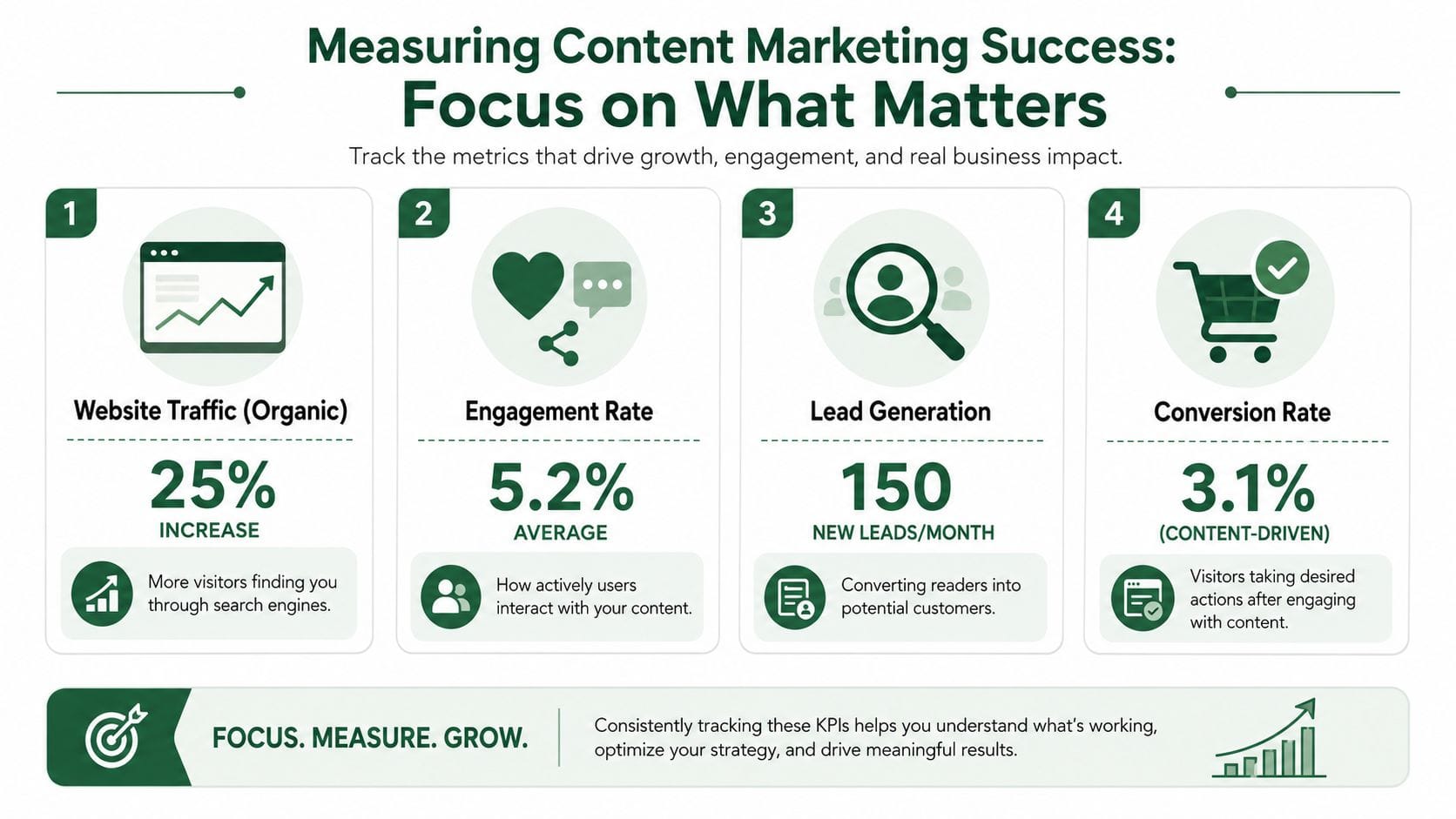
A simple scorecard for a Brisbane service business might track:
- Qualified leads: Contact forms, phone calls, or booking requests from people who fit the target customer.
- Cost per lead: Total marketing spend divided by those qualified leads.
- Lead source: Whether the enquiry came from organic search, Google Business Profile, email, social, or referral.
- New customer revenue: The amount earned from those leads after they convert.
A simple review routine
The tool stack doesn't need to be complicated. VentraIP's small business marketing guide recommends using Google Analytics to measure website visits, conversions, and traffic sources, along with social media insights and email metrics such as open rates and click-throughs to improve ROI.
A practical monthly review might ask:
- Which pages brought in the most useful traffic?
- Which enquiries turned into quotes or sales?
- Which topics attracted the right type of customer?
- Which content didn't contribute and can be improved?
Video can support this nicely when buyers need more confidence before reaching out, especially in service categories where trust matters. A useful example is how this video production services guide shows video fitting into a wider content plan.
Practical rule: If a report can't connect activity to leads, revenue, or customer quality, it's probably too fluffy.
Typical Pricing and What to Expect in Brisbane
A Brisbane business owner might get two proposals for “content marketing” that both land around the same monthly fee. One includes strategy, keyword planning, writing, publishing, basic design, and reporting. The other covers two blog posts and not much else. That gap is why pricing feels murky.
The question is not “what does content marketing cost?” It is “what work is being done, by whom, and how often?”
Common pricing models
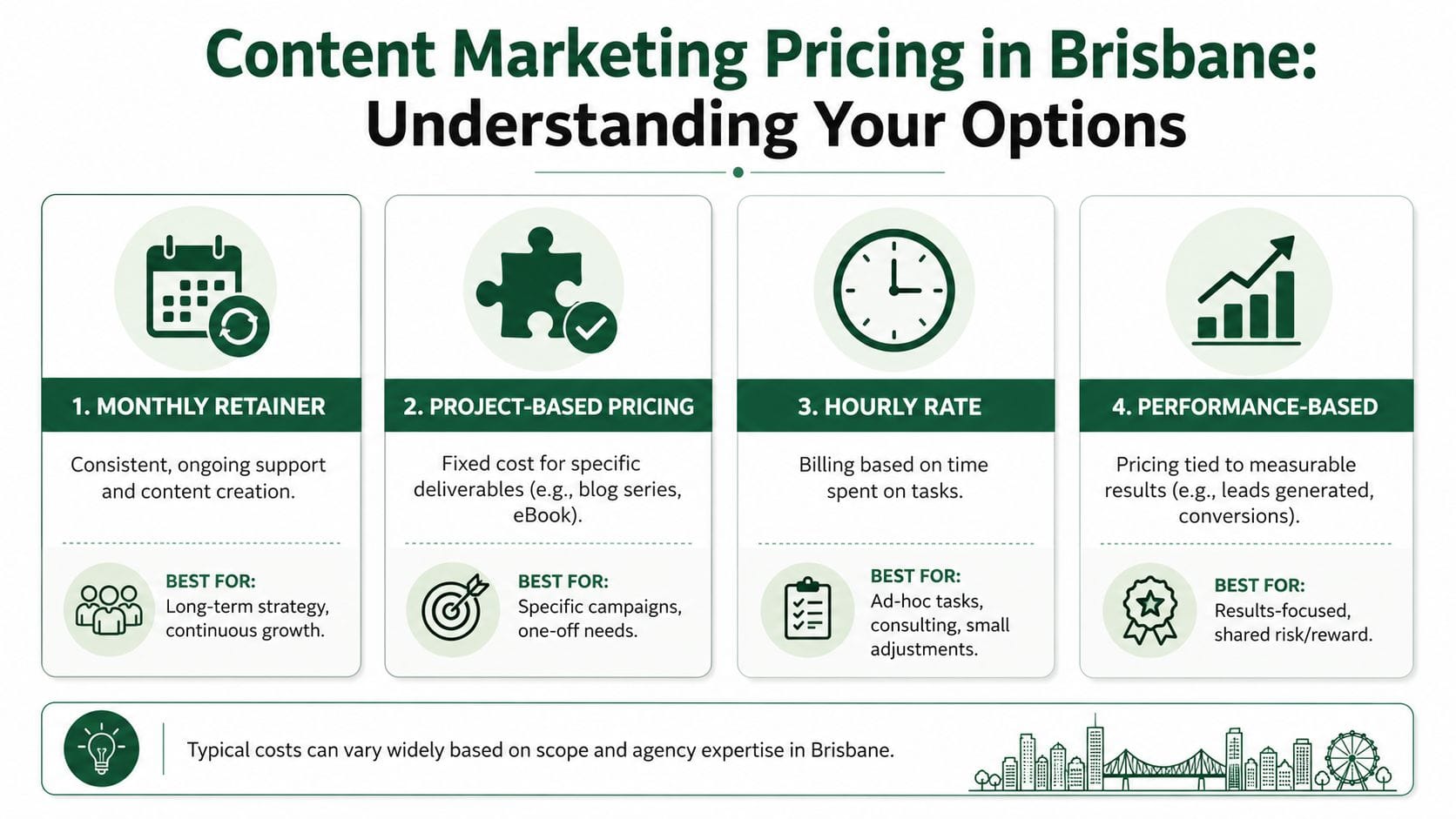
The three pricing models below cover most of the local market:
| Model | Best fit | Trade-off |
|---|---|---|
| Monthly retainer | Ongoing SEO and content work | Best for consistency, but it takes a few months to judge properly |
| Project-based fee | A website refresh, audit, or content sprint | Clear scope and budget, but momentum can stall after delivery |
| Hourly consulting | Advice, reviews, and ad hoc help | Flexible, but usually too patchy for steady content production |
Some agencies also pitch performance-based pricing. Small businesses should treat that carefully. Content often helps a sale indirectly through search visibility, trust, and follow-up visits, so clean attribution is harder than a sales deck makes it sound.
What a small business should expect
For a Brisbane small business, the practical starting point is usually one of three options. A short audit if there is already content on the site. A strategy project if the business needs focus before spending on production. Or a lean retainer if there is enough budget to publish consistently and review results properly.
HubSpot's guide to content marketing pricing shows how widely costs can vary depending on scope, specialist input, and publishing volume. That lines up with what Brisbane owners see in the market. Low-cost packages often buy isolated outputs. Higher-priced engagements usually include planning, SEO input, editing, publishing support, and regular review.
For budgeting, a useful rule is simple. If the monthly fee only seems to cover writing, it probably does. If an agency is also researching topics, mapping keywords, interviewing your team, improving pages, distributing content, and reporting on performance, the price should reflect that work.
Budget discipline is a critical factor. A small business with $1,000 a month usually gets better value from a focused project or a clear quarterly sprint than a watered-down retainer that produces a little content and no traction. Cheap retainers can feel safe because the monthly number is lower. In practice, they often drag on without enough output to change lead flow.
A sensible first investment often looks like one of these:
- A content audit if the website already has useful material but it is outdated, duplicated, or hard to find.
- A strategy sprint if the business needs clear priorities, realistic topics, and a workable publishing plan.
- A lean retainer if there is enough budget for regular execution, review, and improvement.
Small businesses comparing providers should also look at how the relationship is structured, not just the line items. A healthy setup is clear on scope, timelines, approvals, and what success should look like after the first 90 days. This guide to choosing content marketing agencies is a useful benchmark for that kind of partnership.
Good content marketing is not the cheapest option on the table. It should be the option that gives the business a clear path from spend to enquiries, without agency sales-speak or vague promises.
How to Hire the Right Local Agency
Hiring an agency shouldn't feel like sitting through a polished sales routine. It should feel like interviewing a partner who's being trusted with budget, reputation, and lead flow.
A key problem in the Australian market is confidence. Recent AU industry data shows that 65% of small businesses in Australia abandon content marketing within 12 months due to unclear ROI expectations, as reported by Digital Agency Network's Australia content marketing page. That figure says a lot. Businesses often don't quit because content “doesn't work”. They quit because no one explained the numbers, the timeline, or the path to return clearly enough.
Questions worth asking
A good agency should welcome practical questions. A Brisbane owner can ask things like:
- How will success be measured for this specific business? The answer should mention leads, revenue signals, and reporting cadence.
- What's included in the scope? Strategy, keyword research, writing, editing, uploading, graphics, distribution, and reporting should be clearly separated.
- What needs to come from the client side? Delays often happen when approvals and access aren't clarified early.
- How often will communication happen? A monthly check-in with clear reporting is usually more useful than constant chatter.
- What happens if content underperforms? The answer should involve review and iteration, not excuses.
For owners comparing local providers, this roundup of content marketing agencies can help frame what different agency models look like.
Red flags that deserve caution
A few warning signs tend to show up before a bad fit:
- Guaranteed rankings: No serious agency can promise a number one spot.
- Reporting built around vanity metrics: Followers and impressions aren't enough on their own.
- Vague deliverables: If the proposal sounds impressive but doesn't say what gets produced, caution is wise.
- No discussion of budget trade-offs: Good agencies explain what can and can't be done at different spend levels.
- Pressure to sign quickly: A healthy partnership doesn't need theatrics.
The right agency explains the work plainly, sets realistic expectations, and makes the owner feel clearer, not more confused.
For context, digital marketing is now a necessity for Australia's 2.6 million small businesses, and the ASBFEO reviewed 96 cases related to digital marketing services over the same period, averaging roughly four cases per month, according to the ASBFEO final report. That's a reminder to take due diligence seriously.
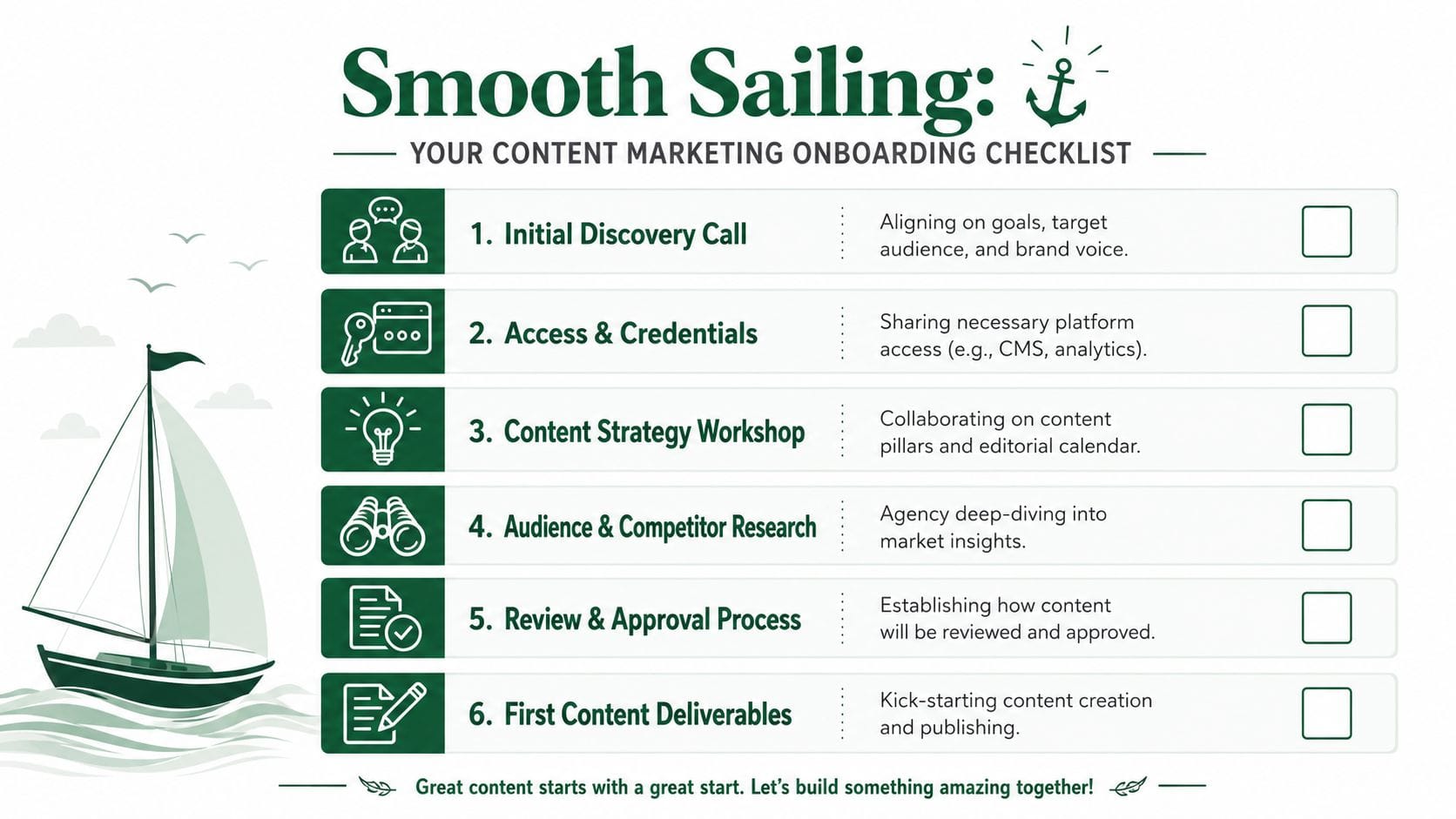
Your Simple Onboarding Checklist
Once an agency is chosen, the first phase should feel organised. Not rushed, not chaotic, and not dependent on the owner chasing every next step.
What the business should prepare
A smooth onboarding usually starts with the client gathering a few basics:
- Website access: CMS logins, hosting details if needed, and any existing page notes.
- Analytics access: Google Analytics, Google Business Profile, Google Search Console, and ad accounts if they exist.
- Business priorities: Which services matter most, which locations matter most, and what a good lead looks like.
- Past marketing material: Old blogs, brochures, proposals, emails, FAQs, and sales call notes.
- Approval contacts: One clear decision-maker saves time and prevents bottlenecks.
It also helps to share the language customers use. Email enquiries, phone call questions, and quote objections often contain the best content topics.
What should happen early
The agency's early work should create clarity fast. That often includes a kickoff meeting, initial research, a draft content plan, and an agreed review process.
A practical early-stage sequence usually includes:
Discovery and goals
The business explains priorities, margins, seasonality, and common customer questions.Research and planning
The agency reviews competitors, current visibility, and the topics worth targeting first.Content calendar and workflow
The owner can see what's being created, when it will be reviewed, and how it will be published.Reporting setup
Enquiry tracking, traffic review, and lead attribution are put in place before too much content goes live.
A business that wants a clearer sense of what website content should support during this phase can review this piece on content writing on website pages.
Turning Content into Customers
Good content marketing services don't just make a website look busier. They help a business become easier to find, easier to trust, and easier to choose.
For Brisbane small businesses, the smart move is usually to start lean, focus on the content that answers real customer questions, and measure results with business metrics rather than applause metrics. That keeps the work grounded and the budget accountable.
The businesses that get the most from Brisbane Digital Marketing support are often the ones that choose clarity over hype. They know what they're paying for, what success looks like, and how the work fits into the bigger picture.