
Marketing often looks productive from the outside. A Brisbane business owner posts on Facebook, updates the website banner, boosts a post, replies to a few comments, then wonders why the phone still isn't ringing enough. The effort is real. The growth often isn't.
That's usually the moment the question comes up. What Is a Digital Marketing Strategy? For a small business, it isn't a corporate document or a fancy slide deck. It's a simple plan that helps every marketing action point in the same direction, so time and budget stop leaking into random activity.
For Brisbane Digital Marketing, that matters more than ever. Local businesses are competing in a crowded online space, often with limited time, limited staff, and budgets that need to work hard from day one. A good strategy cuts through that pressure. It helps a business decide what to do, what to ignore, and how to tell if the work is bringing in enquiries.
From Busywork to Real Results Why Your Brisbane Business Needs a Plan
A local café owner in Brisbane can easily spend a week doing “marketing” without getting any closer to more customers. Monday goes into Instagram posts. Tuesday disappears into tweaking menu photos. Wednesday becomes a quick Google Ads test. By Friday, the business has been busy all week, but nothing connects.
That's the difference between activity and strategy.
A digital marketing strategy is the map. Without it, a business is driving around Brisbane hoping to end up in the right suburb. With it, each action has a job. The website supports search. Search supports enquiries. Social media supports trust. Paid ads support the gaps. The work finally starts pulling in the same direction.
The pressure to get this right is real. The Australian digital advertising market reached AUD $18.4 billion in 2025, and search made up 44% of this activity, which is why search visibility matters so much for local competition in Brisbane, as noted in these Australian digital marketing statistics.
What busywork usually looks like
Small businesses often get stuck in the same pattern:
- Posting without purpose because “the account has gone quiet”
- Running ads too early before the website or offer is clear
- Trying every platform instead of choosing the ones buyers use
- Changing direction weekly because there's no benchmark for what success looks like
That isn't laziness. It's what happens when the plan lives in someone's head, or never existed in the first place.
Practical rule: If a marketing task can't be linked to a clear business goal, it's probably busywork.
A strategy doesn't mean doing more. It usually means doing less, but doing it on purpose. For many small businesses, that starts with a simple question. “What does this marketing need to achieve over the next few months?”
A local operator wanting more clarity on where to start can get a useful baseline from this local business digital marketing guide. It helps turn scattered tactics into a sequence that makes sense.
What a Digital Marketing Strategy Actually Is and Is Not
The simplest way to explain what is a digital marketing strategy is to compare it to a recipe.
Nobody bakes a cake by throwing flour, eggs, sugar, and butter into a bowl and hoping for the best. The ingredients matter, but the recipe matters more. It tells the cook what to use, how much to use, what order to follow, and what result should come out of the oven.
Marketing works the same way.
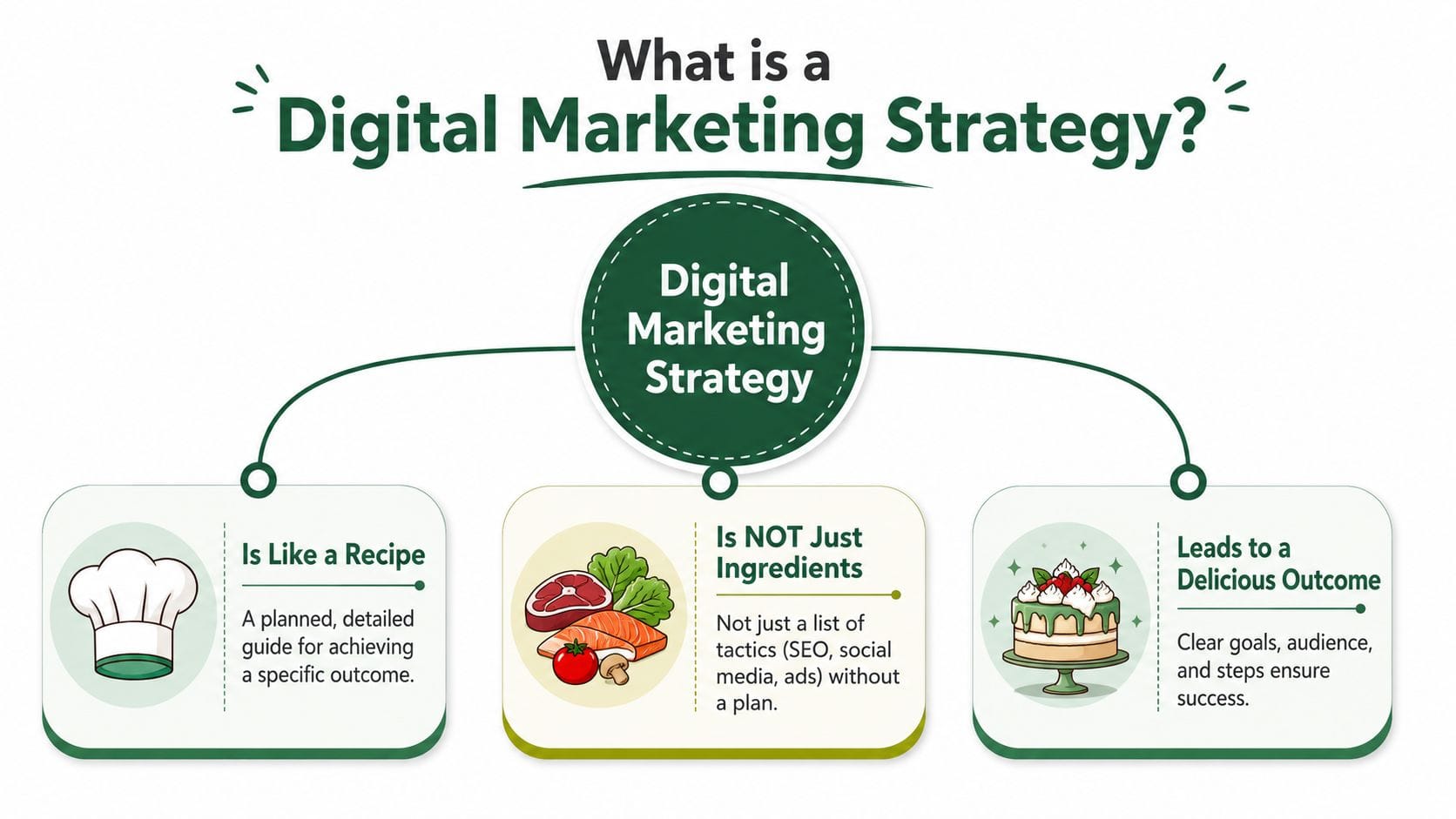
A digital marketing strategy is the decision-making framework behind the work. It links a business goal to a specific audience, message, channel, budget, and way of measuring results. It answers the questions that sit behind the tactics.
What it is
A useful strategy is usually short and practical. For a Brisbane small business, it might sound like this:
Target homeowners in inner-north Brisbane who need urgent plumbing help. Show up in local search, make it easy to call from mobile, and send ad traffic to service pages built for phone enquiries.
That's a strategy because it connects the audience, offer, channel, and desired action.
What it is not
A strategy is not the same as a to-do list. “Post three times a week, run Google Ads, write blogs” is just a collection of tasks.
It's also not a giant document that gets written once and ignored. Most small businesses don't need a thick plan. They need a clear one. If it can't guide decisions quickly, it's probably too bloated.
Here's the easiest way to separate the two:
| Strategy | Not strategy |
|---|---|
| Who the business wants to reach | A list of random platforms |
| What the business wants people to do | A pile of disconnected tasks |
| Why certain channels were chosen | Copying what competitors post |
| How success will be checked | “We'll know it when we see it” |
Why this matters in practice
Without that “why”, businesses waste effort on ingredients instead of outcomes. They chase social content because it feels visible, even when search would bring more qualified traffic. They spend on ads before the landing page is ready. They publish blog posts with no clear topic or local angle.
For business owners who want a clearer handle on the reporting side, this practical guide to marketing analytics helps explain how tracking supports better decisions instead of just producing more dashboards.
The 5 Core Components of Any Good Strategy
A useful strategy doesn't need to be complicated, but it does need a few core parts. If one is missing, the whole thing gets shaky. A business might have traffic without enquiries, content without direction, or leads without any idea where they came from.
This visual sums up the foundations well.
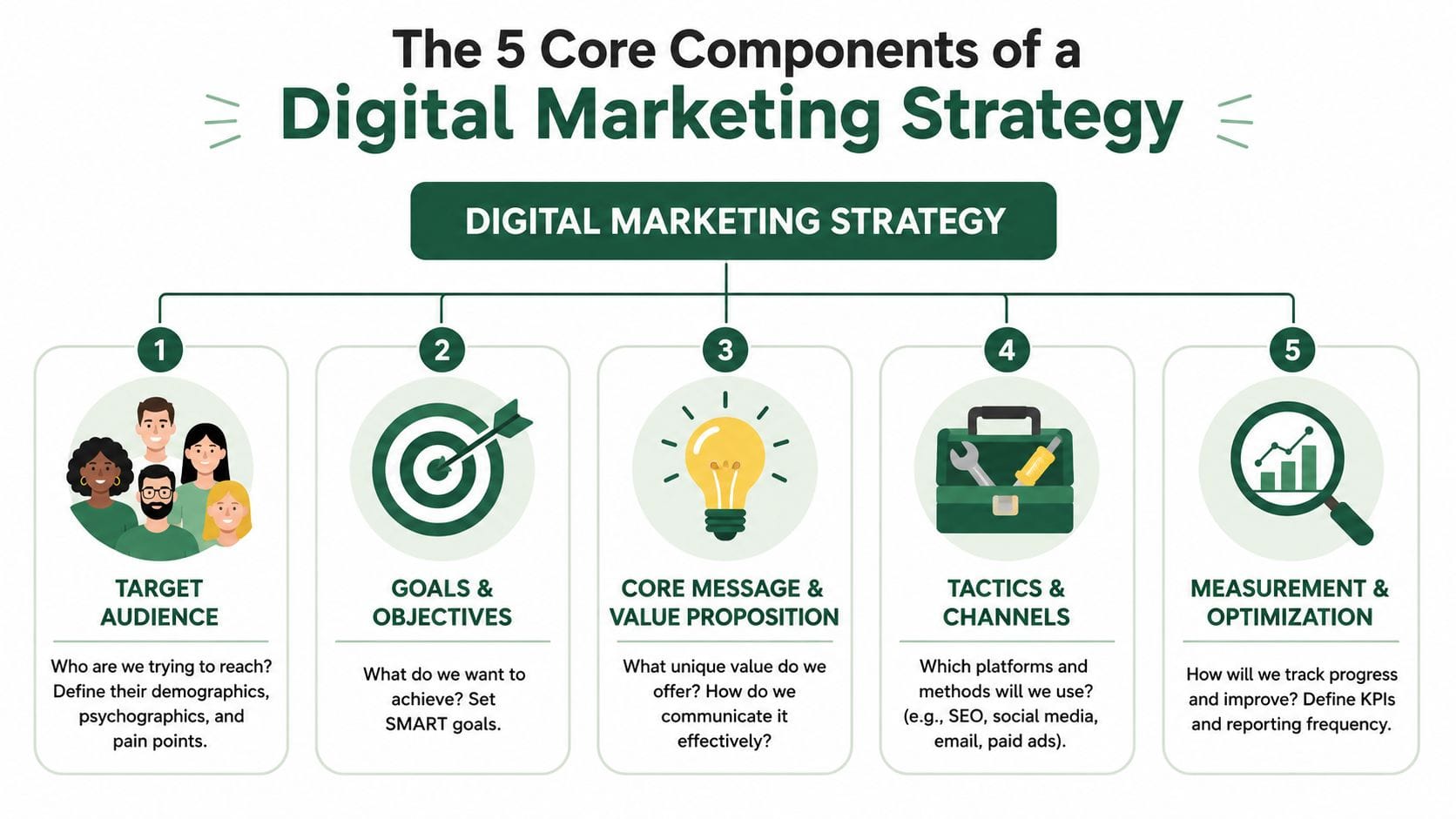
Audience comes first
Every strong strategy starts with a clear audience. Not “everyone in Brisbane”. Not “small businesses”. A real group of buyers with a real problem.
A family lawyer in Brisbane CBD and a pool builder in North Lakes don't need the same message, the same website pages, or the same ad structure. One buyer may need reassurance and trust. The other may be comparing timelines, cost ranges, and design options.
A quick audience prompt helps:
- Who are they really? Homeowners, office managers, parents, tradies, founders
- What are they trying to solve? Urgent help, research, comparison, convenience
- What action matters most? Call, book, enquire, visit, request a quote
Goals need a business outcome
Good goals aren't vague. “Get more visibility” sounds nice but doesn't help anyone decide what to do next. A better goal ties marketing to something the business can recognise.
For a local electrician, the goal might be more phone enquiries for switchboard upgrades. For an accountant, it might be more consultation bookings before EOFY. For an e-commerce brand, it might be more sales from non-branded search.
That clarity changes execution. It affects page structure, calls to action, ad copy, and reporting.
A strategy gets sharper when the business goal is stated in plain language, not marketing language.
Channels should match behaviour
Many small businesses overspend by picking channels based on what feels current, not on how buyers behave.
For some Brisbane service businesses, Google Business Profile, local SEO, and Google Ads do the heavy lifting because they capture demand when someone is ready to act. That's especially important because for Queensland service industries, 70% of bookings are still made by phone, so click-to-call actions on websites and in Google Ads need to be part of the strategy, as explained in this look at small business marketing in Queensland.
Social still has a place, but not every business needs to treat it as the main engine.
A business building stronger reporting around ad performance and owned customer data may also want to read about how to maximize ROAS with first-party data. It's a practical next step once the basics are in place.
Message gives people a reason to choose you
A channel gets attention. A message turns that attention into action.
Many businesses sound too generic. “Quality service”, “trusted team”, and “custom solutions” don't help much because every competitor says the same thing. A message works when it reflects what buyers care about and why this business is a good fit.
For example, a Brisbane pest control company might focus on fast local response and clear treatment explanations. A bookkeeping firm might stress reliable monthly reporting and less admin stress for owners.
A business refining service pages and brand messaging can get useful ideas from this guide to content marketing services.
Measurement keeps the plan honest
Without measurement, marketing turns into opinion. One person thinks Facebook is working. Another thinks SEO is too slow. Nobody really knows.
Measurement doesn't have to be technical. A small business usually needs to know which channels drive calls, forms, bookings, and sales. That's enough to make better decisions next month than it made this month.
The core question is simple. “How will this business know if the strategy is working?”
A Simple Strategy Framework for Brisbane Businesses
Most small businesses don't need a workshop, a whiteboard session, and twenty tabs open at once. They need a one-page document they can fill out in under an hour and use.
That matters because 68% of Queensland small businesses report marketing budgets under $2,000 per month, which means the smartest move is usually to focus on one or two high-ROI channels such as local SEO and Google Business Profile instead of trying to be active everywhere, according to this report on small practice success and digital marketing.
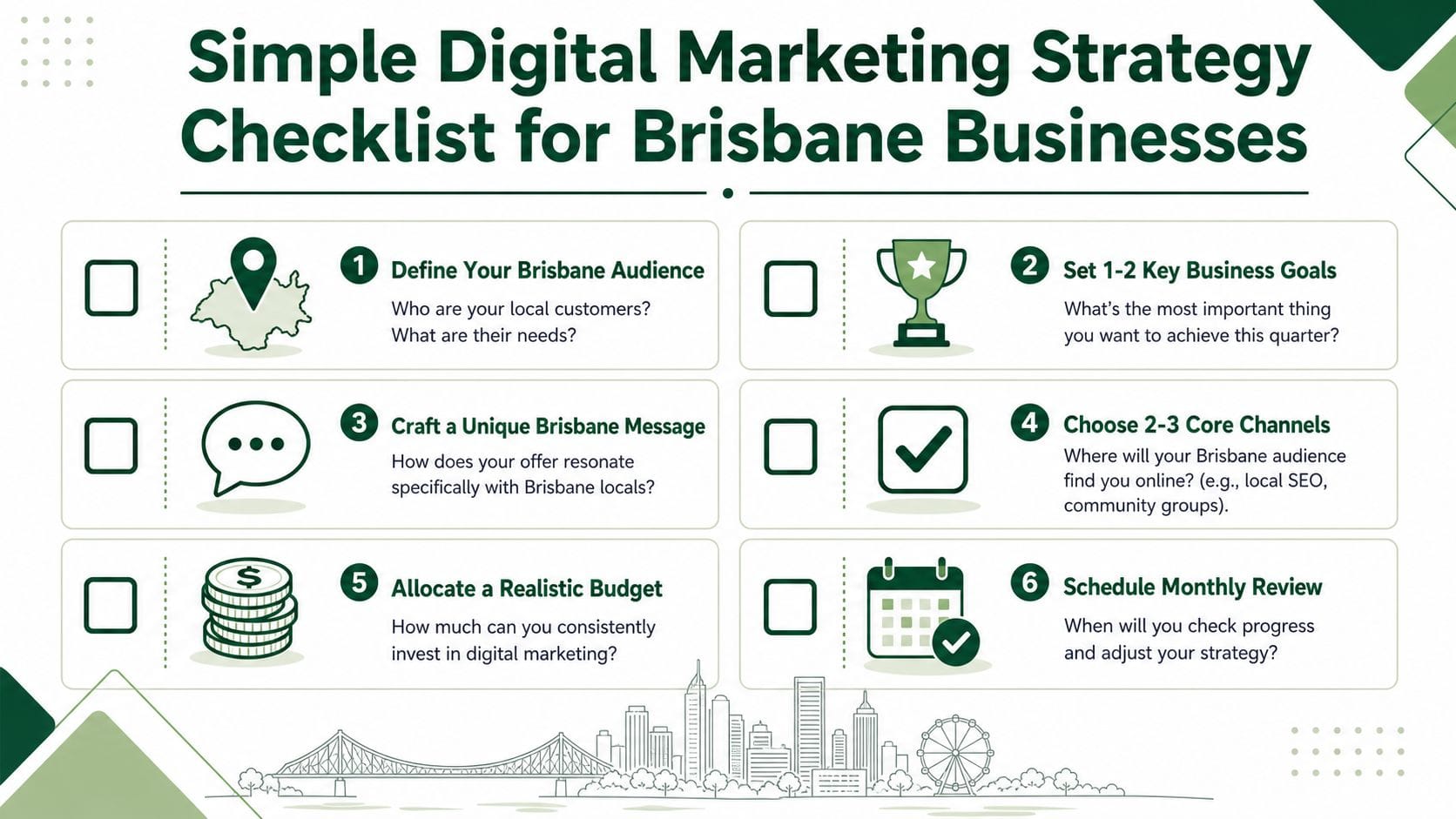
This checklist is a good way to keep the process grounded.
The one-page version
A Brisbane business can write a workable strategy using prompts like these:
Primary customer
“The main customer is a ___ in ___ who needs ___.”Main goal
“Over the next quarter, marketing needs to generate more ___.”Best-fit channels
“The business will focus on ___ and ___ because that's where buyers look first.”Core message
“Customers should choose this business because ___.”Key action
“The most important action is for visitors to ___.”Monthly check-in
“Results will be reviewed by looking at ___.”
A practical example for a Brisbane electrician might read like this:
| Part | Example |
|---|---|
| Primary customer | Homeowners in Chermside needing urgent electrical work |
| Main goal | Increase qualified phone enquiries |
| Best-fit channels | Google Business Profile and Google Ads |
| Core message | Fast local response and clear quoting |
| Key action | Tap to call from mobile |
| Monthly check-in | Calls, quote requests, booked jobs |
How to keep it realistic
A strategy only works if the business can maintain it. That's why restraint matters.
- Choose fewer channels if time is tight. Two channels done properly beats five channels done badly.
- Match the plan to the buying cycle. Urgent services often need search first. Relationship-based services may need content and follow-up.
- Build around existing assets. If the website is weak, fix core pages before buying more traffic.
- Review monthly. Small adjustments are easier than full rebuilds.
Worth remembering: Simplicity is not a weakness in Brisbane Digital Marketing. For small businesses, it's often the reason the strategy survives long enough to work.
For owners wanting more structure around search visibility, this guide on strategy for SEO is a practical follow-on.
Common Mistakes to Avoid and Key Numbers to Track
A strategy can look fine on paper and still underperform if the execution slips into bad habits. The usual problem isn't a total lack of effort. It's effort aimed at the wrong signals.
Mistakes that drain time and budget
One common mistake is chasing vanity metrics. A post gets likes, a reel gets views, and everyone feels busy. But if those actions don't create calls, quote requests, bookings, or sales, they don't tell the business much.
Another is treating the strategy like a set-and-forget document. Search trends change. Offers change. Competitors change. A strategy needs regular review, even if that review is brief.
Ignoring mobile is another costly error. Mobile devices account for 55% of all website traffic, so a business that doesn't build a mobile-first website is making life harder for most potential customers in the Australian market, based on these digital marketing statistics for Australian businesses.
A final trap is making it hard for people to enquire. Long forms, cluttered service pages, weak calls to action, and buried contact details all reduce response. Businesses wanting to tighten that part of the funnel can learn a lot from this guide on optimizing lead acquisition techniques.
Numbers worth watching
A small business doesn't need a massive reporting dashboard. It needs a short list of measures that connect to revenue.
Cost per lead
How much the business spends to generate one enquiry. Useful for paid campaigns and comparing channels.Website conversion rate
How many visitors take an action such as calling, booking, or filling out a form.Phone enquiries from Google
Especially important for local services where calls often lead to bookings.Qualified leads
Not every lead is a good lead. Track whether the enquiry matches the service, area, and customer type the business wants.Top landing pages
Which service pages or campaign pages are generating the most useful action.
The best KPI is the one that helps the owner make a decision next month.
If a business is getting traffic but not enough enquiries, the issue may be conversion rather than visibility. In that case, this guide to conversion rate optimisation in Australia is the right next step.
Let a Local Partner Build Your Brisbane Strategy
Some business owners understand exactly why strategy matters and still don't have the time to build it properly. That's normal. Running the business usually comes first. Quotes need sending, staff need managing, customers need help, and marketing drops to the bottom of the list until leads slow down.
That's where outside support starts to make sense.
When doing it yourself stops making sense
A good local partner doesn't just add more tasks. The job is to remove confusion, set priorities, and run the parts that need consistency. That might mean clarifying the offer, tightening local search visibility, improving landing pages, or building a reporting rhythm that shows what is performing well.
For Brisbane businesses that want outsourced support, digital marketing agency services for small businesses can give a clearer sense of what that relationship looks like.
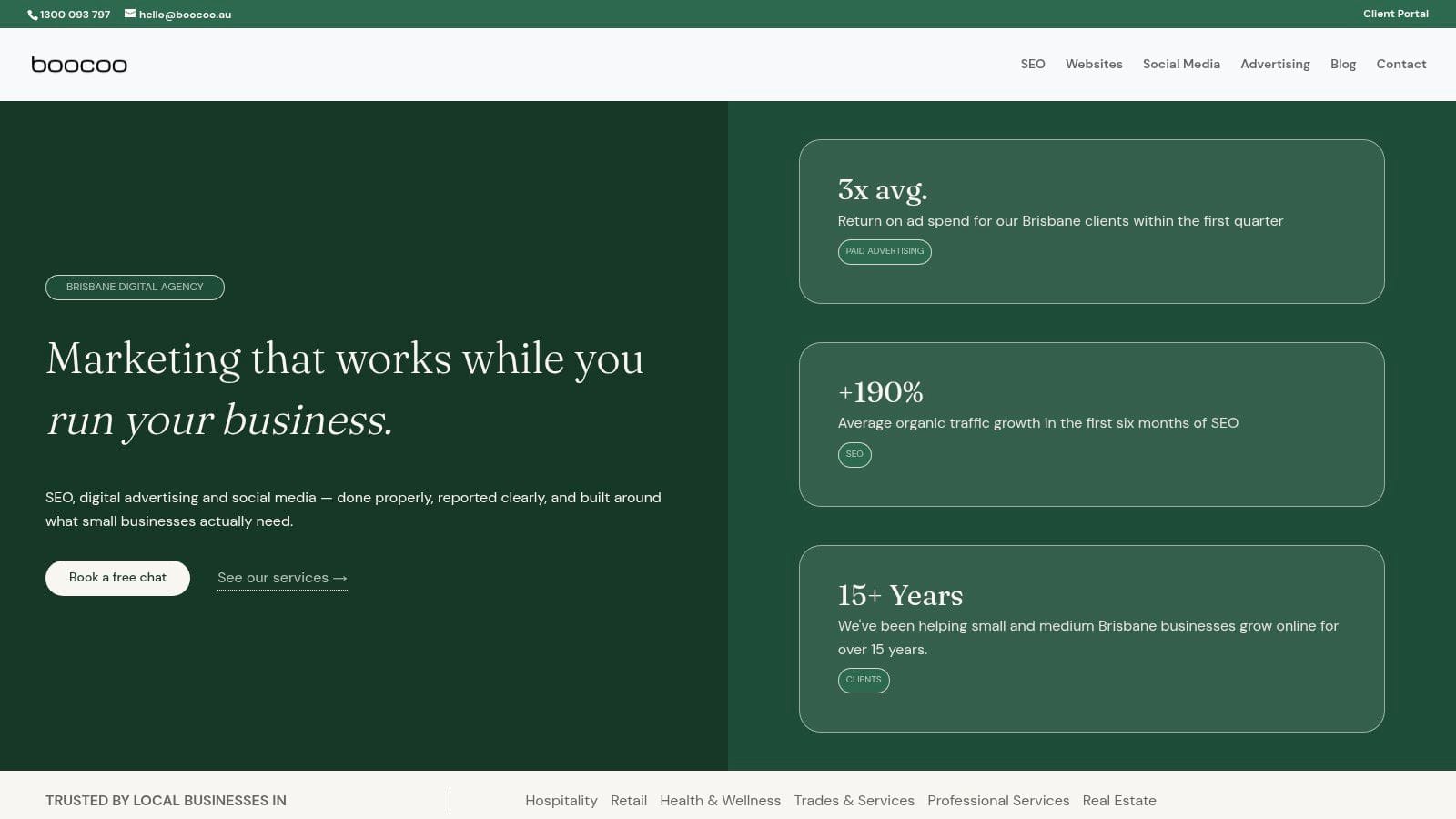
Boocoo is one Brisbane-based option that provides support across SEO, web design, social media management, and paid advertising, with a focus on practical delivery for small businesses.
A practical next step
For a time-poor owner, the first step doesn't need to be a full campaign. It can just be a clear conversation about goals, budget, timeline, and what channel mix makes sense.
Boocoo can be contacted on 1300 093 797 or hello@boocoo.au for a no-obligation chat about the next step.