

A lot of Brisbane owners are in the same spot right now. They're good at the actual work, whether that's fixing hot water systems in Aspley, running a clinic in Carindale, or serving breakfast in New Farm, but leads come in waves. One week the phone is busy. The next week it's quiet, and word-of-mouth alone doesn't fill the gap.
That's usually when local business digital marketing stops sounding like a buzzword and starts sounding like a practical problem. If a business can't be found easily, can't build trust quickly, or makes it hard for people to enquire, nearby customers move on to the next option. They don't always call around. They search, compare, read reviews, check details, and choose.
There's another reason this feels messy for small operators. A 2025 small-business marketing dataset reports that 81% of SMBs use at least two marketing channels, while 37% of businesses increased marketing budgets in 2025, yet confidence remained low at 18% globally according to PostcardMania's small business marketing statistics guide. This is a key challenge for many Brisbane businesses. More tools, more channels, more effort, but not always more clarity.
For appointment-based operators, reviews often become the tipping point. A simple review system can save hours of chasing and help turn happy customers into visible proof. For owners who want a practical example, this guide on how to maximize reviews for appointment businesses shows the kind of lightweight process that fits a busy week instead of adding admin.
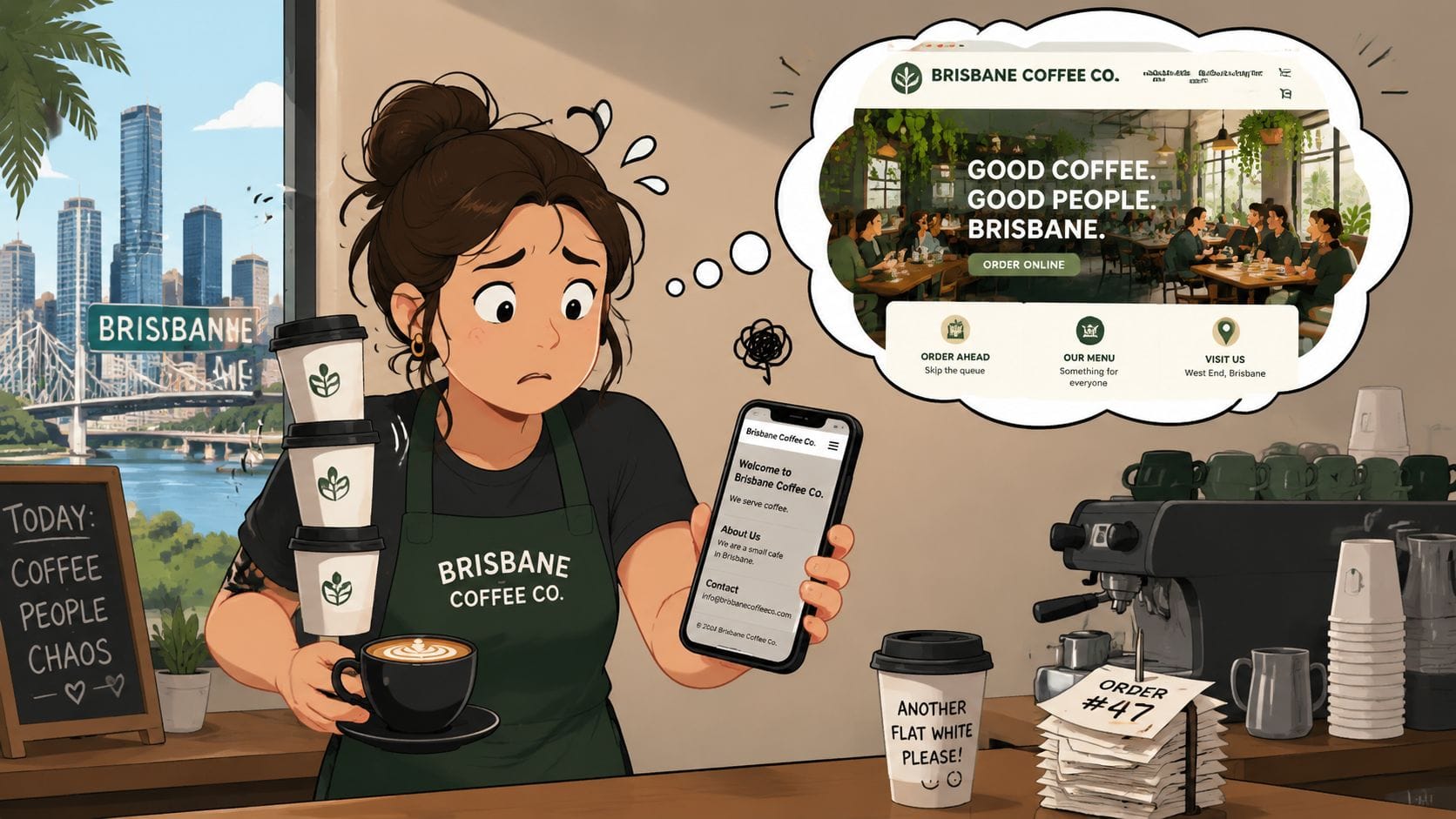
Your Digital Front Door Is It Open for Business
A Brisbane business doesn't need a huge campaign to feel the pressure. A mobile mechanic in Chermside might have great referrals, but if someone in Kedron searches late at night and finds a competitor with clearer reviews, better service info, and an easier call button, the job is gone before morning.
That's what a digital front door really is. It's the combination of search visibility, reviews, business details, website clarity, and the ease of taking the next step. When those pieces line up, the business feels open for business even outside trading hours.
The quiet leak most owners miss
A lot of owners assume the main problem is traffic. Often it isn't. The leak happens earlier.
- Missing trust signals: No recent reviews, no staff or job photos, no suburb-specific proof.
- Unclear contact path: A phone number buried in the footer or a form that asks for too much.
- Inconsistent details: Slightly different service areas, trading hours, or contact info across platforms.
A good local setup doesn't need to look fancy. It needs to answer the customer's basic question fast. Is this business nearby, credible, and easy to contact?
In Brisbane, that matters because buyers often compare several options in a small radius. A cleaner in West End isn't competing with the whole internet. They're competing with whoever looks most reliable in West End, South Brisbane, Highgate Hill, and the nearby suburbs they serve.
What works on a tight schedule
For a time-poor owner, the first useful shift is mental. Digital marketing isn't separate from operations. It's part of how a business gets chosen.
Three simple checks often reveal the biggest gaps:
- Search the business name on a phone. Check what appears first and whether it looks trustworthy.
- Search a service plus a suburb. Try something like “electrician Paddington” or “physio Indooroopilly”.
- Ask a friend to book or enquire. If they get confused, real customers probably do too.
That kind of quick audit beats guessing. It also keeps local business digital marketing grounded in what a customer sees, not what the owner hopes is there.
What Is Local Digital Marketing Actually
Local business digital marketing is the online version of a good shopfront. On a real street, a business needs clear signage, tidy presentation, and a simple way to walk in. Online, it needs to be easy to find, easy to trust, and easy to contact.
That's why this isn't about being on every platform. It's about showing up properly where local customers already look.
Three jobs it needs to do
The clearest way to think about it is through three jobs.
Be found.
If someone in Holland Park searches for a local service, the business needs a realistic chance of appearing in search results, Maps, or suburb-specific pages.
Build trust.
Before many people call, they scan photos, reviews, service descriptions, and business details. They want signs that the operator is active, real, and suitable.
Make action simple.
Once they're ready, the next step should be obvious. Call, book, request a quote, or get directions.
A practical Brisbane example
A gardener servicing Bulimba, Hawthorne, and Morningside doesn't need to post everywhere or chase every trend. A better setup would be:
- a complete Google Business Profile
- a simple website with service pages
- clear suburbs listed
- recent photos of actual work
- a steady flow of genuine reviews
- one or two social platforms used consistently
That's enough to create a useful local footprint.
Video can help here as well, especially for businesses that need to show personality or process. Short clips of a job walkthrough, a treatment room, or a before-and-after clean can reduce hesitation faster than long blocks of text. Owners who want a plain-English overview can look through BlitzReels' insights on video marketing to see where video fits without turning it into a full-time production project.
What it is not
It's not posting random graphics because “social media matters”.
It's not paying for clicks before the basics are sorted.
And it's not chasing vanity metrics that don't lead to calls, bookings, or quote requests.
Practical rule: If a marketing activity doesn't help a local customer find the business, trust the business, or contact the business, it's probably a distraction.
That's the filter that keeps local business digital marketing manageable for small Brisbane teams.
Your Digital Marketing Starter Kit Key Channels
Most small businesses don't need a giant stack of tools. They need a short list of channels that support each other. For Brisbane service businesses, the starter kit usually comes down to search visibility, paid reach when needed, and social proof that feels current.
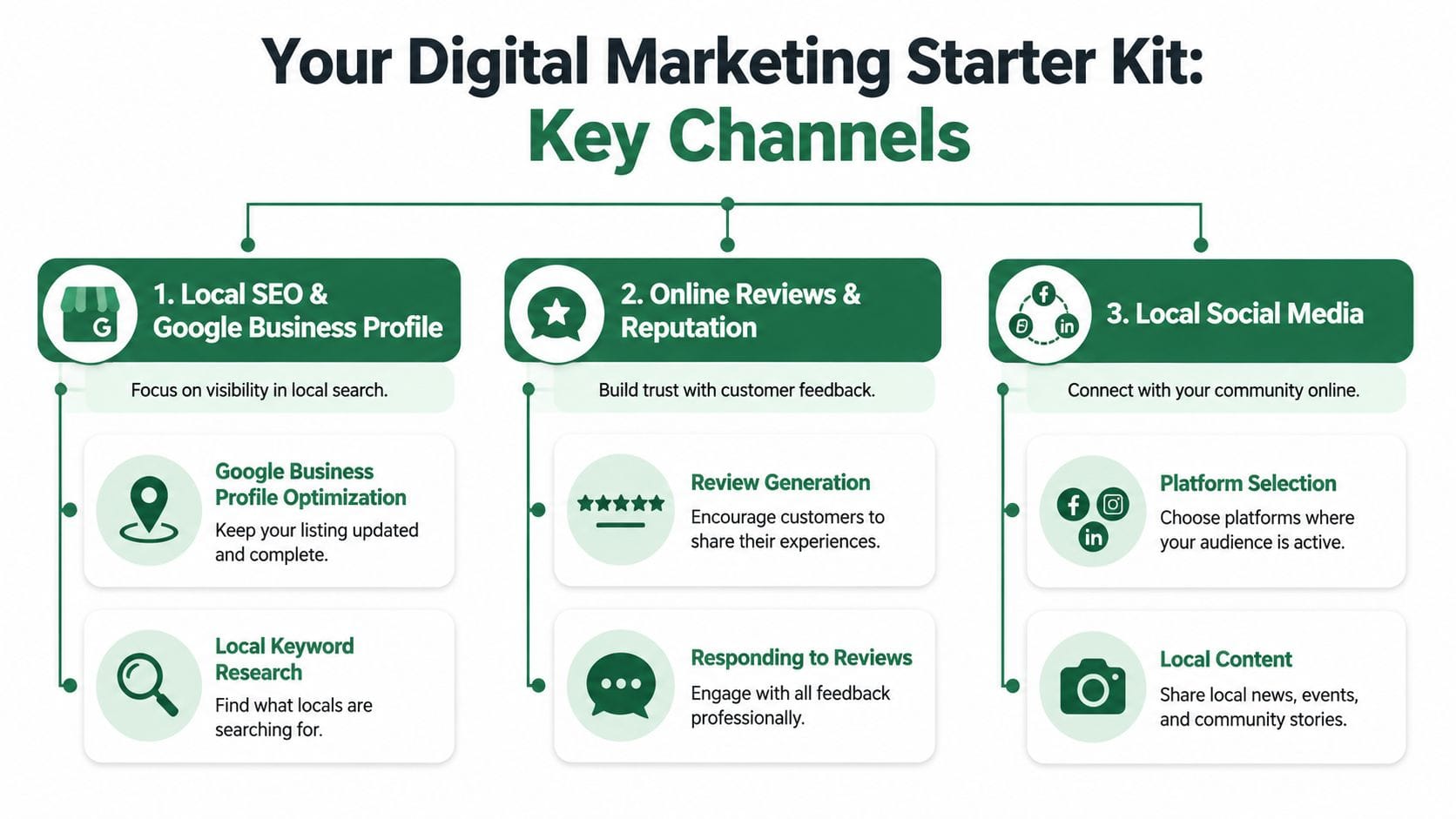
Local SEO and Google Business Profile
This is the first channel to get right because it matches active demand. These are the people already searching.
Google states that local results are driven primarily by relevance, distance, and prominence, so Brisbane businesses with a fully completed profile and location-specific service pages are more likely to surface for suburb-specific or “near me” searches, as outlined in this local search guide from DRC Systems.
For a plumber servicing Everton Park, Stafford, and Enoggera, that means the digital signals should line up. The Google Business Profile should clearly describe the service. The website should mention those service areas naturally. The page titles and headings should reflect real local intent, not broad filler.
Two low-budget actions matter most:
- Complete the profile properly: Add services, opening hours, contact details, photos, and accurate categories. Half-finished profiles lose trust fast.
- Create suburb-focused pages: Not dozens of thin copies. Just solid pages for the suburbs that generate work, with local examples, service details, and a clear enquiry option.
A lot of owners skip the second part and wonder why rankings stay patchy. Google can't connect the service, the place, and the business clearly if the website stays too generic.
Local advertising that stays lean
Paid ads work best when they sit on top of a solid base. If the profile is weak and the website is vague, ads just send paid traffic into confusion.
For Brisbane operators, the smartest starting point is usually narrow targeting. A pest control business in North Lakes shouldn't try to chase the whole metro area on day one. A smaller service radius, tighter keyword focus, and one clear offer keeps waste down.
Useful ground rules include:
- Target service intent first: Ads for “emergency electrician Milton” are usually more useful than broad awareness campaigns.
- Send traffic to the right page: If the ad mentions hot water repairs in The Gap, don't dump the click on the homepage.
Paid social can help, but it often works better for retargeting, reminders, or local offers than for cold lead generation in high-intent service categories. Search ads usually catch stronger intent because the customer is already looking.
For owners who want a simpler system for posting and planning before paying for extra reach, this practical guide to social media management for beginners can help tighten the basics first.
Social media for real local trust
Social media is rarely the whole engine for a local service business. It's the proof layer.
A Brisbane accountant, physio, or plumber often gets more value from showing they're active, local, and credible than from trying to go viral. A few recent project photos, staff updates, local community mentions, and customer-friendly tips do the job.
What tends to work:
- Use local cues: Mention suburbs, jobs, landmarks, or community events where relevant. That helps people feel the business is nearby and real.
- Show the actual work: Finished projects, team photos, behind-the-scenes prep, or simple explainer videos often outperform generic stock content.
What usually doesn't work is overdesigned content with no local context. It looks polished but forgettable. A simple post showing a completed bathroom renovation in Camp Hill can do more than a slick graphic full of generic advice.
If social content can't answer “what does this business actually do around here?”, it probably won't help much.
The main point is this. Search captures demand. Ads can amplify it. Social reinforces trust. Small businesses get better results when those three channels support the same local message instead of pulling in different directions.
Your Website The Hub of Your Local Marketing
A website isn't just an online brochure. It's the one place a business controls fully. Social platforms can change reach overnight. Search layouts can shift. A website stays the central asset that ties everything together.
That matters because local marketing gets messy when all the important actions happen on rented platforms and none of them connect cleanly.
Why rented platforms aren't enough
A strong Google Business Profile can generate enquiries. Social media can help people feel familiar with a brand. But neither replaces a website that explains services properly and sends clear conversion signals.
For many Brisbane businesses, the website is where trust becomes action. It's where a customer decides whether to call now, request a quote, or leave and keep searching.
A good local website should feel like talking to a helpful front desk. Fast answers, clear options, no friction.
Owners rebuilding from scratch don't need an oversized site. They need a clean one. For businesses comparing platforms, this roundup of top website builders for small businesses is a useful starting point before paying a developer or locking into the wrong tool.
What a small business website must do
The site should do two jobs well. Convert visitors and track where they came from.
Expert guidance recommends small businesses track conversions and traffic by channel, using dashboards to separate seasonal noise from true performance. A robust benchmark is a funnel dashboard that ties every lead source, such as organic, paid, and social, to downstream outcomes like booked jobs, according to OneLocal's guide to data-driven local marketing.
That sounds technical, but the practical version is simple. A business should know whether leads came from search, ads, social, or direct traffic, and whether those leads turned into real jobs.
A small service-business website should include:
- A clear phone number: Put it high on the page, especially on mobile.
- A short enquiry form: Ask only what's needed to qualify the lead.
- Real photos and service details: Actual team, actual work, actual suburbs.
- Dedicated service pages: One page per core service is usually more useful than one giant page trying to do everything.
- Useful copy: Plain, specific writing beats vague filler every time. This guide on content writing on website is a solid reference for tightening the message.
Some businesses also need help choosing the build path itself. DIY platforms, freelancers, and local agencies each suit different stages. Boocoo is one Brisbane-based option that handles websites alongside SEO, paid ads, and social support, which can be useful for owners who'd rather keep implementation under one roof.
The key trade-off is simple. A cheaper site that doesn't convert or track properly usually costs more in missed leads than a modest site that does the basics well.
A Practical Roadmap for Brisbane Businesses
The fastest way to waste time is to start in the wrong order. Plenty of small businesses jump into ads, daily posting, or SEO blogs before the basics are sorted. A cleaner sequence saves money and reduces rework.
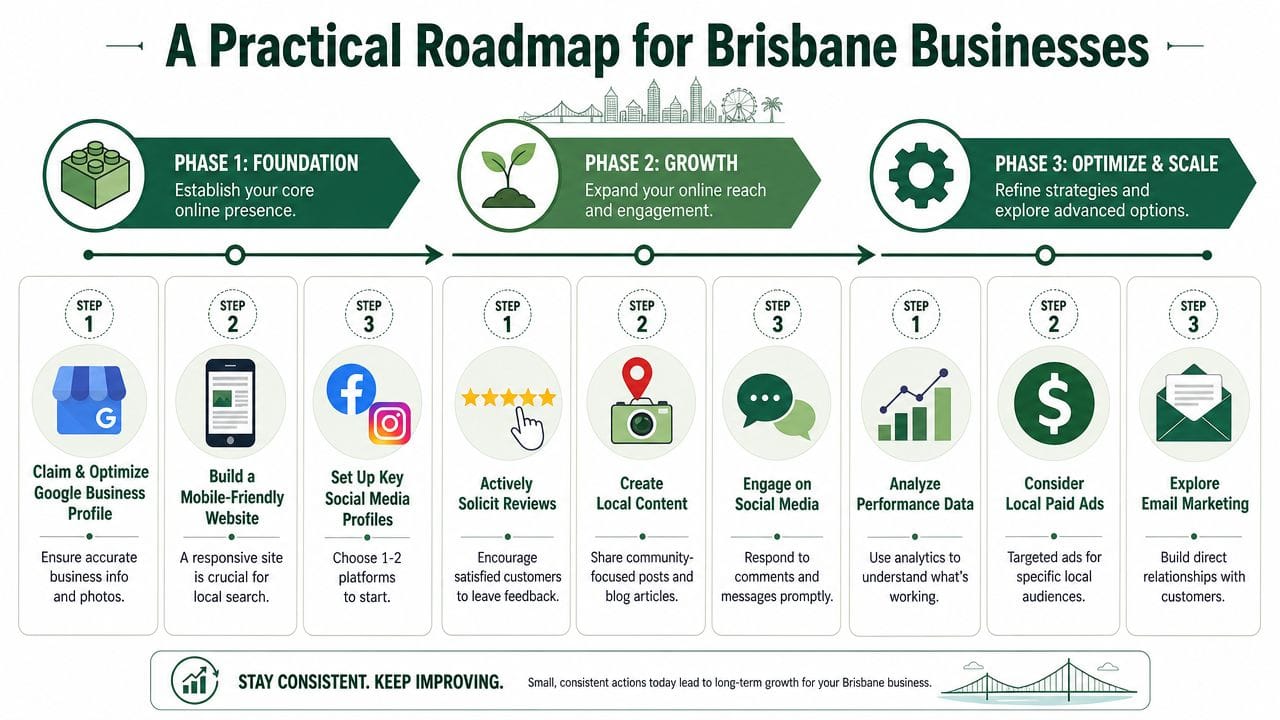
Global search data from 2025 shows Google holds 89.62% of search traffic, with 72% of people using it to find local businesses and 67% reading reviews after a search. That confirms that being findable and review-ready on Google is the essential first step, based on this 2025 search behaviour summary from SEOProfy.
Phase 1 foundation
This stage is about owning the basics.
Start with the Google Business Profile. Make sure the business name, phone number, hours, categories, and service details are accurate. Add genuine photos, not generic stock images. If the business serves Brisbane suburbs rather than a walk-in shopfront audience, make that clear.
Then fix the website. It doesn't need dozens of pages on day one. It does need a homepage that explains the offer, a contact path that works on mobile, and a page for each main service.
A simple checklist helps:
- Check business details: Use the same contact info everywhere.
- Check mobile usability: Most local customers will look on a phone first.
- Check enquiry flow: Call buttons, forms, and service pages should work without friction.
Phase 2 visibility
Once the base is stable, build visibility where it counts.
For a Brisbane electrician, that might mean creating pages such as “emergency electrician Paddington” or “switchboard upgrades Ashgrove” if those are real service areas. For a clinic, it might mean service pages by treatment and suburb, supported by helpful FAQs and patient-friendly explanations.
Reviews become more valuable here because they support both trust and local prominence. The best approach is steady and operational. Ask at the right moment, make it easy, and respond to every review professionally.
This is also where local content helps. Not endless blogging. Just useful, location-aware pages and posts that match how people search and choose.
Don't build content around what sounds clever. Build it around the jobs, suburbs, and questions customers already bring to the business.
Phase 3 acceleration
Only after foundation and visibility are working does paid promotion usually make sense.
At this point, a business can test Google Ads for high-intent services, branded campaigns, or suburb-specific demand. Some businesses can also use paid social to stay visible to past visitors or promote a timely local offer.
Acceleration doesn't always mean spending more. Sometimes it means tightening what already exists:
- Pause weak pages: If they attract the wrong enquiries, rewrite or merge them.
- Adjust ad targeting: Keep the spend close to profitable service areas.
- Improve follow-up: A quick response process often lifts outcomes without touching the budget.
This roadmap works because it respects how local service businesses operate. Build the base. Make it visible. Then scale what proves itself.
Budgeting for Local Digital Marketing
Budget questions matter because most small businesses don't have spare money for experimentation. The good news is that local business digital marketing can start lean if the owner stays disciplined about priorities.
The main cost buckets are usually simple. Website platform or maintenance. A few tools. Optional ad spend. Occasional outside help when setup or strategy gets too time-consuming.
Sample monthly digital marketing budgets for a Brisbane SMB
| Budget Tier | Approx. Monthly Spend (AUD) | Focus Activities |
|---|---|---|
| Bootstrap | Under $200 | DIY Google Business Profile updates, basic website upkeep, review requests, simple social posting |
| Growth | $500 to $1000 | Small local ad budget, service-page improvements, tracking setup, regular content or social support |
| Scale | $1500+ | Ongoing SEO work, stronger paid campaigns, landing pages, reporting, outsourced management |
These aren't guarantees of outcomes. They're planning ranges that help an owner match activity to capacity.
What each tier really means
Bootstrap suits sole traders and new operators. The focus should stay on profile completeness, review collection, basic website clarity, and one consistent channel for updates. This tier requires time more than cash.
Growth suits businesses that already know their core services and service areas. A small paid search budget can help, but only if the landing pages and tracking are in place. This is often the tier where owners start outsourcing pieces they don't want to manage themselves.
Scale fits businesses that want steadier lead flow across multiple services or suburbs. That might include regular page expansion, ad testing, reporting, and campaign management.
For owners weighing whether to add paid search at all, this plain-English guide on pay per click advertising company services can help clarify what should be handled in-house and what usually benefits from outside support.
The trade-off that matters most
The cheapest option isn't always the most efficient. If a business owner spends nights fiddling with ads, forgets to follow up leads, and still has no tracking, the cost is time plus lost opportunities.
A tighter budget usually performs better when it funds fewer things properly. One strong service page is better than six weak ones. One active social platform is better than four half-dead accounts. One measured ad campaign is better than broad spending without a clear landing page.
Measuring Success and Looking Ahead
A lot of owners look at clicks, likes, and impressions because those numbers are easy to find. They're not useless, but they don't answer the question that matters most. Did the marketing produce qualified enquiries and booked work?
The numbers that actually matter
For a local Brisbane business, the most useful KPIs are usually the ones tied to direct action:
- Phone calls
- Form submissions
- Direction requests
- Booked appointments or quoted jobs
- Lead quality by channel
That gives the owner a clearer read on what's profitable. A campaign with fewer clicks can still be the better one if the enquiries are stronger and easier to close.
A simple monthly review often works better than overcomplicated dashboards. Check which channels produced real leads, which pages brought them in, and whether certain suburbs or services are giving better return. Then make small adjustments.
Getting ready for AI assisted search
Search is changing, and local businesses can feel that already. As Google's search results shift toward AI-assisted answers, experts advise that the fundamentals of local SEO, including strong service-area pages, high review velocity, location-specific trust signals, and structured data, will become even more essential for maintaining visibility, as explained in Sprout Media Lab's 2025 local strategy article.
That doesn't mean the basics are outdated. It means the basics matter more.
A business with clear suburb pages, trustworthy reviews, accurate business information, and a website that answers real customer questions is in a stronger position than one chasing shortcuts. That's especially true for Brisbane service businesses outside the CBD, where suburb-level intent often decides who gets the call first.
The steady approach still wins. Be visible where locals search. Look trustworthy when they compare. Make it easy to contact the business. Then measure what leads to real jobs and keep improving from there.